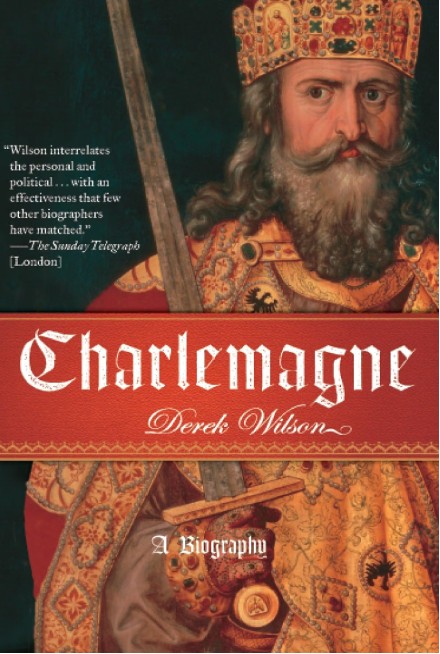
Europe of Conflict and Personality

Derek Wilson’s Charlemagne is a curious book. It is really two books joined by the author’s hope that a purpose he never explicitly states but implicitly imagines will somehow unite the parts thematically; more on that shortly.

The first half is a sparse, almost frugal biography of an emperor on a mission. A mission to spread and reinforce Christianity: Catholicism; a mission to bring to heel the disparate polities of the European mainland; a mission to respect local customs while imposing a common legal and administrative structure. All of this required constant war, diplomatic maneuvering, and court intrigue to keep the continent’s many fiefdoms off balance and unable to mount a coordinated resistance. It is the story of a competent, charismatic leader who, through sheer willpower, fused a fragmented Europe into a congealed, if chaotic and complicated whole.

Then, somewhere around the midpoint, the book undergoes a jarring metamorphosis. The biography dissolves, and Wilson begins speaking not about Charlemagne but about post-Charlemagne Europe itself: its failures, its divisions, its wars, its chronic inability to remain whole. By the end, the book has become less a study of an exceptional man than a lament for a disheveled and unruly continent. Wilson tries to justify this extended romp from the ninth century to the present by occasionally tying Louis XIV, Napoleon, Bismarck, and others back to Charlemagne with ad hoc references, but the connections never really hold. What emerges instead is an endless cycle of personalities and war.

From Charlemagne and the Saxon Wars, through Otto I, the Norman Conquests, and the Crusades of Richard the Lionheart, Philip II, and Saladin, Europe rolled into the Hundred Years’ War with Edward III, Henry V, and Joan of Arc, followed by the Hussite Wars and the rise of the Ottomans. The early modern world brought Martin Luther, Charles V, Philip II, the Eighty Years’ War, and the cataclysmic Thirty Years’ War with Gustavus Adolphus and Wallenstein, alongside Louis XIV’s wars and the English Civil War. The 18th century marched through the War of Spanish Succession, Austrian Succession, and Seven Years’ War, shaped by Frederick the Great, Maria Theresa, and Catherine the Great, before the French Revolution unleashed Napoleon, the Coalition Wars, and the fall of the Holy Roman Empire. The 19th century followed with Metternich, Bismarck, Garibaldi, and Napoleon III, amid the Crimean War, Austro‑Prussian War, Franco‑Prussian War, and the Balkan Wars. The 20th century erupted with World War I under Wilhelm II, Franz Ferdinand, and Lenin, then World War II with Hitler, Stalin, Churchill, Roosevelt, and De Gaulle, followed by the Cold War, Greek Civil War, and Yugoslav Wars under figures like Tito and Gorbachev. The 21st century carried Europe into the Russo‑Georgian War, the Crimean crisis, and the ongoing Russo‑Ukrainian War, dominated by Putin, Zelenskyy, and the collective leadership of NATO and the EU, bringing the continent’s long arc of conflict from Charlemagne’s empire to the geopolitics of 2026. (With heartfelt apologies to Billy Joel and We Didn’t Start the Fire—but the fire never does go out; occasionally smoldering, but never out.)

Wilson heroically tries to connect all this to Charlemagne, but Europe’s never‑ending conflicts are far larger in scope than anything that can be laid at the feet of the medieval “Father of Europe.” And to be fair, Wilson does not explicitly claim that Charlemagne is somehow related to or causative of Europe’s later turmoil. But he does insist that it all rhymes, and that insistence, rather than any articulated evidence, ultimately drives the second half of the book.

What is striking is not that Wilson cares about European unity, but that he never asks the simplest question his own narrative demands. Charlemagne’s empire did not endure. It did not slowly fade, nor did it evolve into something recognizably European. It collapsed almost immediately upon his death. The Treaty of Verdun, signed less than thirty years later, shattered his achievement into three pieces that would become France, Germany, and the Low Countries. The unity Wilson mourns was never structural or natural. It was personal.

And this is a deeper truth Wilson never touches but should have. Charlemagne’s empire was not held together by institutions, laws, or shared identity. It was held together by Charlemagne. His personality: relentless, martial, commanding, and utterly convinced of his own mission, was the glue that bound dozens of cultures, languages, and belief systems into a single political organism. And that glue existed only as long as he did.

Charlemagne ruled through war. Not occasionally, not reluctantly, but continuously. His reign was a forty‑six‑year military campaign. Every year he rode out to fight Saxons, Lombards, Avars, Bretons, Slavs, or Moors. Every year he reminded his subjects that unity would be maintained through the sword. Charlemagne’s empire was not a nation; it was his fiefdom. Its cohesion was not cultural; it was maintained by the force of his arms and personality.

This is why the empire died with him. The moment the personality vanished, the centrifugal forces he had suppressed reasserted themselves. The Saxons remembered they were Saxons. The Aquitanians remembered they were Aquitanians. The Bavarians remembered they were Bavarians. The Franks themselves remembered they were not one people but many. Charlemagne had forced Europe into a single shape, but the shape depended entirely on his hand. When the hand was gone, the shape dissolved.

And this is not unique to Charlemagne. It is the fate of every empire built by a singular, overwhelming personality. Alexander held together Greeks, Persians, Egyptians, and dozens of subject peoples through sheer charisma and military brilliance. When he died, his generals tore the world apart. Genghis Khan unified the steppe through terror, genius, and personal authority; his sons inherited territory, not loyalty. Napoleon imposed a continental system through force, reform, and personal magnetism; once he fell, Europe snapped back to its natural divisions. These empires did not die because their successors were incompetent. They died because their founders were irreplaceable. Those few who managed to maintain their empires: Lenin and Stalin, did so through terror, and even those structures eventually collapsed.

This loss of empire, loss of a truly united, pacified Europe, is a subject Wilson never confronts. He wants Europe to be one. He wants unity to be natural. He wants fragmentation to be pathological. And so, he reaches for the easiest villain available: nationalism. He treats nationalism as though it were a kind of moral contagion: irrational, destructive, hideous, without ever asking what nationalism actually is or why it exists.

But nationalism is not a pathology. Nationalism is the cultural substrate that makes political order possible. It is the shared language, shared memory, shared symbols, shared values, and shared experience that allow millions of people to imagine themselves as a people rather than a population. Without nationalism, there is no glue to hold anything together. Without nationalism, a “United States of Europe” is not a dream deferred; it is a dream impossible.

This is why the European Union became what it is: a vast bureaucracy and a managerial class holding together mounting societal cross‑currents without a shared experience. A market without a nation. A union without unity. A structure that cannot command loyalty because it never created it. A system that cannot inspire devotion because it never articulated what it was supposed to be. A project that imported every language and every culture without ever forging a common one.

Wilson’s frustration becomes more intelligible once you recognize what he wanted Europe to become. He is, unmistakably, a believer in the old dream of a United States of Europe: a continent bound together not by conquest but by shared purpose, shared institutions, and shared destiny. In the aftermath of the Second World War, that dream seemed almost within reach. The European Coal and Steel Community, the Treaty of Rome, and the early Common Market appeared to be the first cautious steps toward a new political organism, one that might finally escape the cycle of war and fragmentation that had defined Europe since Charlemagne’s death.

But the Europe Wilson hoped for never materialized. What emerged instead was technocracy. What emerged was administration. What emerged was a regulatory machine attempting to do what armies, churches, and charismatic rulers once did: hold Europe together. But systems cannot replace culture. Bureaucracy cannot replace identity. Markets cannot replace shared memory.

Charlemagne tried to unify Europe through religion. Napoleon tried through ideology. Hitler, monstrously, tried through racial mythology. Each failed for the same reason: the unity was never structural. It was personal. It was coercive. It was temporary. Europe has only ever been unified by a person: never by a system.

And this leads to the questions Wilson never asks, the questions his own narrative demands. How or why are empires built? How or why are empires lost? How or why are wars started?

How or why empires are won and lost was answered above. Throughout history empires were forged in the fires of an individual’s will to do so. But Wilson never really addresses this question. Charlemagne built an empire of disparate parts. Parts with different cultures and language. Parts with different experiences. It was destined to fall apart the second he no longer put his entire purpose in life behind his vision of a unified Europe.

The question of why wars are started he never explores. Just an ad hoc statement that the Franco-Prussian War was about “the hideous power of nationalism but they [France and Germany] tore open all the old half-healed wounds between the two parts of Charlemagne’s ancient empire.” Wilson slips this statement in and treats it as self-evident with no explanatory text needed. This statement though is just wrong on so many levels. The Franco-Prussian was all about leadership failures. Failure to understand Frances’s weaknesses militarily and politically. One that failed to understand the strength of Prussia’s armies and their leadership. Nowhere was the war about nationalism. Germany wanted a unified state, yes but they needed a unifying purpose to do so. France played right into Wilhelm’s and Bismarck’s hand.

The half-healed wounds of Charlemagne’s empire expired 1000 years previously. Wishful thinking is not the job of a historian. The wounds of Charlemagne’s Empire were still there because the empire was never united around culture, language, and shared experience, just held together by brute force of a strong man with a strong army.  Wilson’s mistake is believing that Europe’s unity was ever structural; when the truth is that it was always personal, and therefore always temporary. The EU today is politically fragmented and culturally thin.

The EU is Europe’s first attempt at unity without personality, without coercion, and without culture: and history suggests that such unity cannot endure unless external pressure forces it to.
Time and Roland

The Song of Roland, the actual point of this story, is a romantic Crusade‑era epic of courage and fortitude, but its origins lie along a long and winding road; a path the world has seen many times before, shaped not by heroism but by political confusion, shifting loyalties, and the hard realities of Muslim civil war in eighth‑century al‑Shām (greater Syria) and Spain.

In 661 AD, year 40 by the Islamic calendar, the Islamic world was ruled by the Umayyad dynasty from Damascus. After nearly a century in power, resentment from non‑Arab converts and continual internal corruption fueled an Abbasid revolutionary movement centered in Persia. In 750, the Abbasids defeated the Umayyad army at the Battle of the Zab in northern Iraq, marched into Damascus, and carried out one of the most violent and consequential political massacres in Islamic history: a systematic extermination of the Umayyad ruling family.

One young Umayyad prince, Abd al‑Rahman, escaped the purge. After a long flight across North Africa, he reached Spain and founded the Emirate of Córdoba. Through the 760s and 770s he consolidated his rule over Córdoba, Seville, Málaga, Granada, Jaén, Mérida, and Toledo. His authority in the south was real, but the northern Iberian Peninsula remained unstable.

The Peninsula was locked in a protracted and confusing Muslim civil war between Abd al‑Rahman and a cluster of rebellious but powerful northern governors in the Ebro Valley, centered around Zaragoza, Barcelona, and Girona. These governors had long traditions of autonomy and viewed Abd al‑Rahman’s centralizing reforms as a direct threat to their power. Frontier loyalties simmered and shifted constantly.

By 776–777, the northern elites realized they were losing ground. Abd al‑Rahman had crushed several uprisings and installed loyalists in key cities. The rebels needed a counterweight; a distant power strong enough to deter Córdoba but too far away to dominate them. They found their candidate in Charlemagne, king of the Franks.

Thus, at the winter assembly of 776–777 in Paderborn, in what is now northern Germany, Muslim envoys from Barcelona, Girona, and Zaragoza appeared before Charlemagne and offered submission, tribute, and the keys to their cities if he would intervene on their behalf. To Charlemagne, this looked like a rare strategic opportunity: a chance to extend Frankish influence into Spain without a full conquest, to secure the Pyrenean frontier, and to present himself as a protector of Christians; even though the rebels were Muslim. He believed the campaign would be quick: Zaragoza would open its gates, the northern cities would align with him, and a friendly buffer zone would emerge.

But the political map of 777 did not survive into 778.

When Charlemagne crossed the Pyrenees in the summer of 778 with roughly 20,000–30,000 fighting men, divided into two great columns, one of the largest assembled armies of his reign, he discovered that the civil war had neither remained as presented to him in the previous year nor had it resolved itself, but only shifted in its loyalties. The same factions existed, but their alliances had flipped. Most critically, al‑Husayn of Zaragoza, who had invited Charlemagne the year before, had reconciled with Abd al‑Rahman. Handing Zaragoza to the Franks now meant treason, loss of office, and retaliation from Córdoba. So, when Charlemagne arrived, Zaragoza refused to open its gates.

Other northern rebels remained hostile to Córdoba and even accompanied the Frankish army. But the coalition was fractured, Abd al‑Rahman’s position had strengthened, and Charlemagne’s intelligence was outdated. He had come expecting a diplomatic handover, not a siege, and he had brought no siege equipment nor an expectation of large casualties.

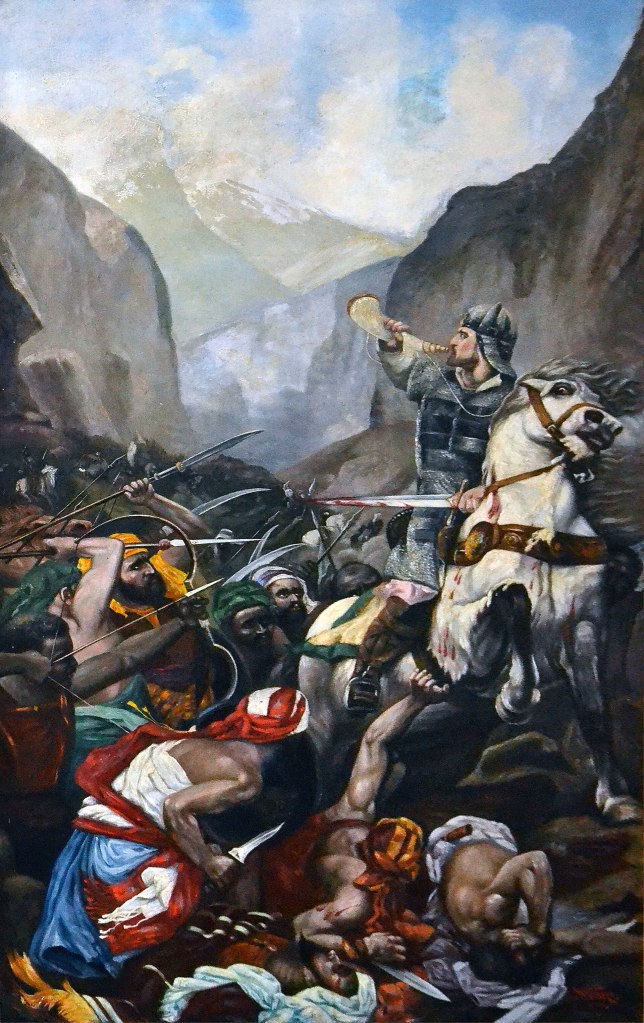
Frustrated, Charlemagne withdrew northward. On his way out, he destroyed the walls of Pamplona, a Christian Basque city whose loyalties were equally tangled in frontier politics. Why Charlemagne did this is subject to much conjecture. It may have been that the Basques of Pamplona resisted Frankish authority and failed to support his Spanish campaign and he set to destroy the city as punishment. Or maybe it was he just needed a trophy for coming to Spain. Whatever the reason, this act of punitive demolition provoked a swift and devastating response. On 15 August 778, as the Frankish column wound through the high passes of the western Pyrenees, Basque fighters ambushed the rearguard at Roncevaux, thought to have been comprised of 2000-3000 men. The attack was local, precise, and motivated by revenge; not by treachery, not by Saracens, not for any strategic advantage, and certainly not by any grand religious reasoning. The Basque rout at Roncevaux was a small skirmish in scale but deadly in execution: a perfect mountain ambush that totally annihilated Charlemagne’s rear guard and left Hruodlandus, aka Roland, prefect of the Breton March, dead on the field.

For two centuries, these events remained a footnote in Carolingian history. Only later would poets transform this small frontier skirmish into the epic clash of civilizations remembered in literature as The Song of Roland.

Between roughly 1040 and 1115, poets reshaped this obscure Charlemagne defeat into a 4000-line epic: La Chanson de Roland, the first great chanson de geste or song of heroic deeds; the oldest surviving major work of French literature. It exists in various manuscript versions, which testify to its enormous and enduring popularity in Medieval and Renaissance literature from the 12th to the 16th centuries.

The world of this poem is not Charlemagne’s but that of the First Crusade. Europe, at the time, was steeped in martial piety, exhausted from centuries of loses to Islamic battles, and hungry for heroic narratives that stiffened spines and sanctified warfare.

The Basques became Saracens; the ambush became an existential battle; and the competent but anonymous frontier officer became the greatest knight of Christendom. The poet introduced Ganelon, Roland’s treacherous stepfather: a purely literary invention inspired by Wenilo, Archbishop of Sens, whose betrayal of Charles the Bald in 858 has been remembered as a notorious but forgivable act of treachery. Ganelon’s presence in this epic gave the story a moral architecture: loyalty was sacred, betrayal was damnable, and death in battle as martyrdom.

Written in the age of the First Crusade, The Song of Roland functioned as a cultural acceptation; a proto‑psychological operation in the medieval sense of influencing the narrative. It was performed aloud by jongleurs before nobles and soldiers, shaping morale, morals, and belief; providing strength before the upcoming battle.

To grasp how Roland as a knight lived, one must imagine the Crusader host as a moving medieval city, which it certainly was. Alongside knights marched wives, children, servants, cooks, smiths, merchants, priests, prostitutes, beggars, and entertainers. Jongleurs and minstrels were professionals, paid in coin, food, and or protection. They sang heroic epics, shared and spread the news, entertained the masses, and sustained morale.

A typical day for the Crusading mass began before dawn: fires were rekindled, tents struck, wagons slowly began to creak forward. Foraging parties scoured the countryside, and when supplies ran low, commanders sanctioned plunder. Merchants sold bread and wine at inflated prices. At dusk, musicians performed, chanting epics like The Song of Roland to remind weary soldiers that their suffering had divine meaning and eventual rewards.

In traveling and siege camps, disease and hunger were constant, yet the performers remained vital. They turned defeats and stalemates into martyrdoms, victories into proof of divine favor, and rumors into rallying cry for continued vigilance. In a world without newspapers or mass communication, the performer was the medium: the voice of not only fact but ideology.

As the Crusading armies marched towards the Holy Land, they were sustained by stripping the land and villages of necessities to sustain their travels. Sometimes by honest barter or payment in coin but mostly by looting. Their vast retinues; sometimes in the tens of thousands of noncombatants, depended on this economy for survival. Looting was not a supplement to their survival but a basic need and the main monetary incentive for the knights. The accumulated loot of money, livestock, grain, clothing, and slaves circulated throughout the camp. And entertainers survived and sometimes thrived in this system, rewarded by nobles and soldiers alike for songs that glorified conquest and sanctified endurance.

Thus, The Song of Roland was not merely art and entertainment. It was part of the apparatus and psychology of war. The need for myth to instill the courage to endure the hardships of the campaign.

Formally, Roland is written in Old French decasyllables: ten syllables per line with a strong caesura or pause after the fourth syllable. The poem is organized into laisses, irregular stanzas bound by assonance, repeated vowel sounds, rather than rhyme. This meter was engineered for oral delivery: rhythmic or chant like, memorable, and flexible enough for performance amid the noise of camp life.

The Song of Roland uses numerous repeated laisses that function like refrains, emotional anchors that heighten tension and aid memory. These repetitions are not a literary embellishment but rather a performance skill, akin to the chorus of a modern song. They allowed jongleurs to emphasize key moments and helped audiences participate emotionally in the unfolding drama. Although no direct evidence survives for vocal audience participation, the refrain‑like structure almost certainly encouraged audible, communal responses at predictable points in the performance.

The historical Roland died in a forgotten mountain pass. The literary Roland lives as the embodiment of loyalty, faith, and heroic death. The poem that bears his name is not history but a psychological tale of courage. A Crusade‑era vision of how men should fight, die, and what they should believe.

In the end, The Song of Roland is less about Charlemagne’s Spain than about Europe’s soul: how myth can redeem failure, how art can sanctify violence, and how a single ambush became the anthem of a civilization.

Centuries later, the medieval Roland echoed through folklore and literature. From the 13th through the 16th century, English Arthurian oral tradition recast him as Childe Rowland, a young knight who ventures into a perilous, enchanted realm to rescue his sister from a dark tower. In the early 17th century, Shakespeare drops a fragment of that myth into King Lear: “Childe Rowland to the dark tower came”, a line that signals the play’s descent into an epitome of madness and nightmare.

In 1855, Robert Browning seized on Shakespeare’s phrase and expanded it into a full quest of existential dread in Childe Roland to the Dark Tower Came, transforming the folkloric knight into a solitary wanderer in a blasted psychological landscape. From there the Roland arc marches forward. Stephen King’s Dark Tower series takes its inspiration from Browning’s poem, recasting Roland as a gunslinger on a doomed, metaphysical quest.

The medieval epic thus became the deep ancestor of modern mythmaking. A story born from a minor, forgotten skirmish, transformed into ideology and legend, and perpetuated through art. It is one of the most remarkable literary genealogies in Western literature: a single line of verse, “Childe Rowland to the dark tower came,” mutating and reappearing across a millennium. And to give modern pop culture its own whimsical participation trophy, we might end with Warren Zevon’s contribution: “Roland the Headless Thompson Gunner.”

Graphic: Painting by Wolf von Bibra (1862 – 1922) of Battle of Roncevaux Pass from The Song of Roland based on print either by Adolf Georg Closs (1840-1894) or Gustav Adolf Carl Closs (1864-1938). Painting is based on an etching by Louis Felix Guesnet (1843-1907). Photograph of painting taken by Carl von Bibra. Wikipedia Creative Commons.

End Times

Isaac Newton (1642–1727), remembered as one of the greatest mathematicians and architect of modern physics, devoted more time to theology and biblical study than to science. Among his vast unpublished papers lies a remarkable calculation: Newton believed that the End of Times would not occur before the year 2060. His thesis was not a prediction of hell on Earth, but rather a forecast of the corrupt secular and spiritual powers giving way to the establishment of Christ’s kingdom on earth.

Newton’s notes on prophecy and chronology survive in the Yahuda manuscripts, now housed at the National Library of Israel. For more than a century, these papers were considered “unfit to print” and remained hidden in the English Earl of Portsmouth’s family archives. In 1936, Sotheby’s auctioned off Newton’s theological and alchemical writings for just over 9,000 British pounds or about $1 million in today’s dollars. Abraham Shalom Yahuda, a Jewish polymath and collector, recognized their importance and purchased a large portion, including Newton’s calculations on the End of Times.

Newton was deeply engaged with biblical prophecy, especially the Books of Daniel and Revelation. He believed these texts contained coded timelines of history on into the future. In Observations upon the Prophecies of Daniel (published posthumously in 1733), he wrote: “The prophecies of Daniel are all of them related to one another, as if they were but several parts of one general prophecy… The Apocalypse of John is written in the same style and language with Daniel, and hath many of the same figures.”

In Daniel 7:25 and 12:7, and again in Revelation 12:14, “a time” is taken as one year, “times” as two years, and “half a time” as half a year—an interpretation rooted in the Aramaic/Hebrew idiom in which “time” means “year.” Revelation 11:2 and 13:5 describe the same period as 42 months, which equals 3½ years (42 ÷ 12). Revelation 11:3 and 12:6 express it again as 1,260 days, using the Jewish symbolic 360‑day prophetic year (360 × 3.5 = 1,260). Across Revelation 11–13, these expressions appear interchangeably, reinforcing the equivalence.

The 3½‑year duration itself is symbolic: it is half of seven, the biblical number of completeness, and thus represents a period of incompleteness or tribulation deliberately cut short. Cut short because in Matthew 24:22 Jesus states, “Unless those days had been cut short, no flesh would be saved; but for the sake of the elect those days will be cut short.” A full seven would symbolize evil completing its course, but Scripture portrays God as limiting evil’s duration, preserving a some but not all, and interrupting the “full seven” before it reaches completion.

Later interpreters extended this further. Drawing on Numbers 14:34: “a day for a year”; and Ezekiel 4:6, where God again assigns “a day for a year,” they applied the day‑year principle to the 1,260 days, transforming them into 1,260 years.

Newton then sought a historical anchor, a year to start the clock to End Times. He identified 800 AD, when Charlemagne was crowned Emperor of the Romans by Pope Leo III, as the beginning of ecclesiastical corruption. For Newton, this coronation marked the fusion of secular and papal power: the fulfillment of Daniel’s prophecy of a blasphemous authority ruling over the saints. Adding 1,260 years to 800 AD produced the year 2060. In his notes, Newton wrote: “The period of 1260 days, if dated from the complete conquest of the three kings A.C. 800, will end A.C. 2060.” (Newton preferred A.C., Anno Christi, in the year of Christ over A.D., Anno Domini, in the year of the Lord.)

Newton also considered 2034 as an alternative. Anchoring the calculation in 774 AD; the year of Charlemagne’s conquest of the Lombards and alliance with Pope Adrian I: 774 plus 1260 equals 2034. The year 774 also coincided with a massive solar storm, sometimes referred to as the Charlemagne Event (stronger than the Carrington Event of 1859), with auroras reaching deep into southern latitudes and temperatures dropping a few degrees. Yet 2060 remained the most consistent date in his manuscripts.

Newton believed that the corrupt powers that would bring about the End of Times was both the papacy and the secular rulers who supported the church. In his manuscripts he clearly identified the papacy as the “little horn” and the “man of sin,” a corrupt ecclesiastical power that had usurped apostolic Christianity. At the same time he perceived that secular rulers were equally part of the apostate system destined to collapse. The ten horns of the Beast were the European kingdoms. Their political power upheld the papal system and thus shared in its guilt and its eschatological fate.

Importantly, Newton did not envision annihilation at the End of Times. He saw 2060 as the end of corruption and the dawn of a new divine order. He cautioned it may end later, but said “I see no reason for its ending sooner. This I mention not to assert when the time of the end shall be, but to put a stop to the rash conjectures of fanciful men…”

Newton feared that false predictions would undermine faith. His calculation was meant as sober interpretation, not sensational prophecy. He emphasized that only God knows the appointed time: “It is not for us to know the times and seasons which God hath put into his own breast.”

Newton’s calculation of the End of Times flows logically from the biblical text, and he treats the prophetic numbers with strict literalism. Yet he interprets the tribulation not as a final, catastrophic episode at the end of history, but as a long historical decline. Slow corruption within secular and ecclesiastical institutions. All culminating in the restoration of true Christianity.

Although Newton’s prophetic writings remained unpublished during his lifetime, the rediscovery of the Yahuda manuscripts in the 1930s revealed the full scope of his vision. He saw the End Times not as annihilation but as transformation: the fall of apostate Christianity, the renewal of true religion, and the establishment of Christ’s kingdom of peace.

Newton’s restrained timing aligns with Christ’s teaching in Matthew 24:36: “But of that day and hour no one knoweth, not the angels of heaven, but the Father alone.” In Christian eschatology, the Second Coming is likened to a Canaanite or Jewish wedding: the Father alone knows the day, the Son prepares a place, and the bride: the Church, must remain watchful. Newton’s calculations were an attempt to glimpse the architecture of prophecy, yet he humbly accepted the unknowable will of God.

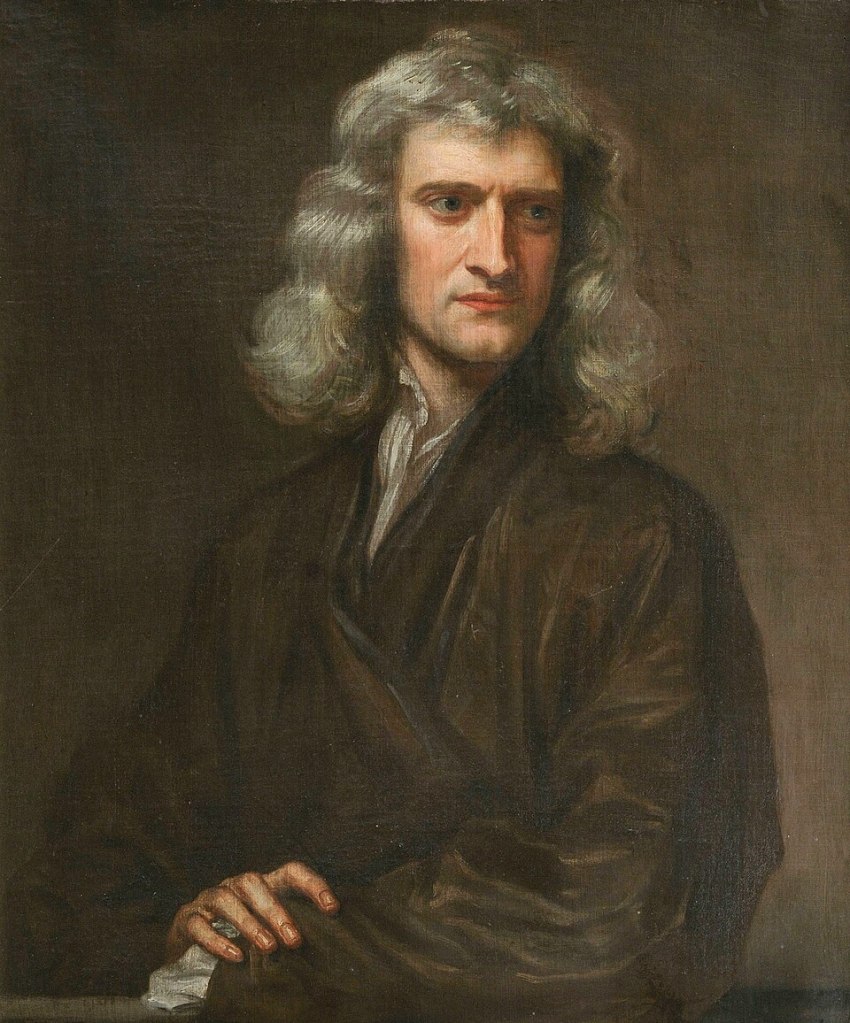
Graphic: Isaac Newton by Godrey Kneller, 1689. Issac Newton Institute. Public Domain.