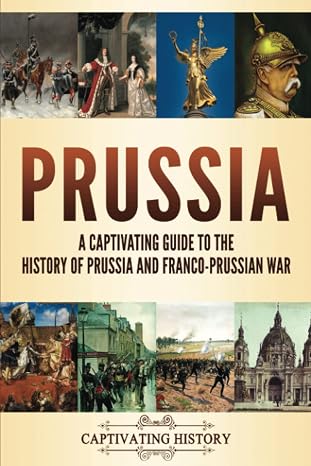
The Rise and Fall of Prussia

Most who encounter Prussia for the first time meet it in its final incarnation: the iron‑ribbed-fisted kingdom that defeated France in 1870, unified Germany, and marched at the head of Europe’s most disciplined army. This is the Prussia of Bismarck and Moltke: bureaucratic, militarized, unmistakably German. A modern state that the 20th century spent millions of lives ensuring would disappear forever. But this was only the end of Prussian history. Its beginning reaches back centuries and is just as dramatic: a story of conquest, intrigue, and violence; of knights, kings, and popes.

The Prussia Bismarck forged in the 19th century was not the Prussia the Hohenzollerns inherited in 1525, nor the Prussia the crusading Teutonic Knights built beginning in 1226. And it certainly was not the Prussia that existed before any of them: the Prussia without a name.

Prussia is a palimpsest: three different histories written over the same land. Each layer overwrote the last, yet traces remain. Long before the Teutonic Order arrived, the region was a mosaic of Baltic tribal homelands inhabited by the peoples later called the Old Prussians. Pomesanians, Pogesanians, Warmians, Natangians, Sambians, Barts, Galindians, and Sudovians shared related languages and pagan religious practices, but never formed a unified political entity or adopted a single name for their territory. Medieval chroniclers, needing a geographic label, simply called it terra Pruthenorum: “the land of the Prussians,” an exonym derived from the people rather than any indigenous place‑name.

The peoples the Teutonic Knights fought in Prussia and Lithuania were the indigenous descendants of the ancient Balts, an Indo‑European group that had occupied the Baltic forests and coasts for two, perhaps three millennia. They were not Germanic, not migrants, and not related to the tribes Rome or Charlemagne fought. Their resistance was the last stand of Europe’s oldest surviving pagan cultures. Christianity arrived late; Lithuania remained officially pagan until the late 14th century.

Thus, long before the crusading conquest by Catholic monastic knights, “Prussia” existed only as an ethnographic zone: a patchwork of fortified settlements, sacred groves, and tribal districts loosely bound by culture and kinship, not by statehood. When the Teutonic Knights arrived in the 13th century, they conquered a land already known to Europeans as Prussia, but one that had never been a unified realm until the Order imposed its monastic state upon it.

The Order itself had begun far away. The “Order of the German House of St. Mary in Jerusalem” (Ordo domus Sanctae Mariae Theutonicorum Hierosolymitanorum) was founded in Acre, now a northern Israeli Mediterranean city, as a German Marian hospital order, caring for pilgrims and wounded crusaders. Only later did it transform into a Baltic crusading power. The Teutonic Knights were both monks and warriors: a deliberate fusion of religious vows and military service, a Crusader invention.

The Teutonic Order’s transformation into a Baltic crusading state began only after 1226, when Konrad I of Masovia, was losing the brutal border war he had initiated against the pagan Prussians. Konrad’s attempts to seize Prussian lands had failed, and the tribes repaid his aggression with devastating raids into Masovia. Unable to contain these incursions, and lacking support from his fellow Piast dukes; the first ruling dynasty of Poland, Konrad turned to the Teutonic Knights: a disciplined military‑monastic order answerable to the papacy.

Before entering Prussia in 1231, the Knights secured two crucial forms of backing. The first was the Golden Bull of Rimini (1226), in which Frederick II granted them sovereign rights over any territory they might conquer, independence from Polish control, and full imperial protection. The second was papal encouragement from Honorius III, who approved their mission but did not yet define their political status.

Konrad never intended to grant the Knights sovereignty, but the Order used imperial and papal law to turn his plea for help into the foundation of their own state. The Baltic conquest was not improvised, but the knights needed additional authority to turn their victories into sovereignty.

The decisive turn of events for the Knights came under Pope Gregory IX. In 1234, Gregory issued bulls: papal legal documents, that confirmed Frederick’s grants, declared the Prussian campaigns a full crusade, and placed the Order under direct papal protection. With this act, the Knights’ foothold became a permanent crusading dominion. Their wars were now holy wars; their conquests legally theirs; their authority recognized by both empire and papacy. The Knights could now exercise king-like authority over the Baltic lands.

Once entrenched, the Teutonic Knights spent three centuries conquering and christianizing the Baltic, importing German settlers, building cities, and waging crusades against Lithuania and Poland. Their monastic state reached its height in the 14th century, then declined after the defeat at Grunwald (1410) and the loss of western Prussia to Poland (1466). By 1500, the Knights Order‑State was a hollow, bankrupt frontier that they could no longer sustain.

In 1525, the Teutonic Order under the Grand Master, Albert of Hohenzollern dissolved its state and secularized its remaining lands creating the Duchy of Prussia. The Teutonic Knights’ Baltic lands did not revert to Polish control though. They became a semi‑autonomous Lutheran state ruled by Albert of Hohenzollern as a vassal of the Polish Crown. Poland gained overlordship, but not direct possession.

Next came the Thirty Years’ War created the conditions that made a Prussian kingdom possible. Prior to the war the Hohenzollerns’ main territory: Brandenburg, was inside the Holy Roman Empire, while the former Teutonic lands of Ducal Prussia were outside it and under Polish suzerainty. This odd dual structure only becomes politically potent because of what the Thirty Years’ War does to, and ultimately for Brandenburg.

Brandenburg was one of the most ravaged regions in the Empire during the war. Some estimates put its populations losses at 50% with concurrent economic collapse, and political paralysis of the individual fiefdoms.  Frederick William, the Great Elector, concluded that Brandenburg could not survive as an estate-dominated state. The war forced him to build a permanent army, form a centralized bureaucracy, create a centralized taxing authority, and finally destroy the political reach of the estates.

Poland, fighting Sweden in the Northern Wars, needed allies, and Frederick William: ever the opportunist, filled that need. In the Treaty of Wehlau (1657) and the Treaty of Oliva (1660), Poland granted the Hohenzollerns full sovereignty over Ducal Prussia. This sovereignty did not make Frederick William a king, but it made kingship possible.

When Frederick William died in 1688, his son Frederick III inherited a militarized Brandenburg and a sovereign Prussia. In 1701, with imperial approval, he crowned himself Frederick I, King in Prussia; a title possible only because Prussia lay outside the Holy Roman Empire. This act transformed the Hohenzollerns from mere electors into kings and marked the beginning of Prussia’s rise as a great power.

The war almost destroyed Brandenburg but, in the end, it made it stronger. Before the war it was weak and disorganized. After the war it shows the beginnings of future Prussian power.

Through continued careful diplomacy and opportunistic events, the Hohenzollerns transformed this peripheral duchy into a sovereign kingdom by 1701 and then into the dominant German power on into the early 20th century. Under the Hohenzollerns, Prussia became synonymous with disciplined governance, military efficiency, and relentless state-building.

In the 19th century, Otto von Bismarck completed the Prussian project. Using war, diplomacy, and political manipulation, he unified the German states under Prussian leadership, culminating in the proclamation of the German Empire in 1871. By then, “Prussia” had evolved from an ethnographic Baltic region into the engine of German nationhood; a transformation spanning six centuries and three radically different political worlds.

By the end of the First World War, the Prussian monarchy had collapsed. Between 1933 and 1935, the Nazi regime dismantled what remained of Prussia’s federal institutions, absorbing its administration into the centralized Reich. After Germany’s defeat in 1945, the Allies governed the country through the Allied Control Council. In February 1947, Allied Control Council Law No. 46 formally abolished the State of Prussia, declaring it a historical bearer of German militarism and dissolving its remaining administrative structures. Thus ended a political entity whose origins lay in Baltic tribal homelands, whose rise was forged by crusading monks and Hohenzollern kings, and whose legacy shaped the fate of Europe for centuries.

Post note:

The first half of the book: History of Prussia is one dimensional and exceptionally incomplete (2 Stars). The Franco-Prussian War is told with enough concise precision to make reading this book worthwhile (3 Stars).
Time and Roland

The Song of Roland, the actual point of this story, is a romantic Crusade‑era epic of courage and fortitude, but its origins lie along a long and winding road; a path the world has seen many times before, shaped not by heroism but by political confusion, shifting loyalties, and the hard realities of Muslim civil war in eighth‑century al‑Shām (greater Syria) and Spain.

In 661 AD, year 40 by the Islamic calendar, the Islamic world was ruled by the Umayyad dynasty from Damascus. After nearly a century in power, resentment from non‑Arab converts and continual internal corruption fueled an Abbasid revolutionary movement centered in Persia. In 750, the Abbasids defeated the Umayyad army at the Battle of the Zab in northern Iraq, marched into Damascus, and carried out one of the most violent and consequential political massacres in Islamic history: a systematic extermination of the Umayyad ruling family.

One young Umayyad prince, Abd al‑Rahman, escaped the purge. After a long flight across North Africa, he reached Spain and founded the Emirate of Córdoba. Through the 760s and 770s he consolidated his rule over Córdoba, Seville, Málaga, Granada, Jaén, Mérida, and Toledo. His authority in the south was real, but the northern Iberian Peninsula remained unstable.

The Peninsula was locked in a protracted and confusing Muslim civil war between Abd al‑Rahman and a cluster of rebellious but powerful northern governors in the Ebro Valley, centered around Zaragoza, Barcelona, and Girona. These governors had long traditions of autonomy and viewed Abd al‑Rahman’s centralizing reforms as a direct threat to their power. Frontier loyalties simmered and shifted constantly.

By 776–777, the northern elites realized they were losing ground. Abd al‑Rahman had crushed several uprisings and installed loyalists in key cities. The rebels needed a counterweight; a distant power strong enough to deter Córdoba but too far away to dominate them. They found their candidate in Charlemagne, king of the Franks.

Thus, at the winter assembly of 776–777 in Paderborn, in what is now northern Germany, Muslim envoys from Barcelona, Girona, and Zaragoza appeared before Charlemagne and offered submission, tribute, and the keys to their cities if he would intervene on their behalf. To Charlemagne, this looked like a rare strategic opportunity: a chance to extend Frankish influence into Spain without a full conquest, to secure the Pyrenean frontier, and to present himself as a protector of Christians; even though the rebels were Muslim. He believed the campaign would be quick: Zaragoza would open its gates, the northern cities would align with him, and a friendly buffer zone would emerge.

But the political map of 777 did not survive into 778.

When Charlemagne crossed the Pyrenees in the summer of 778 with roughly 20,000–30,000 fighting men, divided into two great columns, one of the largest assembled armies of his reign, he discovered that the civil war had neither remained as presented to him in the previous year nor had it resolved itself, but only shifted in its loyalties. The same factions existed, but their alliances had flipped. Most critically, al‑Husayn of Zaragoza, who had invited Charlemagne the year before, had reconciled with Abd al‑Rahman. Handing Zaragoza to the Franks now meant treason, loss of office, and retaliation from Córdoba. So, when Charlemagne arrived, Zaragoza refused to open its gates.

Other northern rebels remained hostile to Córdoba and even accompanied the Frankish army. But the coalition was fractured, Abd al‑Rahman’s position had strengthened, and Charlemagne’s intelligence was outdated. He had come expecting a diplomatic handover, not a siege, and he had brought no siege equipment nor an expectation of large casualties.

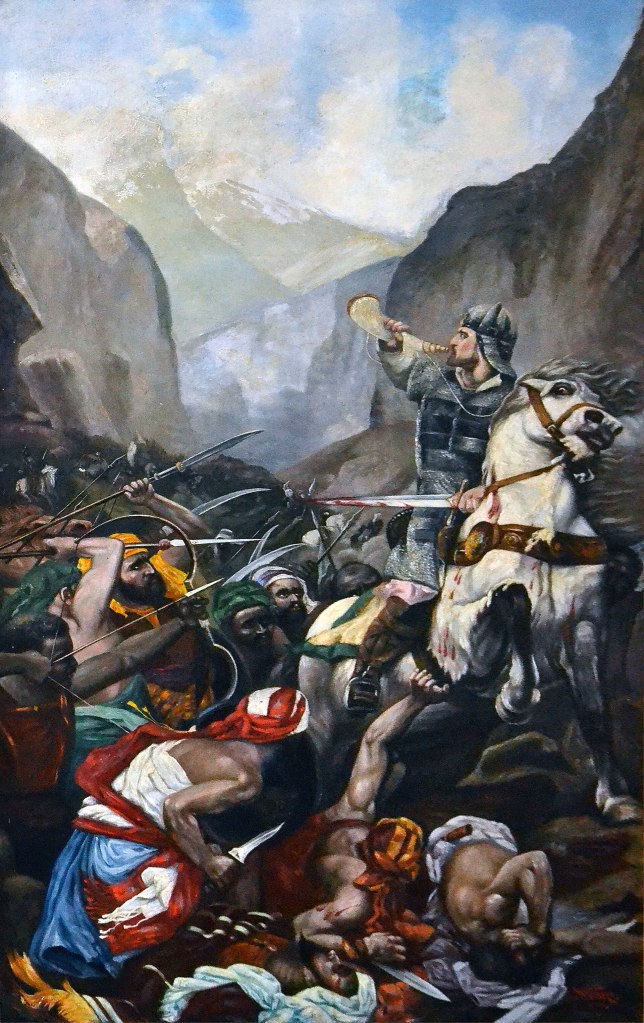
Frustrated, Charlemagne withdrew northward. On his way out, he destroyed the walls of Pamplona, a Christian Basque city whose loyalties were equally tangled in frontier politics. Why Charlemagne did this is subject to much conjecture. It may have been that the Basques of Pamplona resisted Frankish authority and failed to support his Spanish campaign and he set to destroy the city as punishment. Or maybe it was he just needed a trophy for coming to Spain. Whatever the reason, this act of punitive demolition provoked a swift and devastating response. On 15 August 778, as the Frankish column wound through the high passes of the western Pyrenees, Basque fighters ambushed the rearguard at Roncevaux, thought to have been comprised of 2000-3000 men. The attack was local, precise, and motivated by revenge; not by treachery, not by Saracens, not for any strategic advantage, and certainly not by any grand religious reasoning. The Basque rout at Roncevaux was a small skirmish in scale but deadly in execution: a perfect mountain ambush that totally annihilated Charlemagne’s rear guard and left Hruodlandus, aka Roland, prefect of the Breton March, dead on the field.

For two centuries, these events remained a footnote in Carolingian history. Only later would poets transform this small frontier skirmish into the epic clash of civilizations remembered in literature as The Song of Roland.

Between roughly 1040 and 1115, poets reshaped this obscure Charlemagne defeat into a 4000-line epic: La Chanson de Roland, the first great chanson de geste or song of heroic deeds; the oldest surviving major work of French literature. It exists in various manuscript versions, which testify to its enormous and enduring popularity in Medieval and Renaissance literature from the 12th to the 16th centuries.

The world of this poem is not Charlemagne’s but that of the First Crusade. Europe, at the time, was steeped in martial piety, exhausted from centuries of loses to Islamic battles, and hungry for heroic narratives that stiffened spines and sanctified warfare.

The Basques became Saracens; the ambush became an existential battle; and the competent but anonymous frontier officer became the greatest knight of Christendom. The poet introduced Ganelon, Roland’s treacherous stepfather: a purely literary invention inspired by Wenilo, Archbishop of Sens, whose betrayal of Charles the Bald in 858 has been remembered as a notorious but forgivable act of treachery. Ganelon’s presence in this epic gave the story a moral architecture: loyalty was sacred, betrayal was damnable, and death in battle as martyrdom.

Written in the age of the First Crusade, The Song of Roland functioned as a cultural acceptation; a proto‑psychological operation in the medieval sense of influencing the narrative. It was performed aloud by jongleurs before nobles and soldiers, shaping morale, morals, and belief; providing strength before the upcoming battle.

To grasp how Roland as a knight lived, one must imagine the Crusader host as a moving medieval city, which it certainly was. Alongside knights marched wives, children, servants, cooks, smiths, merchants, priests, prostitutes, beggars, and entertainers. Jongleurs and minstrels were professionals, paid in coin, food, and or protection. They sang heroic epics, shared and spread the news, entertained the masses, and sustained morale.

A typical day for the Crusading mass began before dawn: fires were rekindled, tents struck, wagons slowly began to creak forward. Foraging parties scoured the countryside, and when supplies ran low, commanders sanctioned plunder. Merchants sold bread and wine at inflated prices. At dusk, musicians performed, chanting epics like The Song of Roland to remind weary soldiers that their suffering had divine meaning and eventual rewards.

In traveling and siege camps, disease and hunger were constant, yet the performers remained vital. They turned defeats and stalemates into martyrdoms, victories into proof of divine favor, and rumors into rallying cry for continued vigilance. In a world without newspapers or mass communication, the performer was the medium: the voice of not only fact but ideology.

As the Crusading armies marched towards the Holy Land, they were sustained by stripping the land and villages of necessities to sustain their travels. Sometimes by honest barter or payment in coin but mostly by looting. Their vast retinues; sometimes in the tens of thousands of noncombatants, depended on this economy for survival. Looting was not a supplement to their survival but a basic need and the main monetary incentive for the knights. The accumulated loot of money, livestock, grain, clothing, and slaves circulated throughout the camp. And entertainers survived and sometimes thrived in this system, rewarded by nobles and soldiers alike for songs that glorified conquest and sanctified endurance.

Thus, The Song of Roland was not merely art and entertainment. It was part of the apparatus and psychology of war. The need for myth to instill the courage to endure the hardships of the campaign.

Formally, Roland is written in Old French decasyllables: ten syllables per line with a strong caesura or pause after the fourth syllable. The poem is organized into laisses, irregular stanzas bound by assonance, repeated vowel sounds, rather than rhyme. This meter was engineered for oral delivery: rhythmic or chant like, memorable, and flexible enough for performance amid the noise of camp life.

The Song of Roland uses numerous repeated laisses that function like refrains, emotional anchors that heighten tension and aid memory. These repetitions are not a literary embellishment but rather a performance skill, akin to the chorus of a modern song. They allowed jongleurs to emphasize key moments and helped audiences participate emotionally in the unfolding drama. Although no direct evidence survives for vocal audience participation, the refrain‑like structure almost certainly encouraged audible, communal responses at predictable points in the performance.

The historical Roland died in a forgotten mountain pass. The literary Roland lives as the embodiment of loyalty, faith, and heroic death. The poem that bears his name is not history but a psychological tale of courage. A Crusade‑era vision of how men should fight, die, and what they should believe.

In the end, The Song of Roland is less about Charlemagne’s Spain than about Europe’s soul: how myth can redeem failure, how art can sanctify violence, and how a single ambush became the anthem of a civilization.

Centuries later, the medieval Roland echoed through folklore and literature. From the 13th through the 16th century, English Arthurian oral tradition recast him as Childe Rowland, a young knight who ventures into a perilous, enchanted realm to rescue his sister from a dark tower. In the early 17th century, Shakespeare drops a fragment of that myth into King Lear: “Childe Rowland to the dark tower came”, a line that signals the play’s descent into an epitome of madness and nightmare.

In 1855, Robert Browning seized on Shakespeare’s phrase and expanded it into a full quest of existential dread in Childe Roland to the Dark Tower Came, transforming the folkloric knight into a solitary wanderer in a blasted psychological landscape. From there the Roland arc marches forward. Stephen King’s Dark Tower series takes its inspiration from Browning’s poem, recasting Roland as a gunslinger on a doomed, metaphysical quest.

The medieval epic thus became the deep ancestor of modern mythmaking. A story born from a minor, forgotten skirmish, transformed into ideology and legend, and perpetuated through art. It is one of the most remarkable literary genealogies in Western literature: a single line of verse, “Childe Rowland to the dark tower came,” mutating and reappearing across a millennium. And to give modern pop culture its own whimsical participation trophy, we might end with Warren Zevon’s contribution: “Roland the Headless Thompson Gunner.”

Graphic: Painting by Wolf von Bibra (1862 – 1922) of Battle of Roncevaux Pass from The Song of Roland based on print either by Adolf Georg Closs (1840-1894) or Gustav Adolf Carl Closs (1864-1938). Painting is based on an etching by Louis Felix Guesnet (1843-1907). Photograph of painting taken by Carl von Bibra. Wikipedia Creative Commons.

A Little Package of our Past

World History: 50 Key Milestones You Really Need to Know B 50 History

Written by:  Ian Crofton

Published by:  Quercus

Copyright:  © 2011

Attempting to describe 12-15,000 years, since the big ice fields melted, of human endeavors in 200 pages and 50 topics would seem presumptuous and futile, and you would be right, but one has to start somewhere and the first steps can and should be small but decisive.  One can quibble about the exact 50 topics, and I will do just that in a bit, but the author, Ian Crofton, performs the task with aplomb, and provides the maximum amount of useful information possible given the limiting format.

This book is a quick and fun read for both those without a broad or deep introduction to human history or those that just want to refresh their memory on once familiar, but long forgotten topics. Even if you are familiar with all the topics in the book there will be a sufficient amount of new informational tidbits to make it worth your time. For myself, as one example, I found the observation that our ancestral hunter-gather cousins versus the first cereal grain farmers, were healthier, due mainly to their higher protein intake from a meat rich diet, was new and interesting.

Each “idea” or event is developed, chronologically, over 4 printed pages that includes a short thesis, an expansion of that thesis, a timeline of notable events, a famous quote(s) and an ending synopsis of the discussion.  The publisher of this book, Quercus, has published at least 27 other books of a similar nature and format that explore the great topics of the human experience including: architecture, art, astronomy, big ideas, biology, chemistry, the digital world, earth, economics, ethics, the future, genetics, the human brain, literature, management, math, philosophy, philosophy of science, physics, politics, psychology, quantum physics, religion, science, universe, war, and world history. I believe they continue to add more topics as the years go by.  I have several of the topics, listed above on my already too fat reading list.

Not to detract from the topics that the author has chosen, his are all defendable, but for myself I probably would have included 5 different topics devoted to: the Iron Age, Israelites of the 12th century BC, 1st century Christianity, Sumerians development of an alphabet in 300 BC coupled with Guttenberg’s first printing press in the 15th century AD, 18th century BC Babylonian Hammurabi’s, and 7th century BC Greek Draco’s legal codifications, and finally the advent of computers in the 20th century and beyond.  Adding 5 topics requires that 5 be removed. I would likely leave out: Empires and Kingdoms of Africa, The Bubonic Plague, the Vietnam War, integral to the late 20th century US, but will likely be a footnote on communism in the future, and lastly, the Arab-Israeli conflict and the post 9-11 topics, at a minimum, combined into a topic on 21st century divisions in civilization and culture, as if that were something new. On further thought, maybe just leave those last two topics out completely, mainly because they are too fresh to decide their seminality to our future development as a species.

That leaves our list one shy of 50. What topic(s) would you add?

Human Nature Yesterday

The Crusades: The Authoritative History of the War for the Holy Land

Written by:  Thomas Asbridge51c32nyzebl-_sx330_bo1204203200_

Published by:  HarperCollins

Copyright:  © 2010

In 1095 AD, during the high middle ages, the Byzantine Emperor Alexius Comnenus of Constantinople asked the Latin Pope Urban II for assistance in recovering parts of Asia Minor lost to the Seljuk Turks. The Pope responded, with less than altruistic motives towards his eastern Christian cousins, by embroiling western Europe and the Levant in 200 years of war which eventually became known as the Crusades.

Thomas Asbridge presents a compelling history of Christian struggles to seize control of the holy land from the Muslims, thus reviving the Islamic concept of jihad, while attempting to answer the questions of how these battles of conquest and religion reverberate through western history into our modern times.  Interesting enough Asbridge suggests that the crusades “belong in  the past” and inferences to todays apparent sequels are “misguided”.

This is a excellent and thoroughly researched march through the 11th and 12th centuries of western Europe and the Levant, bringing alive names of Richard the Lionheart and Saladin and others that Sir Walter Scott so richly romanticized in his historical 19th century novels, Ivanhoe and The Talisman.  The Crusades is a fast paced read with sufficient twists and turns in the narrative that you may suspect that this is a movie screenplay rather than a history.  This is a great read. Well worth your time.