Time and Roland

The Song of Roland, the actual point of this story, is a romantic Crusade‑era epic of courage and fortitude, but its origins lie along a long and winding road; a path the world has seen many times before, shaped not by heroism but by political confusion, shifting loyalties, and the hard realities of Muslim civil war in eighth‑century al‑Shām (greater Syria) and Spain.

In 661 AD, year 40 by the Islamic calendar, the Islamic world was ruled by the Umayyad dynasty from Damascus. After nearly a century in power, resentment from non‑Arab converts and continual internal corruption fueled an Abbasid revolutionary movement centered in Persia. In 750, the Abbasids defeated the Umayyad army at the Battle of the Zab in northern Iraq, marched into Damascus, and carried out one of the most violent and consequential political massacres in Islamic history: a systematic extermination of the Umayyad ruling family.

One young Umayyad prince, Abd al‑Rahman, escaped the purge. After a long flight across North Africa, he reached Spain and founded the Emirate of Córdoba. Through the 760s and 770s he consolidated his rule over Córdoba, Seville, Málaga, Granada, Jaén, Mérida, and Toledo. His authority in the south was real, but the northern Iberian Peninsula remained unstable.

The Peninsula was locked in a protracted and confusing Muslim civil war between Abd al‑Rahman and a cluster of rebellious but powerful northern governors in the Ebro Valley, centered around Zaragoza, Barcelona, and Girona. These governors had long traditions of autonomy and viewed Abd al‑Rahman’s centralizing reforms as a direct threat to their power. Frontier loyalties simmered and shifted constantly.

By 776–777, the northern elites realized they were losing ground. Abd al‑Rahman had crushed several uprisings and installed loyalists in key cities. The rebels needed a counterweight; a distant power strong enough to deter Córdoba but too far away to dominate them. They found their candidate in Charlemagne, king of the Franks.

Thus, at the winter assembly of 776–777 in Paderborn, in what is now northern Germany, Muslim envoys from Barcelona, Girona, and Zaragoza appeared before Charlemagne and offered submission, tribute, and the keys to their cities if he would intervene on their behalf. To Charlemagne, this looked like a rare strategic opportunity: a chance to extend Frankish influence into Spain without a full conquest, to secure the Pyrenean frontier, and to present himself as a protector of Christians; even though the rebels were Muslim. He believed the campaign would be quick: Zaragoza would open its gates, the northern cities would align with him, and a friendly buffer zone would emerge.

But the political map of 777 did not survive into 778.

When Charlemagne crossed the Pyrenees in the summer of 778 with roughly 20,000–30,000 fighting men, divided into two great columns, one of the largest assembled armies of his reign, he discovered that the civil war had neither remained as presented to him in the previous year nor had it resolved itself, but only shifted in its loyalties. The same factions existed, but their alliances had flipped. Most critically, al‑Husayn of Zaragoza, who had invited Charlemagne the year before, had reconciled with Abd al‑Rahman. Handing Zaragoza to the Franks now meant treason, loss of office, and retaliation from Córdoba. So, when Charlemagne arrived, Zaragoza refused to open its gates.

Other northern rebels remained hostile to Córdoba and even accompanied the Frankish army. But the coalition was fractured, Abd al‑Rahman’s position had strengthened, and Charlemagne’s intelligence was outdated. He had come expecting a diplomatic handover, not a siege, and he had brought no siege equipment nor an expectation of large casualties.

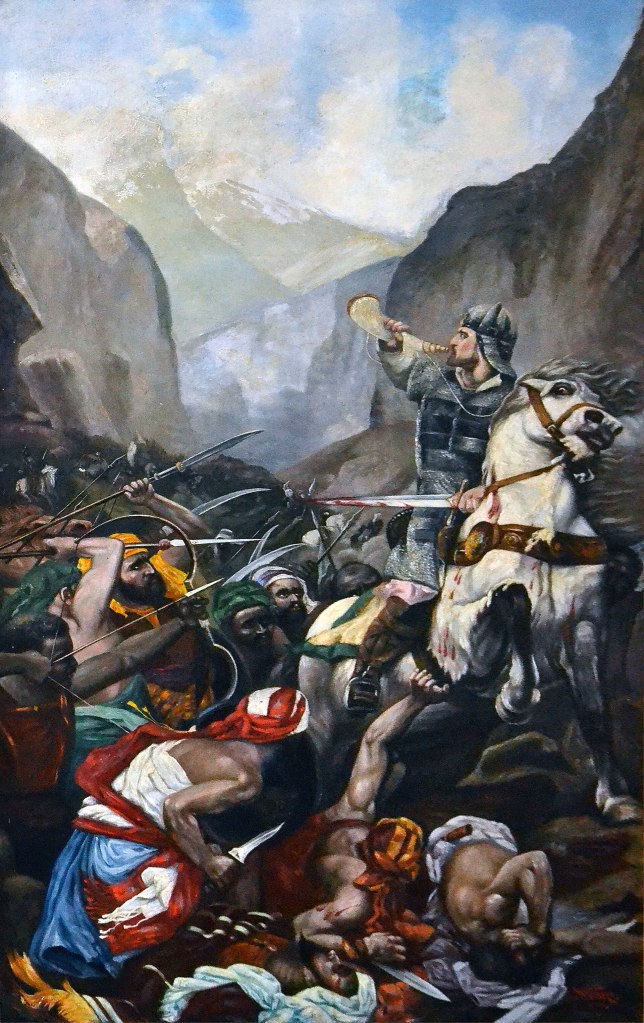
Frustrated, Charlemagne withdrew northward. On his way out, he destroyed the walls of Pamplona, a Christian Basque city whose loyalties were equally tangled in frontier politics. Why Charlemagne did this is subject to much conjecture. It may have been that the Basques of Pamplona resisted Frankish authority and failed to support his Spanish campaign and he set to destroy the city as punishment. Or maybe it was he just needed a trophy for coming to Spain. Whatever the reason, this act of punitive demolition provoked a swift and devastating response. On 15 August 778, as the Frankish column wound through the high passes of the western Pyrenees, Basque fighters ambushed the rearguard at Roncevaux, thought to have been comprised of 2000-3000 men. The attack was local, precise, and motivated by revenge; not by treachery, not by Saracens, not for any strategic advantage, and certainly not by any grand religious reasoning. The Basque rout at Roncevaux was a small skirmish in scale but deadly in execution: a perfect mountain ambush that totally annihilated Charlemagne’s rear guard and left Hruodlandus, aka Roland, prefect of the Breton March, dead on the field.

For two centuries, these events remained a footnote in Carolingian history. Only later would poets transform this small frontier skirmish into the epic clash of civilizations remembered in literature as The Song of Roland.

Between roughly 1040 and 1115, poets reshaped this obscure Charlemagne defeat into a 4000-line epic: La Chanson de Roland, the first great chanson de geste or song of heroic deeds; the oldest surviving major work of French literature. It exists in various manuscript versions, which testify to its enormous and enduring popularity in Medieval and Renaissance literature from the 12th to the 16th centuries.

The world of this poem is not Charlemagne’s but that of the First Crusade. Europe, at the time, was steeped in martial piety, exhausted from centuries of loses to Islamic battles, and hungry for heroic narratives that stiffened spines and sanctified warfare.

The Basques became Saracens; the ambush became an existential battle; and the competent but anonymous frontier officer became the greatest knight of Christendom. The poet introduced Ganelon, Roland’s treacherous stepfather: a purely literary invention inspired by Wenilo, Archbishop of Sens, whose betrayal of Charles the Bald in 858 has been remembered as a notorious but forgivable act of treachery. Ganelon’s presence in this epic gave the story a moral architecture: loyalty was sacred, betrayal was damnable, and death in battle as martyrdom.

Written in the age of the First Crusade, The Song of Roland functioned as a cultural acceptation; a proto‑psychological operation in the medieval sense of influencing the narrative. It was performed aloud by jongleurs before nobles and soldiers, shaping morale, morals, and belief; providing strength before the upcoming battle.

To grasp how Roland as a knight lived, one must imagine the Crusader host as a moving medieval city, which it certainly was. Alongside knights marched wives, children, servants, cooks, smiths, merchants, priests, prostitutes, beggars, and entertainers. Jongleurs and minstrels were professionals, paid in coin, food, and or protection. They sang heroic epics, shared and spread the news, entertained the masses, and sustained morale.

A typical day for the Crusading mass began before dawn: fires were rekindled, tents struck, wagons slowly began to creak forward. Foraging parties scoured the countryside, and when supplies ran low, commanders sanctioned plunder. Merchants sold bread and wine at inflated prices. At dusk, musicians performed, chanting epics like The Song of Roland to remind weary soldiers that their suffering had divine meaning and eventual rewards.

In traveling and siege camps, disease and hunger were constant, yet the performers remained vital. They turned defeats and stalemates into martyrdoms, victories into proof of divine favor, and rumors into rallying cry for continued vigilance. In a world without newspapers or mass communication, the performer was the medium: the voice of not only fact but ideology.

As the Crusading armies marched towards the Holy Land, they were sustained by stripping the land and villages of necessities to sustain their travels. Sometimes by honest barter or payment in coin but mostly by looting. Their vast retinues; sometimes in the tens of thousands of noncombatants, depended on this economy for survival. Looting was not a supplement to their survival but a basic need and the main monetary incentive for the knights. The accumulated loot of money, livestock, grain, clothing, and slaves circulated throughout the camp. And entertainers survived and sometimes thrived in this system, rewarded by nobles and soldiers alike for songs that glorified conquest and sanctified endurance.

Thus, The Song of Roland was not merely art and entertainment. It was part of the apparatus and psychology of war. The need for myth to instill the courage to endure the hardships of the campaign.

Formally, Roland is written in Old French decasyllables: ten syllables per line with a strong caesura or pause after the fourth syllable. The poem is organized into laisses, irregular stanzas bound by assonance, repeated vowel sounds, rather than rhyme. This meter was engineered for oral delivery: rhythmic or chant like, memorable, and flexible enough for performance amid the noise of camp life.

The Song of Roland uses numerous repeated laisses that function like refrains, emotional anchors that heighten tension and aid memory. These repetitions are not a literary embellishment but rather a performance skill, akin to the chorus of a modern song. They allowed jongleurs to emphasize key moments and helped audiences participate emotionally in the unfolding drama. Although no direct evidence survives for vocal audience participation, the refrain‑like structure almost certainly encouraged audible, communal responses at predictable points in the performance.

The historical Roland died in a forgotten mountain pass. The literary Roland lives as the embodiment of loyalty, faith, and heroic death. The poem that bears his name is not history but a psychological tale of courage. A Crusade‑era vision of how men should fight, die, and what they should believe.

In the end, The Song of Roland is less about Charlemagne’s Spain than about Europe’s soul: how myth can redeem failure, how art can sanctify violence, and how a single ambush became the anthem of a civilization.

Centuries later, the medieval Roland echoed through folklore and literature. From the 13th through the 16th century, English Arthurian oral tradition recast him as Childe Rowland, a young knight who ventures into a perilous, enchanted realm to rescue his sister from a dark tower. In the early 17th century, Shakespeare drops a fragment of that myth into King Lear: “Childe Rowland to the dark tower came”, a line that signals the play’s descent into an epitome of madness and nightmare.

In 1855, Robert Browning seized on Shakespeare’s phrase and expanded it into a full quest of existential dread in Childe Roland to the Dark Tower Came, transforming the folkloric knight into a solitary wanderer in a blasted psychological landscape. From there the Roland arc marches forward. Stephen King’s Dark Tower series takes its inspiration from Browning’s poem, recasting Roland as a gunslinger on a doomed, metaphysical quest.

The medieval epic thus became the deep ancestor of modern mythmaking. A story born from a minor, forgotten skirmish, transformed into ideology and legend, and perpetuated through art. It is one of the most remarkable literary genealogies in Western literature: a single line of verse, “Childe Rowland to the dark tower came,” mutating and reappearing across a millennium. And to give modern pop culture its own whimsical participation trophy, we might end with Warren Zevon’s contribution: “Roland the Headless Thompson Gunner.”

Graphic: Painting by Wolf von Bibra (1862 – 1922) of Battle of Roncevaux Pass from The Song of Roland based on print either by Adolf Georg Closs (1840-1894) or Gustav Adolf Carl Closs (1864-1938). Painting is based on an etching by Louis Felix Guesnet (1843-1907). Photograph of painting taken by Carl von Bibra. Wikipedia Creative Commons.
Literary Plots

(Note: This is an updated version of the original post from March of 2026. It now includes a Chowder reference that I recently stumbled across in Heinlein’s juvenile novels.)

“What was the worst thing you’ve ever done?”  “What is the worst thing that has ever happened to you?”

So begins the story of the Chowder Society nightmare. Five men bound since their youth, destined purposefully together by life and consequence, later joined by the main protagonist Don Wanderley, drawn into an A.M. horror with no single name and a thousand shifting labels. Their lives become a tangle of stories within stories, the past bleeding into the present, each tale circling a separate Dantean ring of terror.

Peter Straub (1943–2022) builds “Ghost Story” out of the shadows of man’s dreams of dread and death. Drawing on a century of horror in literature, visual arts, and psychology to create a world of insinuation, illusion, and fear; where nothing is ever said just once, nothing is ever said plainly, and nothing settles. Straub’s references to books, photos, and films, often through Wanderley, but not exclusively, are not decorative touches or character shading. They are physical clues. Each reference is a lens through which the plot becomes clearer.

Don Wanderley’s name is the novel in miniature: this is a tale about a man who wanders through illusions and a town that wanders through its own lies. As the heir to the Chowder Society’s buried horror, Wanderley carries the past into the present, through his criticism of art and letters, through his misreadings of life, and through belief in the oldest self‑deception of all, the belief that the women who charm you are the ones who love you.

As a lecturer at Berkeley, Wanderley teaches Hawthorne’s “The House of the Seven Gables” and encounters R.P. Blackmur’s essay on the novel, which argues: “When every possibility is taken away, then we have sinned.” Wanderley finds that this idea radiates throughout Hawthorne’s work, and he “could connect the novels and stories by this black Christianity,” an impulse or more directly, a desire for nightmares. Hawthorne himself writes that he sometimes achieved a “singular and not unpleasing effect” by imagining incidents in which “the spiritual mechanism of the faery legend” is fused with “the characters and manners of everyday life.”

In modern terms: the ghost and the haunted are part of the same mechanism. Straub uses this to signal that Don and the Chowder Society are haunted not by an external force, but by themselves.

Wanderley extends this line of thought through D.H. Lawrence’s critique of Hawthorne, which ties Blackmur’s concept of sin to lust, and to the New England lineage of Hawthorne, Poe, James, Lovecraft, and King:

And the first thing she does is seduce him.
And the first thing he does is to be seduced.
And the second thing they do is to hug their sin in secret, and gloat over it, and try to understand.
Which is the myth of New England.

Although Straub never states it outright, Stephen King does so in his introduction to “Ghost Story:” this lineage leads directly to Henry James’s “The Turn of the Screw,” which asks whether the supernatural is real or a projection of the psyche. James refuses to resolve the question. Straub resolves it by refusing to choose. His haunting functions like a double‑slit experiment: both interpretations are true simultaneously. The horror is real and psychological. It exists because the Chowder Society created the conditions for it.

Hawthorne fused the supernatural with everyday life. James separated them and let the reader decide. Straub makes them inseparable, a melding of spirit and mind, a duality of horror.

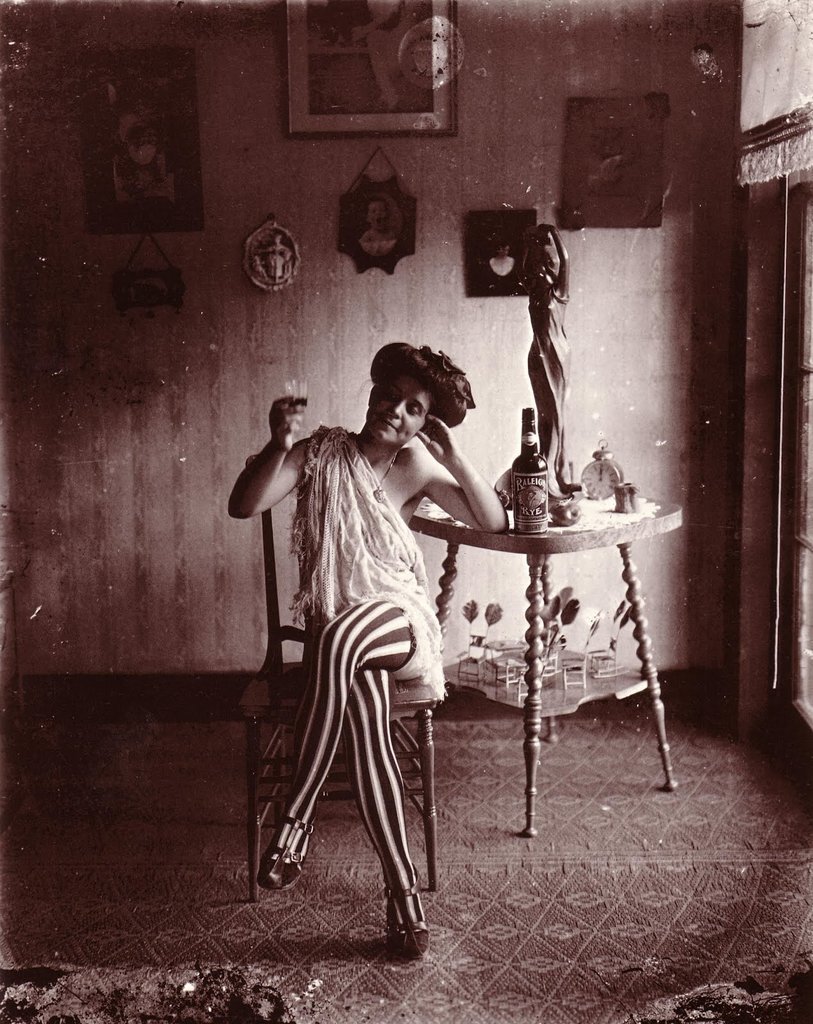
Continuing this duality, Wanderley describes a sudden vision of Alma: “Then suddenly and shockingly, she [Alma] lifting a spoonful of mint-green avocado to her mouth, I had another vision of her. I saw her as a whore, a 1910 Storyville prostitute, her hair exotically twisted, her dancer’s legs drawn up, her naked body was very clear for a moment. Another image of professional detachment, I supposed, but that did not explain the force of the vision.”  A vision of Alma or from Alma?

Alma as a “1910 Storyville prostitute” is not a literary allusion but a visual one. Straub is invoking the E.J. Bellocq photographs of New Orleans prostitutes in Storyville around 1910: stark, intimate portraits rediscovered in the 1970s and now held in major museums such as MoMA. These images show women posed in small, bare rooms, sometimes clothed, sometimes nude, their expressions shifting between defiance and vulnerability. They carry an aura of theatrical melancholy: present yet absent, exposed yet unknowable.

It is a perfect portrait of Alma. And Wanderley misses the meaning entirely. The vision is not “professional detachment.” It is the novel’s gears revealing itself: Alma appears as a figure who is both real and unreal, historical and spectral, seductive and annihilating; the very embodiment of Straub’s fused supernatural psychology of mind and ghost.

Enhancing the contradictions Straub has Don Wanderley bring Alama to a showing of Renoir’s “La Grande Illusion.” The film is about the collapse of the structures that once defined Europe: class, nation, aristocratic codes, the belief that enemies and friends can be cleanly separated. Straub’s novel is about the collapse of the structures that once defined the Chowder Society: honor, memory, guilt, the belief that the past can be buried. It’s not a casual reference; it’s Straub subtly telling the reader how to understand the plot of “Ghost Story.”

In La Grande Illusion, friends are enemies and enemies are friends. A French aristocrat and a German aristocrat share more with each other than with the men they command. Working‑class soldiers form bonds that ignore borders. The “grand illusion” isn’t war; it’s the belief that the old hierarchies still matter in the face of modernity. Renoir uses the prison‑camp setting not for escape‑movie suspense (though there is an escape), but to dissect a social order already dying.

Straub mirrors this logic. “Ghost Story” is a deadly illusion of its own: heroes and villains circle one another, and to know one is to find the other. Evil is a ghost from the past, a supernatural entity and a moral consequence brought to the present. The men who see themselves as honorable are the ones who committed the original sin. The woman they loved is the monster they created and honored. The past they buried is the thing hunting them.

Like Renoir’s war film without battles, Straub builds a ghost story without medieval props of vampires and werewolves, although there is that. The real haunting is psychological. The real prison is memory. The real war is the struggle between the stories the men tell about themselves, the truth they refuse to face, and the nightmares that consume them.

Both works, the film and the novel, strip away the expected genre scaffolding, war without battles, society without walls; ghosts without haunted houses, horror without the supernatural. What remains is the same core revelation: the structures we trust to define us are illusions, and when they collapse, the truth steps forward. “When every possibility is taken away, then we have sinned.”

Alma tells Waverley everything and he misses it entirely. “I (Alma) know some people who are interested in the occult.”…It can’t be…Ordo Templi Orientis.” …They were known to be cruel, even savage.” …”I saw a ghost” …[or] did Alma actually say, “I am a ghost?”

Then the mists begin to dissipate. Don begins to see. “…my second lecture was a disaster. I brought out secondhand ideas unsuccessfully, tried to relate them and got lost in my notes: I contradicted myself. …I said that “The Red Badge of Courage” was a great ghost story in which the ghost never appears. He begins to see ghosts. But Waverley misreads the book just as Henry Fleming in Badge of Courage misreads himself. Fleming was a coward and courageous, he lied and acted with honor, and he was neither hero nor villain. Straub tells the reader that Wanderley is tactically brilliant in seeing ghosts but strategically misreading Alma, and his fears, and his courage, and his guilt. He misses the moral and ocular truth in front of him.

Then Straub moves the deception from Wanderley to the weakest link in the original Chowder Society: Dr. Jaffery. Straub begins Jaffery’s end with a normal scene morphing into the long hidden truth: “The fading wallpaper…the table bearing neat piles of coins, a library book (The Making of a Surgeon) and a lamp…In this room, at once familiar and unreal, he could not stay…Jesus she moved.” This is the moment the author moves beyond Wanderley’s thematic deception onto Jaffrey and the entire Chowder Society’s moral deception.

And “The Making of a Surgeon” is all about moral clarity, facing consequences, and accepting responsibility. It’s a memoir of professional responsibility and moral courage. And the Chowder Society is finally reaching across the abyss of denial and confronting the horror or their past.

Now working backwards, Edward Wanderley, Don Wanderley’s uncle, an original Chowder, enters the story mostly as a memory, but he is the caretaker of all those haunting memories. He is unwitting biographer of their past, recording moments of truth that reveal nothing, saving no one. Edward preserved the past in perfect detail, and like his nephew, it all remained unexamined, redeeming no one.

Finally, if Straub’s novel teaches anything, it is that every circle eventually closes. The Chowder Society’s memories loop back on themselves, and so does the novel’s architecture. Even the name of the Society carries its own literary origin, one that reaches not into the gothic of Hawthorne or James but into the sci-fi literature of Straub’s youth. In Robert Heinlein’s first juvenile novella Rocket Ship Galileo (1947), a trio of boys form a self‑styled “Marching‑and‑Chowder Society.” The phrase is unusual enough that its reappearance is unlikely to be accidental, even if the influence operated subconsciously. In Heinlein the Chowder Society is an exclusive action‑club of boys whose bond is forged through shared adventure and forward‑moving purpose. Straub begins his Chowder Society by inverting this structure: his Chowder Society is a literary circle of elderly men whose bond originates in a youthful action and persists as a lifelong burden. Where Heinlein presents the bright formation of a pact, Straub presents its long shadow, the adult reckoning that follows the kind of formative event boys’ adventure fiction treats as uncomplicated. This possible allusion subtly reinforces Ghost Story’s central concern with how male bonds, once formed, harden into narrative, secrecy, and fate.

Readers often describe Ghost Story as wandering, uneven, or prone to detours, a criticism echoed in contemporary reviews that note Straub’s tendency to drift away from the main plot or indulge in seemingly irrelevant texture. But what looks like narrative drift on the surface is, on a deeper reading, the novel’s strongest logic. Straub isn’t losing the thread; he’s showing us what a haunting feels like. He shows that the lies we tell ourselves are the horrors that destroy us.

Straub’s haunting is not linear. It circles and returns. Like Asimov’s hidden Earth — the point “as far away as possible” that turns out to be the origin — Straub’s details repeat endlessly, drift, and seem meaningless until the moment the circle closes back to the beginning and the truth stands revealed. Straub builds his novel out of these arcs, fragments of a circumference that seem disconnected until the circle closes. He hides this map inside the tangents, and once you see the pattern: Heinlein’s bonding, Hawthorne’s nightmare impulse, Lawrence’s seduction‑and‑sin pattern, Crane’s “ghost story without a ghost,” James’s ambiguity, Renoir’s collapsing social order. Don Wanderley’s literary misreadings are not digressions but the novel’s diagnostic tools. Each failed interpretation reveals the flaw that defines him: he wanders through texts the way he wanders through life, intelligent but unanchored, perceptive but myopic.

Straub refuses to lead the reader by the hand. He insists that you find your own way through the misty, musty traces of arts and letters. He trusts us to assemble meaning the way the Chowder Society must: by piecing together fragments, memories, misreadings, and half‑buried truths. What appears astray is actually ghostly context; the white space in which the novel’s real shape emerges. The wandering is the haunting. The arcs of irrelevances are the clues. The men believe they buried the past, but Straub shows that nothing buried stays buried; it simply waits at the farthest point of the circle to be met again.

The worst thing is the horror circling your mind.

Graphic: 1910 Storyville Photographs by Bellocq. Source: Ghost Story by Peter Straub. Copyright 1979.