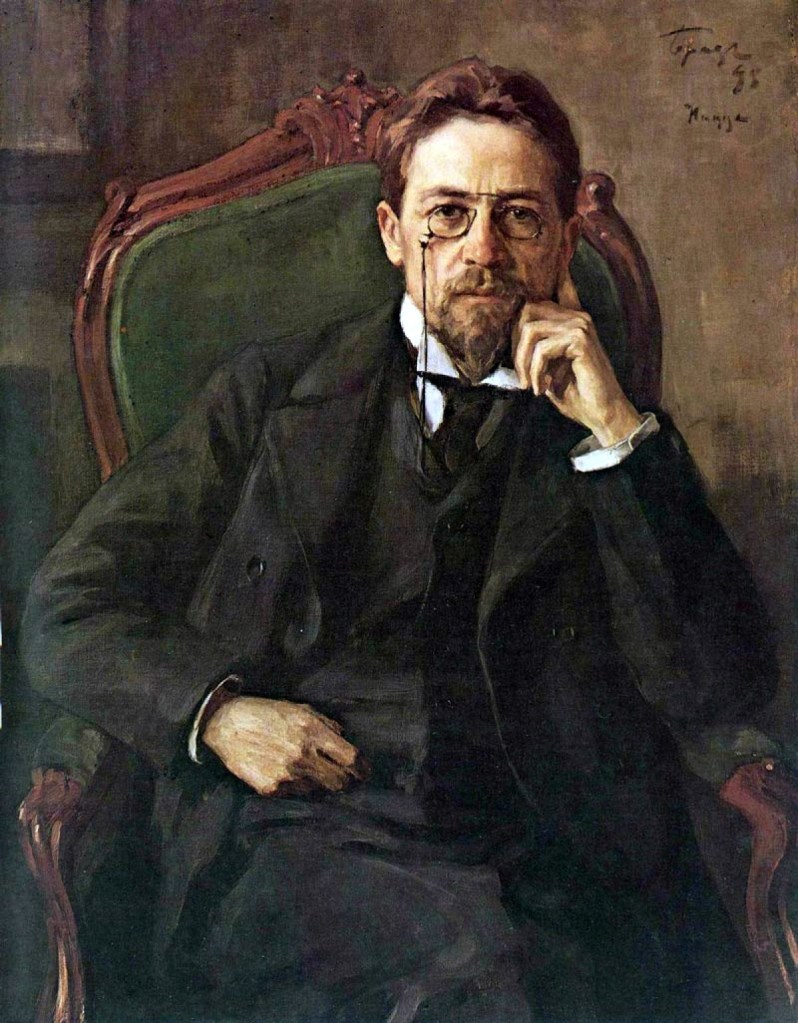
Anton Chekhov is considered the seminal force behind modern theater, penning two of the most honest accounts in the genre of Realism: The Cherry Orchard and The Three Sisters, both probing life’s basic desires and finding them an elusive force in his protagonists’ lives. The Cherry Orchard anticipates Hemingway’s “slowly, then suddenly”; the Ranevskaya‑Gaev family drifts toward ruin not through catastrophe but through inertia. Unable to adapt, the play is a tragedy of pathological unwillingness. In The Three Sisters siblings Masha, Irina, and Olga dreams fail to ignite any transformation, all talk of a better, brighter future but no action towards that new beginning. The sisters are caught up in eternal desire but no ability to reach for it.
Chekhov’s genius in both of these plays is to keep dreams of the future just out of reach leaving everyone frozen in their past. The true tragedy is not that the characters explode in catastrophe, but they just slowly fade away into their past. Life inexorably slipping from their grasp, like old photographs losing their color, the outlines of their lives fading into the bygone era that holds them fast.
Chekhov first developed his theatrical themes with the short story. All of which are partially autobiographical and truly analytical of the human condition and their dreams. He wrote to sustain himself, sometimes financially, but always psychologically as not so much a need but a release, stating, “Medicine is my lawful wife, and literature is my mistress: when I get fed up with one, I spend the night with the other.” After 17 plays and more than 500 stories one suspects that he never really got fed up with the latter, but his stories suggest that he did with the former, frequently.
To understand why Chekhov wrote the way he did; with such clarity about humiliation, inertia, and the erosion of possibility, one must understand the life that shaped him.
Anton Chekhov was born in 1860 in the small port town of Taganrog, the third child of a grocer whose piety was matched only by his cruelty. His childhood was marked by poverty, debt, and the constant threat of his father’s bankruptcy; with the family eventually fleeing to Moscow to escape creditors and debtor’s prison. Chekhov, then sixteen, was left behind to tidy up the business mess and finish school alone, tutoring younger students to pay for food and rent. This early apprenticeship in hardship shaped the clarity with which he later wrote about poverty, humiliation, want, and the quiet heroism of endurance. In his twenties, as a medical student supporting his entire family through magazine sketches, he contracted tuberculosis that would shadow him the rest of his life. Yet it was during this same period that he experienced his brief season of happiness: a deep, tentative love for Lika Mizinova, a friend of the family whose warmth and volatility left a lasting imprint on his stories. The relationship dissolved under the strain of his illness, his obligations, and his own emotional reticence, but its memory forever haunted him. By the time he achieved literary fame, the disease had already begun to hollow him out. His later years, split between Moscow and his beloved estate at Melikhovo, were a race between artistic maturity and physical decline, a life lived with the knowledge that time was running out.
That same sense of dwindling time permeates his fiction, where characters are trapped in systems; social, economic, bureaucratic, that grind them down long before death arrives. Yet he was never overtly polemical, nor was he didactic.
In the introduction to The Greatest Short Stories of Chekhov, translator Constance Garnett repeats the claim that Chekhov “held no fixed political or social views.” But the only way to reach that conclusion is never to have read him.
Chekhov writes of poverty with a doctor’s precision and a patient’s pain. His contempt for the idle rich is unmistakable. Serfs, bureaucrats, and petty tyrants appear again and again, not as caricatures but as symptoms of a society drifting toward moral exhaustion. His work is not overtly political because it refuses the cheap clarity of slogans. Instead, it offers something far more radical: an unflinching, cold account of a world in which people are crushed not by oppression but by inertia, habit, and the slow suffocation of possibility; the lack of imagination and drive. Critics mistook this subtlety for neutrality, his refusal to preach for a refusal to see what everyone else saw. But his stories are saturated with social vision, but rather than openly ideological he settles triumphantly for the diagnostic with surgical precision. This is Chekhov’s most devastating political insight.
Chekhov returns again and again to the question of human purpose, usually finding his characters unequal to the task of rising to higher ideals. In 1889, after losing his older brother Nikolay to tuberculosis at only thirty‑one, he wrote A Dreary Story, a novella that confronts the terror that death renders all human effort meaningless.
The narrator of the story; an aging, clinically depressed professor at the end of a brilliant medical career, examines his life and finds it hollow. He watches his family suffer and feels nothing. He listens to his closest friend and cannot understand his glee, his optimism. Speaking to his adopted daughter, Katya, he delivers a confession that is part lament, part self‑indictment:
“Something is happening to me that is only excusable in a slave… I am full of hatred, and contempt, and indignation, and loathing, and dread… What is the meaning of it?”
He calls these feelings shameful, but he is past shame. He is simply exhausted. When Katya finally leaves him, his last thought is not regret or memory, but a small, mournful stab of self‑pity: “Then, you won’t be at my funeral?”
Depression and the meaning of life enter again into one of my favorite and most psychologically penetrating Chekhov stories: Ward No. 6, a psych ward in a small provincial hospital; if it can even be called a psych ward, more like a containment room for lost causes. Most critics read Ward No. 6 as a parable of moral collapse, institutional cruelty, or the slow degeneration of a complacent doctor. But this interpretation misses the deeper, more unsettling truth Chekhov, as a practicing physician, was actually dramatizing: the plight of medicine at the close of the nineteenth century. The story is not about a man who loses his mental hold on reason. It is about a doctor who realizes, with devastating acuity, the futility of medicine as it was practiced in his world.
Chekhov knew this intimately. As a provincial doctor, he treated thousands of patients he could not cure, including his brother’s tuberculosis and eventually his own. He understood that much of medicine consists of gestures; reassurance, ritual, placebo, the performance of care in the absence of real efficacy. The doctor in Ward No. 6 comes to the same realization. He sees that the best he can offer is comfort, not cure; that his diagnoses change nothing; that his authority is largely symbolic. And once he sees this, he cannot unsee it. He turns inward, looking for an escape.
At one point he describes his dilemma to his after‑work companion: “You know of course…that everything in this world is insignificant and uninteresting except the higher spiritual manifestations of the human mind…Consequently the intellect is the only possible source of enjoyment.” But he finds none, not at home, not in the hospital, not in himself. Nowhere in his world.
This recognition does not make him immoral; it makes him despair. His inability to help the people who come to him, combined with the professional obligation to pretend otherwise, corrodes him from within. The depression that follows is not a personal flaw but the natural consequence of witnessing suffering he cannot alleviate. Chekhov understood this emotional collapse with painful precision.
In this state of disillusionment, the doctor finds an unexpected mirror in a patient in Ward No. 6. This man is not simply “mad”; he is the doctor’s alter ego: the part of him that refuses comforting illusions, the part that speaks honestly about pain, the part that sees the world without anesthetic. Their conversations are not the doctor’s descent into madness but his first encounter with truth. He is drawn to the patient because he recognizes himself.
But in Chekhov’s world the clarity of medicinal limits is dangerous. The doctor’s colleagues, committed to the rituals and hierarchies of their profession, interpret his honesty as emotional instability. His refusal to maintain the performance of medical omnipotence becomes, in their eyes, a symptom of disease. His attention to the mad patient; the only person who speaks to him without pretense, is labeled “unhealthy.” And so, the institution does what institutions do: it protects itself by diagnosing dissent as madness.
The tragedy of Ward No. 6 is not that the doctor goes insane. It is that the system cannot tolerate a doctor who stops keeping up with pretense. His final confinement is not a moral punishment but a professional one. He is destroyed not because he collapses, but because he stops pretending to have answers.
Seen against the backdrop of late‑nineteenth‑century medicine, Ward No. 6 becomes not merely a story about madness but a diagnosis of an entire profession. The doctor’s despair, his attraction to the patient who speaks without illusion, and his final misdiagnosis by his own colleagues all point to the same conclusion: the real sickness lies not in the individual but in the medical culture that cannot admit its own impotence. By ending the story with a stroke, a clinical event that was misdiagnosed as psychological collapse, Chekhov underscores that the tragedy was never moral degeneracy but the catastrophic failure of a profession unable to tell illusion from reality, or performance from truth. In this sense, Ward No. 6 is Chekhov’s most radical indictment: a recognition that when medicine cannot heal, it must at least see clearly, and that clarity itself may be the one thing the system lacks.
Chekhov only rarely lifts the veil of universal futility that hangs over his work, but when he does, he finds solace in the human need for connection. In The Lady with the Dog, love arrives unbidden, and once found, must be seized and held with the tenacity of a vow. Yet the most surprising Chekhovian uplift comes from The Student, an early story that stands against the pervasive loss of meaning and purpose in Chekhov’s world. Here a young seminarian suddenly senses that the past is not dead but vibrantly present; “an unbroken chain of events, one flowing out of another,” and that touching one end makes the other tremble. That the full arc of time and history provides “the inexpressible sweet expectation of happiness.”
In that moment Chekhov anticipates both Bergson and Proust: the endurance of duration, the trembling continuity of memory, the way a present emotion can awaken ancient sorrow. After the despair of A Dreary Story and the clinical futility of Ward No. 6, The Student offers Chekhov’s final insight: that meaning does not arise from certainty or cure, but from the continuity of human experience itself. Time endures. Memory binds. The chain of humanity holds. And for Chekhov, that is enough.
Graphic: Anton Chekhov by Osipp Braz. Oil on Canvas. 1898. Source: The Greatest Short Stories of Anton Chekhov, 2023.




 elsToday