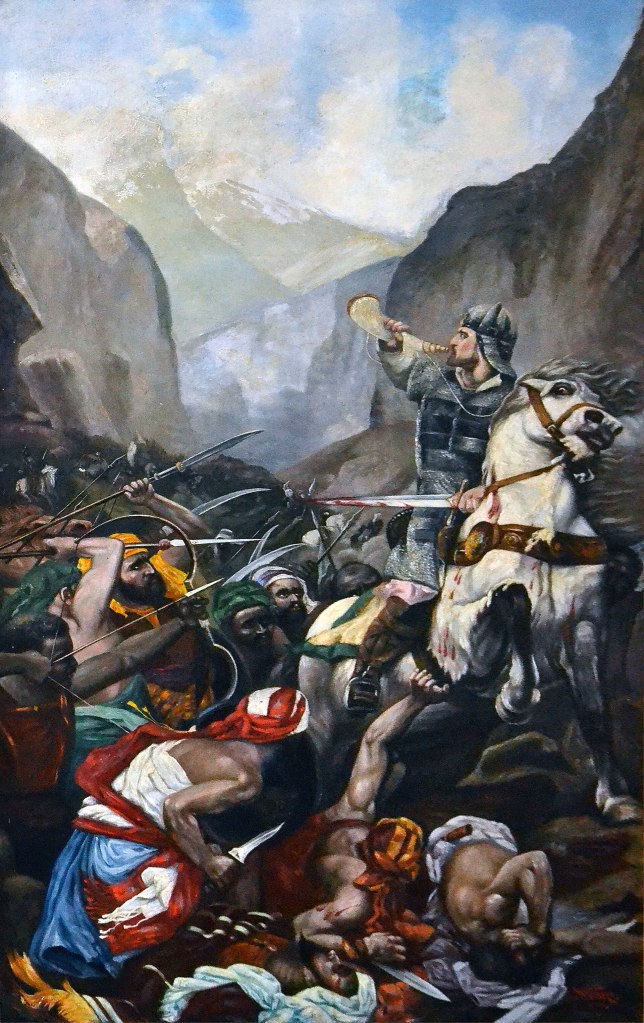
The Song of Roland, the actual point of this story, is a romantic Crusade‑era epic of courage and fortitude, but its origins lie along a long and winding road; a path the world has seen many times before, shaped not by heroism but by political confusion, shifting loyalties, and the hard realities of Muslim civil war in eighth‑century al‑Shām (greater Syria) and Spain.
In 661 AD, year 40 by the Islamic calendar, the Islamic world was ruled by the Umayyad dynasty from Damascus. After nearly a century in power, resentment from non‑Arab converts and continual internal corruption fueled an Abbasid revolutionary movement centered in Persia. In 750, the Abbasids defeated the Umayyad army at the Battle of the Zab in northern Iraq, marched into Damascus, and carried out one of the most violent and consequential political massacres in Islamic history: a systematic extermination of the Umayyad ruling family.
One young Umayyad prince, Abd al‑Rahman, escaped the purge. After a long flight across North Africa, he reached Spain and founded the Emirate of Córdoba. Through the 760s and 770s he consolidated his rule over Córdoba, Seville, Málaga, Granada, Jaén, Mérida, and Toledo. His authority in the south was real, but the northern Iberian Peninsula remained unstable.
The Peninsula was locked in a protracted and confusing Muslim civil war between Abd al‑Rahman and a cluster of rebellious but powerful northern governors in the Ebro Valley, centered around Zaragoza, Barcelona, and Girona. These governors had long traditions of autonomy and viewed Abd al‑Rahman’s centralizing reforms as a direct threat to their power. Frontier loyalties simmered and shifted constantly.
By 776–777, the northern elites realized they were losing ground. Abd al‑Rahman had crushed several uprisings and installed loyalists in key cities. The rebels needed a counterweight; a distant power strong enough to deter Córdoba but too far away to dominate them. They found their candidate in Charlemagne, king of the Franks.
Thus, at the winter assembly of 776–777 in Paderborn, in what is now northern Germany, Muslim envoys from Barcelona, Girona, and Zaragoza appeared before Charlemagne and offered submission, tribute, and the keys to their cities if he would intervene on their behalf. To Charlemagne, this looked like a rare strategic opportunity: a chance to extend Frankish influence into Spain without a full conquest, to secure the Pyrenean frontier, and to present himself as a protector of Christians; even though the rebels were Muslim. He believed the campaign would be quick: Zaragoza would open its gates, the northern cities would align with him, and a friendly buffer zone would emerge.
But the political map of 777 did not survive into 778.
When Charlemagne crossed the Pyrenees in the summer of 778 with roughly 20,000–30,000 fighting men, divided into two great columns, one of the largest assembled armies of his reign, he discovered that the civil war had neither remained as presented to him in the previous year nor had it resolved itself, but only shifted in its loyalties. The same factions existed, but their alliances had flipped. Most critically, al‑Husayn of Zaragoza, who had invited Charlemagne the year before, had reconciled with Abd al‑Rahman. Handing Zaragoza to the Franks now meant treason, loss of office, and retaliation from Córdoba. So, when Charlemagne arrived, Zaragoza refused to open its gates.
Other northern rebels remained hostile to Córdoba and even accompanied the Frankish army. But the coalition was fractured, Abd al‑Rahman’s position had strengthened, and Charlemagne’s intelligence was outdated. He had come expecting a diplomatic handover, not a siege, and he had brought no siege equipment nor an expectation of large casualties.
Frustrated, Charlemagne withdrew northward. On his way out, he destroyed the walls of Pamplona, a Christian Basque city whose loyalties were equally tangled in frontier politics. Why Charlemagne did this is subject to much conjecture. It may have been that the Basques of Pamplona resisted Frankish authority and failed to support his Spanish campaign and he set to destroy the city as punishment. Or maybe it was he just needed a trophy for coming to Spain. Whatever the reason, this act of punitive demolition provoked a swift and devastating response. On 15 August 778, as the Frankish column wound through the high passes of the western Pyrenees, Basque fighters ambushed the rearguard at Roncevaux, thought to have been comprised of 2000-3000 men. The attack was local, precise, and motivated by revenge; not by treachery, not by Saracens, not for any strategic advantage, and certainly not by any grand religious reasoning. The Basque rout at Roncevaux was a small skirmish in scale but deadly in execution: a perfect mountain ambush that totally annihilated Charlemagne’s rear guard and left Hruodlandus, aka Roland, prefect of the Breton March, dead on the field.
For two centuries, these events remained a footnote in Carolingian history. Only later would poets transform this small frontier skirmish into the epic clash of civilizations remembered in literature as The Song of Roland.
Between roughly 1040 and 1115, poets reshaped this obscure Charlemagne defeat into a 4000-line epic: La Chanson de Roland, the first great chanson de geste or song of heroic deeds; the oldest surviving major work of French literature. It exists in various manuscript versions, which testify to its enormous and enduring popularity in Medieval and Renaissance literature from the 12th to the 16th centuries.
The world of this poem is not Charlemagne’s but that of the First Crusade. Europe, at the time, was steeped in martial piety, exhausted from centuries of loses to Islamic battles, and hungry for heroic narratives that stiffened spines and sanctified warfare.
The Basques became Saracens; the ambush became an existential battle; and the competent but anonymous frontier officer became the greatest knight of Christendom. The poet introduced Ganelon, Roland’s treacherous stepfather: a purely literary invention inspired by Wenilo, Archbishop of Sens, whose betrayal of Charles the Bald in 858 has been remembered as a notorious but forgivable act of treachery. Ganelon’s presence in this epic gave the story a moral architecture: loyalty was sacred, betrayal was damnable, and death in battle as martyrdom.
Written in the age of the First Crusade, The Song of Roland functioned as a cultural acceptation; a proto‑psychological operation in the medieval sense of influencing the narrative. It was performed aloud by jongleurs before nobles and soldiers, shaping morale, morals, and belief; providing strength before the upcoming battle.
To grasp how Roland as a knight lived, one must imagine the Crusader host as a moving medieval city, which it certainly was. Alongside knights marched wives, children, servants, cooks, smiths, merchants, priests, prostitutes, beggars, and entertainers. Jongleurs and minstrels were professionals, paid in coin, food, and or protection. They sang heroic epics, shared and spread the news, entertained the masses, and sustained morale.
A typical day for the Crusading mass began before dawn: fires were rekindled, tents struck, wagons slowly began to creak forward. Foraging parties scoured the countryside, and when supplies ran low, commanders sanctioned plunder. Merchants sold bread and wine at inflated prices. At dusk, musicians performed, chanting epics like The Song of Roland to remind weary soldiers that their suffering had divine meaning and eventual rewards.
In traveling and siege camps, disease and hunger were constant, yet the performers remained vital. They turned defeats and stalemates into martyrdoms, victories into proof of divine favor, and rumors into rallying cry for continued vigilance. In a world without newspapers or mass communication, the performer was the medium: the voice of not only fact but ideology.
As the Crusading armies marched towards the Holy Land, they were sustained by stripping the land and villages of necessities to sustain their travels. Sometimes by honest barter or payment in coin but mostly by looting. Their vast retinues; sometimes in the tens of thousands of noncombatants, depended on this economy for survival. Looting was not a supplement to their survival but a basic need and the main monetary incentive for the knights. The accumulated loot of money, livestock, grain, clothing, and slaves circulated throughout the camp. And entertainers survived and sometimes thrived in this system, rewarded by nobles and soldiers alike for songs that glorified conquest and sanctified endurance.
Thus, The Song of Roland was not merely art and entertainment. It was part of the apparatus and psychology of war. The need for myth to instill the courage to endure the hardships of the campaign.
Formally, Roland is written in Old French decasyllables: ten syllables per line with a strong caesura or pause after the fourth syllable. The poem is organized into laisses, irregular stanzas bound by assonance, repeated vowel sounds, rather than rhyme. This meter was engineered for oral delivery: rhythmic or chant like, memorable, and flexible enough for performance amid the noise of camp life.
The Song of Roland uses numerous repeated laisses that function like refrains, emotional anchors that heighten tension and aid memory. These repetitions are not a literary embellishment but rather a performance skill, akin to the chorus of a modern song. They allowed jongleurs to emphasize key moments and helped audiences participate emotionally in the unfolding drama. Although no direct evidence survives for vocal audience participation, the refrain‑like structure almost certainly encouraged audible, communal responses at predictable points in the performance.
The historical Roland died in a forgotten mountain pass. The literary Roland lives as the embodiment of loyalty, faith, and heroic death. The poem that bears his name is not history but a psychological tale of courage. A Crusade‑era vision of how men should fight, die, and what they should believe.
In the end, The Song of Roland is less about Charlemagne’s Spain than about Europe’s soul: how myth can redeem failure, how art can sanctify violence, and how a single ambush became the anthem of a civilization.
Centuries later, the medieval Roland echoed through folklore and literature. From the 13th through the 16th century, English Arthurian oral tradition recast him as Childe Rowland, a young knight who ventures into a perilous, enchanted realm to rescue his sister from a dark tower. In the early 17th century, Shakespeare drops a fragment of that myth into King Lear: “Childe Rowland to the dark tower came”, a line that signals the play’s descent into an epitome of madness and nightmare.
In 1855, Robert Browning seized on Shakespeare’s phrase and expanded it into a full quest of existential dread in Childe Roland to the Dark Tower Came, transforming the folkloric knight into a solitary wanderer in a blasted psychological landscape. From there the Roland arc marches forward. Stephen King’s Dark Tower series takes its inspiration from Browning’s poem, recasting Roland as a gunslinger on a doomed, metaphysical quest.
The medieval epic thus became the deep ancestor of modern mythmaking. A story born from a minor, forgotten skirmish, transformed into ideology and legend, and perpetuated through art. It is one of the most remarkable literary genealogies in Western literature: a single line of verse, “Childe Rowland to the dark tower came,” mutating and reappearing across a millennium. And to give modern pop culture its own whimsical participation trophy, we might end with Warren Zevon’s contribution: “Roland the Headless Thompson Gunner.”
Graphic: Painting by Wolf von Bibra (1862 – 1922) of Battle of Roncevaux Pass from The Song of Roland based on print either by Adolf Georg Closs (1840-1894) or Gustav Adolf Carl Closs (1864-1938). Painting is based on an etching by Louis Felix Guesnet (1843-1907). Photograph of painting taken by Carl von Bibra. Wikipedia Creative Commons.
 elsToday