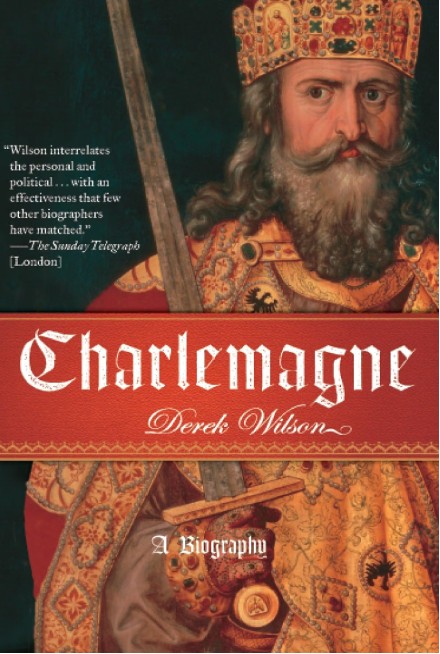
Derek Wilson’s Charlemagne is a curious book. It is really two books joined by the author’s hope that a purpose he never explicitly states but implicitly imagines will somehow unite the parts thematically; more on that shortly.
The first half is a sparse, almost frugal biography of an emperor on a mission. A mission to spread and reinforce Christianity: Catholicism; a mission to bring to heel the disparate polities of the European mainland; a mission to respect local customs while imposing a common legal and administrative structure. All of this required constant war, diplomatic maneuvering, and court intrigue to keep the continent’s many fiefdoms off balance and unable to mount a coordinated resistance. It is the story of a competent, charismatic leader who, through sheer willpower, fused a fragmented Europe into a congealed, if chaotic and complicated whole.
Then, somewhere around the midpoint, the book undergoes a jarring metamorphosis. The biography dissolves, and Wilson begins speaking not about Charlemagne but about post-Charlemagne Europe itself: its failures, its divisions, its wars, its chronic inability to remain whole. By the end, the book has become less a study of an exceptional man than a lament for a disheveled and unruly continent. Wilson tries to justify this extended romp from the ninth century to the present by occasionally tying Louis XIV, Napoleon, Bismarck, and others back to Charlemagne with ad hoc references, but the connections never really hold. What emerges instead is an endless cycle of personalities and war.
From Charlemagne and the Saxon Wars, through Otto I, the Norman Conquests, and the Crusades of Richard the Lionheart, Philip II, and Saladin, Europe rolled into the Hundred Years’ War with Edward III, Henry V, and Joan of Arc, followed by the Hussite Wars and the rise of the Ottomans. The early modern world brought Martin Luther, Charles V, Philip II, the Eighty Years’ War, and the cataclysmic Thirty Years’ War with Gustavus Adolphus and Wallenstein, alongside Louis XIV’s wars and the English Civil War. The 18th century marched through the War of Spanish Succession, Austrian Succession, and Seven Years’ War, shaped by Frederick the Great, Maria Theresa, and Catherine the Great, before the French Revolution unleashed Napoleon, the Coalition Wars, and the fall of the Holy Roman Empire. The 19th century followed with Metternich, Bismarck, Garibaldi, and Napoleon III, amid the Crimean War, Austro‑Prussian War, Franco‑Prussian War, and the Balkan Wars. The 20th century erupted with World War I under Wilhelm II, Franz Ferdinand, and Lenin, then World War II with Hitler, Stalin, Churchill, Roosevelt, and De Gaulle, followed by the Cold War, Greek Civil War, and Yugoslav Wars under figures like Tito and Gorbachev. The 21st century carried Europe into the Russo‑Georgian War, the Crimean crisis, and the ongoing Russo‑Ukrainian War, dominated by Putin, Zelenskyy, and the collective leadership of NATO and the EU, bringing the continent’s long arc of conflict from Charlemagne’s empire to the geopolitics of 2026. (With heartfelt apologies to Billy Joel and We Didn’t Start the Fire—but the fire never does go out; occasionally smoldering, but never out.)
Wilson heroically tries to connect all this to Charlemagne, but Europe’s never‑ending conflicts are far larger in scope than anything that can be laid at the feet of the medieval “Father of Europe.” And to be fair, Wilson does not explicitly claim that Charlemagne is somehow related to or causative of Europe’s later turmoil. But he does insist that it all rhymes, and that insistence, rather than any articulated evidence, ultimately drives the second half of the book.
What is striking is not that Wilson cares about European unity, but that he never asks the simplest question his own narrative demands. Charlemagne’s empire did not endure. It did not slowly fade, nor did it evolve into something recognizably European. It collapsed almost immediately upon his death. The Treaty of Verdun, signed less than thirty years later, shattered his achievement into three pieces that would become France, Germany, and the Low Countries. The unity Wilson mourns was never structural or natural. It was personal.
And this is a deeper truth Wilson never touches but should have. Charlemagne’s empire was not held together by institutions, laws, or shared identity. It was held together by Charlemagne. His personality: relentless, martial, commanding, and utterly convinced of his own mission, was the glue that bound dozens of cultures, languages, and belief systems into a single political organism. And that glue existed only as long as he did.
Charlemagne ruled through war. Not occasionally, not reluctantly, but continuously. His reign was a forty‑six‑year military campaign. Every year he rode out to fight Saxons, Lombards, Avars, Bretons, Slavs, or Moors. Every year he reminded his subjects that unity would be maintained through the sword. Charlemagne’s empire was not a nation; it was his fiefdom. Its cohesion was not cultural; it was maintained by the force of his arms and personality.
This is why the empire died with him. The moment the personality vanished, the centrifugal forces he had suppressed reasserted themselves. The Saxons remembered they were Saxons. The Aquitanians remembered they were Aquitanians. The Bavarians remembered they were Bavarians. The Franks themselves remembered they were not one people but many. Charlemagne had forced Europe into a single shape, but the shape depended entirely on his hand. When the hand was gone, the shape dissolved.
And this is not unique to Charlemagne. It is the fate of every empire built by a singular, overwhelming personality. Alexander held together Greeks, Persians, Egyptians, and dozens of subject peoples through sheer charisma and military brilliance. When he died, his generals tore the world apart. Genghis Khan unified the steppe through terror, genius, and personal authority; his sons inherited territory, not loyalty. Napoleon imposed a continental system through force, reform, and personal magnetism; once he fell, Europe snapped back to its natural divisions. These empires did not die because their successors were incompetent. They died because their founders were irreplaceable. Those few who managed to maintain their empires: Lenin and Stalin, did so through terror, and even those structures eventually collapsed.
This loss of empire, loss of a truly united, pacified Europe, is a subject Wilson never confronts. He wants Europe to be one. He wants unity to be natural. He wants fragmentation to be pathological. And so, he reaches for the easiest villain available: nationalism. He treats nationalism as though it were a kind of moral contagion: irrational, destructive, hideous, without ever asking what nationalism actually is or why it exists.
But nationalism is not a pathology. Nationalism is the cultural substrate that makes political order possible. It is the shared language, shared memory, shared symbols, shared values, and shared experience that allow millions of people to imagine themselves as a people rather than a population. Without nationalism, there is no glue to hold anything together. Without nationalism, a “United States of Europe” is not a dream deferred; it is a dream impossible.
This is why the European Union became what it is: a vast bureaucracy and a managerial class holding together mounting societal cross‑currents without a shared experience. A market without a nation. A union without unity. A structure that cannot command loyalty because it never created it. A system that cannot inspire devotion because it never articulated what it was supposed to be. A project that imported every language and every culture without ever forging a common one.
Wilson’s frustration becomes more intelligible once you recognize what he wanted Europe to become. He is, unmistakably, a believer in the old dream of a United States of Europe: a continent bound together not by conquest but by shared purpose, shared institutions, and shared destiny. In the aftermath of the Second World War, that dream seemed almost within reach. The European Coal and Steel Community, the Treaty of Rome, and the early Common Market appeared to be the first cautious steps toward a new political organism, one that might finally escape the cycle of war and fragmentation that had defined Europe since Charlemagne’s death.
But the Europe Wilson hoped for never materialized. What emerged instead was technocracy. What emerged was administration. What emerged was a regulatory machine attempting to do what armies, churches, and charismatic rulers once did: hold Europe together. But systems cannot replace culture. Bureaucracy cannot replace identity. Markets cannot replace shared memory.
Charlemagne tried to unify Europe through religion. Napoleon tried through ideology. Hitler, monstrously, tried through racial mythology. Each failed for the same reason: the unity was never structural. It was personal. It was coercive. It was temporary. Europe has only ever been unified by a person: never by a system.
And this leads to the questions Wilson never asks, the questions his own narrative demands. How or why are empires built? How or why are empires lost? How or why are wars started?
How or why empires are won and lost was answered above. Throughout history empires were forged in the fires of an individual’s will to do so. But Wilson never really addresses this question. Charlemagne built an empire of disparate parts. Parts with different cultures and language. Parts with different experiences. It was destined to fall apart the second he no longer put his entire purpose in life behind his vision of a unified Europe.
The question of why wars are started he never explores. Just an ad hoc statement that the Franco-Prussian War was about “the hideous power of nationalism but they [France and Germany] tore open all the old half-healed wounds between the two parts of Charlemagne’s ancient empire.” Wilson slips this statement in and treats it as self-evident with no explanatory text needed. This statement though is just wrong on so many levels. The Franco-Prussian was all about leadership failures. Failure to understand Frances’s weaknesses militarily and politically. One that failed to understand the strength of Prussia’s armies and their leadership. Nowhere was the war about nationalism. Germany wanted a unified state, yes but they needed a unifying purpose to do so. France played right into Wilhelm’s and Bismarck’s hand.
The half-healed wounds of Charlemagne’s empire expired 1000 years previously. Wishful thinking is not the job of a historian. The wounds of Charlemagne’s Empire were still there because the empire was never united around culture, language, and shared experience, just held together by brute force of a strong man with a strong army. Wilson’s mistake is believing that Europe’s unity was ever structural; when the truth is that it was always personal, and therefore always temporary. The EU today is politically fragmented and culturally thin.
The EU is Europe’s first attempt at unity without personality, without coercion, and without culture: and history suggests that such unity cannot endure unless external pressure forces it to.