Time and Roland

The Song of Roland, the actual point of this story, is a romantic Crusade‑era epic of courage and fortitude, but its origins lie along a long and winding road; a path the world has seen many times before, shaped not by heroism but by political confusion, shifting loyalties, and the hard realities of Muslim civil war in eighth‑century al‑Shām (greater Syria) and Spain.

In 661 AD, year 40 by the Islamic calendar, the Islamic world was ruled by the Umayyad dynasty from Damascus. After nearly a century in power, resentment from non‑Arab converts and continual internal corruption fueled an Abbasid revolutionary movement centered in Persia. In 750, the Abbasids defeated the Umayyad army at the Battle of the Zab in northern Iraq, marched into Damascus, and carried out one of the most violent and consequential political massacres in Islamic history: a systematic extermination of the Umayyad ruling family.

One young Umayyad prince, Abd al‑Rahman, escaped the purge. After a long flight across North Africa, he reached Spain and founded the Emirate of Córdoba. Through the 760s and 770s he consolidated his rule over Córdoba, Seville, Málaga, Granada, Jaén, Mérida, and Toledo. His authority in the south was real, but the northern Iberian Peninsula remained unstable.

The Peninsula was locked in a protracted and confusing Muslim civil war between Abd al‑Rahman and a cluster of rebellious but powerful northern governors in the Ebro Valley, centered around Zaragoza, Barcelona, and Girona. These governors had long traditions of autonomy and viewed Abd al‑Rahman’s centralizing reforms as a direct threat to their power. Frontier loyalties simmered and shifted constantly.

By 776–777, the northern elites realized they were losing ground. Abd al‑Rahman had crushed several uprisings and installed loyalists in key cities. The rebels needed a counterweight; a distant power strong enough to deter Córdoba but too far away to dominate them. They found their candidate in Charlemagne, king of the Franks.

Thus, at the winter assembly of 776–777 in Paderborn, in what is now northern Germany, Muslim envoys from Barcelona, Girona, and Zaragoza appeared before Charlemagne and offered submission, tribute, and the keys to their cities if he would intervene on their behalf. To Charlemagne, this looked like a rare strategic opportunity: a chance to extend Frankish influence into Spain without a full conquest, to secure the Pyrenean frontier, and to present himself as a protector of Christians; even though the rebels were Muslim. He believed the campaign would be quick: Zaragoza would open its gates, the northern cities would align with him, and a friendly buffer zone would emerge.

But the political map of 777 did not survive into 778.

When Charlemagne crossed the Pyrenees in the summer of 778 with roughly 20,000–30,000 fighting men, divided into two great columns, one of the largest assembled armies of his reign, he discovered that the civil war had neither remained as presented to him in the previous year nor had it resolved itself, but only shifted in its loyalties. The same factions existed, but their alliances had flipped. Most critically, al‑Husayn of Zaragoza, who had invited Charlemagne the year before, had reconciled with Abd al‑Rahman. Handing Zaragoza to the Franks now meant treason, loss of office, and retaliation from Córdoba. So, when Charlemagne arrived, Zaragoza refused to open its gates.

Other northern rebels remained hostile to Córdoba and even accompanied the Frankish army. But the coalition was fractured, Abd al‑Rahman’s position had strengthened, and Charlemagne’s intelligence was outdated. He had come expecting a diplomatic handover, not a siege, and he had brought no siege equipment nor an expectation of large casualties.

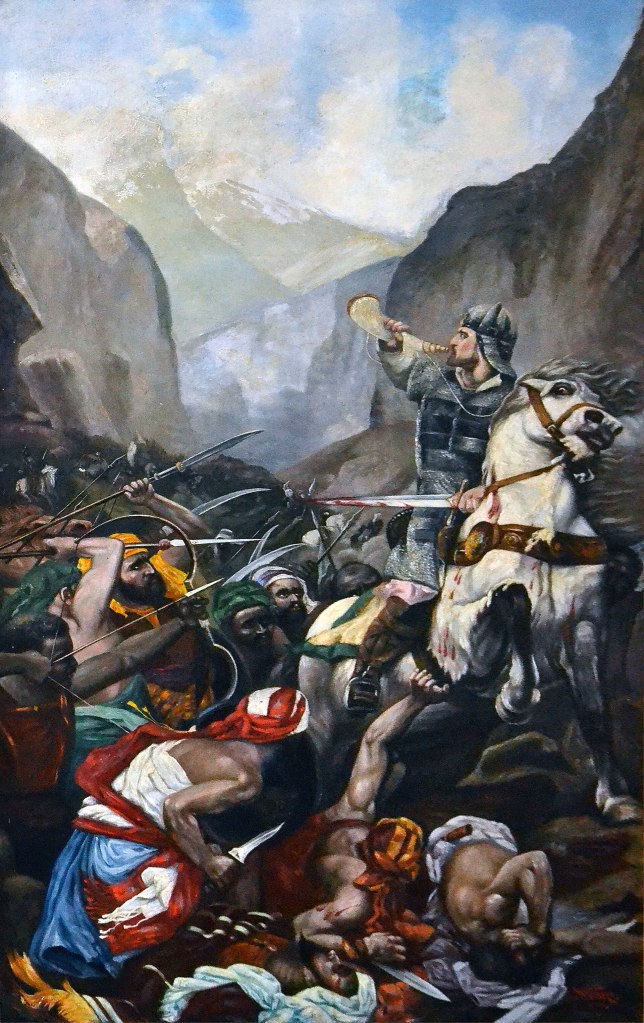
Frustrated, Charlemagne withdrew northward. On his way out, he destroyed the walls of Pamplona, a Christian Basque city whose loyalties were equally tangled in frontier politics. Why Charlemagne did this is subject to much conjecture. It may have been that the Basques of Pamplona resisted Frankish authority and failed to support his Spanish campaign and he set to destroy the city as punishment. Or maybe it was he just needed a trophy for coming to Spain. Whatever the reason, this act of punitive demolition provoked a swift and devastating response. On 15 August 778, as the Frankish column wound through the high passes of the western Pyrenees, Basque fighters ambushed the rearguard at Roncevaux, thought to have been comprised of 2000-3000 men. The attack was local, precise, and motivated by revenge; not by treachery, not by Saracens, not for any strategic advantage, and certainly not by any grand religious reasoning. The Basque rout at Roncevaux was a small skirmish in scale but deadly in execution: a perfect mountain ambush that totally annihilated Charlemagne’s rear guard and left Hruodlandus, aka Roland, prefect of the Breton March, dead on the field.

For two centuries, these events remained a footnote in Carolingian history. Only later would poets transform this small frontier skirmish into the epic clash of civilizations remembered in literature as The Song of Roland.

Between roughly 1040 and 1115, poets reshaped this obscure Charlemagne defeat into a 4000-line epic: La Chanson de Roland, the first great chanson de geste or song of heroic deeds; the oldest surviving major work of French literature. It exists in various manuscript versions, which testify to its enormous and enduring popularity in Medieval and Renaissance literature from the 12th to the 16th centuries.

The world of this poem is not Charlemagne’s but that of the First Crusade. Europe, at the time, was steeped in martial piety, exhausted from centuries of loses to Islamic battles, and hungry for heroic narratives that stiffened spines and sanctified warfare.

The Basques became Saracens; the ambush became an existential battle; and the competent but anonymous frontier officer became the greatest knight of Christendom. The poet introduced Ganelon, Roland’s treacherous stepfather: a purely literary invention inspired by Wenilo, Archbishop of Sens, whose betrayal of Charles the Bald in 858 has been remembered as a notorious but forgivable act of treachery. Ganelon’s presence in this epic gave the story a moral architecture: loyalty was sacred, betrayal was damnable, and death in battle as martyrdom.

Written in the age of the First Crusade, The Song of Roland functioned as a cultural acceptation; a proto‑psychological operation in the medieval sense of influencing the narrative. It was performed aloud by jongleurs before nobles and soldiers, shaping morale, morals, and belief; providing strength before the upcoming battle.

To grasp how Roland as a knight lived, one must imagine the Crusader host as a moving medieval city, which it certainly was. Alongside knights marched wives, children, servants, cooks, smiths, merchants, priests, prostitutes, beggars, and entertainers. Jongleurs and minstrels were professionals, paid in coin, food, and or protection. They sang heroic epics, shared and spread the news, entertained the masses, and sustained morale.

A typical day for the Crusading mass began before dawn: fires were rekindled, tents struck, wagons slowly began to creak forward. Foraging parties scoured the countryside, and when supplies ran low, commanders sanctioned plunder. Merchants sold bread and wine at inflated prices. At dusk, musicians performed, chanting epics like The Song of Roland to remind weary soldiers that their suffering had divine meaning and eventual rewards.

In traveling and siege camps, disease and hunger were constant, yet the performers remained vital. They turned defeats and stalemates into martyrdoms, victories into proof of divine favor, and rumors into rallying cry for continued vigilance. In a world without newspapers or mass communication, the performer was the medium: the voice of not only fact but ideology.

As the Crusading armies marched towards the Holy Land, they were sustained by stripping the land and villages of necessities to sustain their travels. Sometimes by honest barter or payment in coin but mostly by looting. Their vast retinues; sometimes in the tens of thousands of noncombatants, depended on this economy for survival. Looting was not a supplement to their survival but a basic need and the main monetary incentive for the knights. The accumulated loot of money, livestock, grain, clothing, and slaves circulated throughout the camp. And entertainers survived and sometimes thrived in this system, rewarded by nobles and soldiers alike for songs that glorified conquest and sanctified endurance.

Thus, The Song of Roland was not merely art and entertainment. It was part of the apparatus and psychology of war. The need for myth to instill the courage to endure the hardships of the campaign.

Formally, Roland is written in Old French decasyllables: ten syllables per line with a strong caesura or pause after the fourth syllable. The poem is organized into laisses, irregular stanzas bound by assonance, repeated vowel sounds, rather than rhyme. This meter was engineered for oral delivery: rhythmic or chant like, memorable, and flexible enough for performance amid the noise of camp life.

The Song of Roland uses numerous repeated laisses that function like refrains, emotional anchors that heighten tension and aid memory. These repetitions are not a literary embellishment but rather a performance skill, akin to the chorus of a modern song. They allowed jongleurs to emphasize key moments and helped audiences participate emotionally in the unfolding drama. Although no direct evidence survives for vocal audience participation, the refrain‑like structure almost certainly encouraged audible, communal responses at predictable points in the performance.

The historical Roland died in a forgotten mountain pass. The literary Roland lives as the embodiment of loyalty, faith, and heroic death. The poem that bears his name is not history but a psychological tale of courage. A Crusade‑era vision of how men should fight, die, and what they should believe.

In the end, The Song of Roland is less about Charlemagne’s Spain than about Europe’s soul: how myth can redeem failure, how art can sanctify violence, and how a single ambush became the anthem of a civilization.

Centuries later, the medieval Roland echoed through folklore and literature. From the 13th through the 16th century, English Arthurian oral tradition recast him as Childe Rowland, a young knight who ventures into a perilous, enchanted realm to rescue his sister from a dark tower. In the early 17th century, Shakespeare drops a fragment of that myth into King Lear: “Childe Rowland to the dark tower came”, a line that signals the play’s descent into an epitome of madness and nightmare.

In 1855, Robert Browning seized on Shakespeare’s phrase and expanded it into a full quest of existential dread in Childe Roland to the Dark Tower Came, transforming the folkloric knight into a solitary wanderer in a blasted psychological landscape. From there the Roland arc marches forward. Stephen King’s Dark Tower series takes its inspiration from Browning’s poem, recasting Roland as a gunslinger on a doomed, metaphysical quest.

The medieval epic thus became the deep ancestor of modern mythmaking. A story born from a minor, forgotten skirmish, transformed into ideology and legend, and perpetuated through art. It is one of the most remarkable literary genealogies in Western literature: a single line of verse, “Childe Rowland to the dark tower came,” mutating and reappearing across a millennium. And to give modern pop culture its own whimsical participation trophy, we might end with Warren Zevon’s contribution: “Roland the Headless Thompson Gunner.”

Graphic: Painting by Wolf von Bibra (1862 – 1922) of Battle of Roncevaux Pass from The Song of Roland based on print either by Adolf Georg Closs (1840-1894) or Gustav Adolf Carl Closs (1864-1938). Painting is based on an etching by Louis Felix Guesnet (1843-1907). Photograph of painting taken by Carl von Bibra. Wikipedia Creative Commons.

Poliziano Rosso di Montepulciano 2023

Sangiovese from Montepulciano, Tuscany, Italy

Sangiovese 80%, Merlot 20%

Purchase Price $18.99

Vinous 90, Cellar Tracker 88, ElsBob 89

ABV: 14%

 A ruby red, clear wine with vibrant tastes of red fruits. A acidic medium finish that smooths out the tannins. This is meant to be a young wine so don’t overdo it with meal prep. It will go fine with spaghetti in a marinara sauce.

A very good fine wine slightly overpriced at $20. Buy it if you can find it under $14. Current prices range from $14-16. This wine needs to breathe. The first sip from a just open bottle will be rough. Give it 30 minutes.

Trivia: The village of Gracciano, Italy, near the Poliziano vineyard, sits in a Tuscan landscape where everything has happened but nothing that will ever make it to Jeopardy. But it does lie heavily at the crossroads of Etruscan, Roman, medieval, and Renaissance history. Not a place of singular world‑shaping events, but of continuous layers of civilizations that march through and over the land that helped shape the modern world.

From 700 to 100 BC, the entire Montepulciano–Gracciano ridge was Etruscan territory, and they were already cultivating grapes. God bless ‘em. Beyond that, very little was known: their language vanished, their tombs were looted, and Rome’s shadow seemed to erase them…until last year.

In 2025, archaeologists from Baylor University uncovered a sealed Etruscan chamber tomb at San Giuliano, northwest of Rome. Dating to roughly 2,600 years ago, the 7th century BC, it is one of the most significant Etruscan finds in decades. Inside were four individuals laid on carved stone beds, surrounded by more than 100 grave goods: iron weapons, bronze ornaments, ceramic vessels, and delicate silver hair spools, all in their original placement.

This tomb, along with two others discovered recently, is giving researchers an unprecedented chance to illuminate the civilization’s inner life: family structure, gender roles, trade networks, ritual practices, and social hierarchy.

The emerging picture suggests a culture older and more urbanized than early Rome. A society whose religion, architecture, and political symbolism Rome borrowed heavily. Etruscan elites were likely not destroyed but absorbed into the expanding Roman world.

Power Corrupts

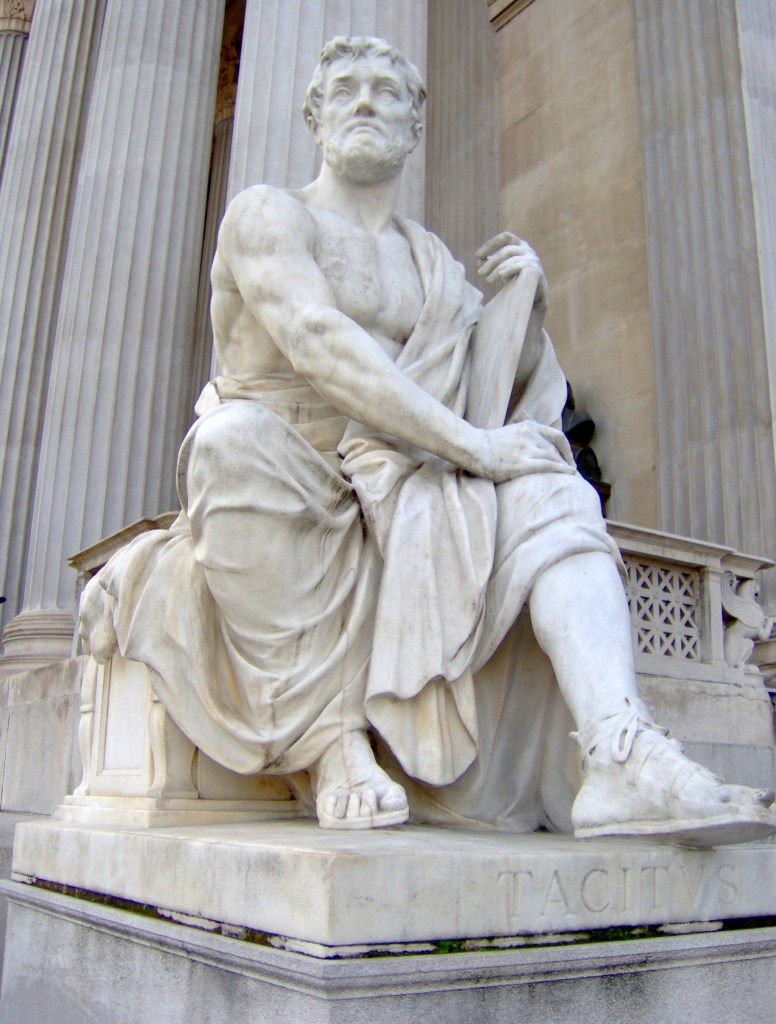
Publius Cornelius Tacitus (c. 56–120 AD), Roman historian, orator, and statesman, was born into a wealthy equestrian family and rose through the imperial system during the Flavian dynasty (Emperors Vespasian, Titus, and Domitian). He began his public career under Vespasian, receiving the latus clavus that marked him for the senatorial track, and entered the Senate itself as quaestor under Titus. His advancement continued under Domitian, whose autocratic rule left a deep imprint on his political philosophy and the cynical tone of his future writings. Tacitus became praetor in 88, suffect consul in 97 under Nerva, and ultimately proconsul of Asia in 112–113 under Trajan; one of the most prestigious governorships available to a senator.

Tacitus’s praenomen has long been debated. Sidonius Apollinaris calls him Gaius, but the principal manuscript tradition gives Publius, now the generally accepted form. The name itself was common in the Republic and famously borne by Publius Valerius Publicola, one of Rome’s early founders. When Hamilton, Madison, and Jay adopted “Publius” as their shared pseudonym for the Federalist Papers, they invoked that republican lineage. The choice was not meant to evoke Tacitus directly, yet the intellectual affinity is unmistakable: the founders read Tacitus closely, admired his moral rigor, and shared his preoccupation with how republics decay into autocracy. Tacitus lays bare the psychology of power and the corrosion of institutions, the hard, universal truth that power corrupts. The Federalist authors attempted to design constitutional structures resistant to precisely those dangers.

Understanding Tacitus’s background clarifies why these themes resonated so strongly. The equestrian order into which he was born had evolved far from its early republican role as a cavalry class. By the first century it had become, in the Roman class hierarchy, a wealthy administrative elite just below the Senate, supplying imperial procurators, financial officers, and provincial administrators; the managerial backbone of the empire. His family’s standing enabled him to enter the cursus honorum under the Flavians: Vespasian (69–79), Titus (79–81), and Domitian (81–96). As a young man he moved from the preparatory rank of the latus clavus into the Senate proper as quaestor, then advanced through praetorship, priesthood, and consulship before receiving the proconsulship of Asia.

Tacitus’s entire political formation occurred under the tutelage of emperors, but it was the republican aristocracy of old that he idealized. He rose because of the imperial system and later turned cynical because of its corrupt morality. The bitterness, irony, and forensic detail of his Histories and Annals emerge from those hard lessons learned at the feet of emperors and from years spent inside the senatorial class.

Your first encounter with Tacitus’s writings is usually one of frustration bordering on bewilderment. Context is sparse, dates are assumed, and linear narrative is treated as optional. To understand him, you must stop reading him as a dry; and his Annals can be dry, dispassionate chronicler of the recent past and start seeing him as a man writing under the weight of hard lessons learned, and sometimes personally endured. His Annals and Histories are not balanced accounts of the early empire; they are the literary equivalent of a post‑mortem. He writes as someone convinced that Rome’s better days were behind it. Everything in his style follows from that conviction: the selective focus, the moral compression, the absence of counterarguments, the uneven chronology, the disproportionate attention to monstrous emperors, and the silence around Rome’s achievements. Like many modern historians, he is heavy on interpretation and opinion, weighted toward failures and abuses, and nearly silent on the empire’s prosperity, engineering feats, or legal innovations such as due process and justice.

Tacitus’s narrative imbalance is not an accident; it is his purpose. In Annals he states, “I write without anger or partiality, for these are feelings I have long put aside… My purpose is to relate… without either bitterness or servility.” He writes for a narrow audience: senators of his own generation, who already knew the timeline, the emperors, the scandals, and the public record. They did not need dates or context; they needed a non‑imperial interpretation. They needed someone to explain how a state that once prided itself on civic virtue and shared governance had become a place where fear, flattery, and corruption were the normal conditions of political life. Tacitus assumes his readers know the “what.” He believed his task was to show them the “why.” That is why the Annals sometimes feel like diary fragments in their immediacy: Tacitus is relying on the imperially sanctioned record while quietly correcting it, without exposing himself to the charge of attacking the regime’s memory. The Histories, written earlier, have a different texture, closer to tragic prose than diary. Tacitus lived through the events they describe; his memory is fresher, his indignation sharper. To him, the Histories were tragedy, and the Annals the farce that served as prologue.

He gives inordinate space to Caligula, Nero, and Vitellius and so little to the emperors who governed competently. The monsters reveal the system’s truth. In Annals he justifies this center of gravity: “Under Tiberius, all was secrecy and suspicion… Nero, who defiled himself by every cruelty and shame.” In Histories he elaborates: “Vitellius… a man who could not rule himself, much less the empire.” Tacitus chooses emperors who embody the moral recidivism he wants to expose. The decent rulers obscure it. He is not interested in balance because balance would dilute his narrative. He is not trying to persuade, only to write a history before the sanitized version takes root. His Rome is a place where power has become addictive, where institutions have rotted from within, where citizens have withdrawn into resignation, and where the machinery of the state grows even as trust declines. That is the world he wants his readers to confront.

This is why Tacitus feels so contemporary. Modern societies that lose confidence in their institutions often follow the same arc he describes. A negative narrative, whether born from war, scandal, abuse of power, or cultural disillusionment, does not only describe the past but also the present. When people internalize a story of corruption or decline, they become less willing to participate, less confident in self‑government, and more susceptible to the quiet expansion of bureaucratic power. Distrust does not produce resistance; it produces apathy. And apathy creates a vacuum. And vacuums are always filled by those willing to seize power. Tacitus watched this happen in Rome: a population that despised the emperors but feared instability more. He expands on this in Histories: “We witness the worst crimes not by the wicked but by the weak.” And again: “The desire for safety is the greatest of dangers.” Citizens gave up freedom for safety and eventually had neither.

Does Tacitus matter today? Probably not because his emperors resemble modern leaders, but because the psychological and structural patterns he describes are universal. When society’s dominant narrative becomes one of failure, corruption, or moral exhaustion, the political consequences tend to run in one direction: more centralization, more administrative power, more resignation, and less freedom. Tacitus is not relevant because he predicted our world; he is relevant because he understood how people behave when they no longer trust their own institutions. His works endure because they capture a recurring human pattern: once power becomes the default solution to fear, it grows, and once it grows, it rarely shrinks except through collapse or death.

The question his writing leaves us with is not whether Rome fell, but whether any society can recover its confidence once it has embraced safety for freedom. In Annals he states, “The more corrupt the state, the more numerous the laws.” This is Tacitus’s worldview in a single stroke: power expands as virtue contracts and freedom fades. In Histories he expands on this thought: “No one has ever wished for power to preserve the liberty of others.” A sentiment the Federalist Papers and the Constitution itself tried to address and avoid. The founders recognized, as Tacitus had before them, that only the restraint of power preserves the liberty it always threatens to consume.

Source: Tacitus: Annals and Histories, 2009, multiple translators. Graphic: Tacitus, Vienna. 2009 Photo by Pe-Jo. Public Domain.

La Lecciaia Cabernet Sauvignon 2017

Cabernet Sauvignon from Tuscany, Italy

Purchase Price $18.99

James Suckling 92, ElsBob 91

ABV 13.5%

A beautifully clear ruby to garnet red with red and black fruits and a touch of spice. On the palate the cherry flavors come home, showcasing a medium to full body, mildly tannic wine with remarkable balance and structure. This wine should improve 5-6 rating points alone if you let it breath 30-60 minutes.

An excellent table wine at a remarkable price. Current pricing from $20-30.

Trivia with Literary License: Long before Cabernet roots worked their way into the slopes of Montalcino, the ridge above La Lecciaia stood as a contested frontier between Siena and Florence. Florence was rising toward its Renaissance artistic peak; Siena was already descending into its long twilight, its fame dimming after centuries of brilliance. In the late summer of 1502, when the dust of Cesare Borgia’s campaigns drifted across central Italy, the hills around the modern vineyard, then fields of grain and olive trees, would have felt its renown beginning to pass out of sight. Couriers rode the ridgelines, mercenaries threaded the valleys, and rumors traveled faster than horses. Borgia, son of Pope Alexander VI, brilliant, corrupt, and blood‑stained; was stitching Romagna, Umbria, and the Tuscan borderlands into the patchwork of his imagined and desired kingdom.

For a moment, it almost worked. With his father’s money, troops, and papal legitimacy, Cesare Borgia came closer than any condottiere of his age to forging a new principality in the heart of Italy. But fortune and fate interceded. Pope Alexander VI died suddenly in 1503, and Cesare himself lay bedridden with malaria, too weak to seize the reins of power. The new pope, Julius II, moved swiftly: stripping him of titles, seizing his fortresses, and unleashing the enemies he had once imprisoned. His fall was swift and complete, but Machiavelli kept him alive for the ages, immortalizing him in The Prince. His life became a cautionary tale. A rise and ruin that reads like a Renaissance tragedy worthy of Hamlet. Borgia had chased destiny with a bloody sword, all without honor.

Crossing this same landscape comes Leonardo da Vinci. Drawn by the promise of designing ideal cities with resources to bring them to fruition, he entered Borgia’s service in the summer of 1502 as Architect and General Engineer. For a brief moment, Borgia’s appetite overlapped with Leonardo’s visions of a symmetrical, ordered world shaped within the folds of his expansive mind. Leonardo traveled across central Italy inspecting fortresses and terrain, producing his famous Imola map. A masterpiece of precision and imagination; one of the first in Europe to apply true orthographic projection to a fully measured city plan.

By November or December of that year, Leonardo likely encountered the true nature of his patron. Although accounts are cloudy, in December 1502 Leonardo, Machiavelli, and Borgia’s captains were together in the Adriatic coastal town of Senigallia. There, Borgia enticed his captains with words of friendship, then had them strangled or stabbed within minutes. An act of theatrical brutality carried out in the very building where Leonardo was said to be working. The episode left a lasting impression on both the artist and Machiavelli.

Leonardo left no written record of that night, but he departed Borgia’s service almost immediately afterward. The timing is unmistakable. It is not difficult to imagine a world in which Leonardo remained in the employ of Borgia, and how his contributions to humanity might have taken a darker, narrower turn. As Paulo Coelho writes in The Alchemist, “when you want something, all the universe conspires in helping you to achieve it.” Leonardo stepped away just as the universe showed him a fork in the road and nudged him from the darker path.

Basin in the Meantime

Maybe there’s nothin’ happenin’ there
Or maybe there’s somethin’ in the air  —
John Hiatt – Memphis in the Meantime

The operation in Caracas did not inaugurate a new doctrine so much as enforce an old one: The Monroe Doctrine or as the new moniker that is sweeping social media: The Don-roe Doctrine, The DDs. It demonstrated that, when the United States chooses to act in its near abroad, it can do so quickly, decisively, and without the prolonged escalation that once defined hemispheric interventions. The speed mattered less than the silence that followed.

What stretches south from the U.S. southern border is not a collection of isolated states so much as a single basin of changing fortunes. A shared space of currents and constraints where energy, food, money, people, and power circulate unevenly. In that basin, geography compresses time, stretching from long somnolence to sudden, decisive action in prestissimo. Decisions made in one port quickly reverberate into another; scarcity in one system bleeds into the next. When a major node fails, the effects do not remain local, they resonate in a loose, syncopated jazz time

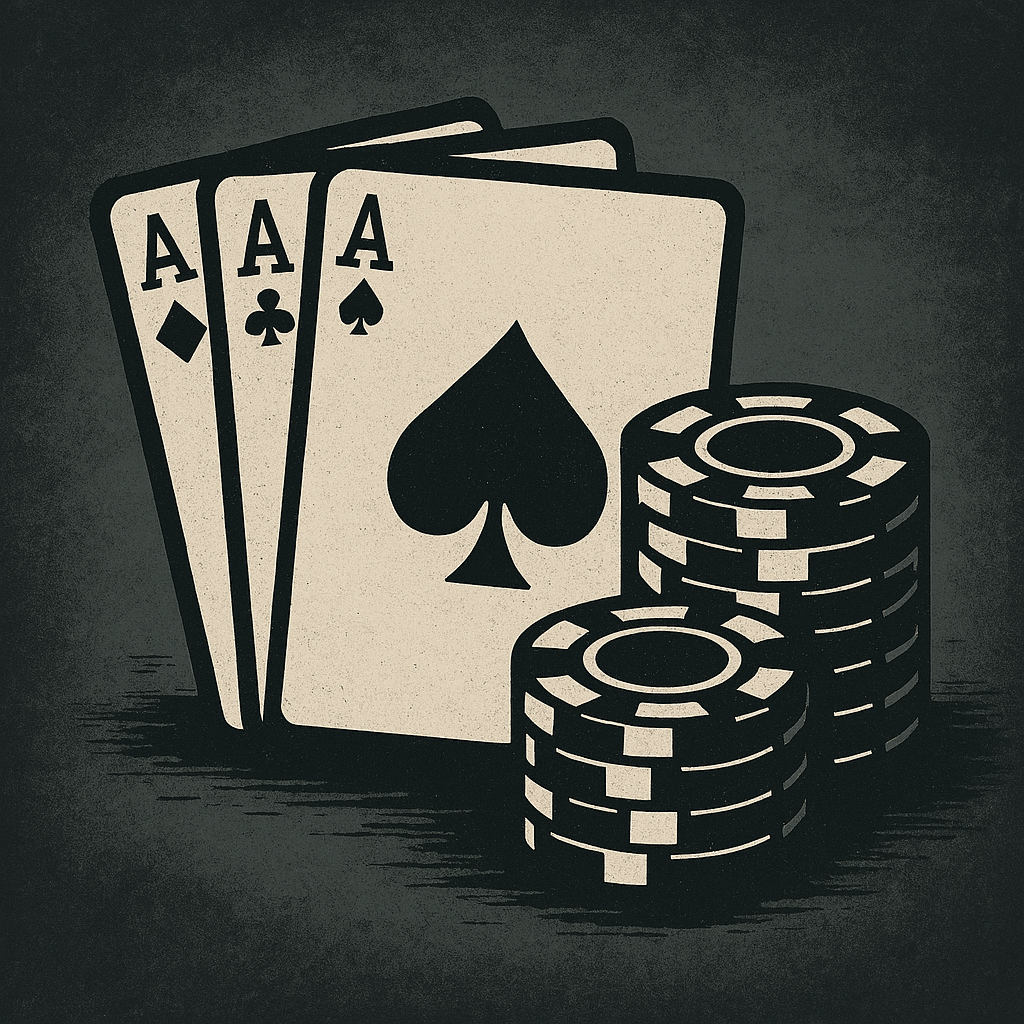
The removal of Venezuela as a patron did not merely end Maduro’s dictatorship, it likely altered the flow of reality in the basin itself. What followed from adjacent confines and distant hegemons alike was not immediate confrontation but boilerplate as hesitancy or visa-versa. Borders were secured. Procedural condemnations were issued. The United Nations will hear of this! Behind the statements, positions were analyzed and reassessed. Cards were checked. No one raised. Everyone counted their chips. Everyone kept their cards, except Maduro, but no one pushed the pot.

In the meantime: the basin holds it breath, the alternatives have no luster, and time has taken on a velocity beyond the speed limits of the usual diplomatic stall. In the basin, survival at all costs no longer promotes stability of government nor docility of the populace. In the basin, the strength of will is now measured in meals, watts, and months: maybe. The Venezuela operation lasted 3 hours.

The absence of a Venezuelan military effective response was not the lack of detection of the opposing force or bribery of key personal to look the other way. It was the predictable outcome of a hollowed-out command structure confronted more attuned to loyalty rather than ability. Selective strikes against decision‑making nodes, combined with degraded communications and uncertainty about leadership status, collapsed the chain of authority before it could cohere into action. In a system likely conditioned to await orders from the top rather than exercise initiative, paralysis was the rational response. No one bucks the top…North Korea redux. A thirty‑minute operation leaves no room for deliberation; it ends before the system can decide what it is seeing. Maduro wasn’t answering his phone.

And the operation was not just the removal of a bad actor; it was also about who was watching.

The Iranian strike was never just a counter‑proliferation exercise. Reducing nuclear capability was the mechanism, not the message. The message was capability itself. It was designed to be seen not by Tehran, which already understood the risks, but by Moscow and Beijing. The flight profiles, the munitions used, the coordination, the timing, the public naming of the operation, all of it communicated U.S. reach, patience, and the ability to act unilaterally at scale without triggering uncontrolled escalation. It was deterrent by demonstration, not a declaration for further action.

The Venezuela operation carries the same scent, even if the target is less world‑ending. Different theater, different tools, same audience. There were other tells. In Moscow, state‑adjacent channels reverted to cultural filler, Swan Lake on shortwave. A gesture with a long memory. In Russian political language, it has historically marked moments of uncertainty at the top: authority suspended, clarity withheld, everyone instructed to wait. It was not a declaration, but it was not nothing either. Less foreknowledge than recognition. An acknowledgment that something irreversible was unfolding, inferred from U.S. posture rather than anything concrete.

That recognition itself would not have gone unnoticed. Intelligence services watch each other as closely as they watch targets, and awareness on one side becomes signal on the other. A brief pause, publicly attributed to weather or timing around the holidays, need not imply any hesitation. It can just as easily reflect confirmation: that inference had not translated into possible interference, that compromised channels would remain compromised, and that recognition would stay passive. In that sense, the music was not a warning, and the delay was not a feint. Both were acknowledgments that the hand had changed, and that no one intended to show their cards before the next move was made.

The unrest in Iran reads differently. Less recognition than diversion. When leverage is limited in one theater, pressure migrates to another. Iran’s internal volatility has long been a known fault line. One where agitation carries asymmetric cost. Disruption there absorbs Iranian authorities’ attention, resources, and narrative bandwidth, reducing the capacity for coordinated response elsewhere. Whether by design or exploitation, the effect is the same: consequences are diluted across theaters rather than concentrated at the point of action. Hezbollah and Hamas in the Caribbean remain isolated and neutered.

This does not require coordination to function. Systems under strain respond predictably to stress applied at their weakest seams. Iran’s unrest filled the information space with noise at precisely the moment clarity elsewhere would have been costly.

In Venezuela, the point wasn’t regime change as an ostentatious show of force or a shot across the bow. It was proof of access, intelligence dominance, and decision‑speed inside a space long assumed to be cluttered with foreign influence. The absence of a name matters. So does the brevity. So does the lack of follow‑on rhetoric, which, for Trump, is really saying something.

Regional reactions reflected this reality. The message, delivered without verbiage, was understood immediately. Except in Congress. Colombia’s troop movements were defensive and stabilizing, aimed at spillover rather than confrontation. Mexico and Colombia’s appeals to multilateral condemnation preserved diplomatic cover without altering facts on the ground. China and Russia issued ritualized objections. Entirely predictable, restrained, and notably unaccompanied by action. Iran’s rhetoric filled space where leverage was absent. Across the board, states assessed their stacks of chips and chose not to raise.

This collective hesitation revealed the deeper shift. The Caracas operation likely removed Venezuela as a structural patron and sanctuary, not just a regime. That removal matters less for ideology than for logistics. It collapses the external framework that allowed other systems: most notably Cuba, to remain in the game, even without chips.

Cuba’s predicament is not strategic; it is temporal and tactical. The island lacks indigenous energy beyond biomass, cannot sustain its grid without imported fuel, and faces chronic food insecurity dependent on foreign exchange. Its export of human capital: doctors, engineers, security personnel, once generated influence and cash, but those returns have diminished, and the population left behind is aging and shrinking. Tourism and remittances no longer provide reliable buffers. Scarcity does not need to become catastrophic to destabilize a system; it only needs to become unpredictable. Revolution is three meals away.

In this context, the familiar options narrow. Refusal to accept the obvious with re-engerized brutality can delay outcomes but the path ahead remains the same. Partial opening risks unleashing forces that cannot be re-contained. A managed transition preserves continuity but requires acknowledging mistakes and ultimately exhibiting weakness. Waiting for the irrational rescue likely recreates Ceausescu execution at the hands of an exhausted populace. Time is now a luxury. And there is no Che Guevara left to pretend this is about anything other than power.

The broader hemispheric picture reinforces this compression. Panama’s strategic assets favor quiet realignment rather than confrontation. Colombia’s incentives point toward containment. Mexico’s long‑standing safety valves, outward migration and remittance flows, have narrowed as borders tighten and returns increase. At the same time, cartel finances face pressure from heightened surveillance, financial enforcement, and disrupted logistics. When money tightens, patience evaporates. Ambiguity and neutrality become expensive.

The external powers, beyond the basin, face their own constraints. Russia’s tools in the hemisphere are limited to smoke signals, narrative, and opportunistic cyber and communication disruption; it cannot project sustained force near U.S. logistics without unacceptable risk. China’s leverage is financial and infrastructural: think Peru’s deepwater port, but money loses persuasive power when leaders weigh it against personal liability. Loans cannot guarantee immunity. Infrastructure cannot extract individuals from collapsing systems. A Berlin‑style airlift to sustain Cuba is implausible: geography, energy requirements, and visibility make sustained resupply untenable without escalation. A step that neither Beijing nor Moscow appear willing to risk.

What emerges instead is a less noisy contest. The real currency becomes safe passage for the unwanted and the management of transitions rather than bids for loyalty. Ports, telecom, finance, and migration policy, to and from the U.S., become the levers. Intelligence exploitation encourages action against cartels, rolling up networks of crime rather than staging battles.

In this environment, public speeches matter less than demonstrated capability. Respectful language toward leaders paired with relentless focus on non‑state threats: cartels, preserves diplomatic niceties while narrowing the options. The message is conveyed not through ultimatums but through persistence: neutrality becomes costly; alignment allows for tomorrows.

The western hemisphere has entered a meantime: not a moment of dramatic conquest, but a period where waiting is the most dangerous strategy. Outcomes will be shaped less by declarations than by which pressures are allowed to accumulate, and which are relieved. The Caracas operation did not end the game; it thinned the table and moved the stakes to the final table.

Monroe Doctrine

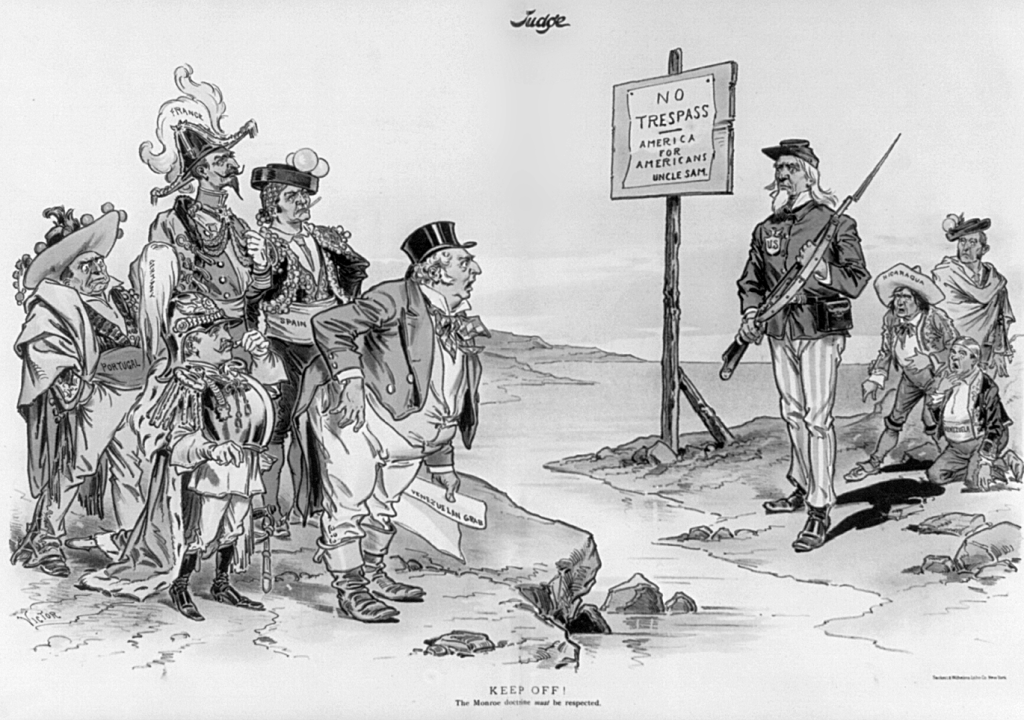
In 1823, President James Monroe issued what became known as the Monroe Doctrine, warning European powers against further colonization or interference in the New World. Though never codified into law or treaty, the doctrine became a guiding principle of U.S. foreign policy, invoked and reinterpreted by successive administrations to assert American influence in the hemisphere. Theodore Roosevelt expanded it, Barack Obama’s administration declared it obsolete, and Donald Trump revived its assertive tone. Its malleability is hailed by some as its strength, denounced by others as its greatest flaw.

The Monroe Doctrine became a symbolic fence around the Western Hemisphere, a firewall against nineteenth‑century imperial powers. Over the next two centuries, it evolved through corollaries, confrontations, and periods of dormancy. Today, in the shadow of Chinese expansion, mainly through its Belt and Road Initiative, Latin American states are drawn to twenty‑first‑century infrastructure with age‑old colonialism lurking in the background. But the Chinese buying influence in the hemisphere is aimed directly at the United States, seeking to erode its traditional dominance and reshape regional loyalties.

The Monroe Doctrine was intended to thwart enemies, potential and real, at the gate. With the exception of Cuba, it largely succeeded through the twentieth century. The 21st century now poses a test of whether the doctrine still has teeth.

If conflict with China is fated, then the United States must first secure its own backyard. The Western Hemisphere cannot be a distraction or a liability, a source of angst and trouble. Before turning its full strategic gaze toward the Middle Kingdom, the U.S. must seal the gates of the New World.

The Monroe Doctrine was written mainly by President Monroe’s Secretary of State, John Quincy Adams. It aimed to support Latin American independence movements from Spain and Portugal, while discouraging Russian influence in the Pacific Northwest and preventing the Holy Alliance: Russia, Austria, Prussia, and France, from restoring monarchs in the Americas. But the doctrine was not all sword: the United States also pledged not to interfere in Europe’s internal affairs or its colonies.

In the early 1800s, the United States lacked the ability to enforce such a bargain militarily. Britain, however, was more than willing to use its naval fleet to guarantee access to New World markets and discourage competition.

By the beginning of the twentieth century, Theodore Roosevelt invoked and expanded the doctrine, effectively making the United States the policeman of the Western Hemisphere. During the Cold War, it was used to counter Soviet influence in Cuba, Nicaragua, and Grenada.

By the 1970s the South American drug trade was declared a national security threat and the War on Drugs began with Colombia the epicenter of hostilities. In 1981, U.S. Congress amended the Posse Comitatus Act to allow military involvement in domestic drug enforcement, extending to Latin America. President Ronald Reagan’s 1986 National Security Decision Directive 221 declared drug trafficking a U.S. national security threat, authorizing military operations abroad, including in Colombia.

After the Cold War, the doctrine faded from explicit policy. In November 2013, Secretary of State John Kerry declared at the Organization of American States that “the era of the Monroe Doctrine is over,” framing a shift toward partnership and mutual respect with Latin America rather than unilateral dominance. By 2020 Colombia’s coca production had hit a new high.

Today, China’s Belt and Road Initiative, port construction and acquisitions, telecom infrastructure, and rare earth diplomacy have carved influence into Latin America and the Caribbean. In this context, the Monroe Doctrine was not asleep but, in a coma, its toes occasionally twitching.

Re-invigorating the Monroe Doctrine is not about making true allies and friends but removing vulnerabilities. The goal is not to bring these nations into the fold but to remove them from Beijing’s orbit.

By mid-2025 official statements claim that ~10% of the U.S. Navy is deployed to counter drug threats, ostensibly from Venezuela and Columbia. But fleet positioning hints at a different story. Most assets are stationed near Puerto Rico, the Virgin Islands, and Guantánamo Bay, closer to Cuba than Caracas. Surveillance flights, submarine patrols, and chokepoint monitoring center on the Florida Straits, Windward Passage, and Yucatán Channel.

This may suggest strategic misdirection. Venezuela is the declared theater, but Cuba is the operational keystone. The U.S. may be deflecting attention from its true concern: Chinese or Russian entrenchment in Cuba and the northern Caribbean.

The Monroe Doctrine began as a warning to monarchs across the Atlantic. In the late twentieth century, it morphed into a war on drugs. Today it reappears as a repurposed drug war, flickering as a warning to Beijing across the Pacific. Whether it awakens as policy or remains sleight of hand, its enduring role is to remind the world that the Western Hemisphere is not a theater for distraction but a stage the United States will guard against intrusion. In the twenty‑first century, its test is not whether it can inspire allies, but whether it can deny adversaries a foothold in America’s backyard.

Graphic: Monroe Doctrine by Victor Gillam, 1896. Public Domain.

Hamlet Goes to Milwaukee—A Tragicomedy in Five Acts

Prolepsis’ Prologue:

The Chorus enters. A single spotlight. A single Damocles’ bullet hangs in the air like a haunted ghost spinning to history’s rhythms and trajectories.

CHORUS:

John Schrank shoots Theodore Roosevelt, 113 long and mostly forgotten years ago, in Milwaukee, Wisconsin on a sharp and chilled Monday, coats pulled tight, 14 October 1912.

That’s the end, my friend, or so it seems. But tragedy demands context, and context demands sacramental passings. Let us reset and reconfigure the scene, with a sentimental barbershop quartet interlude of ‘Moonlight Bay’ drifting in the background and summon the ghosts of campaigns past and the raving refrains of the mad, all served with a bullet.

Act I: The Bull Rising

Before the Bull Moose and the bullet there was tradition and restraint. Before Roosevelt charged up the hill and across the plains, there was McKinley’s calm firmament.

William McKinley, 25th President of the United States, governed with a philosophy of calculated prosperity and protective nationalism, fittingly called the Ohio Napoleon, holding folksy court on America’s front porch. He was deliberate and firm but never rash, he was a Republican loyalist second, leader first, and a quiet expansionist, A Civil War veteran and devout Methodist, McKinley championed high tariffs, the gold standard, and industrial growth as the pillars of American strength.

His first term (1897–1901) unfolded as an economic recovery from Grover Cleveland’s faltering presidency and the Panic of 1893. It was marked by economic stabilization, the Spanish-American War, and the acquisition of overseas territories: Puerto Rico, Guam, the Philippines, and Hawaii, all additions to America’s imperial structure.

His vice president, Garret Hobart died, of heart failure in 1899 at the age of 55. With no constitutional mechanism to fill the vacancy, the office remained vacant until McKinley’s re-election. It wasn’t until the ratification of the 25th Amendment in 1967 that a formal process was established to replace a vice president.

In 1900, Theodore Roosevelt, then Governor of New York and war hero of the San Juan Hill, was chosen as McKinley’s running mate. His nomination was largely a strategy of containment: an attempt to temper his reformist zeal beneath the inconsequential and ceremonial weight of the vice-presidency.

Act II: Bull Cometh

The Bull Moose was buried beneath ceremony, but symbols cannot contain momentum. The front porch would give way to the lists and charging steeds.

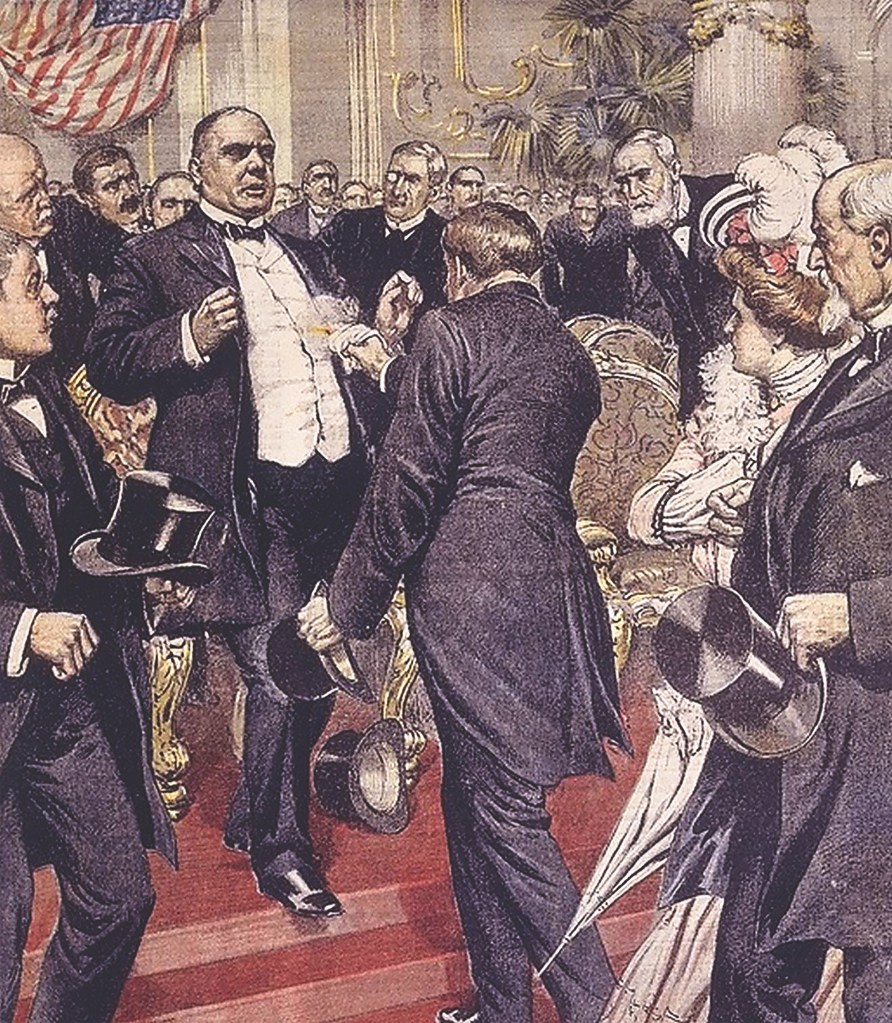
On September 6, 1901, President William McKinley stood beneath the vaulted glass of the Temple of Music at the Pan-American Exposition in Buffalo, New York, an American shrine to progress, electricity, and imperial optimism. There, in the charged glow of modernity, he was shot twice in the abdomen by Leon Czolgosz, a Polish American self-declared anarchist and bitter subject of the Panic of 1893 and its resultant mill closures, strikes and wage collapse, etched into his disillusioned psyche.

Czolgosz had been baptized in the radical writings of Emma Goldman, a Lithuanian emigree and firebrand of the American radical left. Goldman championed anarchism, women’s rights, and sexual liberation. She founded Mother Earth, a journal that became an infamous intellectual hearth for dissent and revolutionary analysis.

To Czolgosz, Mckinley was the embodiment of oppression: capitalism, imperialism, and state violence. His answer to these perceived provocations was violence. Concealing a revolver wrapped in a handkerchief, he fired at close range during a public reception, just as McKinley extended his hand in welcome.

Initially, doctors believed McKinley would recover. But gangrene developed around the damaged pancreas, and he died on 14th of September. His death was slow and tragic, a symbolic collapse of the front porch presidency.

Roosevelt, just 42, stepped up and became the youngest president in U.S. history (JFK was 43). With containment at an end, the Bull broke loose. And he mounted the stage with an agenda.

Act III: The Charge of the Bull

The Bull builds a protective legacy of words and stick, sweat and blood.

Roosevelt’s early presidency honored McKinley’s legacy: trust-busting, tariff moderation, and economic expansion. But he soon added his own signature: conservationism, progressive reform, and a bold, moralistic foreign policy.

He preserved 230 million acres of public land and established the U.S. Forest Service, 5 national parks, 18 national monuments, 150 national forests and a constellation wildlife refuges. Stewardship of the land became a sacred ideal that continues to present day.

In foreign affairs, Roosevelt extended the Monroe Doctrine with his Roosevelt Corollary (1904), asserting that the U.S. had the right to intervene in Latin America to prevent “chronic wrongdoing.” It was a doctrinal pivot from passive hemispheric defense against European imperialism to active imperial stewardship, cloaked in the language of civilization and order. America became the self-appointed policeman of the Western Hemisphere.

The corollary was a response to incidents like the 1902 Venezuelan debt crisis where European navies blockaded ports to force repayment. In Cuba, unrest was quelled with U.S. troops in 1906. Nicaragua, Haiti, and Honduras saw repeated interventions to protect U.S. interests and suppress revolutions. If Latin American failed to maintain order or financial solvency, the U.S. would intervene to stabilize rather than colonize.

The doctrine justified the U.S. dominance of the Panama Canal and set the precedent for Cold War interventions, neutralizing the American back yard while containing Soviet expansion in the east.

Act IV: Hamlet in Milwaukee

Heads of kings rest uneasy. Ghosts of injustice haunt. Princes fall prey.

After winning a full term in 1904, Roosevelt honored his promise not to seek reelection in 1908. But disillusioned with his successor, William Howard Taft, Roosevelt returned to politics in 1912, forming the Progressive Party, nicknamed the Bull Moose Party.

Enter stage left, John Schrank, a former barkeep plagued by visions and imagined slights. In the early morning hours of 15 September 1901, 6 days after McKinley was shot and 2 days before he died, the bar tender dreamt that the slain President rose from his casket and pointed to a shrouded figure in the corner: Roosevelt. “Avenge my death”, the ghost spoke. Schrank claimed to forget the dream for over a decade, until Roosevelt’s bid for a third term in 1912 reawakened the vision, which he now interpreted as a divine command.

Schrank believed Roosevelt’s third-term ambition was a betrayal of American tradition set forth in Washington’s Farewell Address. He hated Roosevelt and feared that he would win the election, seize dictatorial power, and betray the constitutional republic. In his delusional state, he believed Roosevelt was backed by foreign powers and was planning to take over the Panama Canal; an anachronistic fear, given total U.S. control of the canal since 1904. Schrank interpreted the ghost’s voice as God’s will: “Let no murderer occupy the presidential chair for a third term. Avenge my death.”

At his trial for the attempted assassination of Roosevelt, Schrank was remanded to a panel of experts to determine his mental competency. They deemed him insane, a “paranoid schizophrenic”, in the language of the time. He was committed to an asylum, where he remained until his death 31 years later.

Schrank’s madness parallels the haunted introspection of Hamlet, Prince of Denmark. Shakespeare’s longest and most psychologically complex tragedy that revolves around a ghost’s command: “Revenge my foul and most unnatural murder.” Hamlet, driven by the specter’s charge, spirals into feigned (and perhaps real) madness, wrestling with betrayal, duty, mortality, and metaphysical doubt. His uncle, the murderer, has married his mother; an Oedipal inversion within the world’s most enduring tragedy.

On 14 October 1912, as Roosevelt stood outside Milwaukee’s Gilpatrick Hotel, Schrank stepped forward and fired. The bullet pierced his steel glasses case and a folded 50-page tome of a speech, slowing its path. Bleeding, a bullet lodged in his chest, Roosevelt refused medical attention. He stepped onto the stage and spoke for 90 minutes, although it is said that due to his loss of blood, he shortened his speech out of necessity. Whether for himself or the audience is lost to history.

Unlike Hamlet, who dithers and soliloquizes his way toward a graveyard of corpses, Schrank shoots, hits, and leaves Roosevelt standing. Hamlet’s tragedy ends in death and metaphysical rupture. Schrank’s farce begins with the demands of a ghost and ends with a 90-minute speech. One prince takes his world with him into death. The other absorbs a bullet and keeps talking.

Act V: Ghosts and Republics

Ghosts and Republics are ephemeral. At the end of time; those fleeting moments, short and long; some, as Proust says, more and more seldom, are best treated with humor and grace.

In tragedy and near calamity, a man’s soul becomes visible. Some are seen darkly, others, bright, clear, unshaken and unafraid of new beginnings even if that beginning is death.

Roosevelt had already charged up San Juan Hill, bullets and fragments whistling past like invitations to a funeral ball. Each a death marker. So, when a solitary bullet from a madman struck him in Milwaukee, it was merely an inconvenience. He quipped: “Friends, I shall ask you to be as quiet as possible. I don’t know whether you fully understand that I have just been shot, but it takes more than that to kill a Bull Moose.”

Sixty-eight years later, Reagan too survived a bullet to the chest. As he was wheeled into the emergency room at George Washington University Hospital, he said he’d “rather be in Philadelphia,” a throwback to his vaudeville days, a gag line used on fake tombstones: “Here lies Bob: he’d rather be in Philadelphia.” W.C. Fields once requested it as his epitaph. He’s buried in California. To the surgeons, Reagan added: “I hope you’re all Republicans.”

Where Roosevelt offered mettle, Reagan offered mirth. Both answered violence with theatrical defiance: natural-born and unshakable leaders, unbothered by the ghosts that tracked them.

They were not alone. Jackson, beat his would-be-assassin with a cane. Truman kept his appointments after gunfire at Blair house. Ford faced two attempts in seventeen days and kept walking. Bush stood unfazed after a grenade failed to detonate. They met their specters with grace, a joke, and a shrug.

The assassins and would-be assassins vanished into the diffusing whisps of history. The leaders of men left a republic haunted not by ghosts, but by a living memory: charged with the courage to endure and to imagine greatness.

Graphic: Assassination of President McKinley by Achille Beltrame, 1901. Public Domain.

The Lost Boys

The end of the Peloponnesian War in 404 BC marked the end of Athens’ Golden Age. Most historians agree that the halcyon days of Athens were behind her.  Some however, such as Victor Davis Hanson in his multi-genre meditations, A War Like No Other, a discourse on military history, cultural decay, and philosophical framing, offers a more nuanced view suggesting that Athens was still capable of greatness, but the lights were dimming.

During the following six decades, after the war, Athens rebuilt. Its navy reached new heights. Its long walls were rebuilt within a decade. Aristophanes retained his satirical edge even if it was a bit more reflective. Agriculture returned in force. Even Sparta reconciled with Athens or vice versa, recognizing once again that the true enemy was Persia.

Athens brought back its material greatness, but its soul was lost. What ended the Golden Age of Athens wasn’t crumbled walls or sunken ships. It was the loss of lives that took the memory, the virtuosity of greatness with it. With them generational continuity, civic pride, and a religious belief in the polis vanished. The meaning, truth, and myth of Athenian exceptionalism died with their passing. The architects of how to lead a successful, purpose driven civilization had disappeared, mostly through death by war or state but also by plague.

Victor Davis Hanson, in his A War Like No Other lists many of the lives lost to and during the war that took much of Athens’ exceptionalism with them to their graves. Below is a partial listing of Hanson’s more complete rendering with some presumptuous additions.

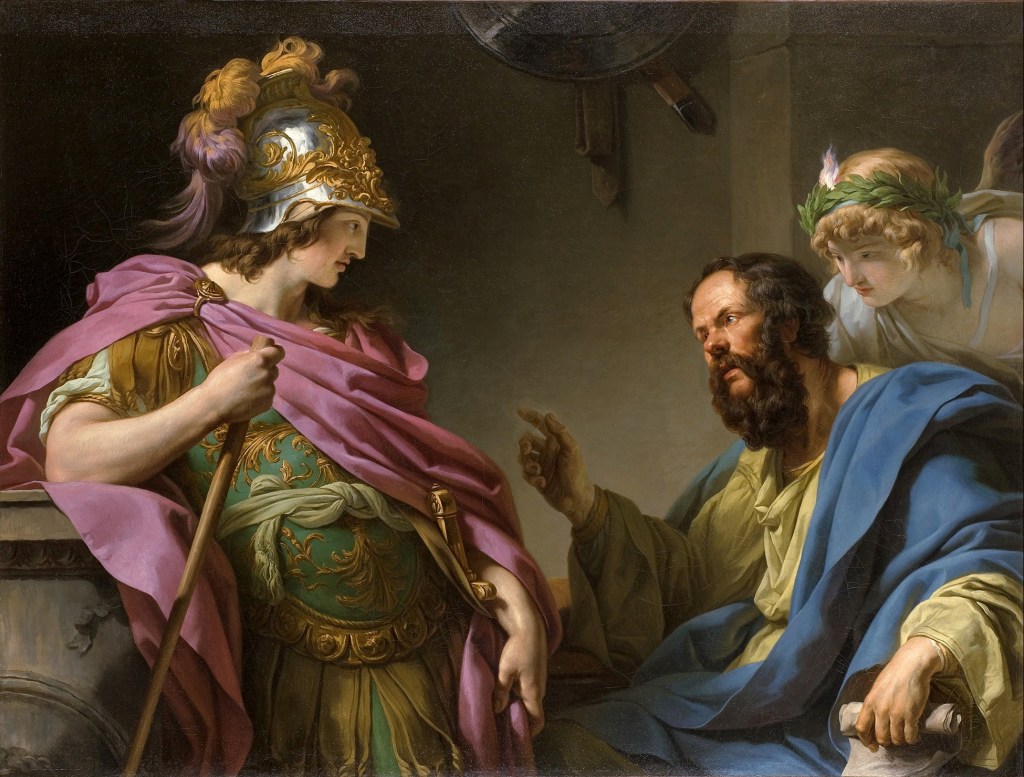
Alcibiades was an overtly ambitious Athenian strategist; brilliant, erratic, and ultimately treasonous. He championed the disastrous Sicilian expedition, Athens greatest defeat. Over the course of the war, he defected multiple times: serving Athens, then Sparta, then Persia, before returning to Athens. He was assassinated in Phrygia around 404 BC while under Persian protection, by, many beleive, the instigation of the Spartan general Lysander.

Euripides though he did not fight in the war exposed its brutality and hypocrisy in his plays such as The Trojan Woman and Helen. The people were not sufficiently appreciative of his war opinions or plays, winning only four firsts at Dionysia compared to 24 and 13 for Sophocles and Aeschylus, respectively. Disillusioned, he went into self-imposed exile in Macedonia and died there around 406 BC by circumstances unknown.

The execution of the Generals of Arginusae remains a legendary example of Athenian arbitrary retribution; proof that a city obsessed with ritualized honor could nullify military genius, and its future, in a single stroke. The naval Battle of Arginusae, fought in 406 BC, east of the Greek island of Lesbos, was the last major Athenian victory over the Spartans in the Peloponnesian War. Athenian command of the battle was split between 8 generals: Aristocrates, Aristogenes, Dimedon, Erasinides, Lysias, Pericles the Younger (son of Pericles), Protomachus, and Thrasyllus. After their victory over the Spartan fleet a storm prevented the Athenians from recovering the survivors, and the dead, from their sunken ships. Of the six generals that returned to Athens all were executed for their negligence. Protomachus and Aristogenes, likely knowing their fate, chose not to return and went into exile.

Pericles, the flesh and blood representation of Athens’ greatness was the statesman and general who led the city-state during its golden age. He died of the plague in 429 BC during the war’s early years, taking with him the vision of democratic governance and Athens’ exceptionalism. His 3 legitimate sons all died during the war. His two oldest boys likely died of the plague around 429 BC and Pericles the Younger was executed for his part in the Battle of Arginusae.

Socrates, the world’s greatest philosopher (yes greater than Plato or Aristotle) fought bravely in the war, but he was directly linked to the traitor Alcibiades. He was tried and killed in 399 BC for subverting the youth and not giving the gods their due. That was all pretense. Athens desired to wash their collective hands of the war and Socrates was a very visible reminder of that. He became a ritual scapegoat swept up into the collective expurgation of the war’s memory.

Sophocles, already a man of many years by the beginning of the war, died in 406 BC at the age of 90 or 91, a few years before Athens’ final collapse. His tragedies embodied the ethical and civic pressures of a society unraveling. With the deaths of Aeschylus in 456 BC, Euripides in 406 BC, and Sophocles soon after, the golden age of Greek tragedy came to a close.

Thucydides, author of the scholarly standard for the Peloponnesian War, was exiled after ‘allowing’ the Spartans to capture Amphipolis, He survived the war, and the plague, but never returned to Athens. His History ends in mid-sentence for the period up to 411 BC. He lived till 400 BC, and no one really knows why he didn’t finish his account of the war. Xenophon picked up where Thucydides left off and finished up the war in his first two books of Hellenica which he composed somewhere in the 380s BC.

The Peloponnesian War ended Athens’ greatest days. The men who kept its lights bright were gone. Its material greatness returned, glowing briefly, but its civic greatness, its soul, slowly dimmed. It was a candle in the wind of time that would be rekindled elsewhere. The world would fondly remember its glory, but Athens had lost its spark.

Source: A War Like No Other by Victor Davis Hanson, 2005. Graphic: Alcibiades Being Taught by Socrates, Francois-Andre Vincent, 1776. Musee Fabre, France. Public Domain.

The Sum of All Fears–Real and Imagined

The Peloponnesian War, fought over 27 years (431-404 BC), cost the ancient Greek world nearly everything. War deaths alone approached 8-10 percent of their population: up to 200,000 deaths from battle and plague. The conflict engulfed nearly all of Greece, from the mainland to the Aegean islands, Asia Minor and Sicily. Though Sparta and its allies, in the end, claimed a tactical victory, the war left Greece as a shadow of its former self.

The Golden Age of Athens came to an end. Athenian democracy was replaced, briefly, by the Thirty Tyrants. Sparta, unwilling to jettison its insular oligarchy, failed to adapt to imperial governance, naval power, or diplomatic nuance. Within a generation Sparta was a relic of history.  First challenged by former allies in the Corinthian War, then shattered by Thebes, which stripped the martial city-state of its aura of invincibility along with its helot slave labor base: the economic foundation of Sparta. Another generation later, Macedon under Philip II and Alexander the Great finished off Greek dominance of the Mediterranean. After Alexander’s death in 323 BC, Rome gradually absorbed all the fractured pieces. Proving again, building an empire is easier than keeping one.

Thucydides, heir to the world’s first historian: Herodotus, reduced the origins of the Peloponnesian War to a primal emotion: fear. In Book I of his History of the Peloponnesian War he writes: “The growth of the power of Athens, and the alarm which this inspired in Sparta, made war inevitable.” Athens had violated trade terms under the Megarian Decree with a minor Spartan ally but that was pretext, not cause. Sparta did not go to war over market access. It went to war over fear. Fear of what Athens had become and a future that armies and treaties may not contain.

War and fear go together like flame to fuse. Sparta went to war not for fear of a foe, Sparta knew no such people. It was not fear of an unknown warrior, nor fear of battlefields yet to be choregraphed, but fear of an idea: democracy maintained and backed by Athenian power. And perhaps, more hauntingly precise, fear of itself. Not that it feared it was weak but of what it may become. They feared no sword or spear, their discipline reigned supreme against flesh and blood. Yet no formation, no stratagem, no tactic of war could bring down a simple Athenian belief: the rule of the many, an idea anathema, heretical even, to the Spartan way of life.

So, they marched to war, not to defeat an idea but to silence the source. Not to avenge past aggression but to stop a future annexation. They won battles, small and large. They razed cities. But they only destroyed men. The idea survived. It survived in fragments, bits here, bits there, across time and memory. What it did kill, though, was the spirit of Athens, the Golden Age of Athens. But the idea that was Athens lived on across space and time: chiseled into republics that rose from its ashes and ruins.

The radiance of Athens dimmed to shadow. Socrates became inconvenient. Theater became therapy; a palliative smothering of a cultural surrender. And so, civilization moved to Rome.

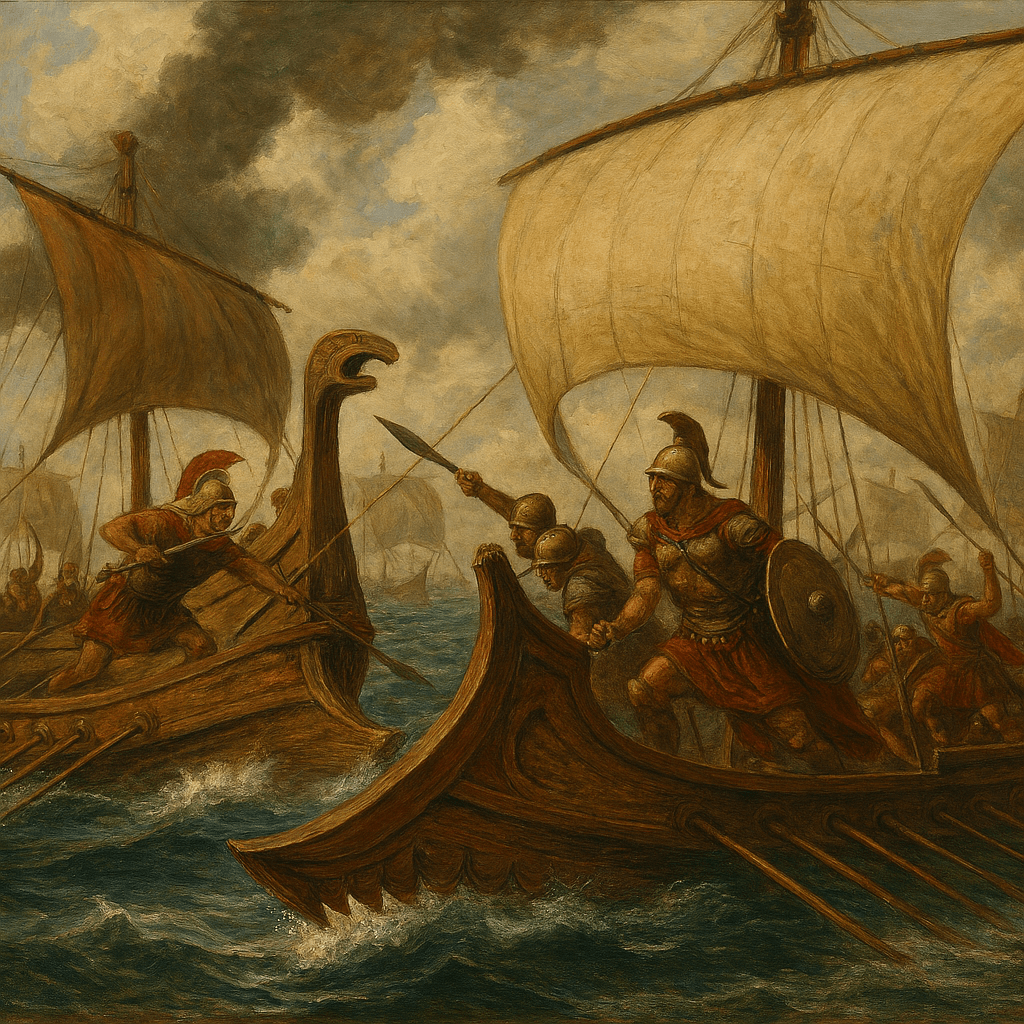
Source: A War Like No Other by Victor Davis Hanson, 2005. History of the Peloponnesian War by Thucydides, Translated by Richard Crawley, 2021. Graphic: Syracuse vs Athens Naval Battle. CoPilot.

Phalanx: Discipline in Geometry

Near the ancient Sumerian city of Girsu, mid-way between present-day Bagdad and Kuwait City, stood a battle marker; the Stele of Vultures, now housed in the Louvre. It commemorates Lagash’s 3rd millennium BC victory over Umma. The stele derives its name from the monument’s carved vultures flying away with the heads of the dead.  It also depicts soldiers of Lagash marching in a dense, shield to shield formation, holding spears chest high and horizontal, led by their ruler: Eannatum, who commissioned the stele in 2460 BC. The importance of the stele, though, is that it is the first visual depiction of the use of a phalanx in a battle. It is believed that the phalanx as a military tactic is much older.

The phalanx was more than a combat formation, it was a battlefield philosophy enshrining discipline and courage over strength, unity of the team over the individual. A dense, rectangular wall of men, generally 8 deep stretching across the battlefield to protect against flanking maneuvers. Each man wore heavy armor of leather and bronze: helmet, cuirass, greaves, armed with a spear and a short sword. But the breakthrough that brought the phalanx great renown was the apsis, a round shield invented for the Greek hoplite in the 8th or 7th century BC. With its dual grip, a forearm strap and central handhold, it allowed the infantryman precise control of his shield, helping create an impenetrable barrier of bronze and bone against the oncoming enemy’s spears and swords. It transformed the phalanx from an offensive wall of attack to an added defensive engine of defiance.

The phalanx only succeeded in cohesion. When courage and discipline held, the formation with the apsis as its core defense was practically unbeatable on confined terrain. It overcame the enemy with a seamless, tight mass executing a relentless forward march into the belly of the opposing beast. But it was only as strong as its weakest link. Once discipline faltered and cohesion broke, the formation collapsed, and the opposing army ran it to ground. Victory belonged not to brute force, but to the combined strength of the military unit. Teams won, individuals lost.

From late 8th century BC onward, Greek phalanxes were manned by hoplites: citizen soldiers, generally landowners and farmers. Emerging in Sparta or Argos, possibly imported from Sumeria or born of parallel discovery in Greece, phalanx battles initially were confined, blunt, and deadly affairs. They devolved into fierce pushing masses of brawn, bone, and metal until one side broke. Heavy casualties occurred when the enemy lines broke and soldiers fled Helter skelter in shock and chaos, pursued by the victors for plunder, unless they were restrained by honor.

The phalanx became the standard that destroyed the mighty Persian armies at Marathon and Thermopylae early in the 5th century BC. At Marathon in 490 BC 10,000 Athenians and 1000 Plataeans stretched out their formation to match the breadth of 26,000 Persians, filling the Marathon plain and denying the armies any room for flanking movements.

The Greeks stacked their wings with additional rows of hoplites and thinned them progressively toward the center creating a convex crescent. The Greek wings advance faster than the center generating a pincer movement that collapsed on the Persian center. When the dust settled 192 Athenians and 11 Plataeans were lost while the Persian losses were approximated at 6400.

In the 19th century, Napoleon, possibly improvising on phalanx encircling tactics developed at Marathon, would invert his attacking army with a concave formation consisting of a strong center and weaker wings. His strategy being to split the enemies’ center with strength and attack their divided ranks on the flanks. The tactic worked until Wellington at Waterloo.

At Marathon, unity triumphed with geometric discipline. At Thermopylae the formation bought time and ended with a sacrifice that concluded Persian hubris.

During the second Persian invasion in 480 BC, Darius’s son Xerxes with 120,000-300,000 men attacked a contingent of 7000 Greeks at Thermopylae. The Greeks held back the Persian advance like a cork in a bottle, using a rotating phalanx of roughly 200 men to defend a narrow pass for two days, until betrayal by Ephialtes exposed their flank and they were destroyed in a inescapable Persian barrage of arrows. Greek losses were estimated at 4000 men including Leonidas’ 300 Spartans and 2000-4000 Persians (beginning and ending estimates for manpower strength vary widely).

The Greeks defiant stand at Thermopylae allowed the Greek navy to regroup at Salamis where they won a decisive victory against the Persian navy. A year later the Greeks at Plataea crushed the Persians quest for a Hellenic satrapy.

The Phalanx endured for another century, including use in the Peloponnesian War, where it remained lethal but of limited use. Then came Epaminondas at Leuctra in 371 BC, transforming the phalanx into a machine that erased Sparta’s mighty reputation. Typically, each army’s phalanx strength was concentrated on their right wing so that the strongest part of a force always faced off against the weaker wing of the opposition. What Epaminondas did was say nuts to that.

He reversed the order and created an oblique formation, more triangular than rectangular with his strongest troops on the left wing. His left wing was stacked 50 deep while keeping his center and right wings thin. His 50-deep was aimed directly at Sparta’s best under the command of King Cleombrotus (in those days officers and kings were in the front rows of the phalanx). As the phalanxes began to attack Epaminondas kept his right-wing stationery creating an asymmetrical front. The left wing easily broke through Sparta’s right wing, killing Cleombrotus and collapsing their superior flank. At that point Epaminondas’s wing pivoted inward creating an enveloping arc around the remaining parts of Sparta’s phalanx effectively ending the Spartan myth of invincibility.

Epaminondas tactics shortened battles with fewer casualties. His innovations proved that properly trained and equipped citizen soldiers could defeat professional warriors while instilling a new civic honor through restraint and discipline. His oblique formation allowed landowners and farmers to settle their disputes, usually in a few hours or less, with minimal loss, and return to their farms in time for the harvest. Epaminondas not only brought asymmetrical tactics to the battlefield but shattered claims of superiority by employing the unexpected.

As the Golden Age of Athens and western civilization’s Greek center waned and Roman hegemony rose, the phalanx evolved again. The Greek phalanx gave way to the Roman manipular system, a staggered checkerboard pattern, enabling units to rotate, reinforce, or retreat as needed. It was a needed refinement and improvement to the phalanx, more effectual on open plains and less susceptible to calvary and arrows.

Then came Hannibal to Cannae in 216 BC. During the 2nd Punic War, he upended the war cart of tactics once again and ruthlessly exploited Rome’s refinements.

Hannibal’s improvisations of the phalanx maneuvering tactics, but not the actual formation, showed that he had studied Marathon. Instead of a convex line with strong wings and a weak center he developed a concave line with strong wings and weak center. He allowed the center to fall back, which the Romans unwittingly obliged by surging into Hannibal’s weak center. With the Romans committed Hannibal’s deception encircled them with precision and brutal lethality. The Romans were annihilated on the field losing somewhere between 50,000-70,000 killed and another 10,000 captured. Hannibal lost 6000-8000 men (again estimates vary). Then came the 3rd Punic War.

The phalanx began as a wall of spears and shields, a bulwark of bronze and bone. Its stunning victories echo through history’s scholarly halls and hallowed plains of death and destruction. Yet its Achilles’ heel, vulnerable flanks, precise terrain requirements proved incompatible to horses and gunpowder.

Still its legacy of discipline and unity endure. Born of necessity, refined through rigor, and studied for centuries, the phalanx stands as a testament Aristotle’s enduring insight, slightly abridged but still profound, ‘The whole is greater than the parts.’ And perhaps the Roman’s said it best: ‘E pluribus unum’, ‘out of many, one.’

Source: A War Like No Other by Victor Davis Hanson, 2005. Et al. Graphic: Stele of Vultures.