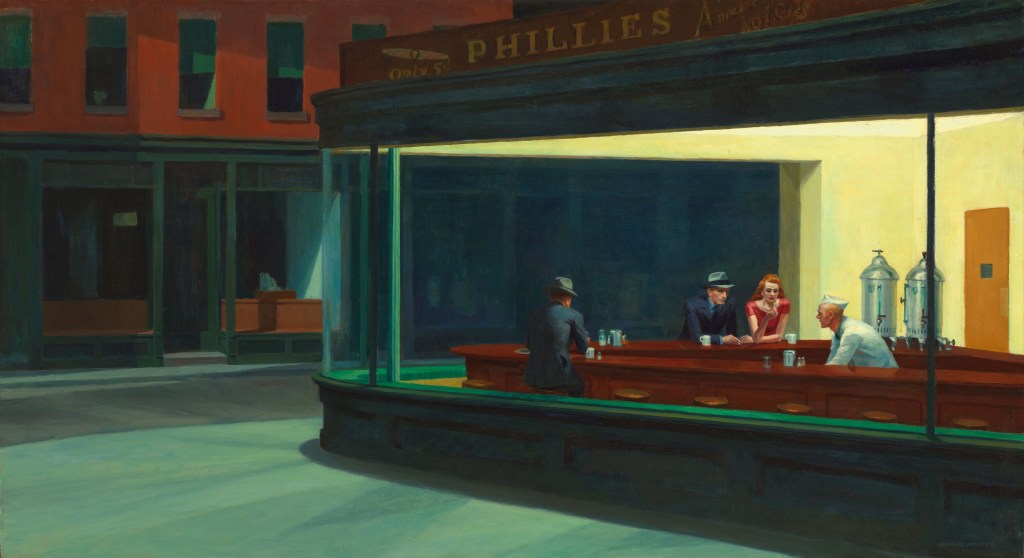
Edward Hopper’s 1942 painting, “Nighthawks” was his best-known piece of art. He commented that, “Nighthawks seems to be the way I think of a night street. I didn’t see it as particularly lonely. I simplified the scene a great deal and made the restaurant bigger. Unconsciously, probably, I was painting the loneliness of a large city.” Later, he again downplayed the loneliness aspect of the painting by stressing that it was just “a restaurant on Greenwich Avenue where two streets meet”.
Source: Hopper by Rolf G. Renner, Taschen, 2020 originally published 1991. Painting, “Nighthawks” by Hopper owned by Daniel Rich. Public domain.
Leonardo Da Vinci and Issac Newton were both consummate note takers. They recorded their thoughts, ideas, and anything else that struck their fancy in innumerable notebooks and loose sheets of paper.
Paper was expensive so they both wrote small and covered every inch of paper with drawings and script.
Newton wrote in Latin, Greek, and English with most subject titles in Latin and the text in Greek. To save space his letters were an eye straining one sixteenth of an inch high. An estimated 4000 pages with around 285,000 words plus drawings of his writings have been found to date.
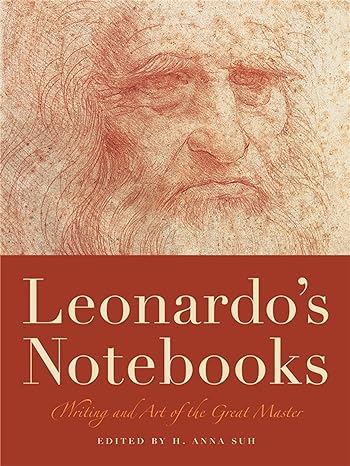
Leonardo wrote in Tuscan Italian, with the text written in a right to left mirror style which some believe he did because he was left-handed, as, by-the-way so was Newton. 13,000 pages of Leonardo’s notes have been found which is believed to be only about a fifth of the total.
Source: “Isaac Newton” by James Gleick, 2003. “Leonardo’s Notebooks” Edited by H. Anna Suh, 2005. “Leonardo Da Vinci” by Walter Isaacson, 2017. Graphic of da Vinci and Newton AI generated.
“Let no one be slow to seek wisdom when he is young nor weary in the search thereof when he is grown old. For no age is too early or too late for the health of the soul.”
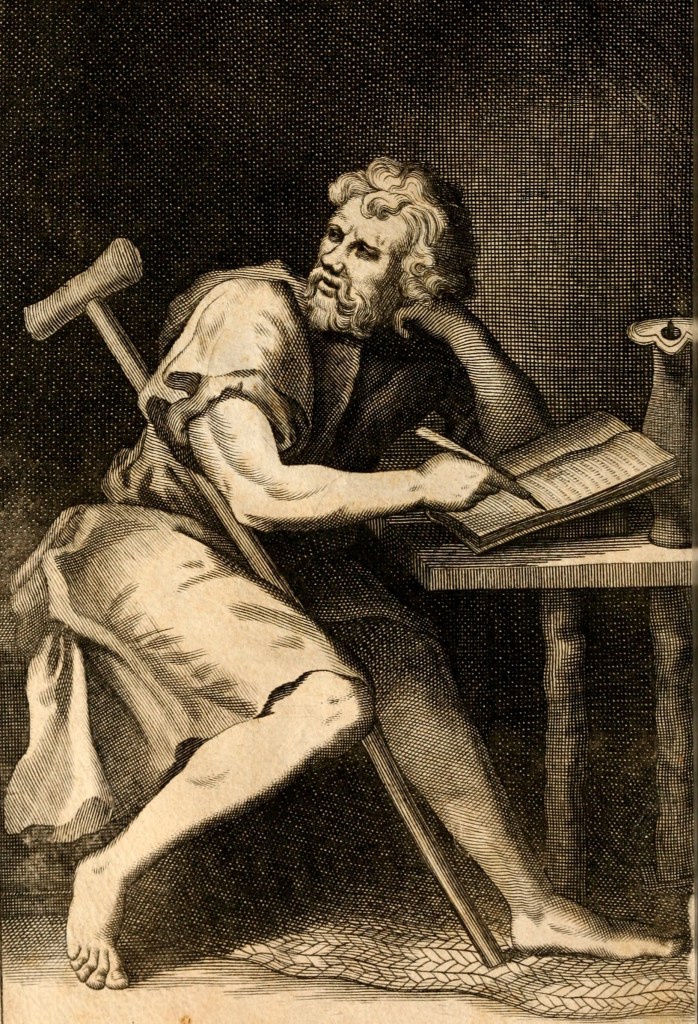
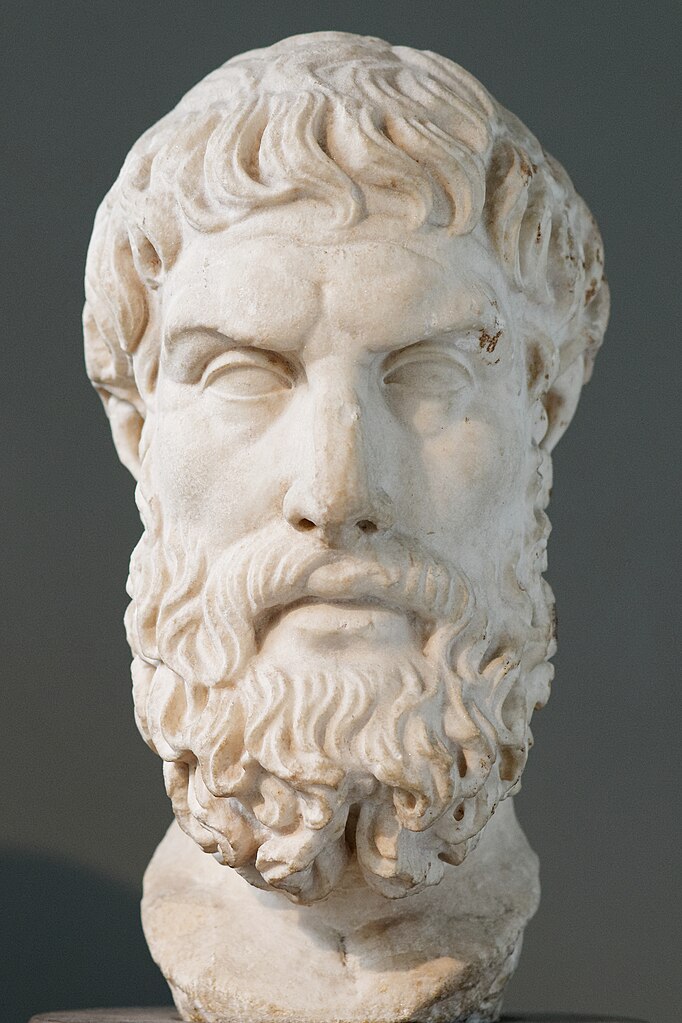
So begins the third and fourth century BC Greek philosopher, Epicurus in his letter to Menoeceus, although who Menoeceus was, has been lost to the ages. Epicurus was a Greek philosopher born on the island of Samos in the Aegean Sea off the coast of Turkey. He established a school next to Plato’s in Athens and taught that one’s purpose in life was to lead a happy, tranquil, self-sufficient life, a pleasant life, and not to fear death.
Epicurus taught that after death there is nothing. Death is/was the end of the body and soul; teaching that self-guilt and shame were the only methods available to prevent the world from overflowing with psychopaths. This is not far from the current Pope’s thoughts on Hell being an empty shell, a place of nothingness. Socrates, on the other hand, taught that the soul is eternal, and one must strive to keep it bright and shiny.
Epicurus ended his letter to Menoeceus, “Meditate therefore on these things (a pleasant life) and things akin to them night and day by yourself, and with a companion like to yourself, and never shall you be disturbed waking or asleep, but you shall live like a god among men. For a man who lives among immortal blessings is not like to a mortal being.”
Sources: “Ancient Greek Philosophers”, numerous translators, published 2018 and Manchester.edu (Indiana). Photo of a bust of Epicurus by Nguyen, public domain.
On the evening of the 18th of April 1775 Paul Revere galloped through the countryside of Massachusetts to warn the populace that British were coming by water: one if by land, two if by water.
The next day the British, after crossing the Charles River from the Boston side, marched on Concord to try and capture colonial military supplies that had been stored there. The patriots knew of the British plans and moved most of their military equipment elsewhere.
The British had to pass through Lexington as they marched their way to Concord. The first shots between the British and Americans were fired at sunrise at Lexington, signaling the beginning of the Revolutionary War. After a minor skirmish in Lexington the British continued on their way to Concord.
The British marched to Concord with 700 troops and the Americans were eventually able to muster about 3500 militiamen although they only had about 77 at Lexington. During the Battles of Lexington and Concord on that day the British suffered 273 losses and the Americans 95.
Source: History.com and “The Many Rides of Paul Revere” by James Giblin published 2007. Photo of a painting showing Paul Rever’s Midnight Ride by Office of War Information http://www.archives.gov.
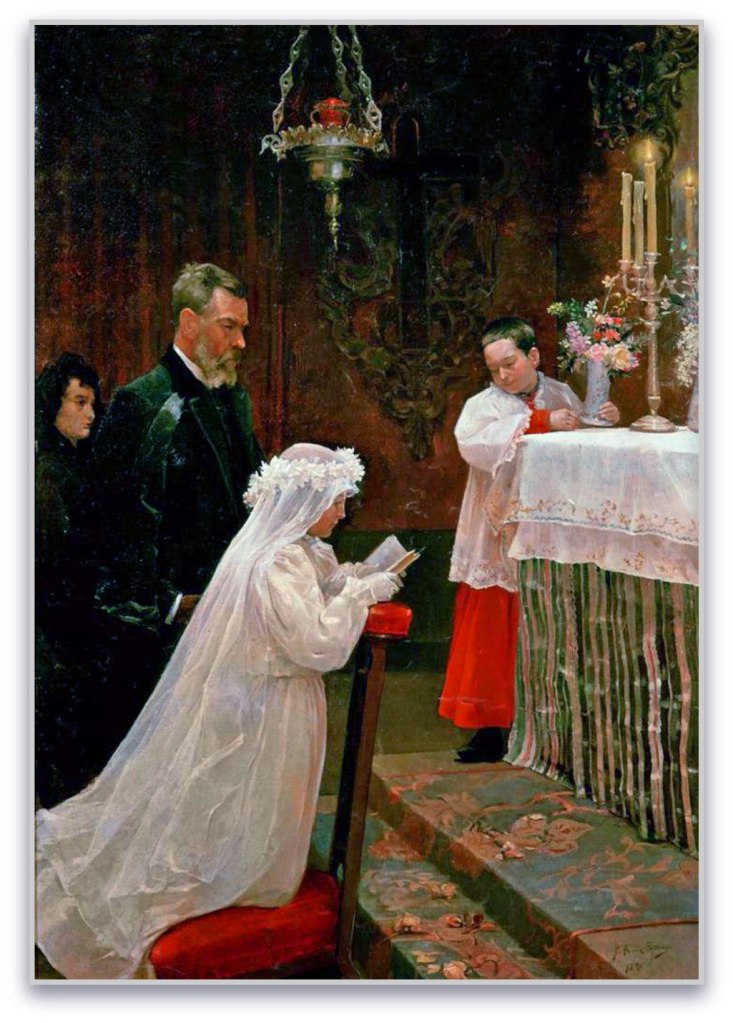
Picasso was recognized as a child prodigy at a very young age. He began to paint with oils when he was eight and by the time he was thirteen he was selling his work. At the age of fourteen, he was admitted to the prestigious Barcelona art school: La Lonja. At the age of fifteen he made his official entry into the professional art world, presenting the painting, “The First Communion” shown to the right, at the Third Exhibition of Fine Arts and Artistic Industries in Barcelona.
“Science and Charity” shown to the left is one of Picasso’s most accessible paintings. He painted it in 1897 at the age of 15. This painting was the culmination of his academic studies and he soon after abandoned this style in pursuit of a more personal, albeit inscrutable, approach to art.
Source: Picasso by Carsten-Peter Warncke. Published 2001. Original publication 1998.
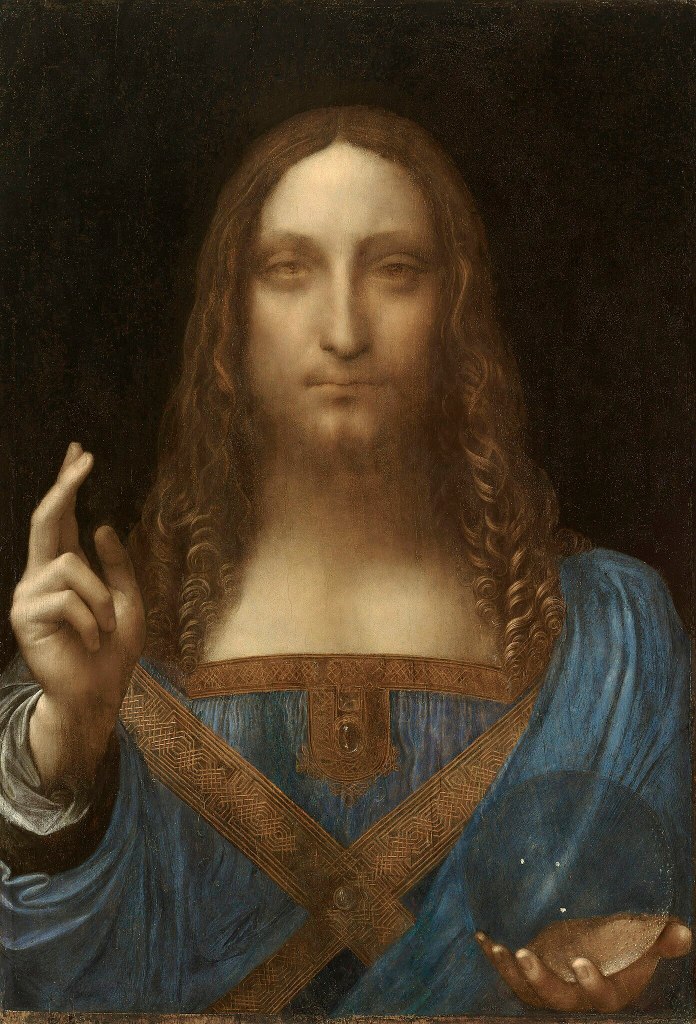
Salvator Mundi, Savior of the World, is believed to have been painted by Leonardo da Vinci sometime between 1499 and 1510 which is considered by historians to be the beginning of the High Renaissance period. The painting was supposedly commissioned by King Louis XII of France and was later recorded in the possession of the English Kings Charles I and II. How the English acquired the painting is unknown. It was then passed onto the Duke of Buckingham in the 1600s after which his son sold it in 1763. The painting then disappeared for 137 years.
It reappeared in 1900, changing hands a few times without anyone realizing it may be an authentic Leonardo. In 2005 a consortium of art dealers and collectors purchased it with the intent to have it cleaned and restored all the while attempting to prove that it was indeed a Leonardo painting. In 2013 most experts agreed that it was an authentic Leonardo allowing it to be sold for $80 million to Swiss art dealer Yves Bouvier which he quickly resold to the Russian Rybolovlev for $127.5 million. This sale quickly became a legal mess with the resolution not entirely clear.
Somehow the legal issues resolved themselves and the painting came to market again in 2017 selling for $450.3 million, making it the most expensive painting ever sold. After much wild and erroneous speculation, it was revealed that Abu Dhabi’s Department of Culture and Tourism bought the painting. It is currently in storage awaiting the completion of the Louvre Abu Dhabi in the United Arab Emirates.
In 2020 the experts have struck again and attribution of the painting to Leonardo is in doubt. Experience says this debate will continue ad infinitum. Meanwhile an extremely expensive art piece supposedly by a gay painter of Jesus Christ resides in the Arab Middle East.
Sources: Leonardo da Vinci by Walter Isaacson published in 2017. Salvator Mundi by Christies published in 2017. Salvator Mundi by ArtNet published in 2020.
Leonardo, dreamer, artist, and scientist; Cesare Borgia, Cardinal, murderer, duplicitous tyrant; and likely subject of Niccolo Machiavelli’s book: The Prince, were holed up together for three months during the Renaissance winter of 1502-1503 in the five blocks by eight blocks Italian walled garrison town of Imola.
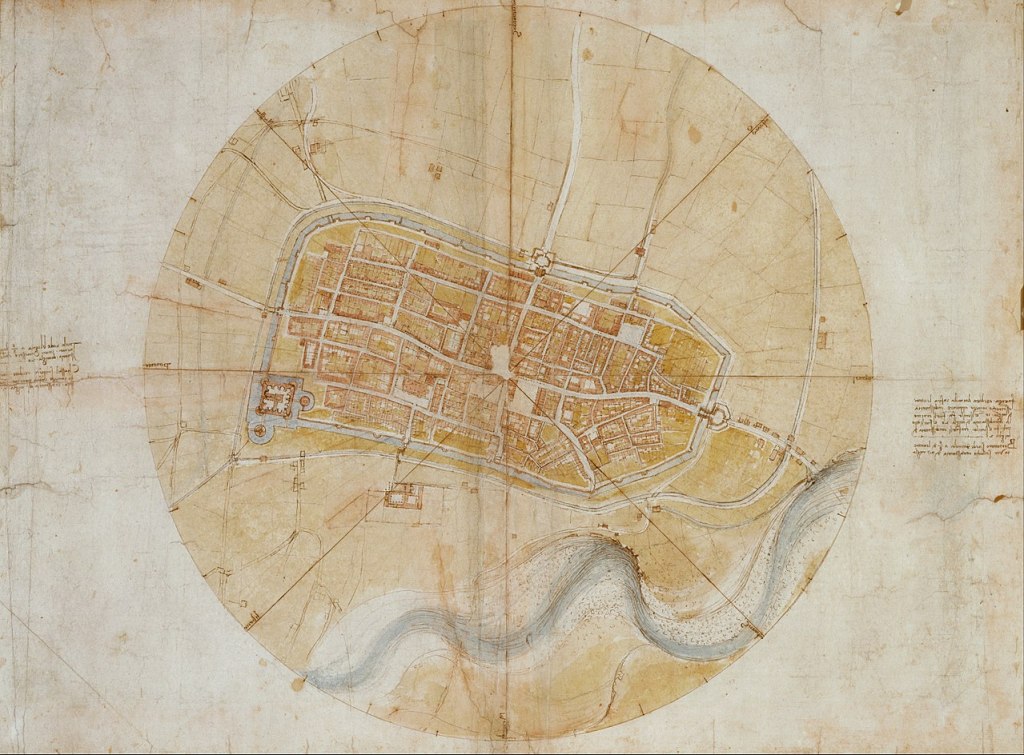
According to Walter Isaacson in his 2017 “Leonardo da Vinci” biography he states that, “While he was in Imola with Machiavelli and Borgia, Leonardo made what may be his greatest contribution to the art of war. It is a map of Imola… It is a work of beauty, innovative style, and military utility…Drawn in ink with colored washes and black chalk… The aerial view is from directly overhead, unlike most maps of the time. On the edges he specified the distances to nearby towns, useful information for military campaigns…”
Cesare Borgia (1475-1507), backed by his father Pope Alexander VI, was on a military campaign to carve out his own personal princedom, by hook, crook or force. He had moved his court to Imola to further plans for his conquest of the area. Leonardo da Vinci (1452-1519) was there because he had signed on as Borgia’s chief military engineer. Leonardo’s task was to reinforce castles and defenses in the region and construct new military machines based on his notebook designs such as his rapid-fire projectile weapon, armored car, helicopter, and giant crossbows; none of which were ever built in his lifetime. Niccolo Machiavelli (1469-1527), was dispatched by the Florentine authorities as a diplomat to discern Borgia’s intentions towards the city and dissuade him, if possible, from attacking Florence.
As an aside, Friedrich Nietzsche (1844-1900), German philosopher and critic, introduced the concept of Ubermensch: an idealized individual who transcends conventional morality and societal norms. Nietzsche elevated Borgia to this lofty status. Borgia’s daring, ruthlessness, and strategic cunning seemed to align with the philosopher’s ideals of a powerful individual who creates his own fate. Many have split hairs with Nietzsche’s concept of Ubermensch but when one creates his own morality it is hard to distinguish the end result from that of a psychopath.
Shown above is Leonardo’s map of Imola drawn in 1502-03. Public domain.
Shown above right is a Friedrich Nietzsche, circa 1975. Photo by Friedrich Hartmann. Public domain.
“I’ll chase him round Good Hope, and round the Horn, and round the Norway Maelstrom, and round perdition’s flames before I give him up.” – From Chapter 36-The Quarter-Deck of Melville’s Moby Dick. Published 1851.
FootNoteA
“Some know him by his peg leg…Others by the white scar that runs head to toe, the result of an unfortunate encounter witha lightning bolt. Still others by his entourage of harpooner henchmen with names like Fedallah, Daggoo, Tashtego, and Queequeq.
Mostly, readers know him because he’s shorthand for any intense, self-destructive fixation…
He, of course, is Captain Ahab…”
Excerpt from “The 100 Greatest Literary Characters”. By Plath, Sinclair, and Curnutt. 2019.
FootNoteB:
The book also has one of the great opening lines in all of literature: “Call me Ishmael.” The narrator introduces himself to the reader in three words. How simple and straightforward can one get? In a few more lines he sets the stage for how he will tell his story. “With a philosophical flourish Cato throws himself upon his sword: I quietly take to the ship.”
FootNoteA: Illustration of the final chase of Moby-Dick. By I.W. Taber. 1902. In Moby-Dick. Charles Scribner’s Sons, New York. Public Domain.
FootNoteB: Illustration below from an early edition of Moby Dick – 1892. C.H. Simonds Co. Public Domain.
“At the end of the day, I’m fighting for the things I said I’d fight for.” – Ron DeSantis
Courage to Be Free is the Florida governor’s biography with a good measure of politics, vision and American government thrown in. It’s a simple read from someone selling himself as an authentic American and an honest and ethical broker who supports the citizens through good government.
Ron Desantis was born in Jacksonville, Florida in 1978, married Casey Black in 2009, and has three children, two girls and a boy. He attended Yale and graduated in 2001 with a B.A. A year later he entered Harvard and graduated with a law degree in 2005. During law school he was commissioned as an officer in the U.S. Navy. In 2007 he was assigned as a legal advisor to SEAL Team One in Fallujah, Iraq where he was awarded the Bronze Star.
In 2012 he was elected to the U.S. House of Representatives and was re-elected in 2014 and 2016. DeSantis decided not to run for re-election to the House for the 2018 term but instead competed for the Florida governorship which he won. He won re-election in 2022 and as he is term limited by Florida law will not seek that office in 2024. Since he has dropped out of the Presidential race what he does next is an open question.
The first half of Desantis’ book is dedicated to his biography followed by his vision of government and national policy. He draws heavily on the expository essays and articles within the Federalist Papers and their vision for a constitutional republic. The authors of the Federalist Papers, Madison, Hamilton, and Jay argue strenuously for a republican form of government and against direct democracy which one could paraphrase in slang terms as mob rule. DeSantis agrees.
His political philosophy is simple in principle, excoriatingly difficult in execution. Encapsulating his thoughts he states, “The right path forward is not difficult to identify; it just requires using basic common sense and applying core American values…” He follows this up with his blueprint for Florida and America: “Be willing to lead, have the courage of your convictions, deliver for your constituents, and reap the political rewards.” Reaping the political rewards sounds like every politician that has ever walked the face of this Earth and I don’t recognize that as a positive trait.
Literary Criticism:
Courage to Be Free was a number one bestseller in the New York Times, Wallstreet Journal, Amazon, and Publisher’s Weekly shortly after it was released in 2023. Although sales figures are almost impossible to find, for free, the book had an initial print run of 250,000. There hasn’t been a second printing.
Hagiographies are one sided affairs with nary a discouraging word to be found, with sainthood lurking right around the corner. DeSantis autobiography is a hagiography but in fairness one doesn’t provide his opposition with free negative research when your goal is to introduce yourself to the public.
This book had only one purpose, to launch DeSantis into the 2024 presidential Republican primary in the best possible light and as a bonus, get your targeted audience to pay for it by purchasing the book. It admirably accomplishes the task, but it certainly is not a literary masterpiece, rather it reads like a college term paper completed under duress. Simple, direct, with no flowery prose or memorable lines. If you want to learn something about this man, give it perusal, a quick read is all it needs and watch one or two of his Republican primary debates for additional elucidation.
The only reason I read this book was because of the title: The Courage to Be Free. It reminded me of the title of John F. Kennedy’s Profiles in Courage. Kennedy’s book employs a better writing style but that is because Kennedy didn’t author his book. In a previous post I stated who did and I’ll leave it to you to look it up if you are curious. In the end both are about embellishing their respective reputations. Mission accomplished.
Paul L. Maier, born 1930 in St. Louis, author, public speaker, and historian has written twenty-three adult and children, fiction and non-fiction, books about Christianity. He is the son of Walter A. Maier, founder, and speaker of The Lutheran Hour.
He graduated from Harvard and Concordia Seminary in St. Louis with additional studies in Heidelberg, Germany and Basel, Switzerland. He was the Seibert Professor of Ancient History at Western Michigan University until he retired in 2011.
In addition to his definitive translation of “Eusebius: The Church History“, his 1993 “Skeleton in God’s Closet” was a number one best seller in religious fiction, a thriller concerning the Resurrection of Jesus. He also co-wrote with Hank Hanegraaff in 2006 a rebuttal to Dan Brown’s “The Da Vinci Code“: “The Da Vinci Code: Fact or Fiction?“
In addition to writing books Maier has produced six religious documentaries including the 2014 “The Week That Changed the World“, detailing the Holy Week before Jesus’s resurrection, discussing the key personalities, the politics, and the treachery that sealed Christ’s fate.
MaierBibliography-Books and Documentaries:
A Man Spoke, A World Listened: The Story of Walter A. Maier 1963
Pontius Pilate 1968
First Christmas: The True and Unfamiliar Story in Words and Pictures 1971
First Easter: The True and Unfamiliar Story in Words and Pictures 1973
First Christians: Pentecost and the Spread of Christianity 1976
Flames of Rome 1981
The Best of Walter A. Maier 1981 (paperback)
Josephus, The Essential Writings 1988
In Fullness of Time 1991
A Skeleton in God’s Closet 1994
The Very First Christmas 1998
The New Complete Works of Josephus with William Whiston 1999
Eusebius: The Church History 1999
The Very First Easter 2000
More Than a Skeleton 2003
Caspar Schwenckfeld on the Person and Work of Christ: A Study of Schwenckfeldian Theology at Its Core 2004 (paperback)
Martin Luther a Man Who Changed the World 2004
The Da Vinci Code: Fact or Fiction? with Hank Hanegraaf 2006
The Real Story of Creation 2007
The Real Story of the Flood 2008
A Skeleton in Rome 2011
The Constantine Codex 2011
The Genuine Jesus 2021
Christianity: The First Three Centuries (Documentary) 2003
The Odyssey of St. Paul (Documentary) 2003
Jesus: Legend or Lord? (Documentary) 2003
How We Got the Bible (Documentary) 2009
Christianity and the Competition (Documentary) 2010
The Week that Changed the World (Documentary) 2011
Eusebius Biography:
FootnoteA
“May I be an enemy to no one and the friend of what abides eternally. May I never quarrel with those nearest me and be reconciled quickly if I should. May I never plot evil against others, and if anyone plots evil against me, may I escape unharmed and without the need to hurt anyone else.” — Eusebius
Eusebius of Caesarea, also known as Eusebius Pamphili, was a historian, interpreter of scripture, and Christian apologist, born around 260-265 AD in Caesarea, where he gained prominence in the fourth century, before passing away around 339 AD. His early education was by the learned presbyter, and eventual saint, Pamphilus, the principle religious scholar of his generation. Eusebius became bishop of Caesarea around 314 AD, shortly after Constantine became Roman Emperor, and remained in that position until his death in 339 AD. Eusebius became a significant figure in the theological controversies and politics of his day, becoming a, if not the leading spiritual advisor and confidant to Constantine.
Christians since the time of Christ were persecuted for their faith which came to a ghoulish crescendo under the Diocletian Edicts, also known as “The Edicts Against the Christians” of 303 AD. The edicts dissolved the Christians’ legal rights, compelled them to reject Jesus and to adhere to the local religious customs of paganism and polytheism. The edict saw the destruction of Christian scripture and churches along with the torture and execution of approximately 3500 church leaders and lay people including Eusebius’ teacher Pamphilus. The persecution ended with the Edict of Milian in 313 AD, decreed and signed by Constantine and Licinius proclaiming religious toleration within the empire.
FootnoteB
The edict gained the life-long gratitude of Eusebius culminating in the Christian bishop’s panegyric, “Life of Constantine“, in which the author details the emperor’s religious policies as well as a hagiographic account of Constantine’s life. Historians have described their relationship as complex, evolving over time. They have also stated that Eusebius may have been the power behind the throne or, as others have surmised, just an obsequious toady seeking protection from his church enemies. Regardless of the actual relationship it is agreed that Eusebius was Constantine’s spiritual and political advisor.
FootnoteC
Eusebius, through his bond with the emperor, helped structure the relationship between church and state, assisting in the creation of the Constantinian concept of a Christian empire, which had a considerable influence on the development of the early Christian Church and the Roman Empire, along with empires to come.
Constantine, to put down an early rebellion of church leaders, ordered three hundred bishops throughout the empire to meet at the First Council of Nicaea in 325 AD to resolve the controversy of Arianism, a concept that Christ was not divine but was created by God. Much of the Church believed that Christ was of the same substance, “consubstantiality“, as the Father and as such: divine. Eusebius, enjoying the emperor’s favor, sat next to him at the council and offered his own creed stating that Christ was begotten, not made, from the Father. The council, in the end, rejected Arianism and formulated the creed that is recited at every High Catholic Mass to this day. The council also set the time for Easter as the Sunday after the first full moon following the Spring equinox rather than occurring on the Sunday closest to Jewish Passover or on the Jewish Passover even it was not on a Sunday. Which explains why no one knowns when Easter occurs. Constantine was adamant about foregoing any Jewish practices in the honor of Jesus.
Eusebius is referred to as the “Father of Church History” due to his voluminous writings in the field including, as discussed below, his account of the first centuries of Christianity in his “Ecclesiastical History” or “Church History“.
Church History (Ecclesiastical History):
FootnoteD
“Church History ” or “Ecclesiastical History” is the only exigent work that chronicles the development of early Christianity and its Church from the birth of Christ on into the fourth century. Eusebius’s account, written in Koiné Greek, lingua franca for the Mediterranean area from fourth century BC to fourth century AD, provides a chronological narrative, using the succession of Roman Emperors as a linear timeline, of the early Christian Church. Eusebius, with his access to the Theological Library of Caesarea, incorporated many church documents, acts of the martyrs, letters, and extracts from earlier Christian writings into his work, many which no longer exists. The “Church History” covers the succession of Church bishops, the history of Christian teachers especially Origen, the history of the many church heresies and conflicts, and Christianity’s relationships with Romans, pagans, and Jews. Despite accusations that “Church History” is more a defense of Christianity, an apologetic and hagiography, than a history, Eusebius’s work remains a valuable source for understanding early Christian history.
Below are the Maier’s chapter listings, brief descriptions, and Roman Emperors during the historical period covered.
Book I: The Person and Work of Christ: Eusebius on Christ. Augustus to Tiberius.
Book II: The Apostles: Eusebius on the Apostles. Tiberius to Nero.
Book III: Missions and Persecutions:Formation of the New Testament. Galba to Trajan.
Book IV: Bishops, Writings, and Martyrdoms: Defenders and Defamers of the Faith. Trajan to Marcus Aurelius.
Book V: Western Heros, Eastern Heretics: Death at Lyons, Rome, and Alexandria. Marcus Aurelius to Septimius Severus.
Book VI: Origen and Atrocities at Alexandria: Life of Origen. Septimius Severus to Decius.
Book VII: Dionysius and Dissent: Church Life According to Dionysius. Gallus to Diocletian.
Book VIII: The Great Persecution: Edicts Against Christians. Diocletian to Galerius.
Book IX: The Great Deliverance: The End of Persecution? Maximin, Maxentius, and Constantine.
Book X: Constantine and Peace: Eusebius and Constantine. Constantine.
Literary Criticism:
In C.F. Cruse’s 1850 translation of “Ecclesiastical History” he states that, “…Eusebius was not without his beauties, but they were rarely scattered, that we can hardly allow him an eminent rank as a writer.” This is an understatement of the 19th century although it is a polite way to admit Eusebius was incapable of engaging his readers in any form other than pedantic verbosity. This is also an example that Cruse was not immune from obfuscating meaning in his written translations and commentary. His comment above simply stated that Eusebius rarely wrote with elegance and concision. Eusebius’ writing was dense, confusing, dogmatic, and sometimes incomprehensible. Eusebius’ writing compares favorably, snark intended, with Edward Gibbons’ “The Decline and Fall of the Roman Empire” whose erudite, verbose, and opaque style has managed to confuse his readers for two plus centuries now, but for some reason no one seems to mind, except me. Gibbons disliked, immensely, Eusebius’ “Ecclesiastical History” stating that it was full of lies and falsehoods which is an exceedingly difficult position to support due to Eusebius’ excessive use, usually in quotes, of original source material. Gibbons blamed the fall of the Roman Empire on the rise of Christianity, a problematic thesis considering Christianity was the least of the Empires worries. Unchecked immigration and a corrupt governing class were much bigger problems than a few Christians asking to be left alone to worship their God in peace.
Paul L. Maier’s translation of “Church History” is a masterful improvement over C.F. Cruse’s 1850 attempt to make Eusebius readable. Cruse strove to accurately translate Eusebius with the result of burdening his readers with difficult and cluttered phrasing. Maier saves his readers by reducing Eusebius’s lengthy sentences, dense language, and abrupt subject changes to intelligible bites of prose that are readable, understandable, and usable. An example of Maier taking difficult sentences and distilling them into something cogent can be seen in the two example sentences below. The first sentence comes from Loeb’s edition of “Ecclesiastical History“, which is a very faithful rendition of Eusebius’ writing, followed by Maier’s translated version. Loeb: “I have already summarized the material in the chronological tables which I have drawn up, but nevertheless in the present work I have undertaken to give the narrative in full detail.” Maier:“Previously I summarized this material in my Chronicle but in the present work I deal with it in the fullest detail.” The first sentence takes a few readings to comprehend the meaning. Maier allows for instant comprehension.
“Ecclesiastical History” or “Church History” is an important work in understanding the beginnings of Christianity and the governing hierarchy that was built up over the centuries. This is not a long book, less than four hundred pages, but it does take dedication to the task of reading and understanding it. In the end it is worth the effort as a little history is always useful if not enlightening.
References and Readings:
Eusebius. By Allan Miller. Wikipedia. 2001 (2024 Update)