Dreams

Anton Chekhov is considered the seminal force behind modern theater, penning two of the most honest accounts in the genre of Realism: The Cherry Orchard and The Three Sisters, both probing life’s basic desires and finding them an elusive force in his protagonists’ lives. The Cherry Orchard anticipates Hemingway’s “slowly, then suddenly”; the Ranevskaya‑Gaev family drifts toward ruin not through catastrophe but through inertia. Unable to adapt, the play is a tragedy of pathological unwillingness. In The Three Sisters siblings Masha, Irina, and Olga dreams fail to ignite any transformation, all talk of a better, brighter future but no action towards that new beginning. The sisters are caught up in eternal desire but no ability to reach for it.

Chekhov’s genius in both of these plays is to keep dreams of the future just out of reach leaving everyone frozen in their past. The true tragedy is not that the characters explode in catastrophe, but they just slowly fade away into their past. Life inexorably slipping from their grasp, like old photographs losing their color, the outlines of their lives fading into the bygone era that holds them fast.

Chekhov first developed his theatrical themes with the short story. All of which are partially autobiographical and truly analytical of the human condition and their dreams. He wrote to sustain himself, sometimes financially, but always psychologically as not so much a need but a release, stating, “Medicine is my lawful wife, and literature is my mistress: when I get fed up with one, I spend the night with the other.” After 17 plays and more than 500 stories one suspects that he never really got fed up with the latter, but his stories suggest that he did with the former, frequently.

To understand why Chekhov wrote the way he did; with such clarity about humiliation, inertia, and the erosion of possibility, one must understand the life that shaped him.

Anton Chekhov was born in 1860 in the small port town of Taganrog, the third child of a grocer whose piety was matched only by his cruelty. His childhood was marked by poverty, debt, and the constant threat of his father’s bankruptcy; with the family eventually fleeing to Moscow to escape creditors and debtor’s prison. Chekhov, then sixteen, was left behind to tidy up the business mess and finish school alone, tutoring younger students to pay for food and rent. This early apprenticeship in hardship shaped the clarity with which he later wrote about poverty, humiliation, want, and the quiet heroism of endurance. In his twenties, as a medical student supporting his entire family through magazine sketches, he contracted tuberculosis that would shadow him the rest of his life. Yet it was during this same period that he experienced his brief season of happiness: a deep, tentative love for Lika Mizinova, a friend of the family whose warmth and volatility left a lasting imprint on his stories. The relationship dissolved under the strain of his illness, his obligations, and his own emotional reticence, but its memory forever haunted him. By the time he achieved literary fame, the disease had already begun to hollow him out. His later years, split between Moscow and his beloved estate at Melikhovo, were a race between artistic maturity and physical decline, a life lived with the knowledge that time was running out.

That same sense of dwindling time permeates his fiction, where characters are trapped in systems; social, economic, bureaucratic, that grind them down long before death arrives. Yet he was never overtly polemical, nor was he didactic.

In the introduction to The Greatest Short Stories of Chekhov, translator Constance Garnett repeats the claim that Chekhov “held no fixed political or social views.” But the only way to reach that conclusion is never to have read him.

Chekhov writes of poverty with a doctor’s precision and a patient’s pain. His contempt for the idle rich is unmistakable. Serfs, bureaucrats, and petty tyrants appear again and again, not as caricatures but as symptoms of a society drifting toward moral exhaustion. His work is not overtly political because it refuses the cheap clarity of slogans. Instead, it offers something far more radical: an unflinching, cold account of a world in which people are crushed not by oppression but by inertia, habit, and the slow suffocation of possibility; the lack of imagination and drive. Critics mistook this subtlety for neutrality, his refusal to preach for a refusal to see what everyone else saw. But his stories are saturated with social vision, but rather than openly ideological he settles triumphantly for the diagnostic with surgical precision. This is Chekhov’s most devastating political insight.

Chekhov returns again and again to the question of human purpose, usually finding his characters unequal to the task of rising to higher ideals. In 1889, after losing his older brother Nikolay to tuberculosis at only thirty‑one, he wrote A Dreary Story, a novella that confronts the terror that death renders all human effort meaningless.

The narrator of the story; an aging, clinically depressed professor at the end of a brilliant medical career, examines his life and finds it hollow. He watches his family suffer and feels nothing. He listens to his closest friend and cannot understand his glee, his optimism. Speaking to his adopted daughter, Katya, he delivers a confession that is part lament, part self‑indictment:

Something is happening to me that is only excusable in a slave… I am full of hatred, and contempt, and indignation, and loathing, and dread… What is the meaning of it?”

He calls these feelings shameful, but he is past shame. He is simply exhausted. When Katya finally leaves him, his last thought is not regret or memory, but a small, mournful stab of self‑pity: “Then, you won’t be at my funeral?”

Depression and the meaning of life enter again into one of my favorite and most psychologically penetrating Chekhov stories: Ward No. 6, a psych ward in a small provincial hospital; if it can even be called a psych ward, more like a containment room for lost causes. Most critics read Ward No. 6 as a parable of moral collapse, institutional cruelty, or the slow degeneration of a complacent doctor. But this interpretation misses the deeper, more unsettling truth Chekhov, as a practicing physician, was actually dramatizing: the plight of medicine at the close of the nineteenth century. The story is not about a man who loses his mental hold on reason. It is about a doctor who realizes, with devastating acuity, the futility of medicine as it was practiced in his world.

Chekhov knew this intimately. As a provincial doctor, he treated thousands of patients he could not cure, including his brother’s tuberculosis and eventually his own. He understood that much of medicine consists of gestures; reassurance, ritual, placebo, the performance of care in the absence of real efficacy. The doctor in Ward No. 6 comes to the same realization. He sees that the best he can offer is comfort, not cure; that his diagnoses change nothing; that his authority is largely symbolic. And once he sees this, he cannot unsee it. He turns inward, looking for an escape.

At one point he describes his dilemma to his after‑work companion: “You know of course…that everything in this world is insignificant and uninteresting except the higher spiritual manifestations of the human mind…Consequently the intellect is the only possible source of enjoyment.” But he finds none, not at home, not in the hospital, not in himself. Nowhere in his world.

This recognition does not make him immoral; it makes him despair. His inability to help the people who come to him, combined with the professional obligation to pretend otherwise, corrodes him from within. The depression that follows is not a personal flaw but the natural consequence of witnessing suffering he cannot alleviate. Chekhov understood this emotional collapse with painful precision.

In this state of disillusionment, the doctor finds an unexpected mirror in a patient in Ward No. 6. This man is not simply “mad”; he is the doctor’s alter ego: the part of him that refuses comforting illusions, the part that speaks honestly about pain, the part that sees the world without anesthetic. Their conversations are not the doctor’s descent into madness but his first encounter with truth. He is drawn to the patient because he recognizes himself.

But in Chekhov’s world the clarity of medicinal limits is dangerous. The doctor’s colleagues, committed to the rituals and hierarchies of their profession, interpret his honesty as emotional instability. His refusal to maintain the performance of medical omnipotence becomes, in their eyes, a symptom of disease. His attention to the mad patient; the only person who speaks to him without pretense, is labeled “unhealthy.” And so, the institution does what institutions do: it protects itself by diagnosing dissent as madness.

The tragedy of Ward No. 6 is not that the doctor goes insane. It is that the system cannot tolerate a doctor who stops keeping up with pretense. His final confinement is not a moral punishment but a professional one. He is destroyed not because he collapses, but because he stops pretending to have answers.

Seen against the backdrop of late‑nineteenth‑century medicine, Ward No. 6 becomes not merely a story about madness but a diagnosis of an entire profession. The doctor’s despair, his attraction to the patient who speaks without illusion, and his final misdiagnosis by his own colleagues all point to the same conclusion: the real sickness lies not in the individual but in the medical culture that cannot admit its own impotence. By ending the story with a stroke, a clinical event that was misdiagnosed as psychological collapse, Chekhov underscores that the tragedy was never moral degeneracy but the catastrophic failure of a profession unable to tell illusion from reality, or performance from truth. In this sense, Ward No. 6 is Chekhov’s most radical indictment: a recognition that when medicine cannot heal, it must at least see clearly, and that clarity itself may be the one thing the system lacks.

Chekhov only rarely lifts the veil of universal futility that hangs over his work, but when he does, he finds solace in the human need for connection. In The Lady with the Dog, love arrives unbidden, and once found, must be seized and held with the tenacity of a vow. Yet the most surprising Chekhovian uplift comes from The Student, an early story that stands against the pervasive loss of meaning and purpose in Chekhov’s world. Here a young seminarian suddenly senses that the past is not dead but vibrantly present; “an unbroken chain of events, one flowing out of another,” and that touching one end makes the other tremble. That the full arc of time and history provides “the inexpressible sweet expectation of happiness.”

In that moment Chekhov anticipates both Bergson and Proust: the endurance of duration, the trembling continuity of memory, the way a present emotion can awaken ancient sorrow. After the despair of A Dreary Story and the clinical futility of Ward No. 6, The Student offers Chekhov’s final insight: that meaning does not arise from certainty or cure, but from the continuity of human experience itself. Time endures. Memory binds. The chain of humanity holds. And for Chekhov, that is enough.

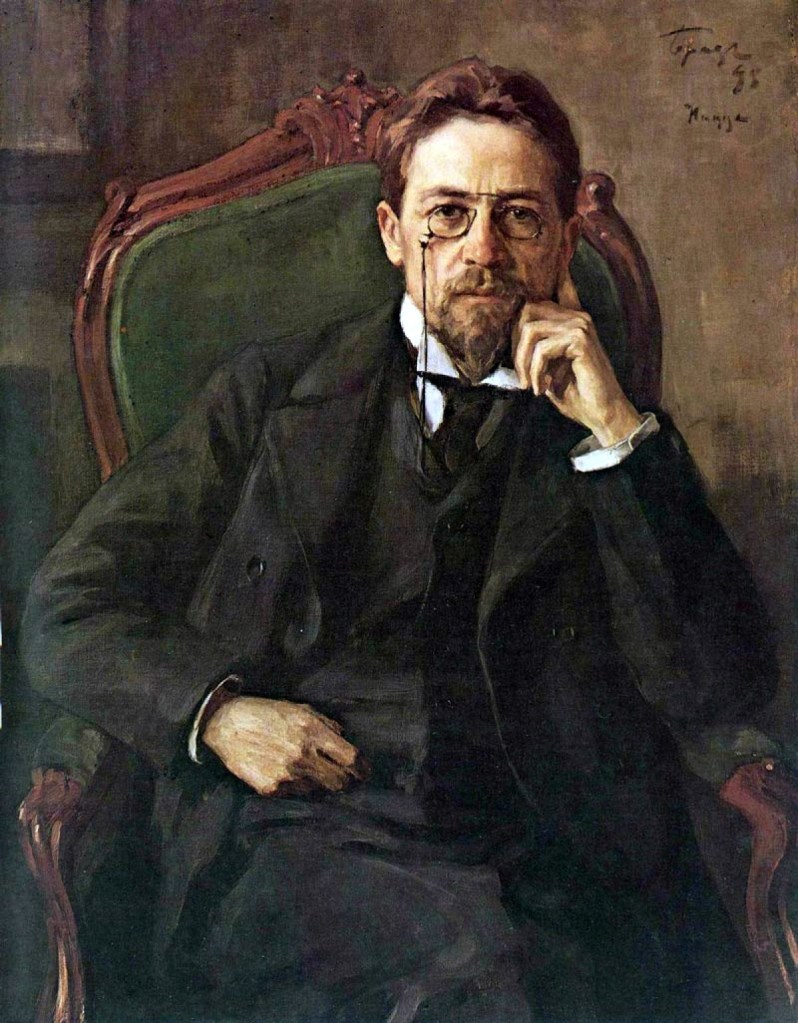
Graphic: Anton Chekhov by Osipp Braz. Oil on Canvas. 1898. Source: The Greatest Short Stories of Anton Chekhov, 2023.
The Long Way

By 1881, literature was shifting, Realism’s clarity giving way to Modernism’s psychological fog. Henry James pioneered the transformation, publishing what many hailed as his masterpiece and others found nearly unreadable. He moved from the crisp windows of Daisy Miller and Washington Square, where social dilemmas are transparent, into the labyrinth of The Portrait of a Lady, a slow, meandering narrative that tested patience to the point of exasperation. James stretched his scenes into long psychological dramas, shadowed by melancholy, lingering on minutiae rather than decisive events. To admirers, this was a profound exploration of consciousness, to detractors, a soporific feast of abstraction.

Where James’s Portrait is a punishing fugue of memory and angst, a darkness at the edge of noon, Proust’s Swann’s Way (1913) offers a sensual slow dance of lush detail, playful childhood games, and adult desire. In Combray, the family had two ways to take their walks: the short way and the long way. The short way was familiar, contained, offering scenery but little transformation. The long way was expansive, expressive, full of detours and revelations. In Swann in Love, the same pattern unfolds: the first half is Swann’s descent into desire, the short way of immediacy; the second half is his struggle to free himself, the long way of disillusionment and reflection. For Proust, the long way is where life’s lessons are held. Meaning is not found in shortcuts but in detours, delays, and the endurance of memory. The long way is the design of his art: winding detours that illuminate the search for lost time.

Wilde enters here as counterpoint. Where Proust lingers in digressive glow, Wilde sharpens language into bite. His wit distills the same metaphysical concerns: beauty, desire, memory, decay, into crystalline aphorisms. Wilde’s sentences are daggers wrapped in velvet, each polished to a point. If Proust is the cathedral of memory, Wilde is the mirror that cuts as it reflects. The Picture of Dorian Gray dramatizes the peril of desire and the corruption of beauty; themes Proust refracts through memory and longing. But Wilde compresses the ineffable into epigram: glow against bite, long way against short.

Cinema, now, becomes the continuance of these styles. Wilde’s paradox and Proust’s memory echo in films as diverse as Spectre (2015), No Time to Die (2021), and Gosford Park (2001). In Spectre, Madeleine Swann, a psychologist whose very name invokes Madeleine tea cakes and Swann’s Way, probes Bond’s past like Proust probing consciousness, turning trauma into narrative. In No Time to Die, desire and mortality entwine, echoing Proust’s meditation that “life has taken us round it, led us beyond it.” And in Gosford Park, Sir William McCordle brushing crumbs from a breast, Swann brushing flowers from a bosom, gestures lifted from Proust’s sensual triggers, collapse time into desire, while Altman’s upstairs-downstairs satire mirrors Wilde’s social wit. These films remind us that both the glow and the bite, the long way and the short, remain inexhaustible. The short as overture, the long as movement. One as a flash of life, the other as the light of experience.

James stretches narrative into labyrinthine difficulty. Proust redeems patience with memory’s illumination. Wilde polishes language into paradoxical brilliance. Chaplin, in Modern Times (1936), adds another metaphor: the gears of industry grinding human life into repetition. Yet even here, the Tramp and the Gamin walk off together, the long way, not the shortcut; suggesting resilience and hope. Between them, Modernism oscillates: fog and clarity, glow and bite, labyrinth and mirror, machine and memory. Meaning is elusive but never absent. It waits in the folds of memory, in the flash of wit, in the shadows of desire, in the detours of the long way, ready to be revealed.

Through memory’s fragments, along the winding road of joy and grace, we taste again the sweetness of love, the timelessness of innocence, and life’s inexhaustible richness.

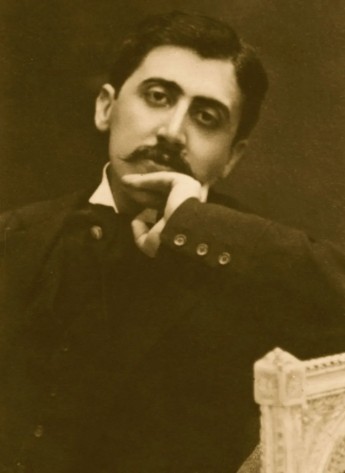
Graphic: Marcel Proust, Hulton Archive/Getty Images.

A Revolution in Paint

“One must either be one of a thousand or all alone,” declared Edouard Manet (1832-1883). Critics and even some among the Impressionist circle believed Manet lacked the courage to be truly alone, both with his art and his essence. And they were half right. He was an extrovert, a social creature drawn to the vivacious pulse of Parisian life, its salons, cafes, and couture. He wanted to belong.

Through his art he sought recognition. He wanted not necessarily respect, but rather something simpler: acceptance. Yet they misunderstood his paintings. He was alone. His canvass spoke volumes to him, but the critics saw only muted, unfulfilled talent. Paintings adrift in a stylistic wilderness. The arbitrators of French taste, the Salon jury, repeatedly rejected him. In 1875 upon viewing The Laundress, one jury exploded: “That’s enough. We have given M. Manet ten years to amend himself. He hasn’t done so. On the contrary, he is sinking deeper.”

Manet longed for approval, and he could deliver what the critics wanted, but the moment he picked up his brush something else took over. He painted what he saw, but never fully controlled the production. His canvases resisted labels. A modern Romantic, a Naturalist with a Realist bent, urban but Impressionistic. A cypher to the critics but true to himself.

Like his friend Degas, he painted contemporary city life. The country landscapes of Monet, Renoir, and Pissarro couldn’t hold him. The color and light of the Impressionists intrigued him briefly, but stark lighting and unconventional perspective held him fast. He used broad quick solid brush strokes and flat, cutout forms.

Manet’s style was rebellion. The critics sensed it, and hated it, but they never understood it. He couldn’t digest academic art, so revered by the Salon. His mutiny was expressed through paint, not polemic. His only verbal defense was a cryptic comment that “anything containing the spark of humanity, containing the spirit of the age, is interesting.”

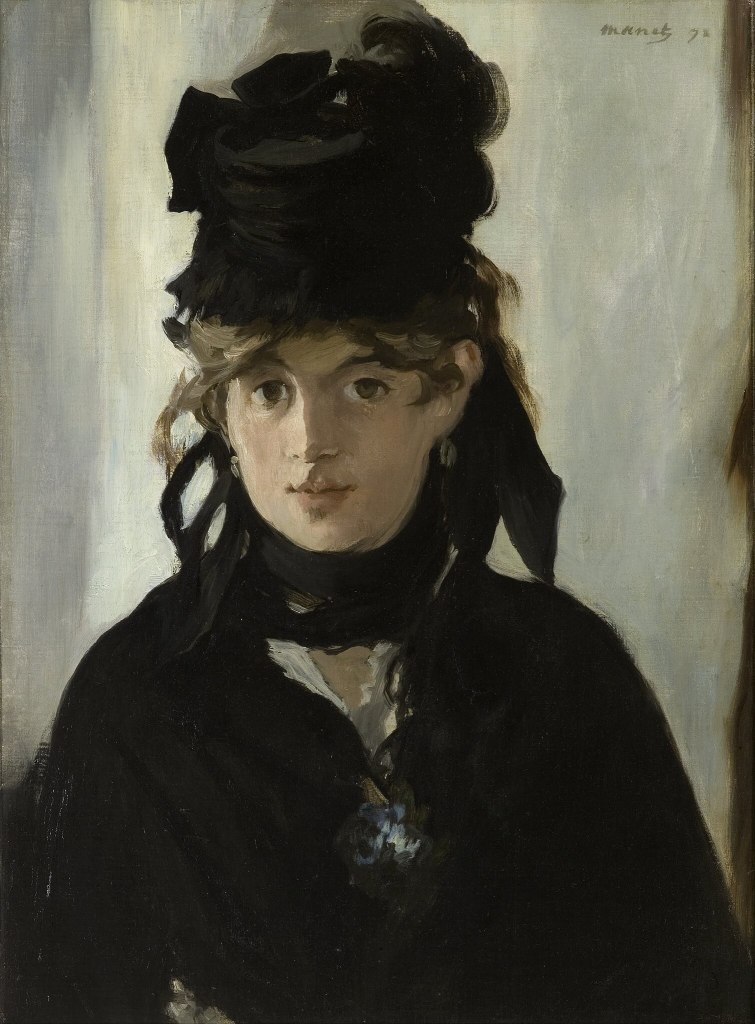
Nowhere is humanity, the spirit of the age, more hauntingly distilled than his masterpiece, his Chef-d’oeuvre: Berthe Morisot with a Bouquet of Violets. Dressed in black, her face half in shadow, Morisot peers questioningly at the viewer, asking what comes next. Manet paints what he sees. And he sees the mystery of femininity. Her green eyes painted black providing an opacity to her gaze, deepening the ambiguity: a comicality behind an expression of curiosity.

Critic Paul Valery wrote, “I do not rank anything in Manet’s work higher than a certain portrait of Berthe Morisot dated 1872.” He likened it to Vermeer, but with more spontaneity that makes this painting forever fresh. It is a timeless, loving portrait that transcends style.

Source: The World of Manet: 1832-1883 by Pierre Schneider, 1968. Graphic: Berthe Morisot with a Bouquet of Violets by Edouard Manet, 1872. Musee d’Orsay, Paris. Public Domain.

Americana

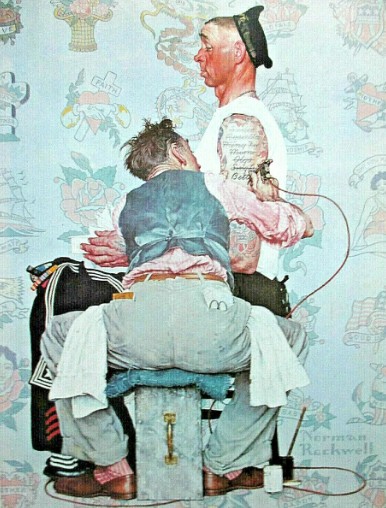
Norman Rockwell, a name synonymous with American Realism, was a master of meticulous detail, yet he never failed to brush a thread of whimsy and rustic existence onto the canvases of his iconic paintings.

Norman Rockwell, an iconic painter of American life, was born on 3 February 1894 into a comfortable New York City family. His father, a lover of Charles Dickens, often sketched illustrations from books, planting early seeds of creativity in young Norman. His mother, overprotective yet proud of her English heritage, spoke often of her artistic but unsuccessful father, whose unrealized dreams seemed to echo in the household. Art wasn’t just a pastime for Rockwell; it pulsed through him, and by age 12, he had resolved to draw for a living, though painting would come later in his journey as an artist.

As a teenager, Rockwell pursued artistic training at the National Academy of Design and later at the Art Students League, where he studied under the influence of Howard Pyle, the renowned illustrator of boys’ adventure tales. Pyle, who had founded the school’s philosophy through his own teachings and legacy, left an indelible mark on Rockwell, shaping his lifelong passion for weaving narrative into art. Before he turned 16, Rockwell landed his first commission—four Christmas cards—a modest start for a boy already dreaming big. By 18, he was painting professionally full-time, his talent unfolding with the quiet determination of youth finding its purpose.

In 1916, Rockwell began his legendary run with The Saturday Evening Post, creating covers that would grace the magazine for the next 47 years. Over that span, 322 of his paintings became what the Post proudly dubbed “the greatest show window in America.” Through these works, Rockwell offered a mirror to the nation—sometimes nostalgic, often tender, always human—reflecting everyday moments that resonated deeply with millions.

While his career soared with the Post, city life never suited him. In 1939, he traded New York’s clamor for the rolling hills of Vermont, and later, in 1953, settled in Massachusetts. These rural landscapes became his muse, dominating his canvases for the first three decades of his career. Rockwell was no haphazard artist; he was methodical, even obsessive, following a rigorous six-step process to bring his visions to life: brainstorming ideas, sketching rough outlines, photographing staged scenes with real people, crafting detailed drawings, experimenting with color studies, and only then committing paint to canvas. Each step was a labor of love, a tip of the hat to the America he loved.

At the heart of his art was a simple, profound drive. As Rockwell himself put it, “Without thinking too much about it in specific terms, I was showing the America I knew and observed to others who might not have noticed.” His paintings weren’t just pictures, they were invitations to see the beauty in the ordinary, the dignity in the overlooked; we see not just an artist, but a storyteller who believed in the quiet goodness of people, brushstroke by brushstroke.

Source: The Norman Rockwell Treasury by Thomas S. Buechner, 1979. Norman Rockwell Museum. Graphic: The Tattooist by Norman Rockwell, 1944, The Brooklyn Museum.

Nighthawks:

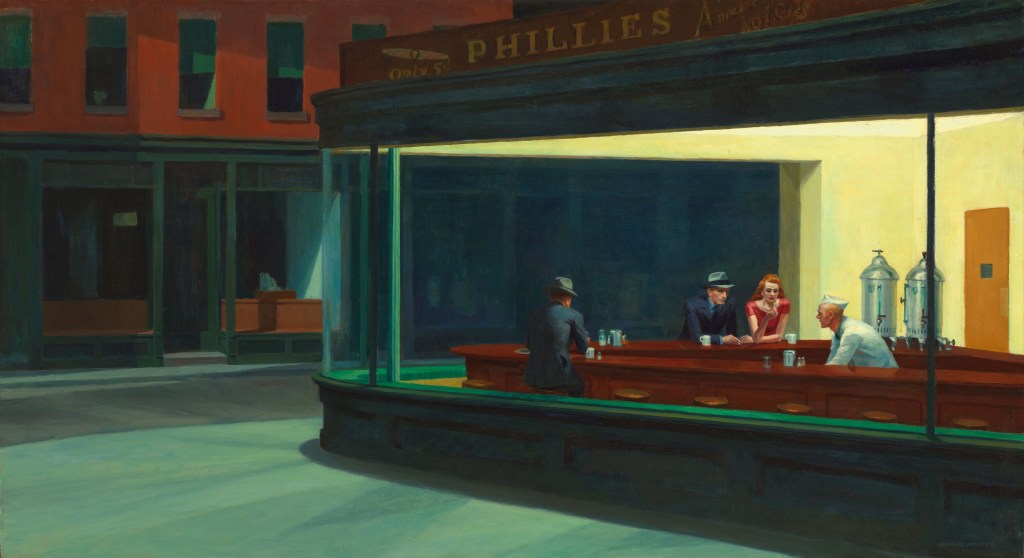
Edward Hopper’s 1942 painting, “Nighthawks” was his best-known piece of art. He commented that, “Nighthawks seems to be the way I think of a night street. I didn’t see it as particularly lonely. I simplified the scene a great deal and made the restaurant bigger. Unconsciously, probably, I was painting the loneliness of a large city.” Later, he again downplayed the loneliness aspect of the painting by stressing that it was just “a restaurant on Greenwich Avenue where two streets meet”.

Source: Hopper by Rolf G. Renner, Taschen, 2020 originally published 1991. Painting, “Nighthawks” by Hopper owned by Daniel Rich. Public domain.

Illuminati for Dummies

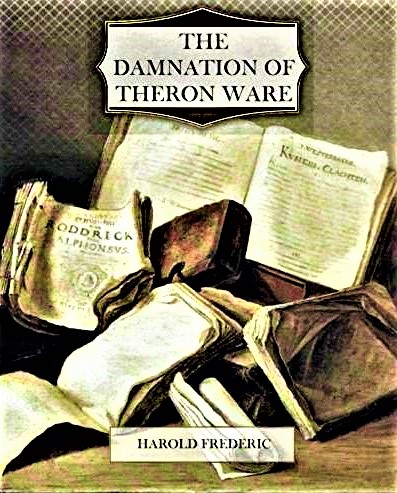
The Damnation of Theron Ware

Written by: Harold Frederic

Originally pPublished by:  Stone and Kimball

Original Copyright:  © 1896B Theron Ware

Harold Frederic, 1856-1898, photographer, journalist, and author, son of Presbyterians, practicing their religion in the churches of Methodists, growing up among immigrant Catholics in upstate New York, adopted a skeptical view of all religions in adulthood. He lived an idiosyncratic life as an unbuttoned, avant-garde individualist, stating near his untimely end in 1897, “I live wholly to myself because I like to live an unshackled life…”. In 1884 he moved to London, bringing along his wife, Grace, and their 5 children, working as a correspondent of the New York Times. He later set up a second household in London with his mistress, Kate Lyon and had 3 additional children by her. His premature death in 1898 left both families in financial difficulty.

Frederic wrote 10 novels, 23 short stories, 2 volumes of non-fiction, and countless newspaper articles over his short life time, but he did not achieve critical acclaim until the publication of his seventh novel: The Damnation of Theron Ware in 1896.  Two other novels followed, Gloria Mundi and The Market Place, cementing his legacy as an accomplished author, on par with, but better known, contemporaries Nathaniel Hawthorne, Mark Twain, Henry James, and Stephen Crane. The posthumously published, The Market Place, was a financial success, alleviating his family’s financial duress.

The Damnation of Theron Ware, likely not autobiographical, but certainly expanding on the author’s experiences growing up in Utica, New York, is a story of a young, naive, married Methodist preacher: Theron Ware, who is posted by his bishop, to a small, conservative, poor congregation in a fictional town in the very real and ancient hills and forests of upstate New York.

Through his witnessing of an Irish worker’s fatal injury, he is innocently introduced to a beautiful, intelligent, but wild, Irish-Catholic young woman named Celia. This encounter sets off a series of faith questioning episodes with this woman and her friends: a priest and a cynical and urbane Catholic scientist; accelerating the protestant minister onto the fast, yet short, road to perdition.  His ensuing infatuation with Celia separates him from his wife. His education at the hands of the Catholic trio separates him from his faith and church. His conversion to religion without god and comprehension separates him from the Catholic trio or more precisely, the Catholics separate from him.

His innocence is gone but his education is incomplete. He is damned.  He concludes that his salvation lies in politics.