Power Corrupts

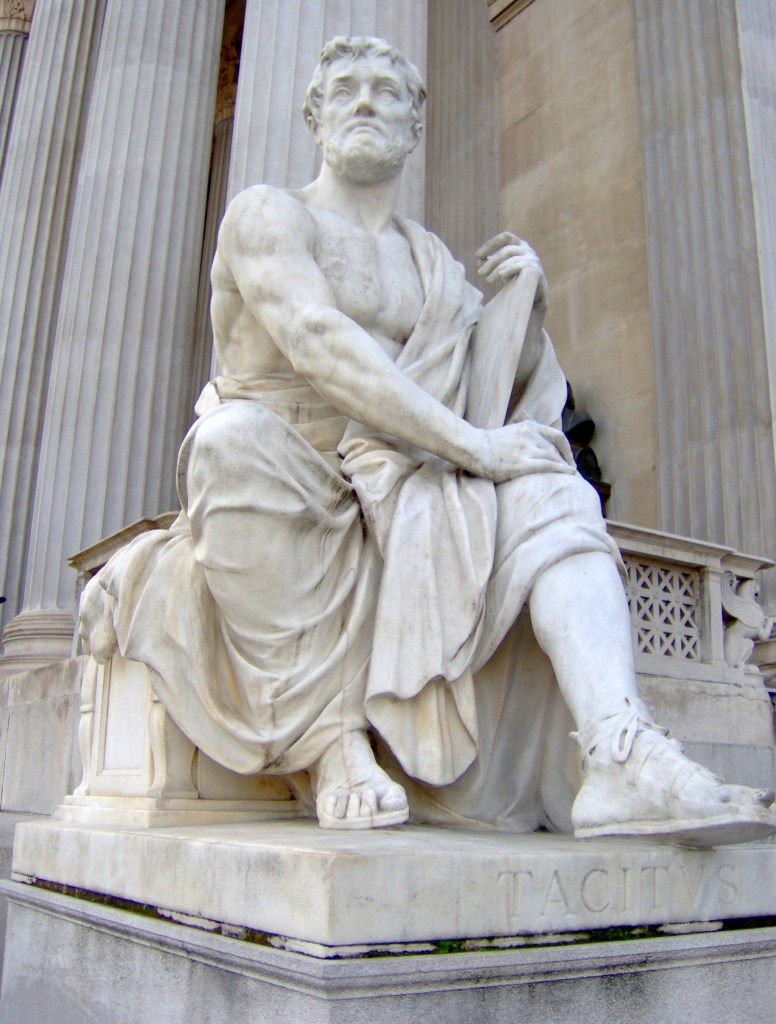
Publius Cornelius Tacitus (c. 56–120 AD), Roman historian, orator, and statesman, was born into a wealthy equestrian family and rose through the imperial system during the Flavian dynasty (Emperors Vespasian, Titus, and Domitian). He began his public career under Vespasian, receiving the latus clavus that marked him for the senatorial track, and entered the Senate itself as quaestor under Titus. His advancement continued under Domitian, whose autocratic rule left a deep imprint on his political philosophy and the cynical tone of his future writings. Tacitus became praetor in 88, suffect consul in 97 under Nerva, and ultimately proconsul of Asia in 112–113 under Trajan; one of the most prestigious governorships available to a senator.

Tacitus’s praenomen has long been debated. Sidonius Apollinaris calls him Gaius, but the principal manuscript tradition gives Publius, now the generally accepted form. The name itself was common in the Republic and famously borne by Publius Valerius Publicola, one of Rome’s early founders. When Hamilton, Madison, and Jay adopted “Publius” as their shared pseudonym for the Federalist Papers, they invoked that republican lineage. The choice was not meant to evoke Tacitus directly, yet the intellectual affinity is unmistakable: the founders read Tacitus closely, admired his moral rigor, and shared his preoccupation with how republics decay into autocracy. Tacitus lays bare the psychology of power and the corrosion of institutions, the hard, universal truth that power corrupts. The Federalist authors attempted to design constitutional structures resistant to precisely those dangers.

Understanding Tacitus’s background clarifies why these themes resonated so strongly. The equestrian order into which he was born had evolved far from its early republican role as a cavalry class. By the first century it had become, in the Roman class hierarchy, a wealthy administrative elite just below the Senate, supplying imperial procurators, financial officers, and provincial administrators; the managerial backbone of the empire. His family’s standing enabled him to enter the cursus honorum under the Flavians: Vespasian (69–79), Titus (79–81), and Domitian (81–96). As a young man he moved from the preparatory rank of the latus clavus into the Senate proper as quaestor, then advanced through praetorship, priesthood, and consulship before receiving the proconsulship of Asia.

Tacitus’s entire political formation occurred under the tutelage of emperors, but it was the republican aristocracy of old that he idealized. He rose because of the imperial system and later turned cynical because of its corrupt morality. The bitterness, irony, and forensic detail of his Histories and Annals emerge from those hard lessons learned at the feet of emperors and from years spent inside the senatorial class.

Your first encounter with Tacitus’s writings is usually one of frustration bordering on bewilderment. Context is sparse, dates are assumed, and linear narrative is treated as optional. To understand him, you must stop reading him as a dry; and his Annals can be dry, dispassionate chronicler of the recent past and start seeing him as a man writing under the weight of hard lessons learned, and sometimes personally endured. His Annals and Histories are not balanced accounts of the early empire; they are the literary equivalent of a post‑mortem. He writes as someone convinced that Rome’s better days were behind it. Everything in his style follows from that conviction: the selective focus, the moral compression, the absence of counterarguments, the uneven chronology, the disproportionate attention to monstrous emperors, and the silence around Rome’s achievements. Like many modern historians, he is heavy on interpretation and opinion, weighted toward failures and abuses, and nearly silent on the empire’s prosperity, engineering feats, or legal innovations such as due process and justice.

Tacitus’s narrative imbalance is not an accident; it is his purpose. In Annals he states, “I write without anger or partiality, for these are feelings I have long put aside… My purpose is to relate… without either bitterness or servility.” He writes for a narrow audience: senators of his own generation, who already knew the timeline, the emperors, the scandals, and the public record. They did not need dates or context; they needed a non‑imperial interpretation. They needed someone to explain how a state that once prided itself on civic virtue and shared governance had become a place where fear, flattery, and corruption were the normal conditions of political life. Tacitus assumes his readers know the “what.” He believed his task was to show them the “why.” That is why the Annals sometimes feel like diary fragments in their immediacy: Tacitus is relying on the imperially sanctioned record while quietly correcting it, without exposing himself to the charge of attacking the regime’s memory. The Histories, written earlier, have a different texture, closer to tragic prose than diary. Tacitus lived through the events they describe; his memory is fresher, his indignation sharper. To him, the Histories were tragedy, and the Annals the farce that served as prologue.

He gives inordinate space to Caligula, Nero, and Vitellius and so little to the emperors who governed competently. The monsters reveal the system’s truth. In Annals he justifies this center of gravity: “Under Tiberius, all was secrecy and suspicion… Nero, who defiled himself by every cruelty and shame.” In Histories he elaborates: “Vitellius… a man who could not rule himself, much less the empire.” Tacitus chooses emperors who embody the moral recidivism he wants to expose. The decent rulers obscure it. He is not interested in balance because balance would dilute his narrative. He is not trying to persuade, only to write a history before the sanitized version takes root. His Rome is a place where power has become addictive, where institutions have rotted from within, where citizens have withdrawn into resignation, and where the machinery of the state grows even as trust declines. That is the world he wants his readers to confront.

This is why Tacitus feels so contemporary. Modern societies that lose confidence in their institutions often follow the same arc he describes. A negative narrative, whether born from war, scandal, abuse of power, or cultural disillusionment, does not only describe the past but also the present. When people internalize a story of corruption or decline, they become less willing to participate, less confident in self‑government, and more susceptible to the quiet expansion of bureaucratic power. Distrust does not produce resistance; it produces apathy. And apathy creates a vacuum. And vacuums are always filled by those willing to seize power. Tacitus watched this happen in Rome: a population that despised the emperors but feared instability more. He expands on this in Histories: “We witness the worst crimes not by the wicked but by the weak.” And again: “The desire for safety is the greatest of dangers.” Citizens gave up freedom for safety and eventually had neither.

Does Tacitus matter today? Probably not because his emperors resemble modern leaders, but because the psychological and structural patterns he describes are universal. When society’s dominant narrative becomes one of failure, corruption, or moral exhaustion, the political consequences tend to run in one direction: more centralization, more administrative power, more resignation, and less freedom. Tacitus is not relevant because he predicted our world; he is relevant because he understood how people behave when they no longer trust their own institutions. His works endure because they capture a recurring human pattern: once power becomes the default solution to fear, it grows, and once it grows, it rarely shrinks except through collapse or death.

The question his writing leaves us with is not whether Rome fell, but whether any society can recover its confidence once it has embraced safety for freedom. In Annals he states, “The more corrupt the state, the more numerous the laws.” This is Tacitus’s worldview in a single stroke: power expands as virtue contracts and freedom fades. In Histories he expands on this thought: “No one has ever wished for power to preserve the liberty of others.” A sentiment the Federalist Papers and the Constitution itself tried to address and avoid. The founders recognized, as Tacitus had before them, that only the restraint of power preserves the liberty it always threatens to consume.

Source: Tacitus: Annals and Histories, 2009, multiple translators. Graphic: Tacitus, Vienna. 2009 Photo by Pe-Jo. Public Domain.
The Sum of All Fears–Real and Imagined

The Peloponnesian War, fought over 27 years (431-404 BC), cost the ancient Greek world nearly everything. War deaths alone approached 8-10 percent of their population: up to 200,000 deaths from battle and plague. The conflict engulfed nearly all of Greece, from the mainland to the Aegean islands, Asia Minor and Sicily. Though Sparta and its allies, in the end, claimed a tactical victory, the war left Greece as a shadow of its former self.

The Golden Age of Athens came to an end. Athenian democracy was replaced, briefly, by the Thirty Tyrants. Sparta, unwilling to jettison its insular oligarchy, failed to adapt to imperial governance, naval power, or diplomatic nuance. Within a generation Sparta was a relic of history.  First challenged by former allies in the Corinthian War, then shattered by Thebes, which stripped the martial city-state of its aura of invincibility along with its helot slave labor base: the economic foundation of Sparta. Another generation later, Macedon under Philip II and Alexander the Great finished off Greek dominance of the Mediterranean. After Alexander’s death in 323 BC, Rome gradually absorbed all the fractured pieces. Proving again, building an empire is easier than keeping one.

Thucydides, heir to the world’s first historian: Herodotus, reduced the origins of the Peloponnesian War to a primal emotion: fear. In Book I of his History of the Peloponnesian War he writes: “The growth of the power of Athens, and the alarm which this inspired in Sparta, made war inevitable.” Athens had violated trade terms under the Megarian Decree with a minor Spartan ally but that was pretext, not cause. Sparta did not go to war over market access. It went to war over fear. Fear of what Athens had become and a future that armies and treaties may not contain.

War and fear go together like flame to fuse. Sparta went to war not for fear of a foe, Sparta knew no such people. It was not fear of an unknown warrior, nor fear of battlefields yet to be choregraphed, but fear of an idea: democracy maintained and backed by Athenian power. And perhaps, more hauntingly precise, fear of itself. Not that it feared it was weak but of what it may become. They feared no sword or spear, their discipline reigned supreme against flesh and blood. Yet no formation, no stratagem, no tactic of war could bring down a simple Athenian belief: the rule of the many, an idea anathema, heretical even, to the Spartan way of life.

So, they marched to war, not to defeat an idea but to silence the source. Not to avenge past aggression but to stop a future annexation. They won battles, small and large. They razed cities. But they only destroyed men. The idea survived. It survived in fragments, bits here, bits there, across time and memory. What it did kill, though, was the spirit of Athens, the Golden Age of Athens. But the idea that was Athens lived on across space and time: chiseled into republics that rose from its ashes and ruins.

The radiance of Athens dimmed to shadow. Socrates became inconvenient. Theater became therapy; a palliative smothering of a cultural surrender. And so, civilization moved to Rome.

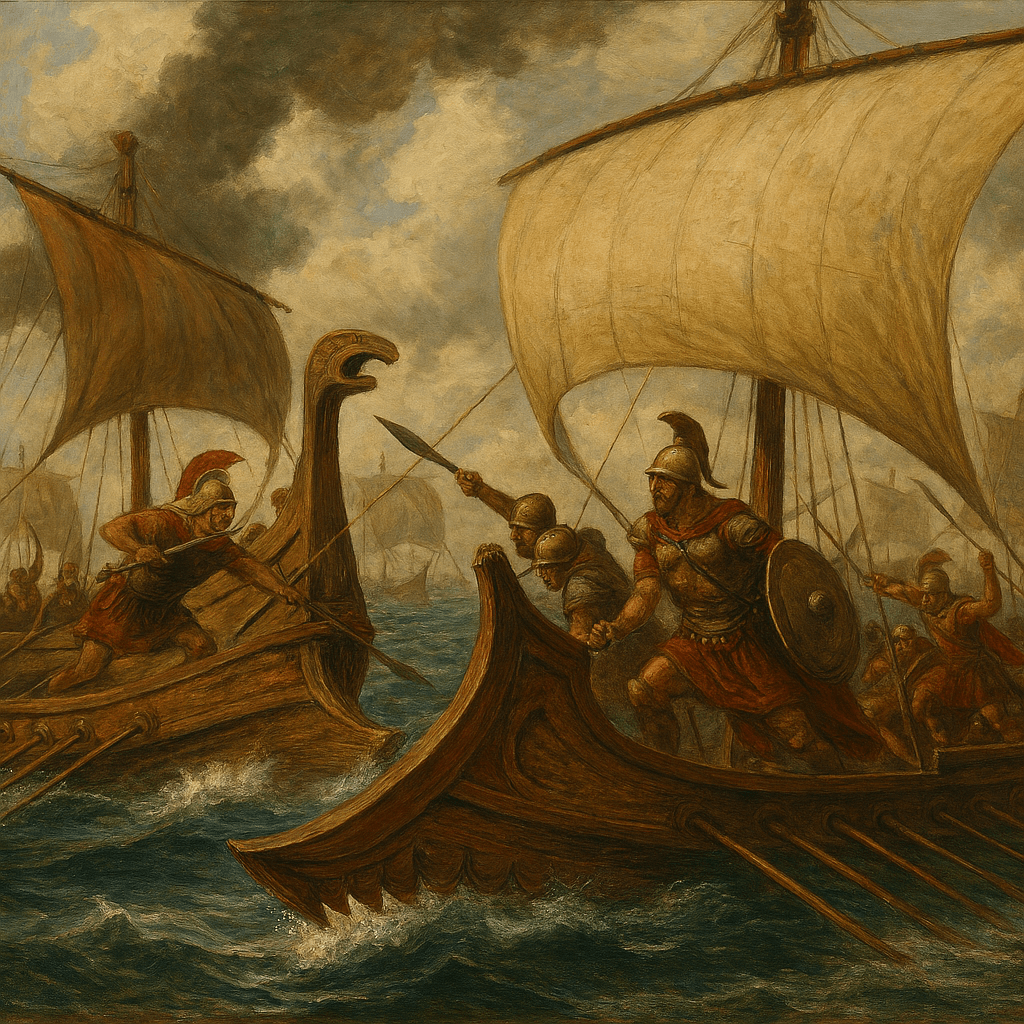
Source: A War Like No Other by Victor Davis Hanson, 2005. History of the Peloponnesian War by Thucydides, Translated by Richard Crawley, 2021. Graphic: Syracuse vs Athens Naval Battle. CoPilot.

The End

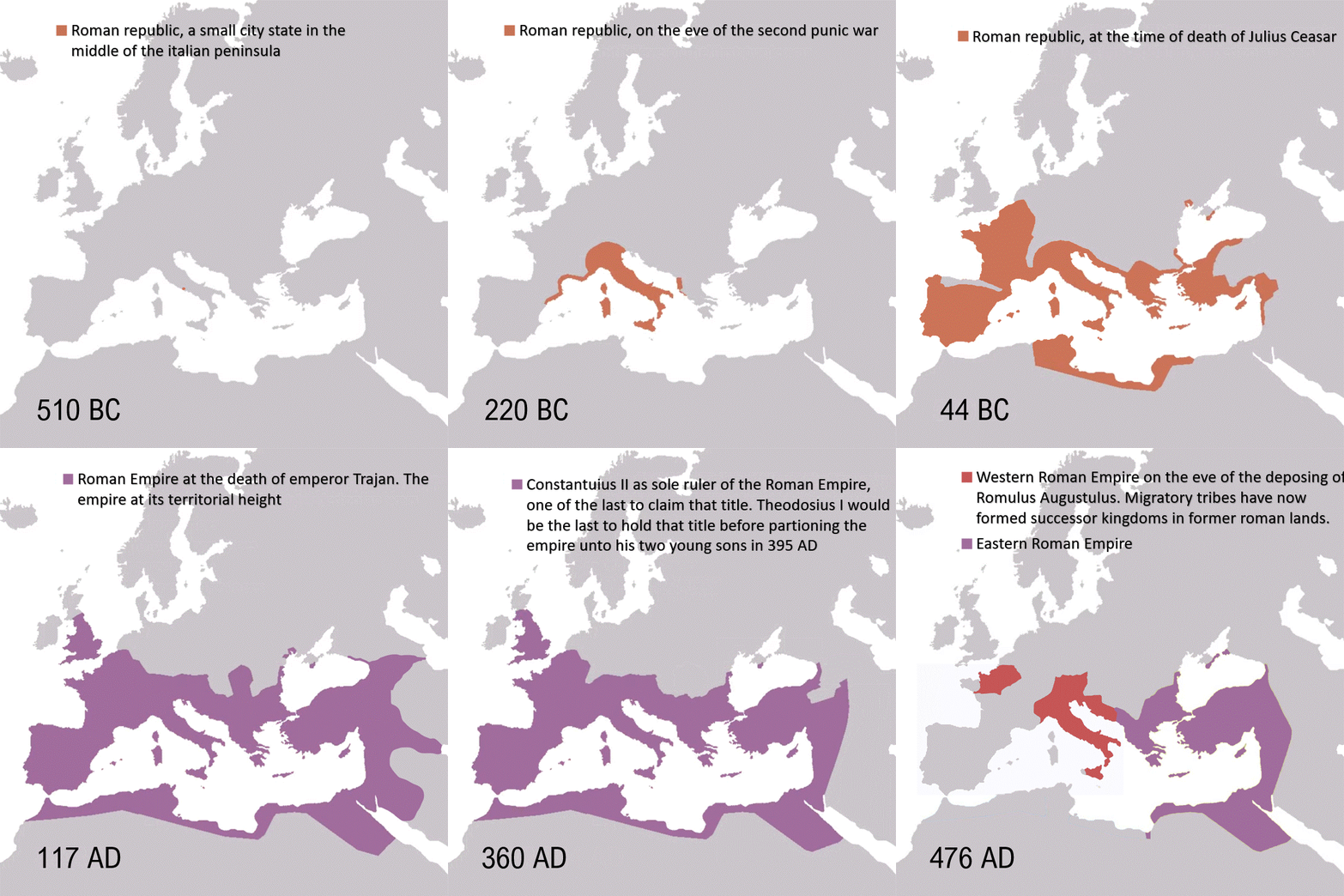
On 16 January 27 BC, the Roman Senate voted to confer the title of Augustus upon Octavian, Julius Caesar’s adopted son, realistically marking the end of the Roman Republic and the beginning of the Roman Empire. This decision aimed to restore stability and order after years of civil war and internal conflict, legitimizing Octavian’s authority while maintaining a veneer of republican governance. Augustus took effective control of the military, religion, bureaucracy, and administrative operations of the empire.

After the assassination of Julius Caesar in 44 BC, Octavian, in 43 BC, formed the Second Triumvirate with Mark Antony and Lepidus. Following their eventual conflict and his decisive victory at the Battle of Actium in 31 BC, Octavian became the uncontested ruler of Rome.

The Roman Empire was the final iteration of the Roman government, which began as a monarchy with Romulus as king in 753 BC, transitioned into a republic in 509 BC, and lasted through the era of civil wars and dictatorships until Octavian’s elevation as Augustus in 27 BC. The Roman Empire as a whole lasted until 476 AD when the Western Empire fell, while the Eastern Empire continued until 1453 AD.

Trivia: 16 January 27 BC, is the actual Julian calendar date, retained and quoted in texts for historical accuracy. According to the Gregorian calendar, however, the date marking the end of the Roman Republic would be 26,27 January 27 BC.

Source: Roman Republic…by M. Vermeulen, The Collector, 2020.  Graphic: Evolution of the Roman Empire, by ESKEHL-Wikipedia, 2022.

The Last Queen

Cleopatra VII, descendant of Alexander the Great’s general Ptolemy Soter, inheriting the Egyptian Empire upon Alexander’s death, was the last pharaoh or queen of Egypt. Upon her death in 30 B.C., less than two weeks after the death of her lover, Mark Antony, she took her own life, likely with a fast-acting poison rather than the bite of an asp. This cleared the way for Augustus, the founder of the Roman Empire, to incorporate Egypt into the Roman realm.

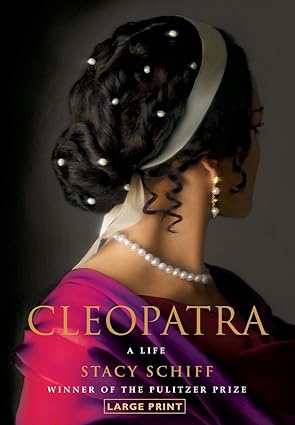
In Cleopatra: A Life, Stacy Schiff weaves an engrossing tale of the queen’s ruthless ambition to restore the Egyptian Empire to its former glory. Though Cleopatra’s life lasted less than 40 years, she brought Rome into her world, achieving greatness that ultimately led to her downfall.

Cleopatra wanted greatness and found the means to attain it. Schiff states in her book that “Cleopatra appears to have had sex with only two men. They happen, however, to have been Julius Caesar and Mark Antony, among the most prominent Romans of the day. …Cleopatra had a child with Caesar and after his murder — three more with his protégé…The two [Cleopatra and Anthony] would together attempt to forge a new empire, in an alliance that spelled their ends.

Source: Cleopatra: A Life by Stacy Shiff, 2010.

Contrived

Conclave: The Pope has died, and Cardinal-Dean Thomas Lawrence (Ralph Fiennes) must convene a Conclave of the College of Cardinals to choose a new Pope. A Conclave acknowledging not so much the guiding hand of God but the vanities of man.

Conclave features stunning visuals and competent acting, yet it is undermined by a script full of amateurish, contrived plot twists designed, supposedly, to advance the writers’ Robert Harris and Straughan’s feverish dreams of utopian Church doctrine rather than create a compelling narrative of suspense detailing the fallibility of man. After 120 minutes of an unending, stacked series of Deus ex machina plot devices, the fatigue reaches a smothering comatose level. Mercifully, the movie ends not with applause but with a resounding sigh of relief that your cinematic suffering is over.

Trivia: According to John Mulderig, under canon law in pectore appointments end with the pope’s death. Cardinal Benitez would not have been allowed into the Conclave.

Genre: Drama-Mystery-Suspense-Thriller

Directed by: Edward Berger

Screenplay by: Peter Straughan

Music by: Volker Bertelmann

Cast: Ralph Fiennes, Stanley Tucci, John Lithgow

Film Location: Rome

ElsBob: 3.0/10

IMDb: 7.5/10

Rotten Tomatoes Critics: 93%

Rotten Tomatoes Popcornmeter: 85%

Metacritic Metascore: 79%

Metacritic User Score: 6.8/10

Theaters: 25 October 2024

Runtime: 120 minutes

Budget: $20 million

Box Office: $34.8 million

Source: Rotten Tomatoes, IMDb, Metacritic.Catholic Review. Graphic: Concave Poster and Trailer, copyright Focus Features

The Roman Jewish Wars

During the first and second centuries AD there were 3 major Jewish revolts against Roman rule in Judea: The first war from 66-73 AD, the Kitos War from 115-117 AD, and the Bar Kokhba Revolt from 132-135 AD. Roman taxation, financial exploitation, religious persecution, oppression, extrajudicial executions, and the plundering of the Second Jewish Temple all contributed to the conflicts.

Roman punishment increased with each successive war eventually leading to wholesale depopulation of Jewish communities by enslavement, death, and exile. It is believed that upwards of 1.3-1.4 million Jews were killed during these revolts, which would have been about one-third of the total worldwide Jewish population. After the Bar Kokhba Revolt the Romans renamed the area Palestina after the Philistines who populated the general area before the 6th century BC.

Source: Josephus. Wikipedia, Heritage-History, WorldHistory, Alchetron, Britannica. Graphic: Roman Triumphal panel from Beth Hatefutsoth showing spoils from the Jewish Temple. Max Morris 2016.

Jewish, Roman, Historian

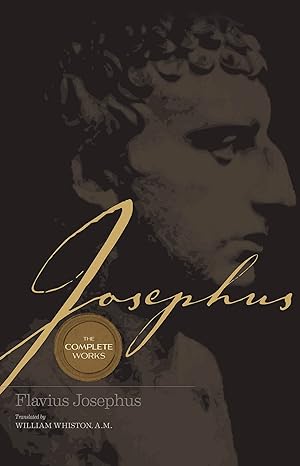
Flavius Josephus, a first century Jewish scholar and historian wrote four extant works:

  1. The Jewish War. (Jewish Revolt) 75 AD – The first revolt against the Romans from 66-73 AD
  2. The Antiquities of the Jews. 95 AD – From Adam to the death of Herod’s sons
  3. Against Apion. 97 AD – A defense of Judaism
  4. Vita or The Life of Flavius. 99 AD – Biography

These works provide significant source material and insight into first-century Judaism and Christianity.

Josephus was born into the Jewish priesthood on his father’s side and of Hasmonean royal descent maternally. He served in the Jewish military during the Jewish War but surrendered to the Romans and he was considered a traitor to Jews ever after. While waiting to be executed by the Romans he predicted that Vespasian would eventually be crowned emperor of Rome. Vespasian, because of the prophecy, spared his life and made him a consultant, but still a slave, to the Roman army. Josephus gained his freedom when Vespasian became emperor in 69 AD, at which time he changed his name to Flavius Josephus. Flavius was the family name of the emperor Vespasian.

Source: Josephus: The Complete Works, 2003. Jewish Virtual Library. World History Encyclopedia.