Real Not Real

Have no fear of perfection; you’ll never reach it.” – Dali.

Salvador Dalí was the entertaining, surrealist voice of the masses. His dreamlike spectacle of melting clocks and flamboyant persona captivated popular culture, injecting eccentric brushstrokes into the lives of the disengaged and disinterested. Dalí spoke directly to the public’s fascination with dreams and absurdity, transforming art into a theatrical experience and a giggly poke at the eminent egos on high altars.

Dalí was a 20th-century Spanish artist who drew from influences such as Renaissance art, Impressionism, and Cubism, but by his mid-twenties, he had fully embraced Surrealism. He spent most of his life in Spain, with notable excursions to Paris during the 1920s and 1930s and to the United States during the World War II years. In 1934, he married the love of his life, Gala. Without her, Dalí might never have achieved his fame. She was not just his muse but also his agent and model. A true partner in both his art and life. Together, they rode a rollercoaster of passion and creativity, thrills and dales, until her death in 1982.

Dalí had strong opinions on art, famously critiquing abstract art as “inconsequential.” He once said, “We are all hungry and thirsty for concrete images. Abstract art will have been good for one thing: to restore its exact virginity to figurative art.” He painted images that were real and with context that bordered on the not real, the surreal. For those who believed that modern abstract art had no life, no beauty, no appeal, he provided a bridge back to a coherent emotional foundation with a dreamlike veneer. Incorporating spirituality and innovative perspectives into his dreams and visions of life.

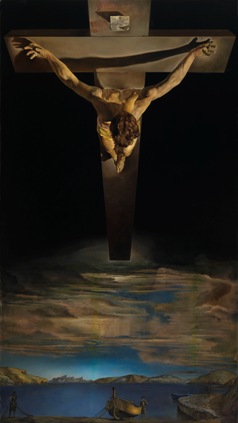
The Persistence of Memory (1931) is Dalí’s most recognizable and famous painting, but his 1951 work Christ of Saint John of the Cross is arguably his most autobiographical and accessible piece. A painting dripping with meaning and perspective, Dalí claimed it came to him in a dream inspired by Saint John of the Cross’s 16th-century sketch of Christ’s crucifixion. The perspective is indirectly informed by Saint John’s vision, while the boat and figures at the bottom reflect influences from La Nain and Velázquez. The triangular shape created by Christ’s body and the cross represents the Holy Trinity, while Christ’s head, a circular nucleus, signifies unity and eternity: “the universe, the Christ!” Dalí ties himself personally to the crucifixion by placing Port Lligat, his home, in the background. He considered this painting a singular and unique piece of existence, one he likely could never reproduce because the part of him that went into the painting was gone forever.That part is shared with his viewers, offering a glimpse into Christ’s pain, Dalí’s anguish, and his compassion: an emotional complexity that transcends mortal comprehension.

Source: Salvador Dali by Robert Descharnes, 1984. Graphic: Christ of Saint John of the Cross, Dali, 1951. Low Res. Copyright Glasgow Corporation.

Swollen Caricatures

Fernando Botero Angulo, 1932-2023, was a Columbian practitioner of figuraism in paint and sculpture, a style where reality is discernable but changed to reflect the artist’s interpretation of his or her world. His unique style has taken on a life of its own and has become known as Boterismo where he exaggerates reality by inflating his objects, mimicking a fat farm on a carbo diet, injecting, according to some, a humor inherent in his plus sized models but it all seems so melodramatic. A melancholic need to explore life’s downsides, forcing the viewer to share not the beauty of life but its complexities and vulnerabilities. There is no happiness in his paintings, just a humorless life.

His style, not far removed from Legar’s Tubism, was the artist’s attempt to find himself and to relieve the self-inflicted anxiety that came from his mode of outward expression not matching his inward vision. He states that “…the moment comes when the painter manages to master the technique and at the same time all of his ideas become clear: at that point his desire to transpose them faithfully onto the canvas becomes so clear and compelling that painting becomes joy itself.”

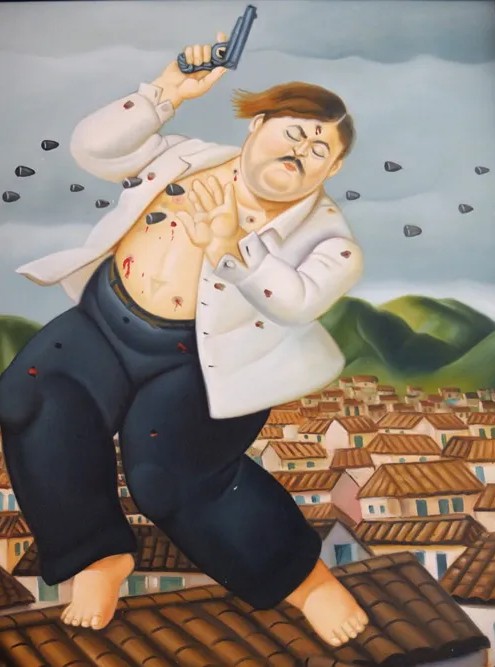
Botero’s 1999 painting, “The Death of Pablo Escobar”, a mafioso interpretation of Chagall’s “Fidler on the Roof”, was an attempt to capture the violence that the drug kingpin brought to Columbia and the world. Standing atop Columbian society, Escobar was laid low by his chosen swordian method of rule: bullets. The artist’s son Juan Carlos Botero states that his father wanted to reflect on the magnitude of the tragedy that Escobar’s actions meant for Columbia, but he also magnified the beast in the man, reminding the world that Columbia and Escobar were once synonymous. A cruel man ruling over a dysfunctional society that he created.

Source: Botero by Rudy Chiappini, 2015. Graphic: The Death of Pablo Escobar by Botero, 1999.

Chagall and Expressionism

Art critic Raimond Cogniat described Marc Chagall as an artist of opposites, a painter who thrived in the interplay of form and color, color and meaning. Chagall infused his paintings with love and happiness, crafting worlds that felt both fantastical and deeply alive. He shaped reality from his feelings, “making it conform to his inner spiritual logic,” even if, as he once confessed, he wasn’t entirely conscious of his process.

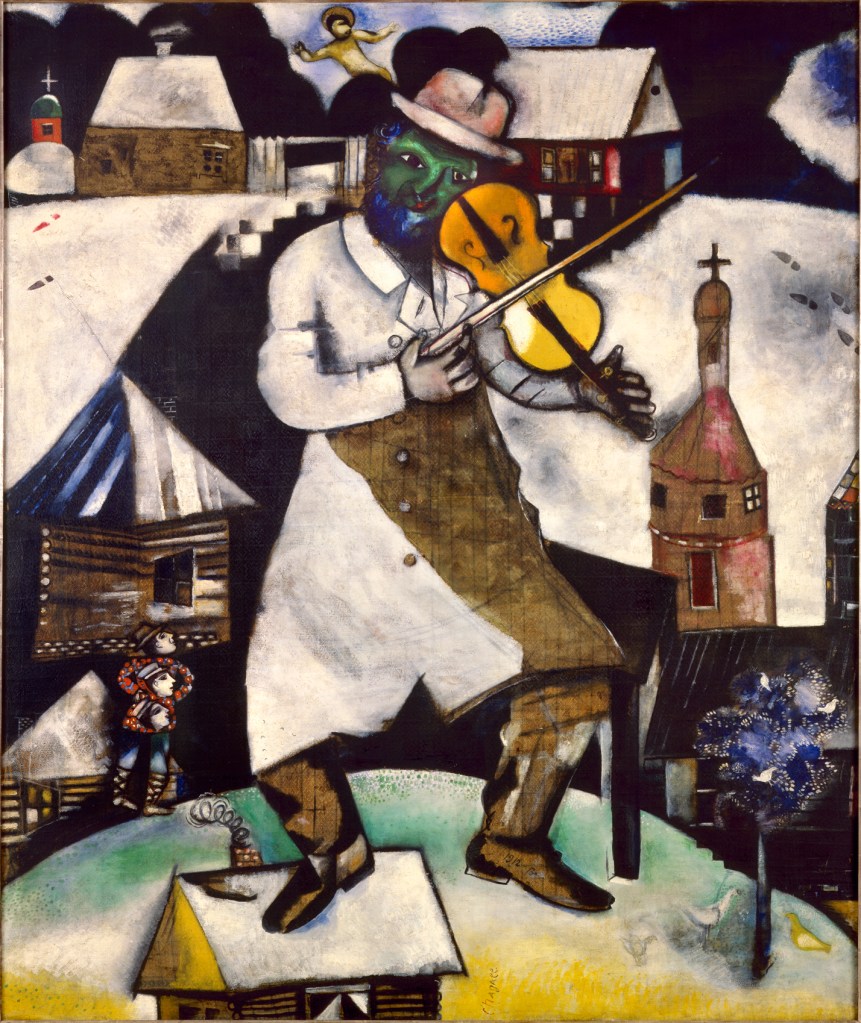
Born Moishe Shagal in 1887 in Vitebsk (now Belarus), Chagall grew up in a Jewish enclave within the Russian Empire. He later embraced France as his adoptive home, blending his Eastern European roots with French artistic flair. Though he briefly explored Cubism during its peak in the early 20th century, he thankfully abandoned that style to carve his own path as an expressionist. Vivid, otherworldly colors, and exaggerated forms defined his style, while his Jewish heritage, evident in depictions of shtetl life, fiddlers, and biblical scenes, remained his anchor. His 1912–1913 painting The Fiddler is said to have inspired the title of the musical Fiddler on the Roof.

In a 1963 speech to an American audience, Chagall reflected on his philosophy: “Any moral crisis is a crisis of color, texture, blood and the elements, of speech, vibration, etc.—the materials with which art, like life, is constructed. Even when mountains of color are piled on a canvas, if one can discern no single object even through great sound and vibration, this will not necessarily give authenticity.” To Chagall, authenticity was more than paint; it demanded the infusion of human experience, blood, and the essence of nature.

Source: Chagall by Raimond Cogniat, translated by Ann Ross, 1977. Graphic: The Fiddler, Chagall, 1912-1913. Public Domain

Americana

Norman Rockwell, a name synonymous with American Realism, was a master of meticulous detail, yet he never failed to brush a thread of whimsy and rustic existence onto the canvases of his iconic paintings.

Norman Rockwell, an iconic painter of American life, was born on 3 February 1894 into a comfortable New York City family. His father, a lover of Charles Dickens, often sketched illustrations from books, planting early seeds of creativity in young Norman. His mother, overprotective yet proud of her English heritage, spoke often of her artistic but unsuccessful father, whose unrealized dreams seemed to echo in the household. Art wasn’t just a pastime for Rockwell; it pulsed through him, and by age 12, he had resolved to draw for a living, though painting would come later in his journey as an artist.

As a teenager, Rockwell pursued artistic training at the National Academy of Design and later at the Art Students League, where he studied under the influence of Howard Pyle, the renowned illustrator of boys’ adventure tales. Pyle, who had founded the school’s philosophy through his own teachings and legacy, left an indelible mark on Rockwell, shaping his lifelong passion for weaving narrative into art. Before he turned 16, Rockwell landed his first commission—four Christmas cards—a modest start for a boy already dreaming big. By 18, he was painting professionally full-time, his talent unfolding with the quiet determination of youth finding its purpose.

In 1916, Rockwell began his legendary run with The Saturday Evening Post, creating covers that would grace the magazine for the next 47 years. Over that span, 322 of his paintings became what the Post proudly dubbed “the greatest show window in America.” Through these works, Rockwell offered a mirror to the nation—sometimes nostalgic, often tender, always human—reflecting everyday moments that resonated deeply with millions.

While his career soared with the Post, city life never suited him. In 1939, he traded New York’s clamor for the rolling hills of Vermont, and later, in 1953, settled in Massachusetts. These rural landscapes became his muse, dominating his canvases for the first three decades of his career. Rockwell was no haphazard artist; he was methodical, even obsessive, following a rigorous six-step process to bring his visions to life: brainstorming ideas, sketching rough outlines, photographing staged scenes with real people, crafting detailed drawings, experimenting with color studies, and only then committing paint to canvas. Each step was a labor of love, a tip of the hat to the America he loved.

At the heart of his art was a simple, profound drive. As Rockwell himself put it, “Without thinking too much about it in specific terms, I was showing the America I knew and observed to others who might not have noticed.” His paintings weren’t just pictures, they were invitations to see the beauty in the ordinary, the dignity in the overlooked; we see not just an artist, but a storyteller who believed in the quiet goodness of people, brushstroke by brushstroke.

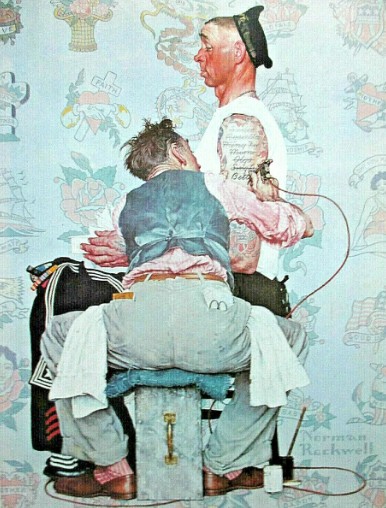
Source: The Norman Rockwell Treasury by Thomas S. Buechner, 1979. Norman Rockwell Museum. Graphic: The Tattooist by Norman Rockwell, 1944, The Brooklyn Museum.

Hundred Days

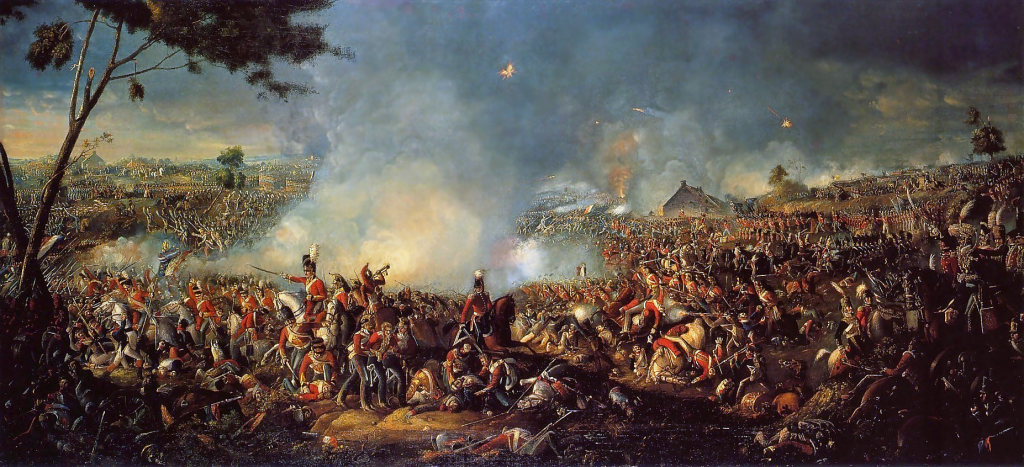
Napoleon Bonaparte, reeling from his disastrous Russian campaign of 1812 and suffering significant losses to the Sixth Coalition in 1813, faced a decisive defeat at the Battle of Leipzig in October of that year. With his options exhausted and his army depleted, Napoleon abdicated his throne on 11 April 1814, and was exiled to Elba, a small island off the coast of Tuscany.

After approximately ten months in captivity, Napoleon executed a daring escape on 26 February 1815, orchestrated by loyal supporters and a small contingent of soldiers. He landed in France and marched triumphantly into Paris on 20th of March, reclaiming his title as Emperor and ushering in his second reign. This brief resurgence, however, ended with his defeat at the Battle of Waterloo on 18 June 1815, at the hands of the Duke of Wellington and Prussian Field Marshal Gebhard Leberecht von Blücher. The victorious Anglo-Prussian forces entered Paris on 7th of July restoring King Louis XVIII to the French throne and effectively concluding Napoleon’s reign—later dubbed the “Hundred Days” (20 March to 8 July) in historical accounts.

Unable to flee to the United States as he had hoped, Napoleon surrendered to the British Navy and was transported to England. From there, he was exiled to the remote island of Saint Helena in the South Atlantic, arriving there on 15 October 1815. He spent his final years there, dying on 5 May 1821.

Source: Napoleon by André Castelot, 1991. Graphic: Battle of Waterloo by William Sadler, 1815 (Public Domain).

Four Women of the Renaissance

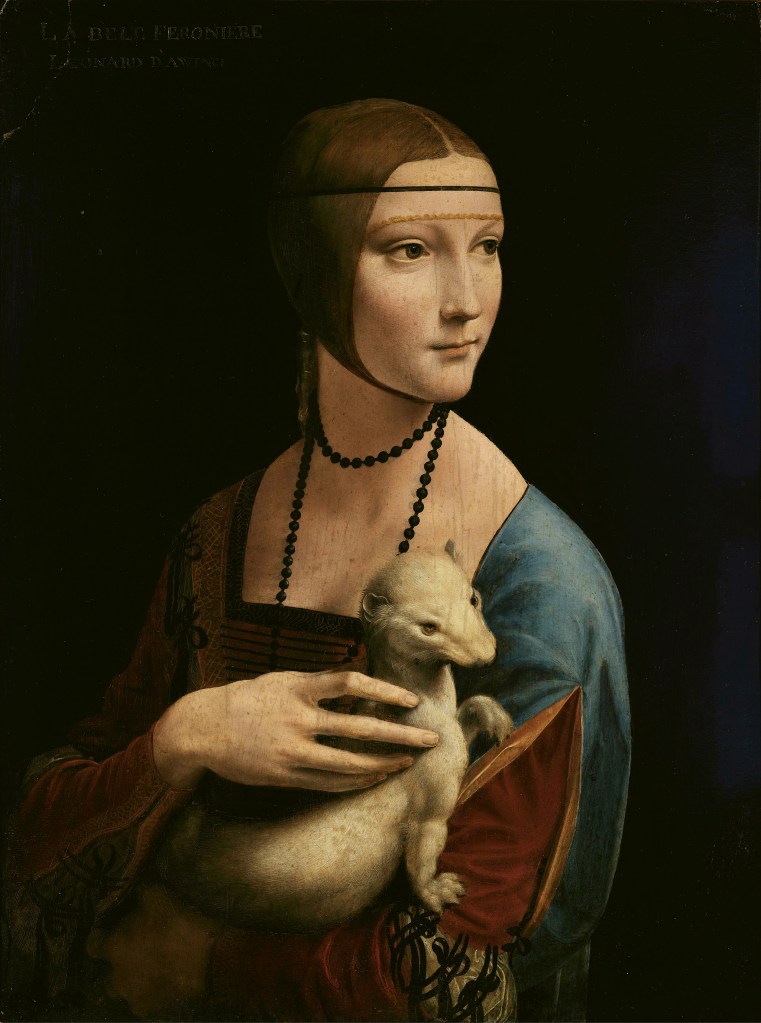
Leonardo da Vinci, who died on May 2, 1519 at the age of 67, began around 40 paintings in his lifetime, of which fewer than 20 survive. Of those that survive, only about 15 are believed to be complete.

The artist painted only four known portraits of women:

  • Ginevra de’ Benci at the National Gallery of Art in Washington, D.C.
  • La Belle Ferronnière at the Louvre Museum in Paris.
  • Mona Lisa also at the Louvre Museum in Paris.
  • Cecilia Gallerani (known as “Lady with an Ermine“) at the Czartoryski Museum in Krakow, Poland.

Cecilia Gallerani was the mistress of Ludovico Sforza, Duke of Milan, and was painted while da Vinci worked in the Duke’s court in Milan, Italy. The Polish government paid 100 million Euros for the painting in 2016.

Trivia: Many believe that Leonardo da Vinci continuously reworked the Mona Lisa throughout his life; it was still in his possession when he died. The fact that the Mona Lisa does not have eyebrows suggests, to me, that the painting was still unfinished. The absence of eyebrows in the Mona Lisa has led to other theories as well:

  • Others argue that da Vinci might have intentionally left them out for artistic reasons.
  • There’s also the theory that the eyebrows might have faded over time due to the varnish or other conservation issues.

Source: Leonardo da Vinci by Walter Isaacson, 2017. Graphic: Lady with and Ermine by da Vinci, public domain.

Sarcasm Slightly Cold

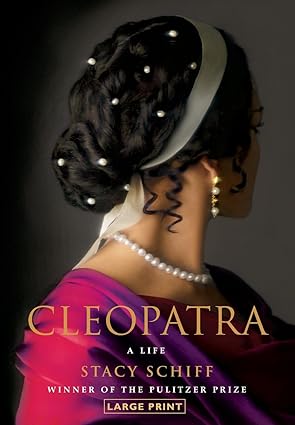
Stacy Schiff, biographer of Cleopatra VII and history of Egypt and Rome during her reign as Egypt’s queen is an entertaining writer with a sardonic sense of humor.

Wit of Schiff I: Cleopatra and Mark Anthony, after a three-year separation, reunited in 37 BC in Antioch. They rekindle their relationship, Cleopatra becomes pregnant, and they part again in early 36 BC, he for a military campaign in Parthia and she to go south to meet with Herod in Jerusalem.

In the course of the visit she met Herod’s fractious extended family…Herod had the misfortune to share an address with several implacable enemies, first among them his contemptuous, highborn mother-in-law, Alexandra…his insinuating mother; a grievance-loving, overly loyal sister; and Mariamme, the cool, exceptionally beautiful wife…who to his frustration, somehow could never get past the fact that Herod had murdered half her family.

Wit of Schiff II: Mark Anthony after conquering Armenia, which included parts of modern Turkey and Azerbaijan, in 34 BC, “returned to Alexandria in triumph, taking with him not only the collected treasure of Armenia, but its King, his wife, their children, and the provincial governors. Out of deference to their rank, he bound the royal family in chains of gold.

Trivia: No good, confirmed likenesses of either Cleopatra or Herod exist. Recently a bust from the Egyptian Taposiris Magna temple near Alexandria has been recovered which the archaeologist, Kathleen Martinez claims is a likeness of Cleopatra. Other experts disagree.

Source: Cleopatra: A Life by Stacy Shiff, 2010. Marble Bust Found, Gadgets 360, 2024.

The Last Queen

Cleopatra VII, descendant of Alexander the Great’s general Ptolemy Soter, inheriting the Egyptian Empire upon Alexander’s death, was the last pharaoh or queen of Egypt. Upon her death in 30 B.C., less than two weeks after the death of her lover, Mark Antony, she took her own life, likely with a fast-acting poison rather than the bite of an asp. This cleared the way for Augustus, the founder of the Roman Empire, to incorporate Egypt into the Roman realm.

In Cleopatra: A Life, Stacy Schiff weaves an engrossing tale of the queen’s ruthless ambition to restore the Egyptian Empire to its former glory. Though Cleopatra’s life lasted less than 40 years, she brought Rome into her world, achieving greatness that ultimately led to her downfall.

Cleopatra wanted greatness and found the means to attain it. Schiff states in her book that “Cleopatra appears to have had sex with only two men. They happen, however, to have been Julius Caesar and Mark Antony, among the most prominent Romans of the day. …Cleopatra had a child with Caesar and after his murder — three more with his protégé…The two [Cleopatra and Anthony] would together attempt to forge a new empire, in an alliance that spelled their ends.

Source: Cleopatra: A Life by Stacy Shiff, 2010.

Amor Fati

Marcus Aurelius in “Meditations” reflects and instructs continuously on living harmoniously within the constructs of the universe, nature, and reason.

His philosophical foundation, Stoicism, meant living virtuously and rationally within a structured system that he believed was a manifestation of “Logos”, the rational principle that governs the universe. “Logos” can be understood as a divine rationality or intelligence that permeates and directs the universe.

Reason or “Logos” is the central pillar of Stoicism and is the guiding principle that governs the universe. Rational thought, rather than emotional impulse, is about seeking wisdom, demonstrating courage, seeking justice, and exercising temperance: living virtuously.

Nature means understanding that everything in life is interconnected, that all life is part of a larger, harmonious system governed by reason.

The Universe, to Stoics, is a well-ordered system where all actions happen for a reason. Stoics believed that one must live in harmony with the universe and embrace “Amor Fati”, accepting fate and focusing only on matters within one’s control.

Source: Meditations by Marcus Aurelius. Friedrich Nietzsche.

Life Goes On

Marcus Aurelius, the last Stoic, stays his fear of death by believing that life’s pauses and changes are preludes to death of which we should not fear. He stated in Book IX of his Meditations: “[as you] …pass to the ages of your life, boyhood for instance, youth, manhood, old age; for each change of these was a death; was there anything to be afraid of?”

This comes directly from Heraclitus, a Greek philosopher and influencer of the first Stoic: Zeno, stating that, “The living and the dead, the sleeper and the watcher, the young and the old are the same.

St. Augustine in Confessions rephrases Marcus and Heraclitus with the joyful question; “And lo! My infancy died long since, and I am alive… Declare to me, your suppliant, did my infancy succeed to some age of mine that is also dead?

Joseph Butler, Christian apologist and philosopher, carries the thought to its logical conclusion, writing: “We have passed undestroyed through those many and great resolutions of matter, so peculiarly appropriated to us ourselves; why should we imagine death will be so fatal to us?”

Butler’s argument is that if we’ve survived many transformations throughout our lives, there’s no reason to believe that death would be our ultimate end. His view is grounded in the belief that our continued existence after death is consistent with the enduring nature of our existence during life.

Source: Meditations by Marcus Aurelius, edited by Farquharson. Graphic: The Last Judgement by Michelangelo, Sistine Chapel. Public Domain.