Power Corrupts

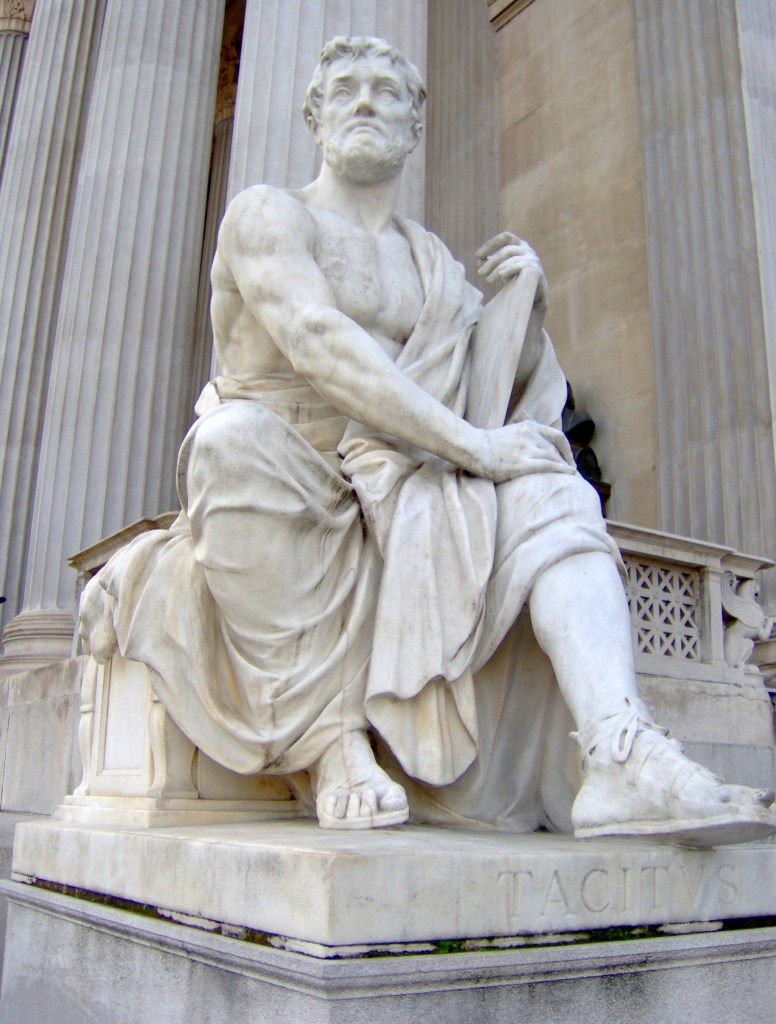
Publius Cornelius Tacitus (c. 56–120 AD), Roman historian, orator, and statesman, was born into a wealthy equestrian family and rose through the imperial system during the Flavian dynasty (Emperors Vespasian, Titus, and Domitian). He began his public career under Vespasian, receiving the latus clavus that marked him for the senatorial track, and entered the Senate itself as quaestor under Titus. His advancement continued under Domitian, whose autocratic rule left a deep imprint on his political philosophy and the cynical tone of his future writings. Tacitus became praetor in 88, suffect consul in 97 under Nerva, and ultimately proconsul of Asia in 112–113 under Trajan; one of the most prestigious governorships available to a senator.

Tacitus’s praenomen has long been debated. Sidonius Apollinaris calls him Gaius, but the principal manuscript tradition gives Publius, now the generally accepted form. The name itself was common in the Republic and famously borne by Publius Valerius Publicola, one of Rome’s early founders. When Hamilton, Madison, and Jay adopted “Publius” as their shared pseudonym for the Federalist Papers, they invoked that republican lineage. The choice was not meant to evoke Tacitus directly, yet the intellectual affinity is unmistakable: the founders read Tacitus closely, admired his moral rigor, and shared his preoccupation with how republics decay into autocracy. Tacitus lays bare the psychology of power and the corrosion of institutions, the hard, universal truth that power corrupts. The Federalist authors attempted to design constitutional structures resistant to precisely those dangers.

Understanding Tacitus’s background clarifies why these themes resonated so strongly. The equestrian order into which he was born had evolved far from its early republican role as a cavalry class. By the first century it had become, in the Roman class hierarchy, a wealthy administrative elite just below the Senate, supplying imperial procurators, financial officers, and provincial administrators; the managerial backbone of the empire. His family’s standing enabled him to enter the cursus honorum under the Flavians: Vespasian (69–79), Titus (79–81), and Domitian (81–96). As a young man he moved from the preparatory rank of the latus clavus into the Senate proper as quaestor, then advanced through praetorship, priesthood, and consulship before receiving the proconsulship of Asia.

Tacitus’s entire political formation occurred under the tutelage of emperors, but it was the republican aristocracy of old that he idealized. He rose because of the imperial system and later turned cynical because of its corrupt morality. The bitterness, irony, and forensic detail of his Histories and Annals emerge from those hard lessons learned at the feet of emperors and from years spent inside the senatorial class.

Your first encounter with Tacitus’s writings is usually one of frustration bordering on bewilderment. Context is sparse, dates are assumed, and linear narrative is treated as optional. To understand him, you must stop reading him as a dry; and his Annals can be dry, dispassionate chronicler of the recent past and start seeing him as a man writing under the weight of hard lessons learned, and sometimes personally endured. His Annals and Histories are not balanced accounts of the early empire; they are the literary equivalent of a post‑mortem. He writes as someone convinced that Rome’s better days were behind it. Everything in his style follows from that conviction: the selective focus, the moral compression, the absence of counterarguments, the uneven chronology, the disproportionate attention to monstrous emperors, and the silence around Rome’s achievements. Like many modern historians, he is heavy on interpretation and opinion, weighted toward failures and abuses, and nearly silent on the empire’s prosperity, engineering feats, or legal innovations such as due process and justice.

Tacitus’s narrative imbalance is not an accident; it is his purpose. In Annals he states, “I write without anger or partiality, for these are feelings I have long put aside… My purpose is to relate… without either bitterness or servility.” He writes for a narrow audience: senators of his own generation, who already knew the timeline, the emperors, the scandals, and the public record. They did not need dates or context; they needed a non‑imperial interpretation. They needed someone to explain how a state that once prided itself on civic virtue and shared governance had become a place where fear, flattery, and corruption were the normal conditions of political life. Tacitus assumes his readers know the “what.” He believed his task was to show them the “why.” That is why the Annals sometimes feel like diary fragments in their immediacy: Tacitus is relying on the imperially sanctioned record while quietly correcting it, without exposing himself to the charge of attacking the regime’s memory. The Histories, written earlier, have a different texture, closer to tragic prose than diary. Tacitus lived through the events they describe; his memory is fresher, his indignation sharper. To him, the Histories were tragedy, and the Annals the farce that served as prologue.

He gives inordinate space to Caligula, Nero, and Vitellius and so little to the emperors who governed competently. The monsters reveal the system’s truth. In Annals he justifies this center of gravity: “Under Tiberius, all was secrecy and suspicion… Nero, who defiled himself by every cruelty and shame.” In Histories he elaborates: “Vitellius… a man who could not rule himself, much less the empire.” Tacitus chooses emperors who embody the moral recidivism he wants to expose. The decent rulers obscure it. He is not interested in balance because balance would dilute his narrative. He is not trying to persuade, only to write a history before the sanitized version takes root. His Rome is a place where power has become addictive, where institutions have rotted from within, where citizens have withdrawn into resignation, and where the machinery of the state grows even as trust declines. That is the world he wants his readers to confront.

This is why Tacitus feels so contemporary. Modern societies that lose confidence in their institutions often follow the same arc he describes. A negative narrative, whether born from war, scandal, abuse of power, or cultural disillusionment, does not only describe the past but also the present. When people internalize a story of corruption or decline, they become less willing to participate, less confident in self‑government, and more susceptible to the quiet expansion of bureaucratic power. Distrust does not produce resistance; it produces apathy. And apathy creates a vacuum. And vacuums are always filled by those willing to seize power. Tacitus watched this happen in Rome: a population that despised the emperors but feared instability more. He expands on this in Histories: “We witness the worst crimes not by the wicked but by the weak.” And again: “The desire for safety is the greatest of dangers.” Citizens gave up freedom for safety and eventually had neither.

Does Tacitus matter today? Probably not because his emperors resemble modern leaders, but because the psychological and structural patterns he describes are universal. When society’s dominant narrative becomes one of failure, corruption, or moral exhaustion, the political consequences tend to run in one direction: more centralization, more administrative power, more resignation, and less freedom. Tacitus is not relevant because he predicted our world; he is relevant because he understood how people behave when they no longer trust their own institutions. His works endure because they capture a recurring human pattern: once power becomes the default solution to fear, it grows, and once it grows, it rarely shrinks except through collapse or death.

The question his writing leaves us with is not whether Rome fell, but whether any society can recover its confidence once it has embraced safety for freedom. In Annals he states, “The more corrupt the state, the more numerous the laws.” This is Tacitus’s worldview in a single stroke: power expands as virtue contracts and freedom fades. In Histories he expands on this thought: “No one has ever wished for power to preserve the liberty of others.” A sentiment the Federalist Papers and the Constitution itself tried to address and avoid. The founders recognized, as Tacitus had before them, that only the restraint of power preserves the liberty it always threatens to consume.

Source: Tacitus: Annals and Histories, 2009, multiple translators. Graphic: Tacitus, Vienna. 2009 Photo by Pe-Jo. Public Domain.

The End

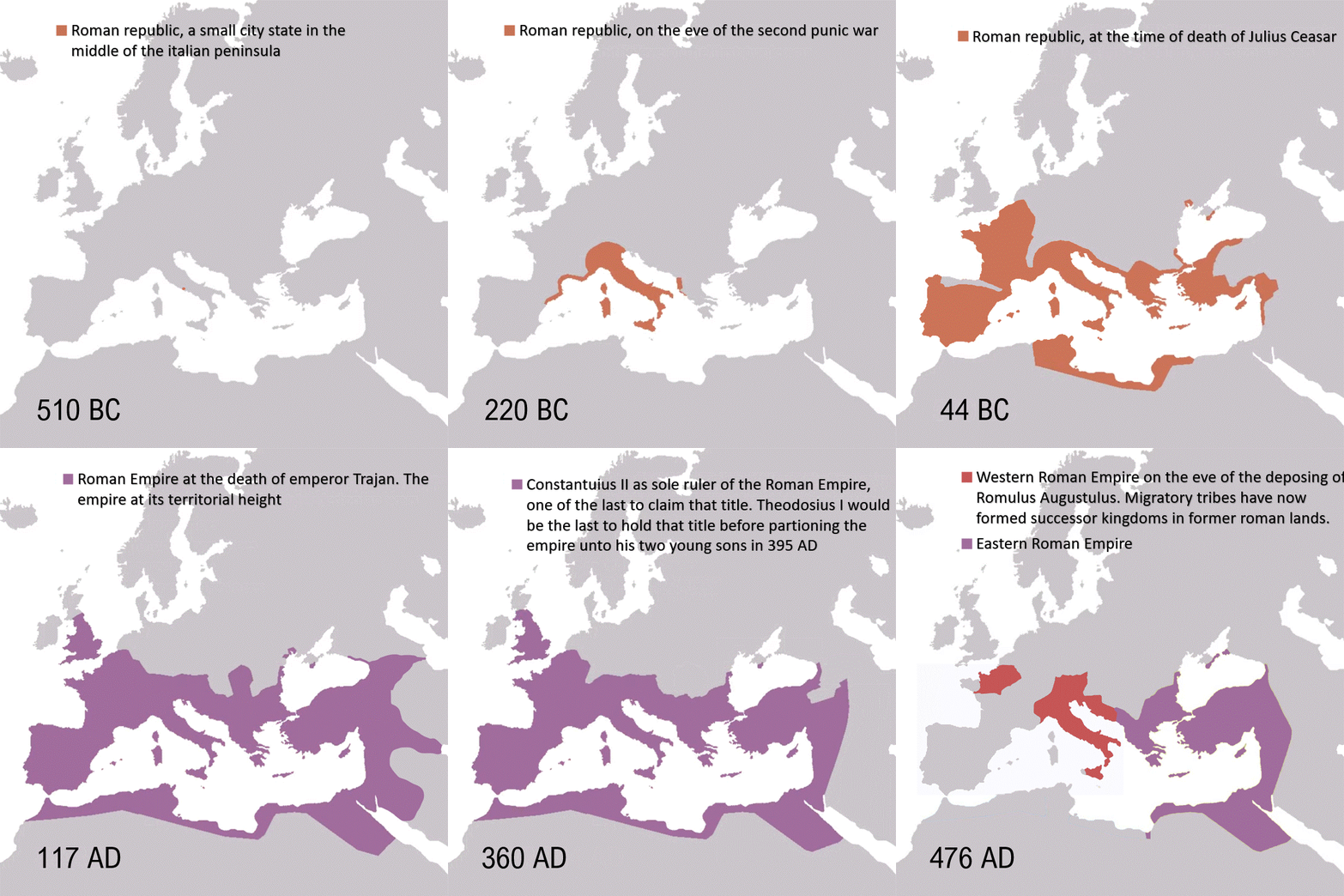
On 16 January 27 BC, the Roman Senate voted to confer the title of Augustus upon Octavian, Julius Caesar’s adopted son, realistically marking the end of the Roman Republic and the beginning of the Roman Empire. This decision aimed to restore stability and order after years of civil war and internal conflict, legitimizing Octavian’s authority while maintaining a veneer of republican governance. Augustus took effective control of the military, religion, bureaucracy, and administrative operations of the empire.

After the assassination of Julius Caesar in 44 BC, Octavian, in 43 BC, formed the Second Triumvirate with Mark Antony and Lepidus. Following their eventual conflict and his decisive victory at the Battle of Actium in 31 BC, Octavian became the uncontested ruler of Rome.

The Roman Empire was the final iteration of the Roman government, which began as a monarchy with Romulus as king in 753 BC, transitioned into a republic in 509 BC, and lasted through the era of civil wars and dictatorships until Octavian’s elevation as Augustus in 27 BC. The Roman Empire as a whole lasted until 476 AD when the Western Empire fell, while the Eastern Empire continued until 1453 AD.

Trivia: 16 January 27 BC, is the actual Julian calendar date, retained and quoted in texts for historical accuracy. According to the Gregorian calendar, however, the date marking the end of the Roman Republic would be 26,27 January 27 BC.

Source: Roman Republic…by M. Vermeulen, The Collector, 2020.  Graphic: Evolution of the Roman Empire, by ESKEHL-Wikipedia, 2022.

The Last Queen

Cleopatra VII, descendant of Alexander the Great’s general Ptolemy Soter, inheriting the Egyptian Empire upon Alexander’s death, was the last pharaoh or queen of Egypt. Upon her death in 30 B.C., less than two weeks after the death of her lover, Mark Antony, she took her own life, likely with a fast-acting poison rather than the bite of an asp. This cleared the way for Augustus, the founder of the Roman Empire, to incorporate Egypt into the Roman realm.

In Cleopatra: A Life, Stacy Schiff weaves an engrossing tale of the queen’s ruthless ambition to restore the Egyptian Empire to its former glory. Though Cleopatra’s life lasted less than 40 years, she brought Rome into her world, achieving greatness that ultimately led to her downfall.

Cleopatra wanted greatness and found the means to attain it. Schiff states in her book that “Cleopatra appears to have had sex with only two men. They happen, however, to have been Julius Caesar and Mark Antony, among the most prominent Romans of the day. …Cleopatra had a child with Caesar and after his murder — three more with his protégé…The two [Cleopatra and Anthony] would together attempt to forge a new empire, in an alliance that spelled their ends.

Source: Cleopatra: A Life by Stacy Shiff, 2010.

Apologetics

Eusebius: The Church History

By Eusebius (of Caesarea)

Translated by Paul L. Maier

Kregel Academic

Copyright: © 2007

Original Publication Dates: 313-326 AD

Original Title: Eusebius: Ecclesiastical History

AmazonPicture

Maier Biography:

Paul L. Maier, born 1930 in St. Louis, author, public speaker, and historian has written twenty-three adult and children, fiction and non-fiction, books about Christianity. He is the son of Walter A. Maier, founder, and speaker of The Lutheran Hour.

He graduated from Harvard and Concordia Seminary in St. Louis with additional studies in Heidelberg, Germany and Basel, Switzerland. He was the Seibert Professor of Ancient History at Western Michigan University until he retired in 2011.

In addition to his definitive translation of “Eusebius: The Church History“, his 1993 “Skeleton in God’s Closet” was a number one best seller in religious fiction, a thriller concerning the Resurrection of Jesus. He also co-wrote with Hank Hanegraaff in 2006 a rebuttal to Dan Brown’s “The Da Vinci Code“: “The Da Vinci Code: Fact or Fiction?

In addition to writing books Maier has produced six religious documentaries including the 2014 “The Week That Changed the World“, detailing the Holy Week before Jesus’s resurrection, discussing the key personalities, the politics, and the treachery that sealed Christ’s fate.

Maier Bibliography-Books and Documentaries:

  • A Man Spoke, A World Listened: The Story of Walter A. Maier 1963
  • Pontius Pilate 1968
  • First Christmas: The True and Unfamiliar Story in Words and Pictures 1971
  • First Easter: The True and Unfamiliar Story in Words and Pictures 1973
  • First Christians: Pentecost and the Spread of Christianity 1976
  • Flames of Rome 1981
  • The Best of Walter A. Maier 1981 (paperback)
  • Josephus, The Essential Writings 1988
  • In Fullness of Time 1991
  • A Skeleton in God’s Closet 1994
  • The Very First Christmas 1998
  • The New Complete Works of Josephus with William Whiston 1999
  • Eusebius: The Church History 1999
  • The Very First Easter 2000
  • More Than a Skeleton 2003
  • Caspar Schwenckfeld on the Person and Work of Christ: A Study of Schwenckfeldian Theology at Its Core 2004 (paperback)
  • Martin Luther a Man Who Changed the World 2004
  • The Da Vinci Code: Fact or Fiction? with Hank Hanegraaf 2006
  • The Real Story of Creation 2007
  • The Real Story of the Flood 2008
  • A Skeleton in Rome 2011
  • The Constantine Codex 2011
  • The Genuine Jesus 2021
  • Christianity: The First Three Centuries (Documentary) 2003
  • The Odyssey of St. Paul (Documentary) 2003
  • Jesus: Legend or Lord? (Documentary) 2003
  • How We Got the Bible (Documentary) 2009
  • Christianity and the Competition (Documentary) 2010
  • The Week that Changed the World (Documentary) 2011

Eusebius Biography:

FootnoteA

“May I be an enemy to no one and the friend of what abides eternally. May I never quarrel with those nearest me and be reconciled quickly if I should. May I never plot evil against others, and if anyone plots evil against me, may I escape unharmed and without the need to hurt anyone else.” — Eusebius

Eusebius of Caesarea, also known as Eusebius Pamphili, was a historian, interpreter of scripture, and Christian apologist, born around 260-265 AD in Caesarea, where he gained prominence in the fourth century, before passing away around 339 AD. His early education was by the learned presbyter, and eventual saint, Pamphilus, the principle religious scholar of his generation.  Eusebius became bishop of Caesarea around 314 AD, shortly after Constantine became Roman Emperor, and remained in that position until his death in 339 AD. Eusebius became a significant figure in the theological controversies and politics of his day, becoming a, if not the leading spiritual advisor and confidant to Constantine.

Christians since the time of Christ were persecuted for their faith which came to a ghoulish crescendo under the Diocletian Edicts, also known as “The Edicts Against the Christians” of 303 AD. The edicts dissolved the Christians’ legal rights, compelled them to reject Jesus and to adhere to the local religious customs of paganism and polytheism. The edict saw the destruction of Christian scripture and churches along with the torture and execution of approximately 3500 church leaders and lay people including Eusebius’ teacher Pamphilus. The persecution ended with the Edict of Milian in 313 AD, decreed and signed by Constantine and Licinius proclaiming religious toleration within the empire.

FootnoteB

The edict gained the life-long gratitude of Eusebius culminating in the Christian bishop’s panegyric, “Life of Constantine“, in which the author details the emperor’s religious policies as well as a hagiographic account of Constantine’s life. Historians have described their relationship as complex, evolving over time. They have also stated that Eusebius may have been the power behind the throne or, as others have surmised, just an obsequious toady seeking protection from his church enemies. Regardless of the actual relationship it is agreed that Eusebius was Constantine’s spiritual and political advisor.

FootnoteC

Eusebius, through his bond with the emperor, helped structure the relationship between church and state, assisting in the creation of the Constantinian concept of a Christian empire, which had a considerable influence on the development of the early Christian Church and the Roman Empire, along with empires to come.

Constantine, to put down an early rebellion of church leaders, ordered three hundred bishops throughout the empire to meet at the First Council of Nicaea in 325 AD to resolve the controversy of Arianism, a concept that Christ was not divine but was created by God. Much of the Church believed that Christ was of the same substance, “consubstantiality“, as the Father and as such: divine. Eusebius, enjoying the emperor’s favor, sat next to him at the council and offered his own creed stating that Christ was begotten, not made, from the Father. The council, in the end, rejected Arianism and formulated the creed that is recited at every High Catholic Mass to this day. The council also set the time for Easter as the Sunday after the first full moon following the Spring equinox rather than occurring on the Sunday closest to Jewish Passover or on the Jewish Passover even it was not on a Sunday. Which explains why no one knowns when Easter occurs. Constantine was adamant about foregoing any Jewish practices in the honor of Jesus.

Eusebius is referred to as the “Father of Church History” due to his voluminous writings in the field including, as discussed below, his account of the first centuries of Christianity in his “Ecclesiastical History” or “Church History“. 

Church History (Ecclesiastical History):

FootnoteD

Church History ” or “Ecclesiastical History” is the only exigent work that chronicles the development of early Christianity and its Church from the birth of Christ on into the fourth century. Eusebius’s account, written in Koiné Greek, lingua franca for the Mediterranean area from fourth century BC to fourth century AD, provides a chronological narrative, using the succession of Roman Emperors as a linear timeline, of the early Christian Church. Eusebius, with his access to the Theological Library of Caesarea, incorporated many church documents, acts of the martyrs, letters, and extracts from earlier Christian writings into his work, many which no longer exists. The “Church History” covers the succession of Church bishops, the history of Christian teachers especially Origen, the history of the many church heresies and conflicts, and Christianity’s relationships with Romans, pagans, and Jews. Despite accusations that “Church History” is more a defense of Christianity, an apologetic and hagiography, than a history, Eusebius’s work remains a valuable source for understanding early Christian history.

Below are the Maier’s chapter listings, brief descriptions, and Roman Emperors during the historical period covered.

  • Book I: The Person and Work of Christ: Eusebius on Christ. Augustus to Tiberius.
  • Book II: The Apostles: Eusebius on the Apostles. Tiberius to Nero.
  • Book III: Missions and Persecutions: Formation of the New Testament. Galba to Trajan.
  • Book IV: Bishops, Writings, and Martyrdoms: Defenders and Defamers of the Faith. Trajan to Marcus Aurelius.
  • Book V: Western Heros, Eastern Heretics: Death at Lyons, Rome, and Alexandria. Marcus Aurelius to Septimius Severus.
  • Book VI: Origen and Atrocities at Alexandria: Life of Origen. Septimius Severus to Decius.
  • Book VII: Dionysius and Dissent: Church Life According to Dionysius. Gallus to Diocletian.
  • Book VIII: The Great Persecution: Edicts Against Christians. Diocletian to Galerius.
  • Book IX: The Great Deliverance: The End of Persecution? Maximin, Maxentius, and Constantine.
  • Book X: Constantine and Peace: Eusebius and Constantine. Constantine.

Literary Criticism:

In C.F. Cruse’s 1850 translation of “Ecclesiastical History” he states that, “…Eusebius was not without his beauties, but they were rarely scattered, that we can hardly allow him an eminent rank as a writer.” This is an understatement of the 19th century although it is a polite way to admit Eusebius was incapable of engaging his readers in any form other than pedantic verbosity. This is also an example that Cruse was not immune from obfuscating meaning in his written translations and commentary. His comment above simply stated that Eusebius rarely wrote with elegance and concision. Eusebius’ writing was dense, confusing, dogmatic, and sometimes incomprehensible. Eusebius’ writing compares favorably, snark intended, with Edward Gibbons’ “The Decline and Fall of the Roman Empire” whose erudite, verbose, and opaque style has managed to confuse his readers for two plus centuries now, but for some reason no one seems to mind, except me. Gibbons disliked, immensely, Eusebius’ “Ecclesiastical History” stating that it was full of lies and falsehoods which is an exceedingly difficult position to support due to Eusebius’ excessive use, usually in quotes, of original source material. Gibbons blamed the fall of the Roman Empire on the rise of Christianity, a problematic thesis considering Christianity was the least of the Empires worries. Unchecked immigration and a corrupt governing class were much bigger problems than a few Christians asking to be left alone to worship their God in peace.

Paul L. Maier’s translation of “Church History” is a masterful improvement over C.F. Cruse’s 1850 attempt to make Eusebius readable. Cruse strove to accurately translate Eusebius with the result of burdening his readers with difficult and cluttered phrasing. Maier saves his readers by reducing Eusebius’s lengthy sentences, dense language, and abrupt subject changes to intelligible bites of prose that are readable, understandable, and usable. An example of Maier taking difficult sentences and distilling them into something cogent can be seen in the two example sentences below. The first sentence comes from Loeb’s edition of “Ecclesiastical History“, which is a very faithful rendition of Eusebius’ writing, followed by Maier’s translated version. Loeb: “I have already summarized the material in the chronological tables which I have drawn up, but nevertheless in the present work I have undertaken to give the narrative in full detail.” Maier: “Previously I summarized this material in my Chronicle but in the present work I deal with it in the fullest detail.” The first sentence takes a few readings to comprehend the meaning. Maier allows for instant comprehension.

Ecclesiastical History” or “Church History” is an important work in understanding the beginnings of Christianity and the governing hierarchy that was built up over the centuries. This is not a long book, less than four hundred pages, but it does take dedication to the task of reading and understanding it. In the end it is worth the effort as a little history is always useful if not enlightening.

References and Readings:

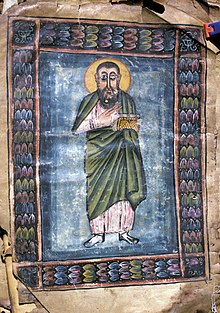
FootnoteA: Eusebius preceding his Eusebian Canons in the Garima Gospels. Michael Gervers. 2004. Public Domain

FootnoteB: The Christian Martyrs’ Last Prayer. Jean-Leon Gerome. Walters Art Museum. 1863-1883. Public Domain

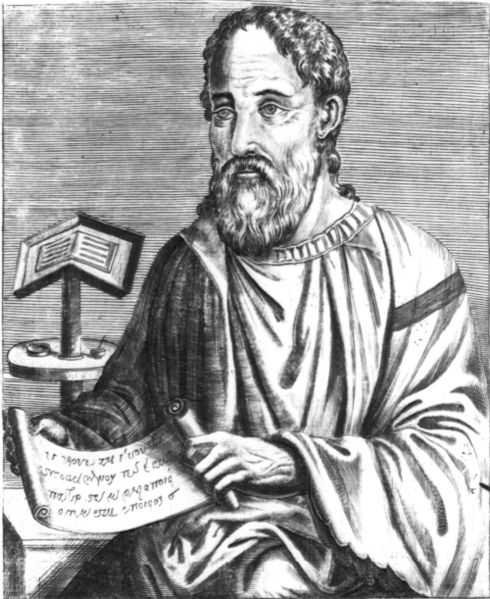
FootnoteC: Eusebius of Caesarea. Unknown Source and Date. Public Domain

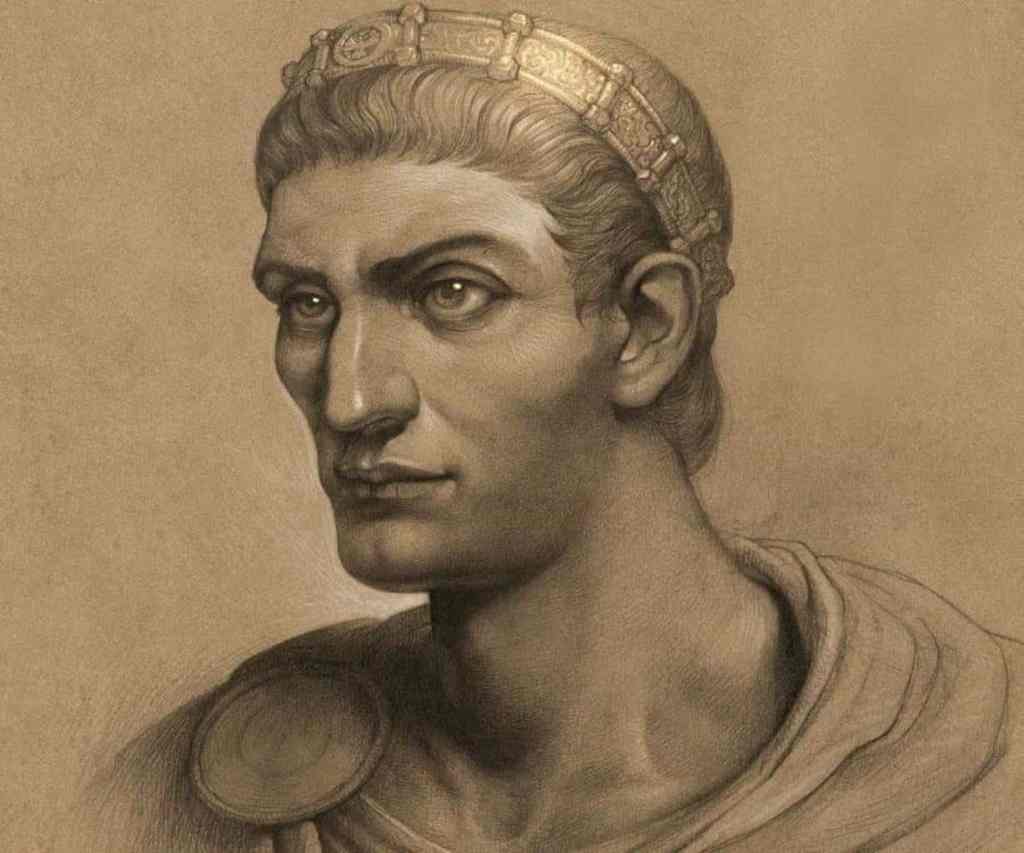
FootnoteD: Constantine the Great. Unknown Source and Date. Public Domain

Out of Eden

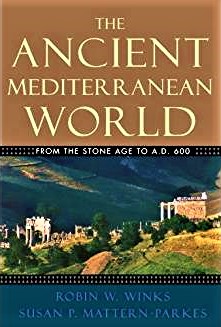
The Ancient Mediterranean World: From the Stone Age to A.D. 600B Mediterranean 2004

Written by:  Robin W. Winks and Susan P. Mattern-Parkes

Published by: Oxford University Press

Copyright:  © 2004

Homo erectus, an upright fellow, showed up during the Pleistocene about 2 million years ago and quickly dispersed throughout Asia and Africa even though his starting point is ambiguous. After mucking about the tropics, the lack of clothes makes it difficult to take skiing vacations in the Alps, decided to take on a bigger brain and chin with less eye brow protuberance, and developed into our mum: Homo sapiens, a couple of hundred thousand years ago.  Some say we came from east Africa, others say east Asia but regardless of our origins we showed up in what is now Israel around 100,000 years ago and our quest for ever larger cell phone screens and civilized table manners had begun.

Agriculture, originating about the 12th century B.C., traces its roots back to the fertile crescent; beginning at the Jordan River progressing north and northeast to the headwaters of the Euphrates and Tigris Rivers and then back down south to the rivers’ marshlands, eventually pouring into the Persian Gulf.  By 9500 B.C. man was cultivating wheat, flax, rye, peas, and other crops that brokered the way for cities, government, laws, and taxes; otherwise known as civilization.

The earliest civilizations are conveniently timed to the discovery of bronze around 2500 B.C.  Bronze tools and weapons, an amalgam of copper and tin, galvanized the rise of city-states and empires until the tin ran out in 1200 B.C., then the Dark Ages set in. Virtually every major city in the eastern Mediterranean was sacked and burned during the first 50 years of the advent of these interesting times, many to disappear from the map forever. The technology to smelt carbon steel brought a renewal of civilization during the Iron Age and the cementing of the Assyrian Empire–for awhile.

By the end of the Iron Age the bright lights of civilization have shifted from Mesopotamia to the northern shores of the Mediterranean; first settling into the Aegean peninsula around the 8th century B.C. before migrating to Rome in the 3rd century B.C.  By the 3rd century A.D. Rome was a spent force and the remnants of the empire shifted back to the eastern Mediterranean in Constantinople.

Christianity’s rise followed Rome’s decline through the Mediterranean. The rapid spread of Christianity is somewhat of enigma, as are other philosophies or religions such as Buddhism and Islam, but the prevailing thoughts are that church improved the lives of its followers and promised a way to life every after.

The authors, Drs Winks and Mattern-Parkes, professors of history at Yale and the University of Georgia respectively, have written a short history of the region that engrosses and enlightens without preaching.  If interested in the history of the Mediterranean from the Stone Age to Islam, this is quick read and is eminently readable.