Liam’s Choice

Radius  (Theaters-2018; Streaming-2017)  Rated: NR  Runtime: 87-93 minutesM Radius 2017

Genre: Fantasy-Mystery-Science Fiction-Suspense-Thriller

els – 6.0/10

IMDb – 6.2/10

Amazon – 3.7/5 stars

Rotten Tomatoes Critics – 7.8/10

Rotten Tomatoes Audience – 3.5/5

Metacritic Metascore – NA/100

Metacritic User Score – NA/10

Directed by:  Caroline Labrèche, Steeve Léonard

Written by:  Caroline Labrèche, Steeve Léonard

Music by:  Benoît Charest

Cast:  Diego Klattenhoff, Charlotte Sullivan

Film Location:  Selkirk, Manitoba, Canada

Budget:  NA

The mystery begins as Liam (Klattenhoff) wakes up in a confused state, lying next to an overturned car.  As he stumbles away from the car and walks down a lonely road, an approaching car slows, possibly to pick him up, but instead, appears to try to run him over in slow motion. Liam sidesteps the car, and it coasts off the road and comes to a stop in the ditch.  In a what-the moment, Liam approaches the car, opens the driver’s door, and finds the occupant dead.  Upon calling 911, or whatever the Canadian equivalent is, the operator asks for Liam’s name; stumped by the question he resorts to looking at his driver’s license for the answer. Liam remembers nothing, who he is, what he is, where he is; his existence started at the point of regaining consciousness at the crash site.  The dead driver scene repeats in various forms; people, birds, any living mammal that approach him, or vice versa, dies.  With the bodies piling up, he ultimately realizes that it isn’t a pathogen killing everyone; its him: get too close to Liam, a radius of a few tens of feet, and you die: instantly. Jane (Sullivan), a passenger in Liam’s car at the time of the crash, but unknown to Liam when he woke up at the crash site, tracks Liam down and they discover that his radius of death is inoperative when she is near. Her yin to his yang.

A set of moral dilemmas are introduced with a semi-transparent brush that are easily resolved, but not very satisfying, at least not from an emotional perspective.  Are you responsible for a past life that you can not remember? Are you responsible for a life that your are fully cognizant of, but unable to control?  Jane answers no to both queries. Liam answers yes, at least to the latter. The movie leaves you to decide his answer to the former.

This is Labreche and Leonard’s second low-budget movie they have directed together. Their first movie they directed, Sans Dessein (Without Design), was filmed in Montreal for $15,000 Canadian, and released in French in 2009. The movie received above average reviews from critics and viewers (IMDb 7.0/10).

In Radius the movie production is very good, for a low-budget film, and has met with similar reviews as Sans Dessein. I suspect their efforts in this movie, as writers and directors, will get them noticed by folks with deeper pockets in the near future.

An original story and script, with mostly good acting, certainly not bad. The directors set a pace that’s a tad slow, resulting in the viewer leaping ahead of the story, which in this case, is not necessarily bad.  An entertaining flick with a unsatisfying, but necessary ending.  Hitchcock may not have approved but he would have understood.

Sketches of Melville’s Mind

Herman Melville Short Stories

Written by:  Herman Melville

Published by:  Easton Press

Copyright:  © 1996B Melville Short Stories

Herman Melville lived for 72 years and 59 days, all in the 1800s, beginning and ending in New York City, but in-between, traveling the worlds oceans and terrains; experiencing, and surviving, some of the greatest land and sea adventures ever told. Many of these affairs surviving as autobiographical elements within in his fictional writings.

As an illustration, the tale of Moby-Dick follows from his real-life quests, on various sea-boats, usually as a deck hand, including the 1820 sinking of the whaler, Essex, going down in the Pacific Ocean; all due to the foul mood and intransigence of a opprobrious sperm whale. Immediately pivoting from the fortuity of surviving the fantastical attack of a mad, but likely, provoked, cetacean; the equally extraordinary tale of the shipwrecked and hapless sailors continues; surviving on the open sea, aboard the whaler’s life-boats, combating storms, thirst, illness, starvation and cannibalism. The totality of the experience should have shattered the sanity of the cursed swabs, but didn’t–maybe. (Melville was subjected to a battery of inconclusive psychiatric  tests in the early 1850s: his friends and family believing that his behavior was not normal.) Pi knows this adventure.  Eventually the few remaining survivors are rescued off the coast of South America, leading Melville to eventually write the knowingly, not-so-absurd tale, of a sea-captain seeking revenge on a whale.

Easton Press’s collection of Melville’s short stories is a seemingly, eclectic compilation of sketches and traditional prose; exhibiting his talent and genus for writing descriptive narratives and telling stories; weaving themes of morality and politics into everything he created. He wrote 17 short stories in his lifetime, 13 of which are collected here. The 13 stories were published between 1853 and 1856, with the exception of The Two Temples, which was published posthumously in 1924.  These short stories were written during the period when Melville’s star, as a writer of fiction, had dimmed to a feeble ember, and which did not flare up again until after his death, some 30 years later in the 1920s.  Melville’s writing, to the uninitiated, can leave one exhausted and bewildered with his detailed narratives, and subtle, and sometimes not so subtle, symbolism and irony. Successfully reading Melville requires a summary of the story beforehand, and an understanding of the themes buried in his tales.  Surely a paradoxical statement, but one that will magnify your enjoyment, and comprehension of his works.  With that in mind, I offer up below, a brief review of the short stories in this collection; listed in their order of appearance in the book.

Bartleby, The Scrivener: A Story of Wall-Street,  originally published in 1853 in Putman’s Monthly Magazine. Ignored mostly by the public at the time of publication, it is now recognized as one of the greatest of all time, American short stories; hilarious and poignant, a tale interpreted to mean just about anything the critics and the readers want it to mean. Bartleby will surely make you a fan of Melville.

Bartleby is a scrivener, a copier of legal documents, who is hired by unnamed lawyer and proceeds to do extraordinary and prodigious amounts of work for his master until he “prefers not to”, at which point Bartleby begins his descent into a void, a nullity of existence.

The Encantadas, originally published in 1854 in Putman’s Monthly Magazine. The Encantadas or The Enchanted Isles is a collection of 10 narrative “sketches” describing life, habitat, and terrain of the Galapagos Islands, mostly from a downbeat, life as a tragedy, viewpoint. The “sketches” were a critical success, likely due to the similarity of the descriptive prose with his earlier, successful novels; though that success did not translate into financial prosperity.

Cock-a-Doodle-Doo! or The Crowing of the Noble Cock Beneventano, originally published in 1853 in Harper’s New Monthly Magazine.  A little read, and little understood story about a man in the depths of depression uplifted by the crowing of a cock. Interpreted variously as a criticism of transcendentalism, a critique in the belief that man is naturally good; or alternately, as a satire on the Puritan sexual mores of the early 19th century.  These critiques are way too deep into the essence of symbols when the story appears to be just a simple expression of hope.  The story ends with an inscription on a tombstone placed over the grave of the cock and its owner’s family, erected by the narrator of the story:

O death, where is thy sting                                                               O grave, where is thy victory

These are not sophomoric expressions of sexuality or words of wickedness or thoughts of hopelessness. Is it not likely that the author intends them to mean that death is not to be feared? That you do not lose the fight, your fight, upon entering a grave? That death is just another beginning, a continuation of the journey.

The Two Temples, originally published in 1924 in the book Billy Budd and Other Prose Pieces.  This story was written in the 1850s but Harper’s wouldn’t publish it  because of its potential to upset the religious sensitivities of the time.  This tale is all about contrasts and beliefs. Contrasts within the practice of the Christian faith, where the meek shall inherit the Earth and the proud and mighty shall perish; the low is high and the high is low. Contrasts of religion versus the arts; religion’s aversion to the low, the arts acceptance of everyone. Beliefs that the wolf and the lamb should lay down together. Beliefs that charity is not an at-arm’s-length transaction but a clasp and a hug of your fellow, suffering brother.

Poor Man’s Pudding and Rich Man’s Crumbs, originally published in 1854 by Harper’s New Monthly Magazine. Another tale in two parts describing the perceptions of the rich about the poor’s needs and wants. The stories detail an American rich man’s pompous, and false, perspective on the quality of a poor family’s meals while cooking with the meager ingredients of their pantry,  and an urban Londoner guide’s, smug, and erroneous, thoughts on feeding the poor with the wealthy’s leftovers. A tale defining false charity and false charity is no charity.  A tale of understanding by walking in foreign shoes.

The Paradise of Bachelors and the Tartarus of Maids, originally published in 1855 by Harper’s New Monthly Magazine. Again a tale in two parts comparing the lives of educated, rich bachelors in London with the menial work of young maids in a New England paper mill. The narrator, the same for both stories, describes the care-free life of unmarried Englishmen, unencumbered by the responsibilities of wives or children.  The flip side is of young, unmarried women living a meaningless existence making paper from the unwanted clothing of the rich.  The maids assist the bachelors in maintaining their uncomplicated and comfortable lives while the bachelors contribute to the maids’ living hell, Tartarus, by casting their unfashionable used clothes to the them.

The Lightning-Rod Man, originally published in 1854 by Putman’s Monthly Magazine.

What grand irregular thunder, thought I, standing on my hearthstone among the Acroceraunian hills, as the scattered bolts boomed overhead and crashed down among the valleys, every bolt followed by zigzag irradiations, and swift slants of sharp rain, which audibly rang, like a charge of spear-points, on my low shingled roof. I suppose, though, that the mountains hereabouts break and churn up thunder, so that it is far more glorious here than on the plain.

Thus begins the straightforward tale of a lightning rod salesman showing up on the narrator’s step during a terrific electrical storm, peddling his copper rods while the thunder crashes around the mountain home. The narrator, skeptical of the salesman’s claims, parries the latter’s sales pitch of the horrific outcomes of unprotected lightning strikes with scientific fact and maybe, just a tad of false courage; arguments that produce a vast schism between the two, each believing that the devil exists in the others skin.

The Happy Failure:  A Story of the River Hudson, originally published in 1855 by Harper’s New Monthly Magazine. A very short story about ambition, a man trying to leave his mark in the world, and failing against a greater ambition; the river’s need to reach its destination.  Fighting the good fight against a superior opponent and rejoicing in the effort of trying, not the conclusion. If you are not the giant, be a happy Lilliputian.

The Fiddler, originally published, anonymously, in 1854 by Harper’s New Monthly Magazine. A story along similar lines as The Happy Failure, a man’s dreams of greatness are dashed against the unkind, the uncaring, the immovable monolith of opinion, leading to a much-needed re-evaluation of ones life and purpose.  If you write bad poems try playing the fiddle instead. Melville abandoned prose in the late 1850s, became a lecturer, a custom inspector, and wrote bad poetry.

Jimmy Rose, originally published in 1855 by Harper’s New Monthly Magazine.  A tale that has been told many times and in many ways; success has many fathers, failure is an orphan. A Londoner, rich and witty, is the toast of town, especially when he is paying, but misfortune strikes, he loses his fortune, and his friends abandon him. Through old age, bereft of friends and money, he retains his cheer and his dignity to the end. Some find this story as an indictment of society’s downward trajectory; an allegorical spin on the decline of morals and religious beliefs. On a simpler level it’s an autobiographical sketch of Melville’s loss of readership, and popularity as an author, with the concomitant loss of financial security, in the 1850s.

The Bell-Tower, originally published in 1855 by Putman’s Monthly Magazine. Bannadonna, an artist creates a bell tower that all of Italy can be proud of, massive and tall, but, unfortunately, not strong enough to support the ill-conceived, even more massive, bell. A story of pride, passion and ambition summed up in the final 3 sentences of the tale:

So the bell was too heavy for the tower. So the bell’s main weakness was where man’s blood had flawed it.  And so pride went before fall.

I and My Chimney, originally published in 1856 by Putnam’s Monthly Magazine.  Melville’s narrator loves his very large chimney and he loves his even bigger house that encircles the chimney.  The narrator’s wife hates the chimney wants to tear it down or at least make it smaller. The narrator loves tradition as he loves his chimney, conservative to his core; a preservationist hoping for continuity of the whole.

In the 1850s, the U.S. was gearing up to tear itself apart, to enter into the largest bloodbath this country has ever known.  Melville expresses his wishes, through the narrator; preserve the chimney, preserve the federal union; preserve the house, preserve the United States. Melville is prescient in his symbolism, publishing this story 2 years prior to Lincoln’s House Divided speech, which he delivered as a campaign speech in Springfield, Illinois. The similarities of story and speech culminate in the best known passage of Lincoln’s address:

A house divided against itself cannot stand. I believe this government cannot endure, permanently, half slave and half free. I do not expect the Union to be dissolved — I do not expect the house to fall — but I do expect it will cease to be divided.

The Apple-Tree Table or Original Spiritual Manifestations, originally published in 1856 by Putman’s Monthly Magazine. Melville layers at least 2 themes into this quaint little tale of ghosts and bugs, all wrapped up in a little apple-tree table, rescued from a dark, dusty attic. The narrator places the cloven-footed apple-table in a prominent location of the family’s parlor and over a few days all hear a distinct tick-tick-tick coming from the petite piece of furniture; a spectral cackling, instilling a creeping fear into the man and his daughter, but not his wife. The mystery of the tick-tick resolves itself as two long, dormant bugs chomp their way to freedom from the wooden confines of the table.

Theme one of the tale, is a composition on gender reversal. The narrator exchanges his masculinity for a more feminine style along with endowing his wife with the more traditional male roles of the husband.  The man wishes to decorate, the woman could care less. The narrator fears the table; the woman looks for a logical explanation. Men and women are not what society says they are, but what they are.

Theme two involves the awakening of the soul.  Shining light, infusing fresh air, into the dark, musty corners of ones mind, creating an atmosphere for spiritual revival; a renewal of cheer and faith, an escape from the cloven, hoofed body of seclusion and depression.

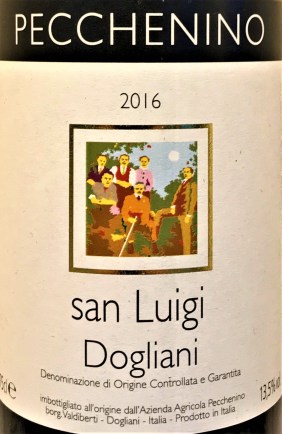
Pecchenino San Luigi Dogliani Dolcetto 2016

W San Luigi 2016Dolcetto from Dogliani, Piedmont, Italy

100% dolcetto

13.5% alcohol

Opened 11 Dec 2017

els: 9.0/10

Wine Spectator: 91

Wine Advocate: 90

The Pecchenino wine estate has been passed from father to son since the late 18th century. The estate, since the 1970s, has tripled in size and now encompasses approximately 62 acres northeast of the commune of Dogliani, a small town of about 5000 people, which is  less than 40 miles southeast of Turin.  The estate has 70% of its acreage planted in Dolcetto vines with the remaining 30% dedicated to their better known cousins: Barbera, Nebbiolo, Chardonnay and Sauvignon Blanc.

The Dolcetto, known in area since at least the early 1400s, is a cool weather, dark-skinned grape with high tannin levels but low acidity, necessitating an early consumption since it will not age well in the bottle much beyond 4 or 5 years. This is not catastrophic, actually just the opposite, since the 2016 vintage is a nice wine to drink right now while you wait for the regions Barbera and Nebbiolo wines to age for 3-5 years.

The Pecchenino soils consist of unconsolidated calcareous alluvium, somewhat fertile but lacking in substantial organics. The vines are perched at an altitude of 1275-1400 feet above sea level, with a generally southern exposure.  Temperatures range from the low 80s during the growing season days to the mid 50s at night.  Rain amounts of 1-3 inches per month are typical.  October is the wettest month with up 3.5 inches expected and July is the driest with an average rainfall of a little more than 1 inch.

A brilliant, medium colored red wine with fruity and earthy aromas. Nice tannins and not too dry, producing a pleasant and satisfying finish. Serves well with, and not trying to be cliché, pizza and pasta.

An outstanding wine. Decant and aerate for at least one hour.

$11.98-17.99  wine-searcher.com


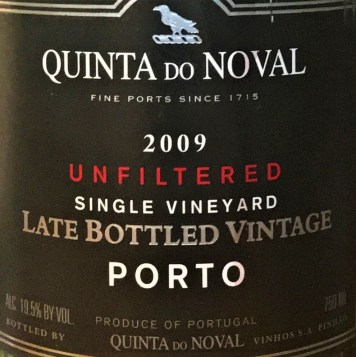
Quinta do Noval Late Bottled Vintage Unfiltered Port 2009

W Noval Port 2009Other Dessert from Douro Valley, Portugal

Grape variety or varieties unknown

19.5% alcohol

Opened 10 Dec 2017

els: 9.2/10

Wine Advocate: 94

Wine Enthusiast: 90

Cellar Tracker: 90

Quinta do Noval is one of the oldest, and without argument, one of the greatest port houses in the Douro River Valley of northern Portugal. Their greatness is due, in part, to their willingness to experiment and innovate with their vineyards and products. They were the first, in 1958, to introduce late bottled vintage port with a 1954 vintage. Robert Parker included this winery in his 2005 book The World’s Greatest Wine Estates; speaking highly of its vineyards and wines:

Quinta do Noval is unusual among the great traditional Port houses in that it emphasizes the importance of the vineyard.  …(The vineyards are) entirely based on the Douro Valley, and that its principal Vintage Ports, Quinta do Noval Nacional and Quinta do Noval, are both single-vineyard wines. The aim is to produce classic Vintage Ports that are harmonious and elegant expressions of Quinta do Noval’s terroir.  Strict selection in the vineyard, low yields, and strict selection again in the tasting room …

Established in 1715, the vineyards, which the wines take their name, have only had 3 owners in 302 years. The current owner, AXA Millesimes, purchased the property in 1993.  The ports all come from a single vineyard planted with 7 classified A grape varieties:  Touriga Nacional, Touriga Franca, Tinta Roriz, Tinto Cão, Tinta Barroca, Tinta Francisca, Sousão. The exact grape(s) used in this port remains unstated.

The 350 acres of vineyards, 250 acres of which have been replanted since 1994, are 300-1500 feet above sea level, on the terraced hills, rooted in a medium grade metamorphic schistose rock with a little weathered clay thrown in to keep it all from cascading down into the river below. (Another great example of great wine grown from inhospitable and infertile soils.) The growing season days are mild with temperatures reaching into the mid-70s with night time lows bottoming out around 50 degrees Fahrenheit. Rain is plentiful, averaging 3-6 inches per month.

The grapes are hand picked, crushed by foot and aged in single vintage, wooden vats for 4-5 years before being bottled; producing a deep purple to almost black hue with sweet aromas and flavors of nuts, toffee and vanilla.  Enjoy alone or with chocolate.

An outstanding port. Decant to remove any sediment.

$29.99  wine-searcher.com


Badly Done Transitory Anarchy

Mayhem  (Theaters-2017; Streaming-2017)  Rated: R  Runtime: 86-87 minutesM Mayham 2017

Genre: Action-Horror-Satire

els – 4.0/10

IMDb – 6.4/10

Amazon – 4.3/5 stars

Rotten Tomatoes Critics – 7.1/10

Rotten Tomatoes Audience – 3.8/5

Metacritic Metascore – 62/100

Metacritic User Score – NA/10

Directed by:  Joe Lynch

Written by:  Matias Caruso

Music by:  Steve Moore

Cast:  Steven Yeun, Samara Weaving, Dallas Roberts

A law firm occupying a modern 9 floor glass and chrome high-rise is infected with a morality inhibiting virus, allowing all that are contaminated to pursue their criminal desires without remorse or retribution. Derek (Yeun), unjustly fired from his job at the firm, is infected with the virus and seeks revenge from the suits upstairs.  He teams up with Melanie (Weaving), a rejected client seeking aid from the firm. They attempt to reach the managing partners on the locked down 9th floor, all the while leaving death, destruction–mayhem in their wake.

Matias Caruso, generally a writer of shorts, scribbled out a screenplay that is shorn of all pretense of artistry, finding a vehicle in the form of a very unoriginal viral infection, that allows him to maximize violent, gory, artery pumping, bloody scenes with an occasional speck of gallows humor interspersed between the bodies, to give the audience time to lessen their laryngeal spasms.  The whole effort is rationalized as a satire on the modern hostile, bureaucratic office. Please.

The director, Joe Lynch, likely to live in the land of forgettable movies for a very long time, plays up the script to its maximum heights allowable, and that still wouldn’t scratch an earthworm’s belly. The voice over narrative is not just distracting, but poorly written and just plain awful. The scene selections and settings are amateurish; B movies are done better.

The acting is tongue-in-cheek throughout and I have yet to decide if that was intentional or not. Enough said.

The Game of Thrones or anything by Quentin Tarantino are likely exhibits number one through a very large integer for efficiently desensitizing the viewing public to gratuitous sex and graphic violence resulting in products that have little to do with art or entertainment. This movie lives in the dark shadows of GoT and Tarantino, badly going where it shouldn’t have. This movie is not art. This movie does not entertain. This movie does not tell a believable story.  This is a movie of gross violence, nudity and cheesy dialog, designed to shock and numb. Save your time, save your dime, don’t watch this movie.


Castello d’Albola Chianti Classico DOCG 2011

W D'Albola Chianti 2011Sangiovese from Tuscany, Italy

95% sangiovese

5% canaiol

13.0% alcohol

Opened 7 Dec 2017

els 8.8/10

JS 91

WS 90

RP 87

The Castello d’Abola estate, drastically renamed Castello di Albola, located in the village of Radda, is smack dab in the middle of the Chianti Classico DOCG. The wine takes its name from the Abola Castle, built sometime around the 1400s and beautifully restored by the current owners: the Zonin family.

Vineyards and wineries have existed in Tuscany Chianti area for at least 2500 years, likely even further into the past, back during the pre-Roman times of the enigmatic Etruscan civilization; who are believed to have introduced wine production to the French. A truer definition of altruistic and noble charity cannot be found.

The vines for this wine are grown at the highest elevation of any vineyard in the Chianti DOCG, rooted in clayey limestone soils that receive anywhere from 0.25 to 1.8 inches of rain per month during the growing season.  Temperatures can reach into the mid-80s during the day and drop into the mid-40s Fahrenheit at night.

This wine exhibits a brilliant ruby-red  to garnet hue, redolent of sweet fruits and pepper. A medium body, balanced and structured wine along with a moderate but pleasant finish. A nice table wine for everyday fare or drink alone while watching the sun sink slowly towards the west.

A good wine. Decant and aerate for at least one hour.

The 2011 is close to impossible to find anymore, at least in the US.  I’ve found one store in the UK and one in Canada that are charging an exorbitant price that you should definitely pass on.  I paid $15.99 for a bottle in 2015, which is (was) an inexpensive to a tad over-priced for wine of this quality.

Grief, Despair and Sanction

Wind River (Theaters-2017; Streaming-2017)  Rated: R  Runtime: 106-111 minutesM Wind River 2017

Genre: Crime-Drama-Mystery-Suspense-Thriller

els – 8.0/10

IMDb – 7.8/10

Amazon – 4.5/5 stars

Rotten Tomatoes Critics – 7.6/10

Rotten Tomatoes Audience – 4.2/5

Metacritic Metascore – 73/100

Metacritic User Score – 7.7/10

Directed by: Taylor Sheridan

Written by: Taylor Sheridan

Produced by:  Elizabeth A Bell, Peter Berg, Matthew George

Music by:  Nick Cave and Warren Ellis

Cast:  Jeremy Renner, Elizabeth Olsen, Gil Birmingham

Martin (Gil Birmingham) and Annie (Althea Sam) are confined to the every darkening mists of sorrow, bereft of solace, by the rape and murder of their 18 year daughter, Natalie; a horror that is brutally shocking, but all too familiar in the land they call home: the Wind River Indian Reservation.

Jane Banner (Olsen), an inexperienced FBI agent, attempts to find the less-than-animals that brought Natalie’s life to a gruesome end; partnering with a Game and Fish predator hunter, Cory Lambert (Renner), who  guides her through the mountainous topography of the Wyoming reservation, and interprets the signs left in the snow by dead souls and living monsters. Cory harbors his own ghosts through the loss of his daughter, also raped and murdered 3 years previous, creating undertones of remorse and revenge that reverberate throughout the movie.

Is there somethin’ I can do other than being here for you to ease the pain
If I can keep you from fallin’, fallin’ down’
I’m sorry to sound selfish but I feel so helpless
Is it okay if I stay here with you and cry for awhile

Whoever made the claim that words could ease the pain
Never watched you fall apart, never put you back together
When you were broken down, into a million pieces
Scattered on the ground

Is There Something I can Do by Five Star Iris on the 2006 Album Live Fools    Music and Lyrics by Alan Schaefer and Dexter Green

Sheridan’s direction and screenplay provides a powerful vehicle for describing the suffering and despondency that attaches itself to a life of little hope and few rewards. Renner and Birmingham give everything in their true-to-life portrayals of men coping, and eventually fighting back against the pain of the helpless insight into knowing senseless, tragic death.

A movie to see, and then, to see again.

Michel Gassier Cercius Rouge 2013

W Cercius 2013Rhone Red Blends from Cotes du Rhone, Rhone, France
85% grenache

15% syrah

15.5% alcohol

Opened 7 Dec 2017

els 9.0/10

RP 91

Cercius, from the Latin term for a wind between north and west, is a delightful vieilles vignes (old vine) Cotes du Rhone blend from the Plateau de Domazan, located about 8 miles west of the Avignon; the 14th century Papal seat which was then part of the Kingdom of Arles within the Holy Roman Empire.

Wine was likely grown and produced in the Rhone Valley as far back as the 6th century BC, believed to have been established by either the Greeks or Persians, with the vineyards and wineries maintained until the end of the Roman Empire in the late 5th century AD. It wasn’t until the late Middle Ages when the Avignon papacy re-established the Rhone area vineyards and wineries, mostly for their own use, beginning with Pope Clement V around 1309.  The rest, as they say, is history.

The 80-year-old plus vines are nurtured by clayey limestone soils topped with a layer of pebbles which contend with blustery, northwest winds, traveling over and down the 6000 foot peaks and slopes of the Central Massif, blowing into the  Michel Gassier’s Rhone Valley vineyards, proudly defying Mother Nature’s blustery assault at 500 feet above sea level.  The growing season climate for the area provides for hot days above 80 degrees Fahrenheit and cool nights with temperatures dipping into the mid-40s to low 50s.  Rainfall averages 2.5-4 inches per month.

The grapes are hand harvested, destemmed, allowing natural yeast fermentation in concrete tanks for 6 months.

The wine exhibits a deep ruby-red color; a wonderful aroma of lilacs, violets and sweet fruits. It’s well-balanced and full-bodied and the finish is long and satisfying.

An outstanding wine. Decant and aerate for at least one hour.

$12.99  wine.com


It’s Magic-Fantasy Will Set You Free

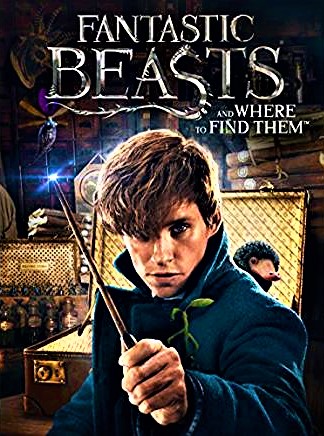
Fantastic Beasts and Where to Find Them  (Theaters-2016; Streaming-2017)  Rated: PG-13  Runtime: 133 minutesM Beasts 2016

Genre: Action-Adventure-Family-Fantasy

els – 7.0/10

IMDb – 7.4/10

Amazon – 4.4/5 stars

Rotten Tomatoes Critics – 6.8/10

Rotten Tomatoes Audience – 3.9/5

Metacritic Metascore – 66/100

Metacritic User Score – 7.3/10

Directed by:  David Yates

Written by:  J.K. Rowling

Produced by:  David Heyman, Steve Kloves, J.K. Rowling, Lionel Wigram

Music by:  James Newton Howard

Cast:  Eddie Redmayne, Katherine Waterston, Dan Fogler

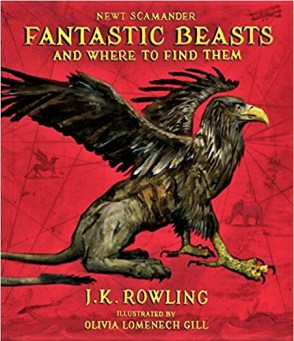
B Beasts 2001.jpgJ.K. Rowling, in 2001, wrote and published a Hogwarts textbook, under the pseudonym of Newt Scamander, on the magical world of Fantastic Beasts and Where to Find Them; a slim encyclopedic volume of fictional animals that made up the enchanted universe of Harry Potter and his bewitched school chums.  The book, though imaginative, generally did not interest anyone much past age of 12, being just a compendium of beasts without any pretense of a story or plot, but it did spin-off this wonderful film, a charming tale of magic and adventure, 70 years before Harry Potter, in the streets of New York.
The movie opens with Newt Scamander (Eddie Redmayne) arriving in New York for a brief stopover before continuing onto Arizona to further his research into “Fantastic Beasts” but almost immediately has an itinerary change due to one of his creatures escaping from his improbably bottomless briefcase. Promptly the escaped beast goes on a hunt for anything shiny: usually solid gold, resulting in a hilarious wizard and beast chase through the streets and banks of New York.  Compounding Newt’s creature capturing problems is an anti-magical society trying to expose and eliminate all witches and wizards along with a controlling magical political hierarchy attempting to keep everything secret and under wraps, including the threat posed by impending arrival of arch-villain and dark wizard, Gellert Grindlewald (Johnny Depp).

David Yates, the director, and Rowling have put together a lively romp of fun through the magical world of New York, enhanced with exemplary acting by just about all involved.  J.K. Rowling continues to surprise her fans, including me, with the depth of her talent, by adroitly changing roles from an accomplished author to a novice, but never-the-less, a master producer and screenplay writer for this movie. I found this movie heads and lizard tails above the Harry Potter movies, mainly because Harry Potter’s sub-par acting was absent. Make time to see this entertaining film for itself, and ultimately, to keep you abreast of the likely sequels.


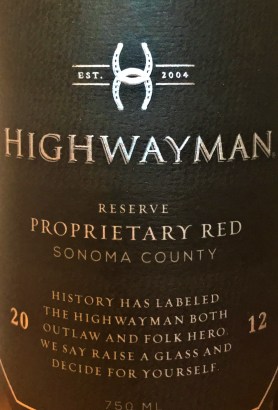
Highway 12 Highwayman Proprietary Red 2012

W Highwayman 2012Other Red Blends from Sonoma County, California

Proprietary red blend:

     cabernet sauvignon

     cabernet franc

     merlot

14.8% alcohol

Opened 2 Dec 2017

els 9.1/10

Highway 12 is a North Coast, Sonoma County winery producing 3 brands of differing quality wines from the vineyards of Sonoma and Carneros regions: Highway 12, Carneros Highway, and their flagship wine: Highwayman.  The Highwayman lineup includes 1 white and 4 reds: Chardonnay, Cabernet Sauvignon, Pinot Noir, and 2 red blends.  Their Proprietary Red was the initial wine in this lineup with the blend of grape types and percentages changing from vintage to vintage.  The 2013 vintage is a blend of Cabernet Franc, Merlot and Petit Verdot as opposed to this 2012 vintage of Cabernet Sauvignon, Cabernet Franc, and Merlot.

Highwayman, the wine, commemorates the fabled gentlemen robbers of days gone by, who relieved, accessible and unguarded, or guarded, travelers of their possessions on the desolate stretches of road in many a nation’s country-sides. In California, a highwayman was known as a road agent, the most famous of which was probably Charles “Black Bart” Boles, a bandit with a particular affinity to Wells Fargo Coaches and their money boxes. He plied his trade of questionable legitimacy for 8 years during the late 19th century, along the deserted roads of northern California.  Black Bart, always armed with a shotgun but never fired during any of his roadside capers, acquired his name by leaving snippets of rhyming poetry at the scene of his crimes. Below is a sample of his poetry that he left at a robbery in 1877, with a slight, germane, editorial modification:

I’ve labored long and hard for (wine and) bread,
For honor, and for riches,
But on my corns too long you’ve tread,
You fine-haired sons of bitches.
 
— Black Bart, 1877.

Fortunately for all of us, highway robbery is now practiced by a better class of erudite individuals.

This wine has a black ruby-red hue, aromas of sweet black and blue berries, with whiffs of spicy herbs and earth, producing an enjoyable, full-bodied, long finish. It exhibits a powerful but balanced and delightful taste of chewy tannins and fruit. Perhaps a tad heavy by itself, better if served with a medium rare rib-eye.

An outstanding wine. Decant and aerate for at least one hour.

$19.38  wine-searcher.com