Crios de Susana Balbo Malbec 2015

W Crios Malbec 2015Malbec from Uco Valley, Mendoza, Argentina

95% malbec

5% bonarda

14.5% alcohol

Opened 2 Feb 2018

els: 9.0/10

Wine Advocate: 90

James Suckling: 90

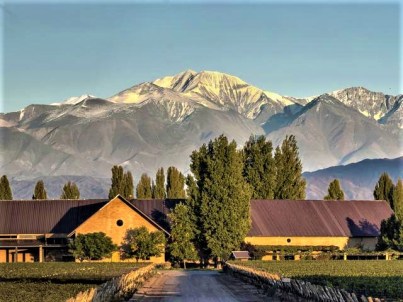
Susana Balbo’s winery, established in the stunning, idyllic eastern foothills of the Andes Mountains, within the viticultural region of Uco Valley, is southwest of Mendoza, Argentina. The winery is surrounded by 52 acres of Malbec, Cabernet Sauvignon, Cabernet Franc and Petit Verdot vines; producing 4 brands of wines with distinct and complex personalities that appreciate long, secluded years in their bottles: Crios, Ben Marco, Nostros and Susana Balbo Signature. The Bonarda grapes are sourced from surrounding non-Balbo vineyards.

The vineyards are at an average elevation of about 3700-3800 feet above sea level where the steppe climate provides a large swing in growing season temperatures ranging from daytime highs in the mid 80s to night-time lows approaching 50°F. The climate is arid and vines receive a paltry 1-1.25″ of rain per month. To compensate for the semi-desert conditions and the well-drained alluvial soils of Uco Valley, the vineyards are drip irrigated using the Andes’ snow melted water to provide just the right of amount of essential moisture to produce these flavorful wines.  This vintage’s growing weather was cooler and wetter than normal.

W Balbo Winery

Susan Balbo Winery

The grapes are hand-harvested and spend 25 days in maceration vats.  After maceration the wine spends 9 months in new French oak barrels.

The wine has ruby-red to purple color with a garnet to peach rim. A bouquet of fresh cherries and blackberries. On the palate the wine is very well-balanced and medium bodied.  Very fresh and cooling.

An outstanding wine at a very good price. Serve with lamb or beef steak. Get adventurous and try with a grilled tuna steak. Drink now, but should last until 2022-2023.  Decant and aerate for one hour before drinking.

$11.99 wine.com

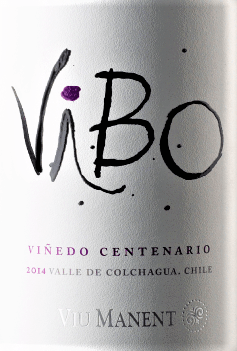
Viu Manent ViBo Vinedo Centenario 2014

W Vibo 2014Bordeaux Red Blend from Colchagua Valley, Rapel Valley, Central Valley, Chile

65% cabernet sauvignon

35% malbec

13.5% alcohol

Opened 31 Jan 2018

els: 9.2/10

Wine Advocate: 91

Colchagua Valley is in the southern and western portions of Rapel Valley, which itself is located in the middle of the 250 mile long Central Valley, all situated between the Andes to the east and the Coastal Ranges to the west. The northern edge of the Colchagua Valley is defined by the life giving, Rapel River and its main tributaries: the Tinguiririca and Cachapoal Rivers. The valley, sheltered from the cold Pacific winds by the Coastal Ranges, has a mild Mediterranean climate, warm but not too hot, or too cold, with rainfall that averages about 24″ per year. The main wine of the valley is Cabernet Sauvignon but in recent years Malbec has been added to the vineyards to capitalize on their Argentinian success on the other side of the Andes. The better wineries of Colchagua Valley have their vineyards located on the eastern slopes of the Coastal Ranges.

In 1935 the Viu family, Catalonian immigrants, founded a Bodega in Santiago, Chile to bottle and market wines locally.   The family, in 1966 purchased a winery and its vineyards in the Colchagua Valley which included very old, pre-Phylloxera, French derived vines.  This purchase marked the beginning of the family’s proprietary production of wine. In 2009, Vibo made its appearance on the Chilean and International markets.

Viu Manent, the Viu family company, operates 3 vineyards, totaling 627 acres, in Colchagua Valley: San Carlos, La Capilla, and El Olivar.  The San Carlos vineyard is 370 acres of 40 year-old plus vines, some more than 100 years old, growing at 800′ above sea level in very thick and porous, silty-sand to clayey-sand soils. The vineyard was established in the 1800s with pre-Phylloxera, French root-stock and vines. The La Capilla vineyard is about 93 acres dedicated to red-wine-only vines growing at 750 feet in a pebbly limestone and limey soil.  The vines are on average 16 years old. The El Olivar is a new land acquisition which the company plans to develop into about 175 acres of vines at an elevation between 500-930′, located on the steep slopes, up to 45°, of the Coastal Range foothills in pebbly-clayey soils.

Vibo Vinedo Centenario is produced from the oldest vines from the San Carlos vineyard. The 2014 growing season was delayed by long spring frosts which eventually led to hot summer days in the low 80s°F but the nights were cooler than normal, resulting in sustained high acidity levels for the grapes until harvest.

The grapes were hand harvested, de-stemmed and crushed in stainless steel tanks. After a 5-day cold water soak the grapes were fermented in natural yeasts.  Malolactic fermentation occurred in oak vats. The wine was aged for 18 months in French oak barrels, about 20% which are new oak.

The wine has ruby-red color with a garnet rim. A bouquet of fruity herbs and spice. The tongue stays happy with a great balance of tannins and acidity.  A wonderful finish.

An outstanding wine at a good price.  Serve with cheese, beef, lamb or duck. Drink now, but should last until 2020-2022. Decant and aerate for one hour before drinking.

$16.99 wine.com

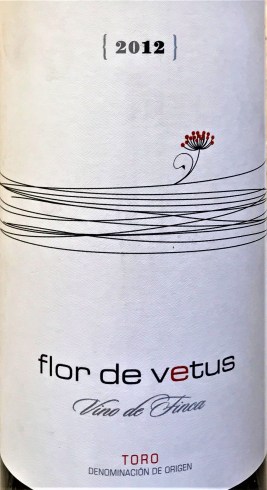
Vetus Flor de Vetus 2012

W Flor Vetus 2012Tempranillo from Toro, Spain

An Eric Solomon Selection

100% tinta de toro (tempranillo)

14.0% alcohol

Opened 29 Jan 2018

els: 9.0/10

Wine Advocate: 92

Decantalo: 92

Guia Penin: 91

Cellar Tracker: 88

The Spanish Northern Plateau Toro Region is 40-50 miles east of the Portuguese border and 125-150 miles south of the Northern Spanish-Atlantic Ocean coast. Wine has been produced in the Toro region for more than 2000 years ever since the Greeks taught the Celts the art of the vine and grape.  During the Middle Ages, Catholic religious orders obtained land in the region from the king under the expressed agreement that they would expand the vineyards. In the 1800s the area’s vineyards escaped the phylloxera crisis resulting, today, in some very old vines.

The Artevino company, under the tutelage of Gonzalo Anton, began its wine making endeavors in Rioja Alavesa, one of the 3 sub-regions of the La Rioja DOC, in 1987, focusing on the hospitality industry with their IZADI labeled wines. In 2000, Gonzalo’s son began to expand the winery’s footprint and soon established, in the Toro Region, Bodegas Vetus in 2003. He initially concentrated on developing their vineyards until they were assured of success before building their winery there, which they eventually opened in 2008.

The 50 acres of 25 year-old vines of the Vetus vineyards surround the winery, and are located less than 10 miles to the south, southwest of the city, Toro, and about 2/3 of a mile west of the Guarena River, a north flowing tributary of the Douro River.  They are at an altitude of approximately 2300′ above sea level, growing in a loose conglomeratic soil, which consists of a dark sandy matrix, some clay, and limestone pebbles; locally known as a puddingstone.  The area experiences a continental climate with growing season temperatures ranging from daytime highs in the mid-80°s to night time lows in the high 50°s F.  Growing season rains range from 0.75 to 2.25″ per month.

The grapes are hand harvested, de-stemmed, partially crushed, and fermented in stainless steel vats. They are aged for 9 months in half new, half second year, half American and half French, oak barrels with the resulting wine falling into the Spanish Crianza aging label category: aged for 2 years with at least 6 months in oak.

The wine exhibits a dark ruby-red to purple hue with a thin garnet rim.  A glorious nose of fresh berries and cherries coupled with a rich, thick taste of berries and chewy tannins. Very balanced acidity and tannins with a very nice finish.

An outstanding wine at a good price.  Serve with lamb and Spanish rice. Drink now, but should last until 2020. Decant and aerate for one hour before drinking.

$14.99 wine.com


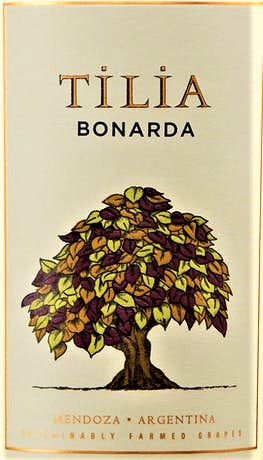
Tilia Bonarda 2016

W Tilia 2016Bonarda from Mendoza, Argentina

100% bonarda (aka: charbono, corbeau de savoie, or douce noire)

12.5% alcohol

Purchased:  8 January 2017 – $10.99

Opened:  27 Jan 2018

els: 8.7/10

Wine Advocate: 88

Argentina’s wine history dates back to the 1500s when Catholic priests planted vineyards around their monasteries to guarantee wine for the parish and Holy Mass. The country was the first South American country attempting to commercially grow vines, beginning in Mendoza in the early to mid-1800s.  Many of the initial plantings came from Chile in the early 1800’s but the varietals that would change world wine history came from the Bordeaux region of France in 1853, including the ubiquitous Malbec.  Eventually, Mendoza was producing world-class Malbec wines, on par or superior to those produced in France, mainly due to its high elevations in the foothills of the Andes, well-drained soils, and lots and lots of hot sunshine. Today the country produces 75% of the world’s Malbec.

Argentina is the world’s 6th largest producer of wine by volume, just behind the US and ahead of Australia. It produces about 6% of the world’s total wine. The country has 510,000 acres planted in grapes, 55% in red wine grapes, 25% in roses and the rest in whites. Malbec plantings account for 20% of the total acres planted with Bonarda, Cabernet Sauvignon, and Chardonnay accounting for another 20%. Argentina has 4 main wine-producing regions: Atlantic, Cuyo, North, and Patagonia.

Cuyo is the largest and most important wine-producing, macroeconomic region in central Argentina and includes the wine sub-regions of La Rioja, Mendoza, and San Juan; with Mendoza being the largest of the 3 by area, population, GDP, and wine production. The region produces about 80% of all wine in the country. The area is arid to semi-arid receiving less than 20 inches of rain per year and experiences large diurnal temperature variations of about 35°F.

The Mendoza region, lapping up onto the eastern foothills of the youthful Andes, is the largest wine producer in Argentina, accounting for 65-75% of the country’s total. A third of the country’s vineyards are dedicated to Malbec with Mendoza also producing the lion’s share of that variety with 85,000 acres planted. The Mendoza wine region is partitioned into another 5 sub-areas: Central Oasis, East Mendoza, North Mendoza, South Mendoza, and Uco Valley. North Mendoza, aka Lujan de Cuyo, designated as an appellation in 1993,  contains an additional 6 micro-regions including: Agrelo, Barrancas, Las Compuertas, Perdriel, Ugarteche, and Vistalba.

Bodegas Esmeralda, founded by Don Juan Fernandez is named in honor of his only daughter: Esmeralda Fernandez. The winery is located in the city of Junin, approximately 300 miles west of Buenos Aires and almost 800 miles east of Mendoza, producing wines both for the local market and for export. The winery’s Tilia labeled wines, named after the Latin name for the Linden tree, are all produced for the export market.

Tilia’s Bonarda vineyard, El Mirador, is located 50 miles to the southeast of Mendoza, at elevations ranging from 1,950 – 2,150’ above sea level. The vineyard is in a true desert climate, receiving less than 1″ of rain per month and is carefully irrigated with the Andes’ snow melt waters flowing down through the Tunuyan River.  Because of the desert conditions the sun shines 90% of time throughout the year, generating hot days and cool nights, perfect for the Bonarda grape.

The grape, also known as the Charbono in California, is a very commonly planted variety, second only to Malbec, in the Mendoza area.  In the desert climate the grapes produce a medium bodied wine of dark fruit and berry flavors with high acidity and medium tannins.

This wine has a deep purple hue with a cherry red rim. A nose full of plums and black fruit hits you hard upon opening.  A medium to full-bodied, but soft on the palate, wine, with an earthy, herbal flavor. It has a medium finish with vivacious tannins, well-nigh a Merlot in character.

A good everyday red at a good price.  Serve with mild cheese, pasta or pizza. Drink now but it should be good through 2020. Decant and aerate for one hour before drinking.

$10.99  wine.com

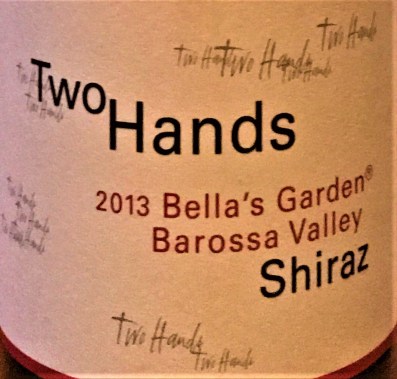
Two Hands Bella’s Garden Shiraz 2013

W Bella Garden 2013Shiraz from Barossa Valley, Barossa, Australia
100% shiraz

14.5% alcohol

Opened 21 Jan 2018

els: 9.4/10

James Halliday: 95

Wine Advocate: 94

Wine Spectator: 94

Cellar Tracker: 93

German immigrants brought the wine industry to Barossa Valley in 1843 and its reputation in the wine trade has waxed and waned through the years, along with the world’s perception of Shiraz. In the late 20th century the valley once again saw its fortunes on the rise and today it rates along side McLaren Vale as South Australia’s premier wine regions.

The Two Hands winery came into existence in 1999 with the single aim of producing the best Shiraz from the best regions of Australia. By 2003 the company had put down roots in Barossa Valley and their Shiraz Garden series wines were in full bloom. The series is currently a collection of 6 Shiraz wines, each sourced from a different growing region in South Australia and Victoria.  The different region’s grapes are prepared and processed in exactly the same manner at their Barossa Estate so that the 6 separate Shirazes’ character becomes a definite reflection of their distinct terroir.

The Barossa Valley vineyards grow in a hot and dry continental climate and receive a scant 6 inches of rain during the growing season. Growing season temperatures peak in the high 80s°F during the day and dip into the low 50s°F at night. The soils tend to be clay and silt with some sand aiding in the drainage. The grapes are de-stemmed, crushed and fermented in open fermenters. After 2 weeks the wine is racked to barrels for malolactic fermentation. The wine is aged for 18 months in new and old French oak hogsheads (59-66 US gallons) and puncheons (132 US gallons).

The wine has a deep and dark purple color with a lighter purple rim. Dark fruits and berries wind their way through your nose and palate, interacting with the perfect balance of acidity and tannins to produce a long and satisfying finish.

An outstanding dinner wine.  My wife and I drank this wine over a delicious meal that started off with warm sourdough bread dipped in a mixture of salt-basil-pepper and olive oil, followed by two small, lightly spiced crab cakes, just to keep our appetites in check until the next course made its appearance. Our entrees consisted of a medium-rare filet mignon and a medium lamb loin, both served with garlic mashed potatoes and grilled, whole baby carrots.  We finished the repast with a slice of lime cheesecake topped with blueberries and unsweetened whipped cream. The Shiraz made it all simply divine and so decadent. This wine should last for many years. Decant and aerate for one hour before drinking.

$49.99-79.99  wine-searcher.com (~ $70.00 at the restaurant)


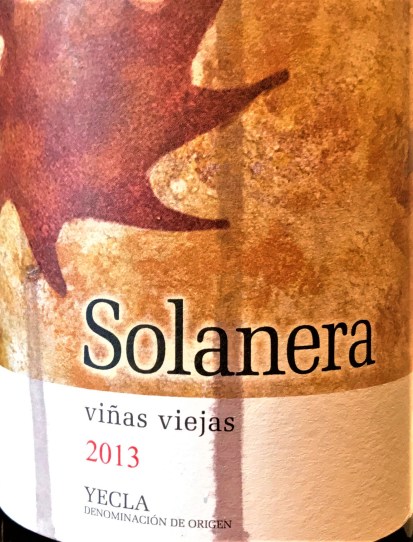
Bodegas Castano Solanera 2013

W Solanera 2013Other Red Blends from Yecla Region, Southern Spain
An Eric Solomon Selection

70% monastrell (mourvedre)

15% cabernet sauvignon

15% garnacha tintorera

14.5% alcohol

Opened 20 Jan 2018

els: 9.0/10

Wine Advocate: 92

Guia Penin: 89

Cellar Tracker: 88

Ramon Castano Santa and his 3 sons have nourished their Yecla vineyards since the 1950s and today they extend over almost 1500 acres, growing a wide assortment of grapes from the ancestral Monastrell, also known as Mourvedre, to Cabernet Franc, Cabernet Sauvignon, Chardonnay, Garnacha Tinta, Macabeo, Merlot, Moscatel, Sauvignon Blanc, Syrah, and Tempranillo. Some of the vines are in excess of 100 years old.  The vines for this wine are 40-100 years old, thus “vinas viejas” or old vines.

The family’s vineyards are located in the northern reaches of the Yecla region, near the foot of Monte Arabi, and are approximately 50 miles northwest of the Mediterranean coast, ranging from 1300-3000 feet above sea level.  The vineyards for this wine are from their Campo Arriba (high land) area and are just shy of 3000′ above sea level, growing in a low organic, clayey limestone with good drainage. The climate is a cross between Mediterranean and a continental weather conditions. Daytime temperatures during the growing season reach into the mid-80s and the night-time lows dip into the mid-50s°F. The summer rains are infrequent and sparse, delivering anywhere from 0.25-2.0 inches per month, perfect for the thick-skinned Monastrell grapes.

The Castano family grapes are used in this Eric Solomon selection and the wine making is supervised by Solomon and Jean-Marc Lafage.  The grapes are hand harvested and fermented separately in stainless steel tanks. The wine is then aged in French and American oak barrels for 10 months.

Dark ruby-red to purple in color with a light purple rim. Elegantly redolent of dark fruits and berries. A rich, thick taste of berries and chewy tannins. Balanced and delicious.

An outstanding everyday red blend at a good price.  Serve with cheese, lamb, pork; the spicier the food the better. Drink now, but should last for many years.  Decant and aerate for one hour before drinking.

$14.99  wine.com

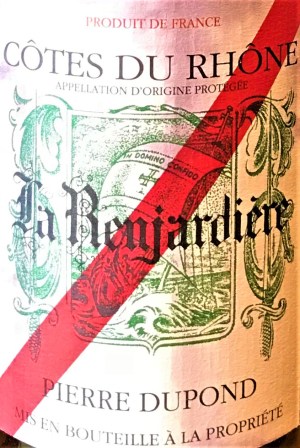
Pierre Dupond La Renjardiere Cotes du Rhone Rouge 2015

W Dupond 2015Rhone Red Blend from Southern Rhone – Cotes du Rhone, Rhone, France
60% grenache

20% syrah

10% mourvedre

10% cinsault

14.0% alcohol

Opened 17 Jan 2018

els: 8.6/10

Tastings: 88

The Cotes du Rhone wine region stretches along the Rhone River, beginning at Vienne in the north to Avignon, 125 miles to the south. The Central Massif defines the western boundary and the foothills of the Alps, the eastern boundary. The region is designated with 4 levels of distinction: at the bottom and the most basic are the Cotes du Rhone wines, this wine falls into that category, followed by 95 Cotes du Rhone-Villages, then, with another step up there are the 18 Cotes du Rhone-Named Villages and finally at the top are the 17 Crus. Cotes du Rhone wines must contain at least 40% Grenache as their main grape, followed by a minimum of 15% from the secondary grapes: Syrah and Mourvedre.  Accessory grapes, such as Cinsault, can not provide more than 30% of the total.

The La Renjardière is a 300 acre+ vineyard, just north of Chateauneuf du Pape and the city of Orange. The vineyards reside on the right bank slopes of the Rhone with soils consisting of sand, clay and limestone with round pebbles which make walking without shoes difficult, but provide a wonderful assist for drainage. The vineyard’s Mediterranean climate has growing season temperatures ranging from the high 40s at night to the low 80s °F during the day.

The wine has a dark ruby-red color with a nice garnet rim. It exhibits a medium but distinct nose of  cherry and strawberries. The tongue tells me that plums and black fruits are nearby. Tannins are easy, acidity isn’t overpowering, or in other words a balanced, mild wine with a medium to long finish, reminiscent of a young woman with small, but invitingly round breasts. The wine should be good for a few more years.

A good everyday red at a good price.  Serve with cheese, lamb, or pork.  Decant and aerate for one hour before drinking.

$12.99  wine.com

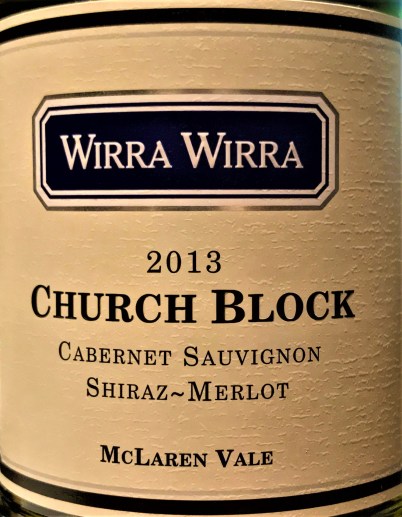
Wirra Wirra Church Block CSM 2013

W Church Block 2013Other Red Blends from McLaren Vale, Australia
50% cabernet sauvignon

37% shiraz

13% merlot

14.5% alcohol

Opened 10 Jan 2018

els: 9.2/10

Australian Wine Companion:  94

James Suckling:  92

Wine Enthusiast:  91

Wine Spectator:  90

Wilfred Wong:  90

Vinous:  89

The McLaren Vale wine region is centered around the eponymous small town populated with approximately 4000 people, located 20 miles south of Adelaide in South Australia.  The wine growing region, triangular in shape, is less than 20 miles in length and 8 miles in width, nestled between the Gulf of St. Vincent on the west-northwest and the Willunga Fault and scarp, known as the Sellicks Hills Range, along its southeastern edge. McLaren Vale grew famous with its Shiraz wines but today its 88 wineries produce world-class reds and whites; including Cabernet Sauvignon, Grenache, Mourvedre, Chardonnay, Riesling, and Sauvignon Blanc. It is not uncommon to find 100-year old vines in McLaren Vale vineyards.

The Wirra Wirra winery was established in 1969 by Greg Trott and others, out of the ruins of the 1894 winery started by a gentleman delightfully named, Robert Strangways Wigley. Greg Trott’s first Wirra Wirra labeled wine was the 1972 Church Block CSM, named after a vineyard adjacent to a small church.

The vineyards of McLaren Vale are subjected to a Mediterranean climate with dry summers and wet winters, perfect for growing red wine grapes.  Rains bring between 20 and 30 inches per year; the rains peaking in the southern hemisphere May to September winter.  Growing season temperatures range from daytime highs in the mid-80s to night time lows in the mid-50s degrees Fahrenheit. Frost and snow are almost unheard of anytime during the year.  The soils are generally well-drained, thin loamy sands with clays and clayey limes underneath.

This wine has a brilliant ruby-red hue with a narrow pink rim.  Redolent of black berries and plums. An intense taste of red fruits with lasting tannins, and a very long, balanced finish.

An outstanding red wine at a great price.  Serves well with beef and lamb. Tastes great by itself.  Tannins suggests that this wine will serve well for many years to come. A very versatile wine. Decant and aerate for one hour before drinking.

$14.99-21.99  wine-searcher.com

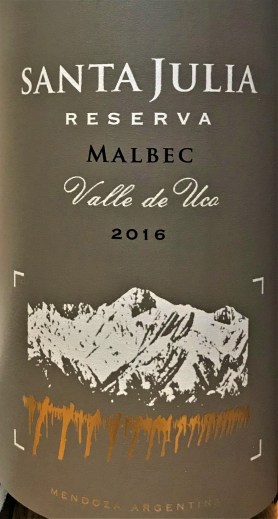
Santa Julia Reserva Malbec 2016

W Julia 2016.jpgMalbec from Uco Valley Mendoza, Argentina

100% malbec

13.0% alcohol

Opened 15 Jan 2018

els: 9.0/10

Wine Advocate: 91-90

Descorchados: 89

Wine Enthusiast: 87

Santa Julia is one of the three brands produced by the Zuccardi Family who have been active in Mendoza area vineyards and bodegas since 1950. The family founded the company in 1963. The Julia brand, named after the founder Jose Alberto Zuccardi’s daughter, was inaugurated in 1982 with the first wines exported in 1990. Today the wines are sold in 45 countries.

Santa Julia Bodega has 2 vineyards in the Uco Valley; Finca La Ribera of 210 acres, and Finca Vista Flores of 106 acres, both at an average elevation of 2900 feet above see level. Temperatures, during the growing season, range from the mid-80s°F during the day to the mid-40s°F at night.  Rainfall averages 1 to 3.5 inches per month with the driest month occurring during April.

The grapes are harvested towards the end of April, fermented at 77°F and allowed to macerate for 20 days. Part of the harvest is then aged in French oak barrels for 10 months.

The wine has a brilliant garnet to ruby-red hue with a faint narrow pink rim.  Light aromas of fruit, red berries and a hint of herbs. A taste of red fruits with a nice dry medium and balanced finish, like a kiss of a pretty, young girl.

An outstanding red wine at a great price.  Serve with cheese, pasta, or pizza. Tastes great slightly chilled: 62-65°F.  Decant and aerate for one hour before drinking.

$10.99  wine.com

Tahbilk Shiraz 2012

W Tahbilk 2012Shiraz from Nagambie Lakes, Australia

100% shiraz

13.7% alcohol

Opened 26 Dec 2017

els: 9.0/10

Australian Wine Companion: 92

Wine and Spirits: 91

Robert Parker: 90

The Wine Front: 90

Cellar Tracker: 89

Tahbilk established itself in 1860 as the first winery in the Goulburn Valley of Central Victoria, Australia, and is one of the oldest wineries in Australia. The Daung-wurrung, a Victorian aboriginal clan, in their native language called the area tabilk-tabilk or the ‘place of many waterholes’, so named because the local Goulburn River dried up periodically and left isolated bodies of water: ‘waterholes’; in the river and along its billabongs. Reginald Purbrick purchased the winery in 1925 and 5 generations of family have been making wines there ever since.

The Shiraz vineyards encompass about 75 acres and contain vines planted between the 1930s and 2000s. The vineyards are situated less than 500 feet above sea level experiencing cool nights of about 50 degrees Fahrenheit and the days hover in the low 80s during the growing season. Rain is sufficient at about 1.5 to 2.5 inches per month. The soils are sandy.

The wine is fermented in open-topped oak barrels and aged in 100 year French oak barrels.

This is a brilliant, garnet colored wine with a pale pink rim. Aromas of red fruits and dark berries, with a hint of oak. Very nice tasting, balanced, medium bodied and smooth, with thick tannins; producing a long, dry, satisfying finish. A classy girl of a wine, reminiscent of long, perfect legs, anchored to glossy stiletto heals, and, unfortunately, partially retiring inside a white silk dress, slit long on the left thigh; the dress continuing upward along luscious curves  with a single, lonely strap across the right shoulder.

An outstanding wine. Serve with beef, lamb or wild game. Decant and aerate for one hour before drinking.

$13.99  wine.com