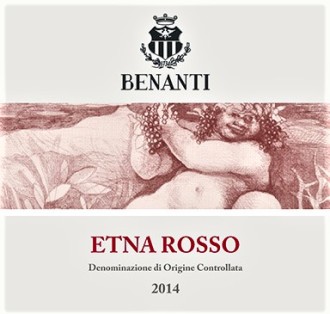
Benanti Etna Rosso 2014

W Etna 2014Other Red Blends from Etna, Mount Etna, Sicily, Italy
80% nerello mascalese

20% nerello cappuccio

13.5% alcohol

Purchased: 21 September 2017  –  $19.99

Opened: 27 March 2018

els:  9.1/10

Wine Enthusiast:  94

Cellar Tracker:  89

The ancient Greeks arrived in southern Italy and Sicily 3000 to 2800 years ago, planting vines, among other, lesser endeavors,  laying the ground work for an extensive Greek tourism outpost in the Iron Age. The Etruscans were quick studies and turned Tuscany into a wine haven soon after.  Then came the Romans expanding the wine trade to their known world, much to everyone’s satisfaction. Italy is the number one producer of wine in the world with a 2017 output in excess of 1 billion gallons versus world-wide production of about 6.5 billion gallons. The greatest amount of Italian wine, by volume, is exported to Germany but the greatest amount by monetary value, is exported to the US.  There are 4 main producing areas in the country; northeast, northwest, central and southern plus the islands, all further divided up into 20 regions, 408 DOCs and DOCGs, growing 396 prime varieties of grapes. White wine accounts for 54% of all wine produced in Italy with the remainder being red or rose. Sangiovese and Trebbiano grapes are the most common varieties planted.

Sicily, the largest island in the Mediterranean located near the western toe of Italy, likely was one of the first Italian areas the sea-faring Greeks planted vines on. They set up a robust trade in wine that continued with the Phoenicians and Romans. Today, Sicilian wine and food go hand in hand, creating gastronomic delights worldwide.  The island is the 4th largest producer of grapes and wine in Italy by volume; equaling more than 10% of the country’s total. 58% of Sicily’s wine is white, slightly higher than Italy as a whole. There is 1 DOCG, 23 DOCs, and 7 IGPs on the island. About 25% of all wines produced are DOC or DOCG. Sicily produced 140 million gallons of wine in 2016.  Catarrato and Nero d’Avola grapes are the most common grapes grown, amounting to 34% and 16% by acreage, respectively.

Etna DOC wraps around Mount Etna in eastern Sicily, covering the entire mountain slopes, except the northwest quadrant, from top to bottom, from the plains to more than 3500′ above sea level, covering it all in 5000 acres of vines. The vineyards contain some of the oldest vines in all of Europe, many over 100 years and some as old as 200 years. Four wines can be produced under the DOC. 1) Bianco: Carricante (minimum 60%), Catarratto (no more than 40%). 2) Bianco Superiore: Carricante (minimum 80%), Catarratto or Minnella (no more than 20%). Grapes have to come exclusively from the Milo area. 3) The most common DOC wine is Rosso or Rosato: Nerello Mascalese (minimum 80%), Nerello Cappuccio or Mantellato (no more than 20%). 4) Spumante: Nerello Mascalese (minimum 60%). More than 70% of the grapes produced in the DOC are Nerello Mascalese and Nerello Cappuccio. The volcanic soils contain a large percent of sand with clays and are very rich in minerals. Because of the elevation and azimuthal changes around the mountain, temperatures and rainfall vary dramatically from place to place.

The Nerello Mascalese grape, thought to have originated on the Mascali plain at the foot of Mount Etna, is possibly a child of the Sangiovese grape plus some other unknown variety. The grape is dark-skinned (nero-Italian for black), producing medium-bodied, dry wines with fairly high acidity. It is the dominate grape in Rosso wines.

Nerello Cappuccio, almost always used in blended wines, thrives on the higher elevations of Mount Etna. It is a sweet, dark-skinned grape with high tannins and acidity. It is usually blended with Nerello Mascalese to soften it up and add a brilliant ruby color.

The Benanti family winery, its origins dating back to the late 1800s, near the southeastern foot of Mount Etna in Catania, was revived and updated by Giuseppe Benanti in 1988.  After many years of studying the local terroir he brought the proud grapes of the past into the modern world of wine making.  His Etna vineyards are located on the northern, eastern, and southern slopes of the volcano. The company has additional vineyards in the southern tip of Sicily at Pachino and also at Pantelleria, a small island of the southwest coast of Sicily.

The Benanti vineyards are on the northern, eastern and southern slopes of Mount Etna from 1500 to 3000′ above sea level, totaling about 30 acres and producing about 30,000 cases per year.. The vines are 10 to 60 years-old growing in sandy volcanic soils.  The vines grow with-in a highly variable humid, mountain climate with lots of sun.

The grapes are hand-picked in October, de-stemmed, crushed and fermented at 77°F in stainless steel vats coupled with a 3 week maceration. 80% of wine matures in stainless steel tanks while the remaining 20% is aged in French oak barrels for 8-10 months. They are further aged in the bottle for 2-3 months.

A brilliant pale ruby-red to a pale tawny wine with a tawny rim. A perfume of cherries and dark fruits. Light, dry and acidic with a wonderful, long finish.

I find this wine similar in structure to Pinot Noirs and Burgundies. I drank this wine while nibbling on strawberries and apples slices which I found very satisfying.  It is a light wine and I would pair it with light fare such as a minestrone or Italian wedding soup.

An outstanding wine at an ok price. Drink this year but likely good until 2021-2022. Decant and aerate for one hour, or more, before drinking.

$16.98-21.99 wine-searcher.com

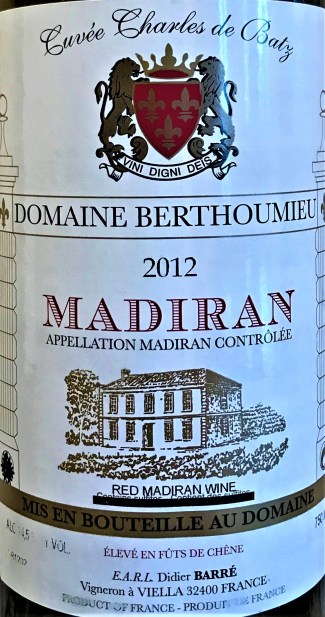
Domaine Berthoumieu Madiran Cuvee Charles de Batz 2014

W Charles Batz 2012Other Red Blends from Madiran, South West, France

90% tannat

10% cabernet sauvignon

14.5% alcohol

Purchased: 12 July 2017  –  $19.99

Opened: 25 March 2018

els:  9.2/10

Wine Enthusiast:  93

France is the 2nd largest producer of wine in the world, just behind Italy and ahead of Spain, representing about 21% of the global wine market. The country is responsible for creating some of the most recognizable old world wines on the planet, from the bubbly Champagnes in the cool north to world-class Bordeaux along the Garonne and Dordogne Rivers to the GSMs in the warm Mediterranean south. There are 17 major wine-producing regions in the country along with another 28 smaller areas, all growing 96 varieties of predominate grapes with Merlot and Grenache the most common. Reds account for almost 70% of the 2 million plus acres planted in vines, with whites accounting for the remainder. As with the other major European wine producers, France’s vineyard acreage has been shrinking over the last couple of decades due to less demand from their home population and increased market pressures from new world producers.

The South West or Sud Quest region, France’s 5th largest wine area, begins in the central north on the eastern edge of the Bordeaux region and continues 150 miles to the southwest towards the Pyrenees, ending near the Spanish border. The region includes 25 AOCs with 120,000 areas planted in grapes producing around 270 million bottles of wine every year; roughly 3% of total for all of France.  The Romans initially cultivated the area for grapes and had it awash in wine before the Bordeaux region even thought about growing their own. But because Bordeaux controlled the wine trading routes they strangled the South West market, through taxes and laws, in the 13th century and the area never regained its prominence in the France, or the world. The area predominately grows red Cabernet Sauvignon, Merlot, and Tannat grapes along with white Semillon Sauvignon, and Ugni Blanc grapes.  The climate is a combination of oceanic and continental with cool wet winters and springs, offset by warm, sunny summers.

Madiran AOC is named after the town of Madiran in the Gascony Provence near the Adour River, 90 miles south of Bordeaux, 80 miles west of Toulouse and 60 miles from the Spanish border. The AOC is available only to red wine containing 40-60% Tannat, although 100% is acceptable (makes no sense to me), and blended with Cabernet Franc and or Cabernet Sauvignon. There are 3200 acres of vineyards in the Madiran AOC producing about 10 million bottles of red wine annually. The Pyrenees to the south have deposited, a generally, well-drained alluvium of clays and silts, rich in limestone interspersed with lots of red iron pebbles and stones. The area enjoys warm summer days rarely topping 80°F with rainfall averaging 1-2″ per month with a few inches of snow in the winter.

The Tannat grape, as its name suggest is very high in tannins, is native to the South West region of France. It is not a commonly grown grape, ranking at 100 out of all grapes grown globally but in Madiran it is king. There are about 15,000 acres planted worldwide or much less than 1% of the total grape acreage.  The wine from the grape is often blended with “softer” wines such as Cabernet Franc and Cabernet Sauvignon to reduce its astringency. To further soften up the wine they are kept in oak barrels for up to 20 months.  The wines exhibit a deep tannic structure with notes of raspberry.  They are very dark in color and have great aging potential. Tannat grapes are high in procyanidins, a condensed tannin class of flavonoid with high antioxidant values that affects the wines astringency, color and mouth-feel.

Cabernet Sauvignon is a cross, believed to have occurred naturally sometime in the 1600s in southwestern France, between Cabernet Franc and Sauvignon Blanc grapes. It is now the most widely planted grape in the world covering more than 700,000 acres or about 6.5% of all vines planted. France is number 1 in the world in acres planted for this grape. It is a thick-skinned grape that’s relatively easy to grow and maintain, exhibiting high tannins and acidity, producing a distinct bell pepper flavor, especially in cool climates, along with aromas of mint and eucalyptus. The grapes produce a full-bodied and dark-ruby colored wine.

The Domaine Berthoumieu  was founded in the 1850s by Virgile Dutour in the tiny village of Viella which is 5 miles northwest of Madiran. In the 1980s Didier Barré took over management of the winery from his father Louise. Today the property is in the hands of the family’s 6th generation of wine makers: Claire and Marion Bortolussi. The Berthoumieu field, part of the Domaine  Berthoumieu, is part of d’Artagnan’s homeland, aka Charles de Batz, Louis XIV’s Musketeer.

The winery has 64 acres which is planted in 85% red and 15% white grapes with the vines being 50-100 years-old.  The reds include: Tannat, Cabernet Sauvignon, Cabernet Franc, and Pinenc.  The whites include: Petit Manseng, Gros Manseng, and Petit Courbu. The soils are a silty-clay, heavy in limestone with gravels and stones. The area enjoys an oceanic climate with diurnal growing season temperatures ranging from 45-80°F and rainfall ranging from 2-2.75″ per month.

After picking and sorting the grapes they are transferred to 150-210 gallon tanks for 30 days of fermentation and maceration.  The wine is then aged for 12 months in new and used oak.

A dark, dark purple, almost black wine with a ruby rim. Strong aromas of delicious raspberries  Full-bodied and powerful.  The tannins are, cut with a knife thick, and the wine is very dry.  A wonderful long, long finish.

This wine needs a strong, flavorful food pairing. Strong cheeses.  Strong tangy barbecue. Meats with strong herbs such as rosemary. Try my slow cooker rosemary stew.  I always make this slightly different so I’ll try to generalize it a bit. Start with 1-2 pounds of beef stew meat cut up in small chunks, add in a cup of beef broth, one chopped medium onion, a small can of tomato sauce (optional), a handful of baby carrots, 10 ounces of canned corn, 1 tablespoon of garlic, a cup of chopped celery, 1-2 teaspoons of dried rosemary, and 2 cups washed and sliced baby potatoes (I usually make these fairly big chunks by just quartering the baby potatoes), 1-2 teaspoons of cornstarch (thickener), salt and pepper, a dash of oregano and basil.  Add everything, except the cornstarch, salt and pepper, into the slow cooker for 8 hours, half on high, half on low.  Add the cornstarch to a half cup of warm water and mix.  Stir into the slow cooker about 15 minutes before serving.  Add water ifs needed. Salt and pepper to taste.

An outstanding wine at a fair price. Drink this year but likely good until 2025-2030. Decant and aerate for one hour, or more, before drinking.

This wine’s vintage appears to be no longer available outside of the borders of France. The 2012 vintage is still available and has ratings of 90 or more.


Finca Decero Remolinos Vineyard Malbec 2014

W Decero 2014Malbec from Agrelo, North Mendoza (Lujan de Cuyo), Mendoza, Cuyo, Argentina

100% malbec

14.5% alcohol

Purchased: 6 March 2017  –  $19.99

Opened: 19 March 2018

els:  9.0/10

James Suckling:  92

Tim Atkin:  92

Vinous:  88

Cellar Tracker:  87

Argentina is the world’s 6th largest producer of wine by volume, just behind the US and ahead of Australia. It produces about 6% of the world’s total wine. The country has 350-400,000 acres planted in grapes. Argentina has 4 main wine-producing regions: Atlantic, Cuyo, North, and Patagonia. Cuyo is the largest and most important wine-producing, macroeconomic region in central Argentina and includes the wine sub-regions of La Rioja, Mendoza, and San Juan; with Mendoza being the largest of the 3 by area, population, GDP, and wine production.

Argentina was the first South American country attempting to grow vines, beginning in Mendoza in the early 1800s.   The initial plantings came from the Bordeaux region of France, including the ubiquitous Malbec.  Eventually, Mendoza was producing world-class Malbec wines, on par or superior to those produced in France, mainly due to its high elevations in the foothills of the Andes, well-drained soils, and lots and lots of hot sunshine. Today the country produces 75% of the world’s Malbec.

The Mendoza region, lapping up onto the eastern foothills of the youthful Andes, is the largest wine producer in Argentina, accounting for 65-75% of the country’s total. A third of the country’s vineyards are dedicated to Malbec with Mendoza also producing the lion’s share of that variety. The Mendoza wine region is partitioned into another 5 sub-areas: Central Oasis, East Mendoza, North Mendoza, South Mendoza, and Uco Valley. North Mendoza, aka Lujan de Cuyo, designated as an appellation in 1993,  contains an additional 6 micro-regions including: Agrelo, Barrancas, Las Compuertas, Perdriel, Ugarteche, and Vistalba.

Agrelo, named after a local village, is one of the most prestigious wine micro-regions in Lujan de Cuyo, North Mendoza, and all of Argentina. Its terroir was made for growing Malbec and Cabernet Sauvignon grapes. The vines grow at an elevation of  2900-3500′ above sea level in very dry air, and as such, the cloudless skies provide for an intense sun producing lots of heat.  The soils are a thick, very sandy loam, encouraging deep root penetration into the cool gravelly subsurface. These subsurface gravels help to cool and protect the green vines above from the hot sun. An auspicious terroir responsible for creating Malbec second to none in the world.

Malbec grapes originated around Cahors in south-west France.  It is a thinned-skinned, dark grape, requiring lots of sun and heat. It produces full-bodied wines with medium to high tannins and acidity. In France most of the Malbec is grown around the Cahors AOC on the low, gravelly terraces of the Lot River. In Cahors, a Malbec must contain at least 70% of this grape and is usually blended with Merlot and Tannat. In Argentina the grapes grow at much higher elevations than in France, producing a high acidity, high tannin wine with herbal-flower aromas and flavors versus the more earthly notes of its French sister.

Thomas Schmidheiny, a descendent of Swiss wine makers, set up shop in Agrelo in the year 2000 upon a land of nothing, “cero”, naming his new winery after that land of nothing: Decero. The land he chose is the highest in all of Agrelo; 3500′ above sea level. He planted all reds; Malbec, Cabernet Sauvignon, Petit Verdot, and Tannat grapes on his 270 acres, calling the vineyard Remolinos, named after the tiny whirlwinds or dust devils that commonly dance across vineyards in tandem with the lazy dry winds. They tease the white-hot summer sun, beaming down from on high, to come and join them in a tango of sleepy idleness and pointless play.

The Remolinos vineyard, with some variation, has soils that are similar to all of Agrelo, sandy loams over a gravelly subsoil. The growing season diurnal temperature range is 55-85ºF with rainfall averaging 0.75-1.5″ per month, dropping to almost nothing in the winter. Temperatures may approach freezing in the winter, but usually don’t.

The winery employs its labor intensive “amano”, by hand, process to its vineyards and wine making processes. In the vineyards, all the vines are planted, pruned, and picked by hand. The vines are relieved of their east facing canopy leaves to increase grape cluster exposure to the sun. The clusters are individually thinned to 1 or 2 per branch.

The 2014 harvest was cool and wet, delaying the grape picking by about a week and taking the entire month of April to complete.  The grapes were individually selected on the vine, hand-picked, and sorted, grape by grape, repeating this process again and again throughout the harvest.  The grapes, after crushing, spend 5-7 days in a cold soak and then 10 days fermenting in small stainless steel tanks.  Most grapes are fermented at 78ºF while a small amount is subject to fermentation at 86ºF, ostensibly to increase texture. After fermentation the grapes spend an additional 15-18 days in the tanks for maceration.  90% of the wine is then aged in new and old French oak barrels for 14 months.  The other 10% remains in the stainless steel tanks to preserve the original aromas.

A dark ruby-red wine with a light purple rim. Aromas of red fruits, mainly cherries, with some spice and flowers. Full-bodied and nicely balanced.  The tannins are thick and the acidity is tad more than usual.  Breathing for an hour definitely improves this wine.  It leaves you with a nice long finish.

I’m not sure were I developed this habit but I prefer fruit, berry and cheese, bits and bites, when I drink a Malbec. I can’t remember the last time I had a full meal with a Malbec wine. I usually prefer thin slices of apple and pear, blueberries and sliced strawberries, and strong cheese.  I once tried chocolate dipped strawberries with a Malbec and I’m certain I glimpsed heaven.

An outstanding wine at a fair price. Drink this year but likely good until 2023-2025. Decant and aerate for one hour, or more, before drinking.

$14.96-19.99  wine-searcher.com


Bodegas Castano Hecula 2013

W Hecula 2013Monastrell (Mourvedre) from Yecla, Murcia, Spain

An Eric Solomon Selection

100% mourvedre (monastrell)

14.0% alcohol

Purchased: 12 November 2017  –  $10.99

Opened: 3 March 2018

els:  9.0/10

Wine Advocate:  91

Guia Penin:  88

Cellar Tracker:  87

The Murcia Region of Spain, located in the Segura River basin in the southeastern part of the country with the Beltic Mountains in the central west, the coastal Mediterranean plain to the southwest and the central high plateau to the north and east. Yecla, 45 miles northwest of the Mediterranean coast, is a small Denominación de Origen (DO — Designation of Origin in English) food and wine region in the northeastern corner of the Murcia Region which takes it name from the eponymous small town of 35,000 people. Yecla enjoys a mixed Mediterranean-continental climate; dry with rare freezes and large swings in the daily temperatures. It is mainly noted for its Monastrell wines and is entirely surrounded by the other notable Monastrell regions of Jumilla, Almansa and Alicante.

The DO classification is Spain’s second highest, DOC being the highest, in terms of quality for wines and food. In 2003 Spain added the DO Pago designation applicable only to single estate wines.  A classification that allows wineries some latitude in production and grape usage, slightly mimicking Italy’s Super Tuscan designation.  Currently there are 2 DOCs (Rioja and Priorat), 69 DOs and 14 DO Pagos in the country.

Yecla vineyards, dating back to the seafaring Phoenicians, are mainly planted in red grapes with Mourvedre vines being the most common. Syrah, Grenacha, Merlot, and Petit Verdot are also grown but in lesser amounts. Currently there are about 26,600 acres of vineyards in the Yecla area with approximately 75% of that existing under the DO designation. This constitutes only 1% of the total grape acreage planted in all of Spain. The Yecla wineries produce upwards to 9,000,000 liters of wine per year, of which 95% is exported out of the country.

Mourvedre is the 9th most planted grape in the world, by acreage, and is the 6th most common in Spain. It is one of the primary grapes for GSM blends, Grenacha and Syrah being the other 2, and is only occasionally bottled as a single grape wine. Spanish wine makers also use this grape, along with others, such as Grenacha and Tempranillo, for making sparkling roses or cava roses. It is a black-skinned variety that is believed to have originated in Spain but is now found throughout the world, especially in France, Australia, US, and South Africa. Spain produces the lions share of this grape with France coming in a distant second; all other countries place as a comparative after thought. The grape has bold flavors of blackberries, tobacco and black pepper.  In cool climates the grape takes on notes of red plums.  It is a full-bodied wine with high tannins and medium high acidity allowing for a long shelf life.

The Bodegas Castano is the best known and largest winery in Yecla. The family run operation traces its roots, in the area, back to the 1950s but it wasn’t until the 1980s they started bottling their own wines. Starting in the early 2000s the family steadily upgraded their winery and cellars including temperature controlled fermentation and smaller tanks for selective vinification. Their vineyards and winery occupy about 16,000 acres with Monastrell grapes planted on a little less than 1000 of those acres.

Only 2 of the 8 Castano vineyards grow the grapes for the Hecula wine: the higher altitude Las Gruesas and Pozuelo. The 400 acre Las Gruesas vineyard at roughly 2600-2800′ above sea level has organically poor, clayey to gravelly limestone soils with 35 to 60-year-old vines. In addition to Monastrell grapes, red varieties of Garnacha, Merlot, Cabernet Sauvignon, Syrah, and Cabernet Franc are also grown. The 100 acre Pozuelo vineyard at approximately the same elevation as Las Gruesas has similar soils but not as rocky. Its vines are slightly  older with some in the 80-year range. This vineyard grows, in addition to Monastrell, Garnacha Tintorera, Merlot, Cabernet Sauvignon, Syrah, Macabeo and Tempranillo grapes. The growing season diurnal temperature range in the area is 50-85ºF with rainfall ranging from 0.25-2.0″ per month.

The Monastrell grapes are hand harvested, destemmed, sorted, fermented, and macerated at 77ºF in stainless steel tanks for 10 days. The wine then spends 6 months in half new, French and American oak barrels at approximately 64ºF. Production is limited to approximately 12,000 cases. This is an Eric Solomon Selection, slated mainly for export to the US.

A medium to dark ruby-red wine with a light purple rim. Aromas of black fruits and pepper. Full-bodied and nicely balanced.  The tannins are thick and chewy with a very easy acidity that produces a long-lasting finish.

Enjoy this wine with a Spanish dish of Chicken Paella. You will need a cup of vegetable oil, 1 green and red pepper diced, 3 breasts of de-boned chicken; each breast cut into 4-6 pieces, 3 cups of white rice, 6 cups of chicken broth, 8 ounces of peas; canned or fresh, 1 small onion chopped, 2 tomatoes diced, 1 clove of garlic or 2 teaspoons, salt and pepper to taste,  and parsley.  Heat half the oil and put the chicken into a(n) (iron) skillet. Cook for 15 minuets or until brown and remove to a holding dish. In the same skillet with the hot oil, cook the chopped onion for 5 minutes, add the diced tomatoes, and cook for an additional 5 minutes while mashing the tomatoes. Strain the mixture through a colander and add the solids to a paella cooking pan; woks work great.  Add the rest of the oil, plus the cooked green pepper and chicken. Stir the mixture to avoid further browning of the chicken.  Add salt, pepper and broth.  Keep hot but do not boil.  Add garlic and parsley to the cooked rice.  Add the rice, peas, and red pepper to the paella pan containing the chicken after the broth is reduced by half.  Cook for another 20 minutes.  Remove from heat, cool for 5 minutes, and serve.

An outstanding wine at an unbelievable price. Drink this year but likely good until 2020-2023. Decant and aerate for one hour, or more, before drinking.

$8.95-15.27 wine-searcher.com

Castiglion del Bosco Dainero 2012

W Dainero 2012Merlot from Riparbella, Pisa, Tuscany, Italy
90% merlot

10% sangiovese

13.5% alcohol

Purchased: 6 March 2017  –  $16.99

Opened: 28 Feb 2018

els: 8.5/10

James Suckling: 92

Wine Spectator: 90

Cellar Tracker:84

Tuscany, a central Italian region bounded by the Tyrrhenian Sea on the west and the Apennines Mountains on the east, is a name synonymous with Italian Renaissance art, ancient history, landscapes of exquisite beauty, and wine. Its wine history dates back to the enigmatic but successful Etruscans in the 8th century BC, growing rich by trading their wine with the Gauls to the north and the Romans and Greeks to the south and east. The aura and renown of Iron Age Tuscany wine secured its perpetuation through the endless generations of Romans, Christian monks, Florentine merchants, Medicis, Hapsburgs, Bourbons, Bonapartes and todays modern Italians. Good wine and time immemorial happily going hand in hand.

Tuscany has the third highest quantity of acres planted in vines in the country but because of its extremely poor soils and the wine makers emphasis on lower yields, it is only sixth in volume, producing just shy of 300,000,000 liters of wine in 2016. The area has a plethora of DOCG and DOC wine regions plus 5 IGT sub-regions that will bewilder even the most diligent and attentive of students and that’s before the Super Tuscans enter into the smorgasbord of categories; all with their rules about grape varieties and percentages spread over a bursting profusion of wineries and vineyards. The better known regions include: Brunello di Montalcino producing rich, full-bodied sangiovese wines; Chianti and Chianti Classico producing the famous medium-bodied wines; and Bolgheri, the region that first produced the well received Super Tuscans.

Merlot is the 3rd most planted grape in the world and 5th most common in Italy. It is one of the primary grapes for Bordeaux blends and is very popular as a stand alone variety. It is a dark blue to purple grape with a soft, velvety structure with medium tannins and low acidity, producing dark fruity flavors.

Sangiovese is the most planted grape in Tuscany and all of Italy, deriving its name from the Latin for the “blood of Jupiter”. It is possible that this grape dates back to the time of Etruscans and is closely related to the Ciliegiolo grape. A sangiovese wine has an earthy cherry flavor that readily acquires a taste of vanilla and oak after aging in barrels.  The tannins are not too strong but the acidity is high.

The Castiglion del Bosco traces its heritage back to 1100 AD when the castile was built and in the 13th century the family owners added stone walls around the castile. Skipping forward a few years to 1967 the estate joins with a few other local families to found the Brunello di Montalcino wine association. Brunello eventually becomes one of the first Italian wines to be granted the DOC and DOCG categories. Massimo Ferragamo, in 2003, purchased Castiglion del Bosco to add to his winery in Riparbella. By the end of the decade he has added guest villas and a golf course to the Castiglion del Bosco estate.

Dainero is produced from the grapes grown at Castiglion del Bosco’s 25 acres of vineyards at Riparbella, less than 8 miles from the western coast and just north of the Bolgheri wine region. The vineyards are located within the wide-ranging Toscana IGT appellation. The vineyards enjoy an Mediterranean  to a sub-continental climate with cool ocean breezes drafting over the 1475′ above sea level west-facing, vine-covered hills.  The iron-rich, alluvial, clayey soils containing metamorphic gravels and pebbles, ensure that the vines are well-drained, healthy and stable. The vineyards are planted with Merlot, Cabernet Franc, Cabernet Sauvignon, and Petit Verdot. The diurnal growing season temperature-range for the vineyards is 50-85ºF with rainfall averaging 3-4″ per month.

The Merlot grapes were harvested during the first part of September while the Sangiovese grapes were harvested during the last part of this month. The grapes are processed at the Castiglion del Bosco cellars. After sorting the grapes they are gravity fed into steel tanks and fermented for 15 days at 82ºF .  The wine spends 6 months in French oak barrels, 30% of which is new and 70% old.  The wine then spends 6 months in the bottle before it’s marketed to the public.

A ruby-red wine trending towards purple with a tawny rim. Aromas of black fruits, currants, and spice. A medium to full-bodied, balanced and structured, but somewhat thick in the mouth.  The tannins and acidity are working well together producing a slightly sharp and long finish. I rated this wine at 8.5/10 mainly because I believe it is past its prime, not as clear and crisp as it should be.  The wine likely peaked about a year ago.

Enjoy this wine with a dish of spaghetti and Italian sausage.  A platter of hard cheeses would also do this wine justice.

A good wine that you shouldn’t spend more than $10 on. Drink this year. Decant and aerate for one hour, or more, before drinking.

$9.99-20.24 wine-searcher.com


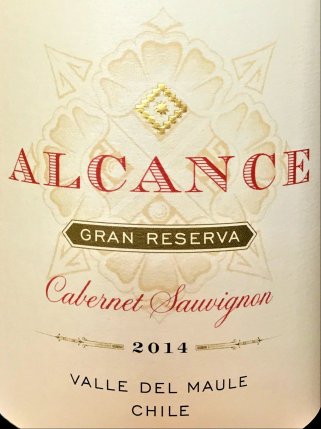
Alcance Gran Reserva Cabernet Sauvignon 2014

W Alcance 2014Cabernet Sauvignon from Maule Valley, Central Valley, Chile
100% cabernet sauvignon

14.5% alcohol

Purchased: 6 March 2017 – $19.99

Opened: 28 Feb 2018

els: 9.0/10

Wine and Spirits: 94

James Suckling: 90

Cellar Tracker: 90

Wine Enthusiast: 87

Maule Valley, the largest wine-producing region in Chile and the southern-most region in Chile’s Central Valley, is tucked in-between the Andes and the Coastal Ranges. The region is named after the east to west flowing Maule River with its headwaters in the western slopes of the Andes Mountains and emptying 50-60 miles downstream into the Pacific Ocean near the small, impoverished city of Constitucion. Due to the Valley’s more southern location in the Central Valley it has cooler temperatures than its northern counterparts but because the Coastal Range’s have lower elevations here the rain shadow is also reduced resulting in more rainfall than up north, particularly in the winter.

The region’s wine history dates back to the mid-1800s when successful Chilean businessmen brought back pre-Phylloxera European vine cuttings to grow in the Valley’s igneous and alluvial soils, primarily along the Maule River. Initially the region grew predominately Pais grapes, generally used for bulk wine sales and table wines but in the recent past most of those vineyards have been replaced with better known selections such as Cabernet Sauvignon, a grape that now accounts for half the 75,000 vine acres planted in the Maule Valley.

Cabernet Sauvignon is a cross, believed to have occurred naturally sometime in the 1600s in southwestern France, between Cabernet Franc and Sauvignon Blanc grapes. It is now the most widely planted grape in the world. Chile is second only to France in the number of acres planted world-wide in this grape. It is a thick-skinned grape that’s relatively easy to grow and maintain, exhibiting high tannins and acidity, producing a distinct bell pepper flavor, especially in cool climates, along with aromas of mint and eucalyptus. The grapes produce a full-bodied and dark-ruby colored wine.

The Alcance winery, founded in 1993, is a Jackson Family enterprise that was instrumental in improving the entire winemaking industry in the Maule Valley.  The family introduced modern techniques to the Valley, through the Alcance winery, and the rest, as they say, is history. The winery started with the lower elevation San Francisco Estate vineyards in the southwestern portion of the Valley. The vines enjoy the cool Pacific winds blowing over their canopy with their roots tapped into soils clogged with large quartz crystals. The growing season temperatures for the San Francisco vineyards ranges from 60-80ºF with rainfall 0.25-1.00″ per month. In 1999 the Jackson Family added the El Maiten Estate winery and vineyards in the southeastern Maule Valley to their Chilean holdings.  The El Maiten vineyards are located in the Andes foothills along the Lircay River, a tributary of the Maule River. The vines grow in a loamy soil containing numerous pebbles and cobbles. The growing season temperatures for the El Maiten area ranges from 60-85ºF with rainfall 0.25-0.75″ per month. Both vineyards total about 200 acres planted in 10 to 20-year-old vines.  The winery produces 5 wines under its Alcance label: Cabernet Sauvignon, Carmenere, Merlot, VIGNO (an old vine Carignan), and Bravura, their celebrated Bordeaux blend.

This wine is produced from a rough 50-50 mix of grapes from both vineyards. The Cabernet Sauvignon vines were 10 to 11-years old for this 2014 vintage. After the grapes are hand harvested, they are hand sorted, cold macerated for 6 days, and fermented in small stainless steel tanks for 20-22 days. Malolactic fermentation is done in French oak barrels for 18 months with 3 intervening racks.

A clear ruby-red wine with a tawny rim. Aromas of cherries and raisins with an oak supplied vanilla in the background. Full-bodied and balanced with a very pleasant, long finish.

Enjoy with a traditional South American stew: Charquican. You will need a pound of cubed beef (cheap to expensive; your choice), a tablespoon of flour, quarter stick of butter, 2 cups of beef stock, a big chopped onion, a teaspoon or two of minced garlic, 2 tablespoons of oil, 1-3 teaspoons of chili peppers finely minced (less or more depending on how spicy you want the stew), 1 cup corn, 1 cup carrots sliced, 2 cups diced potatoes, salt and pepper. Coat the cubes of beef with the flour. Season with salt and pepper. Add to skillet over medium-high heat along with the melted butter. Cook beef until brown. Add the beef stock and simmer for 10 minutes. Transfer the contents of the skillet to a slow cooker.  With the remains of the beef and the beef stock in the skillet add the oil, onion, garlic, chili pepper and cook until the onions are soft. Add the remaining vegetables except the corn to skillet and cook for 5 minutes more. Add the skillet contents to the slow cooker and cook for 6-8 hours. Add in the corn about an hour before serving. Serve over rice.  Delicious. I made this from a modified recipe I found on The Spruce but I left out the squash, beans, and beef jerky; otherwise it was exactly the same:)

An outstanding wine at a fair price. Drink now, but should last until 2023-2025. Decant and aerate for one hour, or more, before drinking.

$15.19-31.49  wine-searcher.com

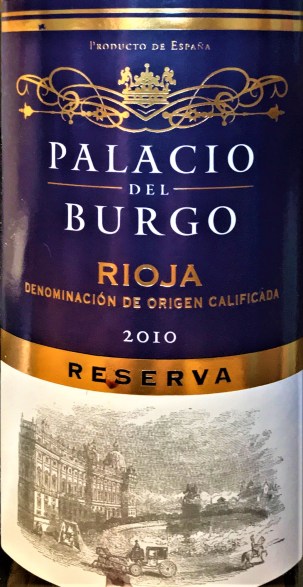
Burgo Viejo Palacio del Burgo Rioja Reserva 2010

W Burgo 2010Red Blend from Alfaro, Rioja Baja, La Rioja, Rioja, Spain

90% tempranillo

10% graciano

13.5% alcohol

Purchased: 12 July 2017 – $18.99

Opened: 20 Feb 2018

els: 9.0/10

Wine Spectator: 93

Stephan Tanzer: 90

Cellar Tracker: 90

Wine and Spirits: 90

Wine Enthusiast: 89

La Rioja, likely the most recognizable, if not the most famous wine region in all of Spain, is located 55-95 miles south of the Spanish-Atlantic coastline in the Ebro River valley, sandwiched between the Pyrenees and Cantabrian Mountains to the north and the Iberian Mountains to the southwest. The history of this area travels back to the time of the Phoenicians, followed by the Romans then the Christian Monks, all intent on producing ever better wines.  Then the French came and the rest is even more history, wine history that is. As phylloxera laid waste to the Bordeaux region in the 1870’s, the unemployed French wine makers migrated into the area and shared their expertise with the local population.

Rioja is divided into three regions: Rioja Alta, Rioja Alavesa, and Rioja Baja. The higher altitude Rioja Alta has alluvial soils of iron and lime, infused clays. Rioja Alavesa, at altitudes lower than Rioja Alta, consists of terraced vineyards growing in a mix of limestone and clays.  Rioja Alta and Alavesa enjoy a continental climate with 4 distinct seasons. Rioja Baja, at the lowest altitude,  has clay soils high in lime and iron growing grapes in a fairly mild Mediterranean climate.  The 3 areas have about 150,000 acres of vineyards producing 4 distinct classifications or categories of Rioja red wines: 1). Rioja wine aged less than a year in oak barrels; 2). Crianza is aged for at least two years, at least one-year of which is in oak; 3). Rioja Reserva is aged for at least three years with at least one-year in oak barrels; 4). Rioja Gran Reserva is aged for at least two-years in oak and three years in bottle. Garnacha, Tempranillo, Viura and Graciano are the main grapes grown in this region of 600 bodegas.

Tempranillo grapes are grown worldwide but Spain grows the lions share, approaching 90% of all acres planted across this blue planet.  Portugal comes in second with less than 10% of the grape’s plantings. The rest of the world occupies a position best described as rounding errors in total acres planted.  Tempranillo is an early ripening black grape with a thick skin, preferring high altitudes that provide hot days and cool nights. The cool nights provide the body and acidity while the hot days stimulate sugar production to higher levels while creating thicker, darker skins. The wines are ruby-red in color, redolent of berries, plum, tobacco, and vanilla.

Carignan, aka Mazuelo, is a red grape, common to southern France and Spain. The grape exhibits aromas of red fruit and spice with high acidity and tannins. It ripens late and produces high yields. The grape is used mostly to add a very deep red color to blends.

Later vintages of this Bodega’s wine have added the Graciano grape to the blend. It is almost exclusively a Spanish red wine grape grown primarily in Rioja. Graciano wine is purple to ruby-red exhibiting aromas of black fruits, cherries and plums.  The grapes love hot dry days.  The wine is generally blended with Tempranillo to add ageing potential and greater structure.

Bodegas Burgo Viejo was founded in 1987 by six Spanish families of La Rioja winemakers which today has grown today to 16 families. The winery is located in Alfaro, a small town of less than 10,000 people situated in the far southeastern edge of the La Rioja region. The town is on the eastern bank of the Ebro River and west of the Yerga Mountain. The Bodegas’ vineyards produce red and white wines in all 4 categories: Rioja, Crianza, Rioja Reserva, and Rioja Gran Reserva.

The almost 500 acres of family vineyards are scattered around the town of Alfaro and the Ebro River growing 90% red, along with 10% combined total of rose and white grapes; including Tempranillo, Mazuelo, Garnacha, Graciano and Viura. The vines are mainly 30 years old but some Garnacha vines exceed 90 years in age. The vines grow in the Rioja Baja terroir; soils of clay and lime at an elevation of approximately 1000′ above sea level. The average growing season temperatures have a range of 45-90ºF with rainfall averaging 2-3″ per month.

The grapes are fermented in controlled temperature, stainless steel tanks. Malolactic fermentation, after the primary fermentation, occurs in temperature stabilized concrete tanks. Once the malolactic fermentation process is over the wine is transferred to stainless tanks or oak barrels depending on the initial quality of the grapes. The Reserva and Gran Reserva wines are transferred to 60 gallon oak barrels; 80-90% American and 10-20% French oak. This wine spent 18 months in the oak barrels.

A clear ruby-red wine with a tawny rim. Aromas of cherries and red berries with vanilla in the background. Medium to full-bodied, very balanced and structured.  The tannins and acidity are working very well together producing a pleasant medium finish.

Enjoy with a Basque Tapas dish such as the very easy to make: Chorizo a la Sidra, or in English, Chorizo with cider.  You only need a couple of uncooked chorizo sausages and a little more than a cup of Spanish cider. Cut up the sausages into bite sized bits and add to a small cooking pan along with the cider. Cook over a medium high heat until the cider begins to exhibit a syrup like consistency. Remove from heat before the sauce gets too thick and arrange on a serving dish.  Dribble some more cider and Spanish spices, such as a crushed Bay leaf and saffron, on the sausages if you wish.  Serve with sour dough to soak up the sauce and Basque country Idiazabal cheese.

An outstanding wine at an OK price. The wine is getting scarce, as such, the price is increasing. Drink now, but should last until 2022-2025. Decant and aerate for one hour, or more, before drinking.

$20.99 wine.com

Falesco Tellus Cabernet Sauvignon 2013

W Tellus 2013Cabernet Sauvignon from Montecchio, Terni Province, Tiber Valley, Umbria, Central Italy, Italy

100% cabernet sauvignon

13.4% alcohol

Purchased: 6 March 2017 – $14.99

Opened: 18 Feb 2018

els: 8.9/10

James Suckling: 92

Wine Advocate: 90

Wine Spectator: 88

Cellar Tracker: 87

Umbria in central Italy is one of the 20 political regions and also one of the 20 wine regions in Italy.  This land-locked area is one of the smallest wine regions, 15th by vine acres planted, and 17th by wine volume produced, in Italy and is totally eclipsed by its larger and more famous adjacent northern neighbor: Tuscany.  This wine region maintains 4 levels of quality: DOCG, DOC, IGT, and table wine. The region grows Sangiovese and Sagrantino in profusion but recently, better known, non-indigenous grapes have successfully taken root in the area such as: Chardonnay, Pinot Nero, and Cabernet Sauvignon. The wine region is famous for its Orvieto wine, a sweet or a dry white wine blend of lesser known grapes such as: Procanico, Verdello, Grechetto, Canaiolo Bianco, and Malvasia Toscana.  This wine is named after the town of its origin, which is also the home of Nobelist: Enrico Fermi.

Cabernet Sauvignon is a cross, believed to have occurred naturally sometime in the 1600s in France, between Cabernet Franc and Sauvignon Blanc grapes. It is now the most widely planted grape in the world. In terms of acreage planted in this grape, Italy has the 8th largest plantings in the world, behind Argentina and ahead of South Africa. A thick-skinned grape that’s relatively easy to grow and maintain, exhibiting high tannins and acidity, along with cool climate-grown aromas of peppers and currants.

Brothers Riccardo and Renzo Cotarella, founded the Falesco winery in 1979 near the southwestern edge of the Umbria region. Falesco provides wines to Leonardo LoCascio Selections, a Winebow Group company that imports and distributes the family’s wines in the US.  The winery produces 4 IGT wines: Chardonnay, Merlot, Cabernet Sauvignon and a white blend. Additionally it produces a DOC white blend based on the Trebbiano grape.

The vineyards are located about a half mile east of the Tiber river and 4 miles west of the Apennines Mountains. There are 925 acres planted with various grapes which produce 2.6 million bottles of wine every year. The Cabernet Sauvignon grapes are grown on 25 acres of calcareous clay at 990′ feet above sea level. The growing season diurnal temperature range is 55-85ºF.  Rainfall is plentiful during the growing season ranging from  1.5-5.5″ per month.  Occasionally, there may be a few days of snow in January or February but it doesn’t accumulate and it shouldn’t have any lasting detrimental affects on the vines.

The grapes are picked in early September then fermented and macerated for 15 days in stainless steel tanks. The wine is then racked into oak barrels for malolactic fermentation. A final 5-month racking, before bottling, occurs in new, 60-gallon French oak barrels. The winery targets a production of 80,000 bottles for this wine. These are young vines and 2013 was the first crop and vintage for the Tellus, a Latin word for Earth, Cabernet Sauvignon label. Not a bad first effort.

A ruby-red wine with a garnet rim. Aromas of blackberries and plums, with a hint of vanilla and spice. A medium-bodied wine with mellow tannins. A very nice, medium finish.

A good wine at a fair price. Try with a traditional Umbra dish of truffles pasta. An easy dish of fettucine, shallots, heavy cream, truffle shavings, truffle butter and butter.  Add some spicy meatballs on the side to complete the meal. Drink now, but should last until 2020-2023.

$10.89-21.99  wine-searcher.com

Mollydooker Carnival of Love 2014

W Love 2014Shiraz from The Gateway, McLaren Vale, Fleurieu Zone, South Australia, Australia

100% shiraz

15.5-16.5% alcohol

Purchased: 14 Feb 2014 – $100.00

Opened: 14 Feb 2018

els: 9.4/10

Wine Spectator: 95

Tasting Panel: 95

Cellar Tracker: 93

Vinous: 70

In the beginning, Australia’s entire stock of vines had to be imported from Europe and South Africa since it does not have any native grape varieties. In the early 1800s John Macarthur, established the first successful vineyards and winery near Sydney. By the early 1820s wine was being produced in sufficient quantities that the first exports were recorded in 1822.  In 1833 James Busby brought additional cuttings from Europe and introduced Shiraz to the fledgling wine industry. By the latter half of the 1800s, Australian wines were garnering world-wide attention and tasting awards.  Then the unspeakable happened. Phylloxera reached Australia around 1875 destroying a majority of vines in the country.  It would take until the 1960s before Australia moved beyond fortified wines and started producing good to great table wines again.

Wine is currently produced in all 6 six of the country’s states which are further divided up into 65 wine regions that contain over 2400 wineries.  The regions creating serious wines, though, are all located in the cooler southern states of Western Australia, South Australia, New South Wales, and Tasmania.

Australia, in 2016, was the 5th largest producer of wine in the world, behind the US and ahead of China, making 343 million gallons of wine or about 4% of the world-wide total.  Australia consumes about 40% of their wine or a little more than 135 million gallons and exports 60%, about 215 million gallons in 2017, and is 4th largest exporter of wine in the world.  The country exports to 126 counties but five of those countries; China, the US, the UK, Canada, and Hong Kong account for 75% of the total wine exports. China is by far the country’s largest market, sending about a 3rd of their total wine exports, by value, to their thirsty northern neighbors.

The country grows over 130 varietals with just a few accounting for the lion’s share of all grapes harvested. The red grapes Shiraz, Cabernet Sauvignon, and Merlot accounted for 85% of all grapes harvested in 2017. Shiraz contributed 47% to that years red grapes total harvest.  Chardonnay is the top white grape harvested in 2017 accounting for 42% of the total.

South Australia is the largest wine area, by acres of vines planted and wine produced, in Australia.  The temperatures vary widely over area, cool along the coast and hot in the interior. The area is consistently dry and requires irrigation almost everywhere. The area first started growing grapes and producing wine back in the 1830s.

The region had almost 190,000 acres planted in 2017, more than half of the country’s total.  The area produced over 160 million gallons of wine in 2017 and exported 135 million gallons. China-Hong Kong, the UK, the US, and Canada are South Australia’s largest export markets.

There are 7 wine zones, further divided up into 20 distinct regions in South Australia. The zones are: Barossa, Fleurieu, Mount Lofty Ranges, Far North, Limestone Coast, Lower Murray, and The Peninsulas.  The 20 regions are all recognized appellations known in the country as Australian Geographical Indications or AGIs.

McLaren Vale, 1 of the 5 regions within the Fleurieu zone, is one of two premier South Australia wine-producing regions in the country; the other being Barossa Valley. McLaren Vale’s wine history goes back at least 175 years to the time of John Reynell and Thomas Hardy and their first grape plantings in the region.  Today’s Accolade Wines traces its beginnings back to the establishment of the Thomas Hardy and Sons winery, in 1853, in Old Reynella, now a suburb of Adelaide. With its Mediterranean climate and well-drained soils, McLaren Vale has 18,000 acres planted in vines and more than 80 wineries. Its star pupil is Shiraz, accounting for 55% of all grapes grown and processed. The region also produces great wines from Cabernet Sauvignon and Grenache grapes.

Australia is the second largest producer of Shiraz or its genetic French twin, Syrah, in the world, France being the first. These are dark-skinned grapes that produce wildly different flavors depending on the terroir they spring from. The cooler climate versions tend towards medium-bodied wines with higher tannins, producing flavors and aromas of pepper and tobacco.  In the hotter climates, such as McLaren Vale, the wine is fuller in body, softer in tannins with notes of leather and velvety chocolate. Ageing potential is 10-15 years.

In 2006, Sparky and Sarah Marquis established their own brand: Mollydooker, and opened their winery the next year just a few miles southwest of Adelaide and a hop, skip, and jump from the Gulf of St. Vincent in The Gateway sub-region of McLaren Vale. From the outset they have produced outstanding wines garnering high 90s ratings and wine of the year accolades, seemingly without effort. The winery includes 3 vineyards: Long Gully Road, Coppermine Road (Steve Earle’s Copperhead Road produced weed and whiskey),  and the Home Block, totaling 114 acres planted in Shiraz, Cabernet Sauvignon and Merlot.

The grapes are cold fermented, below 60ºF, with final fermentation occurring in oak barrels. After fermentation the wine is racked back to tanks for oxygenation. Then back to the barrel for approximately 3 months of malolactic fermentation. The final stage is to rack the wine again into different oak barrels to age some more before finding their way into the colorfully labeled bottles. Even before leaving the cellar these are well-traveled wines.

A dark, dark purple wine with a ruby rim. A bouquet of jammy berries and plums, bursting with chocolate. A very bold wine with medium tannins and acidity.  Luscious silk and velvet on the tongue. A wonderful, lasting, spicy candy finish. A parenthetical aside on the alcohol content.  The bottle states the ABV is 16.5% while the technical sheet states 15.5%.  Either one packs a wallop.

An outstanding wine.  My wife and I had this for our Valentines’ dinner at the Helix Wine and Bites restaurant in Grand Forks, ND. We started the meal off with a terrific morsel of grilled watermelon topped with a pepper spiced shrimp followed by oysters on the half shell heaped with garlic and herbs. The entrees were a medium rare rib eye and a filet of orange roughy tightly wound in herbs and spices.  The wine supremely complemented both of these main dishes. We finished off the wine with a desert of berries and milk chocolate fondue. Actually the wine ran out before we finished the desert forcing us to top off with Bailey’s and Penfolds’ port; life is hard but we try to go along with it.

The wine with the meal was simply astounding. Drink now, but should last until 2025-2029. This is still a young wine so I strongly recommended that you decant and aerate for one hour, or more, before drinking.

$68.99-99.99 wine-searcher.com

Los Vascos Cabernet Sauvignon 2015

W Los Vascos 2015Cabernet Sauvignon from Colchagua Valley, Rapel Valley, Central Valley Region, Chile

100% cabernet sauvignon

14.0% alcohol

Purchased: 6 March 2017 – $9.99

Opened: 16 Feb 2018

els: 9.0/10

James Suckling: 92

Falstaff Magazin: 91

Decanter: 90

Wine Spectator: 88

Cellar Tracker: 86

Colchagua Valley is in the southern and western portions of Rapel Valley, which itself is located in the middle of the 250 mile long Central Valley, all situated between the Andes to the east and the Coastal Ranges to the west. The northern edge of the Colchagua Valley is defined by the life-giving Rapel River and its main tributaries: the Tinguiririca and Cachapoal Rivers. The valley, sheltered from the cold Pacific winds by the Coastal Ranges, has a mild Mediterranean climate, warm but not too hot, or too cold, with rainfall that averages about 24″ per year, the majority coming in the winter. The main wine of the valley is Cabernet Sauvignon but in recent years Malbec has been added to the vineyards to capitalize on their Argentinian success on the eastern side of the Andes. The better wineries of Colchagua Valley have their vineyards located on the eastern slopes of the Coastal Ranges.

270 years ago the Echenique family, Basque immigrants to Chile, established their vineyards and winery in the Peralillo area of the Colchagua Valley, currently a small commune of less than 10,000 people.  The winery eventually acquired the name of Los Vascos meaning “The Basques” in Spanish. One hundred years later, in the 1850s, the family started to plant French derived vines and grapes which led to a large expansion of the vineyards and the wine industry in the area. In 1988 Domaines Barons de Rothschild (Lafite) acquired a 50% interest and management control of the Los Vascos property. The new management brought in new winery techniques and equipment; replanting many of the vineyards which presently and predominately, grow Cabernet Sauvignon (85%), but also Carmenere (5%), Syrah (4%), Malbec (1%), and Chardonnay (5%) grapes.

Cabernet Sauvignon is a cross, believed to have occurred naturally sometime in the 1600s in France, between Cabernet Franc and Sauvignon Blanc grapes. It is now the most widely planted grape in the world. Chile is second only to France in the number of acres planted of this grape. A thick-skinned grape that’s relatively easy to grow and maintain,  exhibiting high tannins and acidity, along with cool climate-grown aromas of peppers and currants.

The vineyards, encompassing a little less than 1600 acres, range in age from 15-70 years. The vineyards are at about 425′ above sea level with soils of volcanic loams and granitic sands. Although the vineyards are less than 25 miles from the Pacific Ocean they are protected from its cold winds by the Coastal Ranges and enjoy a distinct 4 seasons of Mediterranean climate. Growing season temperatures have a diurnal range of approximately 50-85ºF and rainfall amounts average a very dry 0.5″ per month or less. During the southern hemisphere winters rainfall can exceed, but a still dry, 2″ per month. Because of the arid climate the vineyards are drip irrigated.  The 2015 season saw unusually heavy spring rains which contributed to a late bud break.  The harvest was normal though.

The harvest, mainly by manual hand picking, took place between April 1st and May 13th. The grapes were de-stemmed and crushed immediately after picking and fermentation took place in temperature-controlled stainless steel vats between 77-81°F.  A maceration period ranging from 10-15 days was followed by a malolactic fermentation, also in stainless steel vats: unoaked, ostensibly, for the American palate.

A ruby-red color with a garnet rim. Aromas of red fruits and plums with a touch of herbs.  On the tongue it is bold but balanced. A wonderful wine with a medium, fresh finish.

An outstanding wine at an outstanding price.  A fine wine to pair with a fine, rich meal such as Osso Buco or a rib eye. Drink now, but should last until 2025.  Decant and aerate for one hour before drinking.

$8.99 wine.com