Castellani Sangiovese Toscana 2019

Sangiovese from Tuscany, Italy

Purchase Price: $14.99

James Suckling 91, Wilfred Wong 90, ElsBob 88

ABV 13%

A medium to dark garnet red, medium-bodied wine with aromas of red cherries and spice. Forward tannins and mild acidity give it a bit of structure, with a hint of sweetness that softens the edges. The finish is short but pleasing, an easy companion for pizza, tomato-based pastas, and hard cheeses.

A very good table wine at a reasonable price. Recent prices range between $14-24. Anything over $17 is a bridge too far.

Trivia: This wine hails from the Castellani family’s coastal vineyards in Tuscany, near the Tyrrhenian Sea, and is classified as a Toscana IGT. Though it’s made from 100% Sangiovese, a composition fully permissible under Chianti DOCG rules, it does not qualify as a Chianti, as the vineyards lie outside the designated Chianti zones.

The winemaker notes that they follow an “old traditional Tuscan vinification method.” Given the wine’s modest 13% ABV, this likely refers to fermentation in concrete vats, extended skin contact, and the use of native yeasts, a nod to pre-industrial winemaking. It almost certainly does not involve the more elaborate Governo all’Uso Toscano (translates roughly to Tuscan-style winemaking) method, which requires an early harvest, partial grape drying, and a second fermentation that typically results in higher alcohol and a richer body.

Windows into the Soul

Francisco de Goya, court painter to the late 18th century Spanish royalty, was no great admirer nor groveling sycophant of his patrons. He portrayed them, literally and figuratively as pretentious hypocrites and regal bores. Somehow, he was able to convince the king and queen that his paintings embodied their imagined over-hyped majesty. They did, just not in the way the royal couple envisioned.  Goya sold the fiction ‘the king has no clothes but isn’t he marvelous’ with the aptness of Hans Christian Andersen, and it likely paid handsomely.

Modern portraitists of the rich and famous seem to follow a similar creed. A veiled contempt that comes through in their brushwork.  Faces frozen in contempt for the world beyond the palace, bodies wrapped in pop-art symbolism, palates of unmistakable gauche screeching, all undermining an uplifting narrative of benevolent power and grace. And, like Goya, they persuade their patrons that all is light and beauty, even though the cracks and shadows are front and center.

A portrait is not just posture, paint, and brushwork; it is an appointment with truth. Maybe just one minor truth, but truth none-the-less. The true artist illuminates the soul where he finds it. An artist’s symbolic performance can flourish in irrelevance of style, but the truth must come out.

Kehinde Wiley’s 2018 portrait of Barack Obama is a curious specimen. It goes beyond tradition into overt symbolism that lands in a duality of truth. It’s a disruptive panel bordering on cartoonish messaging. Botanical motifs of chrysanthemums and lilies in the background, engulfing Obama seated on a wooden chair with six fingers. A portrait not of a President but a topiary clipped into a pose of nonchalance and a distant soul focused on…nothing. The overall effect is one of mockery. Is Wiley mocking the President or is the President mocking his audience, maybe both. Wiley sold it as an informal symbol of a great man but maybe he was painting what he saw. A man whose legacy, much like the foliage behind him, now blooming with grandeur but fading to irreverence over time.

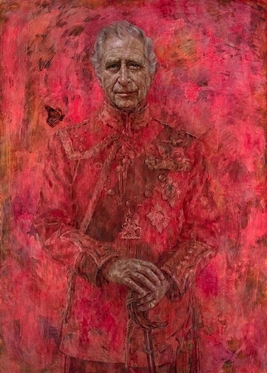
Compare this to Jonathan Yeo’s two portraits of King Charles III and Camilla. The former awash in crimson ambiguity, with vague lines of demarcation. Its symbolism is gaudy and obtuse: the lone butterfly, the seeping reds, the gaze misplaced: together, a haunting emergence from a bloody mess. A reliance on cryptic visual metaphors over soulful revelation. A painting wishing to express depth, and it does, but as a downward drift into circles of Dante rather than a royal crimson of empire. Yeo does not explain much of his trajectory of the portrait. He seems satisfied to leave the interpretation to others. Camilla says it captures him perfectly. But what it captures is not a dignified, confident king, but one who bartered his soul for the crown which Yeo captured impeccably, consciously or not.

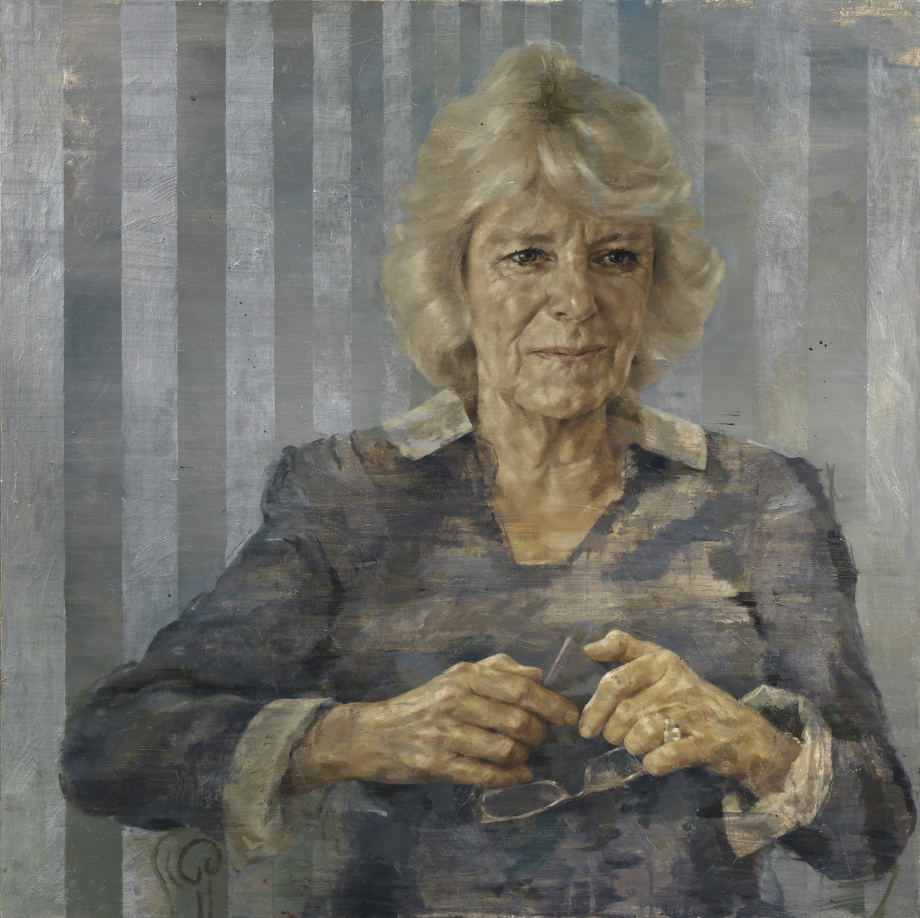
Yeo’s 2014 portrait of Camilla, HRH The Duchess of Cornwall, compliments his painting of King Charles: another study of a lost soul. A picture of non-essence. A painting of emotional neglect. Blotches of earth tones for blood and straight lines of iron and fog for character and birthright. In the background vertical lines of changing width suggestive of a perspective view of Camilla sitting in the corner of a prison cell, trapped in a unwanted life, with sub-horizontal lines crossing her clothing like lines of filtered light originating from a broken, tilted structure of casements in disrepair. Windows into a soul without balance or integrity. A blotchy face, pressed lips and the piercing eyes of disgust are the caricature of woman who finds the world a bore and the artist gives wholehearted ascent to her wishes.

Yeo’s portraits of the royal dyad are of tragic symmetry. Charles as an entitled blood-soaked monarch, lost in a mythic realm of post over duty. Camilla is a shadow brought along for form without script, shadow without light.

Each of the three portraits in the triptych, at first blush, are merely lacking in technique or likeness and immensely soulless. With further exposure and examination, the artists have captured their subject’s essence. They are gauche and grotesque, but the painter’s truth is bleeding through. They portray their subjects as an antithesis to their public persona. Wiley’s Obama is lost in symbolic foliage, Yeo’s Charles stands embalmed in a crimson history of unrestrained desire, and Camilla appears accidentally sentenced to royalty by an artist barely able to contain his disdain.

Symbolism, when wielded well, lives in the background, like Botticelli’s Primavera, where flora guides the viewer through renewal without eclipsing the figures themselves. Art that elevates does so through integration, not ornamentation. Symbolism must serve beauty, and beauty must point toward goodness. But if the truth isn’t of beauty, what then?

True portraiture captures the soul and, if need be, is not afraid to offend. It does not flatter blindly, nor does it subtract without cause. It seeks something elemental. It lets the canvas speak, the brush guide, and the palate reverberate with reality. Great portraits are a reckoning of the soul, not decoration of form.

Graphics: President Obama by Kehinde Wiley, 2018. King Charles and Camilla by Jonathan Yeo, 2023 and 2014. All copyrighted. Used for purposes of critique.

Dr. Konstantin Frank Cabernet Franc 2021

Cabernet Franc from Finger Lakes, New York, U.S.

Purchase Price: $27.99

ElsBob 89

ABV 12%

A clear medium garnet to a deeper ruby in color, aromas of fresh red fruits, medium-bodied, slightly acidic with balanced, moderate tannins. A nice finish but brief.

A very good table wine at an elevated price. Currently retails from $28-30. Pay the suggested retail for the novelty but a second bottle, probably not.

Trivia: The first known vineyard in the Finger Lakes area was planted by William Bostwick in 1829. In 1860 the Pleasant Valley Wine Company became the first commercial winery in the area, followed soon after by the Taylor Wine Company in the early 1880s (closed 1995). Konstantin Frank planted the first vinifera (European) vines in 1957 in the Finger Lakes and the winery lays claim to some of the oldest vines still producing in the US. In 1982 Finger Lakes AVA was officially recognized. Today over 100 wineries dot the region with Riesling the signature varietal.

Off the Beaten Path

Not every grape is born to be a Cab or Merlot. Not every vine survives the frozen winter’s cold. But, sometimes, you can find a remarkably obscure wine, and you get what you need. (With apologies to the Rolling Stones.)

Wine does not need a household name or worldwide cultivation to leave an impression. Some, from the cracks and corners off the main viticultural beat, fill a glass with a style that beckons notice and draws a grudging nod of respect. Grapes of lesser renown are legion but here we will bow to three worthy of a close encounter. The Amur grape straddling the banks of the thousand-mile Amur River at the intersection of Russia and China; the Saperavi grape of a thousand names, slightly exaggerated, from the rolling Asian hills of eastern Georgia; and the Marquette grape born in the land of a ten-thousand lakes from the test beds of U. of Minnesota.

The Amur grape (Vitis amurensis) is an ancient varietal dating back to pre-Pleistocene times, a survivor at the margins of glaciers and regions of permanent snow and ice. Evolution favored a rootstock capable of withstanding sub-zero winters and the ability to send forth fresh shoots with the swiftness of kudzu covering a Georgia (State) pine, bravely managing the brief, wet summers of floodplains and permafrost.

Its native lavender to deep purple berries yield a full-bodied red wine with subtle aromatics, hinting at dark fruits and recollections of the long-gone boreal forest. The tannins are firm, the acidity cleansing; sharp enough to demand a gentle, sweet companion. Amore mio of chocolate and Amur. I tried a Amur wine in Beijing many years ago and I found it a worthy experience.

Saperavi (Vitis vinifera) is a rare teinturier grape, its flesh and skin both red, born in the soils newly freed from the retreating glacial ice and snow of southeastern Georgia, nurtured in the cradle of winemaking and civilization. Descended from wild vines cultivated over 8,000 years ago, the spirits and life of Saperavi still retain their vitality in modern times accounting for 30% of its total wine production. Georgians once fermented this varietal in qvevri, (kveh-vree—rhymes with every) egg-shaped clay vessels, dating to the Bronze Age, buried underground, where time, earth, grape, and chemistry converge in a spirited dance of Bacchanalian delight. Though about 10% of Georgian wines still develop in clay, most now age in oak, trading ancestral custom for ease and balance.

Dark as ink in a deep well and high in acidity, Saperavi yields wines that are intense and age-worthy, layered with plum, blackberry, clove, and sometimes a wisp of rising smoke. They range from bone-dry to deliciously sweet, each bottle a tale of terroir and ancestry. Today, the heart of prehistoric craftsmanship still beats in chests of these rugged Caucasus descendants. This wine is hard to find in the U.S., but if you’re in Georgia, try it, just have something sweet nearby to balance its acidity.

Marquette (Vitis vinifera × Vitis riparia, etc.) is a cold-hardy hybrid born in Minnesota in 2006, now finding homes in Vermont and New York. With its ruby hue, medium body, and notes of cherry, blackcurrant, and spice, it evokes a northern acceptance of the land’s tempered gifts. It survives brutal winters, resists disease, and thrives in organic soils that traditional wine grapes often shun. Though oak-aging adds depth, even youthful Marquette wines hold their own. Already, a few notable bottlings hint at its potential. The 2021 La Garagista “In A Dark Country Sky a Whole-Cluster Marquette”, received a rating of 92, described as bold and structured: $43.

Together, this trio of wines form a brave departure from the pack. They are not overt crowd-pleasers, not yet anyway, but a small, short break from tradition can’t be all bad.

Graphic: Amur Grapes, Vitis amurensis, by Andshel, 2015. Public Domain.

Women and Glass: The Starlight Calculators of Harvard

In the halcyon days of yore before digital ubiquity and tonal exactitude, computers were made of flesh and blood, fallibility crossed with imaginative leaps of genius. Photographs etched starlight’s past onto glistening glass and preserved silver. Solid archives where memory endures and future discoveries shimmer with potential, encoded in celestial light of the heavens awaiting the discerning caress of curiosity, intuition, and reason.

In 1613, English poet Richard Brathwait, best remembered for his semi-autobiographical Drunken Barnaby’s Four Journeys, enshrined the word computer into written English while contemplating the divine order of the heavens, calling God the “Truest computer of Times.” Rooted in the Latin computare, meaning “to reckon together,” the term evolved over the next three centuries to describe human minds inimitably attuned to the interpretation of visual data: star fields, spectral lines, geologic cross-sections, meteorological charts, and other cognitive terranes steeped in mystery, teasing initiates with hints of vision and translation. These were not mere calculators nor unimaginative computers, but perceptive analysts, tracing patterns, exposing truths, and coaxing insights from fluid shapes etched into the fabric of nature.

By the time of the Enlightenment and the scientific revolution, human computers had become the invisible deciphering force behind truth seeking laboratories, the unsung partners in progress, cataloging, interpreting, and taming the flood of empirical but seemingly nonsensical data that overwhelmed those without insight. Harvard College Observatory was no exception. With photography now harnessed to astronomy’s telescopes, the observatory could suddenly capture and archive starlight onto glass plates of coated silver, forever changing astronomy from the sketches of Galileo to silver etches of eternal starlight.

But these glass plates, resplendent with cosmic information, remained galleries of dusty, exposed negatives, inert until absorbed and guided by human curiosity and insight.

Enter the women computers of Harvard, beginning in 1875, over 140 women, many recruited by Edward Charles Pickering, processed more than 550,000 photographic plates, the last collected in 1992, bringing much needed coherence and linearity to the chaos of too much. They sorted signal from celestial noise, revealing the hidden order of the universe inscribed in silver, preserved in silica.

In 1875 the initial cohorts, the pioneers, the first names of Harvard women computers, although not exactly given that moniker, to appear on the glass plates were names like Rebecca Titsworth Rogers, Rhoda G. Saunders, and Anna Winlock assisting in the absolutely essential process of what we would now call cross-referencing the glass plate’s ‘metadata’ with the astronomical data.  Ascertaining that time and space of the data match the time and space of the metadata. In 1881 Pickering, the observatory’s fourth director, began hiring women specifically as Astronomical Computers, a formal role focused on analyzing and deciphering the growing collection of glass plate photographs.

This shift in 1881 was more than semantic, a fancy title for drudge work and tedious plate cataloging but a structured program where women like Williamina Fleming, Annie Jump Cannon, Henrietta Swan Leavitt, and Cecilia Payne-Gaposchkin were tasked with not just cataloging stars, but studying stellar spectra, and the lights powering life and imagination throughout the universe. Indispensable efforts that lead to the Henry Draper Catalogue, eventually containing the half million plus glass plates, and the foundations of modern stellar classification systems and 21st century astronomy. Their stories are worthy of a Horatio Alger novel, maybe not exactly rags to riches, but certainly humble beginnings to astronomical fame. They were paid peanuts, but they were the elephants in the observatory.

Williamina Fleming, in 1879 arrived in Boston penniless and abandoned by her husband secured a job as a domestic in the home of Edward Pickering, yes that guy. She impressed Pickering’s wife, Elizabeth, with such intelligence that she recommended her for work in the observatory. She quickly outpaced her male counterparts and in 1881 was officially hired as one of the first Harvard Computers.

Studying the photographed spectra of stars, she developed a classification system, the natural human desire to find order in apparent chaos, based on the abundance of hydrogen on the surface of a star or more exact the strength of hydrogen absorption lines from the spectra data. The most abundant stars were classed as A stars, the next most abundant as B stars, and on down to V.

In 1896 Pickering hired Annie Jump Cannon, a physics degree from Wellesley and an amateur photographer, modified Fleming’s stellar classification system based also on the surface temperature of a star rather than hydrogen abundance. Her method was to use the strength of the Balmer absorption lines, electrons excited within hydrogen atoms, like dancers at different tempos, reveal themselves through subtle spectral lines now understood to be differing ionization states of the atom directly tied to the surface temperature of the star.

Her system used the same letters to avoid redoing the entire Harvard catalogue, but she reduced the list down to 7 and reordered them from hottest to coolest: O, B, A, F, G, K, M. Her classification is still in use today. Earth revolves around a G-class star which has a medium surface temperature of about 5800 K (9980 F or 5527 C).

Henrietta Swan Leavitt graduated from Harvard’s Women’s College in 1892 with what we might now call a liberal arts degree. A year later, she began graduate work in astronomy, foundation for employment at the Harvard Observatory. After several extended detours tucked under her petticoats, Edward Charles Pickering brought her back to the Observatory in 1903. She worked initially without pay, later earning an unfathomable 30 cents an hour.

There, Leavitt collaborated with Annie Jump Cannon, in a coincidence of some note both women were deaf, though one is left with the feeling that the absence of sound may have amplified the remaining sensory inputs to their fertile minds. In time, Leavitt uncovered a linear relationship between the period of Cepheid variable stars and their luminosity, a revelation that became an integral part of the cosmic yardstick for measuring galactic distances. The Period-Luminosity relation is now enshrined as Leavitt’s Law.

Cepheid variables form the second rung of the Cosmic Distance Ladder; after parallax, and before Type Ia supernovae, galaxy rotation curves, surface brightness fluctuations, and, finally, the ripples of Einsteinian gravitational waves. Leavitt’s metric would prove essential to Edwin Hubble’s demonstration that the universe is expanding.

Swedish mathematician Gösta Mittag-Leffler considered nominating her for the Nobel Prize in Physics, but his plans stalled upon learning she had died in 1921. The Nobel, then as now, is non-awardable to the dead.

Cecilia Payne-Gaposchkin, a transplanted Brit, joined the Harvard Observatory as an unpaid graduate fellow while working towards her PhD at Radcliffe in astronomy. Upon earning her doctorate, she continued at the Observatory with no title and little pay. By 1938 she was awarded the title of Astronomer and by 1956 was made full professor of Harvard’s faculty.

In her dissertation she accurately showed for the first time that stars are composed primarily of hydrogen and helium, proving that hydrogen was the most abundant element in the universe, overturning long held but erroneous assumptions. But in a twist of fate, astronomer Henry Norris Russell persuaded her to label her conclusions of hydrogen abundance as spurious. Four years later Russell’s research reached the same conclusion, but he barely gave her an honorable mention when he published his results.

She wasn’t the first nor will she be the last to suffer at the hands of egotistical professors, more enamored of self rather than truth, but her elemental abundance contribution to astronomy brushed away the conceit that stars must mimic rocky planets in their composition, much like Galileo ended Earth’s reign as a center of everything. Twentieth century astronomer Otto Struve hailed her dissertation as “the most brilliant PhD thesis ever written in astronomy.”

Undeterred and building on her studies of spectral emissions of stars she turned her gaze to high luminosity and variable stars with husband astronomer Sergi Illarionovich Gaposchkin. After 2 million observations of variable stars, their efforts laid the groundwork for stellar evolution: how stars change over the course of time. From hints of dispersed stardust to starlight and back again. Cycles of stellar life repeated billions of times over billions of years.

Harvard’s astronomical female human computers, initially mere clerks transcribing stars from silver and glass, evolved into interpreters of light, shaping the very foundations of astronomy. Through logic, imagination, and an unyielding devotion to truth, they charted the heavens and opened lighted pathways for generations to follow.

Graphic: The Harvard Computers standing in front of Building C at the Harvard College Observatory, 13 May 1913, Unknown author. Public Domain

Bodegas La Purisma Old Vines Red Blend 2019

Red Blend Other (GSM) from Yecla, Spain

Monastrell (Mourvedre) 85%, Syrah 10%, Garnacha (Grenache) 5%

Purchase Price: $12.99

James Suckling 93, Wilfred Wong 90, ElsBob 89

ABV 14.5%

A dark cherry in color, medium to full-bodied, aromas of black ripe fruits with a touch of vanilla and spice. Balanced acidity and tannins with a strong, long finish.

A very good fine wine that retails around $11-19. Don’t pay more than $15 for this wine. Drink now or let it age for up to another 5 years. Cheers.

Trivia: Bodegas La Purísima is a cooperative of small-holding farmers in Yecla, Spain, united under the stewardship of María Teresa Ruiz González. Their old-vine Monastrell, over 40 years in age, thrives on 250 acres of sand and limestone soil. Grapes are picked by hand in late October, preserving the integrity of the fruit and the tradition behind the growers and the blend.

To Boldly Go

On 23 June 2025, after more than three decades of evolution, from a gleam of an idea to detailed planning, exacting execution, and the physical realization of the world’s largest astronomical camera, the Vera C. Rubin Observatory’s Legacy Survey of Space and Time (LSST) in Chile unveiled to the public its first breathtaking images. Among them: razor-sharp mosaics of the Trifid and Lagoon Nebulae, and the sprawling Virgo Cluster, home to millions of galaxies. Captured with world-class light-collecting mirrors, these images marked the beginning of a spectacular ten-year quest to map the known universe and illuminate the 95% we still don’t understand: dark matter and dark energy. An exciting, albeit, Herculean future awaits, built on an equally stunning past where dreams and science converged into one of the most staggering feats of technological achievement in modern astronomy.

Let the future map of the universe tell its own story in due time. The path to the map deserves a chapter all its own.

In 1969 Willard Boyle and George Smith of Bell Labs invented a device capable of detecting and measuring the intensity of light which they named CCD or Charge-Coupled Device: a breakthrough that earned them the 2009 Nobel Prize in Physics. A CCD converts incoming photons into electrical signals, creating a voltage map of light intensity, a digital proxy for the number of photons striking its surface. Initially constructed as a semiconductor chip, it quickly evolved into a pixelated imaging sensor. These sensors quickly became the gold standard for digital consumer and scientific imaging but due to costs, consumer applications such as your phone camera switched over to CMOS sensors due to lower costs. Scientific and surveillance systems, such as the Hubble Telescope, SOAR, and SNAP, still employ CCDs because of their superior image fidelity.

In the late 1980s J. Anthony ‘Tony’ Tyson, an experimental physicist at Bell Labs, focused on developing instrumentation to detect faint optical signals using CCDs. His inspiring contribution to the CCD was to recognize their potential in imaging the heavens and laying the groundwork for digital deep sky surveys. He quickly discovered faint blue galaxies and gravitational lensing using modified CCDs that he helped developed. Additionally, he helped build the Big Throughput Camera that was instrumental in the 1998 discovery of dark energy.

Tyson never thought small. His CCDs were instruments of the infinitesimal, but his dreams were as gargantuan as the universe itself. In fact, his dream was the universe. In 1994 he proposed his “Deep Wide Fast” telescope, a scaleup of his Big Throughput Camera and the forerunner of the LSST. The Deep Wide Fast was a concept that would combine a deep imaging device with rapid cadence, and broad coverage simultaneously. In other words, synoptic realization of the universe in near real time.

Throughout the 1990s, Tyson rallied minds and resources to shape his cosmic vision. John Schaefer of the Research Corporation helped secure early funding. Roger Angel proposed the use of the innovative Paul Baker three-mirror telescope design. Institutions like the Universities of Arizona and Washington, along with the Optical Astronomy Observatory, all hitched their wagons to Tyson’s star-filled dream of mapping the universe.

In 1998 Tyson presented designs for a Dark Matter Telescope and in 1999 the science case was submitted to the Astronomy and Astrophysics Decadal Survey. In 2003 the first formal proposal was sent to the Experimental Program Advisory Committee at SLAC (Stanford Linear Accelerator Center). It consisted of an 8.4-meter mirror with a 2.3-billion-pixel camera capable of surveying the entire visible sky every few nights. The proposal also laid out the NSF–DOE partnership, with SLAC leading the camera development and other institutions handling optics, data systems, and site operations.

In 2004 Tyson left Bell Labs and joined the University of California at Davis as a cosmologist and continued to shepherd the LSST project from there.

In 2007 the project received $30 million in private funding from Charles Simonyi, Bill Gates, and others. The telescope is named the Simonyi Survey Telescope. In 2010 U.S. National Science Foundation (NSF) and Department of Energy (DOE) joined in the quest to view the universe through the sharp eyes of the LSST.

The telescope’s primary 8.4-meter and the 5.0-meter tertiary mirrors were built at the University of Arizona, beginning in 2008, completed in 2015, and stored on-site in Chile since 2019. Fabricated in the U.S., the 3.4-meter secondary was later coated in Germany with nickel-chromium, silver, and silicon nitride, materials chosen to enhance reflectivity, durability, and long-term performance.

In 2015 SLAC, which oversaw the design, fabrication, and integration of the camera, began building the components with assistance from Brookhaven National Laboratory, Lawrence Livermore National Laboratory, and IN2P3/CNRS in France. By 2024 the camera was finished and shipped to Chile. In 2025 the camera was installed and integrated with the telescope. In June of 2025 the first light images were released to the public.

The camera measures roughly 3 meters in length, 1.65 meters in diameter, and weighs 3 metric tons, an imposing instrument, rivaling the bulk of a small car. Its imaging surface, a 64-centimeter focal plane, contains 3.2 billion pixels, each a 10-micron square, roughly one-tenth the width of a human hair. These pixels, etched across 189 custom CCD sensors arranged into 21 modular “rafts,” are laid flat to within 10 microns, ensuring near-perfect focus. The entire array is chilled to –100°C to suppress electronic and thermal noise, enhancing signal fidelity.

Before photons reach the sensor, they pass through three precision-crafted corrective lenses, including the largest ever installed in an astronomical camera, and up to six interchangeable filters spanning ultraviolet to near-infrared. The filter exchange system enables the observatory to target specific wavelength bands, tailored to sky conditions and science goals.

The integrated LSST system is engineered to capture a 15-second exposure every 20 seconds, producing thousands of images per night, tallying approximately 15 terabytes of new data. Each image covers 9.6 square degrees of sky, roughly equivalent to the diameter of 45 full moons, allowing the system to survey the entire visible southern sky every 3–4 nights. Imaging a single field across all six filters can take up to 5–6 minutes, though filters are selected dynamically based on science goals and atmospheric conditions.

The system’s angular resolution is sharp enough to resolve a golf ball from 15 miles away and at the edge of the observable universe, this scales to structures no smaller than a large galaxy; certainly not stars, not planets, nor restaurants. Over its decade-long campaign, LSST is projected to catalogue more than 17 billion stars and 20 billion galaxies, a composite digital universe stitched together from individual photons captured from 3 million images, each snapped every few seconds over the clear night sky of Chile. The LSST will not simply map what’s visible but illuminate the unknown. Beneath the sophisticated hardware and software lies a deeper purpose: to shine the light of curiosity on the 95% of the universe that remains in the shadows of time and space: dark matter and dark energy, the known unknown dynamic force behind galactic formation and cosmic expansion. The LSST is more than a camera. It is a reckoning with the vast unknown, a testament to humanity’s refusal to let mystery remain unexplored and uncharted: to find God.

In 2013 Tyson was named chief scientist of the LSST and is still actively contributing to the intellectual vision of the project and mentoring the next gen of cosmologists and engineers.

Graphic: LSST Camera Schematic and Trifid Nebula by SLAC-DOE-NSF.

Goya: Beauty Unmasked

Francisco de Goya, a late 18th to early 19th century Spanish painter of the Romantic school, is a fascinating study in evolving style, a visual descent into deafness, isolation, and existential dread, though more philosophically, his lifelong disillusionment with civilization’s failure to embody the Enlightenment’s promised ideals of reason, justice, and human dignity. His art swung like a pendulum, from crisp detail to loose rendering to the raw emotion of a mind increasingly separated from reason.

As a court painter to the Spanish monarchy, Goya’s portraits became canvases for cynicism, derision, and paradox. He offered scathing critiques hidden beneath formal composition, and the court loved him for it. They mistook his precision for praise, even as he quietly dismantled their poise and splendor.

His colossal canvas Charles IV of Spain and His Family (110 × 132”) does not illustrate majesty or brilliance; it immerses the senses in familial estrangement and tedium. Awkward poses; lifeless gazes; a composition emotionally hollowed, drained of vitality and intent. These are not confident rulers but bored figures waiting for the dinner bell to summon a distraction: ceremonial chatter over fish soup and presentation of chocolates. In the background of the painting, Goya includes himself, brush in hand, an artist caught in the act of witnessing. It was a nod to Velázquez’s Las Meninas; Goya once said he “had only three masters: Nature, Velázquez, and Rembrandt”; but here, reverence turns to scorn. Goya didn’t flatter his subjects; he distorted the real, undermining not his own reverence for form, but theirs. His royal figures do not speak; they stare blankly, confirming that the emperor wears no clothes. He looked beneath the surface in search of beauty and instead found something far less attractive, an insignificant echo of a tired reality.

Goya’s notion of beauty, conventionally understood, remained intact. But in his subjects, he saw hypocrisy, a lie, elegantly draped, concealing the moral disfigurement beneath. This critique finds haunting expression in his etching Nadie se Conoce (“Nobody recognizes himself”), Plate No. 6 of Los Caprichos, where masked carnival patrons drift like phantoms of untruth. On the reverse of the plate, Goya inscribed his chilling reflection: “The world is a mask; the face, the costume, and the voice are all feigned. Everyone wants to appear what they are not, everyone deceives, and no one knows himself.”

Goya painted the existential. His late works: The Disasters of War, The Black Paintings, The Madhouse, Saturn Devouring His Son, reveal more of his suffering psyche than his technical ability. Anthony Cascardi argues in Francisco de Goya and the Art of Critique that Goya’s entire oeuvre is a sustained confrontation with Enlightenment ideals. Reason and beauty dissolve under his brush. Societal decay no longer whispers, it screams.

In style, Goya stands at the edge of the Impressionist movement, decades before its arrival. His gestural freedom, emotional brushwork, and psychological texture prefigure the rawness of Manet and even hint at Bacon’s existential grotesque. Paint becomes not just medium but mood, an extension of perception unraveling. Form overrides detail. But Goya moved to a darker rhythm, his brushwork shades where theirs shimmered. Where Monet dances with light, Goya wrestles with darkness. The Impressionists chose beauty over Goya’s emotional appeal, which ultimately served to mock his subjects’ feigned grace.

Unlike Picasso’s theatrical mockery, Goya’s assessment is surgical. He dispenses with pretense and seeks truth, not a truth easily embraced, but one rooted in the soul’s unpleasant, hidden recesses. Picasso once echoed a similar sentiment in a 1923 interview with The Arts: “Art is a lie that makes us realize truth, at least the truth that is given us to understand.” Art distorts to reveal what reality conceals, truth not always visible, but deeply felt. Superficial beauty without the soul is not art, it is a lie.

In contrast to today’s symbolic excess, where the subject is buried beneath concept and symbols, Goya’s portraits are revealing to the point of brutality. He doesn’t idealize; he removes the layers of deceit. The beast within becomes the subject. His cynicism is constant, his honesty sometimes absurd, but always truthful.

Goya takes a moral stance. His genius lies in the ability to paint the conscious with the unconscious, to render not just what he saw, but what he felt and feared, the form with the spiritual. His style matched his psyche. He painted the perceived rot beneath grandeur, the weariness behind powdered wigs, the absurdity beneath court spectacle.

Goya’s fame was built and balanced on a knife’s edge: he gave the rich what they wanted in form, while seeding beneath it a quiet, damning truth. That duality, beauty as lure, truth as blade, is Goya’s lasting contribution to art.

Graphic: Self-Portrait at 69 Years, by Goya, 1815. Museo del Prado-Madrid.

Millworks Pillar & Post Cabernet Sauvignon 2018

Cabernet Sauvignon from Napa, California

Purchase Price: $19.99 (retail range $20-22)

Cellar Tracker 89, ElsBob 89

ABV 14.5%

A deep, dense red with full body and aromas of black currants and blackberries. Tannins are assertive up front, balanced by acidity, leading to an excellent finish.

A fine wine with surprising structure and complexity at this price point. Drink now or hold for 2-3 more years.

Trivia: This wine was produced by Millworks, a now-defunct label and bottling entity owned by Paul Hobbs. Though both the company and label are no longer active, the wine’s origins trace back to Paul Hobbs Winery, where it was vinified using Hobbs’ signature methods and materials. The grapes were sourced from Napa Valley vineyards not owned by Hobbs, placing this bottle stylistically adjacent to his Sonoma Crossbarn project, which similarly emphasizes quality fruit and precise techniques, including wines crafted from both estate and non-estate sources. A quiet echo of Hobbs’ craftsmanship, delivered under a separate name. (Editor’s note: This section was pieced together from disparate and incomplete sources, so its accuracy may be imperfect.)

Sunny Side Up: Gömböc, Bille, and the Geometry of Falling

In Shel Silverstein’s poem “Falling Up,” a child trips on his shoelace and soars skyward instead of tumbling down. A delightful inversion of reality, a child’s imagination conjuring tomorrow’s focus. In the world of mathematics and physics, a similar inversion has captivated minds for decades: can you design an object that always falls the same way, always sunny side up, no matter how it starts, like a cat landing on all fours.

In the realm of numbers and materials this is the problem of monostability: creating a shape that, when placed in any orientation, will always return to a single, stable resting position. It’s a deceptively simple question with grudgingly difficult solutions. And it has at least two very different answers.

The first answer to the cat landing on all fours came in 2006 with the discovery of the Gömböc, a smooth, convex, homogeneous shape that rights itself without any differential weighting or moving parts. Invented by Hungarians Gábor Domokos and Péter Várkonyi, the Gömböc, meaning “little sphere or roundy” in Hungarian, has only one stable and one unstable equilibrium point. No matter how you place it, it will wobble and roll until it settles in its preferred orientation.

The Gömböc is a triumph of pure geometry. It solves the monostability problem using only shape, no tricks, no hidden weights but some serious math. It’s been compared to a mathematical cat: always landing on its feet, a design with a natural convergence toward the domed asymmetry of tortoise shells, whose shapes nature may have unconsciously optimized for self-righting.

Although uses for Gömböc are still being explored, some have developed designs for passive orientation systems, and the name has been co-opted for a company that is building self-correcting cloud infrastructure.

The second answer came recently in June of this year, when Gergő Almádi, Robert Dawson, and Gábor Domokos, of Gomboc fame, constructed a monostable tetrahedron, a four-faced scalene or irregular polyhedron that always lands on the same face which they named Bille: “to tip or to tilt” in Hungarian. A solution to a decades-old conjecture by John Conway, a Princeton polymath professor, with a talent for finding tangible solutions to abstract problems.

In this case, unlike the geometric solution of the Gömböc, geometry enables self-righting only when paired with carefully engineered mass distribution: a lightweight carbon-fiber frame and a dense tungsten-carbide core, precisely positioned to shift the center of gravity into a narrow “loading zone.” It’s a hybrid of form and force, where the shape permits monostability, but the mass forces the issue.

Unlike the Gömböc, which might inspire real-world designs, the monostable tetrahedron is too fragile, too constrained, and too dependent on ideal conditions to be practical. It’s a mathematical curiosity, not an engineering breakthrough. But like numerous mathematical solutions, practicality may occupy some interesting spaces in the future because landing on your feet is a useful function in many areas of commerce and science.

In space exploration lunar landers have recently had a bad, and expensive habit of falling over. In marine safety, users of escape pods and lifeboats prefer them to remain upright and watertight. Come to think most occupants of any watercraft prefer to remain upright and dry. Robots and drones benefit from shapes that naturally return them to a functional position without motors or sensors.

In the end, both the Gömböc and the weighted tetrahedron are about their inevitable position and stability. They are objects that always know where they stand. One does it with elegance; the other with abstraction and compromise. One is a cat. The other is a clever box of lead and air.

And maybe that’s the real lesson of “falling up”: that sometimes, the most interesting ideas aren’t the ones that solve problems, but the ones that reframe the question, and quietly remind us that some problems, left alone, reveal their own solutions.

As Calvin Coolidge once observed, “If you see ten troubles coming down the road, you can be sure that nine will run into the ditch before they reach you.” Meaning he didn’t need to attack and solve 10 problems, just the persistent one. The Gömböc and Bille didn’t wait for the problem to develop, they honored the ditch. Their designs never left the ditch. The problem never materialized in the first place.

Source: Mon-monstatic Bodies by Varkonyi and Domokos, Springer Science, 2006. Bulilding a Monostable Tetrahedron by Almadi et al, arXiv, 2025.