Thrilla in Manila: 50 Years On

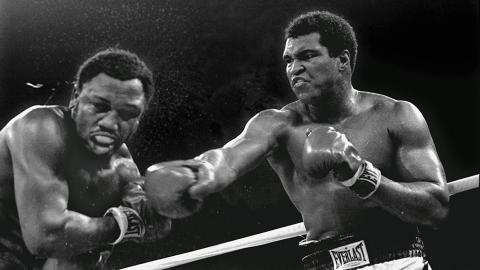
The greatest heavyweight fight ever, likely the greatest fight, period, and certainly the most brutal was slugged out 50 years ago today in the Philippines. As it came to be known, The Thrilla in Manila between Muhammad Ali, age 33, and Joe Frazier, age 31, was their third, and final; the rubber match: Frazier took the first, Ali the second, and this was for the belt. The scheduled 15-round contest was held at the Araneta Coliseum in Cubao, Quezon City, with the temperatures reaching a roasting, exhausting, debilitating 100 degrees Fahrenheit (38 degrees Celsius).

Ali won by corner retirement (RTD), also known as a corner stoppage, after Frazier’s chief second, Eddie Futch, asked the referee to stop the fight between the 14th and 15th rounds. This bout is almost universally regarded as one of the greatest and most punishing in boxing history.

With the series tied, the third encounter in the sweltering Philippine heat drove both men to the brink of collapse. They exchanged unremitting punishment, refusing to yield, superhuman fury and drive overriding physical endurance.

Ali dazzled early and late with his patented “rope-a-dope” strategy, occasional dancing, but mostly flat-footed, measuring with the left, and delivering crunching right leads in an insolent rhythm. Frazier’s aggressive left hooks, and especially his punishing body blows, found their mark in the middle rounds, battering Ali with relentless force. By the 14th, Frazier’s eyes were nearly swollen shut, and Ali was exhausted, yet still able to summon his signature dance: bobbing, weaving, taunting with energy he no longer possessed.

After that round, Ali slumped in his corner, exhaustion permeating his entire being. He asked his trainer Angelo Dundee to cut off his gloves: a submission to body over mind. But before Dundee could act, Eddie Futch stepped in and stopped the fight. Mercifully recognizing the unprecedented brutality of the contest, Futch told Frazier, “No one will ever forget what you did here today.”  Ali later admitted, “Frazier quit just before I did. I didn’t think I could fight any more.”

Howard Cosell, ABC sportscaster for the fight commented, “A brutal, unrelenting war between two men who gave everything they had—and then some.”

The official scorecards at the end of the 14th round:

Referee Carlos Padilla: 66-60 for Ali

Judge Larry Nadayag: 66-62 for Ali

Judge Alfredo Quiazon: 67-62 for Ali

Ali summed up the fight with poignant clarity: “It was the closest thing to dying that I know of.

The final bell rang. The two fighters have gone down in history as Titans of the ring: survivors of the most brutal fight ever fought.

(Postscript: Ali and Frazier in 1975 earned about $9 and $5 million respectively for the fight: a pittance by today’s standards.)

Source: Thrilla in Manila-ABC TV fight with Howard Cosell. Watch here–  https://youtu.be/MaRNsNzqsJk  Graphic: Ali-Frazer Fight, PLN Media.

Chateau Moulin de Mallet 2020

Bordeaux Red Blends from Bordeaux, France

Merlot 90%, Cabernet Sauvignon 10%

Purchase Price: $12.98

Wine Enthusiast 90, ElsBob 86

ABV 14%

A deep garnet to deep ruby wine, with aromas of black fruits, medium bodied, strong tannins verging on overpowering and acidic.  Sub 90 wines always go better with spicy or tomato-based appetizers such as meatballs in a marinara sauce or aged cheeses such as cheddar, blue, or Gouda.

A good wine at an elevated price. I wouldn’t pay more than $8-9 for this wine. Currently the wine ranges from $12-15.

Trivia: In the 17th century, the Médoc, now home to legendary estates like Château Margaux and Château Latour, was a marshland, better known for corn than Cabernet. Dutch masters of hydraulic engineering and maritime trade drained the swamps, transforming them into arable land ideal for vineyards. Their aim was strategic rather than altruistic: to buy Bordeaux wine and sell it to the English at a modest profit, or a ludicrous one, if the winds blew favorably.

Windmills pumped water into manmade canals that emptied into the Gironde estuary, terraforming the landscape into a system of trade, terroir, tale, and endless lore. Though water management continues today, steam and electric pumps have long replaced the windmills. Most were dismantled or left to decay, their blades stilled by steam and electric pumps.

One survivor, the restored 18th-century Moulin de Lansac and another, depicted on the wine label shown above, Moulin de Mallet, were not water-pumpers but grain-grinders. Moulin in French translates to grain-grinder, turning wind into flour rather than marsh into vineyard. Still, it stands as a quiet admission of simpler times.

Dutch windmills turning. Pleistocene gravels emerging. French vines growing.

Like the circles that you find in the windmills of your mind “ by Noel Harrison, The Thomas Crown Affair, 1968.

Shot in the Dark

The Earth orbits the Sun at a brisk 107,000 km/hr (66,486 mi/hr). The Sun, in turn, circles the Milky Way at a staggering 828,000 km/hr (514,495 mi/hr). And deep in the galactic core, stars whirl around the supermassive black hole at relativistic speeds, up to 36 million km/hr (22,369,363 mi/hr). Gravity is the architect and master of this motion: the invisible hand that not only initiates these velocities but binds our galaxy into a luminous spiral of unity.

Except it shouldn’t. Not with the piddling amount of mass that we can see.

The Milky Way contains 60-100 billion solar masses, an impressive sum, but a puny, gravitationally insufficient amount. With only that amount of ordinary matter, the galaxy would disperse like dry leaves in a breeze. Its stars would drift apart, its spiral arms dissolve, and the universe itself would remain a diffuse fog of light and entropy, never coalescing into structure or verse. No Halley’s Comet. No seasons. No Vivaldi.

To hold the Milky Way together at its observed rotation speeds requires about 1.4 trillion solar masses, seven times the visible amount. And we know this mass is there not because we’ve seen it, but because the galaxy exists. Much like Descartes’ Cogito, ergo sum (“I think, therefore I am”), we reason: The Milky Way is; therefore, it must possess sufficient mass.

The problem is that 85% of that mass is missing; from view, from touch, from detection. Enter stage right: Dark Matter. It does not emit, absorb, or reflect light. It does not interact with ordinary matter in any known way. It is invisible, intangible, a Platonic ether of shadow reality. Without it, the sacrament of gravity and being floats away like a balloon on a huff and puff day. And the universe loses its meaning.

Much like the neutrino, predicted by theory, is a particle once postulated to preserve the sanctity of conservation laws, a piece of the quantum world long before it was ever seen. Dark Matter is another elusive phantom, inferred by effect, but physically undetected. Dark Matter bends light, sculpts galaxies, and governs gravitational dynamics, yet it inhabits a metaphysical realm that requires faith to make it real. Unlike the neutrino, it lacks a theoretical platform. The General Theory of Relativity insists it must have mass; the Standard Model offers it no space. It is an effect without a cause: a gravitational fingerprint without a hand.

Yet, physicists are trying to tease it out, not so much to grasp a formless ghost, but rather to catch a glimpse of a wisp, a figment, without knowing how or where to look. To bring light to the dark one must grope around for a switch that may or may not exist.

Researchers at the University of Zurich and the Hebrew University of Jerusalem have devised an experiment called QROCODILE: Quantum Resolution-Optimized Cryogenic Observatory for Dark matter Incident at Low Energy (One can only guess at the amount of time and gin the Docs spent on that acronym 😊) to help tease out the existence of Dark Matter.

The experiment is designed to detect postulated ultralight dark matter particles that may interact with ordinary matter in currently unfathomable ways. To find these particles they have built a detector of superconducting nanowire sensors, cooled to near absolute zero, that achieves an astounding sensitivity to detect an infinitesimally small mass of 0.11 electron-volts (eV).

0.11 eV is roughly the energy difference between two quantum states in a molecule. An imperceptible shiver in the bond between two hydrogen atoms: a mass so slight, it might provoke a murmur of dark matter itself.

Using this detector over a 400-hour run (16.66 days) the team recorded a handful of unexplained signals that are real but not necessarily dark matter. Eventually they hope to achieve detections that resolve directionality, helping distinguish dark matter from background noise. The next phase of the experiment: NILE QROCODILE, (groan*) will move the detectors underground to reduce cosmic interference.

QROCODILE is a shot in the dark. It’s an epistemological paradox: how do you build a detector for something you don’t understand? How, or why, do you build an energy detector for a substance, if it is indeed a substance, that doesn’t emit or absorb energy.

While dark matter is known through its gravitational pull, that detection at a particle level is infeasible. Energy detectors, then, are a complementary strategy, betting on weak or exotic interactions beyond gravity.

Whether it finds Dark Matter or not, QROCODILE reminds us that science begins not with certainty, but with the courage to ask questions in the dark, and the craftsmanship to build instruments that honor the unknown.

* NILE QROCODILE: an acronym that evokes remembrance of the socially awkward Dr. Brackish Okun, a secluded researcher of aliens and their tech at Area 51 in the 1996 movie Independence Day.

Source: …Dark Matter Search with QROCODILE… by Laura Baudis et al, Physical Review Letters, 2025. Graphic: Nile Crocodile Head by Leigh Bedford, 2009. Public Domain.

Austin Hope Cabernet Sauvignon 2021

Cabernet Sauvignon from Paso Robles, California

Purchase Price: Gift (~$60)

ElsBob 93

ABV 15%

A deep bright ruby in color with notes of blackberry and plum, full bodied, wonderfully tannic with an acidic balance, followed by a long, pleasant finish. This wine will pair well with all red meat dishes, cheeses, or just by itself; which I hightly recommend. Simply irresistible—Robert Palmer cool.

A excellent fine wine at a great price. Drink now or hold for 10-15 years. Current prices are in the $55-65 range. Cheers.

Trivia: For centuries, the thermal springs of Paso Robles, California have been a source of sulphuryl sanitorium healing and naturally, a tourist sensation. First revered by the Salinan indigenous people and later developed by Franciscan padres, these geothermal waters gained national fame in the late 19th century when entrepreneurs like Daniel Blackburn and Drury James developed the area into a luxurious spa destination. The Paso Robles Inn, built atop the sulfur springs, drew travelers from across the country, including famed pianist Ignacy Paderewski, who sought relief from arthritis in the mineral-rich baths.

Over time, urban development and shifting groundwater dynamics led to a decline in spring activity. Some wells dried up, and the once-thriving spa culture faded. But in 2003 the San Simeon 6.5 earthquake shook the Paso Robles area causing two sulfur springs to erupt; one beneath the city hall parking lot, creating a massive sinkhole. Because this was California it took 7 years to fill the giant hole in.

As an aside, Drury James was the uncle of Jesse James. Following a bank robbery in Kentucky, Jesse and his brother Frank hid out at Drury’s La Panza Ranch in California during the winter of 1868-1869.

Color in the Eye of the Beholder

Ansel Adams (1902-1964), photographer of the majestic, was exceptionally elusive when it came to why he preferred black-and-white photographs over color, offering only a few comments on his medium of choice. He believed that black-and-white photography was a “departure from reality” which is true on many levels but that is also true of most artistic efforts and products. He also held the elementary belief that “one sees differently with color photography than black-and-white.” Some have even suggested that Adams said, “…when you photograph them in black and white, you photograph their souls,” but this seems apocryphal since most of his oeuvre was landscape photography.

Adams’s black-and-white photography framed the grandeur of the mountainous West in stark, unembellished terms. Yet without color, a coolness loiters, untouched by human sentiment or warmth. As an unabashed environmentalist, maybe that was his point, the majesty of the outdoors was diminished by human presence. In black-and-white, the wilderness remained unsullied and alone.

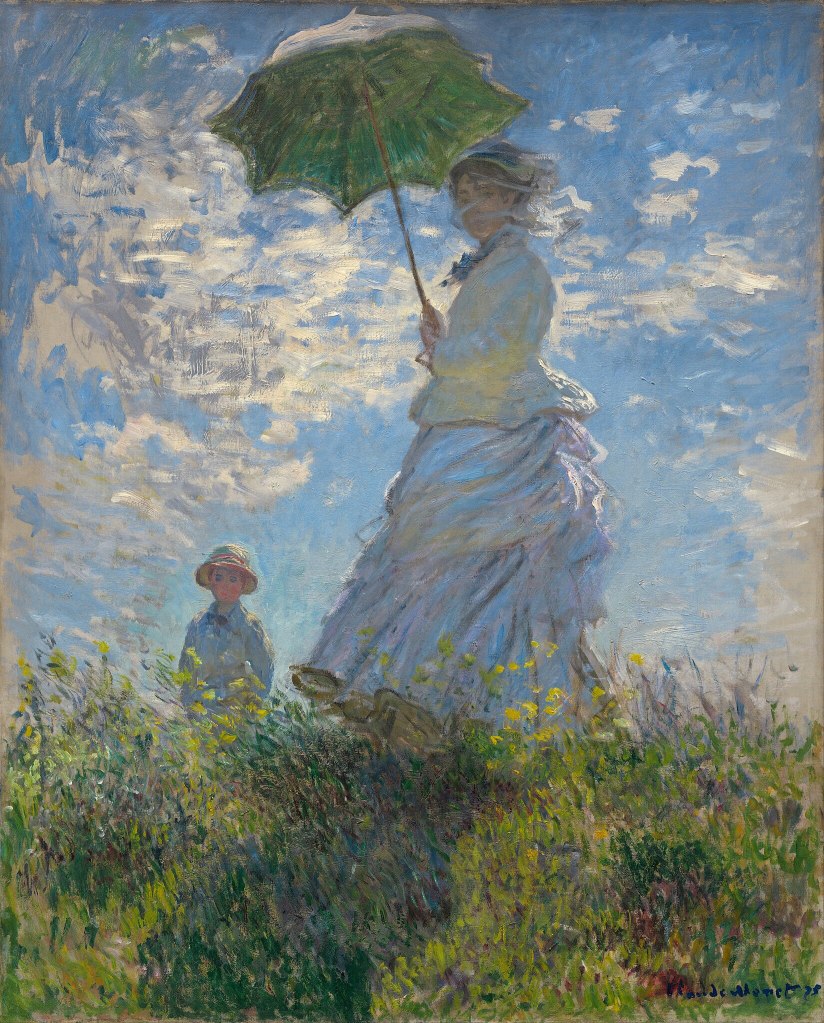
But to Claude Monet (1840-1926), founding French Impressionist, color and light, was everything in his eye. Color defined his paintings, professing that “Color is my day-long obsession, (my) joy…,” he confessed. Color was also a constant burden that he carried with him throughout the day and into the night, lamenting, “Colors pursue me like a constant worry. They even worry me in my sleep.” He lived his aphorism: “Paint what you really see, not what you think you ought to see…but the object enveloped in sunlight and atmosphere, with the blue dome of Heaven reflected in the shadows.” His reality was light and color with a human warming touch.

Adams and Monet’s genius were partially contained in their ability to use light to capture the essence of the landscape, but Monet brought the soul along in living color. Monet’s creed, “I want the unobtainable. Other artists paint a bridge, a house, a boat, and that’s the end…. I want to paint the air which surrounds the bridge, the house, the boat, the beauty of the air in which these objects are located…”

Color is a defining quality of humanity. Without color life would be as impersonal as Adam’s landscapes, beautiful, majestic even, but without passion or pulse. A sharp, stark visual with little nuance, no emotional gradations from torment to ecstasy, just shadows and form.

Understanding color was not just a technical revelation for 19th-century French artists, it was a revolutionary awakening, a new approach to how the eye viewed color and light. The Impressionists and Pointillists brought a new perception to their canvases. And the catalyst for this leap away from the tired styles of Academic Art and Realism was Michel Eugene Chevreul, a chemist whose insight into color harmony and contrast inspired the Monets and Seurats to pursue something radically different in the world of art. His chromatic studies inspired them to paint not for the viewer’s eye, but with it, transforming perception from passive witness into an active collaboration between painter, subject, and observer.

Chevreul’s breakthrough was deceivingly simple. Colors are not static blots on a canvas but relational objects that come alive when surrounded by other hues of the spectrum. A hue in isolation is perceived differently than when seen next to another. Red deepens next to green; blue pulsates with enthusiasm against orange. This principle, simultaneous contrast, revealed that the eye does not just passively accept what it sees but synthesizes it to a new reality.

Chevreul’s theories on complementary colors and optical mixing laid the foundation for painters to forsake rigid outlines, often rendered in the non-color of black, and embrace Impressionism: not merely an art style, but a promise of perception, a collaboration between painter and viewer. Rather than blending pigments on a palette, artists like Monet and Seurat placed discrete strokes side by side, allowing the viewer’s mind to complete the image.

This optical mixing is a product of the way the eye and the brain process the various wavelengths of white light. When complementary colors are adjacent to one another the brain amplifies the differences. Neurons in the eye are selfish. When a photoreceptor is stimulated by a color it suppresses adjacent receptors sharpening the boundaries and contrast. And the brain interprets what it sees based on context. Which is why sometimes we see what is not there or misinterpret what is there, such as faces on the surface of Mars or UFOs streaking through the sky. There is also a theory that the brain processes color in opposing pairs. When it sees red it suppresses green creating a vibrancy of complementary colors when placed together.

The Impressionists intensely debated Chevreul’s concepts then they brushed them to life with paint. They painted not concrete objects, but forms shaped by light and color. Haystacks and parasols within a changing mood of contrasting color. . Interpretation by the eye of the beholder.

Chevreul’s collected research, The Principles of Harmony and Contrast of Colors and Their Applications to the Arts, originally published in 1839, remains in print nearly two centuries later.

Source: The Principles of Harmony and Contrast of Colors and Their Applications to the Arts by Michel Eugène Chevreul, 1997 (English Translation). Graphic: Woman with a Parasol by Monet, 1875. National Gallery of Art, Washington, DC. Public Domain.

Devin Nunes Patriot 2021

Cabernet Sauvignon from Santa Margarita Ranch, Paso Robles, California

Purchase Price: $50.00

ElsBob 93

ABV 14.29%

A clear deep ruby color, full-bodied and bold with aromas of dark fruit and oak. On the palate the wine exhibits tastes of cherries and plums. Slightly acidic with noticeable but fine tannins and a very long satisfying finish. We served this wine over a meal of cheese tortellini in a mushroom garlic alfredo sauce topped with a grilled chicken breast. Somehow it worked perfectly.

An excellent fine wine at a very reasonable price. Drink now or hold for another 10 plus years.

Trivia: Devin Nunes’ winemaking venture is a revival of his family heritage. His grandfather farmed grapes in California, and the family vineyards endured until the 1990s. In 2020, Nunes leased vineyards in San Luis Obispo County and partnered with winemaker Mike Sinor to craft blends using Portuguese varietals.

This Cabernet Sauvignon is named The Patriot, a moniker crowdsourced via Truth Social. The bottle design features large white lettering reminiscent of vintage port, a possible nod to Nunes’ less ostentatious Portuguese roots and perhaps a subtle dig at Napa’s more overt polish. Part of his folksy branding includes leaving bottle neck naked sans the capsule, stripped of all pretenses on the rack, a silent expression of independence in a land of hyper-homogeneity.

A Revolution in Paint

“One must either be one of a thousand or all alone,” declared Edouard Manet (1832-1883). Critics and even some among the Impressionist circle believed Manet lacked the courage to be truly alone, both with his art and his essence. And they were half right. He was an extrovert, a social creature drawn to the vivacious pulse of Parisian life, its salons, cafes, and couture. He wanted to belong.

Through his art he sought recognition. He wanted not necessarily respect, but rather something simpler: acceptance. Yet they misunderstood his paintings. He was alone. His canvass spoke volumes to him, but the critics saw only muted, unfulfilled talent. Paintings adrift in a stylistic wilderness. The arbitrators of French taste, the Salon jury, repeatedly rejected him. In 1875 upon viewing The Laundress, one jury exploded: “That’s enough. We have given M. Manet ten years to amend himself. He hasn’t done so. On the contrary, he is sinking deeper.”

Manet longed for approval, and he could deliver what the critics wanted, but the moment he picked up his brush something else took over. He painted what he saw, but never fully controlled the production. His canvases resisted labels. A modern Romantic, a Naturalist with a Realist bent, urban but Impressionistic. A cypher to the critics but true to himself.

Like his friend Degas, he painted contemporary city life. The country landscapes of Monet, Renoir, and Pissarro couldn’t hold him. The color and light of the Impressionists intrigued him briefly, but stark lighting and unconventional perspective held him fast. He used broad quick solid brush strokes and flat, cutout forms.

Manet’s style was rebellion. The critics sensed it, and hated it, but they never understood it. He couldn’t digest academic art, so revered by the Salon. His mutiny was expressed through paint, not polemic. His only verbal defense was a cryptic comment that “anything containing the spark of humanity, containing the spirit of the age, is interesting.”

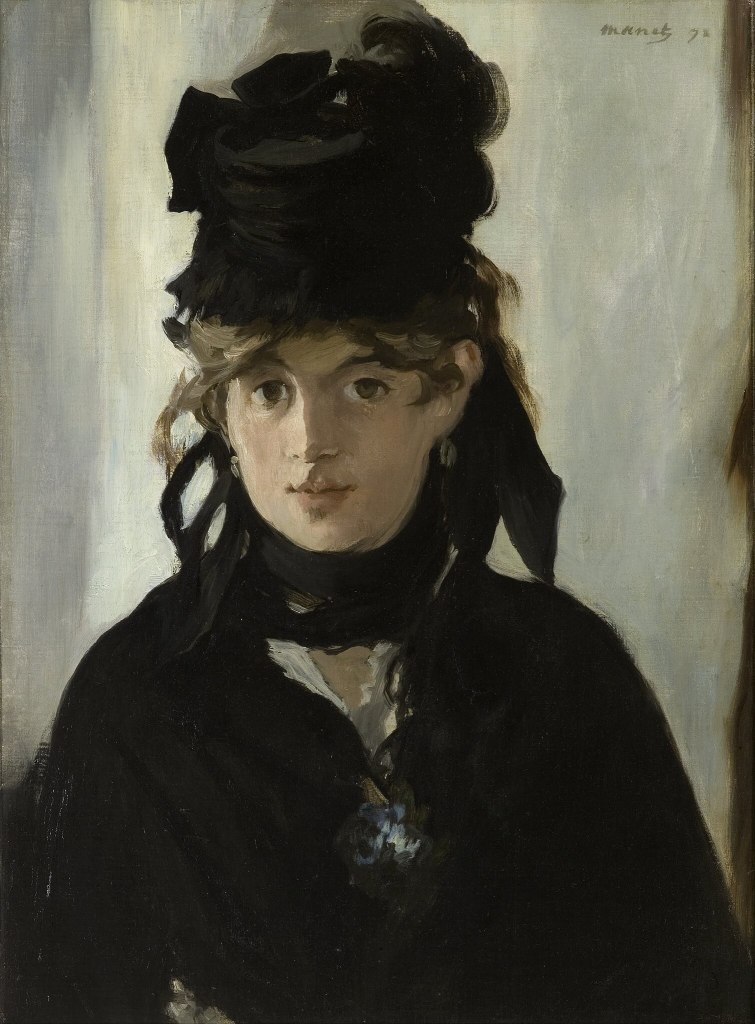
Nowhere is humanity, the spirit of the age, more hauntingly distilled than his masterpiece, his Chef-d’oeuvre: Berthe Morisot with a Bouquet of Violets. Dressed in black, her face half in shadow, Morisot peers questioningly at the viewer, asking what comes next. Manet paints what he sees. And he sees the mystery of femininity. Her green eyes painted black providing an opacity to her gaze, deepening the ambiguity: a comicality behind an expression of curiosity.

Critic Paul Valery wrote, “I do not rank anything in Manet’s work higher than a certain portrait of Berthe Morisot dated 1872.” He likened it to Vermeer, but with more spontaneity that makes this painting forever fresh. It is a timeless, loving portrait that transcends style.

Source: The World of Manet: 1832-1883 by Pierre Schneider, 1968. Graphic: Berthe Morisot with a Bouquet of Violets by Edouard Manet, 1872. Musee d’Orsay, Paris. Public Domain.

Old Soul Cabernet Sauvignon 2021

Cabernet Sauvignon from Lodi, California

Purchase Price: $11.99

Tasting Panel 91, Wine Enthusiast 90, ElsBob 90

ABV 14.5%

Garnet in color, aromas of plums, full-bodied, dry with a tannic finish.

An excellent fine wine at a very reasonable and friendly price.

Trivia:  The first mug of A&W Root Beer was poured in Lodi in 1919, making it the birthplace of one of America’s earliest fast-food franchises. Also, John Fogerty admits he never actually visited Lodi but chose the name for the CCR song because it sounded cool: “Oh Lord, I’m stuck in Lodi again”. Continuing with Lodi irreverence, the town’s west edge features the geographic head scratcher of South Lower Sacramento Road located north of North Lower Sacramento Road.

Cosmos of the Lonely

The universe keeps expanding. When researchers analyze data from the Hubble and James Webb telescopes, alongside a suite of other astronomical tools, they find that the recessional velocity of galaxies, the speed at which they appear to move away from the Earth, varies depending on what they measure.

If they calibrate distances deep into the cosmos using Cepheid variable stars, the expansion rate appears faster than when they use red giant stars or the Cosmic Microwave Background (CMB). This discrepancy, known as the Hubble tension, reveals a deeper mystery: different cosmic yardsticks yield different rates of expansion.

Yet despite the disagreement in values, all methods affirm the same truth: space is stretching…a lot…like a sheet pulled and stretched taut between Atlas’s burden and Hermes flight: a cosmos caught between gravitational pull and a mysterious push: Pushmi-Pullyu on a cosmic scale.

To understand why the cosmos resembles a sheet of rubber we need to travel back about 110 years and peer into the minds of those who first saw increasing separation as a universal law. These new architects of reality: Einstein, Friedmann, Lemaitre; who replaced Newton’s planetary, static models of the cosmos with a dynamic spacetime of bends, ripples, and persistent expansion.

After Einstein published his General Theory of Relativity in 1915, Russian physicist Alexander Friedmann’s analysis of his work showed that the universe could be expanding, and that Einstein’s equations could be used to calculate the rate. In 1927 Belgium priest and physicist Georges Lemaitre proposed that the expansion might be proportional to a galaxy’s velocity relative to its distance from Earth. By 1929, American astronomer Edwin Hubble expanded on Lemaitre’s work and published what became known as Hubble-Lemaitre law: galaxies are moving away from us at speeds proportional to their distance. The greater the distance the faster the speed.

A key feature of this law is the Hubble constant, the proportionality that links velocity and distance. Hubble’s initial estimate for this constant was whopping, and egregiously off, 500 kilometers per second per megaparsec (km/s/Mpc), but as measurements improved, it coalesced around a range between 67 and 73, with the most recent value at 70.4 km/s/Mpc, published by Freedman et al. in May 2025.

The Hubble constant is expressed in kilometers per second per megaparsec. The scale of these units is beyond human comprehension but let’s ground it to something manageable. A megaparsec is about 3.26 million light-years across, and the observable universe, though only 13.8 billion light-years old, has stretched to 46 billion light-years in radius, or 93 billion light-years in diameter, due to the expansion of space (see mind warping explanation below).  

To calculate the recessional velocity across this vast distance, we first convert 46 billion light-years into megaparsecs: which equates to 14,110 megaparsecs. Applying Hubble’s Law: 70 km/s/Mpc times 14,110 Mpc equals 987,700 km/s. This is the rate at which a galaxy 46 billion light-years away would be receding relative to another galaxy one megaparsec closer to Earth.

That’s more than three times the speed of light (299,792 km/sec) or Warp 3 plus in Star Trek parlance. Einstein said this was impossible but fortunately there is some nuance that keeps us in compliance with Special Relativity (or else the fines would be astronomical). This isn’t the speed of a galaxy moving through space, but the speed at which space between galaxies is expanding. Which, admittedly, is terribly confusing.

The speed of a galaxy, composed of matter, energy, and dark matter, must obey Einstein’s rules: gravity and Special Relativity. And one of the rules is that the speed of light is the cosmic speed limit, no one shall pass beyond this.

But space between the galaxies decides to emphasize the rules in a different order. The expansion of space is still governed by Einstein’s equations, just interpreted through the lens of spacetime geometry rather than the motion of objects. This geometry is shaped by, yet not reducible to, matter, energy, and dark matter.

Expansion is a feature of spacetime’s structure, not velocity in the usual sense, and thus isn’t bound by the speed of light. If space wants to expand, stretch, faster than a photon can travel, well so be it.

The space between galaxies is governed by dark energy and its enigmatic rules of geometry. Within galaxies, the rules are set by dark matter, and to a lesser extent by matter and energy, even though dark energy is likely present, its influence at galactic scales is minimal.

Note the use of the word scale here. Galaxies are gigantic, the Milky Way is 100,000-120,000 light-years in diameter. But compared to the universe at 93,000,000,000 light-years across, they’re puny. You would need 845,000 Milky Ways lined up edge-to-edge to span the known universe.

Estimates of the number of galaxies in the universe range from 100 billion to 2 trillion. So, at the scale of the universe, galaxies are mere pinpoints of light; blips of energy scattered across the ever-expanding heavens.

This brings us to dark energy, the mysterious force driving cosmic expansion. No one knows what it is, but perhaps empty space and dark energy are the same. There’s even some speculation, mostly mine, that dark energy is a phase shift of dark matter. A shift in state. A triptych move from Newtonian physics to Quantum Mechanics to…Space Truckin’.

In the beginning moments after the big bang, the universe was dominated by radiation composed of high energy particles and photons. As the universe cooled, the radiation gave way to matter and dark matter. As more time allowed gravity to create structures, black holes emerged and a new force began to dominate, dark energy. But where did the dark energy come from? Was it always part of the universe or did it evolve from other building blocks. Below are a few speculative ideas floating around the cosmic playroom.

J.S. Farnes proposed a unifying theory where dark matter and dark energy are aspects of a single negative mass fluid. This fluid could flatten galaxy rotation curves and drive cosmic expansion, mimicking both phenomena simultaneously.

Mathematicians Tian Ma and Shouhong Wang developed a unified theory that alters Einstein’s field equations to account for a new scalar potential field. Their model suggests that energy and momentum conservation only holds when normal matter, dark matter, and dark energy are considered together.

Ding-Yu Chung proposed a model where dark energy, dark matter, and baryonic matter emerge from a dual universe structure involving positive and negative mass domains. These domains oscillate and transmute across dimensions.

These ideas all rotate around the idea that reality revolves around a concept that everything evolves and that matter and energy, of all forms, flickers in and out of existence depending on dimensional scaffolding of space and the strength of gravity and radiation fields.  Rather than radiation, energy, matter, dark matter, and dark energy as separate entities, these may be expressions of a single evolving field, shaped by phase transitions, scalar dynamics, or symmetry breaking.

Now back to my regularly scheduled program. In August 2025, Quanta Magazine reported on a study led by Nobel laureate Adam Riess using the James Webb Telescope (JWST) to measure over 1,000 Cepheid variable stars with unprecedented precision. Cepheid stars pulsate in brightness over time with a highly predictable rate or rhythm, making them ideal cosmic yardsticks. Riess’s team found a Hubble constant of ~73.4 km/s/Mpc, consistent with previous Hubble Space Telescope measurements of Cepheid stars but still significantly higher than what theory predicts.

That theory comes from the standard model of cosmology: Lambda Cold Dark Matter. According to this framework photons decoupled from the hot electron-proton opaque soup about 380,000 years after the Big Bang went boom, allowing light to travel freely for the first time, and allowing space to be somewhat transparent and visible. This event produced the Cosmic Microwave Background (CMB).

This CMB permeates the universe to this day. It was discovered in 1964 by Bell Lab physicists Arno Penzias and Robert Wilson, who were trying to eliminate background noise from their radio antenna. The noise turned out to be the faint afterglow from the Big Bang, cooled down from its original 3000 Kelvin to a frosty 2.7 Kelvin. They received the Nobel Prize in Physics for this discovery in 1978.

Light from the CMB, as measured by the European Space Agency Planck satellite, has a redshift of approximately 1100, meaning the universe has expanded by a factor of 1100 over the past 13.42 billion years. By analyzing the minute temperature fluctuations in the CMB, Planck can infer the density of matter, dark energy, and curvature of the universe. Inserting these parameters into the Lambda Cold Dark Matter model yields a Hubble constant which turns out to be 67.4 + 1.71 (65.69-69.11). This value is considered the gold standard. Values beyond the Planck measurement are not necessarily wrong, just not understood.

At first glance, the difference between Planck’s 67.4 and Riess’ 73.4 may seem small. But it is cosmically significant. Two galaxies 43 billion light-years away and 3.26 billion light-years apart (1000 Mpc) would have a velocity difference of 6000 km/s or about 189 billion kilometers of increased separation per year. That’s the scale of what small differences in the value can add up to and is referred to as the Hubble tension.

Meanwhile, a competing team of researchers studying red branch and giant branch stars consistently scored the Hubble constant closer to the theoretical prediction of 67.4. This team led by Wendy Freedman believes that Hubble tension, the inability of various methods of measuring the Hubble constant to collapse to a single value, is a result of measurement errors

While some researchers, Wendy Freedman and others, suggest lingering systematic errors may still be at play, the persistence of this discrepancy, across instruments, methods, and team, has led others to speculate about new physics. Among the most provocative ideas: the possibility that the universe’s expansion rate may vary depending on direction, hinting at anisotropic expansion and challenging the long-held assumption of cosmic isotropy. But this seems far-fetched and if true it would likely break the Lambda Cold Dark Matter model into pieces.

And so, the cosmos grows lonelier. Not because the galaxies are fleeing, but because space itself is stretching, a wedge governed by the geometry of expansion. The further they drift apart, the less they interact, a divorce from neglect rather than malice. In time, entire galaxies will slip beyond our cosmic horizon, receding faster than light, unreachable even in principle. A cosmos of the lonely.

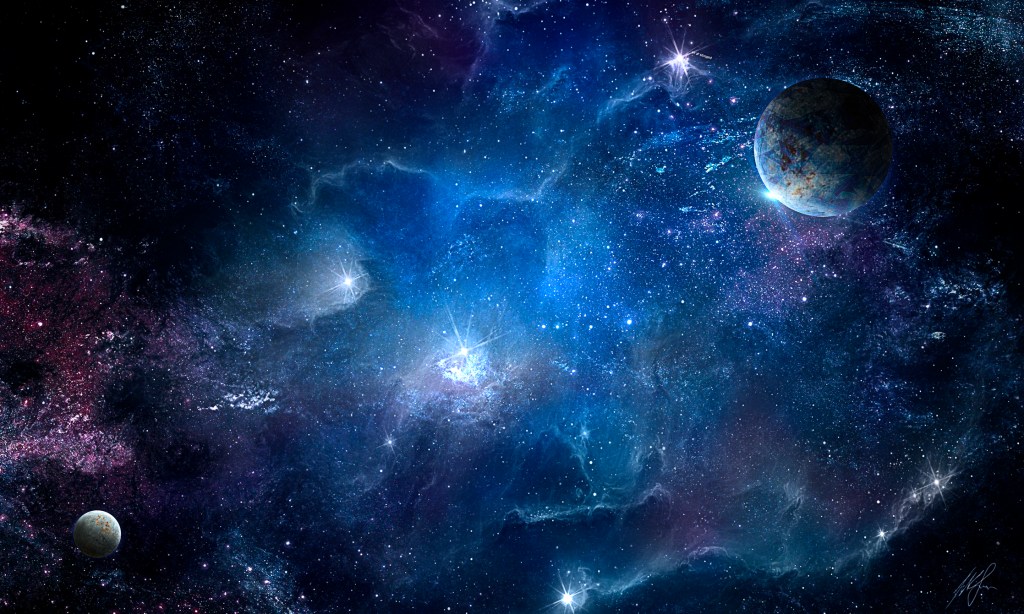
Source: The Webb Telescope Further Deepens the Biggest Controversy in Cosmology by Liz Kruesi, Quanta Magazine, 13 August 2024. JWST Observations Reject Unrecognized Crowding of Cepheid Photometry as an Explanation for the Hubble Tension at 8σ Confidence by Riess et al, The Astrophysical Journal Letters, 6 February 2024. Graphic: Cosmic Nebula by Margarita Balashova.

Duckhorn Napa Valley Cabernet Sauvignon 2019

Cabernet Sauvignon from Napa Valley, California

Cabernet Sauvignon 83%, Merlot 13%, Cabernet Franc 2%, Petit Verdot 2%

Purchase Price: $59.99

James Suckling 92, Wilfred Wong 92, Connoisseurs Guide 91, Wine Spectator 90, Wine Buyer 90, ElsBob 92

ABV 14.5%

A dark ruby wine with aromas of anise, dark fruits, spices, and vanilla. Full-bodied, with tingly fresh acidity, tannins with a bite, and flavors of blackberries and black cherries on the palate. A wonderful long finish.

An excellent fine Napa wine at a fair price. Recent retail prices range from $60 to $115, with a median price just under $70 for a 92-point 2019 vintage. Selected retail is $78.

Trivia: Founded in 1976 by Dan and Margaret Duckhorn in St. Helena, Duckhorn Vineyards was one of Napa Valley’s first 40 wineries. Their inaugural releases in 1980 included both Cabernet Sauvignon and the now-iconic Merlot. Over the decades, they expanded into Sonoma, Anderson Valley, and Washington State under various duck-themed labels.

Beginning in 2007, the Duckhorns began selling controlling interests to private equity firms. After several transitions to various companies, the winery was acquired by Butterfly Equity in 2024, a firm specializing in food and beverage investments.