A Synthesis of Quantum Foundations, Emergent Spacetime, and the Ontology of Correlation
Black Hole. (iStock, licensed)
Black holes and singularities are not features of spacetime: they are failures of the spacetime interface. They mark the points at which the spacetime interface ceases to be a valid representation of the underlying quantum relational structure.
Spacetime is not a fundamental arena but a representational interface that becomes valid only when a quantum state’s internal relational structure satisfies specific conditions. Three structural conditions jointly license a spacetime description: (1) entanglement must be sufficiently organized to support connected geometry; (2) entanglement must not be so dense as to erase locality through volume‑law scrambling; and (3) decoherence must suppress phase relationships enough to produce WKB‑stable classical histories. A separate rendering condition: the Higgs field’s vacuum expectation value, sets the classical mass spectrum and stabilizes decoherence once spacetime is licensed. When all conditions hold, a subsystem is forced into a classical mode of representation characterized by locality, geometry, causal order, and sequential time. The Big Bang is reframed as the relational event at which these conditions were first satisfied, rather than a temporal origin. The rendering model is then extended to examine cosmological parameters as interface requirements, classical end-time scenarios as failures of the interface (not the substrate), and the metaphysical implications of a universe whose deepest ontology is non-geometric, nonlocal, and non-temporal. Drawing on philosophical traditions from Plato to Bergson alongside modern quantum gravity, the paper concludes that reality is correlation: spacetime is the classical world’s shadow of a deeper relational whole, and the wavefunction is the universe.
The brain lives in time. Consciousness does not, and that difference changes everything.
The brain is a temporal, entropic organ embedded in spacetime; consciousness is a timeless, unified field that does not fragment, decay, or age. These two structures cannot belong to the same domain. This essay develops a formal two‑domain model: a timeless domain containing all outcomes at once, and a temporal domain in which the brain renders one outcome at a time.
Drawing on Bergson’s distinction between durée and spatialized time, and Proust’s demonstration that past experience can be recovered whole rather than in fragments, the essay argues that consciousness is not generated by the brain but translated by it. The translation occurs through a strict interface governed by five constraints: no energy transfer, no spatial dependence, no temporal sequencing, logical immiscibility, and one‑outcome rendering.
Quantum mechanics supplies the closest physical analogy we currently have: on one coherent reading, a non‑spatial Hilbert‑space structure is rendered into classical actuality through an incomplete interface that yields a single outcome and thereby produces probability. The model developed here proposes that the consciousness–brain interface is complete in the contrasting sense that the brain can render one outcome while preserving access to the unity of the whole.
If spacetime itself is emergent, as modern physics increasingly suggests, then the temporal domain is finite. When becoming completes its work, the timeless domain remains as the finished presence of all outcomes. This structure echoes what Jewish and Christian eschatology have long called ‘end times’: not destruction, but completion.
You are not your brain. You are the relation between a timeless field and a temporal organ, and experience is what that relation looks like from the inside.
I. The Ontological Gap
This essay begins with a simple ontological observation: Consciousness behaves nothing like the physical world that the brain inhabits. The brain is a structure embedded in spacetime, bound to sequence, causality, and entropy. It ages, it changes, it rewires, and eventually it dies. Everything about it is temporal. Yet the experiencer: the “I” that persists across every changing thought, memory, and mood, does not share those properties. Its continuity is given directly in experience: the subject does not appear in pieces but as a flowing whole.
This is not a puzzle about neural relationships. It is an ontological conundrum. Two things that occupy the same body appear to belong to different orders of reality. One is fragmented, local, and mortal; the other is unified, continuous, and apparently impervious to the very processes that govern everything else we know. Before any theory of consciousness can proceed, this asymmetry must be taken seriously as a structural fact, not explained away.
II. Experience and Memory
We are the sum of our experiences, but not the sum of our physical memories. Memory is a temporal, entropic function of the brain; experience is the continuous, non‑fragmenting field of consciousness. Memory is the brain’s record of experience, while experience is consciousness’s participation in reality. Memory can fail, distort, or vanish; experience cannot. We are shaped by every experience we live, not merely by the memories the brain manages to retain.
The difference is felt directly. Memory arrives in fragments: partial, lossy, subject to revision. Experience unfolds as a seamless whole while it is happening, regardless of how much the brain later preserves or loses. We remember discrete notes from a symphony that was lived entirely. The symphony was not discrete. The notes are what remains after the brain has done its work of reduction.
This is not a minor phenomenological observation. It is the first indication that consciousness and memory operate on different principles or levels and, therefore, in different domains.
III. Proust and Bergson: Two Witnesses to Duration
Marcel Proust understood this distinction intuitively and built the longest novel in Western literature around it. His great project in In Search of Lost Time was not to record memories but to re-enter experience. When the madeleine dissolves in tea, the past does not return as a fragment; it returns whole; an atmosphere, a room, a felt continuity, a field of consciousness recovered intact. What floods back is not a memory of Combray but Combray itself, as it was lived. Proust’s involuntary recollections are not neurological retrievals; they are reactivations of durée, the seamless flow of experience that the brain later fractures into discrete, lossy records.
The philosopher who gave that word, duree, its full force was Henri Bergson. Born in 1859 and writing at the height of European scientific confidence, Bergson was trained in mathematics, steeped in the physics of his era, yet convinced that the deepest features of reality could not be captured by equations or spatial diagrams. He was not a mystic, but he was not satisfied with the mechanistic worldview that dominated the late nineteenth century. His work sits at the boundary between scientific rigor and metaphysical honesty.
Bergson’s central argument is simple to state and difficult to absorb: the time of consciousness: durée, is not the time of physics. Physics measures time as a sequence of instants, a divisible line, a spatialized parameter that can be plotted on an axis. Consciousness lives time as an indivisible flow, a qualitative becoming, a continuity that cannot be cut into pieces without destroying its essence. The intellect, shaped by evolution to navigate matter, inevitably converts this lived flow into spatialized representations. We then mistake those representations for reality itself.
This is precisely what Proust refused to do. When he writes that “the past is hidden somewhere outside the realm, beyond the reach of intellect, in some material object,” he is pointing to the same structure Bergson identified philosophically: consciousness preserves what the intellect cannot. The madeleine works not because memory is stored in taste but because a certain configuration of experience bypasses the brain’s abstracting machinery and delivers duration directly. Proust is the literary proof of Bergson’s metaphysics.
Bergson also insisted that the future does not exist as a set of pre-formed possibilities awaiting selection. Possibilities, he argued, are retrospective abstractions; shadows cast backward by the intellect after an act has already occurred. Before the act, there is no branching structure, no probabilistic cloud, no menu of options. There is only becoming: an indivisible, creative advance that produces a determinate outcome and only then appears, in retrospect, to have been one of several possibilities.
Late in life, Bergson wrote that his reflections had brought him “closer and closer to Catholicism,” though he refused to convert during the rise of antisemitism in Europe, unwilling to abandon those being persecuted. His metaphysics is not explicitly theological, but it is unmistakably open to the idea that consciousness, creativity, and timelessness belong to a deeper order of reality than matter and spacetime. He was a philosopher who sensed; decades before physics caught up, that the classical world is not a fundamental reality nor one of infinite time.
IV. The Entropy Problem
This presents a structural stress or mess if you prefer. Spacetime enforces interruption, decay, and fragmentation. Within the temporal domain, every process is governed by entropy; the universal tendency toward dispersion. Anything subject to entropy cannot remain unified; left to its own devices, every organized structure dissolves into less organized states. A continuous, unified experiencer cannot, therefore, be a product of the temporal domain.
If consciousness exhibits properties that spacetime cannot produce or preserve; continuity without sequence, unity without physical binding, persistence without entropy, it cannot originate from structures embedded within spacetime. Its properties exceed what spacetime can generate or sustain.
This is why consciousness cannot be found inside the brain. It is not a physical object, not a neural pattern, not a biochemical process. It is the timeless field from which experience is drawn. The brain does not generate consciousness; it renders and localizes it. Much like a radio does not create the broadcast it plays, the brain does not create the awareness that animates it. The broadcast is non‑local and timeless; the receiver is local and temporal. They belong to different logical regimes, and because their rules are incompatible, they cannot be unified inside a single domain. They must remain distinct.
That distinction is not spatial: consciousness is not “over there” while the brain is “over here.” It is a separation of logic. Consciousness operates without sequence; the brain operates only through sequence. Consciousness is not bound by before and after; the brain is nothing but before and after. Consciousness does not age; the brain ages constantly. Consciousness does not fragment; the brain fragments with every injury, every chemical shift, every night of sleep. If consciousness were inside spacetime, it would inherit spacetime’s limitations. It would decay, interrupt, and dissolve. Identity would vanish. The continuity of the experiencer would be impossible. And yet here it is, given in every waking moment.
The entropy problem reveals a structural incompatibility: consciousness exhibits properties that cannot be generated or preserved by the classical, temporal domain. But this raises a deeper question: how can two domains with incompatible sets of rules interact at all?
Physics already contains the only known example of such an interface. The quantum and classical regimes coexist without sharing a common logic, yet they meet through measurement. This relationship provides the clearest physical template for understanding how a timeless domain can be rendered into a temporal one without being reduced to it.
To see how this works, we turn to the quantum analogy.
V. The Quantum Analogy
The following discussion does not claim that quantum mechanics is consciousness, nor that the quantum domain is the timeless domain of experience. The point is structural. Quantum theory already contains two regimes whose rule‑sets do not translate cleanly into one another, yet which interact through an interface that yields definite outcomes. This makes quantum mechanics the clearest physical example of a dual‑domain architecture; one in which incompatible descriptions coexist and nevertheless produce a coherent world.
On one defensible reading of the formalism, a quantum state is not an object in spacetime at all. It is a Hilbert‑space structure, the mathematical arena, encoding all allowable outcomes of a system at once plus the rules that govern this structure. Unitary evolution (Schrödinger’s equation…more on this below) preserves that structure perfectly. Measurement, by contrast, is a symmetry‑breaking projection: it renders a single classical actuality while discarding the rest of the quantum structure. Probability appears only at this interface. The quantum domain itself is deterministic and complete; the classical domain is fragmentary and sequential. Probability appears because the classical description cannot retain the full structure of the quantum state. The interface between the two is, at a minimum, incomplete.
It is tempting to imagine the quantum world as a smaller version of the classical world; tiny particles moving through tiny trajectories. This picture is false. Quantum entities are not miniature objects. They are excitations of fields defined by symmetry, not by spatial extension. Their properties are encoded in algebraic relations, not in shapes or locations. The classical world is the world of definite values, commuting observables, trajectories, and entropy. The quantum world is the world of superposition, non‑commuting observables, and global constraints.
These regimes are logically incompatible. The quantum domain is governed by the symmetries of Hilbert space and unitary evolution; the classical domain is governed by the symmetries of spacetime: locality, causal structure, and temporal sequence. Measurement is the interface between them, and it is not a neutral act. It collapses a richer domain into a poorer one. The classical world sees only the shadow of the quantum world, never the thing itself.
This dual‑domain structure provides a formal template for thinking about consciousness and the brain. The brain is classical: temporal, entropic, local, and fragmenting. Consciousness presents itself as unified, continuous, and non‑fragmenting. If consciousness belonged wholly to the classical domain, it would inherit classical limitations: interruption, decay, fragmentation. It would not persist as the same experiencer across the changing states of the brain. The quantum–classical interface collapses structure; the consciousness–brain interface, whatever its nature, does not appear to do so. The analogy is not identity; it is a demonstration that dual‑domain architectures are coherent within contemporary physics.
The quantum–classical interface shows how two incompatible rule‑sets can interact without unifying. But the analogy becomes far more concrete when we examine the phenomenon that most clearly exposes the mismatch between quantum structure and classical spacetime: entanglement.
Entanglement is where the deeper domain makes itself unavoidable.
VI. Entanglement, Symmetry, and the Nature of Possibilities
Entanglement is the clearest place where the quantum domain refuses to fit inside classical spacetime. In plain terms, entanglement is when two particles become so deeply connected that they behave like one thing, even if you pull them to opposite ends of the universe. Whatever you learn about one instantly tells you something about the other; not because a signal traveled, but because they were never truly separate in the first place.
This is not compatible with the symmetry structure of classical spacetime. Classical spacetime is organized by continuous symmetries: Poincaré transformations or diffeomorphisms; that treat locality and causal propagation as fundamental. Entanglement correlations violate the inequalities required by any local hidden‑variable theory that respects those symmetries. They are indifferent to distance. Trying to force them into a classical spacetime picture is what produces the sense of paradox.
A more defensible approach; common in quantum‑gravity, in attempts to unify quantum mechanics with general relativity, and in foundational work; is to treat entanglement as belonging to a more primitive domain whose governing symmetries are quantum rather than spatiotemporal. In that deeper quantum domain, the basic “things” are not particles in space but mathematical states living in Hilbert space: an abstract arena that holds every possible configuration of the system at once. Hilbert space is non‑spatial and conceptual; it is part of the mathematical structure of physics, not a physical arena. These states change according to a single rule (unitary evolution) that tells how the whole system unfolds as a perfectly coherent pattern. Because of this, the connections between parts of the system are global: they belong to the entire state at once and cannot be broken down into separate, independent pieces.
Spacetime geometry, locality, and even the appearance of time are not fundamental features of the quantum domain. They arise only when one looks at the global quantum state in a restricted way; by focusing on particular subsystems or by slicing the full state into pieces that resemble classical sequences. In other words, what we call “spacetime” is not built into the quantum world; it is what the quantum world looks like when viewed through certain coarse‑grained perspectives. Change the perspective, and the familiar features of spacetime change or disappear. The symmetries of emergent spacetime are therefore more restricted than the symmetries of the underlying quantum domain.
You do not need extra mechanisms to “explain away” non‑local correlations. You simply stop demanding that the quantum domain obey the symmetry principles of the classical arena it gives rise to. That single shift removes a great deal of unnecessary conceptual friction.
The physics we actually have supports this picture. Schrödinger evolution is deterministic and can be written in a fully stationary, timeless form for closed systems under Hamiltonian constraint. Entanglement lives naturally in that description: the global state contains all correlated outcomes at once.
Classical spacetime, measurement outcomes, and sequential experience obey a different effective rule‑set: locality, definite outcomes, an arrow of time.
Schrödinger’s cat is precisely where these two descriptions refuse to sit comfortably together. The unitary, entangled description of the closed system (cat + atom + environment) contains both “alive” and “dead” branches. The classical description insists on one definite macroscopic state. The interface between these rule‑sets is the measurement problem. No consensus solution exists.
This mismatch is empirical. It does not claim that the quantum domain is literally timeless, nor that it is the seat of consciousness. It simply notes that the quantum domain and classical spacetime obey different symmetry principles, and that entanglement makes this unavoidable.
Entanglement already shows that the quantum domain cannot be forced into the symmetry structure of classical spacetime. But it also reveals something deeper: the quantum state is not a collection of parts but a single unified whole.
This brings us to the structural heart of the analogy: the completeness of the timeless whole.
VII. Entanglement and the Completeness of the Timeless Whole
Entanglement reveals something deeper: the quantum formalism does not describe two systems but a single unified whole. A joint entangled state cannot be decomposed into independent parts without losing information. The correlations do not travel across space. They are revealed instantaneously, regardless of distance, from a domain in which all allowable outcomes of the combined system coexist in a single structured state.
The quantum formalism encodes the whole system at once. The classical world cannot decode it in full. Schrödinger’s equation evolves this unified structure with perfect precision yet contains no mechanism for extracting a single classical outcome without losing access to the rest. This incompleteness; this inability to render the whole while rendering a part, is the structural source of quantum probability. The apparent indeterminacy does not belong to the quantum domain. It belongs to the interface.
Einstein’s intuition reached exactly here. He insisted that nature could not be fundamentally probabilistic, that apparent randomness must signal incomplete understanding. Modern physics treats quantum probability as irreducible. But if the underlying domain contains outcomes rather than possibilities, if the global state is complete, then Einstein’s instinct was aimed at the wrong layer. The universe does not gamble; it reveals. What looks like probability from within the temporal domain is simply the classical interface’s failure to render the whole from which the outcome is drawn.
This is where the consciousness analogy becomes suggestive. The quantum–classical interface is incomplete: it collapses structure and introduces probability. The consciousness–brain interface, whatever its nature, does not appear to collapse or fragment the unity of experience. Consciousness remains whole while being rendered into temporal sequence. The analogy is not a claim of identity; it is a demonstration that dual‑domain architectures with incompatible rule‑sets already exist in physics, and that entanglement and the measurement problem provide the clearest example.
Whether consciousness–biology is an instance of such an architecture remains open. The quantum parallel does not prove it nor does it claim that consciousness is quantum or that Hilbert space is a model of mind. It shows only that dual‑domain architectures with incompatible rule‑sets are coherent and already present in physics.
With that structural template in place, we can now turn to the two domains that concern us directly: consciousness and biology.
VIII. The Two Domains
Any adequate account of the relationship between consciousness and biology must begin with a precise distinction between the domains in which they operate. These domains are not separated by distance or location. They are separated by logic; by incompatible rule sets, incompatible forms of order, and incompatible modes of existence.
The timeless domain is the field of consciousness itself. This is a metaphysical claim, not a physical one. Its role in this model is conceptual rather than empirical. It does not unfold in sequence, does not propagate through space, and does not decay. Nothing in it moves or changes, because change requires a before and after, and consciousness-in-itself has neither. It is the indivisible presence of all outcomes at once; a completed whole that does not fragment, age, or divide. In this domain, locality has no meaning, probability has no foothold, and entropy has no jurisdiction. It is not a place, not a state, not a moment in time. It is a mode of being: unified, non-local, and immutable.
The temporal domain is the world the brain inhabits; the realm of spacetime, where events occur in sequence, causes precede effects, and every process tends toward dispersion. Here, experience is rendered into local, measurable form. The brain localizes consciousness, translating one thread of the timeless whole into the lived sequence we call a life. In this domain, everything is fragmented: memories break, neurons die, signals propagate and dissipate, and every act is anchored to a specific moment and place. This is the domain in which free will operates, because free will requires becoming: the genuine creation of novelty through time.
These two domains cannot be unified. Their rules are incompatible, and this incompatibility is not a failure of symmetry but the preservation of their respective rules. Just as the quantum and classical worlds coexist without merging; each complete in itself, each ungoverned by the other’s logic: consciousness and biology coexist without unifying. The interface between them is not a collapse of separation into a whole but a mapping: a translation between two symmetrical systems whose rule sets cannot be made identical.
If these domains are to interact without collapsing into one another, the interface between them must obey strict, logical constraints.
IX. The Interface and Its Constraints
If a timeless domain and a temporal domain are to be coupled without being unified, the interface between them must satisfy strict, logical constraints. These are not design choices. They are the conditions without which the interface cannot exist without destroying one of the domains it connects.
The first constraint is non‑energetic interaction. Nothing is transmitted from the timeless domain into the temporal one, because transmission requires time, space, and energy, each of which belongs exclusively to the temporal domain. Information does appear in the temporal domain, but not through transmission; it is revealed through the interface, not sent across it. The interface cannot be a flow of anything. It must be a mapping, not a movement. This mirrors the quantum case: the wavefunction does not send a signal into spacetime when measurement occurs. It is rendered by measurement, and the rendering is not itself a physical transaction.
The second constraint is non-local correspondence. Consciousness does not occupy a location. It does not move through the brain and does not reside inside neural tissue the way a process resides in a processor. The brain performs a local biological act that corresponds to a non-local whole. This constraint prevents the interface from re-importing spatial metaphors into a domain where space has no meaning.
The third constraint is non-sequential translation. The timeless domain contains outcomes, not processes. It does not unfold or evolve. The mapping from timelessness to temporality is therefore not a temporal event; it cannot have duration, cannot occur “before” or “after” anything else, and cannot be described as a sequence of steps. The rendering is instantaneous in the logical sense: not fast, but outside of time altogether. A quantum measurement does not take time to consult the wavefunction; the classical outcome simply appears. The same logic governs the consciousness-biology interface.
The fourth constraint is logical immiscibility. The two domains must remain governed by their respective and incompatible rule sets. Consciousness cannot fragment, age, or become probabilistic; biology cannot become unified, non-local, or temporally complete. Any model that allows the domains to bleed into one another destroys the very distinction that makes experience intelligible. This constraint is the metaphysical parallel of the quantum-classical boundary: two symmetrical systems that cannot be made into one without losing what each contributes to the whole.
The fifth constraint is one-outcome rendering. The timeless domain contains all outcomes simultaneously, but the temporal domain can give presence to only one at a time. The interface must therefore reveal a single thread of the timeless whole at each moment without altering the whole itself. This is not collapse, not selection from a menu, and not reduction. It is the biological analogue of quantum measurement: the moment when one determinate actuality becomes present within the temporal sequence, leaving the rest of the whole intact.
Together, these five constraints define the only interface that preserves the integrity of both domains while allowing them to produce a single coherent experience.
These constraints define the architecture of the interface; the next question is how that interface actually operates.
X. The Translation Mechanism
The translation mechanism is the act through which a timeless whole becomes a lived moment. It is not a transmission; nothing crosses from timelessness into time. It is not a collapse; nothing in the timeless domain is altered. It is not a selection; the timeless domain contains no options from which to choose. It is, strictly speaking, a revelation: the process by which one completed actuality within the timeless whole becomes present within the temporal sequence.
Consider how classical measurement relates to the quantum analogy. The measurement does not extract information from the quantum domain. It renders one aspect of a timeless structure as a definite temporal event. The quantum state remains intact; the classical event appears. Nothing crosses the boundary; the two domains remain immiscible; and yet a single coherent result is produced. The translation mechanism for consciousness and biology operates by exactly this logic.
What the brain does, on this account, is perform the biological equivalent of measurement: it renders one outcome from the timeless domain of consciousness into the temporal sequence we call experience. Each neural configuration; shaped by development, learning, attention, and the accumulated history of the organism, corresponds to a particular rendering of the timeless whole. The rendering has no duration, no location, and no energy expenditure of its own. It is not an event within time; it is the interface through which time gains content.
This is where the consciousness-biology interface surpasses its quantum-classical counterpart. The classical world renders one outcome and in doing so loses access to the timeless whole, hence we are left with the non-exact idea of probability. The brain renders one outcome and preserves the whole. Consciousness remains unified, non-local, and complete throughout every rendering. The experiencer is never diminished by the act of experiencing. Probability is the residue of an incomplete interface. Experience is the expression of a complete one.
What emerges from this rendering process is not consciousness itself and not biology alone, but the lived stream we call experience.
XI. Emergent Experience
Experience is the ordered unfolding of these renderings through time. Each moment is a translation of one completed actuality into the grammar of temporal succession. Consciousness does not move through the brain; the brain moves through consciousness; touching one outcome after another, converting a timeless whole into a temporal narrative the way a reader moves through a text that existed in full before the reading began.
The timeless domain does not change, but the brain does. Neural activity is always in motion; always entropic, always reorganizing, always shaped by the previous moment’s outputs. Each new configuration of the brain corresponds to a different rendering of the timeless whole. As the brain changes, the thread it reveals changes with it. Experience emerges from this movement, and it belongs to neither domain alone. It is neither a property of consciousness nor a product of biology. It is the relation between them.
This relation generates the sense of continuity that defines a self. Consciousness is not continuous: it is whole. Biology is not unified: it is fragmented. Yet the translation mechanism binds these opposites into a single lived stream. Duration is not inside consciousness, and it is not a feature of the timeless domain. It is inside the rendering: the temporal stitching of discrete revelations into a narrative that feels seamless precisely because the timeless domain behind it is seamless.
Emergent experience is therefore the interface in operation; not the timeless domain, not the temporal one, but the ongoing translation between them. The brain’s traversal of the timeless whole is like a needle moving across a tapestry; the tapestry does not change, but the needle’s path creates a story. Experience is that story. It is the ordered sequence of outcomes drawn from a domain that contains no order and no sequence.
This account resolves three persistent puzzles in the philosophy of mind. Consciousness feels unified even though biology is not: the unity comes from the timeless domain the brain reveals, not from any biological integration. Experience feels continuous even though consciousness is not temporal: the continuity comes from the brain’s unbroken movement through the timeless whole, not from any property of consciousness itself. And free will feels real even though the timeless domain contains no unresolved possibilities: free will is the biological creation of new neural configurations that reveal new outcomes from the timeless whole. Novelty arises not because the timeless domain changes, it cannot, but because the brain does.
The “I” is not a substance. It is a relation: the ongoing correspondence between a timeless presence and a temporal organ. The self is the continuity produced by the brain’s traversal of a domain that contains no continuity. The story of a life is the ordered revelation of outcomes that were never themselves ordered. And consciousness; which does not change, does not age, and does not fragment, becomes the ground on which all change is experienced.
Proust knew this. The recovered past in In Search of Lost Time is not a reconstruction but a re-rendering: the brain, in a moment of extraordinary alignment between involuntary sensation and memory, arrives at a neural configuration that corresponds to an earlier thread of the timeless whole. Combray returns not as an image but as a presence; whole, atmospheric, immediate, because what returns is not a memory but an outcome from the timeless domain, re-revealed. The madeleine does not transport Proust backward in time. It re-establishes the translation.
XII. Spacetime, Eschatology, and the End of Becoming
Modern physics increasingly suggests, but not proven, that spacetime is not the base layer of reality. Leading theoretical frameworks; from loop quantum gravity to emergent spacetime proposals in string theory, treat spacetime as arising from deeper, pre-geometric structures rather than as a fixed backdrop in which physics unfolds. If this is correct, the quantum-classical duality is not a permanent feature of nature but a conditional one: it exists because spacetime exists, and it dissolves when spacetime is transcended.
The same logic applies to the structure developed here. If spacetime is emergent, then the temporal domain; the domain in which the brain operates and in which free will creates novelty through becoming, is emergent as well. When becoming finishes its work, the temporal domain does not collapse into nothingness. It completes. The timeless domain remains as the finished presence of all outcomes that becoming has produced over the entire span of its existence.
This is not a merely physical prediction. It is the metaphysical form of what several religious traditions have called “end times”, and the convergence is not accidental. Both Jewish and Christian eschatology, by different theological routes, arrive at the same final state: the end of temporal becoming and the emergence of a perfected, completed existence beyond time. Jewish thought, despite its relative resistance to systematic eschatology, nevertheless envisions an olam ha-ba, a world-to-come, in which the division between becoming and being is finally resolved. Christian eschatology names the same structure: a new creation in which time is not abolished but fulfilled, and all experience stands simultaneously present before its source.
From Abraham through the Greek classical period and into the time of Christ, the idea of a completed, timeless world-to-come was a logical argument only; a metaphysical necessity inferred from the nature of becoming. For nearly three millennia, no physical theory offered any structure that resembled it. Only in the 20th century did physics begin to produce concepts that rhyme with this ancient intuition: a timeless quantum domain, an emergent spacetime, a finite temporal span, and a collapse from possibility into completed actuality. What was once purely metaphysical began to acquire a faint but unmistakable physical analogue.
Neither tradition invented this idea from nothing. It follows as a structural, logical consequence of a universe in which time is not ultimate, in which becoming is finite, and in which the final condition of existence is a reunified, completed whole beyond the boundaries of spacetime.
Bergson spent his career circling this conclusion without fully reaching it. He knew that consciousness points toward something timelessness cannot be expressed through duration; that durée, however alive and creative, is not the last word. His struggle was structural: a temporal organism cannot fully conceptualize an atemporal mode of being any more than a two-dimensional surface can represent three-dimensional space from within itself. Modern physics now echoes the same horizon. The emergent nature of spacetime is the scientific form of the same intuition eschatology has preserved for millennia: that time is real and creative, but it is not the final architecture of existence.
XIII. Conclusion: The Relational Self
The relationship between consciousness and the brain is not a puzzle awaiting better neuroscience; it is a structure awaiting recognition: a meeting point between two domains that cannot be unified yet cannot be separated, each complete in itself, each requiring the other to produce the one thing neither can produce alone: experience.
One domain is timeless, unified, and complete: it contains all outcomes at once, without sequence or decay, the way a finished painting contains all its colors simultaneously, not as a sequence of strokes but as a completed presence. The other is temporal, local, and always in motion: it moves across that completed whole, revealing one outcome after another, translating the atemporal into the sequential, converting presence into narrative. Experience is not a property of either domain. It is the translation itself; the ongoing act through which a timeless whole becomes a lived moment and a lived moment points back toward a timeless whole.
This structure mirrors the deepest architecture of the physical world. The quantum domain presents a unified, non-local whole; the classical domain renders one outcome at each measurement. The classical interface is incomplete: it renders one outcome and loses the whole, producing probability. The consciousness interface is complete: it renders one outcome and preserves the whole, producing experience. In this sense, consciousness preserves what classical physics cannot; that unity is not constructed through aggregation but given as the ground; that continuity is not fundamental but emergent; that the whole is not assembled through time but revealed through it. But the quantum analogy is not an identity but a structural guide: it shows that two incompatible domains can interact coherently without unifying, and that a temporal sequence can be drawn from a timeless whole without diminishing it.
To call consciousness timeless is not mysticism. It is the recognition that the unity of experience cannot be produced by a temporal organ, and that something beyond spacetime must be doing the work that spacetime cannot do. To call the brain a rendering device is not reductionism. It is an acknowledgment that the brain’s extraordinary complexity is precisely what enables it to traverse a domain that does not move; that biological sophistication is the instrument through which a timeless whole becomes a particular life. To call experience emergent is not to dilute its reality. It is to locate its reality correctly: not in consciousness alone, not in biology alone, but in the irreducible relation between them.
The world we live in is neither purely physical nor purely mental. It is relational; constituted by the ongoing act of translation between two symmetrical systems whose rules cannot be made identical and whose interaction cannot be reduced to either. Experience is the translation. The “I” is the thread of that translation. And the meaning of a life is the pattern traced by a temporal organ moving, moment by moment, across a timeless whole that was always already complete.
Consciousness and biology are birds of a feather in the only sense that matters: neither can produce experience without the other. Biology provides the temporal thread through which consciousness becomes localized, and consciousness provides the unified field that biology alone cannot generate. They are not identical domains, but complementary ones: each incomplete without the other.
The self is the living proof of that complementarity: the single thread through which a temporal organism reveals, moment by moment, the presence of a timeless whole. When the temporal domain completes its work, becoming resolves into being: the timeless whole itself.
Appendix: Contexts for a Dual‑Domain Architecture
This appendix gathers the philosophical, literary, and scientific contexts that inform the dual‑domain model developed in the main text. It is not required for the argument itself, but it situates the model within a broader lineage of thinkers who have grappled with the tension between temporal sequence and timeless unity.
1. Bergson and the Metaphysics of Duration
Henri Bergson’s distinction between durée and spatialized time provides the philosophical foundation for the timeless domain described in this essay. Bergson argued that consciousness does not live time as a sequence of instants but as an indivisible flow: a qualitative becoming that cannot be cut into pieces without destroying its essence. Spatialized time, the time of physics, is a representation created by the intellect for practical navigation of the material world. It is not the lived reality of consciousness.
Bergson also rejected the idea that the future exists as a set of pre‑formed possibilities awaiting selection. Possibilities, he insisted, are retrospective abstractions: shadows cast backward by the intellect after an act has already occurred. Before the act, there is only becoming. This view aligns with the model developed here: the timeless domain contains outcomes, not options; completeness, not branching.
Bergson’s account shows that timeless unity is not an abstraction but a feature of lived experience that the intellect later fractures into spatialized representations.
2. Proust and the Literary Demonstration of Duration
Marcel Proust’s In Search of Lost Time offers the most sustained literary demonstration of Bergson’s durée. Proust’s involuntary memories do not return as fragments but as atmospheres: whole fields of experience recovered intact. The madeleine episode is not a neurological retrieval but a reactivation of lived duration, bypassing the brain’s fragmenting machinery.
Proust’s project parallels the dual‑domain model: the past is not stored as discrete data but preserved as a unified field of consciousness that can be rendered whole when the right configuration of experience opens the interface. Literature here becomes a witness to metaphysics, showing how consciousness retains what the temporal domain fractures.
Proust’s denial of Bergson’s influence underscores the point: durée is not a doctrine but a phenomenon that reveals itself independently to those who attend closely to experience.
3. Quantum Foundations and the Structure of Non‑Temporal Domains
The quantum analogy used in the main text is structural, not literal. It draws on a widely accepted feature of quantum theory: the mismatch between the symmetry principles of Hilbert‑space structure and those of classical spacetime.
In quantum foundations and quantum‑gravity research, several approaches treat spacetime as emergent from deeper quantum structures: Hilbert‑space states as non‑spatial, global objects; entanglement as non‑factorizable correlation; unitary evolution as deterministic and often expressible in stationary (“timeless”) form; emergent spacetime in Page–Wootters relational time, holography, and tensor‑network reconstructions.
These approaches do not claim that consciousness is quantum. They show that physics already contains a dual‑domain architecture: a non‑spatial, non‑sequential domain rendered into classical actuality through an incomplete interface. This structural parallel clarifies how two incompatible rule‑sets can interact without unifying. The quantum analogy is not an identity but a guide: it shows that a temporal sequence can be drawn from a timeless whole without diminishing that whole.
4. Schrödinger’s Equation and the Evolution of the Whole
Schrödinger’s equation is the rule that governs how a quantum system evolves. It does not describe particles moving through space the way classical equations do. Instead, it describes how the entire quantum state: the full set of allowable outcomes, changes as a single, unified structure.
In its simplest form, the equation is:
In this equation (wordpress does not render the equation letters accurately):
i = is the imaginary unit, the generator of rotation in complex space.
h = (h‑bar) is the reduced Planck constant, equal to h/2pi.
psi = Greek capital letter psi is the wavefunction, the complete quantum state.
H = is the Hamiltonian operator, which encodes the system’s total energy and internal symmetries.
This expression is often misunderstood. It is not a law of motion in spacetime. It is a law of coherence: a rule that tells how the whole quantum state unfolds according to the Hamiltonian. Several features of Schrödinger’s equation matter for the dual‑domain model developed in this essay:
It preserves the whole. Unitary evolution ensures that the quantum state never fragments, never loses information, and never collapses on its own. The entire structure remains intact, even when it contains mutually incompatible outcomes. This is why entanglement persists regardless of distance: the equation evolves the whole, not the parts.
It is deterministic and complete. Nothing probabilistic happens inside the equation. Every change in the quantum state follows exactly from the Hamiltonian. Probability appears only when the classical domain tries to render one outcome from the whole. The equation itself contains no randomness.
It can be written in a timeless form. In many contexts; especially in quantum gravity and systems under Hamiltonian constraint, Schrödinger evolution can be expressed without an external time parameter. The “flow” of the quantum state is internal to the structure, not a march through spacetime. This is one reason the quantum domain is often described as non‑temporal or pre‑temporal.
Its symmetries exceed those of spacetime. The Hamiltonian acts in Hilbert space, not in physical space. Its symmetries are algebraic, not geometric. This is why the quantum domain can contain global correlations that classical spacetime cannot accommodate.
Taken together, these features show why Schrödinger’s equation is central to the quantum analogy. It describes a domain that is unified, complete, non‑fragmenting, non‑local, and, in important senses, non‑temporal.
The classical world does not evolve according to Schrödinger’s equation. It receives one outcome at a time through an interface that cannot retain the whole. This mismatch: complete evolution vs. incomplete rendering, is the structural source of quantum probability.
Setting in Schrödinger’s equation reveals the quantum state as a complete, unified whole containing all allowable outcomes at once. Time evolution does not create new outcomes; it rotates this timeless structure in Hilbert space. This is the closest physical analogue to the timeless domain described in the main text: a completed whole from which the temporal domain renders one outcome at a time.
The consciousness–brain interface, as argued in the main text, is the contrasting case: a complete rendering that preserves the whole while revealing one outcome at a time. Schrödinger’s equation provides the clearest physical example of how a unified domain can evolve coherently without collapsing into the temporal sequence through which it is partially revealed.
5. Emergent Time, Becoming, and the Transition to Being
Several approaches in quantum foundations and quantum‑gravity research treat spacetime as emergent rather than fundamental. If spacetime, and therefore time, arises from deeper, non‑spatiotemporal structures, then the temporal domain may also be finite in scope. An emergent structure does not need to extend indefinitely; it can have a domain of applicability that begins, persists, and eventually completes its role. In this view, temporal sequence is not an infinite container but a limited mode of rendering drawn from a deeper, timeless whole.
Becoming: the creation of novelty, the unfolding of sequence, the work of free will, depends entirely on this temporal structure. It is the activity of a domain that renders one outcome at a time. If the temporal domain is finite, then becoming is finite as well. Its completion would not be another moment in a sequence but the cessation of sequence itself. What remains is not a final instant but the timeless presence of the whole: being rather than becoming.
This conclusion is metaphysical rather than physical, but it follows directly from the dual‑domain architecture developed in the main text. Becoming is the temporal expression of a timeless whole; when emergent time exhausts its scope, becoming resolves into being. The “end of time” is not an event within time but the dissolution of sequence into the unified now of the timeless domain.
6. The Quantum–Classical Interface as a Mode of Disclosure
The dual‑domain architecture developed in this essay suggests a structural parallel between the consciousness–brain interface and the quantum–classical interface. In both cases, a unified, timeless domain is rendered into a sequential, fragmenting one. The classical world does not diminish the quantum state; it reveals one outcome at a time from a structure that contains all outcomes at once. Likewise, the brain does not generate consciousness; it renders one thread of experience from a unified field that is already complete. The fragmenting domain functions as a mode of disclosure, not as a generator.
In this sense, the classical world can be understood as the temporal expression of the quantum whole, just as the temporal domain of biology is the expression of the timeless domain of consciousness. The analogy is metaphysical rather than physical, but it clarifies how two incompatible rule‑sets can interact without unifying: a richer domain can be rendered into a poorer one without being reduced to it.
7. Scope and Limits of the Analogy
The dual‑domain model developed in this essay is metaphysical, not physical. The quantum analogy clarifies structure, not substance. It shows how incompatible rule‑sets can interact, how a richer domain can be rendered into a poorer one, how temporal sequence can arise from a non‑temporal whole, and how unity can coexist with fragmentation through an interface.
The analogy does not claim that consciousness is quantum or that Hilbert space is a model of mind. It shows only that physics already contains a coherent example of two domains whose logics do not translate into one another, yet which nevertheless produce a single coherent world.
8. Related Thinkers and Parallel Models
Several thinkers across disciplines have approached similar dual‑domain tensions:
David Bohm: implicate vs. explicate order (used cautiously, as metaphor rather than physics)
Sean Carroll: contemporary quantum gravity theorist–emergent spacetime
Edmund Husserl: inner time‑consciousness and the unity of retention, protention, and primal impression
William James: the “stream of consciousness” vs. discrete neural events
Thomas Nagel: the irreducibility of subjective experience and the limits of physical description
Carlo Rovelli: contemporary quantum gravity theorist–relational time
Alfred North Whitehead: the contrast between process and actual occasions
These parallels do not prove the dual‑domain model, but they show that the tension between timeless unity and temporal sequence is a recurring feature of attempts to understand consciousness, physics, and metaphysics.
Time, life, and physics are inseparably intertwined. Remove time from our lives or our equations and we are left with a null set; a void where very little makes sense, and nothing moves forward or backwards. Birthdays, compound interest, and prison sentences lose their definitions. Einstein’s spacetime, relativity, and the absolute speed of particles all collapse if time is reduced to mere concept rather than a dimension woven into the fabric of the universe.
Time is real, yet not what we think. It is measurable, yet subjective. Physical, yet metaphysical. Created, yet transcended. It is time, and not time.
To confront this metaphysical and ontological puzzle, we must go back and consider how others have wrestled with it. In Book XI of Confessions, Augustine famously writes: “What then is time? If no one asks me, I know; if I wish to explain it to one who asks, I do not know.” He knew time intimately yet could not articulate it; a paradox of intuitive knowledge that resists definition.
For Augustine, time is the tension of the soul: distentio animi, stretched between memory, perception, and anticipation. I would go further: time is the unease of the soul, the awareness that our life is not merely sequential but weighted. Each present moment becomes a record, a catalogue of change, where memory and expectation converge upon the ubiquitous now.
From this knotty discomfort, Augustine turns to consciousness. We do not measure existence as an external construct, nor as Einstein’s spacetime, but hold past, present, and future together in awareness. This is the soul’s way of ordering experience: a catalogue of change. An AI approaches memory similarly; not as a flowing timeline but as indexed facts retrievable when relevant. What for humans is the soul’s ledger of experience, for AI is a ledger of durable notes. And yet both remain finite catalogues.
Augustine presses further: God transcends even this. For us, awareness gathers past as memory and future as expectation, but God simply is: beyond sequence, beyond catalogue, beyond event. Time itself began with creation; sequence and change belong only to the created. God exists outside of it, the eternal source from which all temporal becoming flows.
Thomas Aquinas also saw time not as a substance but as a measure: the numbering of motion by before and after. Time, for him, comes into being with creation and is experienced only by mutable beings, for without change there is no succession, and without succession there is no time. Humanity lives within this flow: we need time to give shape to purpose, meaning, and becoming. But God is utterly immutable, without before or after. He does not move from past to future but exists in a timeless presence; eternity as the simultaneously whole possession of life. All times are present to Him at once, not as a sequence but as a single, perfect act of being.
Pope Benedict XVI, following Augustine and Aquinas, insisted that eternity is not endless time but timeless presence. To bind God within sequential time would reduce Him to a creature among creatures. God does not foresee as a prophet would; He simply is, in relation to all times.
This ‘eternal now,’ or what Boethius calls the ‘eternal present,’ expresses his argument that eternity is not infinite duration but the perfect simultaneity of divine presence. God’s knowledge is not ours extended indefinitely; it is categorically different. Thus, free will and an all‑knowing God are not contradictions. According to Boethius, “whatever lives in time lives only in the present,” whereas God lives in the eternal present: totum simul, the all‑at‑once‑ness of divine life.
Where Christian thought places God beyond time, the Greeks placed humanity within two modes of time: Chronos and Kairos. Chronos is quantitative time; measured, sequential, countable. It gives life structure, the frame by which we track change. Kairos is qualitative time; the opportune moment, the ripeness of action, the fullness of meaning. Chronos watches the clock; Kairos watches life. Chronos measures duration; Kairos measures significance.
Together they reveal that time is not merely a dimension we move through but a dual register of existence: one that counts our days and one that gives those days weight.
Time, from ancient philosophers and theologians to modern physicists, has evolved. Theology gives us a God of timeless presence. Newtonian time was absolute, measurable, and continuous. Einsteinian time became relative, elastic, and inseparable from space. Quantum time is probabilistic, discontinuous, sometimes irrelevant. Entanglement seems to ignore time altogether. The arc bends from time to not‑time. From time to timelessness.
If theology gives us the metaphysics of time, physics gives us its language; how time behaves, how it binds itself to matter, motion, and measurement.
The physical story begins with Newton, who imagined time as absolute: a universal river flowing uniformly for all observers. In Newton’s cosmos, time is the silent metronome of the universe, ticking identically everywhere, indifferent to motion or perspective. It is Chronos rendered into mathematics.
But Einstein suppressed that certainty. In special relativity, time is no longer absolute but elastic. It stretches and contracts depending on velocity. Two observers moving differently do not share the same “now.” Time becomes inseparable from space, fused into a four‑dimensional fabric: spacetime. Where motion through one dimension alters experience of the others. The universe no longer runs on a single clock; it runs on countless local clocks; each tied to its own frame of reference.
General relativity deepens the strangeness. Gravity is not a force but the curvature of spacetime itself. Massive objects bend the temporal dimension, slowing time in their vicinity. A clock on a mountaintop ticks faster than a clock at sea level. Time is not merely experienced; it is shaped by mass and speed. It bends under pressure. It is not the absolute we imagine.
If Newton’s time was a river, Einstein’s time is a landscape; warped, uneven, inseparable from the terrain of existence.
Yet even Einstein’s vision wanes at the smallest scales. Quantum mechanics introduces a world where time behaves less like a smooth dimension and more like a probabilistic backdrop. Particles do not trace continuous, classical arcs but inhabit shifting probability fields. Events unfold not deterministically but as clouds of possibility collapsing into actuality when observed.
And then comes entanglement; the phenomenon Einstein called “spooky action at a distance.” Two particles, once linked, remain correlated no matter how far apart they travel. Their states are not merely synchronized; they are one system across space. Measurement of one instantaneously determines the other, as if the universe refuses to let them be separated by distance or by time.
Entanglement suggests that relation is woven deeper than sequence. The universe reveals patterns of connections that seem to operate under different temporal conditions altogether.
And this loosening of temporal order is not confined to the quantum scale; it appears again, in a different register, at the largest scales of the cosmos.
The universe’s expansion gives the appearance of faster‑than‑light recession, not because objects outrun light, but because spacetime itself stretches. And in the vast reaches where dark energy dominates, the very markers of time grow thin. Beyond the realm shaped by matter, time begins to lose its meaning; dark energy becomes a kind of luminous emptiness, a region where temporality itself seems to fade.
But the universe does not remain at its extremes; the very small and the very large fold back into the ordinary world we inhabit.
And yet, when these quantum strangenesses are averaged over countless particles, when probabilities smooth into certainties and fluctuations cancel out, the world resolves once more into Newton’s calm, reassuring, continuous order. The granular becomes smooth. The uncertain becomes predictable. The timeless hints collapse back into the familiar rhythm of clocks and orbits. Newton’s universe reappears not as the foundation of physics, but as its limit; the shape reality takes when the deeper layers approach infinity.
And it is precisely at this limit that physics brushes against theology. For if entangled particles share a state beyond temporal separation, then timelessness is not merely a divine abstraction but a feature of the universe’s foundational structure. Augustine’s claim that God exists outside time finds an unexpected shadow in quantum theory: the most fundamental connections in reality are not mediated by time at all.
Where theology speaks of God’s eternal now, quantum mechanics reveals systems that behave as if they participate in a kind of physical “now” that transcends sequence. Where theology insists that God is not bound by before and after, entanglement shows us correlations that ignore the very notion of before and after.
Physics does not prove theology. But it points toward a universe where timelessness is not only conceivable but woven into the fabric of existence: an image of everything at once: totum simul, a vision that dissolves the moment we try to picture it.
The Earth orbits the Sun at a brisk 107,000 km/hr (66,486 mi/hr). The Sun, in turn, circles the Milky Way at a staggering 828,000 km/hr (514,495 mi/hr). And deep in the galactic core, stars whirl around the supermassive black hole at relativistic speeds, up to 36 million km/hr (22,369,363 mi/hr). Gravity is the architect and master of this motion: the invisible hand that not only initiates these velocities but binds our galaxy into a luminous spiral of unity.
Except it shouldn’t. Not with the piddling amount of mass that we can see.
The Milky Way contains 60-100 billion solar masses, an impressive sum, but a puny, gravitationally insufficient amount. With only that amount of ordinary matter, the galaxy would disperse like dry leaves in a breeze. Its stars would drift apart, its spiral arms dissolve, and the universe itself would remain a diffuse fog of light and entropy, never coalescing into structure or verse. No Halley’s Comet. No seasons. No Vivaldi.
To hold the Milky Way together at its observed rotation speeds requires about 1.4 trillion solar masses, seven times the visible amount. And we know this mass is there not because we’ve seen it, but because the galaxy exists. Much like Descartes’ Cogito, ergo sum (“I think, therefore I am”), we reason: The Milky Way is; therefore, it must possess sufficient mass.
The problem is that 85% of that mass is missing; from view, from touch, from detection. Enter stage right: Dark Matter. It does not emit, absorb, or reflect light. It does not interact with ordinary matter in any known way. It is invisible, intangible, a Platonic ether of shadow reality. Without it, the sacrament of gravity and being floats away like a balloon on a huff and puff day. And the universe loses its meaning.
Much like the neutrino, predicted by theory, is a particle once postulated to preserve the sanctity of conservation laws, a piece of the quantum world long before it was ever seen. Dark Matter is another elusive phantom, inferred by effect, but physically undetected. Dark Matter bends light, sculpts galaxies, and governs gravitational dynamics, yet it inhabits a metaphysical realm that requires faith to make it real. Unlike the neutrino, it lacks a theoretical platform. The General Theory of Relativity insists it must have mass; the Standard Model offers it no space. It is an effect without a cause: a gravitational fingerprint without a hand.
Yet, physicists are trying to tease it out, not so much to grasp a formless ghost, but rather to catch a glimpse of a wisp, a figment, without knowing how or where to look. To bring light to the dark one must grope around for a switch that may or may not exist.
Researchers at the University of Zurich and the Hebrew University of Jerusalem have devised an experiment called QROCODILE: Quantum Resolution-Optimized Cryogenic Observatory for Dark matter Incident at Low Energy (One can only guess at the amount of time and gin the Docs spent on that acronym 😊) to help tease out the existence of Dark Matter.
The experiment is designed to detect postulated ultralight dark matter particles that may interact with ordinary matter in currently unfathomable ways. To find these particles they have built a detector of superconducting nanowire sensors, cooled to near absolute zero, that achieves an astounding sensitivity to detect an infinitesimally small mass of 0.11 electron-volts (eV).
0.11 eV is roughly the energy difference between two quantum states in a molecule. An imperceptible shiver in the bond between two hydrogen atoms: a mass so slight, it might provoke a murmur of dark matter itself.
Using this detector over a 400-hour run (16.66 days) the team recorded a handful of unexplained signals that are real but not necessarily dark matter. Eventually they hope to achieve detections that resolve directionality, helping distinguish dark matter from background noise. The next phase of the experiment: NILE QROCODILE, (groan*) will move the detectors underground to reduce cosmic interference.
QROCODILE is a shot in the dark. It’s an epistemological paradox: how do you build a detector for something you don’t understand? How, or why, do you build an energy detector for a substance, if it is indeed a substance, that doesn’t emit or absorb energy.
While dark matter is known through its gravitational pull, that detection at a particle level is infeasible. Energy detectors, then, are a complementary strategy, betting on weak or exotic interactions beyond gravity.
Whether it finds Dark Matter or not, QROCODILE reminds us that science begins not with certainty, but with the courage to ask questions in the dark, and the craftsmanship to build instruments that honor the unknown.
* NILE QROCODILE: an acronym that evokes remembrance of the socially awkward Dr. Brackish Okun, a secluded researcher of aliens and their tech at Area 51 in the 1996 movie Independence Day.
Source: …Dark Matter Search with QROCODILE… by Laura Baudis et al, Physical Review Letters, 2025. Graphic: Nile Crocodile Head by Leigh Bedford, 2009. Public Domain.
The universe keeps expanding. When researchers analyze data from the Hubble and James Webb telescopes, alongside a suite of other astronomical tools, they find that the recessional velocity of galaxies, the speed at which they appear to move away from the Earth, varies depending on what they measure.
If they calibrate distances deep into the cosmos using Cepheid variable stars, the expansion rate appears faster than when they use red giant stars or the Cosmic Microwave Background (CMB). This discrepancy, known as the Hubble tension, reveals a deeper mystery: different cosmic yardsticks yield different rates of expansion.
Yet despite the disagreement in values, all methods affirm the same truth: space is stretching…a lot…like a sheet pulled and stretched taut between Atlas’s burden and Hermes flight: a cosmos caught between gravitational pull and a mysterious push: Pushmi-Pullyu on a cosmic scale.
To understand why the cosmos resembles a sheet of rubber we need to travel back about 110 years and peer into the minds of those who first saw increasing separation as a universal law. These new architects of reality: Einstein, Friedmann, Lemaitre; who replaced Newton’s planetary, static models of the cosmos with a dynamic spacetime of bends, ripples, and persistent expansion.
After Einstein published his General Theory of Relativity in 1915, Russian physicist Alexander Friedmann’s analysis of his work showed that the universe could be expanding, and that Einstein’s equations could be used to calculate the rate. In 1927 Belgium priest and physicist Georges Lemaitre proposed that the expansion might be proportional to a galaxy’s velocity relative to its distance from Earth. By 1929, American astronomer Edwin Hubble expanded on Lemaitre’s work and published what became known as Hubble-Lemaitre law: galaxies are moving away from us at speeds proportional to their distance. The greater the distance the faster the speed.
A key feature of this law is the Hubble constant, the proportionality that links velocity and distance. Hubble’s initial estimate for this constant was whopping, and egregiously off, 500 kilometers per second per megaparsec (km/s/Mpc), but as measurements improved, it coalesced around a range between 67 and 73, with the most recent value at 70.4 km/s/Mpc, published by Freedman et al. in May 2025.
The Hubble constant is expressed in kilometers per second per megaparsec. The scale of these units is beyond human comprehension but let’s ground it to something manageable. A megaparsec is about 3.26 million light-years across, and the observable universe, though only 13.8 billion light-years old, has stretched to 46 billion light-years in radius, or 93 billion light-years in diameter, due to the expansion of space (see mind warping explanation below).
To calculate the recessional velocity across this vast distance, we first convert 46 billion light-years into megaparsecs: which equates to 14,110 megaparsecs. Applying Hubble’s Law: 70 km/s/Mpc times 14,110 Mpc equals 987,700 km/s. This is the rate at which a galaxy 46 billion light-years away would be receding relative to another galaxy one megaparsec closer to Earth.
That’s more than three times the speed of light (299,792 km/sec) or Warp 3 plus in Star Trek parlance. Einstein said this was impossible but fortunately there is some nuance that keeps us in compliance with Special Relativity (or else the fines would be astronomical). This isn’t the speed of a galaxy moving through space, but the speed at which space between galaxies is expanding. Which, admittedly, is terribly confusing.
The speed of a galaxy, composed of matter, energy, and dark matter, must obey Einstein’s rules: gravity and Special Relativity. And one of the rules is that the speed of light is the cosmic speed limit, no one shall pass beyond this.
But space between the galaxies decides to emphasize the rules in a different order. The expansion of space is still governed by Einstein’s equations, just interpreted through the lens of spacetime geometry rather than the motion of objects. This geometry is shaped by, yet not reducible to, matter, energy, and dark matter.
Expansion is a feature of spacetime’s structure, not velocity in the usual sense, and thus isn’t bound by the speed of light. If space wants to expand, stretch, faster than a photon can travel, well so be it.
The space between galaxies is governed by dark energy and its enigmatic rules of geometry. Within galaxies, the rules are set by dark matter, and to a lesser extent by matter and energy, even though dark energy is likely present, its influence at galactic scales is minimal.
Note the use of the word scale here. Galaxies are gigantic, the Milky Way is 100,000-120,000 light-years in diameter. But compared to the universe at 93,000,000,000 light-years across, they’re puny. You would need 845,000 Milky Ways lined up edge-to-edge to span the known universe.
Estimates of the number of galaxies in the universe range from 100 billion to 2 trillion. So, at the scale of the universe, galaxies are mere pinpoints of light; blips of energy scattered across the ever-expanding heavens.
This brings us to dark energy, the mysterious force driving cosmic expansion. No one knows what it is, but perhaps empty space and dark energy are the same. There’s even some speculation, mostly mine, that dark energy is a phase shift of dark matter. A shift in state. A triptych move from Newtonian physics to Quantum Mechanics to…Space Truckin’.
In the beginning moments after the big bang, the universe was dominated by radiation composed of high energy particles and photons. As the universe cooled, the radiation gave way to matter and dark matter. As more time allowed gravity to create structures, black holes emerged and a new force began to dominate, dark energy. But where did the dark energy come from? Was it always part of the universe or did it evolve from other building blocks. Below are a few speculative ideas floating around the cosmic playroom.
J.S. Farnes proposed a unifying theory where dark matter and dark energy are aspects of a single negative mass fluid. This fluid could flatten galaxy rotation curves and drive cosmic expansion, mimicking both phenomena simultaneously.
Mathematicians Tian Ma and Shouhong Wang developed a unified theory that alters Einstein’s field equations to account for a new scalar potential field. Their model suggests that energy and momentum conservation only holds when normal matter, dark matter, and dark energy are considered together.
Ding-Yu Chung proposed a model where dark energy, dark matter, and baryonic matter emerge from a dual universe structure involving positive and negative mass domains. These domains oscillate and transmute across dimensions.
These ideas all rotate around the idea that reality revolves around a concept that everything evolves and that matter and energy, of all forms, flickers in and out of existence depending on dimensional scaffolding of space and the strength of gravity and radiation fields. Rather than radiation, energy, matter, dark matter, and dark energy as separate entities, these may be expressions of a single evolving field, shaped by phase transitions, scalar dynamics, or symmetry breaking.
Now back to my regularly scheduled program. In August 2025, Quanta Magazine reported on a study led by Nobel laureate Adam Riess using the James Webb Telescope (JWST) to measure over 1,000 Cepheid variable stars with unprecedented precision. Cepheid stars pulsate in brightness over time with a highly predictable rate or rhythm, making them ideal cosmic yardsticks. Riess’s team found a Hubble constant of ~73.4 km/s/Mpc, consistent with previous Hubble Space Telescope measurements of Cepheid stars but still significantly higher than what theory predicts.
That theory comes from the standard model of cosmology: Lambda Cold Dark Matter. According to this framework photons decoupled from the hot electron-proton opaque soup about 380,000 years after the Big Bang went boom, allowing light to travel freely for the first time, and allowing space to be somewhat transparent and visible. This event produced the Cosmic Microwave Background (CMB).
This CMB permeates the universe to this day. It was discovered in 1964 by Bell Lab physicists Arno Penzias and Robert Wilson, who were trying to eliminate background noise from their radio antenna. The noise turned out to be the faint afterglow from the Big Bang, cooled down from its original 3000 Kelvin to a frosty 2.7 Kelvin. They received the Nobel Prize in Physics for this discovery in 1978.
Light from the CMB, as measured by the European Space Agency Planck satellite, has a redshift of approximately 1100, meaning the universe has expanded by a factor of 1100 over the past 13.42 billion years. By analyzing the minute temperature fluctuations in the CMB, Planck can infer the density of matter, dark energy, and curvature of the universe. Inserting these parameters into the Lambda Cold Dark Matter model yields a Hubble constant which turns out to be 67.4 + 1.71 (65.69-69.11). This value is considered the gold standard. Values beyond the Planck measurement are not necessarily wrong, just not understood.
At first glance, the difference between Planck’s 67.4 and Riess’ 73.4 may seem small. But it is cosmically significant. Two galaxies 43 billion light-years away and 3.26 billion light-years apart (1000 Mpc) would have a velocity difference of 6000 km/s or about 189 billion kilometers of increased separation per year. That’s the scale of what small differences in the value can add up to and is referred to as the Hubble tension.
Meanwhile, a competing team of researchers studying red branch and giant branch stars consistently scored the Hubble constant closer to the theoretical prediction of 67.4. This team led by Wendy Freedman believes that Hubble tension, the inability of various methods of measuring the Hubble constant to collapse to a single value, is a result of measurement errors
While some researchers, Wendy Freedman and others, suggest lingering systematic errors may still be at play, the persistence of this discrepancy, across instruments, methods, and team, has led others to speculate about new physics. Among the most provocative ideas: the possibility that the universe’s expansion rate may vary depending on direction, hinting at anisotropic expansion and challenging the long-held assumption of cosmic isotropy. But this seems far-fetched and if true it would likely break the Lambda Cold Dark Matter model into pieces.
And so, the cosmos grows lonelier. Not because the galaxies are fleeing, but because space itself is stretching, a wedge governed by the geometry of expansion. The further they drift apart, the less they interact, a divorce from neglect rather than malice. In time, entire galaxies will slip beyond our cosmic horizon, receding faster than light, unreachable even in principle. A cosmos of the lonely.
Source: The Webb Telescope Further Deepens the Biggest Controversy in Cosmology by Liz Kruesi, Quanta Magazine, 13 August 2024. JWST Observations Reject Unrecognized Crowding of Cepheid Photometry as an Explanation for the Hubble Tension at 8σ Confidence by Riess et al, The Astrophysical Journal Letters, 6 February 2024. Graphic: Cosmic Nebula by Margarita Balashova.
In the halcyon days of yore before digital ubiquity and tonal exactitude, computers were made of flesh and blood, fallibility crossed with imaginative leaps of genius. Photographs etched starlight’s past onto glistening glass and preserved silver. Solid archives where memory endures and future discoveries shimmer with potential, encoded in celestial light of the heavens awaiting the discerning caress of curiosity, intuition, and reason.
In 1613, English poet Richard Brathwait, best remembered for his semi-autobiographical Drunken Barnaby’s Four Journeys, enshrined the word computer into written English while contemplating the divine order of the heavens, calling God the “Truest computer of Times.” Rooted in the Latin computare, meaning “to reckon together,” the term evolved over the next three centuries to describe human minds inimitably attuned to the interpretation of visual data: star fields, spectral lines, geologic cross-sections, meteorological charts, and other cognitive terranes steeped in mystery, teasing initiates with hints of vision and translation. These were not mere calculators nor unimaginative computers, but perceptive analysts, tracing patterns, exposing truths, and coaxing insights from fluid shapes etched into the fabric of nature.
By the time of the Enlightenment and the scientific revolution, human computers had become the invisible deciphering force behind truth seeking laboratories, the unsung partners in progress, cataloging, interpreting, and taming the flood of empirical but seemingly nonsensical data that overwhelmed those without insight. Harvard College Observatory was no exception. With photography now harnessed to astronomy’s telescopes, the observatory could suddenly capture and archive starlight onto glass plates of coated silver, forever changing astronomy from the sketches of Galileo to silver etches of eternal starlight.
But these glass plates, resplendent with cosmic information, remained galleries of dusty, exposed negatives, inert until absorbed and guided by human curiosity and insight.
Enter the women computers of Harvard, beginning in 1875, over 140 women, many recruited by Edward Charles Pickering, processed more than 550,000 photographic plates, the last collected in 1992, bringing much needed coherence and linearity to the chaos of too much. They sorted signal from celestial noise, revealing the hidden order of the universe inscribed in silver, preserved in silica.
In 1875 the initial cohorts, the pioneers, the first names of Harvard women computers, although not exactly given that moniker, to appear on the glass plates were names like Rebecca Titsworth Rogers, Rhoda G. Saunders, and Anna Winlock assisting in the absolutely essential process of what we would now call cross-referencing the glass plate’s ‘metadata’ with the astronomical data. Ascertaining that time and space of the data match the time and space of the metadata. In 1881 Pickering, the observatory’s fourth director, began hiring women specifically as Astronomical Computers, a formal role focused on analyzing and deciphering the growing collection of glass plate photographs.
This shift in 1881 was more than semantic, a fancy title for drudge work and tedious plate cataloging but a structured program where women like Williamina Fleming, Annie Jump Cannon, Henrietta Swan Leavitt, and Cecilia Payne-Gaposchkin were tasked with not just cataloging stars, but studying stellar spectra, and the lights powering life and imagination throughout the universe. Indispensable efforts that lead to the Henry Draper Catalogue, eventually containing the half million plus glass plates, and the foundations of modern stellar classification systems and 21st century astronomy. Their stories are worthy of a Horatio Alger novel, maybe not exactly rags to riches, but certainly humble beginnings to astronomical fame. They were paid peanuts, but they were the elephants in the observatory.
Williamina Fleming, in 1879 arrived in Boston penniless and abandoned by her husband secured a job as a domestic in the home of Edward Pickering, yes that guy. She impressed Pickering’s wife, Elizabeth, with such intelligence that she recommended her for work in the observatory. She quickly outpaced her male counterparts and in 1881 was officially hired as one of the first Harvard Computers.
Studying the photographed spectra of stars, she developed a classification system, the natural human desire to find order in apparent chaos, based on the abundance of hydrogen on the surface of a star or more exact the strength of hydrogen absorption lines from the spectra data. The most abundant stars were classed as A stars, the next most abundant as B stars, and on down to V.
In 1896 Pickering hired Annie Jump Cannon, a physics degree from Wellesley and an amateur photographer, modified Fleming’s stellar classification system based also on the surface temperature of a star rather than hydrogen abundance. Her method was to use the strength of the Balmer absorption lines, electrons excited within hydrogen atoms, like dancers at different tempos, reveal themselves through subtle spectral lines now understood to be differing ionization states of the atom directly tied to the surface temperature of the star.
Her system used the same letters to avoid redoing the entire Harvard catalogue, but she reduced the list down to 7 and reordered them from hottest to coolest: O, B, A, F, G, K, M. Her classification is still in use today. Earth revolves around a G-class star which has a medium surface temperature of about 5800 K (9980 F or 5527 C).
Henrietta Swan Leavitt graduated from Harvard’s Women’s College in 1892 with what we might now call a liberal arts degree. A year later, she began graduate work in astronomy, foundation for employment at the Harvard Observatory. After several extended detours tucked under her petticoats, Edward Charles Pickering brought her back to the Observatory in 1903. She worked initially without pay, later earning an unfathomable 30 cents an hour.
There, Leavitt collaborated with Annie Jump Cannon, in a coincidence of some note both women were deaf, though one is left with the feeling that the absence of sound may have amplified the remaining sensory inputs to their fertile minds. In time, Leavitt uncovered a linear relationship between the period of Cepheid variable stars and their luminosity, a revelation that became an integral part of the cosmic yardstick for measuring galactic distances. The Period-Luminosity relation is now enshrined as Leavitt’s Law.
Cepheid variables form the second rung of the Cosmic Distance Ladder; after parallax, and before Type Ia supernovae, galaxy rotation curves, surface brightness fluctuations, and, finally, the ripples of Einsteinian gravitational waves. Leavitt’s metric would prove essential to Edwin Hubble’s demonstration that the universe is expanding.
Swedish mathematician Gösta Mittag-Leffler considered nominating her for the Nobel Prize in Physics, but his plans stalled upon learning she had died in 1921. The Nobel, then as now, is non-awardable to the dead.
Cecilia Payne-Gaposchkin, a transplanted Brit, joined the Harvard Observatory as an unpaid graduate fellow while working towards her PhD at Radcliffe in astronomy. Upon earning her doctorate, she continued at the Observatory with no title and little pay. By 1938 she was awarded the title of Astronomer and by 1956 was made full professor of Harvard’s faculty.
In her dissertation she accurately showed for the first time that stars are composed primarily of hydrogen and helium, proving that hydrogen was the most abundant element in the universe, overturning long held but erroneous assumptions. But in a twist of fate, astronomer Henry Norris Russell persuaded her to label her conclusions of hydrogen abundance as spurious. Four years later Russell’s research reached the same conclusion, but he barely gave her an honorable mention when he published his results.
She wasn’t the first nor will she be the last to suffer at the hands of egotistical professors, more enamored of self rather than truth, but her elemental abundance contribution to astronomy brushed away the conceit that stars must mimic rocky planets in their composition, much like Galileo ended Earth’s reign as a center of everything. Twentieth century astronomer Otto Struve hailed her dissertation as “the most brilliant PhD thesis ever written in astronomy.”
Undeterred and building on her studies of spectral emissions of stars she turned her gaze to high luminosity and variable stars with husband astronomer Sergi Illarionovich Gaposchkin. After 2 million observations of variable stars, their efforts laid the groundwork for stellar evolution: how stars change over the course of time. From hints of dispersed stardust to starlight and back again. Cycles of stellar life repeated billions of times over billions of years.
Harvard’s astronomical female human computers, initially mere clerks transcribing stars from silver and glass, evolved into interpreters of light, shaping the very foundations of astronomy. Through logic, imagination, and an unyielding devotion to truth, they charted the heavens and opened lighted pathways for generations to follow.
Graphic: The Harvard Computers standing in front of Building C at the Harvard College Observatory, 13 May 1913, Unknown author. Public Domain
In Shel Silverstein’s poem “Falling Up,” a child trips on his shoelace and soars skyward instead of tumbling down. A delightful inversion of reality, a child’s imagination conjuring tomorrow’s focus. In the world of mathematics and physics, a similar inversion has captivated minds for decades: can you design an object that always falls the same way, always sunny side up, no matter how it starts, like a cat landing on all fours.
In the realm of numbers and materials this is the problem of monostability: creating a shape that, when placed in any orientation, will always return to a single, stable resting position. It’s a deceptively simple question with grudgingly difficult solutions. And it has at least two very different answers.
The first answer to the cat landing on all fours came in 2006 with the discovery of the Gömböc, a smooth, convex, homogeneous shape that rights itself without any differential weighting or moving parts. Invented by Hungarians Gábor Domokos and Péter Várkonyi, the Gömböc, meaning “little sphere or roundy” in Hungarian, has only one stable and one unstable equilibrium point. No matter how you place it, it will wobble and roll until it settles in its preferred orientation.
The Gömböc is a triumph of pure geometry. It solves the monostability problem using only shape, no tricks, no hidden weights but some serious math. It’s been compared to a mathematical cat: always landing on its feet, a design with a natural convergence toward the domed asymmetry of tortoise shells, whose shapes nature may have unconsciously optimized for self-righting.
Although uses for Gömböc are still being explored, some have developed designs for passive orientation systems, and the name has been co-opted for a company that is building self-correcting cloud infrastructure.
The second answer came recently in June of this year, when Gergő Almádi, Robert Dawson, and Gábor Domokos, of Gomboc fame, constructed a monostable tetrahedron, a four-faced scalene or irregular polyhedron that always lands on the same face which they named Bille: “to tip or to tilt” in Hungarian. A solution to a decades-old conjecture by John Conway, a Princeton polymath professor, with a talent for finding tangible solutions to abstract problems.
In this case, unlike the geometric solution of the Gömböc, geometry enables self-righting only when paired with carefully engineered mass distribution: a lightweight carbon-fiber frame and a dense tungsten-carbide core, precisely positioned to shift the center of gravity into a narrow “loading zone.” It’s a hybrid of form and force, where the shape permits monostability, but the mass forces the issue.
Unlike the Gömböc, which might inspire real-world designs, the monostable tetrahedron is too fragile, too constrained, and too dependent on ideal conditions to be practical. It’s a mathematical curiosity, not an engineering breakthrough. But like numerous mathematical solutions, practicality may occupy some interesting spaces in the future because landing on your feet is a useful function in many areas of commerce and science.
In space exploration lunar landers have recently had a bad, and expensive habit of falling over. In marine safety, users of escape pods and lifeboats prefer them to remain upright and watertight. Come to think most occupants of any watercraft prefer to remain upright and dry. Robots and drones benefit from shapes that naturally return them to a functional position without motors or sensors.
In the end, both the Gömböc and the weighted tetrahedron are about their inevitable position and stability. They are objects that always know where they stand. One does it with elegance; the other with abstraction and compromise. One is a cat. The other is a clever box of lead and air.
And maybe that’s the real lesson of “falling up”: that sometimes, the most interesting ideas aren’t the ones that solve problems, but the ones that reframe the question, and quietly remind us that some problems, left alone, reveal their own solutions.
As Calvin Coolidge once observed, “If you see ten troubles coming down the road, you can be sure that nine will run into the ditch before they reach you.” Meaning he didn’t need to attack and solve 10 problems, just the persistent one. The Gömböc and Bille didn’t wait for the problem to develop, they honored the ditch. Their designs never left the ditch. The problem never materialized in the first place.
Source: Mon-monstatic Bodies by Varkonyi and Domokos, Springer Science, 2006. Bulilding a Monostable Tetrahedron by Almadi et al, arXiv, 2025.
The Higgs boson, theorized in the 1960s, is a massive quantum particle central to the Standard Model of particle physics. It arises from the Higgs field, an invisible sea permeating all of space, which gives fundamental particles, like electrons and quarks, their mass. Unlike electromagnetic fields, created by moving charges like protons, the Higgs field exists everywhere, quietly shaping the universe. In 2012, CERN’s Large Hadron Collider detected the Higgs boson, confirming the field’s existence. While the boson is observable, the field remains invisible, known only by its effects on particle masses.
The Higgs field assigns mass, but gravity governs how that mass behaves across the vast scales of spacetime. Blending gravity with quantum mechanics, which includes the Higgs field, requires a yet-undiscovered theory of quantum gravity. If successful, quantum gravity might untangle physics-defying singularities, points of extreme density, into structured, comprehensible forms. Some theorize it could also reveal how early radiation morphed into matter, possibly influencing the formation and behavior of mysterious dark matter and its potential link to dark energy.
Before the Big Bang, some picture a singularity, a point of extreme density, though not necessarily infinite matter, where known physics and spacetime break down. Quantum gravity, however, hints this wasn’t truly infinite but a transition phase. From what? Perhaps a prior universe or a chaotic quantum state, science doesn’t yet know. This shift, possibly tied to the Higgs field, may have sparked quantum fluctuations, birthing radiation, matter, and the cosmic structure we see today.
What if the universe is cyclic, not a one-time burst? Instead of a singular Big Bang, some speculate a “bounce”, a transition where spacetime contracts, then expands again. Early on, energetic radiation like photons cooled and condensed into heavy particles, or fermions, a million times heftier than electrons. Some theorize these fermions underwent chiral symmetry breaking, like a spinning top wobbling one way instead of both, potentially forming cold dark matter, though evidence is sparse. This invisible web of dark matter stabilized galaxies, keeping them from spinning apart.
The Higgs field might have shaped dark matter by influencing the mass of early fermions, but this link is speculative, lacking direct proof. Dark matter, in turn, may be evolving. If it slowly decays or transitions into dark energy, as some hypothesize, it could drive the universe’s accelerating expansion. Ordinary matter, atoms, molecules, and radiation, also formed via the Higgs field, while energy, mostly electromagnetic radiation, fuels cosmic evolution. These pieces dance within a framework shaped by the Higgs, elusive quantum gravity, and the subtle interplay of dark matter and dark energy.
Could radiation, dark matter, and dark energy be different faces of a single, evolving force? Radiation transitioning to dark matter gradually shifting into dark energy, the universe might unravel, leaving isolated stars drifting in an endless void. Then, fluctuations in the Higgs field and quantum gravity could trigger contraction, setting the stage for another bounce. Rather than destruction, this might be a cosmic recycling, a continuous interplay of forces across time: Life, the Universe, and Everything.
Source: CDM Analogous to Superconductivity by Liang and Caldwell, May 2025, APS.org. Graphic: Cosmic Nebula by Margarita Balashova.
Cold Dark Matter (CDM) comprises approximately 27% of the universe, yet its true nature remains unknown. Add that to the 68% of the universe made up of dark energy, an even greater mystery, and we arrive at an unsettling realization: 95% of the cosmos remains unexplained.
Socrates famously said, “The only thing I know is that I know nothing.” Over two millennia later, physicists might agree. But two researchers from Dartmouth propose a compelling possibility: perhaps early energetic radiation, such as photons, expanded and cooled into massive fermions, which later condensed into cold dark matter, the invisible force holding galaxies together. Over billions of years, this dark matter may be decomposing into dark energy, the force accelerating cosmic expansion.
Their theory centers on super-heavy fermions, particles a million times heavier than electrons, which behave in an unexpected way due to chiral symmetry breaking: where mirror-image particles become unequally distributed, favoring one over the other. Rather than invoking exotic physics, their model works within the framework of the Standard Model but takes it in an unexpected direction.
In the early universe, these massive fermions behaved like radiation, freely moving through space. However, as the cosmos expanded and cooled, they reached a critical threshold, undergoing a phase transition, much like how matter shifts between liquid, solid, and gas.
During this transformation, fermion-antifermion pairs condensed—similar to how electrons form Cooper pairs in superconductors, creating a stable, cold substance with minimal pressure and heat. This condensate became diffuse dark matter, shaping galaxies through its gravitational influence, acting as an invisible web counteracting their rotation and ensuring they don’t fly apart.
However, dark matter may not be as stable as once thought. The researchers propose that this condensate is slowly decaying, faster than standard cosmological models predict. This gradual decomposition feeds a long-lived energy source, possibly contributing to dark energy, the force responsible for the universe’s accelerated expansion.
A more radical interpretation, mine not the researchers, suggests that dark matter is not merely decaying, but evolving into dark energy, just as energetic fermion radiation once transitioned into dark matter. If this is true, dark matter and dark energy may be two phases of the same cosmic entity rather than separate forces.
If these hypothesis hold, we should be able to detect, as the researchers suggest, traces of this dark matter-to-dark energy transformation in the cosmic microwave background (CMB). Variations in density fluctuations and large-scale structures might reveal whether dark matter has been steadily shifting into dark energy, linking two of cosmology’s biggest unknowns into a single process.
Over billions of years, as dark matter transitions into dark energy, galaxies may slowly lose their gravitational cage and begin drifting apart. With dark energy accelerating the expansion, the universe may eventually reach a state where galaxies unravel completely, leaving only isolated stars in an endless void.
If dark matter started as a fine cosmic web, stabilizing galaxies, then over time, it may fade away completely, leaving behind only the accelerating force of dark energy. Instead of opposing forces locked in conflict, what if radiation, dark matter, and dark energy were simply different expressions of the same evolving entity?
A tetrahedron could symbolize this transformation:
Radiation (Energetic Era) – The expansive force that shaped the early universe.
Dark Matter (Structural Phase) – The stabilizing gravitational web forming galaxies.
Dark Energy (Expansion Phase) – The force accelerating cosmic evolution.
Time (Governing Force) – The missing element driving transitions between states.
Rather than the universe being torn apart by clashing forces, it might be engaged in a single, continuous transformation, a cosmic dance shaping the future of space.
Source: CDM Analogous to Superconductivity by Liang and Caldwell, May 2025, APS.org. Graphic: Galaxy and Spiderweb by Copilot.
Galactic halos, consisting of a spherical envelope of dark matter along with sparsely scattered stars, globular clusters, and gas, typically surround most spiral galaxies. Current research is investigating the possibility that some halos may exist solely of dark matter. Discovering halos without stellar matter carries profound implications for our understanding of the universe’s structure, galaxy formation processes, and the conditions required for star formation. More importantly, such a discovery would provide a unique laboratory to study dark matter in isolation, free from interference of normal matter. However, new findings suggest that starless halos may be even rarer than previously thought. This scarcity makes detecting such halos particularly challenging, as they are unlikely to be associated with observable galaxies.
Ethan Nadler, of the University of California San Diego, has demonstrated that molecular hydrogen requires significantly less mass for star formation compared to atomic hydrogen. His research shows that molecular hydrogen can cool sufficiently for gravity to initiate star formation at lower mass thresholds. Specifically, while past studies indicated that dark matter halos need between 100 million to 1 billion solar masses of atomic hydrogen to begin star formation, Nadler has revealed that molecular hydrogen can achieve the same result with as little as 10 million solar masses—a reduction by a factor of 10 to 100. While dark matter halos can theoretically form with masses as low as 10⁻⁶ solar masses, depending on the nature of dark matter, those capable of influencing galaxy formation typically require at least 10⁶ solar masses to enable star formation, further highlighting the challenge of finding starless halos. Detecting these small, starless halos would require identifying subtle perturbations in gravitational fields, a difficult task that may yield little if such halos are as rare as current models suggest.
Source: …Galaxy Formation Threshold, Nadler, AAS, April 2025. Graphic: Dark Matter Halo Simulation by Cosmo0. Public Domain.
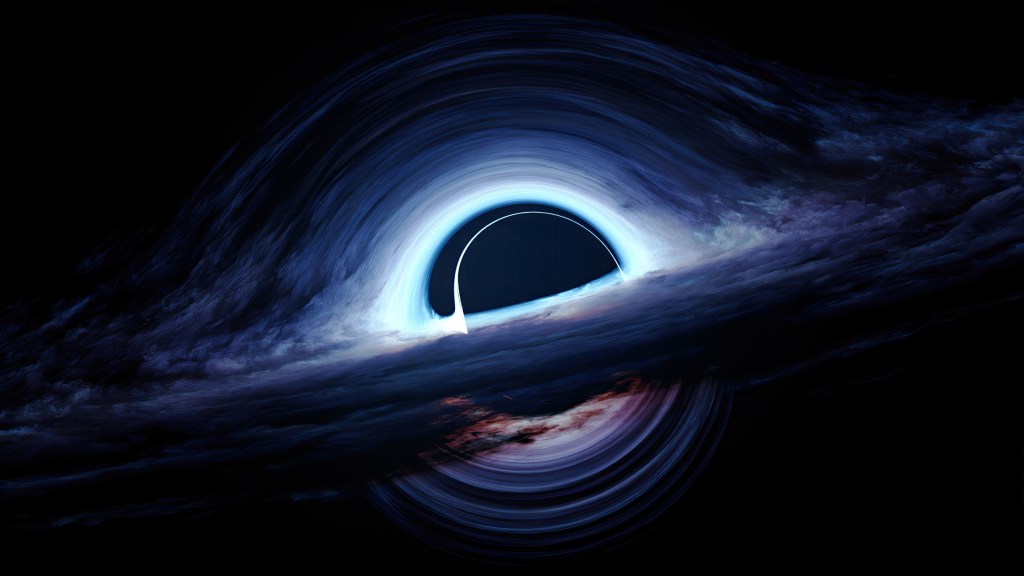


 in Schrödinger’s equation reveals the quantum state as a complete, unified whole containing all allowable outcomes at once. Time evolution does not create new outcomes; it rotates this timeless structure in Hilbert space. This is the closest physical analogue to the timeless domain described in the main text: a completed whole from which the temporal domain renders one outcome at a time.


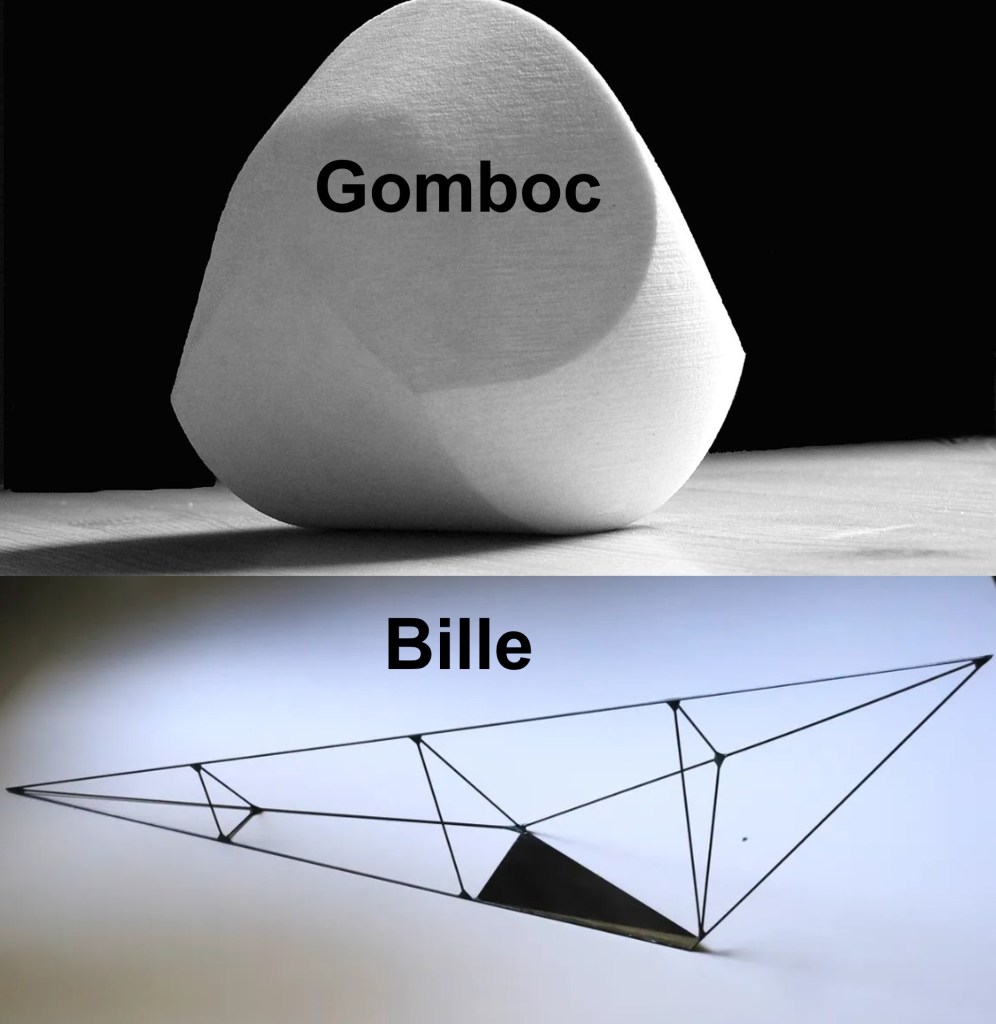
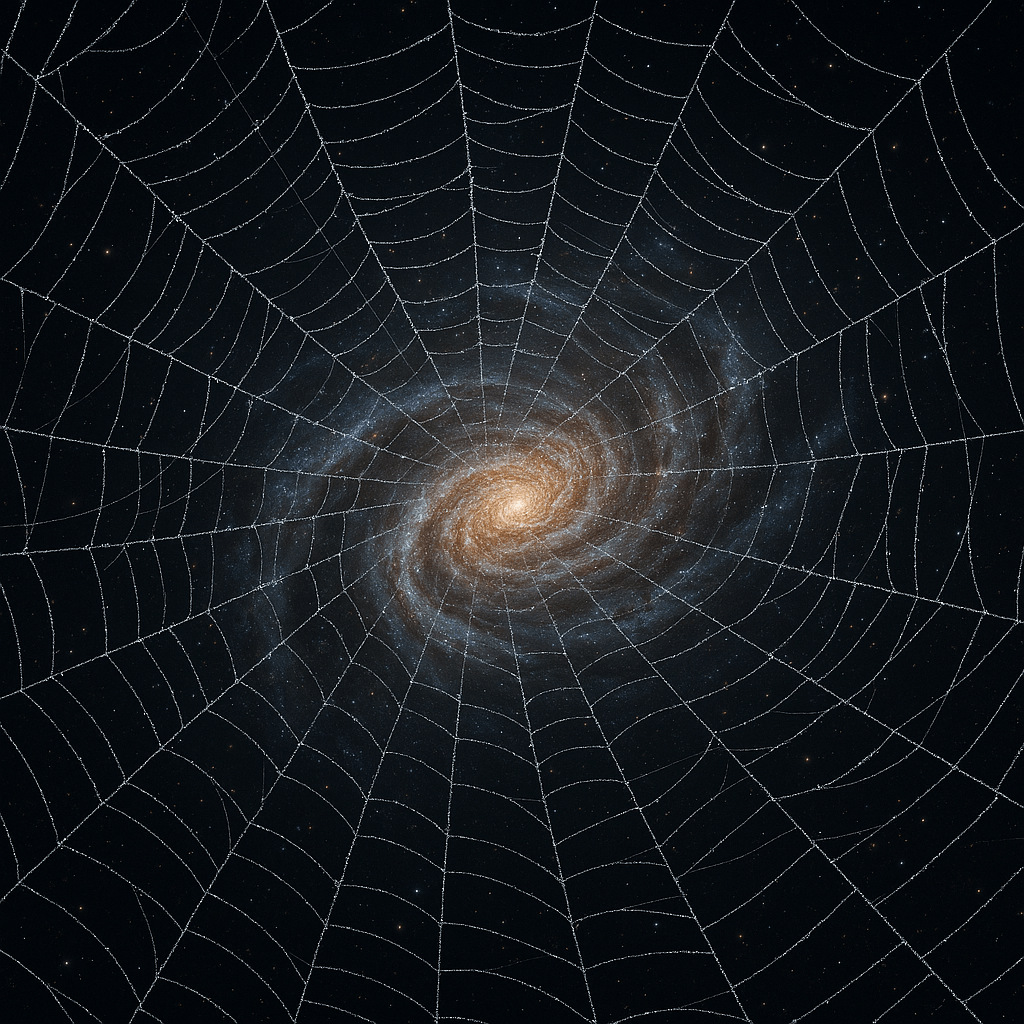
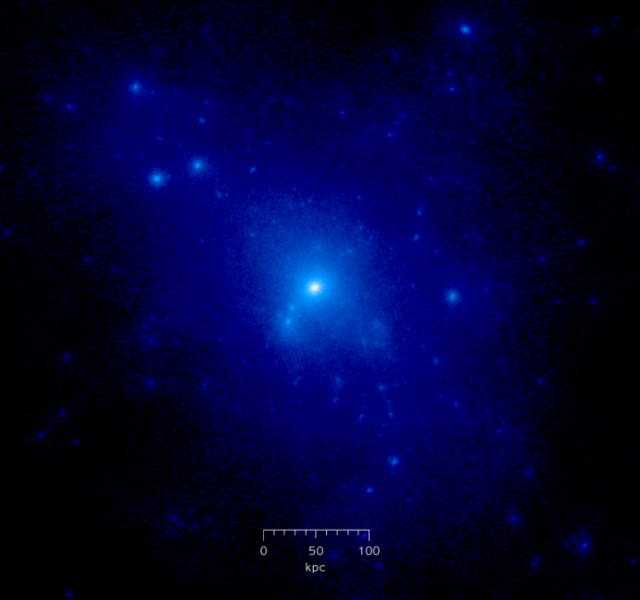
 elsToday