Curse of the Estranged

Gabriel García Márquez’s (1927–2014) One Hundred Years of Solitude is a masterpiece of magical realism; at once stoic, uplifting, comically despondent, and burdened by the fatigue of generational inheritance. Yet the novel is less an invention of imagination than a genealogical metaphor of memory, familial hope, and civilizational rise and fall. It rises like a sanctuary built from familiar tablets: the Bible, Cervantes, Voltaire, Tolstoy, Proust, Faulkner, Joyce, Steinbeck, and Borges. Each echo resounds through the Colombian fictional town of Macondo, transforming it into a mythic stage where memory, estrangement, and loneliness endlessly repeat.

From the very first pages, Márquez threads this cycle with solitude: literally. Including the title, the word appears fifty‑two times in the century‑long history of Macondo and the Buendías. This repetition carries a biblical resonance, binding the family of protagonists and antagonists alike to a penitential tether, chained to their founding dynasty.

In Spanish, soledad is semantically broader than its English counterpart. It signifies estrangement and alienation, being cut off from community, intimacy, or history, even exiled. Yet it also carries the weight of aloneness and solitude: quiet, contemplative, existential. Both registers coexist, and the Spanish reader does not have to choose.

For the English reader, however, the word disconnects, pulling them towards a definition that resists the narrative. The translator, and likely Márquez himself, kept this tension to force meditation not only on the word but on the characters’ purgatory. The Buendías are lost in their obsessions, unable to connect to those around them. In the first half of the book, solitude leans toward estrangement and alienation; by the latter half, it transforms into aloneness, as the Buendías begin to accept their fate. The family lives together in their sanctuary but they live their lives separate and alone. In its final use, the meaning retreats back to estrangement and collective dissolution, a history erased, trapped in a myth of their own making: “because races condemned to one hundred years of solitude did not have a second opportunity on earth.”

Márquez saturates the Buendía saga with biblical archetypes, weaving Genesis, Exodus, Revelation, and Marian purity into the fabric of Macondo: an Eden where death was alien, maturing into purgatory, then the Flood, and finally apocalypse. José Arcadio Buendía, the founder, is Adam and Noah at once, naming the world yet cursed by forbidden knowledge. “The earth is round, like an orange,” he declares, signaling a lifelong obsession with the metaphysical and the scientific. His wife, Úrsula Iguarán, is Eve and Sarah, burdened by genealogy and the fear of incest as original sin, a fear that culminates in the pig’s tail. Melquíades, the gypsy prophet, is Elijah and Daniel, his parchments the scripture of Macondo. The saga culminates in apocalyptic imagery: four years of rain, a final wind of destruction, Revelation retold as estrangement and erasure: endless solitude.

But Márquez’s tablets of echoes reach further, extending beyond scripture into the canon of world literature. The novel from the first pages breeds familiarity with the reader. One Hundred Years of Solitude is less a solitary invention than a refracting of the great books through Macondo’s myth. Its pages carry the shadows of Ovid’s transformations, Homer’s wanderings, Cervantes’ absurd quests, Kafka’s fate, Borges’ magic, and Proust’s memory; a literary inheritance reborn in Macondo’s myth.

These echoes form the very foundations of the narrative, opening into critiques of power, class, and the absurdity of the human condition. They expose an overreliance on human appetites; sexuality, incest, adultery, compulsion; that drive the fate of the family. The Buendías cannot conquer their world or their desires. Noble beginnings collapse into a fated Sartrian No Exit. And in the end, the Buendías’ saga dissolves into futility, their century of solitude reduced to the bitter irony that “wisdom was worth nothing if it could not be used to invent a new way of preparing chickpeas.”

Graphic: Gabriel Garcia Marquez by Jose Lara, 2002. Flickr
The Art of Growing Without Burning Out: A Realistic Guide to Sustainable Self-Improvement

(Note: The following is a guest post by Emilia Ross. She is a life coach who specializes in helping individuals navigate their personal and professional lives. Visit her site at Schedule-Life.com)

TL;DR

Self-improvement isn’t a sprint; it’s a system. Focus on progress over perfection, rest as a form of discipline, and build structures that sustain growth instead of draining it. Below you’ll find a mix of checklists, tables, and insights to help you evolve without self-destructing.

Why Self-Improvement Sometimes Backfires

Let’s face it: the culture of constant optimization can turn even the most grounded person into a restless machine chasing “better.” Motivation spikes, then collapses. Rest feels like regression. Sound familiar?

That’s because burnout is often disguised as dedication. Sustainable personal growth demands balance — between doing and being, striving and stillness.

Quick Reference Table: Burnout vs. Balanced Growth

DimensionBurnout ModeBalanced Growth Mode
Energy UseConstant output with no recoveryAlternates exertion and rest intentionally
Goal DesignPerfectionism & endless listsDefined milestones and review pauses
Emotional StateIrritable, anxious, detachedCurious, reflective, emotionally steady
Feedback LoopValidation-seekingLearning-oriented
Core Belief“I must do more.”“I can do better sustainably.”

The Core Mindset Shift

Think in systems, not goals. Systems (habits, environments, routines) reduce decision fatigue and preserve energy. A system can include:

  • Morning ritual to anchor focus
  • Sleep/wind-down hygiene
  • Scheduled reflection every Sunday
  • Weekly “digital detox” hour

Resources like Evernote can support structured consistency — just don’t let the tool become another task.

Self-Improvement Without Overwhelm: Mini-Checklist

  1. Define one “north star” outcome — not ten micro-goals.
  2. Design micro-habits that take <10 min (e.g., journaling one line).
  3. Schedule recovery as non-negotiable.
  4. Rotate focus — physical → mental → social → creative.
  5. Reflect weekly: What worked? What felt forced?
  6. Reassess quarterly — evolution beats escalation.
  7. Celebrate plateaus; they’re proof of consistency.

Use free habit-tracking tools like Loop Habit Tracker or community boards on Coach.me to visualize patterns.

FAQ

Q: Isn’t taking breaks just procrastination?
 A: Not if it’s deliberate. Strategic rest prevents cognitive depletion — the silent killer of motivation.

Q: How do I know I’m improving at all?
 A: Track lagging indicators (energy, sleep, joy) instead of vanity metrics like hours worked.

Q: What if I lose momentum?
 A: Adjust, don’t abandon. Momentum dips signal recalibration, not failure.

Q: Can structure kill creativity?
 A: Only rigid structure. Think of it as rhythm — predictability that frees mental space.

How-To: Build a Sustainable Growth Loop

  1. Audit your baseline. Where do your time and attention go? Try a week with RescueTime.
  2. Identify friction points. Which habits drain vs. feed you?
  3. Prototype a single change. Treat habits like experiments.
  4. Automate stability. Use reminders, not willpower
  5. Review outcomes monthly. Journal with prompts like “What made me feel lighter this month?”
  6. Iterate. Drop what doesn’t serve. Multiply what does.

Education as a Catalyst for Growth

Continuous learning doesn’t just sharpen skills — it deepens self-trust. Formal education can act as structured self-improvement when balanced with life’s demands. Earning a degree can enhance career mobility, improve confidence, and create networks that accelerate opportunity.

For those balancing work and growth, an online degree offers flexibility without losing rigor. You can learn more about programs that strengthen competencies in systems, networking, scripting, and data management — particularly useful if cybersecurity or IT leadership is part of your professional evolution.

Spotlight Product: Calm’s Daily Move

Integrating physical and mental alignment boosts sustainable growth. Apps like Calm’s Daily Move combine micro-workouts with mindfulness cues — five-minute sessions that regulate your nervous system, not overclock it.

Conclusion

Self-improvement that lasts feels quiet, not frantic. It’s a slow accumulation of small, reversible experiments that expand capacity rather than deplete it. Growth done right feels like breathing: effort, release, repeat.

Beringer Knights Valley Cabernet Sauvignon 2019

Cabernet Sauvignon from Sonoma County, California

Cabernet Sauvignon 87%, Merlot 8%, Cabernet Franc 2%, Malbec 2%, Petit Verdot 1%

Purchase Price ~$40 (Gift)

James Suckling 94, Wine & Spirits 92, Robert Parker 90, ElsBob 91

ABV 14.5%

A dense deep ruby with a pale red rim. Full-bodied wine with aromas of cherries, blackberries, with hints of lavender and spice. On the palate, approachable tannins, crisp acidity, and beautiful long finish. A wine made to enjoy with ribeyes and filets.

An excellent fine wine at a slightly elevated price. The wine is hard to find but Beringer still offers it for sale on their website for $24 (half bottle).

Trivia: Knights Valley, originally known as Mallacomes Valley, was granted to José de los Santos Berryessa by the Mexican governor in 1843. In 1853, Thomas B. Knight, a native of Maine and a veteran of the Bear Flag Revolt of 1846, purchased much of Berryessa’s ranch. Knight renamed it Rancho Muristood and planted vineyards, fruit trees, and wheat. Mallacomes Valley gradually became known as Knights Valley. After Knight’s death in 1881, the property passed through numerous hands, and much of the land reverted to small farms and cattle ranches. By the mid‑20th century, viticulture returned when Beringer bought large tracts of land in the valley and initially focused on Cabernet Sauvignon and other Bordeaux varietals. They released their first Knights Valley wine in 1974.

Galactic Emptiness

I like the quiet.

From the dark, an enigmatic mass of rock and gas streaks inward. Discovered by the ATLAS telescope in Chile on 1 July 2025, it moves at 58 km/s (~130,000 mi/hr), a billion-year exile from some forgotten, possibly exploded star, catalogued as 3I/Atlas. The press immediately fact-checks then shrieks alien mothership. Harvard’s Avi Loeb suggests it could be artificial, citing its size, speed: “non-gravitational acceleration”, and a “leading glow” ahead of the nucleus. Social media lights up with mothership memes, AI-generated images, and recycled Oumuamua panic.

Remaining skeptical but trying to retain objectivity, I ask; is it anything other than a traveler of ice and dust obeying celestial mechanics? And it is very difficult to come up with any answer other than, no.

NASA’s flagship infrared observatory, the James Webb Space Telescope (JWST) spectra show amorphous water ice sublimating 10,000 km from the nucleus. The Hubble telescope resolves a 13,000-km coma (tail), later stretching to 18,000 km that is rich in radiation forged organics: tholins, and fine dust.

The “leading glow” is sunlight scattering off ice grains ejected forward by outgassing. The “non-gravitational acceleration” is gas jets, not engines. Loeb swings and misses again: ‘Oumuamua in 2017, IM1 in 2014, now this. Three strikes. The boy who cried alien is beginning to resemble the lead character in an Aesop Fable.

Not that I’m keeping score…well I am…sort of. Since Area 51 seeped into public lore, alien conspiracies have multiplied beyond count, but I still haven’t shaken E.T.’s or Stitches’ hand. No green neighbors have moved next door, no embarrassing probes, just the Milky Way in all its immense, ancient glory remaining quiet. A 13.6-billion-year-old galaxy 100,000 light-years across, 100–400 billion stars, likely most with host planets, and us, alone on a blue dot warmed by a middle-aged G2V star, 4.6 billion years old, quietly fusing hydrogen in the Orion Spur, between the galaxy’s Sagittarius and Perseus spiral arms.

No one knocking. But still, I like the quiet.

An immense galaxy of staggering possibilities, where the mind fails to comprehend the vastness of space and physics provides few answers.  The Drake Equation, a probabilistic 7 term formula used to estimate the number of active, communicative extraterrestrial civilizations in the Milky Way galaxy yields an answer of less than one (0.04 to be exact) which is less than the current empirical answer of 1, which is us on the blue dot.

For the show me crowd here’s the Drake Equation N = R* × f_p × n_e × f_l × f_i × f_c × L and inserting 2025 consensus for the parameters: Two stars born each year. Nearly all with planets. One in five with Earth‑like worlds. One in ten with life. One in a hundred with intelligence. One in ten with radio. A thousand years of signal. And the sum is: less than one.

For the true optimist let’s bump up N to 100.  Not really a loud party but enough noise that someone should have called the police by now.

No sirens. I like the quiet.

But now add von Neumann self-replicating probes traveling at relativistic speeds, one advanced civilization could explore the galaxy in 240 ship-years (5,400 Earth years). A civilization lasting 1 million years could do this 3000 times over. Yet we see zero Dyson swarms, zero waste heat, zero signals. Conclusion: Either N = 0, or every civilization dies before it advances to the point it is seen by others. That leaves us with a galaxy in a permanent civilizational nursery state, or existing civilizations have all died off before we had the ability to look for them, or we are alone and always have been.

Maybe then, but not now. Or here but sleeping in the nursery. I like the quiet.

But then I remember Isaac Asimov’s seven‑novel Foundation saga. The Galactic Empire crumbles. Hari Seldon’s psychohistory predicts collapse and rebirth. The Second Foundation manipulates from the shadows. Gaia emerges as a planet‑wide mind. Robots reveal they kept it going: Daneel Olivaw, 20,000 years old, guiding humanity. And the final page (Foundation and Earth, 1986) exposes the beginning: Everything traces back to Earth. A radioactive cradle that forced primates to evolve repair genes, curiosity, and restlessness. We are radiation’s children. We didn’t find aliens. We are the aliens.

We are the cradle. We are the travelers. I still like the quiet.

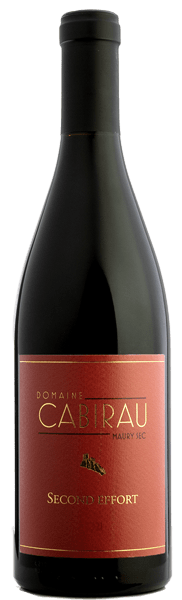
Domaine Cabirau Maury Sec ‘Second Effort’ 2021

Red Blend Other from Languedoc-Roussillon, France

62% Grenache, 38% Syrah

Purchase Price: $14.00

Jeb Dunnuck 94, Rober Parker 90-93, ElsBob 92

ABV 14.5%

An opaque ruby colored wine, medium-full bodied, with powerful aromas of black fruit and pepper. Red berries on the palate with a wonderful long balanced finish.

An excellent fine wine at a ridiculous price. Current pricing ranges from $22-28.

Trivia: In the 12th century, Languedoc became the epicenter of the Cathar movement: a dualist Christian sect deemed heretical by the Catholic Church. Their beliefs challenged ecclesiastical authority and rejected materialism outright.

The Cathars held that a benevolent God created the invisible, eternal realm of spirit, while a malevolent demiurge, often equated with Satan, crafted the physical world. In contrast, Gnostic traditions dating back to Plato portrayed the demiurge not as evil, but as ignorant: a blind artisan who shaped the material realm without awareness of the higher divine source. For the Cathars, however, the true God was pure and transcendent, wholly uninvolved in the corrupt domain of matter. The physical world, including human bodies, was a prison of suffering, designed to entrap divine sparks of life: fallen souls of lost virtue, anchored in flesh.

For the Cathars, the goal was not to purify Earth but to escape it: to transcend flesh and return to its spiritual source. Their sole sacrament, the Consolamentum, was a spiritual baptism liberating the soul from the material world, often performed at death’s door. Readings from the Gospel of John, with emphasis on light and spirit, were central to this rite.

Their beliefs echo Socrates in the 5th century BC, who taught that man’s highest task was to keep his soul bright and shiny. Death, for Socrates, was not an end but a door to a new beginning in a higher realm of destiny for the safe-guarded virtuous soul.

The Cathar movement was ultimately extinguished, beginning with Pope Innocent III’s Albigensian Crusade in the 13th century and continuing through the Medieval Inquisition into the mid-14th century. Through the efforts to stamp out the sect it is estimated that between 200,000 and 1 million adherents were killed by hanging, burning, or other brutish methods. Raphael Lemkin, who coined the term genocide in 1944 to describe Nazi atrocities, recognized in the Cathar extinction a grim precedent: a spiritual lineage extinguished by fear that invisible truths might reshape visible order.

Centuries later, Deists such as American Revolutionary figures Washington, Jefferson, and Franklin embraced a belief in a benevolent Creator who did not intervene in human affairs. Like the Cathars and Socrates, they emphasized spiritual virtue over dogma, without dualist cosmology. The American Founders vision of divinity was rational, moral, and benevolent, interested in virtue, yet non-interfering in the affairs of man.

The Long Way

By 1881, literature was shifting, Realism’s clarity giving way to Modernism’s psychological fog. Henry James pioneered the transformation, publishing what many hailed as his masterpiece and others found nearly unreadable. He moved from the crisp windows of Daisy Miller and Washington Square, where social dilemmas are transparent, into the labyrinth of The Portrait of a Lady, a slow, meandering narrative that tested patience to the point of exasperation. James stretched his scenes into long psychological dramas, shadowed by melancholy, lingering on minutiae rather than decisive events. To admirers, this was a profound exploration of consciousness, to detractors, a soporific feast of abstraction.

Where James’s Portrait is a punishing fugue of memory and angst, a darkness at the edge of noon, Proust’s Swann’s Way (1913) offers a sensual slow dance of lush detail, playful childhood games, and adult desire. In Combray, the family had two ways to take their walks: the short way and the long way. The short way was familiar, contained, offering scenery but little transformation. The long way was expansive, expressive, full of detours and revelations. In Swann in Love, the same pattern unfolds: the first half is Swann’s descent into desire, the short way of immediacy; the second half is his struggle to free himself, the long way of disillusionment and reflection. For Proust, the long way is where life’s lessons are held. Meaning is not found in shortcuts but in detours, delays, and the endurance of memory. The long way is the design of his art: winding detours that illuminate the search for lost time.

Wilde enters here as counterpoint. Where Proust lingers in digressive glow, Wilde sharpens language into bite. His wit distills the same metaphysical concerns: beauty, desire, memory, decay, into crystalline aphorisms. Wilde’s sentences are daggers wrapped in velvet, each polished to a point. If Proust is the cathedral of memory, Wilde is the mirror that cuts as it reflects. The Picture of Dorian Gray dramatizes the peril of desire and the corruption of beauty; themes Proust refracts through memory and longing. But Wilde compresses the ineffable into epigram: glow against bite, long way against short.

Cinema, now, becomes the continuance of these styles. Wilde’s paradox and Proust’s memory echo in films as diverse as Spectre (2015), No Time to Die (2021), and Gosford Park (2001). In Spectre, Madeleine Swann, a psychologist whose very name invokes Madeleine tea cakes and Swann’s Way, probes Bond’s past like Proust probing consciousness, turning trauma into narrative. In No Time to Die, desire and mortality entwine, echoing Proust’s meditation that “life has taken us round it, led us beyond it.” And in Gosford Park, Sir William McCordle brushing crumbs from a breast, Swann brushing flowers from a bosom, gestures lifted from Proust’s sensual triggers, collapse time into desire, while Altman’s upstairs-downstairs satire mirrors Wilde’s social wit. These films remind us that both the glow and the bite, the long way and the short, remain inexhaustible. The short as overture, the long as movement. One as a flash of life, the other as the light of experience.

James stretches narrative into labyrinthine difficulty. Proust redeems patience with memory’s illumination. Wilde polishes language into paradoxical brilliance. Chaplin, in Modern Times (1936), adds another metaphor: the gears of industry grinding human life into repetition. Yet even here, the Tramp and the Gamin walk off together, the long way, not the shortcut; suggesting resilience and hope. Between them, Modernism oscillates: fog and clarity, glow and bite, labyrinth and mirror, machine and memory. Meaning is elusive but never absent. It waits in the folds of memory, in the flash of wit, in the shadows of desire, in the detours of the long way, ready to be revealed.

Through memory’s fragments, along the winding road of joy and grace, we taste again the sweetness of love, the timelessness of innocence, and life’s inexhaustible richness.

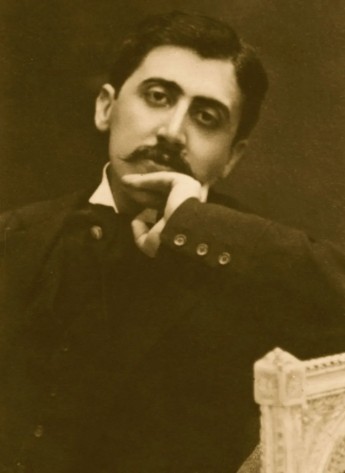
Graphic: Marcel Proust, Hulton Archive/Getty Images.

Bieler Pere et Fils La Jassine Cotes du Rhone Villages Rouge 2022

Rhone Red Blends from Cotes du Rhone Villages, Rhone, France

Grenache 60%, Syrah 40%

Purchase Price $14.99

James Suckling 90, ElsBob 91

ABV 14.5%

A medium purple with tawny rim and slightly opaque. A medium-full bodied wine with aromas plums, chocolate, and a whiff of tobacco. On the palate the tannins are easy and very well balanced with the acidity. A very nice finish. We enjoyed this with soft cheese and hard salami. Delicious.

An excellent fine wine at a very comfortable price. Current prices range from about $15-18.

Trivia: The Côtes du Rhône Villages appellation was officially established in 1967 to recognize superior-quality wines from select villages in the southern Rhone Valley. These wines rank above standard Cotes du Rhone but below Cotes du Rhone Crus (such as Chateauneuf-du-Pape).

The idea of distinguishing higher-quality Rhone valley wines began circulating in the 1950s. By 1953, five communes: Cairanne, Gigondas, Chusclan, Laudun, and Saint-Maurice-sur-Eygues were identified for their exemplary potential. Wineries could append their village name to the label if they met strict production standards, minimum alcohol levels of 12.5%, and grape composition of at least 50% Grenache, and 20% Syrah.

Today, 21 villages are allowed to include their name on the label, while others use the generic “Côtes du Rhône Villages” designation. Bieler Pere et Fils chose not to list their village, but their La Jassine Cotes du Rhone Villages Rouge 2022 originates from Valreas, located in the northern reaches of the Southern Rhone Valley.

On the label is rooster or classic French coq: a symbol of traditional farming, terroir authenticity and rural pride.

Monroe Doctrine

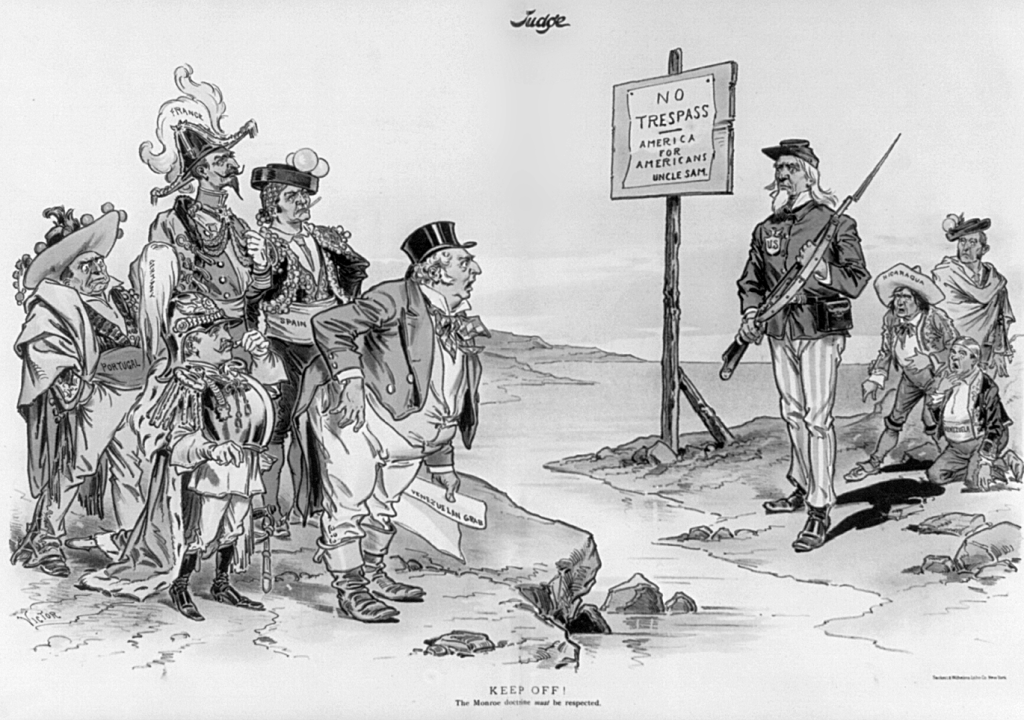
In 1823, President James Monroe issued what became known as the Monroe Doctrine, warning European powers against further colonization or interference in the New World. Though never codified into law or treaty, the doctrine became a guiding principle of U.S. foreign policy, invoked and reinterpreted by successive administrations to assert American influence in the hemisphere. Theodore Roosevelt expanded it, Barack Obama’s administration declared it obsolete, and Donald Trump revived its assertive tone. Its malleability is hailed by some as its strength, denounced by others as its greatest flaw.

The Monroe Doctrine became a symbolic fence around the Western Hemisphere, a firewall against nineteenth‑century imperial powers. Over the next two centuries, it evolved through corollaries, confrontations, and periods of dormancy. Today, in the shadow of Chinese expansion, mainly through its Belt and Road Initiative, Latin American states are drawn to twenty‑first‑century infrastructure with age‑old colonialism lurking in the background. But the Chinese buying influence in the hemisphere is aimed directly at the United States, seeking to erode its traditional dominance and reshape regional loyalties.

The Monroe Doctrine was intended to thwart enemies, potential and real, at the gate. With the exception of Cuba, it largely succeeded through the twentieth century. The 21st century now poses a test of whether the doctrine still has teeth.

If conflict with China is fated, then the United States must first secure its own backyard. The Western Hemisphere cannot be a distraction or a liability, a source of angst and trouble. Before turning its full strategic gaze toward the Middle Kingdom, the U.S. must seal the gates of the New World.

The Monroe Doctrine was written mainly by President Monroe’s Secretary of State, John Quincy Adams. It aimed to support Latin American independence movements from Spain and Portugal, while discouraging Russian influence in the Pacific Northwest and preventing the Holy Alliance: Russia, Austria, Prussia, and France, from restoring monarchs in the Americas. But the doctrine was not all sword: the United States also pledged not to interfere in Europe’s internal affairs or its colonies.

In the early 1800s, the United States lacked the ability to enforce such a bargain militarily. Britain, however, was more than willing to use its naval fleet to guarantee access to New World markets and discourage competition.

By the beginning of the twentieth century, Theodore Roosevelt invoked and expanded the doctrine, effectively making the United States the policeman of the Western Hemisphere. During the Cold War, it was used to counter Soviet influence in Cuba, Nicaragua, and Grenada.

By the 1970s the South American drug trade was declared a national security threat and the War on Drugs began with Colombia the epicenter of hostilities. In 1981, U.S. Congress amended the Posse Comitatus Act to allow military involvement in domestic drug enforcement, extending to Latin America. President Ronald Reagan’s 1986 National Security Decision Directive 221 declared drug trafficking a U.S. national security threat, authorizing military operations abroad, including in Colombia.

After the Cold War, the doctrine faded from explicit policy. In November 2013, Secretary of State John Kerry declared at the Organization of American States that “the era of the Monroe Doctrine is over,” framing a shift toward partnership and mutual respect with Latin America rather than unilateral dominance. By 2020 Colombia’s coca production had hit a new high.

Today, China’s Belt and Road Initiative, port construction and acquisitions, telecom infrastructure, and rare earth diplomacy have carved influence into Latin America and the Caribbean. In this context, the Monroe Doctrine was not asleep but, in a coma, its toes occasionally twitching.

Re-invigorating the Monroe Doctrine is not about making true allies and friends but removing vulnerabilities. The goal is not to bring these nations into the fold but to remove them from Beijing’s orbit.

By mid-2025 official statements claim that ~10% of the U.S. Navy is deployed to counter drug threats, ostensibly from Venezuela and Columbia. But fleet positioning hints at a different story. Most assets are stationed near Puerto Rico, the Virgin Islands, and Guantánamo Bay, closer to Cuba than Caracas. Surveillance flights, submarine patrols, and chokepoint monitoring center on the Florida Straits, Windward Passage, and Yucatán Channel.

This may suggest strategic misdirection. Venezuela is the declared theater, but Cuba is the operational keystone. The U.S. may be deflecting attention from its true concern: Chinese or Russian entrenchment in Cuba and the northern Caribbean.

The Monroe Doctrine began as a warning to monarchs across the Atlantic. In the late twentieth century, it morphed into a war on drugs. Today it reappears as a repurposed drug war, flickering as a warning to Beijing across the Pacific. Whether it awakens as policy or remains sleight of hand, its enduring role is to remind the world that the Western Hemisphere is not a theater for distraction but a stage the United States will guard against intrusion. In the twenty‑first century, its test is not whether it can inspire allies, but whether it can deny adversaries a foothold in America’s backyard.

Graphic: Monroe Doctrine by Victor Gillam, 1896. Public Domain.

Beginnings

A recent ScienceDaily write‑up titled “Scientists just found the hidden cosmic fingerprints of dark matter” suggests a breakthrough in the elusive substance that binds galaxies together. In reality, the study reports that Lyman‑Alpha emitters are a transient phenomenon, interesting, but nowhere near the revolutionary advance implied by the headline.

For readers uninitiated in cosmology and astrophysics, that’s a lot of jargon at once. So let’s bring it down a notch with some plain definitions.

Dark matter is the invisible mass that holds galaxies together through gravity. Without it, galaxies would fly apart. We infer its existence only because galaxies behave as they do. It makes up about 27% of the universe’s total energy density. By comparison, ordinary matter, the stuff we can see and measure, accounts for a measly 5%. Dark energy, the mysterious driver of cosmic acceleration, contributes about 68%. But that’s a story for another day.

Lyman‑Alpha emitters (LAEs) are distant, generally low‑mass galaxies that shine in Lyman‑alpha radiation: ultraviolet light produced when a hydrogen electron drops from the second energy level to the ground state (n=2 → n=1). Because this light is strongly redshifted by cosmic expansion, LAEs act as beacons of the early universe. Observing the ones implied in the opening science press headline means looking back to a time when the cosmos was less than a billion years old.

Scientists examine the clustering of LAEs across three epochs, each marking a milestone in cosmic evolution, a page from the manuscript of creation. At a redshift of 6, when the universe was about 0.9 to 1.0 billion years old, roughly 12.8 billion years ago, the first galaxies and stars were re‑ionizing neutral hydrogen, lifting the primordial fog and making the universe transparent. This period is known as the Epoch of Reionization.

The next epoch, at a redshift of 5.7 (about 100 million years later, or 12.7 billion years ago), is called the Late Reionization / Transition Epoch. Here, scientists measure how quickly the fog of neutral hydrogen dissipated and how galaxies began to cluster. Clustering serves as a proxy for the gravitational wells of dark matter, which drew in and anchored ordinary matter.

Finally, at a redshift of 3, around 11.8 billion years ago, the Post‑Reionization Epoch reveals a more mature universe with large‑scale structures taking shape. LAEs in this era trace galaxy clustering and help infer the masses of the dark matter halos they inhabit. These halos are vast, spherical envelopes of unseen matter surrounding galaxies and clusters.

With this groundwork, we return to the science press claim that researchers have found the “fingerprints” of dark matter itself. In truth, the fingerprints show no loops or swirls, no identification of what dark matter is or how it is distributed, only confirmation of what is already established. Without dark matter, galaxies would not exist. It is, in essence, a Cartesian maxim: I gather, therefore I am. Nothing more. Nothing less.

There was, however, a genuine insight. Lyman‑alpha emitters are transient, short‑lived luminous phases in galaxies that trace the framework of dark matter. The clustering function does not reveal dark matter’s nature; it just shows how rarely baryonic light, the real stuff of frogs, men, and cybertrucks aligns with gravitational tugs.

This raises a deeper question: why does dark matter clump at all, instead of remaining uniform across the cosmos? The answer lies in gravitational instability. Minute quantum fluctuations in the infant universe were stretched to cosmic scales by inflation, imprinting faint density variations, ripples in spacetime itself (if time exists is another a question for a different day). Cold, non‑interacting dark matter streamed into these wells, not merely seeking density but becoming it, deepening the imprints and laying the invisible scaffolding upon which galaxies and clusters would later rise. In turn, the growing clumps reinforced the very variations that seeded them, a feedback loop that sculpted the universe’s large‑scale structure. Quantum fractures first, dark matter responding.

And yet another knot: where did dark matter come from? If it does not interact, how could it be born from interaction? Perhaps it is not a product of the Big Bang at all. Did it exist outside the Bang, or was it a transformation from an earlier state?

Unto the spirit of dark energy, the expansive gust that stretches spacetime, accelerating the universe’s drift into an ever‑expanding horizon. If dark matter is transformation, is dark energy its continuation, or merely a phase toward dissolution?

Together they form a cosmic tension: cohesion and dispersal, gathering and vanishing. The Big Bang may not be the beginning, but only the first visible flare in a manuscript already dictated eons before the dawn.

In this reframing, baryonic matter: atoms, stars, flesh, machines, is a late arrival. Bone, blood, and silicone are ritual sparks, flaring briefly in the gravitational wells carved by dark matter and stretched by dark energy. We are not the fathers of the universe, but the children of a violent past.

Dark matter is the glue. Dark energy erases the image. We are but the punctuation; marks in a manuscript whose lines were written long before our arrival.

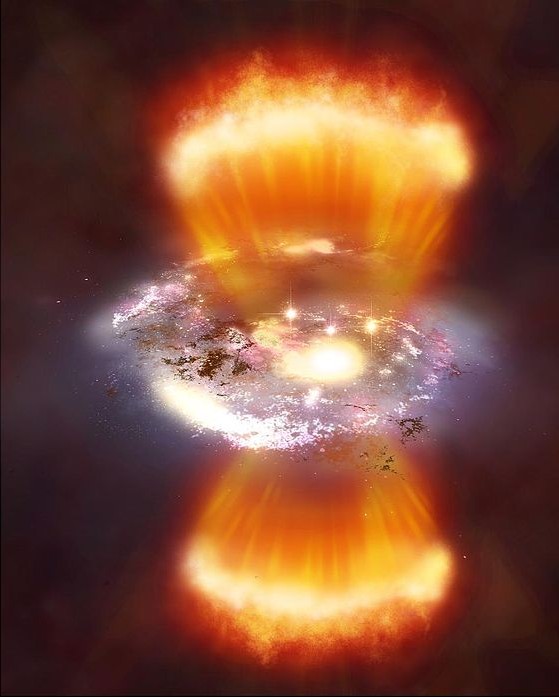
Source: …Fingerprints of Dark Matter, Science Daily, Sept. 2025. ODIN: Clustering Analysis… by Herrera et al, Astrophysical Journal Letters, 2025. Graphic: Lyman-Alpha Galaxy Up Close Illustration by M. Wiss, 2009. Public Domain

Michel de Montaigne Bergerac 2019

Bordeaux Red Blends from Southwest, France

Merlot 60%, Cabernet Franc 20%, Cabernet Sauvignon 20%

Purchase Price $16.99

Wine Enthusiast 90, Wilfred Wong 90, ElsBob 90

ABV 14%

A clear ruby to purple wine in color. A medium to full bodied wine with aromas of red and black fruits and spice. On the palate plums and cherries predominant with oak derivatives. The tannins are meaty and balanced with crisp acidity. A beautiful finish that will compliment most beef dishes.

An excellent fine wine at a very attractive price. Current prices range from $13.50-18.00.

Trivia:  Michel de Montaigne was likely the most influential philosopher of the 16th-century French Renaissance. A dyed-in-the-wool skeptic, a cantankerous crank whose motto Que sais-je? (“What do I know?”) enshrined his worldview; much like Socrates, who also claimed to know nothing. Montaigne questioned everything and taught that doubt was the only path to wisdom.

But he carried it too far: intellectually thin and logically obtuse. He believed that customs and morals were cultural artifacts, lacking any universal tether. Truth, for Montaigne, was a matter of perspective; malleable, contingent, shaped by accepted practice. One man’s cannibal was another man’s epicurean.

To anchor this relativism, he wrote: “We are, I know not how, double in ourselves, so that what we believe we disbelieve, and cannot rid ourselves of what we condemn.” A long-winded version of c’est la vie (“that’s life”), or more precisely, à chacun son goût (“to each his own”).

Experience was his shrine, but it lacked a foundation. No base of knowledge to anchor belief. A man easily swayed by his own prejudices and lack of a black and white moral code.

His philosophy of go-along-to-get-along, born of tolerance and introspection, risked becoming a prescription for annihilation, not of others, but of moral clarity and oneself. A path to accepting everything and believing nothing. A philosophy polished so smooth it reflects everything and reveals nothing.