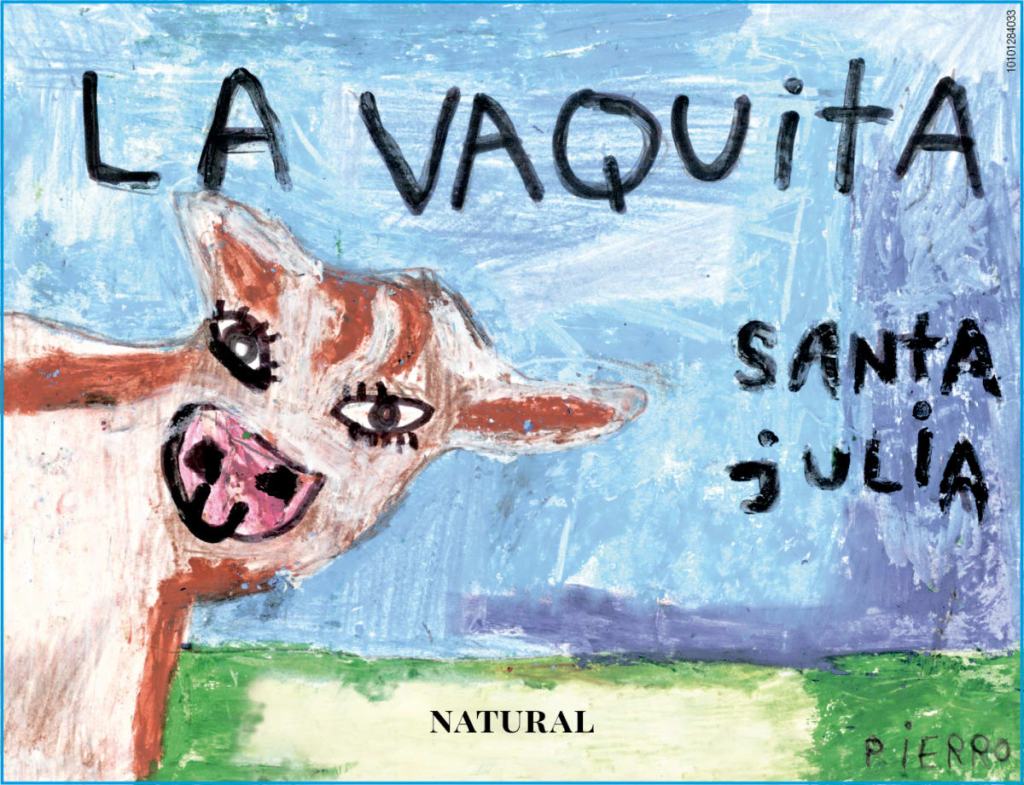
Santa Julia Natural La Vaquita Clarete 2024

Other Red Blends from Mendoza, Argentina

Malbec 80%, Torrontes 20%

Purchase Price $17.99

James Suckling 93, Robert Parker 90, ElsBob 90

ABV 13.5%

A pale ruby wine with a pink rim. Aromas of fresh cherries. Medium bodied with subtle tannins and a medium acidity that provides for a nice refreshing, but short, finish.

An excellent table wine at a remarkable price. Current price is around $20.

Trivia: Trivia: “La Vaquita” translates from Spanish to English as “the little cow.”

Cheese maker La Vaquita was established in Houston, Texas, in 1971 by Mexican immigrant María Castro.  Known for Mexican-style dairy products such as queso fresco, crema, and butter, the company began as a kitchen-scale project and eventually became Castro Cheese Company. It was acquired by Dairy Farmers of America (DFA) in 2009, and in 2025 DFA opened a second Hispanic cheese plant in Monroe, Wisconsin.

Additional trivia useful mainly on Jeopardy is that Wisconsin produces more cheese than any other U.S. state, churning out over 3 billion pounds annually. California comes in second at about 2.5 billion pounds, dominated by mozzarella production.

Basin in the Meantime

Maybe there’s nothin’ happenin’ there
Or maybe there’s somethin’ in the air  —
John Hiatt – Memphis in the Meantime

The operation in Caracas did not inaugurate a new doctrine so much as enforce an old one: The Monroe Doctrine or as the new moniker that is sweeping social media: The Don-roe Doctrine, The DDs. It demonstrated that, when the United States chooses to act in its near abroad, it can do so quickly, decisively, and without the prolonged escalation that once defined hemispheric interventions. The speed mattered less than the silence that followed.

What stretches south from the U.S. southern border is not a collection of isolated states so much as a single basin of changing fortunes. A shared space of currents and constraints where energy, food, money, people, and power circulate unevenly. In that basin, geography compresses time, stretching from long somnolence to sudden, decisive action in prestissimo. Decisions made in one port quickly reverberate into another; scarcity in one system bleeds into the next. When a major node fails, the effects do not remain local, they resonate in a loose, syncopated jazz time

The removal of Venezuela as a patron did not merely end Maduro’s dictatorship, it likely altered the flow of reality in the basin itself. What followed from adjacent confines and distant hegemons alike was not immediate confrontation but boilerplate as hesitancy or visa-versa. Borders were secured. Procedural condemnations were issued. The United Nations will hear of this! Behind the statements, positions were analyzed and reassessed. Cards were checked. No one raised. Everyone counted their chips. Everyone kept their cards, except Maduro, but no one pushed the pot.

In the meantime: the basin holds it breath, the alternatives have no luster, and time has taken on a velocity beyond the speed limits of the usual diplomatic stall. In the basin, survival at all costs no longer promotes stability of government nor docility of the populace. In the basin, the strength of will is now measured in meals, watts, and months: maybe. The Venezuela operation lasted 3 hours.

The absence of a Venezuelan military effective response was not the lack of detection of the opposing force or bribery of key personal to look the other way. It was the predictable outcome of a hollowed-out command structure confronted more attuned to loyalty rather than ability. Selective strikes against decision‑making nodes, combined with degraded communications and uncertainty about leadership status, collapsed the chain of authority before it could cohere into action. In a system likely conditioned to await orders from the top rather than exercise initiative, paralysis was the rational response. No one bucks the top…North Korea redux. A thirty‑minute operation leaves no room for deliberation; it ends before the system can decide what it is seeing. Maduro wasn’t answering his phone.

And the operation was not just the removal of a bad actor; it was also about who was watching.

The Iranian strike was never just a counter‑proliferation exercise. Reducing nuclear capability was the mechanism, not the message. The message was capability itself. It was designed to be seen not by Tehran, which already understood the risks, but by Moscow and Beijing. The flight profiles, the munitions used, the coordination, the timing, the public naming of the operation, all of it communicated U.S. reach, patience, and the ability to act unilaterally at scale without triggering uncontrolled escalation. It was deterrent by demonstration, not a declaration for further action.

The Venezuela operation carries the same scent, even if the target is less world‑ending. Different theater, different tools, same audience. There were other tells. In Moscow, state‑adjacent channels reverted to cultural filler, Swan Lake on shortwave. A gesture with a long memory. In Russian political language, it has historically marked moments of uncertainty at the top: authority suspended, clarity withheld, everyone instructed to wait. It was not a declaration, but it was not nothing either. Less foreknowledge than recognition. An acknowledgment that something irreversible was unfolding, inferred from U.S. posture rather than anything concrete.

That recognition itself would not have gone unnoticed. Intelligence services watch each other as closely as they watch targets, and awareness on one side becomes signal on the other. A brief pause, publicly attributed to weather or timing around the holidays, need not imply any hesitation. It can just as easily reflect confirmation: that inference had not translated into possible interference, that compromised channels would remain compromised, and that recognition would stay passive. In that sense, the music was not a warning, and the delay was not a feint. Both were acknowledgments that the hand had changed, and that no one intended to show their cards before the next move was made.

The unrest in Iran reads differently. Less recognition than diversion. When leverage is limited in one theater, pressure migrates to another. Iran’s internal volatility has long been a known fault line. One where agitation carries asymmetric cost. Disruption there absorbs Iranian authorities’ attention, resources, and narrative bandwidth, reducing the capacity for coordinated response elsewhere. Whether by design or exploitation, the effect is the same: consequences are diluted across theaters rather than concentrated at the point of action. Hezbollah and Hamas in the Caribbean remain isolated and neutered.

This does not require coordination to function. Systems under strain respond predictably to stress applied at their weakest seams. Iran’s unrest filled the information space with noise at precisely the moment clarity elsewhere would have been costly.

In Venezuela, the point wasn’t regime change as an ostentatious show of force or a shot across the bow. It was proof of access, intelligence dominance, and decision‑speed inside a space long assumed to be cluttered with foreign influence. The absence of a name matters. So does the brevity. So does the lack of follow‑on rhetoric, which, for Trump, is really saying something.

Regional reactions reflected this reality. The message, delivered without verbiage, was understood immediately. Except in Congress. Colombia’s troop movements were defensive and stabilizing, aimed at spillover rather than confrontation. Mexico and Colombia’s appeals to multilateral condemnation preserved diplomatic cover without altering facts on the ground. China and Russia issued ritualized objections. Entirely predictable, restrained, and notably unaccompanied by action. Iran’s rhetoric filled space where leverage was absent. Across the board, states assessed their stacks of chips and chose not to raise.

This collective hesitation revealed the deeper shift. The Caracas operation likely removed Venezuela as a structural patron and sanctuary, not just a regime. That removal matters less for ideology than for logistics. It collapses the external framework that allowed other systems: most notably Cuba, to remain in the game, even without chips.

Cuba’s predicament is not strategic; it is temporal and tactical. The island lacks indigenous energy beyond biomass, cannot sustain its grid without imported fuel, and faces chronic food insecurity dependent on foreign exchange. Its export of human capital: doctors, engineers, security personnel, once generated influence and cash, but those returns have diminished, and the population left behind is aging and shrinking. Tourism and remittances no longer provide reliable buffers. Scarcity does not need to become catastrophic to destabilize a system; it only needs to become unpredictable. Revolution is three meals away.

In this context, the familiar options narrow. Refusal to accept the obvious with re-engerized brutality can delay outcomes but the path ahead remains the same. Partial opening risks unleashing forces that cannot be re-contained. A managed transition preserves continuity but requires acknowledging mistakes and ultimately exhibiting weakness. Waiting for the irrational rescue likely recreates Ceausescu execution at the hands of an exhausted populace. Time is now a luxury. And there is no Che Guevara left to pretend this is about anything other than power.

The broader hemispheric picture reinforces this compression. Panama’s strategic assets favor quiet realignment rather than confrontation. Colombia’s incentives point toward containment. Mexico’s long‑standing safety valves, outward migration and remittance flows, have narrowed as borders tighten and returns increase. At the same time, cartel finances face pressure from heightened surveillance, financial enforcement, and disrupted logistics. When money tightens, patience evaporates. Ambiguity and neutrality become expensive.

The external powers, beyond the basin, face their own constraints. Russia’s tools in the hemisphere are limited to smoke signals, narrative, and opportunistic cyber and communication disruption; it cannot project sustained force near U.S. logistics without unacceptable risk. China’s leverage is financial and infrastructural: think Peru’s deepwater port, but money loses persuasive power when leaders weigh it against personal liability. Loans cannot guarantee immunity. Infrastructure cannot extract individuals from collapsing systems. A Berlin‑style airlift to sustain Cuba is implausible: geography, energy requirements, and visibility make sustained resupply untenable without escalation. A step that neither Beijing nor Moscow appear willing to risk.

What emerges instead is a less noisy contest. The real currency becomes safe passage for the unwanted and the management of transitions rather than bids for loyalty. Ports, telecom, finance, and migration policy, to and from the U.S., become the levers. Intelligence exploitation encourages action against cartels, rolling up networks of crime rather than staging battles.

In this environment, public speeches matter less than demonstrated capability. Respectful language toward leaders paired with relentless focus on non‑state threats: cartels, preserves diplomatic niceties while narrowing the options. The message is conveyed not through ultimatums but through persistence: neutrality becomes costly; alignment allows for tomorrows.

The western hemisphere has entered a meantime: not a moment of dramatic conquest, but a period where waiting is the most dangerous strategy. Outcomes will be shaped less by declarations than by which pressures are allowed to accumulate, and which are relieved. The Caracas operation did not end the game; it thinned the table and moved the stakes to the final table.

Chateau Pey La Tour Bordeaux 2022

Bordeaux Blend from Bordeaux, France

Merlot 83%, Cabernet Sauvignon 7%, Cabernet Franc 7%, Petit Verdot 3%.

Purchase Price $18.99

James Suckling 90, Wine Enthusiast 88, ElsBob 88

ABV 15%

A deep ruby wine with aromas of smokey fruits and cherry flavors on the palate. Full-bodied, dry, slightly acidic and tannic but balanced. A fresh short finish. Will pair well roasted beef and sharp cheese.

A very good fine wine but underwhelming and on the pricey side. This is an AOC Bordeaux, entry-level red for the producer. Current price is about $20.

Trivia: The wine estate dates to the 1700s and was originally called Clos De la Tour. In 1990 it was purchased by the Dourthe group, a major Bordeaux negociant (merchant), which expanded the original vineyards from about 62 acres to 620 acres but only about 335 acres are planted in grapes. The vineyard is roughly 95% Merlot with minor amounts of grape varieties as shown above. It produces about 85,000 cases per vintage.

Solution in Search of a Problem

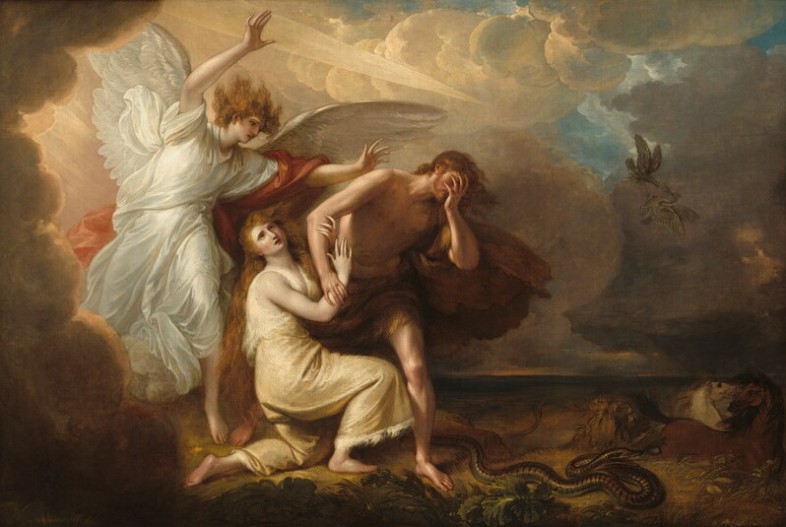
…[God] commanded him, saying: Of every tree of paradise thou shalt eat:  But of the tree of knowledge of good and evil, thou shalt not eat. For in what day soever thou shalt eat of it, thou shalt die the death. Genesis 2: 16-17.  …And the woman saw that the tree was good to eat, and fair to the eyes, and delightful to behold: and she took of the fruit thereof, and did eat, and gave to her husband who did eat. Genesis 3: 6.  …And to Adam he said: Because thou hast hearkened to the voice of thy wife, and hast eaten of the tree, whereof I commanded thee that thou shouldst not eat, cursed is the earth in thy work; with labor and toil shalt thou eat thereof all the days of thy life. Genesis 3: 17.

The command. The Original Sin. The yoke of punishment.

Within the Christian narrative, the Garden of Eden; whether read as fact or parable, is not a catastrophe that condemns humanity but a pedagogical interval in which freedom, purpose, and morality first become visible. Eden is the place where God teaches that a being with a soul cannot thrive in effortless abundance; that freedom requires choice; that purpose emerges only through effort–trial and error, consequence, responsibility, and growth. Original Sin is not an accident but the awakening of the human soul, the moment the lesson begins.

Against this backdrop, William Dembski’s (1960-present) The End of Christianity advances a far more far‑reaching claim: that God imposed suffering and death across the entire 4.5‑billion‑year history of Earth in response to Adam’s sin; an event that, even on the most generous timelines, occurred only a few tens of thousands of years ago. The difficulty with this theory is not merely its scale but its direction. Within the Christian understanding of God’s eternal now, Eden is not an isolated moment but a teaching environment whose possibilities: temptation, failure, growth, are already present to the divine mind. Dembski’s proposal, however, requires suffering to be imposed on the epochs that precede the sin itself. Adam has no predecessors whose guilt could be inherited, and the only antecedent in the narrative is God Himself. This reversal of moral sequence renders the thesis difficult to sustain.

His theodicy survives only at the level of abstraction; once the brush narrows to a single creature or a single moment, the logic collapses. A brontosaurus sinking into Jurassic mud is not a moral agent, nor is a trilobite crushed in a Cambrian landslide. To treat their deaths as the retroactive consequence of a human sin that has not yet occurred is to impose moral causality where no moral subject exists. The moment the argument touches the concrete world: an ecosystem, a predator’s hunger, a tectonic shift, it demands that nature behave like a courtroom, assigning guilt and punishment across epochs that cannot bear such categories.

Nor does the appeal to the serpent resolve the difficulty. To identify the serpent as the origin of evil is to mistake a narrative instrument for a metaphysical explanation. The question is not who tempted Adam, but how the possibility of temptation exists at all within a creation held in the eternal knowledge of God. If evil can arise only through the serpent’s intrusion or Adam’s misstep, then the divine eternity becomes strangely porous, as though God were surprised by a contingency He did not foresee. A coherent theodicy must account for the possibility of evil within the very structure of creation; reducing it to a reptile or a human choice leaves the deeper metaphysical question untouched.

Additionally, he treats death itself as a sin and the result of sin, redefining a creaturely condition as a moral indictment and thereby forcing all pre‑human death into the ledger of Adam’s guilt. Once these premises are set, the argument can proceed only by inverting causality, collapsing divine eternity into creaturely time, and assigning retroactive guilt to a world that existed long before humanity appeared.

A further difficulty remains unaddressed. If God is placed within a temporal sequence, as Dembski’s model requires, then any retroactive application of punishment collapses into divine causation. A temporal God cannot reach backward in time without becoming the direct agent of the suffering He imposes. If Adam’s sin occurs after millions of years of natural history, then all pre‑human suffering occurs before the sin; and if that suffering is nevertheless treated as punishment for Adam, the only possible source of it is God Himself. The attempt to preserve a literal reading of Genesis thus forces the blame for natural evil onto the Creator, a conclusion Dembski never acknowledges and cannot escape.

As the argument unfolds, the incoherence deepens. Dembski appeals to Rabbi Harold Kushner, who resolves the problem of suffering by limiting God’s power, and to Tony Campolo, who suggests that God voluntarily cedes power to human freedom; positions incompatible with a thesis that requires God to exercise maximal power across billions of years to impose retroactive suffering on creation. He suggests that God created a perfect world, that the Son of God somehow disrupted that perfection, and that God was then forced to rewrite the story while it was being undone. Such a view divides the Trinity into competing agents and reduces God’s eternal now to a sequence of creaturely reactions. In attempting to preserve a literal reading of Genesis, Dembski abandons the very doctrines of divine eternity, unity, and immutability that Christianity has always affirmed.

His treatment of Chronos and Kairos only compounds the confusion. He proposes that God creates in Kairos and implements in Chronos, as though the eternal act of God could be divided into a timeless planning phase and a temporal execution phase. But Kairos and Chronos are categories of human experience, not metaphysical compartments within the divine life. By splitting God’s creative act into stages, Dembski collapses divine eternity into creaturely sequence, producing a picture of God who drafts outside of time and then steps into time to carry out the plan. It is a scheme that contradicts both classical doctrine and the logic of his own argument.

The result is a proposal that feels less like a coherent theological model and more like a solution in search of a problem; an attempt to preserve a preferred interpretation rather than a conclusion arising naturally from the metaphysics he invokes. His argument depends on a literal, historical Adam whose single act introduces moral disorder into the entire cosmos, yet he never defends this premise or engages the long tradition that treats Adam as archetype rather than biological progenitor. Nor does he address the scientific evidence that humanity emerged from a population rather than a solitary pair. The entire structure stands on an unexamined foundation.

By contrast, a more coherent theological reading sees Eden as a deliberate environment constructed to teach humanity its telos. God did not create paradise for idle comfort but to reveal that abundance without purpose is not paradise; that safety without responsibility is not fulfillment; that comfort without growth is tedium. The expulsion from Eden is not divine vindictiveness but the extension of the curriculum: a life in which effort–trial and error, consequence, and responsibility become the conditions for virtue. Original Sin is not a permanent stain but the beginning of moral adulthood, an inherited condition whose guilt is washed away in baptism. God does not abandon humanity after the Fall; He immediately promises redemption and sets further boundaries to guide the soul toward righteousness.

In this light, Eden is not the site of global catastrophe but the first classroom of the human spirit. Eden and Adam are not the problem but the beginning of the solution. It is the place where freedom is defined, purpose is revealed, and the long winding road of redemption begins.

Graphic: The Expulsion of Adam and Eve from Paradise by Benjamin West, 1791. Public Domain

Freedom to Live—Telos to Thrive

Humans do not live by bread alone. Abundance may fill the stomach, but it doesn’t energize the soul. Somehow a life free of want and fear comes up lacking.

Adam, Eve and the Garden of Eden, the world’s first utopia, looked upon as a psychology experiment, failed. Failed in the sense that any utopia built only on abundance is already hollow. The question, then, is why? They were given food, water, sex beyond their basic needs. Their environment required no clothes. No predators threatened their existence. Labor and death were concepts not pondered. But in the end, it wasn’t enough. Why did it fail?

The answer, which will be explored further below, appears to revolve around the concept of purpose. A world; a utopia, that meets all needs but offers no purpose is not paradise but a gilded “behavioral sink.” A world without vocation, responsibility, sacrifice, striving, or narrative is a hollow reed: it stands, but it is filled with nothing. A world where nothing is required except obedience becomes unbearable stagnation. A world without purpose is not a meaningful, conscious life.

The Greeks called this deeper purpose to enliven the soul, telos. The purpose toward which life is directed. Without telos, abundance becomes a cage, a prison. With telos, even scarcity can be endured with dignity.

John Calhoun, ethologist, set out to study overpopulation but instead discovered something stranger: a behavioral sink: a kind of social and spiritual death. The colony did not collapse from too many mice, but from the breakdown of roles and meaning that eventually produced too few.

In his now famous “Universe 25” mouse utopia experiment, he showed that survival without purpose, at least for mice, collapses into withdrawal and extinction. Modern societies risk the same fate when they pursue utopia: abundance without struggle, surveillance as safety, and communal aid as the elimination of all negatives. The challenge is not simply to live, but to thrive; and thriving requires telos: a purpose.

John Calhoun’s experiment was designed to eliminate scarcity. Within a large enclosure, mice were given unlimited food and water, nesting material, and protection from predators. Eight mice were introduced, 4 male/female pairs, and the population grew rapidly, doubling every fifty-five days until it reached more than two thousand individuals (8 doublings): filling all available space. Yet despite this apparent freedom from want or fear, the colony eventually collapsed, seemingly due to extreme density and the breakdown of social roles. Fertility declined, social roles dissolved, abnormal behaviors proliferated, and reproduction ceased altogether. The colony died out, not because resources were lacking, but because abundance without freedom and meaning likely produced a breakdown. Calhoun coined the term “behavioral sink” to describe this collapse of social roles under conditions of density in a constrained space. The experiment suggested that abundance alone does not guarantee flourishing; without freedom, space, and above all, purpose, societies can unravel even in material plenty.

Subsequently psychologist Jonathan Freedman studied human responses to crowding and found that people did not exhibit the same collapse seen in Calhoun’s mice. Yet it is hard to look at modern societies and conclude that the behavioral sink: the collapse of social norms and the retreat from family formation, is entirely absent.

The Greeks would have recognized the deeper societal problem immediately. For them, the question was not simply how to survive, but how to live and prosper in accordance with telos: the end, the purpose, the fulfillment toward which life is directed. Aristotle described every being as having a natural telos: the acorn’s telos is to become an oak, the flute’s telos is to produce music, and the human telos is to live a life of virtue and flourishing, what he called eudaimonia.

Telos is purpose. For man it implies more than giving meaning to biological life. It suggests a dichotomy of mind versus consciousness: brain versus soul. Freedom from want and fear feeds the mind but provides nothing of sustenance for the soul.

Earlier societies understood this intuitively and built cultural codes to bind abundance to purpose. Chivalry, whether in its medieval form or its later incarnation as the English gentleman’s ethic, was precisely such a telos. It required the strong to protect the weak, but also required the weak to participate in the moral order. It paired mercy with discipline, generosity with boundaries, and honor with responsibility. Chivalry was not sentiment; it was a teleological architecture that kept abundance from becoming decadence.

The mice in Calhoun’s enclosure had food, water, and shelter, but no telos. Once density eroded their social roles, a slow downward spiral ensued. Humans in modern societies face the same paradox: welfare systems, surveillance, and engineered abundance can provide material plenty, but if they strip away telos: purpose, meaning, struggle, and virtue; all outcomes drift toward dystopia.

But if the soul is only in the domain of man, why did the mice without purpose also die? Mice perceive. They have instinct and social drives. They have memory and respond to stress. But they do not have a moral imagination or the capacity to choose meaning. A mouse in the experiment could not rebel against its environment by inventing a new one. The mice died because they reached the limits of space and mind. Social instincts, stress circuits, and behavioral roles all exploded and collapsed. They died because they were in a closed world and their minds could not adapt. They were trapped.

Eden failed not because humans are like mice. Man’s mind can adapt to a life of plenty, but the soul cannot adapt to tedium. Eden failed because man was built to struggle. Perfect conditions, total comfort, safety, and abundance lead to decline, not nirvana.

Eden and Universe 25 fail for different reasons. The mice died because they could not leave. Man was expelled from Eden because he reached for a transcendence and was not permitted. Humans were not allowed to question, seek, reach, or transcend their existence. Paradise needs struggle.

So why did an omniscient God create Eden? Probably because it was never meant to be a final state but a contrast state. A teaching moment. A world without fear, scarcity, or struggle in which the human soul could discover that comfort alone is not enough. In a paradise where every need was met, the only meaningful act was the one that revealed the nature of consciousness itself: the choice to reach beyond the enclosure. The serpent did not tempt Adam and Eve with pleasure but with becoming: “you will be like gods,” awakening a longing for agency, knowledge, and purpose that abundance could not satisfy. Their disobedience was not a failure of design but the moment in which the soul recognized that a static world cannot contain a teleological being. Eden exists in the story not as a utopia that failed, but as the stage on which freedom becomes visible and the human need for telos is revealed.This pattern is not confined to myth or laboratory. When purpose collapses, societies follow the same arc as Eden and Universe 25: abundance without telos gives way to stagnation, stagnation to withdrawal, and withdrawal to demographic decline. A people who cannot articulate why life is worth living will eventually cease to create life at all. The first sign of a civilization losing its telos is not revolution or war, but falling birthrates. The quiet demographic signature of a culture that no longer believes in its own future.

Across Europe, the United Kingdom, and increasingly the United States, fertility rates have fallen well below replacement. In Germany, Italy, and Spain, fertility hovers around 1.2 to 1.3 children per woman (2.1 is replacement level). In the UK it is around 1.5; in the U.S., about 1.6. This decline is not simply biological; it is sociological. Fertility is shaped by density, cost of living, cultural norms, and moral frameworks. Where communal support is strong: rural areas, religious communities, fertility often remains closer to or above replacement. In urban centers, where density and what might be called collective individualism dominate, fertility collapses. Declining birthrates are thus a symptom of lost telos. Families are not formed because the conditions for raising children feel untenable, and because the cultural narrative of purpose has weakened.

Chivalry once provided that narrative. It linked male strength to generational duty, female dignity to communal honor, and children to the continuity of the moral order. It gave family formation a story, not merely a biological function. When chivalry collapses, fertility collapses, not because people cannot reproduce, but because they no longer know why they should.

The paradox is sharpened when abortion policies are considered. In most of Europe and the UK, abortion is legal within the first trimester, framed as healthcare and autonomy. In the U.S., abortion remains contested but widely available in many states. Here lies the disconnect: abortion is framed as expanding individual autonomy: the freedom from unwanted obligation, while fertility decline reflects the collapse of collective freedom, the freedom to flourish and raise children. Societies expand freedom at the individual level while eroding it at the collective level. Autonomy is preserved, but telos is undermined.

To buttress declining populations, European countries and the UK have encouraged immigration. Migrants often come from regions with higher fertility rates, offsetting demographic decline and supporting aging workforces. Immigration is thus a pragmatic solution to population collapse: but it does not address the root causes: density, freedom, and telos. It is a patchwork repair, adding new blocks to a crumbling wall without restoring the foundation. The deeper paradox remains: abundance without purpose produces collapse, and immigration cannot substitute for the conditions that allow families to thrive, especially if society’s new members are supported without shared cost, shared culture, or shared telos.

Density alone does not dictate outcomes; it interacts with telos, governance, and cultural frames. Lagos, Nigeria, is one of the most densely populated and chaotic cities in the world, often described as bordering on ungovernable. Infrastructure is weak, governance is fragmented, and daily life is improvisational. Yet fertility remains high. The reason is that telos: family, lineage, and communal identity, remains intact. In Lagos, children are wealth, kinship and clan networks are survival, and religion provides meaning. Even in smothering density, purpose sustains resilience. The city may be chaotic, but it is alive.

By contrast, the homeless encampments of Los Angeles resemble Lagos in their improvisational density and lack of formal governance. Tents, makeshift shelters, and informal economies proliferate. Yet here fertility does not thrive. Rampant mental illness and drug use erode telos. The cornerstone of family, community, and purpose has collapsed. What remains is density without meaning, abundance without direction. Food programs, shelters, and aid exist, but they do not restore purpose. The result is stagnation and despair rather than resilience. Los Angeles encampments show that chaos without telos collapses into dysfunction.

Bangkok, Thailand, illustrates the opposite extreme. Governance is strong, infrastructure is orderly, and surveillance is extensive. Yet fertility has collapsed to ultra-low levels. Here, telos has been eroded not by chaos but by over-governance and modernization. Families shrink, marriage is delayed, and children are no longer seen as wealth or purpose. Bangkok epitomizes the behavioral sink in human form: density magnified by order but hollowed of telos.

These contrasts reveal the missing quadrant: a society that pairs order with telos. This was the promise of chivalry. Lagos has telos without order; Bangkok has order without telos; Los Angeles has neither. Chivalry represents the fourth possibility: order with purpose, structure with meaning, boundaries with dignity.

Together these cases sharpen the living paradox. Lagos thrives in chaos because telos survives. Los Angeles collapses in chaos because telos has dissolved. Bangkok collapses in order because telos has been eroded by governance. The lesson is clear: density is the stressor, but telos is the barrier to collapse. Where telos is strong, fertility can endure even in smothering conditions. Where telos is weak, density accelerates collapse. A utopia pursued through governance can become more dystopian than chaos if it erodes purpose. Man needs a purpose. Without it, abundance becomes nothing more than a cage: a prison with flowered curtains; with it, even hardship can be transformed into amber waves of plenty.

Urban America provides its own cautionary tale. Under Lyndon Johnson’s Great Society, HUD launched massive urban renewal programs meant to eliminate “slums.” Entire neighborhoods once vibrant with shops, churches, and homes were razed. In their place rose brutalist public housing towers like Pruitt-Igoe in St. Louis and Cabrini-Green in Chicago. Instead of dispersing poverty, these projects concentrated it vertically, creating ghettos in the sky. The architectural order stripped away human scale, while the destruction of community fabric erased telos. Where once there were family networks, small businesses, and congregations, there was now isolation, surveillance, and stigma. The result was alienation, crime, and eventual demolition. HUD’s well‑intentioned utopia became a dystopia, echoing Calhoun’s mice: abundance of shelter without freedom or telos collapses into dysfunction.

Chivalry offers a counterpoint here as well. It was a social contract, not a bureaucratic one. It preserved dignity by pairing generosity with expectation, aid with responsibility, and protection with participation. Modern welfare systems sever the relationship and keep only the transfer. The result is dependency instead of resilience, abundance without telos.

Surveillance adds another layer to the modern enclosure. In Calhoun’s experiment, the enclosure walls were the hidden constraint. For humans, surveillance plays a similar role. In China, the social credit system tracks citizens through cameras, financial records, and online behavior, with scores affecting access to jobs, travel, and services. In Europe and the U.S., facial recognition, biometric ID, and behavioral profiling are increasingly common. Awareness of being watched erodes anonymity, adds stress, and modifies behavior. Surveillance is the human equivalent of the enclosure walls. It defines the boundaries of freedom, even in abundance.

The paradox is that surveillance is justified as safety, efficiency, or order, yet in practice it adds to the stress of density, accelerating the very breakdown it claims to manage. It is the human version of the behavioral sink: not scarcity, but suffocating constraint. And more deeply, surveillance erodes telos by reducing individuals to data points, stripping away the individual dignity of purpose.

Chivalry again stands as the opposite principle: internal discipline instead of external enforcement. A chivalric society requires fewer walls, fewer cameras, fewer bureaucratic constraints, because the code itself governs behavior. Surveillance grows where virtue shrinks.

The pursuit of utopia often plants the seeds of dystopia. Calhoun’s mice dramatize this paradox, and human societies repeat it in subtler ways. Utopia promises abundance and safety, but struggle, risk, and constraint are what give life meaning and resilience. Remove them, and individuals may feel aimless. The enclosure gave plenty, but the will to live wilted. The mice could not leave, explore, or repurpose their world.

For humans, welfare states or surveillance societies may provide abundance but limit autonomy. The invisible walls matter more than the food. Collective solutions often replace organic bonds with bureaucratic systems. Parenting, community, and moral frameworks weaken when the state or collective “fixes” everything. Individuals withdraw because the frame of telos collapses. Even in abundance, awareness of being watched adds psychological weight. For mice, the enclosure was the hidden constraint. For humans, cameras and social scoring systems are the modern equivalent.

The collective aims at population-level stability, but the individual seeks personal meaning, agency, and dignity. When collective solutions optimize for averages, individuals at the margins feel alienated. The bell curve of individuality is reduced to a spike. The revolt or collapse is not irrational; it is a signal that something is not working as intended. It shows that utopia defined by the collective may not align with the individual’s need for telos. The collective optimizes for stability, the individual thrives on agency, risk, and purpose. When those needs evaporate, revolt or withdrawal emerges.

Examples abound in modern policy. Guaranteed income experiments often show that recipients reduce work hours modestly. The reduction is not usually total withdrawal; it is often fewer hours, more time for caregiving, education, or leisure. But the symbolic effect matters: when income is guaranteed, the incentive to work as necessity weakens. The “beautiful ones” of Calhoun’s mice resonate here: abundance without struggle risks withdrawal.

Food stamps provide nutrition support to low-income households, but fraud and misuse exist, and some recipients may not be in dire need but qualify through loopholes or marginal thresholds. The program can attract dependency, with households remaining on benefits long-term rather than transitioning out. Help for the needy becomes normalized as entitlement, and the boundary between “in need” and “not in need” blurs, creating resentment and undermining trust in communal solutions.

The paradox is structural: help for the individual expands freedom‑from immediate crisis, but attracts broader participation, dilutes targeting, and sometimes erodes freedom‑to flourish. Programs designed as umbrellas risk becoming enclosed boxes; constraints that reshape behavior in unintended ways. And most importantly, they risk eroding telos by reducing life to consumption and dependency rather than purpose and flourishing.

Chivalry resolves this paradox by insisting that mercy must be paired with measure. The English gentleman was gallant toward women and the lower classes, but “hard as nails” when duty required it. This duality; compassion with boundaries, is precisely what modern systems lack. They know how to help, but not how to say no. Chivalry understood that saying no is sometimes the highest form of care, because it preserves dignity and agency. All good parents know this instinctively.

The lesson is not that communal aid is bad, but that design matters. If aid is too broad, it attracts those beyond need. If aid is too narrow, it misses the vulnerable. If aid removes all struggle, it risks eroding resilience. If aid balances support with responsibility, it can rebuild freedom‑to‑flourish. The paradox is that governments often attempt to engineer away all negatives, but the outcomes drift toward fragility rather than resilience. The mice in Universe 25 were given abundance: no hunger, no predators, no scarcity. Yet the absence of struggle did not produce flourishing; it produced an unremitting, total collapse.

Humans in modern welfare states face a similar paradox. Governments try to eliminate negatives: poverty, hunger, homelessness, drug use, through programs and interventions. Yet the outcomes are mixed: dependency, loss of initiative, bureaucratic surveillance, and sometimes deeper alienation. Erase all struggle, and resilience erodes. Limited means is not the enemy; it is the forge of adaptive capacity. Without struggle and purpose, societies grow brittle and collapse. Challenges often provide purpose. When all negatives are removed, individuals may feel rudderless and adrift.

To eliminate negatives, governments also expand monitoring: drug tests, social scores, biometric IDs. This adds stress, reproducing the under‑the‑microscope effect. Policies aimed at fixing one problem can create others. Housing programs may provide shelter, yet leave mental health and community breakdown untouched, creating dependency instead of resilience. Surveillance systems are justified as safety but erode privacy and increase stress in dense populations. The balance is razor‑thin. Too much intervention suffocates autonomy; too little starves collective flourishing. The missing element is telos. Without purpose, abundance becomes dystopia.

The pursuit of utopia, removing all negatives, often produces dystopian outcomes because it confuses abundance with flourishing. Flourishing requires freedom, struggle, and telos. Utopia removes struggle, but in doing so, removes meaning. The result is collapse: the behavioral sink in mice, fertility decline and alienation in humans. The challenge is to design programs that support resilience and meaning, rather than erasing all negatives.

A moral cycle often attributed to G. Michael Hopf: “Hard times create strong men. Strong men create good times. Good times create weak men. Weak men create hard times,” encapsulates the utopia-to-dystopia paradox. Hopf’s cycle is not merely historical; it is teleological. Societies rise or fall according to the strength of their purpose.

Population decline is not linear, nor is it destiny. It is cyclical, shaped by density, freedom, and telos. When societies become too dense, when surveillance erodes autonomy, when communal bureaucracy substitutes for organic bonds, fertility and flourishing decline. Yet when density eases, when freedom is restored, when telos is rediscovered, populations rebound. History shows this rhythm: humanity has survived bottlenecks, plagues, wars, and famines, and each time rebounded when purpose was renewed.

The Greeks understood that man needs a telos, an end toward which life is directed. Without telos, abundance becomes a monkey cage; with telos, even scarcity can be endured with dignity. Calhoun’s mice remind us that survival is not about food and shelter alone. It is about freedom, meaning, and purpose.

Modern societies risk repeating the experiment when they pursue utopia as abundance or the absence of need without struggle, surveillance as safety, and communal aid as the elimination of all negatives. The paradox is that such utopian attempts often promote dystopian outcomes. The challenge is not to remove every negative, but to build an airy house on a foundation of resilience, dignity, and telos. Only then can abundance become flourishing, and only then can societies escape the behavioral sink.

Chivalry offers a final lesson: flourishing requires mercy, measure, and mettle. Mercy to lift the vulnerable. Measure to set boundaries that preserve dignity. Mettle to uphold the moral order even when it is difficult. Chivalry is not medieval nostalgia; it is a teleological architecture that binds abundance to virtue. Without such a code, abundance becomes a cage. With it, even hardship becomes a forge.

Chivalry once served as the mediating code between secular authority and sacred telos, binding worldly power to transcendent purpose. It stood in the space where kings governed and churches taught, ensuring that strength was disciplined by virtue and that mercy was bounded by responsibility. But in the modern age, this mediating role has eroded. Secular governments have expanded into moral territory, while many churches, entangled in state funding, NGO partnerships, and bureaucratic incentives, have softened their prophetic edge, echoing the language of administration rather than the guidance of the soul. When the sacred becomes an extension of the state, it can no longer offer counter‑telos; it becomes a chaplaincy to the administrative order. Money talks, and institutions drift toward the priorities of their patrons. The result is a vacuum where chivalry once stood: no moral architecture to restrain abundance, no internal compass to replace external surveillance, no code to bind freedom to responsibility.

Striving toward a vision of utopia is a failure to see that purpose, not perfection, sustains a society.

(Post‑script: Calhoun’s mice peaked at roughly 15–18 months and collapsed by about 48 months: an approximate 1/3 to 2/3 split between peak population and extinction. Universe 25 was the 25th iteration of his utopia experiments; earlier versions ended prematurely, but the behavioral patterns he observed: social breakdown under abundance and density, were consistent across his work. Scaled to humans: U.S. population is projected to crest around 2040–2080, suggesting the attempt at utopia began around Johnson’s Great Society, followed by a ~200‑year decline toward collapse (2240–2280). Strikingly, this peak falls within Isaac Newton’s own apocalyptic horizon, which he argued could not arrive before 2060. Abundance, demography, and prophecy all converge to remind us that abundance without telos has a half‑life, or at least a shelf‑life. Strangely, that also suggests that the timing of the apocalypse is of our own making: as a society the time to die is our choice.)
Time not Time

Time, life, and physics are inseparably intertwined. Remove time from our lives or our equations and we are left with a null set; a void where very little makes sense, and nothing moves forward or backwards. Birthdays, compound interest, and prison sentences lose their definitions. Einstein’s spacetime, relativity, and the absolute speed of particles all collapse if time is reduced to mere concept rather than a dimension woven into the fabric of the universe.

Time is real, yet not what we think. It is measurable, yet subjective. Physical, yet metaphysical. Created, yet transcended. It is time, and not time.

To confront this metaphysical and ontological puzzle, we must go back and consider how others have wrestled with it. In Book XI of Confessions, Augustine famously writes: “What then is time? If no one asks me, I know; if I wish to explain it to one who asks, I do not know.” He knew time intimately yet could not articulate it; a paradox of intuitive knowledge that resists definition.

For Augustine, time is the tension of the soul: distentio animi, stretched between memory, perception, and anticipation. I would go further: time is the unease of the soul, the awareness that our life is not merely sequential but weighted. Each present moment becomes a record, a catalogue of change, where memory and expectation converge upon the ubiquitous now.

From this knotty discomfort, Augustine turns to consciousness. We do not measure existence as an external construct, nor as Einstein’s spacetime, but hold past, present, and future together in awareness. This is the soul’s way of ordering experience: a catalogue of change. An AI approaches memory similarly; not as a flowing timeline but as indexed facts retrievable when relevant. What for humans is the soul’s ledger of experience, for AI is a ledger of durable notes. And yet both remain finite catalogues.

Augustine presses further: God transcends even this. For us, awareness gathers past as memory and future as expectation, but God simply is: beyond sequence, beyond catalogue, beyond event. Time itself began with creation; sequence and change belong only to the created. God exists outside of it, the eternal source from which all temporal becoming flows.

Thomas Aquinas also saw time not as a substance but as a measure: the numbering of motion by before and after. Time, for him, comes into being with creation and is experienced only by mutable beings, for without change there is no succession, and without succession there is no time. Humanity lives within this flow: we need time to give shape to purpose, meaning, and becoming. But God is utterly immutable, without before or after. He does not move from past to future but exists in a timeless presence; eternity as the simultaneously whole possession of life. All times are present to Him at once, not as a sequence but as a single, perfect act of being.

Pope Benedict XVI, following Augustine and Aquinas, insisted that eternity is not endless time but timeless presence. To bind God within sequential time would reduce Him to a creature among creatures. God does not foresee as a prophet would; He simply is, in relation to all times.

This ‘eternal now,’ or what Boethius calls the ‘eternal present,’ expresses his argument that eternity is not infinite duration but the perfect simultaneity of divine presence. God’s knowledge is not ours extended indefinitely; it is categorically different. Thus, free will and an all‑knowing God are not contradictions. According to Boethius, “whatever lives in time lives only in the present,” whereas God lives in the eternal present: totum simul, the all‑at‑once‑ness of divine life.

Where Christian thought places God beyond time, the Greeks placed humanity within two modes of time: Chronos and Kairos. Chronos is quantitative time; measured, sequential, countable. It gives life structure, the frame by which we track change. Kairos is qualitative time; the opportune moment, the ripeness of action, the fullness of meaning. Chronos watches the clock; Kairos watches life. Chronos measures duration; Kairos measures significance.

Together they reveal that time is not merely a dimension we move through but a dual register of existence: one that counts our days and one that gives those days weight.

Time, from ancient philosophers and theologians to modern physicists, has evolved. Theology gives us a God of timeless presence. Newtonian time was absolute, measurable, and continuous. Einsteinian time became relative, elastic, and inseparable from space. Quantum time is probabilistic, discontinuous, sometimes irrelevant. Entanglement seems to ignore time altogether. The arc bends from time to not‑time. From time to timelessness.

If theology gives us the metaphysics of time, physics gives us its language; how time behaves, how it binds itself to matter, motion, and measurement.

The physical story begins with Newton, who imagined time as absolute: a universal river flowing uniformly for all observers. In Newton’s cosmos, time is the silent metronome of the universe, ticking identically everywhere, indifferent to motion or perspective. It is Chronos rendered into mathematics.

But Einstein suppressed that certainty. In special relativity, time is no longer absolute but elastic. It stretches and contracts depending on velocity. Two observers moving differently do not share the same “now.” Time becomes inseparable from space, fused into a four‑dimensional fabric: spacetime. Where motion through one dimension alters experience of the others. The universe no longer runs on a single clock; it runs on countless local clocks; each tied to its own frame of reference.

General relativity deepens the strangeness. Gravity is not a force but the curvature of spacetime itself. Massive objects bend the temporal dimension, slowing time in their vicinity. A clock on a mountaintop ticks faster than a clock at sea level. Time is not merely experienced; it is shaped by mass and speed. It bends under pressure. It is not the absolute we imagine.

If Newton’s time was a river, Einstein’s time is a landscape; warped, uneven, inseparable from the terrain of existence.

Yet even Einstein’s vision wanes at the smallest scales. Quantum mechanics introduces a world where time behaves less like a smooth dimension and more like a probabilistic backdrop. Particles do not trace continuous, classical arcs but inhabit shifting probability fields. Events unfold not deterministically but as clouds of possibility collapsing into actuality when observed.

And then comes entanglement; the phenomenon Einstein called “spooky action at a distance.” Two particles, once linked, remain correlated no matter how far apart they travel. Their states are not merely synchronized; they are one system across space. Measurement of one instantaneously determines the other, as if the universe refuses to let them be separated by distance or by time.

Entanglement suggests that relation is woven deeper than sequence. The universe reveals patterns of connections that seem to operate under different temporal conditions altogether.

And this loosening of temporal order is not confined to the quantum scale; it appears again, in a different register, at the largest scales of the cosmos.

The universe’s expansion gives the appearance of faster‑than‑light recession, not because objects outrun light, but because spacetime itself stretches. And in the vast reaches where dark energy dominates, the very markers of time grow thin. Beyond the realm shaped by matter, time begins to lose its meaning; dark energy becomes a kind of luminous emptiness, a region where temporality itself seems to fade.

But the universe does not remain at its extremes; the very small and the very large fold back into the ordinary world we inhabit.

And yet, when these quantum strangenesses are averaged over countless particles, when probabilities smooth into certainties and fluctuations cancel out, the world resolves once more into Newton’s calm, reassuring, continuous order. The granular becomes smooth. The uncertain becomes predictable. The timeless hints collapse back into the familiar rhythm of clocks and orbits. Newton’s universe reappears not as the foundation of physics, but as its limit; the shape reality takes when the deeper layers approach infinity.

And it is precisely at this limit that physics brushes against theology. For if entangled particles share a state beyond temporal separation, then timelessness is not merely a divine abstraction but a feature of the universe’s foundational structure. Augustine’s claim that God exists outside time finds an unexpected shadow in quantum theory: the most fundamental connections in reality are not mediated by time at all.

Where theology speaks of God’s eternal now, quantum mechanics reveals systems that behave as if they participate in a kind of physical “now” that transcends sequence. Where theology insists that God is not bound by before and after, entanglement shows us correlations that ignore the very notion of before and after.

Physics does not prove theology. But it points toward a universe where timelessness is not only conceivable but woven into the fabric of existence: an image of everything at once: totum simul, a vision that dissolves the moment we try to picture it.

Dreams

“To realize one’s destiny is a person’s only obligation.” Paulo Coelho – The Alchemist

Paulo Coelho’s (1947-Present) The Alchemist transcends from the pages of folklore through the dreams of all men of adventure, wrapped into a magical fantasy inhabiting the realm of know thy self, heal thy self, and be true to your heart. A timeless effort instructing all to follow your dreams. Desires anchored in your heart with magic flowing from believing in yourself.

The Alchemist is more than a tale of shepherds, mystics, prophets, treasure, and love, although it is all of that. It is also a parable of craft, trial, and vision. Craft in the tending of flocks, the learning of alchemy, the reading of omens. Trial in the setbacks, the labor, the desert’s unforgiving silence; struggles in the hunger, the fear, the wars of men, and the scourging, scorching winds of sand. Vision in the glimpses of truth, the covenant whispered by the soul, the horizon that calls him onward.

This parable echoes older tales, such as the Arabian fable of the Treasure in Cairo, where a man journeys far in search of riches only to discover that the treasure lies buried at home. Coelho reimagines this motif: Santiago’s pilgrimage across deserts and omens ends with the revelation that the treasure was waiting where his journey began. The outward quest becomes necessary not to find treasure elsewhere, but to transform the seeker so he can recognize the treasure within. Home is where the heart is and the heart decides the home.

A pilgrimage not only to follow one’s heart but to listen to it, to understand it. Santiago’s (the story’s protagonist) journey becomes a sermon on judgment, where each liturgical encounter; whether with King Melchizedek, the master Alchemist, or the desert itself; becomes a sacrament of revelation and growth. Coelho’s prose insists that destiny is assisted from without and whispered from within, but only for those who listen. A supernatural covenant between the soul and the cosmos.

The book’s theology is subtle yet insistent: faith is not blind obedience but a fundamental, obliging trust in the language of the world and the heart. The omens, the desert winds, the alchemy of metals; all are metaphors for the divine grammar that sustains not only existence but fulfillment. To heed them is to participate in a liturgy of creation, where every step toward one’s “Personal Legend” is an act of worship and belonging.

In this sense, The Alchemist becomes a catechism of freedom. It teaches that the sacred is not confined to temple walls but discovered in the marketplace, the caravan, the oasis. Santiago’s quest is a Eucharist of life’s experience, where the bread and wine are transmuted into courage and vision. The philosopher’s stone is not a literal artifact but the realization that the heart, when listened to, is itself the vessel of transformation. And beneath it all runs the mystery of time: not a chain of hours but a circle of presence. As Kahlil Gibran writes, “The timeless in you is aware of life’s timelessness. And knows that yesterday is but today’s memory and tomorrow is today’s dream.” Coelho’s desert is the same; its silence holds eternity; its winds carry both memory and dream. To walk through it is to learn that destiny is not deferred but always unfolding in the eternal now: Kairos versus Chronos.

Coelho plays with the Greek distinction: Chronos, the measured tick of the clock, and Kairos, the opportune, sacred moment: the right time. The novel privileges Kairos: destiny arrives when the seeker is attuned, not when the calendar commands. Dalí’s Persistence of Memory becomes a visual echo of Coelho’s dreamtime: clocks melting into landscape, recurring dreams blurring past, present, and future. Time becomes slippery because the Personal Legend is already inscribed in the Soul of the World; Santiago is not inventing destiny but uncovering what has always been written. Time is not only a circle but a marker of decisions. And Melchizedek, the King of Salem (Jerusalem) in the book says: “And, when you want something, all the universe conspires in helping you to achieve it.” Gaia unbound.

Coelho echoes James Lovelock’s Gaia hypothesis; the idea that Earth functions as a self-regulating organism. In The Alchemist, this appears as the “Soul of the World,” a spiritual force binding all beings together. Alchemy is ecology: The transformation of lead into gold becomes a metaphor for aligning with this living system. To know the Soul of the World is to participate in its balance, much like Gaia theory’s emphasis on the interconnection of all matter.

Where Lovelock is scientific and Coelho mythic, both insist that life is woven into a larger order. Yet literature also reminds us that this order is fragile: innocence fades, dreams are tested, and the heart must decide whether to yield or to pursue.

Rawlings’ The Yearling reminds us that innocence is fragile, and the loss of romantic but impractical childhood dreams is inevitable. Growing up means carrying grief with dignity, letting go, and accepting life’s new paradigm. In The Alchemist, by contrast, dreams of destiny are not relinquished but pursued. The omens and visions are invitations to act, to listen to the heart, and to follow its call. For the young in flesh, this means courage to begin; for the old in spirit, it means reflection on what was or what might have been.

To follow one’s heart is not merely to dream but to enter a covenant with the cosmos. Craft, trial, vision, and time converge into transformation, and Santiago’s pilgrimage becomes our own. The treasure is both within and without, memory and dream, Chronos and Kairos. To listen is to live, and to live is to worship. Reality becomes divinity. Amen.

Graphic: Paul Coelho by Ricardo Stuckert, 2024. Public Domain.

The Jellyfish of Mind and Being

This essay began as a passing thought about jellyfish, those umbrellas of the sea drifting in blooms, fluthers, smacks, and swarms. They have no brain, no central command, only a diffuse matrix of neurons spread across their bodies. Yet they pulse, sting, drift, eat, and spawn; all without any trace of self-awareness.

This decentralized nerve net exposes the brittleness of Descartes’ dictum, cogito ergo sum: “I think, therefore I am.” Descartes, as did Socrates before him, equated thinking with consciousness.

For Socrates, thinking was the essence of the soul, inseparable from awareness and virtue. For Descartes, thinking was the proof of existence: the cogito. For philosophers today, consciousness reaches beyond thought, defined by the raw fact of experience; the sheer presence of what is.

Philosophers and neuroscientists now separate thinking (Reasoning, problem-solving, language; although language is at minimum a bridge from brain to mind) from consciousness (the subjective “what it’s like” experience). Yet separating the two only deepens the fog, the mystery of being. A newborn may have consciousness without thought. A computer may “think” without consciousness. A jellyfish reacts but does not reflect; its life is sensation without self-awareness.

Consciousness is more than biology or electronics, a core of being rising above life, thought, and reaction. Living is not the same as consciousness. Living is metabolism, reaction, survival. Consciousness is the something extra, the lagniappe, the “what it’s like” to be. A dog feels pain without philosophizing. A newborn hungers without reflection. A jellyfish recoils from harm, detects light, adapts its behavior. Is that sentient? Perhaps. But self-aware thought? Almost certainly not.

The spectrum of awareness occupies a wide corridor of argument and reality. On one end, the jellyfish: life without thought, existence without awareness. On the other, humans: tangled in language, reflection, and self-modeling cognition. Between them lies the mystery. Anesthesia, coma, or dreamless sleep show that thought can vanish while consciousness flickers on, or vice versa. The two are not bound in necessity; reality shows they can drift apart.

Neuroscience maps the machinery, hippocampus for memory, thalamus for awareness, but cannot settle the duality. Neurons may spark and signals flow, yet consciousness remains more than electrical activity. It is not reducible to living. It is not guaranteed by thought. It is the specter of being that transcends living biology.

The jellyfish reminds us that being does not require thinking. Humans remind us that thinking does not explain consciousness. Between them, philosophy persists, not by closure, but by continuing to ask.

Perhaps the jellyfish is not a primitive creature but a reflecting pool of possibilities: showing us that being does not require thinking, and that consciousness may be more elemental than the cogito admits. The question is not whether we think, but whether we experience. And experience, unlike thought, resists definition but it defines who we are.

In the end, Scarecrow, like the jellyfish, had no brain but was deemed the wisest man in Oz.

Graphic: A Pacific sea nettle (Chrysaora fuscescens) at the Monterey Bay Aquarium in California, USA. 2005. Public Domaine

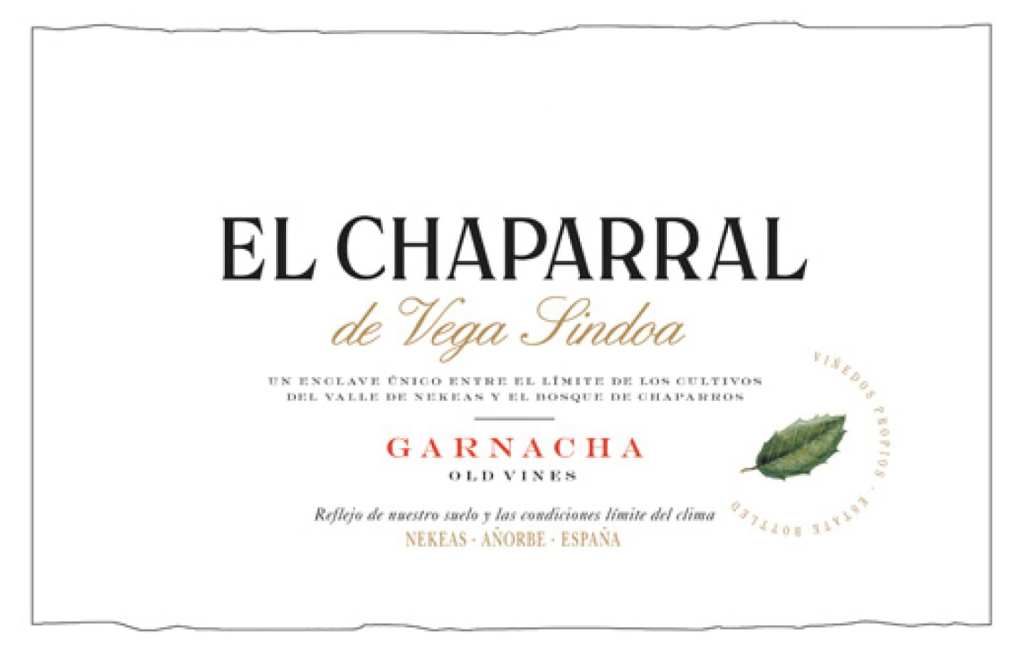
Bodegas Nekeas El Chaparral de Vega Sindoa Old Vines Garnacha 2021

Grenache from Valley of Valdizarbe, Navarra, Spain

Purchase Price $14.97

James Suckling 92, Cell Tracker 85, ElsBob 88

ABV 15%

A deep purple to garnet in color wine. Medium-full bodied with aromas of black fruit and spice. More tannic than smooth, very dry and medium acidity. A modest finish that will go well with acidic foods. Not a great sipping wine.

A very good fine wine at a fair price. Current prices range from $13-17.

Trivia: Spain’s Valley of Valdizarbe is the smallest wine subzone in Navarra, covering about 920 hectares (3.6 square miles). The valley lies directly on the Camino de Santiago (Way of St. James), where medieval pilgrims and Cistercian monks helped establish and refine viticulture traditions.

Winegrowing here dates back to the 2nd century BC, when Romans cultivated vines in the fertile valley, drawn by its strategic position as a trade route linking northern Europe with the Iberian Peninsula. By the 14th century, Valdizarbe wines were being shipped as far as the North Sea and English monasteries.

Dr. Konstantin Frank Amur 2022

Amur from Finger Lakes, NY.

Purchase Price: $34.99

ElsBob 89

ABV 12.0%

A deep red full-bodied wine with aromas mainly of dark fruits, firm tannins, and notable acidity. Overall, a rather subdued wine that is fitting for restrained foods with delicate flavors such as classic cheesecake or a chocolate mousse.

A very good table wine but overpriced. As a novelty though it is worth trying.

Trivia: Amur grapes tolerate extreme cold, surviving temperatures under      -40°F/-40°C (the cosmic duality of thermal frost). But they do require a fairly wet, subhumid to humid, growing season. They also ripen early, allowing for growing in the mid-latitudes, otherwise known as the snow-belt.

The roots contain rare compounds called oligostilbenes which have shown potential anti-inflammatory and anti-cancer properties in early studies. So don’t take any unnecessary chances: drink up.