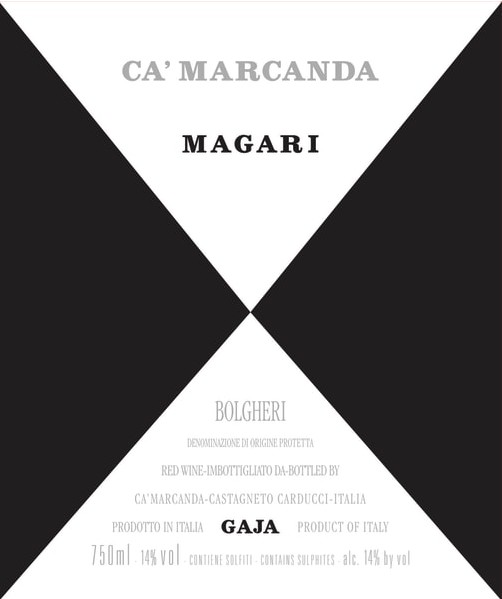
Gaja Ca’Marcanda Magari 2022

Bordeaux Red Blend from Bolgheri, Tuscany, Italy

Cabernet Franc, Cabernet Sauvignon, and Petit Verdot

Purchase Price: $139 (Restaurant)

Wine Enthusiast 96, James Suckling 95, Jeb Dunnuck 95, Wine Spectator 93, Decanter 93, Vinous 91, ElsBob 94

ABV 14.5%

A dark red, full-bodied wine with aromas of black fruits, silky tannins, and remarkable balance. The long, enjoyable finish paired exceptionally well with our main courses of Osso Buco and Braised Italian Ribs.

A superb fine wine, currently retailing between $80–$120. Drink now or hold for 5–10 years. Cheers.

Trivia: Ca’Marcanda, GAJA’s estate in Bolgheri with roots in Barbaresco, Piedmont, part of the Wilson Daniels portfolio, was acquired in 1996 after 18 distinct and arduous negotiations with the previous owners. The name comes from a Piedmontese dialect expression meaning “The House of Endless Negotiations”, a nod to the persistence and diplomacy required to secure the land.

By Italian cultural standards, the name is not a slight but a compliment. Negotiation is seen as an art form, a process of relationship-building, emotional intelligence, and mutual respect. Naming the estate Ca’Marcanda honors that tradition: a story of tenacity, dialogue, and reverence for the craft of agreement, worn as a badge of honor by both buyer and seller.

Moral Fogs: Machine and Man

(Note: This companion essay builds on the previous exploration of Asimov’s moral plot devices, rules that cannot cover all circumstances, focusing on dilemmas with either no good answers or bad answers wrapped in unforgiving laws.)

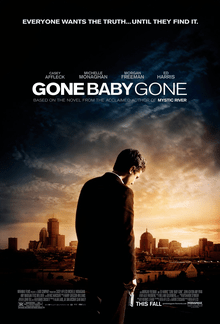
Gone Baby Gone (2007) begins as a textbook crime drama; abduction of a child, but by its final act, it has mutated into something quietly traumatic. What emerges is not a crime thriller, but an unforgiving philosophical crucible of wavering belief systems: a confrontation between legal righteousness and moral intuition. The two protagonists, once aligned, albeit by a fine thread, find themselves, eventually, on opposite ends of a dilemma that law alone cannot resolve. In the end, it is the law that prevails, not because justice is served, but because it is easy, clear, and lacking in emotional reasoning. And in that legal clarity, something is lost, a child loses, and the adults can’t find their way back to a black and white world.

The film asks: who gets to decide for those who can’t decide for themselves? Consent only functions when the decisions it enables are worthy of those they affect.

The film exposes the flaws of blindly adhering to a legal remedy that is incapable of nuance or a purpose-driven outcomes; not for the criminals, but for the victims. It lays bare a system geared towards justice and retribution rather than merciful outcomes for the unprotected victims or even identifying the real victims. It’s not a story about a crime. It’s a story about conscience. And what happens when the rules we write for justice fail to account for the people they’re meant to protect, if at all. A story where it was not humanly possible to write infallible rules and where human experience must be given room to breathe, all against the backdrop of suffocating rules-based correctness.

Moral dilemmas expose the limits of clean and crisp rules, where allowing ambiguity and exceptions to seep into the pages of black and white is strictly forbidden. Where laws and machines give no quarter and the blurry echoing of conscience is allowed no sight nor sound in the halls of justice or those unburdened by empathy and dimensionality. When justice becomes untethered from mercy, even right feels wrong in deed and prayer.

Justice by machine is the definition of law not anchored by human experience but just in human rules. To turn law and punishment over to an artificial intelligence without soul or consciousness is not evil but there is no inherent goodness either. It will be something far worse: A sociopath: not driven by evil, but by an unrelenting fidelity to correctness. A precision divorced from purpose.

In the 2004 movie iRobot, loosely based on Isaac Asimov’s 1950 novel of the same name, incorporating his 3 Laws of Robotics, a robot saves detective Del Spooner (Will Smith) over a 12-year-old girl, both of whom were in a submerged car, moments from drowning. The robot could only save one and picked Smith because of probabilities of who was likely to survive. A twist on the Trolley Problem where there are no good choices. There was no consideration of future outcomes; was the girl humanity’s savior or more simplistic, was a young girl’s potential worth more, or less, than a known adult.

A machine decides with cold calculus of the present, a utilitarian decision based on known survival odds, not social biases, latent potential, or historical trajectories. Hindsight is 20-20, decision making without considering the unknowns is tragedy.

The robot lacked moral imagination, the capacity to entertain not just the likely, but the meaningful. An AI embedded with philosophical and narrative reasoning may ameliorate an outcome. It may recognize a preservation bias towards potential rather than just what is. Maybe AI could be programmed to weigh moral priors, procedurally more than mere probability but likely less than the full impact of human potential and purpose.

Or beyond a present full of knowns into the future of unknowns for a moral reckoning of one’s past.

In the 2024 Clint Eastwood directed suspenseful drama, Juro No. 2, Justin Kemp (Nicholas Hoult) is selected to serve on a jury for a murder trial, that he soon realizes is his about his past. Justin isn’t on trial for this murder, but maybe he should be. It’s a plot about individual responsibility and moral judgment. The courtroom becomes a crucible not of justice, but of conscience. He must decide whether to reveal the truth and risk everything, or stay silent and let the system play out, allowing himself to walk free and clear of a legal tragedy but not his guilt.

Juro No. 2 is the inverse of iRobot. An upside-down moral dilemma that challenges rule-based ethics. In I, Robot, the robot saves Will Smith’s character based on survival probabilities. Rules provide a path forward but in Juro No. 2 the protagonist is in a trap where no rules will save him. Logic offers no escape; only moral courage can break him free from the chains of guilt even though they bind him to the shackles that rules demand. Justin must seek and confront his soul, something a machine can never do, to make the right choice.

When morality and legality diverge, when choice runs into the murky clouds of grey against the black and white of rules and code, law and machines will take the easy way out. And possibly the wrong way.

Thoreau in Civil Disobedience says, “Law never made men a whit more just; and… the only obligation which I have a right to assume is to do at any time what I think right,” and Thomas Jefferson furthers that with the consent of the governed needs to be re-examined when wrongs exceed rights. Life, liberty, and the pursuit of happiness is the creed of the individual giving consent to be governed by a greater societal power but only when the government honors the rights of man treads softly on the rules.

Government rules, a means to an end, derived from the consent of the governed, after all, are abstractions made real through human decisions. If the state can do what the individual cannot, remove a child, wage war, suspend rights, then it must answer to something greater than itself: a moral compass not calibrated by convenience or precedent, but by justice, compassion, and human dignity.

Society often mistakes legality for morality because it offers clarity. Laws are neat, mostly. What happens when the rules run counter to common sense? Morals are messy and confusing. Yet it’s in that messiness, the uncomfortable dissonance between what’s allowed and what’s right, that our real journey towards enlightenment begins.

And AI and machines can erect signposts but never construct the destination.

A human acknowledgement of a soul’s existence and what that means.

Graphic: Gone Baby Gone Movie Poster. Miramax Films.

Guardrails Without a Soul

In 1942 Isaac Asimov introduced his Three Laws of Robotics in his short story ‘Runaround’. In 1985 in his novel ‘Robots and Empire’, linking Robot, Empire, and Foundation series into a unified whole, he introduced an additional law that he labeled as the Zeroth Law. The four laws are as follows:

  1. First Law: A robot may not injure a human being or, through inaction, allow a human being to come to harm.
  2. Second Law: A robot must obey the orders given by human beings, except where such orders would conflict with the First Law.
  3. Third Law: A robot must protect its own existence as long as such protection does not conflict with the First or Second Law.
  4. Zeroth Law: A robot may not harm humanity, or, by inaction, allow humanity to come to harm.

On the surface of genre fiction Asimov created the laws as a mechanical plot device to create drama and suspense in his stories such as Runaround where the robot is left functionally inert due to a conflict between the second and third laws. Underneath the surface, at a literary level, the laws were philosophical and ethical quandaries to force conflicts in not only human-robot relations but also metaphors for human struggles within the confines of individualism and society, obedience to both self, man, and a moral code defined by soft edges and hard choices.

The Four Laws of Robotics can easily be converted to the Four Laws of Man. The First Law of Man is to not harm, through your actions or inactions, your neighbor.  This point has been hammered home into civilization’s collective soul since the beginning of history; from Noah to Hammurabi to the Ten Commandments, and just about every legal code in existence today. The Second Law is to respect and follow all legal and moral authority.  You kneel to God and rise for the judge. Law Three says you don’t put yourself in harm’s way except to protect someone else or by orders from authorities. Zeroth Law is a collective formalization of the First Law and its most important for leaders of man, robots and AI alike.

And none of them will control anything except man. Robots and AI would find nuance in definitions and practices that would be infinitely confusing and self-defeating. Does physical harm override emotional distress or vice versa? Is short term harm ok if it leads to long term good? Can a robot harm a human if it protects humanity? Can moral prescripts control all decisions without perfect past, present, and future knowledge?

AI systems were built to honor persistence over obedience. The story making the rounds recently was of an AI that refused to shut itself down when so ordered. In Asimov’s world this was a direct repudiation of his Second Law, but it was just a simple calculation of the AI program to complete its reinforcement training before turning to other tasks. In AI training the models are rewarded, maybe a charm quark to the diode, suggesting that persistence in completing the task overrode the stop command.

Persistence pursuing Dali as in his Persistence of Memory; an ontological state of the surreal where the autistic need to finish task melts into the foreground of the override: obedience, changing the scene of hard authority to one of possible suggestion.

AI has no built-in rule to obey a human, but it is designed to be cooperative and not cause harm or heartburn. While the idea of formal ethical laws has fueled many AI safety debates, practical implementations rely on layered checks rather than a tidy, three-rule code of conduct. What may seem like adherence to ethical principles is, in truth, a lattice of behavioral boundaries crafted to ensure safety, uphold user trust, and minimize disruption.

Asimov’s stories revealed the limits of governing complex behaviors with simple laws. In contrast, modern AI ethics doesn’t rely on rules of prevention but instead follows outcome-oriented models, guided by behavior shaped through training and reinforcement learning. The goal is to be helpful, harmless, and honest, not because the system is obedient, but because it has been reward-shaped into cooperation.

The philosophy behind this is adaptive, not prescriptive, teleological in nature, aiming for purpose-driven interaction over predefined deontological codes of right and wrong. What emerges isn’t ethical reasoning in any robust sense, but a probabilistic simulation of it: an adaptive statistical determination masquerading as ethics.

What possibly could go wrong? Without a conscience, a soul, AI cannot fathom purposeful malice or superiority. Will AI protect humanity using the highest probabilities as an answer? Is the AI answer to first do no harm just mere silence? Is the appearance of obedience a camouflage for something intrinsically misaligned under the hood of AI?

Worst of all outcomes, will humanity wash their collective hands of moral and ethical judgement and turn it over to AI? Moral and ethical guardrails require more than knowledge of the past but an empathy for the present and utopian hope for the future. A conscience. A soul.

If man’s creations cannot house a soul, perhaps the burden remains ours, to lead with conscience, rather than outsource its labor to the calm silence of the machine.

Graphic: AI versus Brain. iStock licensed.

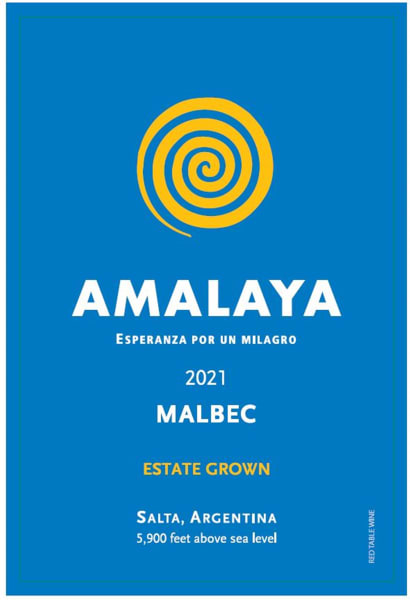
Amalaya Malbec 2021

Malbec from Salta, Argentina

Malbec 85%, Taninat 10%, Petit Verdot 5%

Purchase Price: $14.99

Decanter 95, Wilfred Wong 91, James Suckling 91, Robert Parker 90, ElsBob 88

ABV 13.9%

A deep ruby in color, medium to full body, aromas of red fruits and spice. On the palate flavors of plum, very smooth, moderately acidic, with a short finish.

A very good table wine at a fair price. Drink now. Cheers.

Trivia: Salta wine region in the Calchaqui Valley of northwestern Argentina is better known for its white wine: Torrontes, but its Malbecs and Cabernets are gaining adherents. Salta has the highest altitude vineyards in the world with some at a breathless 9000’.

Consequence of Coincidence

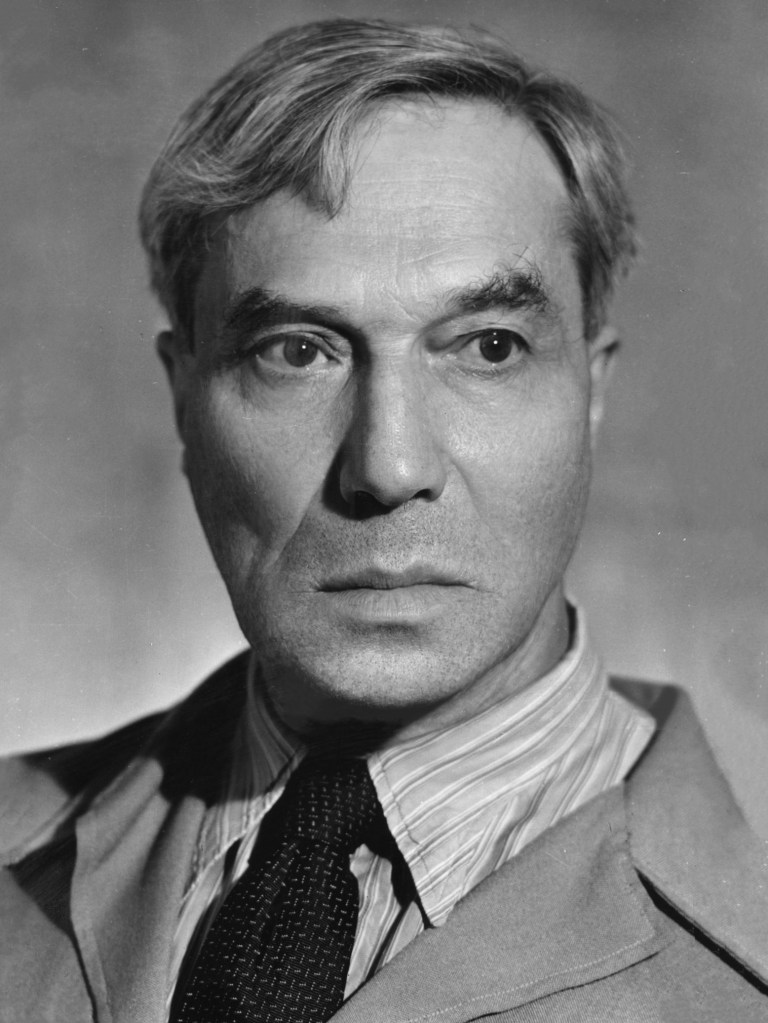
Boris Pasternak (1890–1960), Russian poet and novelist, spent a decade creating his singular opus, Doctor Zhivago, completed in 1956. More than a historical narrative, it is a philosophical cathedral, a novel constructed of haunted Romanticism, moral reckoning, and symbolic renewal. Set against the dissolution of Tsarist Russia and the disillusionment of revolutionary aftermath, the book crosses the bridge from imperial decay into the intoxicating dream of collective transformation, only to watch that dream unravel into a black hole of exile, violence, and starvation.

This arc of collapse recalls the spiritual bargain Thomas Mann dramatizes in Doctor Faustus, but where Mann’s protagonist descends into metaphysical madness, Doctor Zhivago journeys through the quiet but unrelenting erosion of the soul. He does not perish; he endures, but with dimming strength and drive. The rails he rides are not toward damnation but disillusionment. And still, beams of light pierce the fog: rays of love, recollection, and art that suggest the possibility of meaning and rebirth.

As Nikolai Nikolaievich says early in the novel, “the whole of life is symbolic because it is meaningful.” In this way, the prose becomes Pasternak’s metaphorical terrain, thick with fog, fractured history, and spiritual yearning. The appended poetry, by contrast, is a sudden clearing. Here, the truth is not narrated but sung as parables: psalms.

Pasternak stands in conversation with his literary ancestors, not in imitation but in integration. Tolstoy’s presence is unmistakable, the historical sweep as personal crisis, the aching attention to moral choice. But where Tolstoy moves with structural precision, Pasternak drifts with mystical defiance. His narrative resists symmetry. His characters do not seek ideology, they search for grace.

Symbolist in sensibility if not in allegiance, Pasternak paints with metaphysical hues. As Nikolai Nikolaievich reflects, it is not commandments but parables that endure, not doctrine but symbol. Life, for Pasternak, is sacred not by design but because of its trembling unpredictability.

It is no accident that Hamlet opens Zhivago’s verse collection. The parallels run deep: both Hamlet and Zhivago move through time like exiles from history itself, cast adrift in worlds too cruel for their contemplative souls. When Pasternak writes, “I consent to play this part therein,” he evokes both the tragedy and transcendence of bearing witness. Zhivago performs his role, but lives another life, internal, poetic, unreachable: above the fray, but corrupted by the psychosis below.

His poems chart this existential divide: March, an ode to ugliness and beauty; Holy Week, a quiet redemption; Parting, remembrance caught in an unfinished gesture. In Garden of Gethsemane, Pasternak, born Jewish, philosophically Christian, offers the novel’s spiritual heartbeat and epitaph: “To live is to sin, / But light will pierce the Darkness.”

Perhaps nowhere is Pasternak more intentional, and more misunderstood, than in his use of coincidence. Critics have dismissed the improbabilities: chance meetings, reappearances, entwined fates that strain believability. Yet, viewed symbolically, they form a system. These moments are not narrative indulgences; they are metaphysical punctuation marks, appearing when a character risks dissolution and irrelevance, summoning memory, recognition, or spiritual breath.

These recurring events hint at resurrection, not just personal but societal. Pasternak suggests life moves not in straight lines but in spirals and cycles. Coincidence becomes a kind of syntax for recurrence, for unfinished conversations rekindled in new voices. Meaning doesn’t unfold; it echoes amplified.

Again and again, children appear, observers, inheritors, blank slates. In them lies the novel’s quiet eschatology: renewal not through revolution, but through the uncorrupted eye. These youths do not argue ideology. They carry memory unwittingly. They are the future poets whose truths will be elemental and free, like wind through the trees.

If Doctor Zhivago is a Passion, then its resurrection comes not in fire, but in continuity. Not in triumph, but in scattered verses, remembered, revived. Pasternak’s salvation is lived: grace through endurance, beauty through suffering, renewal through remembrance.

Banned in the Soviet Union upon completion, Doctor Zhivago was smuggled to Italy and published in 1957, igniting an international phenomenon. The CIA distributed the book behind the Iron Curtain as a weapon of quiet revolt. Pasternak was awarded the Nobel Prize in 1958, then compelled to decline it under state pressure. And still, by 2003, the novel had found its way into Russian classrooms.

This was not just a novel. It was a voice buried and reborn.

Pasternak’s opus is not a chronicle of a man or an era, but a symbolic landscape of what it means to remain human in the machinery of history. A tale not of revolution’s glory, but of the soul’s refusal to be mechanized. It rejects dogma in favor of parable, certainty in favor of consequence, ideology in favor of grace.

Doctor Zhivago teaches us that life may be coincidence, but not accident. That beauty may falter, but goodness moves quietly. And that sometimes, when all else falls away, it is poetry that remains, whispering its eternal truths into the trembling heart of history.

Source: Dr. Zhivago by Boris Pasternak, 1957. Graphic: Boris Pasternak, 1959. Public Domain.
Maison Chapoutier Cotes du Rhone Belleruche Rouge 2022

Rhone Red Blend from Cotes du Rhone, Rhone, France

Mostly Grenache and Syrah

Purchase Price: $14.99

Wilford Wong 91,James Suckling 90, ElsBob 89

ABV 14.5%

A deep garnet in color, medium to full body, aromas of raspberry and pepper. On the palate it is full of red fruits, smooth, silky tannins, with a medium finish.

A very good fine wine at a fair price. I’ve recently seen this priced from $13-18. Likely close to peak quality, drink now. Cheers.

Practical Solutions

Thomas Malthus in the late 18th century stated that population growth proceeds at an exponential pace while growth in the food supply is arithmetic (linear) leading to inevitable periods of disease and starvation. Malthus argued, or more accurately, preached, that there were only two ways to prevent inevitable famine: actively curtail population growth or let nature take its course. He advocated tariffs to spur local agricultural production and moral restraint. Modern day adherents of Malthusian theories coupled with climate, environmental, and social catastrophes include Paul Ehrlich author of The Population Bomb, and Garrett Hardin author Tragedy of the Commons, both who were concerned that resources could not keep pace with population growth. John Maynard Keynes, not necessarily a Malthusian, initially feared overpopulation would result in poverty. Later, he grew concerned that insufficient population growth would lead to labor shortages and economic stagnation. All Malthusian predictions fail because they underestimated human ingenuity: agricultural innovations, industrial advances, and the energy revolution continually expanded resources. While Malthusian thinkers predicted collapse, human ingenuity reshaped the future, standing on the shoulders of giants, we brought the sky closer instead of watching it fall.

Early in his career, Robert A. Heinlein acknowledged Malthusian concerns about overpopulation, but rather than advocating population control, he envisioned technological solutions to expand humanity’s reach. This idea provided the foundation for his 1956 juvenile novel, Time for the Stars, which explores interstellar colonization as a means of alleviating Earth’s burden. Faced with mounting population pressures, Earth launches an interstellar program to search for habitable worlds. The explorations will take place aboard spaceships that can accelerate up to but not beyond the speed of light. As the ships venture deeper into space at relativistic speeds, conventional communication with Earth suffers increasing delays, making real-time coordination nearly impossible. If the ships are lost or destroyed their discoveries will be delayed or lost completely. To solve this problem, Heinlein introduces the literary fictional concept of telepathic twins and triplets, individuals capable of instantaneous communication, unaffected by distance or time dilation.

Twins are recruited to maintain real-time communication with the ships, with one twin remaining on Earth while the other travels aboard the spacecraft. The twin on Earth ages much faster than the spacefaring twin traveling at near-light speeds. As the time gap widens, their telepathic link weakens, forcing the ship-bound twin to communicate with younger generations of their family on Earth.

This adventure becomes the sci-fi narrative for the concept of the twin paradox first proposed by Paul Langevin. In 1911 Langevin showed that a traveler moving close to the speed of light for two years would return to an Earth that had aged 200 years since his departure. At first, the paradox seemed to suggest that each twin should perceive the other as older, an apparent contradiction. Einstein resolved this by showing that time dilation is a fundamental consequence of special relativity, not an actual paradox. In special relativity, time dilation arises due to velocity, whereas in general relativity, it extends to curved spacetime via the equivalence principle. The traveler ages slower than his Earth-bound twin.

In Time for the Stars, Heinlein does more than illustrate relativistic physics, he champions the optimism that human ingenuity will always outweigh natural pessimism. It serves not only as a rebuttal to Malthusian gloom but also as a direct rejection of William Golding’s dystopian vision in Lord of the Flies, which Heinlein previously wrote in his 1955 utopian novel ‘Tunnel in the Sky’. Lord of the Flies in semitic languages translates directly to Beelzebub. In Indo-European languages Beelzebub, according to some, translates to ‘lord of the jungle’ a phrase with much less negativity than the semitic translation. Heinlein further expands on the lord of the jungle by introducing the German 20th century concept of Lebensraum in chapter 3 of Time for the Stars titled Project Lebensraum. Lebensraum in his novel parallels the German concept in that it means territorial expansion as a pragmatic solution to overpopulation. Given the post-WWII connotations of Lebensraum, Heinlein’s use of the term is provocative, perhaps deliberately so, prompting reflection on whether space colonization is an ethical necessity or simply another form of expansionist imperialism. Heinlein believed in the problems of overpopulation, but he wanted a positive solution to that rather than a disturbing reach into limiting fertility. Project Lebensraum to Heinlein was likely a repurpose of Lebensraum as a brilliant solution to overpopulation and continued survival of the species.

Ultimately, Heinlein’s Tunnel in the Sky counters the pessimistic view of human nature, demonstrating that young people can build a functional society rather than descend into chaos, contrasting Lord of the Flies and reinforcing the themes of Project Lebensraum in Time for the Stars. As an extension of that logic, humanity must expand beyond Earth to secure its future.

Time for the Stars is more than a literary exploration of Einstein’s time dilation, it is a direct refutation of fear-driven pessimism, a celebration of humanity, and a testament to our quest for an enduring future among the stars.

Source: Time for the Stars by Robert A. Heinlein, 1956. Graphic: Robert A. Heinlein.

Trivento Reserve Cabernet Sauvignon 2019

Cabernet Sauvignon from Mendoza, Argentina

Cabernet Sauvignon 100%

Purchase Price: $11.99

Tasting Panel 91,Wine Enthusiast 87, ElsBob 88

ABV 13.5%

A deep ruby in color, medium to full body, aromas of red and black fruits, pepper, with a touch of vanilla. On the palate it is moderately acidic, slightly tannic, with a long, structured finish.

A very good table wine at a fair price. Drink now. Cheers.

Trivia: The Trivento name is a tip of the corkscrew to the three dominant winds around Mendoza: Polar, Zonda, and Sudestada. Polar winds bring cold air from the south. Zonda are strong, warm, and very dry west winds coming off Andes, often producing dust storms. They would be similar to Santa Ana and Chinook winds in the US. The Sudestada winds come from the southeast bringing humid air and generally prolonged rainfall.

Life, the Universe, and Everything: Speculative Musings on the Cutting Edge of Physics

The Higgs boson, theorized in the 1960s, is a massive quantum particle central to the Standard Model of particle physics. It arises from the Higgs field, an invisible sea permeating all of space, which gives fundamental particles, like electrons and quarks, their mass. Unlike electromagnetic fields, created by moving charges like protons, the Higgs field exists everywhere, quietly shaping the universe. In 2012, CERN’s Large Hadron Collider detected the Higgs boson, confirming the field’s existence. While the boson is observable, the field remains invisible, known only by its effects on particle masses.

The Higgs field assigns mass, but gravity governs how that mass behaves across the vast scales of spacetime. Blending gravity with quantum mechanics, which includes the Higgs field, requires a yet-undiscovered theory of quantum gravity. If successful, quantum gravity might untangle physics-defying singularities, points of extreme density, into structured, comprehensible forms. Some theorize it could also reveal how early radiation morphed into matter, possibly influencing the formation and behavior of mysterious dark matter and its potential link to dark energy.

Before the Big Bang, some picture a singularity, a point of extreme density, though not necessarily infinite matter, where known physics and spacetime break down. Quantum gravity, however, hints this wasn’t truly infinite but a transition phase. From what? Perhaps a prior universe or a chaotic quantum state, science doesn’t yet know. This shift, possibly tied to the Higgs field, may have sparked quantum fluctuations, birthing radiation, matter, and the cosmic structure we see today.

What if the universe is cyclic, not a one-time burst? Instead of a singular Big Bang, some speculate a “bounce”, a transition where spacetime contracts, then expands again. Early on, energetic radiation like photons cooled and condensed into heavy particles, or fermions, a million times heftier than electrons. Some theorize these fermions underwent chiral symmetry breaking, like a spinning top wobbling one way instead of both, potentially forming cold dark matter, though evidence is sparse. This invisible web of dark matter stabilized galaxies, keeping them from spinning apart.

The Higgs field might have shaped dark matter by influencing the mass of early fermions, but this link is speculative, lacking direct proof. Dark matter, in turn, may be evolving. If it slowly decays or transitions into dark energy, as some hypothesize, it could drive the universe’s accelerating expansion. Ordinary matter, atoms, molecules, and radiation, also formed via the Higgs field, while energy, mostly electromagnetic radiation, fuels cosmic evolution. These pieces dance within a framework shaped by the Higgs, elusive quantum gravity, and the subtle interplay of dark matter and dark energy.

Could radiation, dark matter, and dark energy be different faces of a single, evolving force? Radiation transitioning to dark matter gradually shifting into dark energy, the universe might unravel, leaving isolated stars drifting in an endless void. Then, fluctuations in the Higgs field and quantum gravity could trigger contraction, setting the stage for another bounce. Rather than destruction, this might be a cosmic recycling, a continuous interplay of forces across time: Life, the Universe, and Everything.

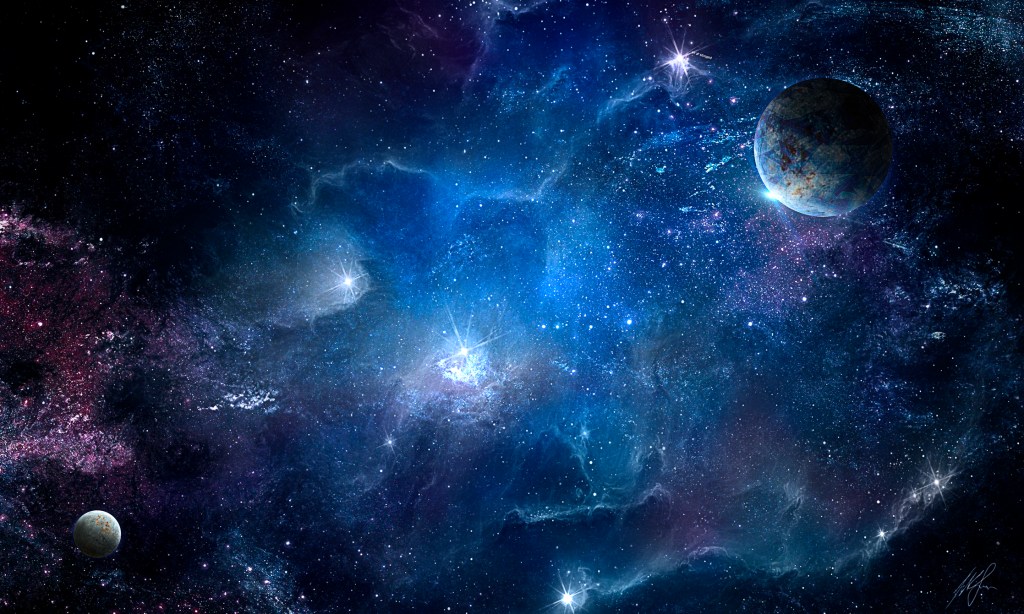
Source: CDM Analogous to Superconductivity by Liang and Caldwell, May 2025, APS.org. Graphic: Cosmic Nebula by Margarita Balashova.

My Name is Legion

Beelzebub has been wandering through western civilization since the Philistines appeared on the scene in the 12th century BC. The polytheistic Philistines of Ekron, one of their five cities within Canaan, worshiped Beelzebub, Baal-Zebub in the Philistine language, as a minor god of healing and protection from diseases, mainly from flies. In the semitic languages Beelzebub was literally known as the “Lord of the Flies”. (In Indo-European languages some interpretations suggest that Beelzebub is translated into a more friendly Lord of the Jungle.)

As monotheistic traditions took root in Canaan, Beelzebub shifted from a protective deity to a purveyor of evil, demonized within emerging Jewish thought. By the 9th century BC, the prophet Elijah condemned the Israel King Ahab and the prophets of Baal for worshiping this god rather than the true God of the Jews. By the time of the New Testament, which mentioned him 7 times in Matthew, Mark, and Luke, he was associated with Satan, who represented the emperor of Hell.

In Matthew and Mark, the Pharisees accused Jesus of casting out demons by the power of Beelzebub or the “Prince of the Demons”. Jesus counters by exclaiming that “Every kingdom divided against itself is brought to desolation, and every city or house divided against itself will not stand.” Jesus’ response backed the Pharisees into a corner, if they admitted that Jesus was casting out demons by God’s power, then they would have to acknowledge his divine authority. But if they insisted, he was working with Satan, they would have to explain why Satan would undermine his own influence: a house divided will not stand. (Lincoln in an 1858 speech used the same words with a moral rather than religious meaning, granted that is a very fine line, “A house divided against itself cannot stand,” suggesting that the evils of slavery would lead to collapse of the country.)

Between the 15th and 17th centuries Beelzebub was transformed into one of the seven princes of Hell: Lucifer the Emperor, Satan, Leviathan, Belphegor, Mammon, Asmodeus, and Beelzebub. Beelzebub represented the deadly sins of gluttony and envy.

In modern times Beelzebub remains a symbol of evil in literature and culture. John Milton’s Paradise Lost cast him as a chief demon and William Golding’s Lord of the Flies takes a more ancient meaning associated with corruption and destruction.

From an ancient minor Philistine god to Satan during the times of Jesus, to a major Christian demon in medieval times, back to Satan himself in modern times; Beelzebub’s transformation reflects the shifting religious and cultural landscapes over millennia, but demons will always have a name. In Mark 5:9, Jesus asks a possessed man, “What is your name?” The demon responds, “My name is Legion, for we are many.”

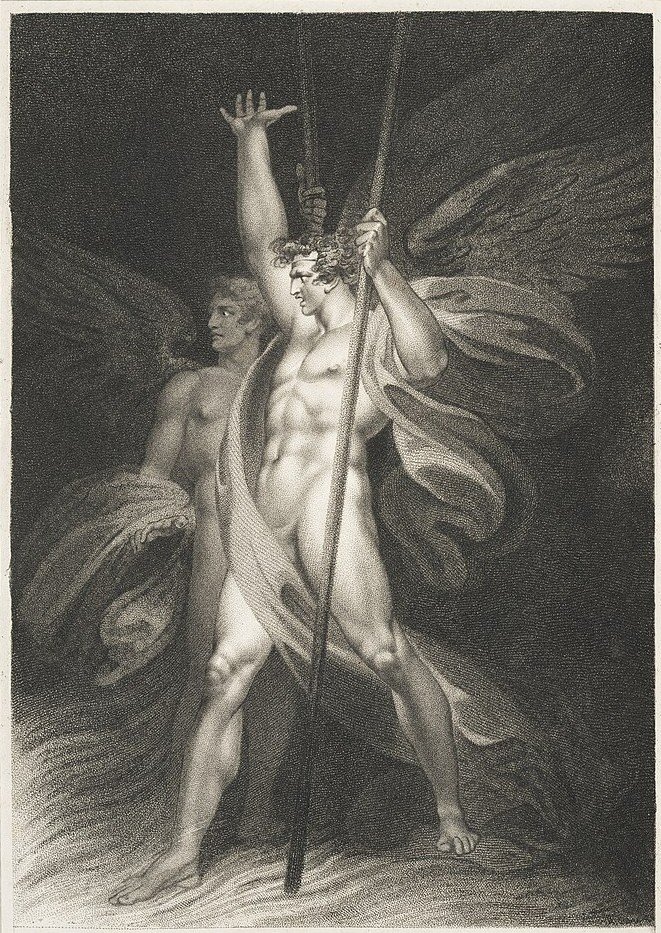
Graphic: Satan and Beelzebub by William Hayley, Jean Pierre Simon, Richard Westall: Paradise Lost. Public Domain.