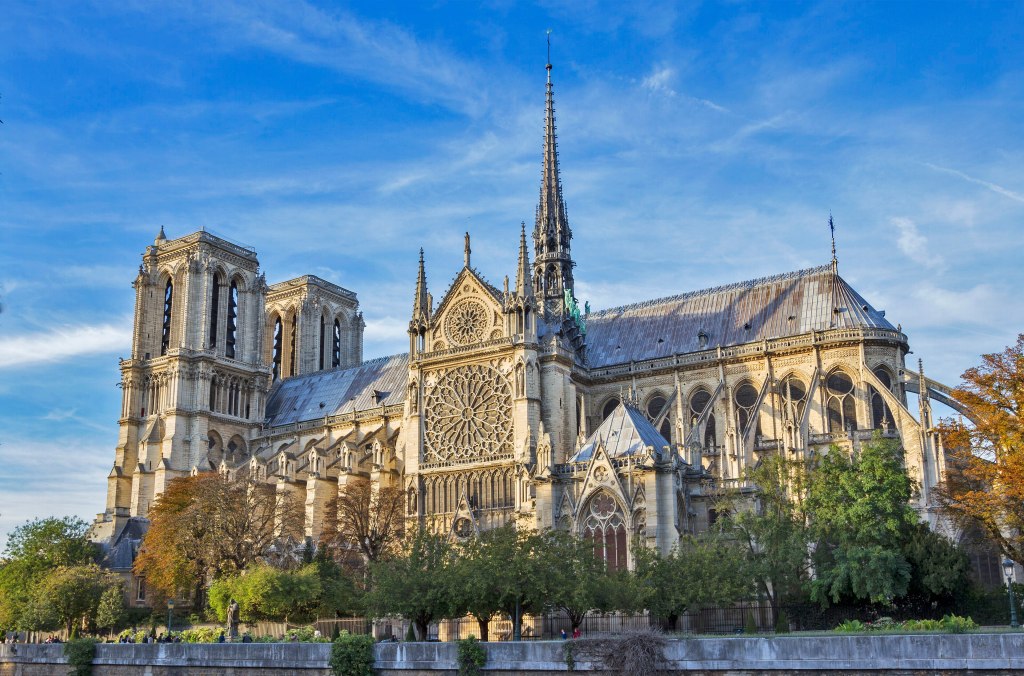
Beauty is a leading indicator of a society’s health. When a civilization loses confidence in itself, beauty is the first thing to fade. Beauty cannot be manufactured to restore confidence; it is the natural expression of those who already possess it. Like Michelangelo carving the Pietà, one removes what does not belong; confusion, torment, disbelief, until the form within emerges. Civilizations are no different. When they chip away what obscures truth and goodness, beauty appears as the visible sign of inner clarity.
Beauty shows up everywhere: in human form, in nature, in paintings, and for this essay, in architecture. When a culture believes in itself with unpretentious conviction, it builds boldly with results spanning generations. It invests in the future because it trusts the future. When that belief evaporates, beauty dissolves with it, drifting into the mists of a doubtful future.
The loss of belief begins when a society abandons boundaries and accepts all impressions as equal. A mind without form cannot discern truth or goodness. And beauty requires clarity, clarity requires form, and form requires a frame. When the frame splinters, architecture becomes utilitarian, art becomes cynical, and culture stops believing in greatness. Nowhere traces this rise and fall more clearly than Parisian architecture over the last millennium.
To understand that arc, we begin not with kings or cathedrals but at the beginning with the first simple, rustic settlers along the Seine around 7600 BC, when the landscape was young and belief was simple. Farming had taken root in the fertile soils of the not‑yet‑named Paris Basin, and small cohorts of semi‑sedentary farmers, herders, hunters, and craftsmen gathered along the river to sustain their lives.
By the 3rd century BC, the Parisii: a Celtic tribe, had settled the Île de la Cité, the island seed that would one day become Paris. They were farmers and traders, positioned perfectly between northern tribes and Mediterranean merchants.
Then came the Romans. In 52 BC, Caesar’s legions conquered the Parisii and founded Lutetia atop their settlement. This is often treated as the city’s formal beginning, though it would take until the 5th century AD for the name Paris to take hold, when Clovis I made it his Frankish capital.
Before Christianity, the boatmen of Roman Lutetia erected a temple to Jupiter on the very site where Notre‑Dame now stands. When Christianity took root, a cathedral called Saint‑Étienne rose atop the old Roman temple in the 6th century. By the 12th century, Saint‑Étienne had grown decrepit, and Bishop Maurice de Sully resolved to replace it. In 1163, the first stones of Notre‑Dame de Paris were laid; the beginning of a cathedral that would become one of the great monuments of and to Western civilization.
Here begins the Parisian story of architecture‑as‑art: a chronicle of a culture that once believed deeply enough to reveal the beauty within itself, and then, over centuries, slowly lost that radiance of truth and goodness.
Paris reveals that architectural civilizational arc: from Gothic certainty to Haussmannian order, from Second Empire spectacle to a nostalgic retreat, from iron’s engineering faith to the late‑modern emptiness. Each movement is a confession of what the culture believed about itself, until, finally, belief becomes incoherent.
Notre‑Dame de Paris (1163–1345)
In the 12th century, France was not yet the France we know today, but its culture was beginning to consolidate around a pious Catholic king and a Paris that was rapidly becoming the kingdom’s political and cultural center. The University of Paris was emerging as Europe’s intellectual powerhouse: the renaissance before the Renaissance. The French language was taking shape, the merchant class was rising, and Paris was swelling into one of the largest cities in Europe. The city was bursting with intellectual and artistic energy, and out of that confidence they raised a Gothic cathedral of stone that embodied their faith in God and their belief in a promising future.
Notre‑Dame is the archetype of Parisian architecture‑as‑art. A cathedral that is more than a building; it is a testament to a society that believes in God and in themselves as children of God. A Gothic masterpiece born from greatness, rising stone by stone into beauty made visible.
As Caroline de Sury of OSV (Our Sunday Visitor) writes, Notre‑Dame is “one of the great monuments of human civilization, a work that reveals the ambition and ingenuity of medieval builders.”
Sainte-Chapelle (1238-1248)
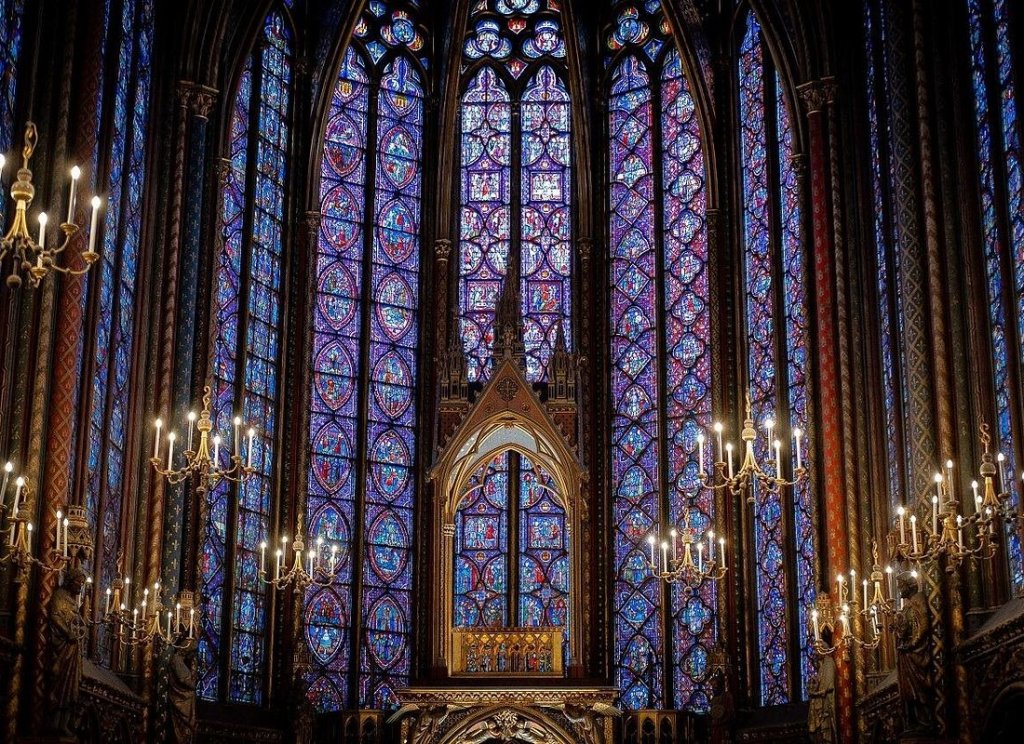
If truth and goodness are beauty made visible, then the Gothic masterwork Sainte‑Chapelle is beauty translated into light: a soaring reliquary of faith where daybreak reds and midnight blues radiate with glory through stained glass. A spiritual journey through Genesis, the Passion, and the Apocalypse: beginnings, the Way, and the end of all things.
Sainte‑Chapelle was the natural continuation of the same cultural confidence that raised Notre‑Dame. Before Notre‑Dame was even complete, Louis IX envisioned a new sanctuary worthy of the relics of Christ’s Passion. In 1239 he purchased the Crown of Thorns from Baldwin II, the financially desperate Latin Emperor of Constantinople, for 135,000 livres. Within a few years he added a fragment of the True Cross and the Holy Lance, housing them in a gold‑and‑silver châsse that cost another 100,000 livres. The chapel built to enshrine them required a further 40,000. In modern terms, the king devoted the equivalent of half a billion dollars to gather and honor these relics.
The relics arrived in Paris from Venice in solemn procession, carried by Dominican friars and received by Louis himself, barefoot and dressed as a penitent. The upper chapel, conceived as a two‑story royal sanctuary, rises as a nearly weightless cage of stone and glass, its walls dissolved into color, its architecture awash with light.
To later generations, the result was nothing less than otherworldly. Jean de Jandun, the 14th‑century scholastic, praised Sainte‑Chapelle as “the most beautiful of chapels…its ruddy windows bestowing such hyperbolic beauty that one believes oneself, as if rapt to heaven, to enter one of the best chambers of Paradise.”
Sainte‑Chapelle is a medieval anticipation of Impressionism, a world where form dissolves into light. But where the Impressionists sought the light and color of the natural world, the 13th century sought the prismatic glory of the divine. The Impressionists never turned their canvases toward it, not out of indifference, but because their gaze was fixed on the modern world, while Sainte‑Chapelle belonged to an age where painted light came from God.
Haussmann Renovation (1853-1927)
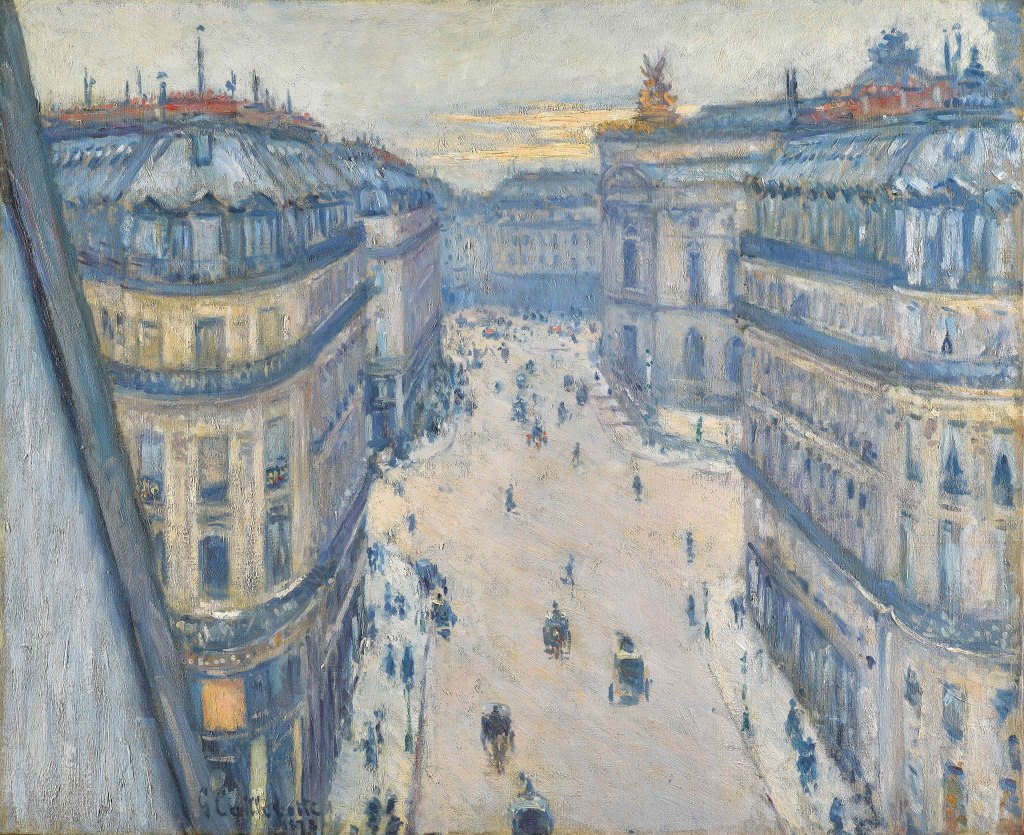
In the mid‑19th century, central Paris couldn’t breathe. It was taking short, asthmatic gulps of dirty air from dark, narrow medieval streets where sunlight rarely reached, plants withered, and human life was short and precarious. Disease thrived. Childhood was a gamble. The city had no coherent structure; only a tangle of alleys, filth, and improvisation.
And without order, there was no beauty.
For Plato, beauty emerges from the harmonious ordering of the cosmos toward the Good. Aquinas makes the point explicit: beauty requires integritas (wholeness), proportio or consonantia (due proportion, order, harmony), and claritas (radiance). Order is not an aesthetic preference; it is one of the metaphysical conditions for beauty itself. Balthasar later described beauty as the radiant expression of ordered love‑truth‑goodness in the drama of being. Disorder is not neutral; it is the antithesis of form and thus beauty.
Napoleon III wanted a beautiful city, and he sought it through order. And that desire itself reveals something deeper: Paris still believed that beauty was possible, that the city could manifest a visible order. Baron Georges‑Eugène Haussmann became the instrument of that belief. His renovation of Paris was not merely an infrastructure project; it was one of the most ambitious exercises in urban aesthetics in the modern era.
He treated the city center as a single vision rather than a collection of buildings. The result was a radical shift toward ensemble thinking; unified perspectives, monumental scale, and living environments conducive to modern societies.
The wide, straight boulevards created long dramatic sightlines that turned everyday movement into a kind of urban procession. These axes imposed rationality and clarity, echoing the formal perspectives of Baroque urbanism but expanded to a modern scale. Haussmann insisted on light, air, and luminosity in his designs. Building heights were calibrated to street widths, allowing daylight to flood the city and turning the pale limestone facades into soft reflectors. Paris acquired its characteristic glow; an Impressionist atmosphere before Impressionism existed.
The street front became a dignified stage for bourgeois life: tall French windows, wrought‑iron balconies, and a clear hierarchy of floors. Decorative without excess, elegant without aristocratic pomp. A civic beauty built not for kings but for citizens.
Critics at the time called this uniformity authoritarian, monotonous, even soulless. By 1870, the political backlash, mainly the constant, never-ending construction, was strong enough that Napoleon dismissed him. Yet his vision continued to shape the city well into the 1920s. And from today’s vantage point, the achievement is unmistakable: Haussmann created one of the most recognizable and photogenic urban textures in the Western world. A master class in balance of order, livability, and aesthetic coherence.
He redesigned central Paris as a single, harmonious work of civic art, where beauty arises not from isolated monuments but from the collective whole.
Aquinas would have recognized instantly what Haussmann achieved: a city where order becomes radiance. A city that believes that order can create beauty.
Palais Garnier (1861–1875)
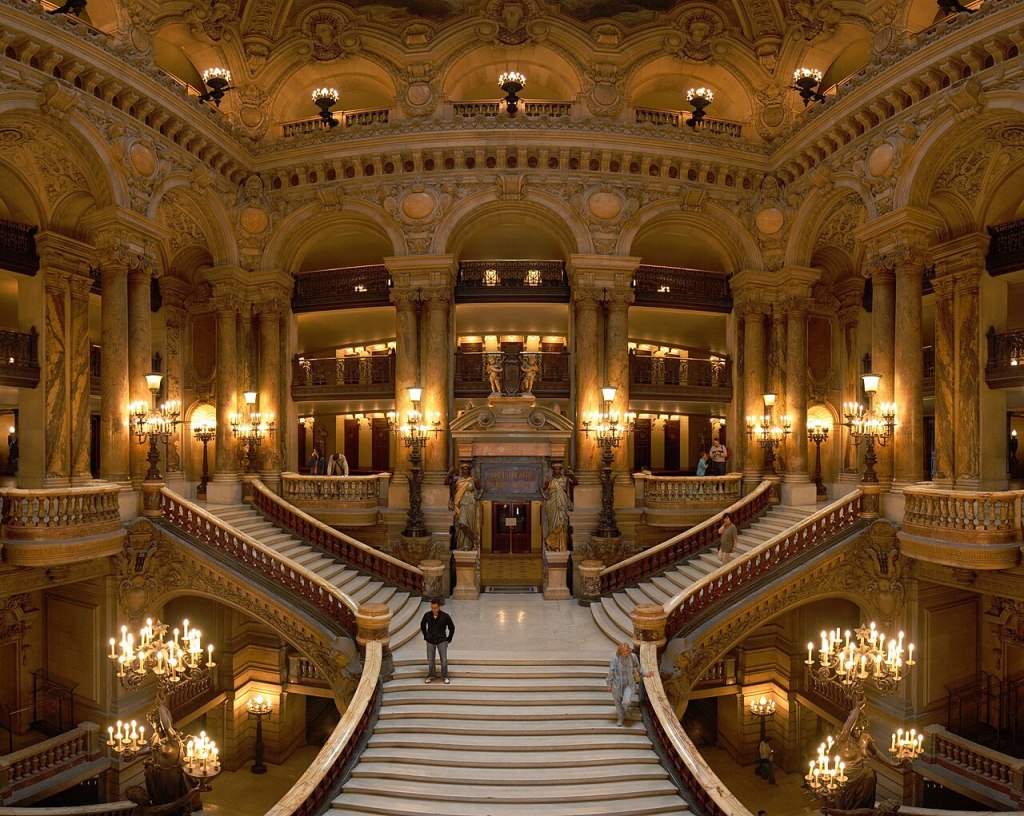
On a dreary winter night in January 1858, with a light, bone‑chilling drizzle misting the streets of Paris, Napoleon III and his wife, Empress Eugénie, arrived at the old opera house, the Salle Le Peletier, to attend a performance of Guillaume Tell. As their carriage pulled up to the entrance, Italian anarchist Felice Orsini and his accomplices hurled three bombs at the imperial couple. The Emperor and Empress survived, but eight people were killed and roughly 150 injured.
Shaken by the attack, Napoleon III insisted that a new opera house be built, one in which his safety was not an afterthought but a built-in design principle. He loved the opera and wanted to attend without fear, so his instructions to Charles Garnier concerned security, circulation, and protection. The aesthetics he left entirely to the architect.
Amid Haussmann’s orderly redefinition of central Paris, Garnier revealed a society that still believed in beauty and in itself. He created a solid, physical embodiment of the Gesamtkunstwerk: a total work of art, a fusion of architecture, sculpture, painting, ritual, and movement into a coherent, immersive whole. Gesamtkunstwerk: Everything all at once. The term, popularized by Wagner, described the union of architecture, poetry, staging, gesture, and sound into a single living concept of beauty. Garnier achieved the impossible: he made society come alive in stone, marble, and gold.
The architect constructed a monument that proclaimed a cultural confidence that Parisian society may not have fully articulated, but only a civilization still open to greatness could have built what this opera house became. A loving spectacle of marble, gold, and fresco, choreographed like a Tchaikovsky ballet: complete with cannon, procession, and royalty.
Sacré-Coeur Basilica (1875–1914)
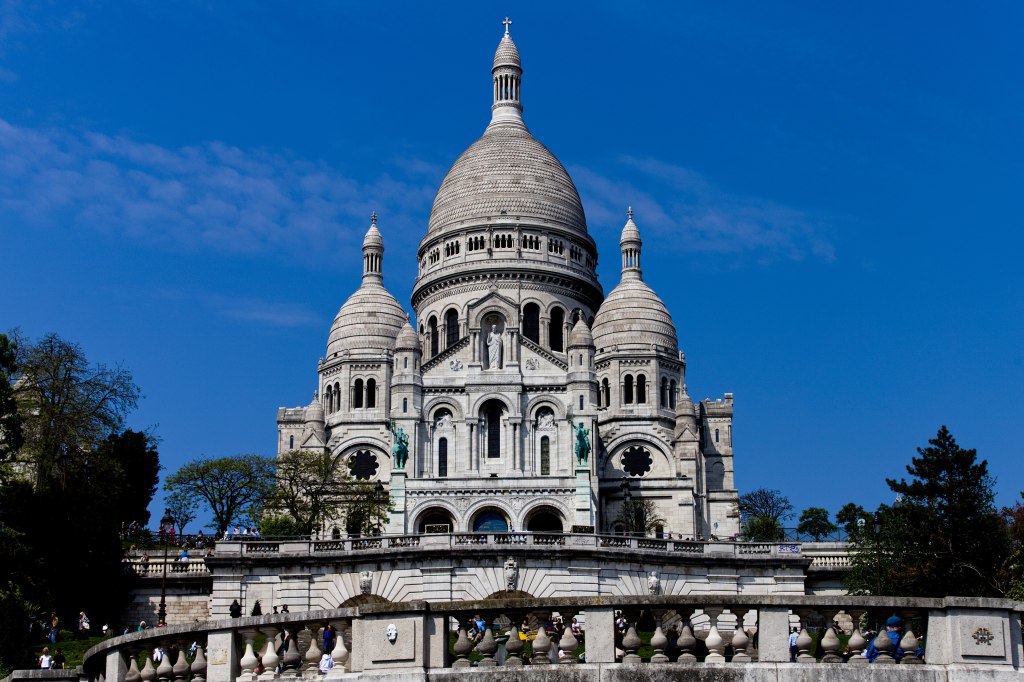
Sacré‑Coeur, a travertine wonder of white absolution, was a national act of catharsis. A reliquary of past beauty and honor. In 1871, Otto von Bismarck goaded a militarily weak France into declaring war on a superior Prussian empire. The conflict lasted barely six months, during which France suffered three‑quarters of a million casualties, the capture of Napoleon III, and the collapse of its regime, while Prussian losses remained comparatively light. It was a bloody, humiliating defeat that ended the French monarchy and, more importantly, shifted the balance of European power from France to a newly unified Germany. A realignment that would shape the grotesque catastrophes of the twentieth century.
In the aftermath, Paris reached backward for comfort. The city sought a therapeutic vision of an older, less violent world: Romano‑Byzantine domes, shimmering mosaics, and a vernacular of sacred purity untouched by the modern machinery of destruction. Sacré‑Coeur is beautiful, but its beauty is retrospective and prophetically tentative. It looks for solace in the rearview mirror because the future felt too dangerous to contemplate. In the long arc of Parisian architecture, the basilica is a holding pattern; a pause in the light built from the hope that the coming century might offer more than the dark silhouettes of humiliation and destruction.
Sacré‑Coeur contains a trace of the old Parisian confidence, a belief that beauty could be recovered by reaching backward into older, protective forms. The Catholic Church, convinced that the nation’s defeat was divine retribution for moral decline, proposed a new basilica on the highest hill of the city. Conceived as the antithesis of the secular opulence of the Palais Garnier, it emerged as a sacred neo‑Byzantine tapestry of color and pattern; a deliberate return to the safety of inherited forms. It was, in truth, a brief fling with the past, a luminous attempt to steady a wounded nation while the future was already projecting unfamiliar forms.
Opposed from its inception, sometimes violently, the basilica nonetheless became one of Paris’s most visited sites. It did not erase the humiliation of 1870, but it offered a place to set it down, closure, a brief, consoling pause before the city stepped into a future it no longer fully trusted or orchestrated. Sacré‑Coeur was a last, luminous fling with the past, a moment when Paris tried to steady itself by returning to forms that once offered meaning. But the modern world was already unwinding beneath its domes, carrying architecture toward a new purpose: not the revelation of beauty through form, but the expression of a deeper, more unsettled consciousness. In that sense, Sacré‑Coeur stands as the final exhale of an old metaphysics, just before the Eiffel Tower announces the beginning of something entirely different.
Eiffel Tower (1887–1889)
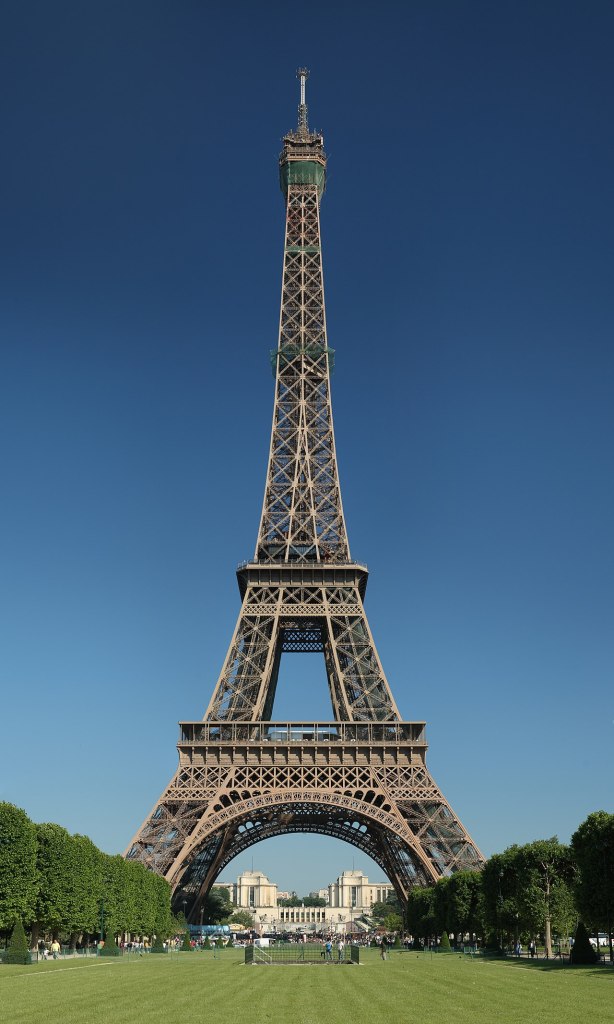
When I look at the Eiffel Tower, I don’t see a piece of 19th‑century whimsy or a symbol of Parisian romance. I see Rome. Not in style or material, but in spirit. The Tower rises from four sweeping iron legs that form, at their base, a kind of elongated, quadripartite arch; the same structural logic that held up aqueducts, amphitheaters, and triumphal monuments two thousand years earlier. Strip away the iron lattice and the modern height, and the underlying gesture is unmistakably Roman: an engineer’s declaration of what a civilization believes it can build.
The Tower is not beautiful in the Gothic or Baroque sense. It has no ornament, no narrative program, no sculptural allegory. Its beauty is structural, not decorative. The kind of beauty the Romans understood instinctively. They built in stone what Eiffel built in iron: arches, vaults, and exposed frameworks that celebrated the triumph of engineering over gravity. The Tower is simply the Roman impulse stretched upward, essentially a triumphal arch turned vertical, raised not to an emperor but to the idea of progress itself.
It was built for the Exposition Universelle of 1889, a centennial monument to the Revolution, but it functions more like a modern Column of Trajan: a national exclamation point. It is the last moment Paris built something with imperial confidence, before the long slide into the functional neutrality of the 20th century. The Tower does not seduce its viewers; it asserts a dominance of French will. It does not charm; it declares. It stands not as a palace of beauty but as a monument to the audacity of engineering; the final great structure of a civilization that still believed in its own strength.
In hindsight, the Eiffel Tower reads like a perfect exclamation point at the end of an era; the last moment Paris could still build with civilizational confidence, yet at the turn into the modern age, unable to express beauty from within. Its grandeur is external, not internal: a feat of engineering rather than a revelation of beauty or meaning. The Tower celebrates structure for its own sake, a Roman impulse translated into iron, but it also marks the pivot toward a new architectural age in which engineering replaces art, and performance replaces symbolism. Seen from the present, it feels less like a continuation of Parisian beauty than the hinge on which the city swings toward modernism, functionalism, and eventually the exposed ducts and structural exhibitionism of the Centre Pompidou. It is both the final shout of a culture that still believed in its own strength and the first unmistakable sign that it no longer knew how to build something beautiful. A celebration of the past with an unmistakable unease for the future.
Centre Pompidou (1977)
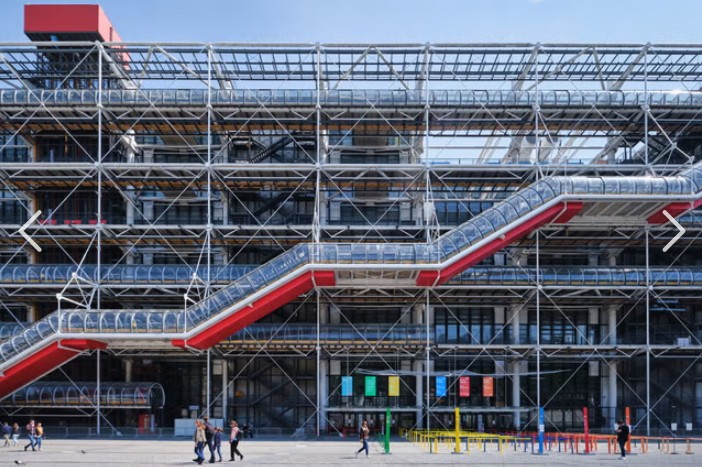
Contemporary art, the world French President Georges Pompidou championed with such confidence and enthusiasm in the late 1960s and early 1970s, was still in its formative slurry of dissociative forms when he embraced it. It was a movement emerging just as the last metaphysical foundations of Western art had quietly dissolved into the mists of an artistic tradition already deemed superannuated. Modernism had exhausted its internal logic: revealing beauty had become a secondary objective, while experimentation without rails had become its primary engine. Its successor inherited that momentum but none of the metaphysical grounding. Contemporary art had not yet discovered a voice of its own, yet the improvisation continued. What passed for innovation was mostly provocative drift and grift, gestures searching not for meaning but for acceptance. A tragedy of novelty as farce.
The Centre Pompidou emerged from this vacuous experimentation with almost comic inevitability. What began as a playful provocation; a design submitted with a wink, more dare than proposal, was suddenly embraced as the future of French culture. A joke, once accepted in earnest, just had to be retrofitted with meaning, and so a narrative was hastily draped over a building that had no internal logic to support it. Its exposed pipes and skeletal frame were praised as transparency, its industrial scaffolding as democratic openness, its externalized systems celebrated as newfound functionality, though this was mostly justification layered on after the fact. The truth was simpler: the Pompidou embodies the moment when architecture no longer knew what it meant to finish anything, because it no longer knew what it meant to begin with an idea of beauty and proceed to its revelation. It was, in spirit, a retelling of The Emperor’s New Clothes: a building so brazenly inside‑out that it dared the world to call its bluff. No one did. No child shouted out. And Paris was left with a structure that looks permanently under construction, as if the scaffolding were never removed because there was no final form waiting beneath it; the builders went to lunch and never came back.
Institut du Monde Arabe (1987)
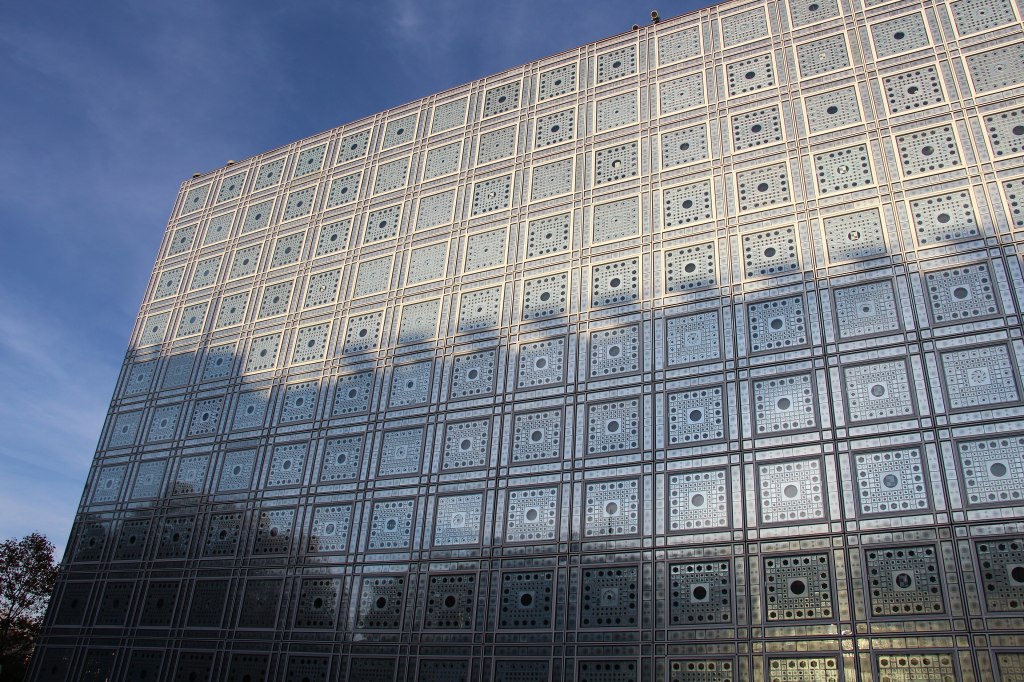
When I look at the Institut du Monde Arabe, I find myself at a loss for words; not because it overwhelms, but because it offers so little to respond to. There is no beauty here, and not even the consolation of provocation. It is simply a box wrapped in a pattern of dots, a techno‑mashrabiya that repeats the symbolism of privacy and modesty after the conditions that once gave those meanings a living visualness have disappeared. The facade behaves like a piece of needlepoint stretched across a five‑and‑dime tin: a surface treatment meant to suggest depth, enclosing a void no one dares open for fear that what lies inside might be as stale as the gesture that contains it. The building promises intricacy and depth but delivers only process; it gestures toward tradition but speaks none of its language. Even its celebrated diaphragms; those photo‑sensitive apertures that, on paper, were the building’s great promise, the mechanism that justified its existence, produced little more than a momentary novelty, a gesture that quickly settled into a kind of architectural ‘whatever.’ They jammed long ago, and no one was moved enough to repair them. Their failure revealed what the building had always been: a technological simulation of a symbolic language that no one spoke.
And this muteness is nowhere more striking than in its placement. The Institut du Monde Arabe faces Notre‑Dame across the Seine, a cathedral whose every arch and proportion bursts with metaphysical drama. Yet the IMA offers no counter‑narrative, no dialogue, not even a gesture of acknowledgment. It simply sits there, mute before a building that still knows how to radiate meaning. A patterned box across from a cathedral, its mechanisms and symbolism inert and frozen, a structure of indifference that neither provokes nor participates, content to remain unopened, like a tin whose contents everyone quietly suspects have long since gone stale.
Louvre Pyramid (1989)
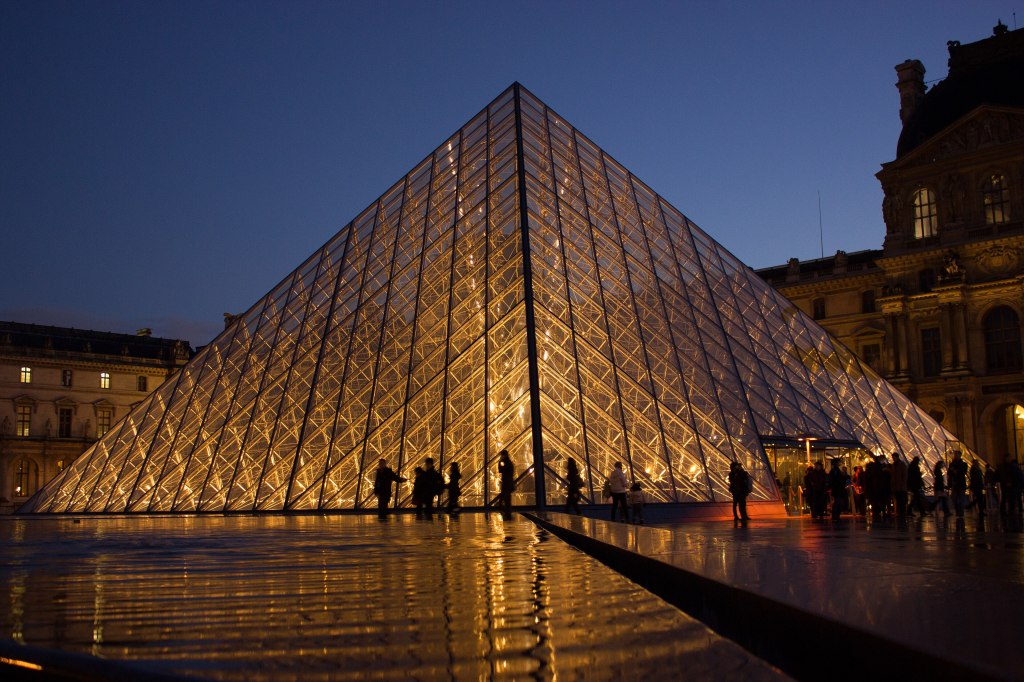
The Louvre Pyramid was born of a practical need: the museum had outgrown its entrances, and the over-flow crowds pleaded for a solution. In that narrow sense, the pyramid succeeded; it streamlined circulation, clarified access, and organized the subterranean lobby with admirable efficiency. But in reaching for transcendence, it failed as art. The glass pyramid, often praised as a dialogue between past and present, is in truth a structure that reflects because it cannot speak a language of its own. Its transparency is not revelation but absence, a geometric gesture that offers no symbolic meaning of its own. Placed at the heart of the Louvre’s courtyard, a space saturated with centuries of artistic conviction; it behaves like a visitor rather than a participant. It mirrors the palace because it has nothing to add to it. The entire structure could have been placed discreetly below the courtyard and left at that; instead, it rises into view as a polite confession of modernity’s exhaustion, a form that admits its own emptiness with immaculate clarity.
Opera Bastille (1989)
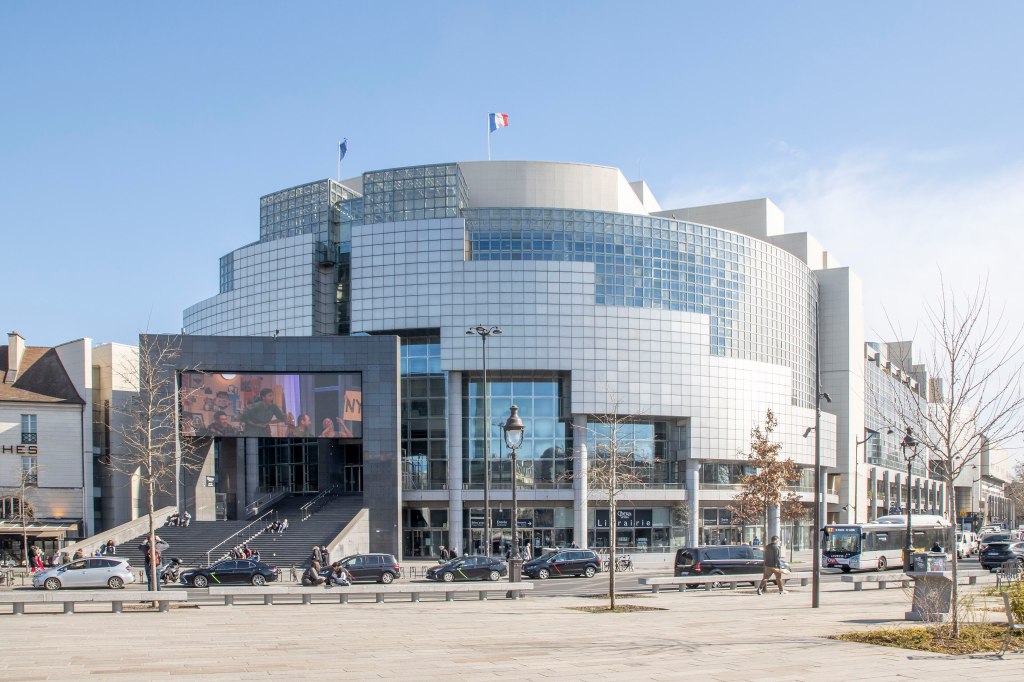
Opera was once the sound of beauty, an art meant to be absorbed, felt, seen, and heard as a single ascending experience. It needed a setting equal to its purpose, a space that prepared the soul for what it was about to encounter. The Opéra Bastille offers the opposite. It treats opera not as revelation but as logistics, a cultural event to be processed with the architectural vocabulary of airports and modern shopping. At street level it doesn’t merely echo retail; it becomes retail, its façade functioning like a mall’s frontage: glass bays arranged for transaction rather than transcendence. Its square entrance, the same monumental outline that defines the Grande Arche completed that same year, behaves like a photographer’s finger‑frame: a device for excluding everything beyond the immediate now. What might have signified clarity or democratic openness becomes instead a gesture of erasure, geometry used to forget rather than remember. The square here is not neutral; it is the architectural form of a culture rejecting its inheritance. The vast glass facade and anonymous granite curves reinforce this absence of beauty, evoking commercial neutrality rather than the dignity of a house of art. Inside, circulation and efficiency dominate, as if the highest aim of opera were the smooth movement of crowds. What was once a ritual of ascent has been reduced to a pedestrian experience, a building that confuses functionality with meaning. If the Palais Garnier is a palace for opera, the Bastille is a shopping mall where opera happens to occur. A structure that shows, with painful clarity, what happens when a civilization forgets that beauty was the purpose.
The Cost of Forgetting:
What began as a civilization’s attempt to reveal beauty, successfully I might add, slowly unraveled into a search for novelty that mistook disruption and provocation for depth. The great works of the past were not beautiful by accident; they were the outward expression of an inner confidence; a belief that the world possessed order, meaning, and purpose waiting to be disclosed. But as that confidence faded, art turned away from revelation and toward experimentation for its own sake. In its hunger for the new, it discovered only decadence and despair. And the despair was not in the forms themselves but in the culture that produced them; a society that no longer believed in its own metaphysical foundations. The darkness that followed was not dramatic; it was quiet, incremental, a slow drift into soullessness. Architecture became little more than gesture, spectacle, logistics, branding. The pursuit of beauty gave way to the performance of innovation. And in that exchange, something essential was lost: the sense that art could still reveal truth.
Graphics: Notre Dame de Paris by Ali Sabbagh. Public Domain. Sainte-Chapelle by Unknown. Public Domain. Halevy Street by Gustave Caillebotte, 1878. Public Domain. Palais Garnier Grand Staircase. Photo by Benh Lieu Song. Public Domain. The Basilica of Sacre-Coeur photo by Oliveira TP. Public Domain. Eiffel Tower, photo by Paul 012. Public Domain. Centre Pompidou. Copyright Independent UK. Institut du Monde Arabe photo by Fred Romero. Public Domain. Opera Bastille photo by IronGargolyle. Public Domain.



 elsToday