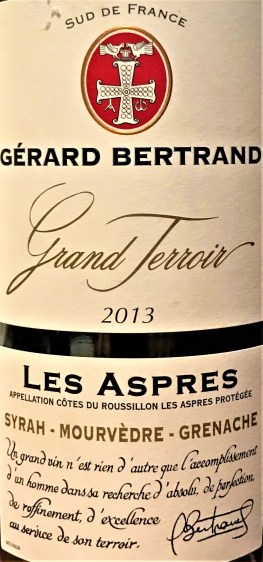
Gerard Bertrand Grand Terroir Les Aspres 2013

W Gerard 2013Rhone Red Blends from Languedoc-Roussillon, France

50% syrah

40% mourvedre

10% grenache

14.0% alcohol

Opened 3 Nov 2017

els 9.1/10

Wine Advocate 90-92

Gerard Bertrand, living a charmed life, grew up in the vineyards of southern France, a rugby union flanker for 10 years, captain of the team in 1993-1994, winemaker, owner and manager of 13 estates in the region of Languedoc-Roussillon; not exactly a Dickens’ Pip, but one who has reached heights of achievement likely unimagined by his father, Georges.

The vineyards for this Rhone Red are located in sun setting shadows of Mont Canigou, one of the lofty peaks of the Pyrenees along the French-Spanish border, 30 miles from the Mediterranean coast. The area around the mountain is known as Les Aspres, meaning arid in Catalan, forested at higher altitudes, barren scrublands occupying the lower, flatter altitudes.

Les Aspres, officially delimited, as a red wine only, viticultural area in 2004, is a sub-region of the Cotes du Roussillon appellation, in Languedoc-Roussillon, southern France. The Les Aspres label is reserved for Roussillon’s higher-quality red wines.

The land rises gently from the Mediterranean coast in the east to the Pyrenean foothills in the west. Most wineries and vineyards are located at altitudes around 330 feet. The climate for Les Aspres is definitively Mediterranean, with long, hot, dry summers; temperatures ranging from the low 80s during the day to the low 60s, Fahrenheit, at night; delivering rains of less than one inch per month from June through August. The
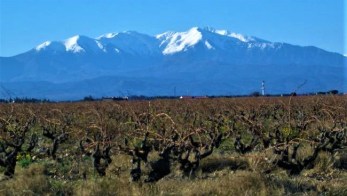
W Mount Canigou

Vineyards below Mount Canigou in France. Photo from Wikimedia Commons.

poor soils within Gerard Bertrand’s Les Aspres vineyards are generally Tertiary, detrital and alluvial schists, ranging in size from pebbles to silt.


The Syrah and Mourvedre, the primary grape varieties, along with secondary grenache, are used to produce these rich, full-flavored Les Aspres wines. The area, recently, is undergoing a ‘wine revolution’; fine wines replacing the past production of sweet table wines.

This wine has a splendid garnet-brick color. The bouquet brings forth visions of plums, prunes and cloves. The acidity and tannins are smooth producing a full-bodied wine with a long finish.  Serve with lamb. Decant and aerate for at least one hour.

$16.99 wine.com
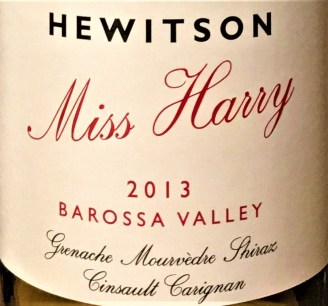
 

Hewitson Miss Harry G.S.M. 2013

W Miss Harry 2013Rhone Red Blends from Barossa Valley, Barossa, Australia
47% grenache

31% mourvedre

12% shiraz

7% cinsault

3% carignan

14.0% alcohol

Opened 31 Oct 2017

els 9.0/10

Australian Wine Companion  95

Wine Spectator 90

The Hewitson’s vineyards and winery are located in the heart of Australia’s famous wine-producing region, Barossa Valley, about 35 miles northeast of downtown Adelaide, along Australia’s south-central coast. The Barossa Valley, named after the low, rounded mountains of the Barossa Range, was formed by the North Para River, para meaning river in the local dialect. The river provides the vine loving soils and water to nourish the extensive vineyards in the area.

The Barossa Range is named after the British-French, 1811, Battle of Barrosa near Cadiz, Spain, where the British, outnumbered 2-1, routed the French. The different spellings are attributed to a clerical error when the names were registered from the survey records.

The Hewitson’s vineyards contain some of the oldest vines in Australia. Their Old Garden vineyard contains 8 rows of Mourvedre, planted 164 years ago in 1853. The roots of the vines reach down 30 feet into the sandy soils, keeping the plants cool and refreshed even on the hottest, driest days.

The continental climate of Barossa Valley produces summer days reaching past 100 degrees Fahrenheit with the nights dropping down into the low 50s. Rain, during the growing season, has a scanty range and output of less than 1 inch to 1.5 inches per month.

This is a clear ruby-red wine redolent of cherries and spice.  The acidity blends well with the tannins producing a delightfully smooth and balanced wine.  This wine pairs well with just about anything, marbled steaks to pasta to cheese to a solitary glass, or two, enjoyed in the shade on a hot summer day. Decant and aerate the wine for an hour or two, it will help immensely.

$18.99 wine.com

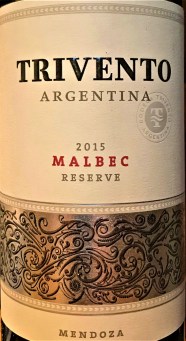
Trivento Malbec Reserve 2015

W Trivento Malbec 2015Malbec from Mendoza, Argentina

100% malbec

13.5% alcohol

Opened 29 Oct 2017

els 8.9/10

Decanter 95

Guia Descorchados 90

Bodega Trivento, the Three Winds Winery, sources its Malbec grapes from the Andean alluvial and colluvium soils of Lujan de Cuyo and Uco Valley, south of Mendoza, Argentina. The vineyards are at an altitude of approximately 3400 feet, soaking up 250 days per year of intense sun, in the dry, thin air; temperatures ranging in the summer growing season from highs of 95 degrees Fahrenheit during the days to 55 degrees at night. The semi-arid climate sparingly doles out less than 1.5 inches of rain per month during the growing season, forcing the growers to add drip irrigation to  assuage the vines thirst.

This inexpensive wine has a wonderful, clear, ruby-red color begging you to further investigate its aromas of cherry and strawberries, its soft tannins, and velvety, favorable finish. Chocolates and pasta will pair well with this Malbec.  Remember to decant and aerate the wine for an hour or two, it will help immensely.

$8.99 wine.com.

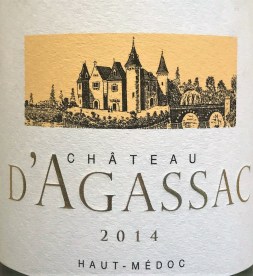
Chateau d’Agassac 2014

W D'Agassac 2014Bordeaux Red Blends from Haut-Medoc, Bordeaux, France
Proprietary blend of  cabernet sauvignon and merlot

Opened 14 Oct 2017

els 9.0/10

James Suckling 92

Wine Enthusiast 91

Robert Parker 83

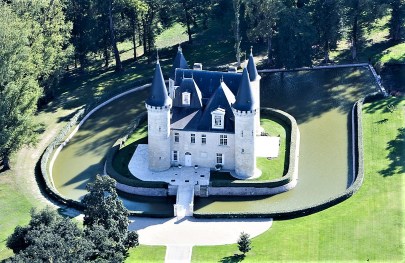
Chateau D’Agassac, a Haut-Medoc winery, purchased in 1996 by the French insurance conglomerate, Groupama, is located in the village of Ludon-Medoc, less than 10 miles north from the center of Bordeaux, and less than 3 miles west of the Garonne River. TheW Chateau d'Agassac charming, fairytale Chateau located at the winery, complete with turrets and moat, is known to have existed as far back as 1238 AD, under the lordship of Gaillard de Gassac, vassal of King Edward I of England. The vineyards, originally swampland, around the Chateau, were  not known to exist prior to the French Revolution in the late 18th century, when the area was drained.
The vines are grown on a young alluvium cover, deposited from the nearby Garonne River during its flood stage. In the western vineyards the soil consists of a  gravel, up to 10 feet thick, and produces refined and elegant wines. Sandy gravels in the middle vineyards, produce subtle wines high in tannins. The eastern most vineyards, closest to the river, consist of clayey gravels, with rounded stones the size of ping-pong balls, reaching 20 feet thick, and produce full body wines.  The vineyards encompass 106 acres, planted with 50% Merlot, 47% Cabernet Sauvignon, and 3% Cabernet Franc; the grapes are harvested from, on average, 25-year-old vines.

The temperatures of Ludon-Medoc reach their peak during August, with highs near 80 and lows hovering around 60. August is the driest month of the year, still producing, on average, about 2.5 inches of rain over those 30 days, with the remaining growing season, before and after August, producing 3 to 3.5 inches of rain each month. The gravels release their sun-acquired heat at night, protecting the vines’ roots from extreme temperature variations during the growing season, and especially during the harvesting of the grapes. The loose gravels also drain away the rain water quickly, keeping the grapes in peak condition.

This Bordeaux needs decanting and aeration for at least 2 hours, 4-6 hours, even better; if not, the acidity and tannins will overpower your senses, infusing your soul with utter regret that you even came to purchase this bottle of fermented grape juice. I opened this bottle after 3 years but in hindsight I should have let it set for at least 2 more years.  With that said, and with proper aeration, this is a good wine; an incredibly dark ruby-purple wine, redolent of plums, prunes and raisins. Full-bodied, dry, and intense with an excellent and protracted finish.

An outstanding wine.

$19.99 wine.com.

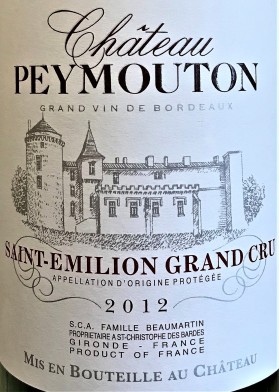
Chateau Peymouton 2012

W Chateau PeymoutonBordeaux Red Blends from St. Emilion, Bordeaux, France

65% merlot

25% cabernet franc

10% cabernet sauvignon

13.5% alcohol

Opened 9 Oct 2017

els 8.9/10

Wilfred Wong 92

Wine Enthusiast 90

The Beaumartin family winery, approximately 2 miles east of picturesque St. Emilion and 23 miles east-northeast of Bordeaux, on the right bank of the Dordogne River, consists of 2 vineyards; the Chateau Laroque, covering 150 acres, and the Chateau Peymouton, covering 76 acres, both growing predominately Merlot, with lesser amounts of Cabernet Franc, and minor acreage devoted to Cabernet Sauvignon grapes, all from vines planted in the early 1960s.

The vines of the Saint Emilion area spring from clayey limestones, with growing season temperatures ranging from the low 50s at night to the mid-80s during the day, receiving as little as a half-inch to as much as 4 inches of rain per month with the harvest season usually being the driest time of the year.  Cabernet Sauvignon vines generally do not grow well here, due to dampness of the soils, thus Merlot and Cabernet Franc vines dominate.

St. Emilion wines are reclassified every 10 years, vying for the elite, but limited award, Premier Cru Classes, and the lesser, but still good Grand Cru Classes, judged and assigned by two different tasting panels. The recent year’s reclassifications, 2006 and 2012, are hopelessly tied up in legal dramas by Chateaus that have lost their Cru Class. Chateau Peymouton is rated below the Grand Cru Class as a generic grand cru, although it is still a very good wine.

A dark, ruby-red wine, aromas of dark berries, smooth tannins and acidity with a nice balance and moderate finish.  This wine will go well with red, fatty meats.

A good wine.

$21.99 wine.com

Chateau Bel Air Haut-Medoc 2012

W Bel Air.jpgBordeaux Red Blends from Medoc, Bordeaux, France (Domaines Joel Irigaray)
55% cabernet sauvignon

45% merlot

12.5% alcohol

Opened 7 Oct 2017

els 8.9/10

Hailing from the St. Emilion area on the right bank of the Gironde, Chateau Bel Air, Joel Irigaray Domaines, is a Bordeaux blend of Cabernet Sauvignon and Merlot.  St. Emilion is blessed with wonderful mix of vine growing soils of gravel, clays and limestone, coupled with an oceanic climate of hot summers, and warm autumns, with just the right amount of rain when needed. The vineyards around St. Emilion and the Bordeaux region date back to at least the Roman plantings in the 2nd century AD; proving that good things do last.

A good, solid, dark, purple to ruby-red wine, redolent of cherry fruits, smooth tannins and acidity.  Serve with a juicy rib-eye and enjoy its balanced and long finish.

A good wine.

$13.99

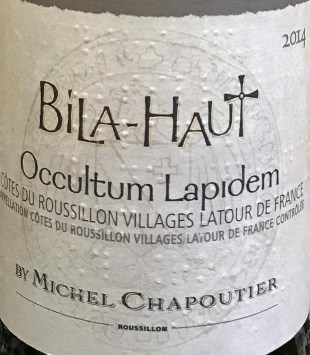
Bila-Haut Occultum Lapidem 2014

W Bila HautRhone Red Blends from Languedoc-Roussillon, France
Proprietary blend of syrah, grenache, and carignan

14% alcohol

els 9.2/10

Wine Advocate 92

Wilfred Wong 91

Wine Spectator 90

Occultum Lapidem, in Latin, a hidden stone, wine birthed in the valleys and terraces on the northern flanks of the Pyrenees in southern France, about 25-30 miles from Catalan Spain, and 20-25 miles from the Gulf of Lion in the Mediterranean Sea, near the small villages of Latour and Lesquerde; not far from the path of Hannibal’s army and elephants around 218 BC, marching towards the heart of the Roman Empire. The Pyrenees’ rock layers, jumbled, and thrust together in towering, reaching for the heavens, jagged waves, by the cataclysmic joining of the Iberian peninsula subducting beneath southern France, supply the building blocks for the vineyards’ difficult and cantankerous soils.  The soils, composed of gnarled gneisses, and pressured schists, both from the Devonian (maybe Precambrian gneisses), along with Jurassic chalky carbonates, impart diverse and distinctive, but obviously, as noted below, delicious and enticing flavors to the wines.

This Rhone red blend has a dark garnet color, extolling pleasant aromas of blackberries, cherries and plums, spicy and full-bodied with very balanced tannins and acidity.  Beautiful finish.

An outstanding wine.

$26.99 wine.com

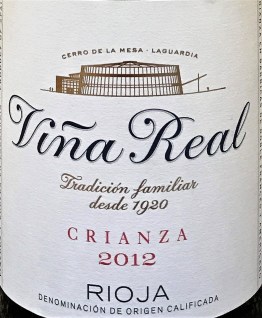
Vina Real Crianza 2012

W Vina RealOther Red Blends from Rioja, Spain

90% tempranillo

10% garnacha, graciano and mazuela

13.2% alcohol by volume

els 9.0/10

Guia Penin 93

Wine Advocate 92

Compañía Vinícola del Norte del España, CVNE, a family winery and vineyard, was founded in 1879 in the small town of Haro within the wine growing region of Rioja, Spain. The town is renowned for the annual Haro Wine Festival, celebrated on the 29th of June, in honor of the town’s patron saint, San Pedro.  The event is inaugurated each year, with a possibly, somber and sober mass at the Hermitage of San Felices de Bilibio, followed by wine drinking competitions, and drenching thine neighbor with buckets of red wine, producing a population of lovely, glowing, lavender hued, inebriated participants. Songkran take note.

Today the company includes 4 wineries including Vina Real in Laguardia, established in 1920s, near the provincial seat of the Rioja wine district, Logrono; producing some of first oak barrel aged wine in the region.

The vineyards are grown on calcareous soils in the Rioja Alavesa wine sub-region at a few hundred feet above sea level, south of the Cantabrian Mountains, enjoying a calm, continental climate of moderate days in the low 70s, and nights dipping into the low 60s with 2 to 4 inches of rain during the growing season, although 2012 was very dry.

The wine has a clear to brilliant, garnet to ruby-red coloring; a bouquet of blackberries, cherries, plums, and earth. A wonderfully balanced, medium bodied wine with a very nice finish.

An outstanding wine.

$13.99 wine.com

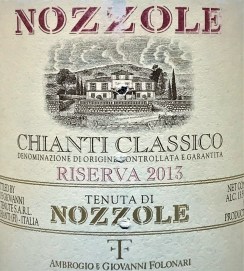
Tenuta di Nozzole Chianti Classico Riserva 2013

W Nozzole ChiantiSangiovese from Chianti, Tuscany, Italy

100% sangiovese

13.5% alcohol by volume

els 9.1/10

Vinous 93

Wilfred Wong 90

The Italians, Ambrogio, and his son Giovanni, the seventh and eighth generations of wine makers in the Folonari family, acquired the Nozzole Estate in 1971; continuing the family tradition of producing fine Tuscany wines since the 1700s.

The Nozzole Estate, less than 20 miles south of Florence, was known as a producer of fine wines as far back as the 1300s. The immediate proximity of the estate to Florence is prima facie evidence that the winery supplied the city with a significant amount of Nozzole’s output, making a claim to the creative spirit and charm of this city.

Florence, birthplace of the Renaissance in the middle 1300s was known, from historical records, to import, during this time period, 6 to 7 million gallons of wine inside the city walls each year; estimated to have a population of 80,000 to 95,000 citizens; happily providing every person with a bottle of wine every day. It is no coincidence that the Florence of old is synonymous with the creative brilliance, magnificence, patronage of notables like Leonardo, Botticelli, and Medici: paintings, sculpture and money.

Moving into the present, estimates are that the world produces upwards to 36 billion bottles of wine every year, barely enough to give every soul a miserly bottle of wine every 2 or 3 months. It is no coincidence that the world today generates copious amounts of lawyers, guns and…money.

The Nozzole’s vineyards are  222 acres of Sangiovese grapes, grown in the Chianti Classico sub-region of central Tuscany, sunning themselves 1000 feet above sea level on the rolling hills of weathered sandstone and chalky marlstones. Mild nights, temperatures from the low to high 50s, and hot days reaching up into the mid-80s persuade the grapes to give up a full-bodied wine, nudged along with 1.5 to 3 inches of rain per month during the growing season.

This Chianti is a dark, purple to ruby-red, aromas of acidic, dark cherries and raisins, tannins just right for a long, structured finish.

An outstanding wine.

$19.99 wine.com

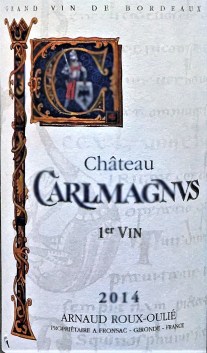
Chateau Carlmagnus 2014

W Carlmagnus BordeauxBordeaux Red Blend from Fronsac, Bordeaux, France.
Proprietary red blend.
14.5% alcohol by volume

els 9.1/10

Wine Advocate 90-92

Wine Spectator 90

James Suckling 90

Fronsac, a wooded and hilly area, east of the Bordeaux wine region, in southwest France, is located near the northern bank of the Dordogne river, just a few miles west of the small city, Libourne; home of numerous appellations including Saint-Emilion, Pomerol, and of course, Fronsac.

Merlot is the main grape variety harvested here along with a smattering of Cabernet Franc, grown on primarily clayey-limestone soils. The vineyards sit atop a network of limestone caves, serving as the winery’s cellars. The summer climate is mild and sunny with temperatures dipping into the low 50s at night, and the days range from the mid 70s to the low 80s. Rain brings 1 to 2.5 inches of water per month.

Chateau Carlmagnus is a gorgeous dark purple, cherries and plums dance into your nose, slightly acidic but is quickly tamed.  This is a full-bodied, complex but balanced wine.

A outstanding wine.

$17.99 wine.com