Castiglion del Bosco Dainero 2012

W Dainero 2012Merlot from Riparbella, Pisa, Tuscany, Italy

90% merlot

10% sangiovese

13.5% alcohol

Purchased: 6 March 2017  –  $16.99

Opened: 28 Feb 2018

els: 8.5/10

James Suckling: 92

Wine Spectator: 90

Cellar Tracker:84

Tuscany, a central Italian region bounded by the Tyrrhenian Sea on the west and the Apennines Mountains on the east, is a name synonymous with Italian Renaissance art, ancient history, landscapes of exquisite beauty, and wine. Its wine history dates back to the enigmatic but successful Etruscans in the 8th century BC, growing rich by trading their wine with the Gauls to the north and the Romans and Greeks to the south and east. The aura and renown of Iron Age Tuscany wine secured its perpetuation through the endless generations of Romans, Christian monks, Florentine merchants, Medicis, Hapsburgs, Bourbons, Bonapartes and todays modern Italians. Good wine and time immemorial happily going hand in hand.

Tuscany has the third highest quantity of acres planted in vines in the country but because of its extremely poor soils and the wine makers emphasis on lower yields, it is only sixth in volume, producing just shy of 300,000,000 liters of wine in 2016. The area has a plethora of DOCG and DOC wine regions plus 5 IGT sub-regions that will bewilder even the most diligent and attentive of students and that’s before the Super Tuscans enter into the smorgasbord of categories; all with their rules about grape varieties and percentages spread over a bursting profusion of wineries and vineyards. The better known regions include: Brunello di Montalcino producing rich, full-bodied sangiovese wines; Chianti and Chianti Classico producing the famous medium-bodied wines; and Bolgheri, the region that first produced the well received Super Tuscans.

Merlot is the 3rd most planted grape in the world and 5th most common in Italy. It is one of the primary grapes for Bordeaux blends and is very popular as a stand alone variety. It is a dark blue to purple grape with a soft, velvety structure with medium tannins and low acidity, producing dark fruity flavors.

Sangiovese is the most planted grape in Tuscany and all of Italy, deriving its name from the Latin for the “blood of Jupiter”. It is possible that this grape dates back to the time of Etruscans and is closely related to the Ciliegiolo grape. A sangiovese wine has an earthy cherry flavor that readily acquires a taste of vanilla and oak after aging in barrels.  The tannins are not too strong but the acidity is high.

The Castiglion del Bosco traces its heritage back to 1100 AD when the castile was built and in the 13th century the family owners added stone walls around the castile. Skipping forward a few years to 1967 the estate joins with a few other local families to found the Brunello di Montalcino wine association. Brunello eventually becomes one of the first Italian wines to be granted the DOC and DOCG categories. Massimo Ferragamo, in 2003, purchased Castiglion del Bosco to add to his winery in Riparbella. By the end of the decade he has added guest villas and a golf course to the Castiglion del Bosco estate.

Dainero is produced from the grapes grown at Castiglion del Bosco’s 25 acres of vineyards at Riparbella, less than 8 miles from the western coast and just north of the Bolgheri wine region. The vineyards are located within the wide-ranging Toscana IGT appellation. The vineyards enjoy an Mediterranean  to a sub-continental climate with cool ocean breezes drafting over the 1475′ above sea level west-facing, vine-covered hills.  The iron-rich, alluvial, clayey soils containing metamorphic gravels and pebbles, ensure that the vines are well-drained, healthy and stable. The vineyards are planted with Merlot, Cabernet Franc, Cabernet Sauvignon, and Petit Verdot. The diurnal growing season temperature-range for the vineyards is 50-85ºF with rainfall averaging 3-4″ per month.

The Merlot grapes were harvested during the first part of September while the Sangiovese grapes were harvested during the last part of this month. The grapes are processed at the Castiglion del Bosco cellars. After sorting the grapes they are gravity fed into steel tanks and fermented for 15 days at 82ºF .  The wine spends 6 months in French oak barrels, 30% of which is new and 70% old.  The wine then spends 6 months in the bottle before it’s marketed to the public.

A ruby-red wine trending towards purple with a tawny rim. Aromas of black fruits, currants, and spice. A medium to full-bodied, balanced and structured, but somewhat thick in the mouth.  The tannins and acidity are working well together producing a slightly sharp and long finish. I rated this wine at 8.5/10 mainly because I believe it is past its prime, not as clear and crisp as it should be.  The wine likely peaked about a year ago.

Enjoy this wine with a dish of spaghetti and Italian sausage.  A platter of hard cheeses would also do this wine justice.

A good wine that you shouldn’t spend more than $10 on. Drink this year. Decant and aerate for one hour, or more, before drinking.

$9.99-20.24 wine-searcher.com
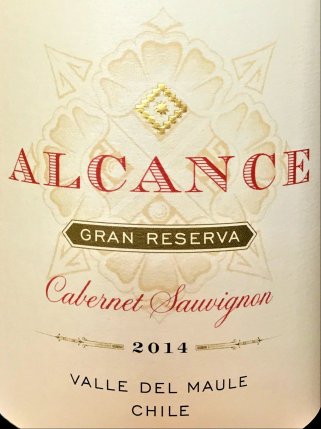
 

Alcance Gran Reserva Cabernet Sauvignon 2014

W Alcance 2014Cabernet Sauvignon from Maule Valley, Central Valley, Chile
100% cabernet sauvignon

14.5% alcohol

Purchased: 6 March 2017 – $19.99

Opened: 28 Feb 2018

els: 9.0/10

Wine and Spirits: 94

James Suckling: 90

Cellar Tracker: 90

Wine Enthusiast: 87

Maule Valley, the largest wine-producing region in Chile and the southern-most region in Chile’s Central Valley, is tucked in-between the Andes and the Coastal Ranges. The region is named after the east to west flowing Maule River with its headwaters in the western slopes of the Andes Mountains and emptying 50-60 miles downstream into the Pacific Ocean near the small, impoverished city of Constitucion. Due to the Valley’s more southern location in the Central Valley it has cooler temperatures than its northern counterparts but because the Coastal Range’s have lower elevations here the rain shadow is also reduced resulting in more rainfall than up north, particularly in the winter.

The region’s wine history dates back to the mid-1800s when successful Chilean businessmen brought back pre-Phylloxera European vine cuttings to grow in the Valley’s igneous and alluvial soils, primarily along the Maule River. Initially the region grew predominately Pais grapes, generally used for bulk wine sales and table wines but in the recent past most of those vineyards have been replaced with better known selections such as Cabernet Sauvignon, a grape that now accounts for half the 75,000 vine acres planted in the Maule Valley.

Cabernet Sauvignon is a cross, believed to have occurred naturally sometime in the 1600s in southwestern France, between Cabernet Franc and Sauvignon Blanc grapes. It is now the most widely planted grape in the world. Chile is second only to France in the number of acres planted world-wide in this grape. It is a thick-skinned grape that’s relatively easy to grow and maintain, exhibiting high tannins and acidity, producing a distinct bell pepper flavor, especially in cool climates, along with aromas of mint and eucalyptus. The grapes produce a full-bodied and dark-ruby colored wine.

The Alcance winery, founded in 1993, is a Jackson Family enterprise that was instrumental in improving the entire winemaking industry in the Maule Valley.  The family introduced modern techniques to the Valley, through the Alcance winery, and the rest, as they say, is history. The winery started with the lower elevation San Francisco Estate vineyards in the southwestern portion of the Valley. The vines enjoy the cool Pacific winds blowing over their canopy with their roots tapped into soils clogged with large quartz crystals. The growing season temperatures for the San Francisco vineyards ranges from 60-80ºF with rainfall 0.25-1.00″ per month. In 1999 the Jackson Family added the El Maiten Estate winery and vineyards in the southeastern Maule Valley to their Chilean holdings.  The El Maiten vineyards are located in the Andes foothills along the Lircay River, a tributary of the Maule River. The vines grow in a loamy soil containing numerous pebbles and cobbles. The growing season temperatures for the El Maiten area ranges from 60-85ºF with rainfall 0.25-0.75″ per month. Both vineyards total about 200 acres planted in 10 to 20-year-old vines.  The winery produces 5 wines under its Alcance label: Cabernet Sauvignon, Carmenere, Merlot, VIGNO (an old vine Carignan), and Bravura, their celebrated Bordeaux blend.

This wine is produced from a rough 50-50 mix of grapes from both vineyards. The Cabernet Sauvignon vines were 10 to 11-years old for this 2014 vintage. After the grapes are hand harvested, they are hand sorted, cold macerated for 6 days, and fermented in small stainless steel tanks for 20-22 days. Malolactic fermentation is done in French oak barrels for 18 months with 3 intervening racks.

A clear ruby-red wine with a tawny rim. Aromas of cherries and raisins with an oak supplied vanilla in the background. Full-bodied and balanced with a very pleasant, long finish.

Enjoy with a traditional South American stew: Charquican. You will need a pound of cubed beef (cheap to expensive; your choice), a tablespoon of flour, quarter stick of butter, 2 cups of beef stock, a big chopped onion, a teaspoon or two of minced garlic, 2 tablespoons of oil, 1-3 teaspoons of chili peppers finely minced (less or more depending on how spicy you want the stew), 1 cup corn, 1 cup carrots sliced, 2 cups diced potatoes, salt and pepper. Coat the cubes of beef with the flour. Season with salt and pepper. Add to skillet over medium-high heat along with the melted butter. Cook beef until brown. Add the beef stock and simmer for 10 minutes. Transfer the contents of the skillet to a slow cooker.  With the remains of the beef and the beef stock in the skillet add the oil, onion, garlic, chili pepper and cook until the onions are soft. Add the remaining vegetables except the corn to skillet and cook for 5 minutes more. Add the skillet contents to the slow cooker and cook for 6-8 hours. Add in the corn about an hour before serving. Serve over rice.  Delicious. I made this from a modified recipe I found on The Spruce but I left out the squash, beans, and beef jerky; otherwise it was exactly the same:)

An outstanding wine at a fair price. Drink now, but should last until 2023-2025. Decant and aerate for one hour, or more, before drinking.

$15.19-31.49  wine-searcher.com

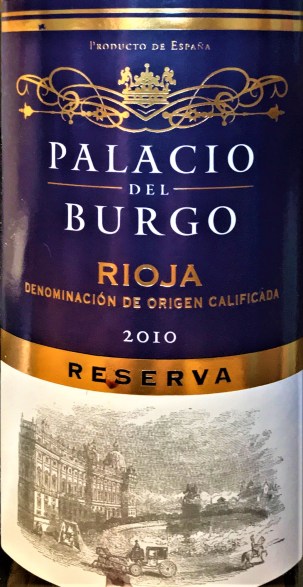
Burgo Viejo Palacio del Burgo Rioja Reserva 2010

W Burgo 2010Red Blend from Alfaro, Rioja Baja, La Rioja, Rioja, Spain

90% tempranillo

10% graciano

13.5% alcohol

Purchased: 12 July 2017 – $18.99

Opened: 20 Feb 2018

els: 9.0/10

Wine Spectator: 93

Stephan Tanzer: 90

Cellar Tracker: 90

Wine and Spirits: 90

Wine Enthusiast: 89

La Rioja, likely the most recognizable, if not the most famous wine region in all of Spain, is located 55-95 miles south of the Spanish-Atlantic coastline in the Ebro River valley, sandwiched between the Pyrenees and Cantabrian Mountains to the north and the Iberian Mountains to the southwest. The history of this area travels back to the time of the Phoenicians, followed by the Romans then the Christian Monks, all intent on producing ever better wines.  Then the French came and the rest is even more history, wine history that is. As phylloxera laid waste to the Bordeaux region in the 1870’s, the unemployed French wine makers migrated into the area and shared their expertise with the local population.

Rioja is divided into three regions: Rioja Alta, Rioja Alavesa, and Rioja Baja. The higher altitude Rioja Alta has alluvial soils of iron and lime, infused clays. Rioja Alavesa, at altitudes lower than Rioja Alta, consists of terraced vineyards growing in a mix of limestone and clays.  Rioja Alta and Alavesa enjoy a continental climate with 4 distinct seasons. Rioja Baja, at the lowest altitude,  has clay soils high in lime and iron growing grapes in a fairly mild Mediterranean climate.  The 3 areas have about 150,000 acres of vineyards producing 4 distinct classifications or categories of Rioja red wines: 1). Rioja wine aged less than a year in oak barrels; 2). Crianza is aged for at least two years, at least one-year of which is in oak; 3). Rioja Reserva is aged for at least three years with at least one-year in oak barrels; 4). Rioja Gran Reserva is aged for at least two-years in oak and three years in bottle. Garnacha, Tempranillo, Viura and Graciano are the main grapes grown in this region of 600 bodegas.

Tempranillo grapes are grown worldwide but Spain grows the lions share, approaching 90% of all acres planted across this blue planet.  Portugal comes in second with less than 10% of the grape’s plantings. The rest of the world occupies a position best described as rounding errors in total acres planted.  Tempranillo is an early ripening black grape with a thick skin, preferring high altitudes that provide hot days and cool nights. The cool nights provide the body and acidity while the hot days stimulate sugar production to higher levels while creating thicker, darker skins. The wines are ruby-red in color, redolent of berries, plum, tobacco, and vanilla.

Carignan, aka Mazuelo, is a red grape, common to southern France and Spain. The grape exhibits aromas of red fruit and spice with high acidity and tannins. It ripens late and produces high yields. The grape is used mostly to add a very deep red color to blends.

Later vintages of this Bodega’s wine have added the Graciano grape to the blend. It is almost exclusively a Spanish red wine grape grown primarily in Rioja. Graciano wine is purple to ruby-red exhibiting aromas of black fruits, cherries and plums.  The grapes love hot dry days.  The wine is generally blended with Tempranillo to add ageing potential and greater structure.

Bodegas Burgo Viejo was founded in 1987 by six Spanish families of La Rioja winemakers which today has grown today to 16 families. The winery is located in Alfaro, a small town of less than 10,000 people situated in the far southeastern edge of the La Rioja region. The town is on the eastern bank of the Ebro River and west of the Yerga Mountain. The Bodegas’ vineyards produce red and white wines in all 4 categories: Rioja, Crianza, Rioja Reserva, and Rioja Gran Reserva.

The almost 500 acres of family vineyards are scattered around the town of Alfaro and the Ebro River growing 90% red, along with 10% combined total of rose and white grapes; including Tempranillo, Mazuelo, Garnacha, Graciano and Viura. The vines are mainly 30 years old but some Garnacha vines exceed 90 years in age. The vines grow in the Rioja Baja terroir; soils of clay and lime at an elevation of approximately 1000′ above sea level. The average growing season temperatures have a range of 45-90ºF with rainfall averaging 2-3″ per month.

The grapes are fermented in controlled temperature, stainless steel tanks. Malolactic fermentation, after the primary fermentation, occurs in temperature stabilized concrete tanks. Once the malolactic fermentation process is over the wine is transferred to stainless tanks or oak barrels depending on the initial quality of the grapes. The Reserva and Gran Reserva wines are transferred to 60 gallon oak barrels; 80-90% American and 10-20% French oak. This wine spent 18 months in the oak barrels.

A clear ruby-red wine with a tawny rim. Aromas of cherries and red berries with vanilla in the background. Medium to full-bodied, very balanced and structured.  The tannins and acidity are working very well together producing a pleasant medium finish.

Enjoy with a Basque Tapas dish such as the very easy to make: Chorizo a la Sidra, or in English, Chorizo with cider.  You only need a couple of uncooked chorizo sausages and a little more than a cup of Spanish cider. Cut up the sausages into bite sized bits and add to a small cooking pan along with the cider. Cook over a medium high heat until the cider begins to exhibit a syrup like consistency. Remove from heat before the sauce gets too thick and arrange on a serving dish.  Dribble some more cider and Spanish spices, such as a crushed Bay leaf and saffron, on the sausages if you wish.  Serve with sour dough to soak up the sauce and Basque country Idiazabal cheese.

An outstanding wine at an OK price. The wine is getting scarce, as such, the price is increasing. Drink now, but should last until 2022-2025. Decant and aerate for one hour, or more, before drinking.

$20.99 wine.com

Falesco Tellus Cabernet Sauvignon 2013

W Tellus 2013Cabernet Sauvignon from Montecchio, Terni Province, Tiber Valley, Umbria, Central Italy, Italy

100% cabernet sauvignon

13.4% alcohol

Purchased: 6 March 2017 – $14.99

Opened: 18 Feb 2018

els: 8.9/10

James Suckling: 92

Wine Advocate: 90

Wine Spectator: 88

Cellar Tracker: 87

Umbria in central Italy is one of the 20 political regions and also one of the 20 wine regions in Italy.  This land-locked area is one of the smallest wine regions, 15th by vine acres planted, and 17th by wine volume produced, in Italy and is totally eclipsed by its larger and more famous adjacent northern neighbor: Tuscany.  This wine region maintains 4 levels of quality: DOCG, DOC, IGT, and table wine. The region grows Sangiovese and Sagrantino in profusion but recently, better known, non-indigenous grapes have successfully taken root in the area such as: Chardonnay, Pinot Nero, and Cabernet Sauvignon. The wine region is famous for its Orvieto wine, a sweet or a dry white wine blend of lesser known grapes such as: Procanico, Verdello, Grechetto, Canaiolo Bianco, and Malvasia Toscana.  This wine is named after the town of its origin, which is also the home of Nobelist: Enrico Fermi.

Cabernet Sauvignon is a cross, believed to have occurred naturally sometime in the 1600s in France, between Cabernet Franc and Sauvignon Blanc grapes. It is now the most widely planted grape in the world. In terms of acreage planted in this grape, Italy has the 8th largest plantings in the world, behind Argentina and ahead of South Africa. A thick-skinned grape that’s relatively easy to grow and maintain, exhibiting high tannins and acidity, along with cool climate-grown aromas of peppers and currants.

Brothers Riccardo and Renzo Cotarella, founded the Falesco winery in 1979 near the southwestern edge of the Umbria region. Falesco provides wines to Leonardo LoCascio Selections, a Winebow Group company that imports and distributes the family’s wines in the US.  The winery produces 4 IGT wines: Chardonnay, Merlot, Cabernet Sauvignon and a white blend. Additionally it produces a DOC white blend based on the Trebbiano grape.

The vineyards are located about a half mile east of the Tiber river and 4 miles west of the Apennines Mountains. There are 925 acres planted with various grapes which produce 2.6 million bottles of wine every year. The Cabernet Sauvignon grapes are grown on 25 acres of calcareous clay at 990′ feet above sea level. The growing season diurnal temperature range is 55-85ºF.  Rainfall is plentiful during the growing season ranging from  1.5-5.5″ per month.  Occasionally, there may be a few days of snow in January or February but it doesn’t accumulate and it shouldn’t have any lasting detrimental affects on the vines.

The grapes are picked in early September then fermented and macerated for 15 days in stainless steel tanks. The wine is then racked into oak barrels for malolactic fermentation. A final 5-month racking, before bottling, occurs in new, 60-gallon French oak barrels. The winery targets a production of 80,000 bottles for this wine. These are young vines and 2013 was the first crop and vintage for the Tellus, a Latin word for Earth, Cabernet Sauvignon label. Not a bad first effort.

A ruby-red wine with a garnet rim. Aromas of blackberries and plums, with a hint of vanilla and spice. A medium-bodied wine with mellow tannins. A very nice, medium finish.

A good wine at a fair price. Try with a traditional Umbra dish of truffles pasta. An easy dish of fettucine, shallots, heavy cream, truffle shavings, truffle butter and butter.  Add some spicy meatballs on the side to complete the meal. Drink now, but should last until 2020-2023.

$10.89-21.99  wine-searcher.com

Mollydooker Carnival of Love 2014

W Love 2014Shiraz from The Gateway, McLaren Vale, Fleurieu Zone, South Australia, Australia
100% shiraz

15.5-16.5% alcohol

Purchased: 14 Feb 2014 – $100.00

Opened: 14 Feb 2018

els: 9.4/10

Wine Spectator: 95

Tasting Panel: 95

Cellar Tracker: 93

Vinous: 70

In the beginning, Australia’s entire stock of vines had to be imported from Europe and South Africa since it does not have any native grape varieties. In the early 1800s John Macarthur, established the first successful vineyards and winery near Sydney. By the early 1820s wine was being produced in sufficient quantities that the first exports were recorded in 1822.  In 1833 James Busby brought additional cuttings from Europe and introduced Shiraz to the fledgling wine industry. By the latter half of the 1800s, Australian wines were garnering world-wide attention and tasting awards.  Then the unspeakable happened. Phylloxera reached Australia around 1875 destroying a majority of vines in the country.  It would take until the 1960s before Australia moved beyond fortified wines and started producing good to great table wines again.

Wine is currently produced in all 6 six of the country’s states which are further divided up into 65 wine regions that contain over 2400 wineries.  The regions creating serious wines, though, are all located in the cooler southern states of Western Australia, South Australia, New South Wales, and Tasmania.

Australia, in 2016, was the 5th largest producer of wine in the world, behind the US and ahead of China, making 343 million gallons of wine or about 4% of the world-wide total.  Australia consumes about 40% of their wine or a little more than 135 million gallons and exports 60%, about 215 million gallons in 2017, and is 4th largest exporter of wine in the world.  The country exports to 126 counties but five of those countries; China, the US, the UK, Canada, and Hong Kong account for 75% of the total wine exports. China is by far the country’s largest market, sending about a 3rd of their total wine exports, by value, to their thirsty northern neighbors.

The country grows over 130 varietals with just a few accounting for the lion’s share of all grapes harvested. The red grapes Shiraz, Cabernet Sauvignon, and Merlot accounted for 85% of all grapes harvested in 2017. Shiraz contributed 47% to that years red grapes total harvest.  Chardonnay is the top white grape harvested in 2017 accounting for 42% of the total.

South Australia is the largest wine area, by acres of vines planted and wine produced, in Australia.  The temperatures vary widely over area, cool along the coast and hot in the interior. The area is consistently dry and requires irrigation almost everywhere. The area first started growing grapes and producing wine back in the 1830s.

The region had almost 190,000 acres planted in 2017, more than half of the country’s total.  The area produced over 160 million gallons of wine in 2017 and exported 135 million gallons. China-Hong Kong, the UK, the US, and Canada are South Australia’s largest export markets.

There are 7 wine zones, further divided up into 20 distinct regions in South Australia. The zones are: Barossa, Fleurieu, Mount Lofty Ranges, Far North, Limestone Coast, Lower Murray, and The Peninsulas.  The 20 regions are all recognized appellations known in the country as Australian Geographical Indications or AGIs.

McLaren Vale, 1 of the 5 regions within the Fleurieu zone, is one of two premier South Australia wine-producing regions in the country; the other being Barossa Valley. McLaren Vale’s wine history goes back at least 175 years to the time of John Reynell and Thomas Hardy and their first grape plantings in the region.  Today’s Accolade Wines traces its beginnings back to the establishment of the Thomas Hardy and Sons winery, in 1853, in Old Reynella, now a suburb of Adelaide. With its Mediterranean climate and well-drained soils, McLaren Vale has 18,000 acres planted in vines and more than 80 wineries. Its star pupil is Shiraz, accounting for 55% of all grapes grown and processed. The region also produces great wines from Cabernet Sauvignon and Grenache grapes.

Australia is the second largest producer of Shiraz or its genetic French twin, Syrah, in the world, France being the first. These are dark-skinned grapes that produce wildly different flavors depending on the terroir they spring from. The cooler climate versions tend towards medium-bodied wines with higher tannins, producing flavors and aromas of pepper and tobacco.  In the hotter climates, such as McLaren Vale, the wine is fuller in body, softer in tannins with notes of leather and velvety chocolate. Ageing potential is 10-15 years.

In 2006, Sparky and Sarah Marquis established their own brand: Mollydooker, and opened their winery the next year just a few miles southwest of Adelaide and a hop, skip, and jump from the Gulf of St. Vincent in The Gateway sub-region of McLaren Vale. From the outset they have produced outstanding wines garnering high 90s ratings and wine of the year accolades, seemingly without effort. The winery includes 3 vineyards: Long Gully Road, Coppermine Road (Steve Earle’s Copperhead Road produced weed and whiskey),  and the Home Block, totaling 114 acres planted in Shiraz, Cabernet Sauvignon and Merlot.

The grapes are cold fermented, below 60ºF, with final fermentation occurring in oak barrels. After fermentation the wine is racked back to tanks for oxygenation. Then back to the barrel for approximately 3 months of malolactic fermentation. The final stage is to rack the wine again into different oak barrels to age some more before finding their way into the colorfully labeled bottles. Even before leaving the cellar these are well-traveled wines.

A dark, dark purple wine with a ruby rim. A bouquet of jammy berries and plums, bursting with chocolate. A very bold wine with medium tannins and acidity.  Luscious silk and velvet on the tongue. A wonderful, lasting, spicy candy finish. A parenthetical aside on the alcohol content.  The bottle states the ABV is 16.5% while the technical sheet states 15.5%.  Either one packs a wallop.

An outstanding wine.  My wife and I had this for our Valentines’ dinner at the Helix Wine and Bites restaurant in Grand Forks, ND. We started the meal off with a terrific morsel of grilled watermelon topped with a pepper spiced shrimp followed by oysters on the half shell heaped with garlic and herbs. The entrees were a medium rare rib eye and a filet of orange roughy tightly wound in herbs and spices.  The wine supremely complemented both of these main dishes. We finished off the wine with a desert of berries and milk chocolate fondue. Actually the wine ran out before we finished the desert forcing us to top off with Bailey’s and Penfolds’ port; life is hard but we try to go along with it.

The wine with the meal was simply astounding. Drink now, but should last until 2025-2029. This is still a young wine so I strongly recommended that you decant and aerate for one hour, or more, before drinking.

$68.99-99.99 wine-searcher.com

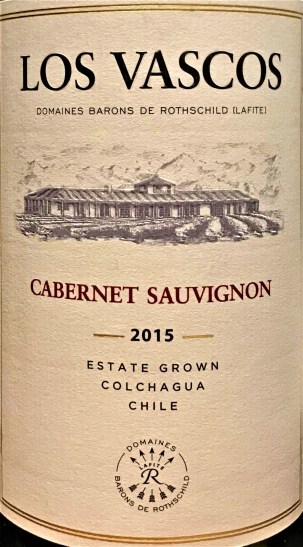
Los Vascos Cabernet Sauvignon 2015

W Los Vascos 2015Cabernet Sauvignon from Colchagua Valley, Rapel Valley, Central Valley Region, Chile

100% cabernet sauvignon

14.0% alcohol

Purchased: 6 March 2017 – $9.99

Opened: 16 Feb 2018

els: 9.0/10

James Suckling: 92

Falstaff Magazin: 91

Decanter: 90

Wine Spectator: 88

Cellar Tracker: 86

Colchagua Valley is in the southern and western portions of Rapel Valley, which itself is located in the middle of the 250 mile long Central Valley, all situated between the Andes to the east and the Coastal Ranges to the west. The northern edge of the Colchagua Valley is defined by the life-giving Rapel River and its main tributaries: the Tinguiririca and Cachapoal Rivers. The valley, sheltered from the cold Pacific winds by the Coastal Ranges, has a mild Mediterranean climate, warm but not too hot, or too cold, with rainfall that averages about 24″ per year, the majority coming in the winter. The main wine of the valley is Cabernet Sauvignon but in recent years Malbec has been added to the vineyards to capitalize on their Argentinian success on the eastern side of the Andes. The better wineries of Colchagua Valley have their vineyards located on the eastern slopes of the Coastal Ranges.

270 years ago the Echenique family, Basque immigrants to Chile, established their vineyards and winery in the Peralillo area of the Colchagua Valley, currently a small commune of less than 10,000 people.  The winery eventually acquired the name of Los Vascos meaning “The Basques” in Spanish. One hundred years later, in the 1850s, the family started to plant French derived vines and grapes which led to a large expansion of the vineyards and the wine industry in the area. In 1988 Domaines Barons de Rothschild (Lafite) acquired a 50% interest and management control of the Los Vascos property. The new management brought in new winery techniques and equipment; replanting many of the vineyards which presently and predominately, grow Cabernet Sauvignon (85%), but also Carmenere (5%), Syrah (4%), Malbec (1%), and Chardonnay (5%) grapes.

Cabernet Sauvignon is a cross, believed to have occurred naturally sometime in the 1600s in France, between Cabernet Franc and Sauvignon Blanc grapes. It is now the most widely planted grape in the world. Chile is second only to France in the number of acres planted of this grape. A thick-skinned grape that’s relatively easy to grow and maintain,  exhibiting high tannins and acidity, along with cool climate-grown aromas of peppers and currants.

The vineyards, encompassing a little less than 1600 acres, range in age from 15-70 years. The vineyards are at about 425′ above sea level with soils of volcanic loams and granitic sands. Although the vineyards are less than 25 miles from the Pacific Ocean they are protected from its cold winds by the Coastal Ranges and enjoy a distinct 4 seasons of Mediterranean climate. Growing season temperatures have a diurnal range of approximately 50-85ºF and rainfall amounts average a very dry 0.5″ per month or less. During the southern hemisphere winters rainfall can exceed, but a still dry, 2″ per month. Because of the arid climate the vineyards are drip irrigated.  The 2015 season saw unusually heavy spring rains which contributed to a late bud break.  The harvest was normal though.

The harvest, mainly by manual hand picking, took place between April 1st and May 13th. The grapes were de-stemmed and crushed immediately after picking and fermentation took place in temperature-controlled stainless steel vats between 77-81°F.  A maceration period ranging from 10-15 days was followed by a malolactic fermentation, also in stainless steel vats: unoaked, ostensibly, for the American palate.

A ruby-red color with a garnet rim. Aromas of red fruits and plums with a touch of herbs.  On the tongue it is bold but balanced. A wonderful wine with a medium, fresh finish.

An outstanding wine at an outstanding price.  A fine wine to pair with a fine, rich meal such as Osso Buco or a rib eye. Drink now, but should last until 2025.  Decant and aerate for one hour before drinking.

$8.99 wine.com


Chateau Ampelia Castillon-Cotes de Bordeaux 2011

W Ampelia 2011Bordeaux Red Blend, St. Philippe d’ Aiguilhe, Castillon-Cotes de Bordeaux, Bordeaux, France
95% merlot

5% cabernet franc

13.5% alcohol

Purchased: 24 April 2014 – $17.99

Opened: 14 Feb 2018

els: 8.9/10

Wine Enthusiast: 92

Cellar Tracker: 89

Wine Spectator: 88

The Despagne family has been making wines in the Saint-Emilion AOC  for more than 200 years. Today Francois, a seventh generation descendent of the Despagne family, is currently manager, since 1996, of Grand Corbin-Despagne winery and founder of the Chateau Ampelia in 1999. Breaking with family tradition the new winery and vineyards are located to the east, and adjacent to Saint-Emilion in the Castillon-Cotes de Bordeaux appellation 1.5 miles west of Saint-Philippe-d’Aiguille, and a little more than 4 miles north of the Dordogne River. This AOC was upgraded from Bordeaux Superior in 2008 and the area includes about 230 families working, on average, 25 acres of vines; predominately Merlot (70%), but also Cabernet Franc (20%), and Cabernet Sauvignon (10%).  Vines in this area date back to at least the 2nd century AD when the Romans planted Vitus Biturica, an ancient cousin of Cabernet Sauvignon and Cabernet Franc.

Merlot, the most planted grape in France, in known for its mellow and rounded flavors and is often blended with its close cousin: Cabernet Sauvignon and or its parent: Cabernet Franc, to soften them up. Cabernet Franc is a black skinned grape that imparts a peppery character to Bordeaux blends.

The grapes are harvested and sorted twice, once in the vineyard and then again at the winery. They are crushed, de-stemmed and fermented in temperature controlled, concrete and stainless steel tanks.  The post-fermented juice is racked into French oak barrels, one-third which are new, and allowed to age for 12 months before being blended and bottled.

The wine has ruby-red color with a garnet rim. A bouquet of cherries, plums and cedar with a hint of pepper. On the palate the wine is medium-bodied with soft tannins.  It has a pleasant, medium lasting, and soothing finish. Not overly bold but a refreshing wine.

A good wine but hard to find and a little expensive for the quality. Pair with a snack of soft cheese and berries.  Drink now, but should last for another year or two.  Decant and aerate for one hour before drinking.

$22.37 wine-searcher.com (limited availability)


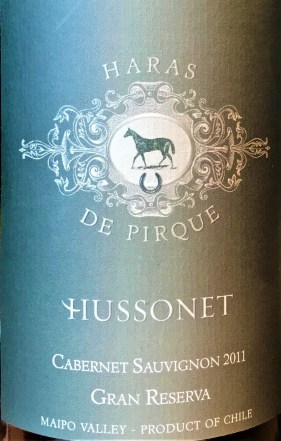
Haras de Pirque Hussonet Gran Reserva Cabernet Sauvignon 2011

W Hussonet 2011Cabernet Sauvignon from Maipo Valley, Central Valley and Andes, Chile

100% cabernet sauvignon

14.0% alcohol

Purchased: 20 Aug 2016 – $12.99

Opened: 11 Feb 2018

els: 8.7/10

James Suckling: 95

Wine Spectator: 88

Cellar Tracker: 88

Eduardo Matte in 1991 purchased an estate he later named Haras de Pirque, a term derived from the combination of a name for a 1892 thoroughbred stud: Haras; which also is the French term for stud farm, and the Chilean commune name for the area: Pirque.  The estate is less than 20 miles southeast from the center of Santiago, Chile in the Maipo Valley and a little over 20 miles east of the Andes Mountain’s year-round snow fields. The estate, eventually growing to encompass approximately 1500 acres, lies on the western edge of a peripheral, Miocene-Pliocene aged, Andes’ thrust fault and has almost 250 acres devoted to growing Cabernet Sauvignon, Merlot, Carmenere, Chardonnay, and Sauvignon Blanc grapes. The remainder of the estate is dedicated to raising horses for racing and show. The Hussonet name comes from a famous eponymous American-Chilean stud, whose offspring have achieved some success as race horses in Chile and Australia.

The vineyards and winery, beginning in 2003, were originally a 50-50 joint venture with the Italian company, Marchesi Antinori, and their first wine was a Bordeaux red blend under the Albis label.  The Hussonet label followed a few years later.

The Antinori family, an ancient clan believing they can trace their blood lines back to the 11th century BC city of Troy, and their winemaking, a more persuasively detailed chronicle, dating back to at least the time of the Florentine Renaissance, bought out Matte’s share in the Harris de Pirque estate in mid-2017 and they plan extensive changes to the winery and vineyards to better reflect their name, which is synonymous with prestigious wines in general and Super Tuscans in particular.

Cabernet Sauvignon is a cross, believed to have occurred naturally sometime in the 1600s in France, between Cabernet Franc and Sauvignon Blanc grapes.  It is now the most widely planted grape in the world.  A thick-skinned grape that’s relatively easy to grow and maintain and it exhibits high tannins and acidity, along with cool climate grown aromas of peppers and currants.

The Haras de Pirque vineyards are located between 1800-2100′ above sea level on the west side of an outlier Andes series of foothills. The soils are clays and loams mixed with large alluvial and colluvial stones. Growing season temperatures have a diurnal range of approximately 50-85ºF and rainfall amounts average a very dry 0.5″ per month or less. During the southern hemisphere winters rainfall can exceed, but still dry, 2″ per month.

There is no useful information available, that I can find, on the actual details of making of this wine.

The wine has ruby-red to purple color with a garnet rim. A bouquet of black currants, pepper, and a hint of vanilla. On the palate the wine is full-bodied, rich in tannins, but slightly drier and more acidic than usual for a Cabernet Sauvignon. The finish is short to medium.

A good wine at a fair price. Pair with a snack of hard cheese and salami.  Not a great wine to add to the menu for an expensive or fancy beef meal. Drink now, but should last until 2021.  Decant and aerate for one hour before drinking.

$9.99-16.12 wine-searcher.com

Arzuaga Pago Florentino 2007

W Florentino 2007Tempranillo from Malagon, Ciudad Real, Castile-La Mancha, Spain
100% cencibel (tempranillo)

14.5% alcohol

Purchased: 18 Aug 2014 $13.98

Opened: 7 Feb 2018

els: 9.2/10

Cellar Tracker: 93

Decantalo: 89

Penin: 89

In the early 1990s the Arzuaga Group established themselves in the small hamlet of Quintanilla de Onésimo, Spain, north of Madrid about 90 miles and 125 miles south of the northern Spanish Atlantic coast.  The hamlet of little more than 1000 souls occupies the flat agricultural plains adjacent and immediately south of the Duero River. The companies vineyards in the area grow Cabernet Sauvignon, Merlot, Pinot Noir, Tempranillo, and Chardonnay grapes.

In 1997 the company, looking for additional olive groves for their olive oil business, instead found and purchased the existing 143 acre vineyard: La Solana. The vineyard is near the small town of Malagon, Spain, located between the Toledo Mountains to the north and the Sierra Madrones to the south. The vineyards and winery did not begin producing wines until 5 years later in 2002.  In 2009 the vineyard was granted Vino de Pago status; the highest quality category of Spanish wine.  To obtain this designation the wines have to not only meet the DOCa requirements, but must also have a proven track record of consistently high quality and the grapes have to be grown, processed and aged on the estate.

Tempranillo grapes, called cencibel in the Ciudad Real area, are thick-skinned and love sunny, long hot days and cool nights, all of which brings forth a deep red wine with mild to moderate tannins and low to medium acidity. These qualities help generate a deep-colored medium-bodied wine with a wide range of aromas and tastes, including strawberries, blackcurrants, cherries, leather and tobacco.

The La Solana vineyard is on the north side of a series of low hills, with the vines growing in a rocky, pebbly top soil with an impermeable clay layer below. The vineyard grows, in addition to Tempranillo; Syrah, and Petit Verdot grapes. The growing season temperatures range from about 50-92ºF with rainfall ranging from as little as 0.25 inches to as much as 2.25 inches per month.

The grapes are hand-picked, sorted, de-stemmed and then gravity fed into casks or barrels. The grapes undergo approximately a 5 day cold maceration and a 7 day hot fermentation at roughly 82ºF. Only some of the wine undergoes malolactic fermentation in new oak barrels. The wine is aged for about 12 months in French and American oak barrels.

The wine has ruby-red to purple color with a garnet rim. A bouquet of fresh cherries, leather, and earthy mushrooms. On the palate the wine is well-balanced, medium to full-bodied with a medium finish. Wonderful.

An outstanding wine at a  good price, if you can find it, but later vintages should be similar. The 2012 vintage was a good year with similar ratings. Serve with traditional La-Mancha dishes; such as pisto soup, cuchifritos and paella. If you wish lighter fair try with crab stuffed mushrooms and soft cheese. Drink now, but should last until 2020.  Decant and aerate for one hour before drinking.

$18.99 wine-searcher.com


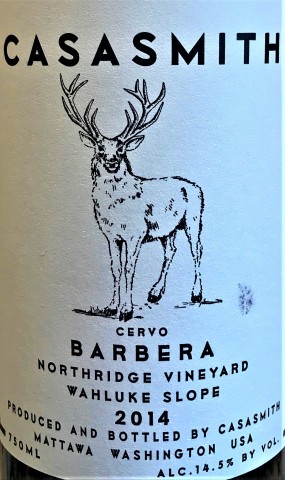
CasaSmith Cervo Barbera 2014

W CasaSmith 2014Barbera from Columbia Valley, Washington, US
100% barbera

14.5% alcohol

Opened 5 Feb 2018

els: 9.1/10

Wine Advocate: 93

Wine Enthusiast: 91

International Wine Report: 90

Cellar Tracker: 88

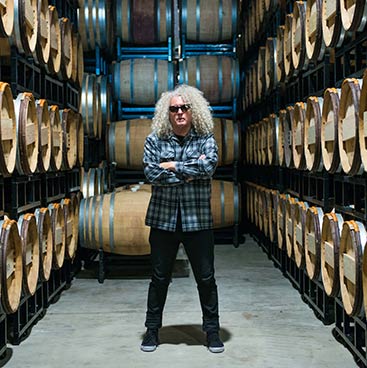
Charles Smith, vagabond, restaurateur, rock band manager, hard partier, and after almost 40 years decides to postpone adulthood further by starting a winery.  And doggone it, he’s good at it.  Mr. Smith builds up the winery, produces some darn good wines and sells the business for a ludicrous amount of money, and then promptly starts another winery; which he will likely sell for an even larger and more absurd (ludicrouser?) amount of money.  I spent 35 years at a nice, respectable and steady day job, thinking I was proceeding down a proper path.  Retrospection of ones life can be painful.

W Charles Smith 2018

Charles Smith.  Photo stolen from one of his web sites.

Charles Smith has set up shop in the southeastern Washington state, Columbia Valley town of Walla Walla; a megalopolis of about 45,000 folks which sits close to the Oregon border. The Cervo Barbera wine is part of a collection of Italian grapes grown and produced from his Washington vineyards, where he strives to reproduce the quality and integrity that one would find in Italy.

The Barbera, native to northwestern Italy, is a dark purple skinned grape producing a wine of low tannins and high acidity.  To combat the acidity, ageing the wine in old or neutral oak barrels is highly recommended to give the product more balance and a smoother finish.

The Northridge vineyard, planted in 2003, is a 92 acre site on a Wahluke Slope alluvial gravel fan, created approximately 15,000 years ago, in the Late Pleistocene, from the periodic floods originating from the ice dammed Glacial Lake Missoula in western Montana. Underneath the gravels are caliche deposits and Miocene-aged flood basalts.  The gravels provide excellent drainage for the vine’s roots and the caliche provides the calcium carbonate that the Barbera grapes thrive on.  Growing season temperatures range from daytime highs around 90ºF to nighttime lows approaching 40ºF.   Rainfall, during the growing season, ranges from 0.6-2.25″ per month.  The Northridge vineyard is approximated 2º degrees of latitude further north than its Italian Barbera counterparts in northwestern Italy and as a result receives more summertime sunshine.

The wines are whole cluster fermented and macerated for 37 days.  The wine is aged in old oak barrels for 12 months.

A wine with a garnet to ruby-red color and an amber rim. A bouquet of earthy herbs and black berries. On the palate a fruity, full-bodied, slightly acidic but balanced wine.  It has a fresh, long finish.

An outstanding wine at a fair price.  Serve this Italian wine with Italian pastas and pizzas. Drink now, but should last until 2020. Decant and aerate for one hour before drinking.

$20.00 wine-searcher.com