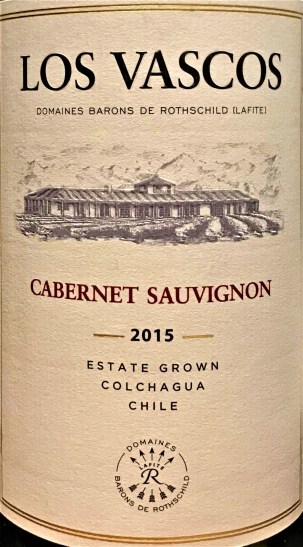
Los Vascos Cabernet Sauvignon 2015

W Los Vascos 2015Cabernet Sauvignon from Colchagua Valley, Rapel Valley, Central Valley Region, Chile

100% cabernet sauvignon

14.0% alcohol

Purchased: 6 March 2017 – $9.99

Opened: 16 Feb 2018

els: 9.0/10

James Suckling: 92

Falstaff Magazin: 91

Decanter: 90

Wine Spectator: 88

Cellar Tracker: 86

Colchagua Valley is in the southern and western portions of Rapel Valley, which itself is located in the middle of the 250 mile long Central Valley, all situated between the Andes to the east and the Coastal Ranges to the west. The northern edge of the Colchagua Valley is defined by the life-giving Rapel River and its main tributaries: the Tinguiririca and Cachapoal Rivers. The valley, sheltered from the cold Pacific winds by the Coastal Ranges, has a mild Mediterranean climate, warm but not too hot, or too cold, with rainfall that averages about 24″ per year, the majority coming in the winter. The main wine of the valley is Cabernet Sauvignon but in recent years Malbec has been added to the vineyards to capitalize on their Argentinian success on the eastern side of the Andes. The better wineries of Colchagua Valley have their vineyards located on the eastern slopes of the Coastal Ranges.

270 years ago the Echenique family, Basque immigrants to Chile, established their vineyards and winery in the Peralillo area of the Colchagua Valley, currently a small commune of less than 10,000 people.  The winery eventually acquired the name of Los Vascos meaning “The Basques” in Spanish. One hundred years later, in the 1850s, the family started to plant French derived vines and grapes which led to a large expansion of the vineyards and the wine industry in the area. In 1988 Domaines Barons de Rothschild (Lafite) acquired a 50% interest and management control of the Los Vascos property. The new management brought in new winery techniques and equipment; replanting many of the vineyards which presently and predominately, grow Cabernet Sauvignon (85%), but also Carmenere (5%), Syrah (4%), Malbec (1%), and Chardonnay (5%) grapes.

Cabernet Sauvignon is a cross, believed to have occurred naturally sometime in the 1600s in France, between Cabernet Franc and Sauvignon Blanc grapes. It is now the most widely planted grape in the world. Chile is second only to France in the number of acres planted of this grape. A thick-skinned grape that’s relatively easy to grow and maintain,  exhibiting high tannins and acidity, along with cool climate-grown aromas of peppers and currants.

The vineyards, encompassing a little less than 1600 acres, range in age from 15-70 years. The vineyards are at about 425′ above sea level with soils of volcanic loams and granitic sands. Although the vineyards are less than 25 miles from the Pacific Ocean they are protected from its cold winds by the Coastal Ranges and enjoy a distinct 4 seasons of Mediterranean climate. Growing season temperatures have a diurnal range of approximately 50-85ºF and rainfall amounts average a very dry 0.5″ per month or less. During the southern hemisphere winters rainfall can exceed, but a still dry, 2″ per month. Because of the arid climate the vineyards are drip irrigated.  The 2015 season saw unusually heavy spring rains which contributed to a late bud break.  The harvest was normal though.

The harvest, mainly by manual hand picking, took place between April 1st and May 13th. The grapes were de-stemmed and crushed immediately after picking and fermentation took place in temperature-controlled stainless steel vats between 77-81°F.  A maceration period ranging from 10-15 days was followed by a malolactic fermentation, also in stainless steel vats: unoaked, ostensibly, for the American palate.

A ruby-red color with a garnet rim. Aromas of red fruits and plums with a touch of herbs.  On the tongue it is bold but balanced. A wonderful wine with a medium, fresh finish.

An outstanding wine at an outstanding price.  A fine wine to pair with a fine, rich meal such as Osso Buco or a rib eye. Drink now, but should last until 2025.  Decant and aerate for one hour before drinking.

$8.99 wine.com


Chateau Ampelia Castillon-Cotes de Bordeaux 2011

W Ampelia 2011Bordeaux Red Blend, St. Philippe d’ Aiguilhe, Castillon-Cotes de Bordeaux, Bordeaux, France
95% merlot

5% cabernet franc

13.5% alcohol

Purchased: 24 April 2014 – $17.99

Opened: 14 Feb 2018

els: 8.9/10

Wine Enthusiast: 92

Cellar Tracker: 89

Wine Spectator: 88

The Despagne family has been making wines in the Saint-Emilion AOC  for more than 200 years. Today Francois, a seventh generation descendent of the Despagne family, is currently manager, since 1996, of Grand Corbin-Despagne winery and founder of the Chateau Ampelia in 1999. Breaking with family tradition the new winery and vineyards are located to the east, and adjacent to Saint-Emilion in the Castillon-Cotes de Bordeaux appellation 1.5 miles west of Saint-Philippe-d’Aiguille, and a little more than 4 miles north of the Dordogne River. This AOC was upgraded from Bordeaux Superior in 2008 and the area includes about 230 families working, on average, 25 acres of vines; predominately Merlot (70%), but also Cabernet Franc (20%), and Cabernet Sauvignon (10%).  Vines in this area date back to at least the 2nd century AD when the Romans planted Vitus Biturica, an ancient cousin of Cabernet Sauvignon and Cabernet Franc.

Merlot, the most planted grape in France, in known for its mellow and rounded flavors and is often blended with its close cousin: Cabernet Sauvignon and or its parent: Cabernet Franc, to soften them up. Cabernet Franc is a black skinned grape that imparts a peppery character to Bordeaux blends.

The grapes are harvested and sorted twice, once in the vineyard and then again at the winery. They are crushed, de-stemmed and fermented in temperature controlled, concrete and stainless steel tanks.  The post-fermented juice is racked into French oak barrels, one-third which are new, and allowed to age for 12 months before being blended and bottled.

The wine has ruby-red color with a garnet rim. A bouquet of cherries, plums and cedar with a hint of pepper. On the palate the wine is medium-bodied with soft tannins.  It has a pleasant, medium lasting, and soothing finish. Not overly bold but a refreshing wine.

A good wine but hard to find and a little expensive for the quality. Pair with a snack of soft cheese and berries.  Drink now, but should last for another year or two.  Decant and aerate for one hour before drinking.

$22.37 wine-searcher.com (limited availability)


Alone

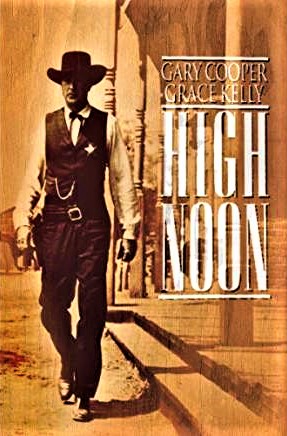
High Noon (Theaters-1952; DVD-May 2004) Rated: TV-PG  —  Runtime: 84-85 minutesM High Noon 1952

Genre: Action-Drama-Suspense-Thriller-Western

els – 8.5/10

IMDb – 8.0/10

Amazon – 4.7/5 stars

Rotten Tomatoes Critics – 8.8/10

Rotten Tomatoes Audience – 4.0/5

Metacritic Metascore – 89/100

Metacritic User Score – 8.4/10

Awards: 4 Academy, 4 Golden Globes

Directed by:  Fred Zinnemann

Written by:  Carl Foreman

Music by: Dimitri Tiomkin

Cast: Gary Cooper, Lloyd Bridges, Grace Kelly

Film Locations:  Burbank, Columbia State Historic Park, Iverson Movie Ranch, Jamestown, Tuolumme, Wanerville; all in California, US

Budget: $730,000

Worldwide Box Office: $8,000,000-18,000,000

Will Kane (Gary Cooper), a soon to be retired lawman from a small, quite, town of dusty streets in old west New Mexico, is getting married and taking his new Quaker wife (Grace Kelly) away for a fresh beginning in another town; to raise a family and run a store.  Moments before they are to leave they learn that Frank Miller, a convicted murderer that Kane and a local judge captured, convicted, and sent to prison has received a pardon from the governor. Miller is coming in on the noon train to settle the score. Waiting at the train station for Miller is his younger brother and two other shifty varmints, eagerly providing guns and muscle to back him up in his all-consuming quest for revenge.  Kane attempts to round-up a pose to face Miller and his gang, but all the town folk decline and insist, instead, that he leave town, a suggestion heartily supported by his pretty young wife.  Knowing that if he ran Miller would follow, Kane stays to make his stand now rather than later: alone.

A truly classic western filmed in black and white under Foreman’s spartan script and directed by Zinnemann in real-time at a parsimonious and fast pace.  The stark cinematography provides the tension inherent in the plot, always pushing the viewer onward to the next scene, straight ahead or around the corner.  The acting was absolutely first-rate.  Gary Cooper won a best actor Oscar for his efforts and had a supporting cast that included some of the greatest names in Hollywood; Lloyd Bridges, Grace Kelly, Otto Kruger, Eve McVeagh, Thomas Mitchell, Henry Morgan, and Lon Chaney Jr.  What a lineup.  Finally the movie included the legendary theme song Do Not Forsake Me, Oh My Darlin’ aka The Ballad of High Noon written by Dimitri Tiomkin and preformed by Tex Ritter; a hardy but forlorn synopsis of the movie’s plot.

The film, when previewed for the press was greeted with derision.  Due to the critics proclaiming the movie a failure the producers decided not to release the movie.  Tiomkin then bought the rights to the theme song and released it with Frankie Laine singing the lyrics, becoming an immediate worldwide hit.  Because of the public’s  positive reaction to the song, the movie was released a few months later, eventually garnering Tiomkin 2 Oscars for movie’s theme song and score.

The movie, released in 1952, played in theaters during Korean War and McCarthy’s Red Scare: the hunt for communists in US government and private institutions, especially Hollywood.  The movie was, and still is, believed to be an allegorical expression of the downtrodden, the just David standing tall against the unjust and unproven allegations. Standing up to the Goliath known as Joseph McCarthy.  During this time being branded, with or without proof, by the scarlet, hot iron C of communism was the end of many careers in the US.  The movie tried to push back and with all things Hollywood, feigned righteous innocence.

Without, or maybe even with, the knowledge of the Red Scare, the movie today is seen more as good versus bad without the partisan grey over-prints.   The right and the small meeting the wrong and the mighty.  Fighting the good fight whatever the odds. Being small doesn’t make you weak.  Being alone doesn’t make you wrong.


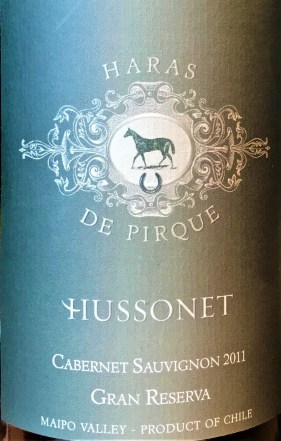
Haras de Pirque Hussonet Gran Reserva Cabernet Sauvignon 2011

W Hussonet 2011Cabernet Sauvignon from Maipo Valley, Central Valley and Andes, Chile

100% cabernet sauvignon

14.0% alcohol

Purchased: 20 Aug 2016 – $12.99

Opened: 11 Feb 2018

els: 8.7/10

James Suckling: 95

Wine Spectator: 88

Cellar Tracker: 88

Eduardo Matte in 1991 purchased an estate he later named Haras de Pirque, a term derived from the combination of a name for a 1892 thoroughbred stud: Haras; which also is the French term for stud farm, and the Chilean commune name for the area: Pirque.  The estate is less than 20 miles southeast from the center of Santiago, Chile in the Maipo Valley and a little over 20 miles east of the Andes Mountain’s year-round snow fields. The estate, eventually growing to encompass approximately 1500 acres, lies on the western edge of a peripheral, Miocene-Pliocene aged, Andes’ thrust fault and has almost 250 acres devoted to growing Cabernet Sauvignon, Merlot, Carmenere, Chardonnay, and Sauvignon Blanc grapes. The remainder of the estate is dedicated to raising horses for racing and show. The Hussonet name comes from a famous eponymous American-Chilean stud, whose offspring have achieved some success as race horses in Chile and Australia.

The vineyards and winery, beginning in 2003, were originally a 50-50 joint venture with the Italian company, Marchesi Antinori, and their first wine was a Bordeaux red blend under the Albis label.  The Hussonet label followed a few years later.

The Antinori family, an ancient clan believing they can trace their blood lines back to the 11th century BC city of Troy, and their winemaking, a more persuasively detailed chronicle, dating back to at least the time of the Florentine Renaissance, bought out Matte’s share in the Harris de Pirque estate in mid-2017 and they plan extensive changes to the winery and vineyards to better reflect their name, which is synonymous with prestigious wines in general and Super Tuscans in particular.

Cabernet Sauvignon is a cross, believed to have occurred naturally sometime in the 1600s in France, between Cabernet Franc and Sauvignon Blanc grapes.  It is now the most widely planted grape in the world.  A thick-skinned grape that’s relatively easy to grow and maintain and it exhibits high tannins and acidity, along with cool climate grown aromas of peppers and currants.

The Haras de Pirque vineyards are located between 1800-2100′ above sea level on the west side of an outlier Andes series of foothills. The soils are clays and loams mixed with large alluvial and colluvial stones. Growing season temperatures have a diurnal range of approximately 50-85ºF and rainfall amounts average a very dry 0.5″ per month or less. During the southern hemisphere winters rainfall can exceed, but still dry, 2″ per month.

There is no useful information available, that I can find, on the actual details of making of this wine.

The wine has ruby-red to purple color with a garnet rim. A bouquet of black currants, pepper, and a hint of vanilla. On the palate the wine is full-bodied, rich in tannins, but slightly drier and more acidic than usual for a Cabernet Sauvignon. The finish is short to medium.

A good wine at a fair price. Pair with a snack of hard cheese and salami.  Not a great wine to add to the menu for an expensive or fancy beef meal. Drink now, but should last until 2021.  Decant and aerate for one hour before drinking.

$9.99-16.12 wine-searcher.com

Arzuaga Pago Florentino 2007

W Florentino 2007Tempranillo from Malagon, Ciudad Real, Castile-La Mancha, Spain
100% cencibel (tempranillo)

14.5% alcohol

Purchased: 18 Aug 2014 $13.98

Opened: 7 Feb 2018

els: 9.2/10

Cellar Tracker: 93

Decantalo: 89

Penin: 89

In the early 1990s the Arzuaga Group established themselves in the small hamlet of Quintanilla de Onésimo, Spain, north of Madrid about 90 miles and 125 miles south of the northern Spanish Atlantic coast.  The hamlet of little more than 1000 souls occupies the flat agricultural plains adjacent and immediately south of the Duero River. The companies vineyards in the area grow Cabernet Sauvignon, Merlot, Pinot Noir, Tempranillo, and Chardonnay grapes.

In 1997 the company, looking for additional olive groves for their olive oil business, instead found and purchased the existing 143 acre vineyard: La Solana. The vineyard is near the small town of Malagon, Spain, located between the Toledo Mountains to the north and the Sierra Madrones to the south. The vineyards and winery did not begin producing wines until 5 years later in 2002.  In 2009 the vineyard was granted Vino de Pago status; the highest quality category of Spanish wine.  To obtain this designation the wines have to not only meet the DOCa requirements, but must also have a proven track record of consistently high quality and the grapes have to be grown, processed and aged on the estate.

Tempranillo grapes, called cencibel in the Ciudad Real area, are thick-skinned and love sunny, long hot days and cool nights, all of which brings forth a deep red wine with mild to moderate tannins and low to medium acidity. These qualities help generate a deep-colored medium-bodied wine with a wide range of aromas and tastes, including strawberries, blackcurrants, cherries, leather and tobacco.

The La Solana vineyard is on the north side of a series of low hills, with the vines growing in a rocky, pebbly top soil with an impermeable clay layer below. The vineyard grows, in addition to Tempranillo; Syrah, and Petit Verdot grapes. The growing season temperatures range from about 50-92ºF with rainfall ranging from as little as 0.25 inches to as much as 2.25 inches per month.

The grapes are hand-picked, sorted, de-stemmed and then gravity fed into casks or barrels. The grapes undergo approximately a 5 day cold maceration and a 7 day hot fermentation at roughly 82ºF. Only some of the wine undergoes malolactic fermentation in new oak barrels. The wine is aged for about 12 months in French and American oak barrels.

The wine has ruby-red to purple color with a garnet rim. A bouquet of fresh cherries, leather, and earthy mushrooms. On the palate the wine is well-balanced, medium to full-bodied with a medium finish. Wonderful.

An outstanding wine at a  good price, if you can find it, but later vintages should be similar. The 2012 vintage was a good year with similar ratings. Serve with traditional La-Mancha dishes; such as pisto soup, cuchifritos and paella. If you wish lighter fair try with crab stuffed mushrooms and soft cheese. Drink now, but should last until 2020.  Decant and aerate for one hour before drinking.

$18.99 wine-searcher.com


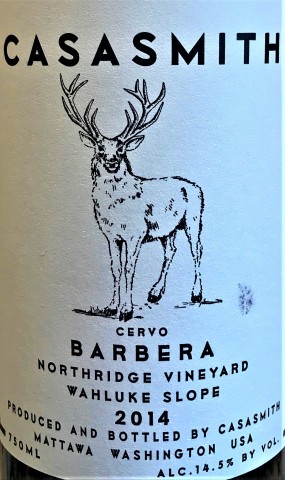
CasaSmith Cervo Barbera 2014

W CasaSmith 2014Barbera from Columbia Valley, Washington, US
100% barbera

14.5% alcohol

Opened 5 Feb 2018

els: 9.1/10

Wine Advocate: 93

Wine Enthusiast: 91

International Wine Report: 90

Cellar Tracker: 88

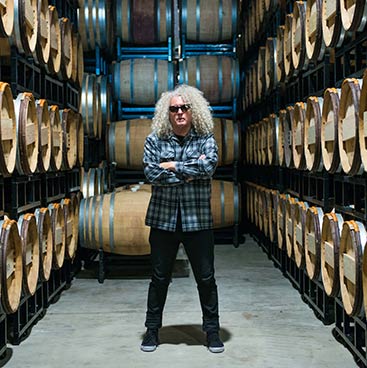
Charles Smith, vagabond, restaurateur, rock band manager, hard partier, and after almost 40 years decides to postpone adulthood further by starting a winery.  And doggone it, he’s good at it.  Mr. Smith builds up the winery, produces some darn good wines and sells the business for a ludicrous amount of money, and then promptly starts another winery; which he will likely sell for an even larger and more absurd (ludicrouser?) amount of money.  I spent 35 years at a nice, respectable and steady day job, thinking I was proceeding down a proper path.  Retrospection of ones life can be painful.

W Charles Smith 2018

Charles Smith.  Photo stolen from one of his web sites.

Charles Smith has set up shop in the southeastern Washington state, Columbia Valley town of Walla Walla; a megalopolis of about 45,000 folks which sits close to the Oregon border. The Cervo Barbera wine is part of a collection of Italian grapes grown and produced from his Washington vineyards, where he strives to reproduce the quality and integrity that one would find in Italy.

The Barbera, native to northwestern Italy, is a dark purple skinned grape producing a wine of low tannins and high acidity.  To combat the acidity, ageing the wine in old or neutral oak barrels is highly recommended to give the product more balance and a smoother finish.

The Northridge vineyard, planted in 2003, is a 92 acre site on a Wahluke Slope alluvial gravel fan, created approximately 15,000 years ago, in the Late Pleistocene, from the periodic floods originating from the ice dammed Glacial Lake Missoula in western Montana. Underneath the gravels are caliche deposits and Miocene-aged flood basalts.  The gravels provide excellent drainage for the vine’s roots and the caliche provides the calcium carbonate that the Barbera grapes thrive on.  Growing season temperatures range from daytime highs around 90ºF to nighttime lows approaching 40ºF.   Rainfall, during the growing season, ranges from 0.6-2.25″ per month.  The Northridge vineyard is approximated 2º degrees of latitude further north than its Italian Barbera counterparts in northwestern Italy and as a result receives more summertime sunshine.

The wines are whole cluster fermented and macerated for 37 days.  The wine is aged in old oak barrels for 12 months.

A wine with a garnet to ruby-red color and an amber rim. A bouquet of earthy herbs and black berries. On the palate a fruity, full-bodied, slightly acidic but balanced wine.  It has a fresh, long finish.

An outstanding wine at a fair price.  Serve this Italian wine with Italian pastas and pizzas. Drink now, but should last until 2020. Decant and aerate for one hour before drinking.

$20.00 wine-searcher.com

Wine, Wine, Wine

The Home Winemaker’s Companion B Wine 2000

Written by:  Gene Spaziani and Ed Halloran

Published by:  Storey Publishing

Copyright:  © 2000

Give me wine, wine, wine, all the time, time, time
‘Cause when I get it, I feel so doggone fine

Well, a little bit o’ wine is never bad
People drink wine to keep from feelin’ sad
‘Cause when I get it, I feel so doggone fine

Give me wine, wine, wine, all the time, time, time
‘Cause when I get it, I feel so doggone fine

Well my grandmother loved wine so much
It even took her off the crutch

Give me wine, wine, wine, all the time, time, time
‘Cause when I get it, I feel so doggone fine

Wine Wine Wine by Maxwell Davis and Floyd Dixon ©1976?

Many years ago I read an interview of an Earth scientist, a geophysicist, in a technical journal discussing his life’s work.  I no longer remember the man’s name or much of what he said in that article; in fact the only thing I do remember, and I have absolutely no idea why it has stuck with me, is a comment that he made on the subject of red wine. Why that was germane to the article also remains a mystery to me but the quote was succinct and indubitable, and I believe I can recite it verbatim: “I wish I had started drinking red wine much earlier in life.”  I can only add that I whole heartedly agree.  My red wine drinking days started, regrettably, way too late in life. At my age one realizes that life is short, so let’s get on with it.  Get on with the good things in life that is.

I enjoy all things about red wine; researching, reading, writing, buying and above all else drinking.  The next step in my journey is to start making my own red wine, learning the steps and methods that go into creating a drinkable, and hopefully, a good red wine.  An excellent first step is to study and learn from this book: The Home Winemaker’s Companion.

The book is compendium of need-to-know facts and processes about making wine in your home.  Making wine is not rocket science but discipline and patience are required. It starts out listing and describing the equipment, the hardware, the tools, you will need, both what is essential and what is useful but not entirely necessary.  Some of the materials you may already have in your home such as funnels and measuring cups but likely you will need to invest in some 6-7 gallon food-grade pails and carboys for fermenting and aging your wine plus some basic tools such as stirring paddles and large bottle brushes.

Next come the ingredients other than the grapes themselves; yeasts, cleaning and fining agents and other simple or specialty chemicals needed to ensure a successful wine. The book helpfully lists numerous yeasts that are needed for various varieties of wine.

Cleanliness and sanitation of your equipment is a must for making wine.  The book states over and over the importance of sanitation, and describes the proper methods and chemicals needed to ensure clean and sanitized equipment.

The book then describes the basic steps in actually turning your grapes into wine.  This includes, but not limited to, testing for sugar and acid, racking (transferring to another container) your wine, imparting an oak flavor, and finally bottling and corking your wine.  Save your old wine bottles for reuse but purchase new corks.

Before the book gets into the actual recipes for the various red and white varieties of wine, it discusses the advantages, and disadvantages, of using kits and grape concentrates versus crushing and maceration of your own grapes.  Once you decide your starting point on the initial condition of the grape, you can select the actual recipe, all of which include detailed, step-by-step instructions.

The final, and maybe the first, step in wine making is patience.  Patience to allow the wine to ferment, age and improve.  My initial plan is to allow the wine to age in glass carboys, oak and bottles for at least 2 years.  Success will take some time to determine.  I do hope I have the patience.

Crios de Susana Balbo Malbec 2015

W Crios Malbec 2015Malbec from Uco Valley, Mendoza, Argentina

95% malbec

5% bonarda

14.5% alcohol

Opened 2 Feb 2018

els: 9.0/10

Wine Advocate: 90

James Suckling: 90

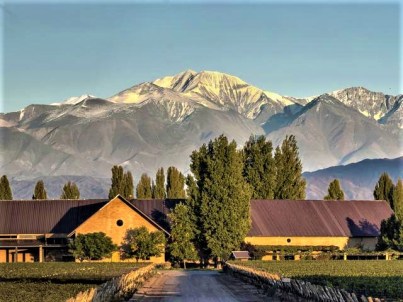
Susana Balbo’s winery, established in the stunning, idyllic eastern foothills of the Andes Mountains, within the viticultural region of Uco Valley, is southwest of Mendoza, Argentina. The winery is surrounded by 52 acres of Malbec, Cabernet Sauvignon, Cabernet Franc and Petit Verdot vines; producing 4 brands of wines with distinct and complex personalities that appreciate long, secluded years in their bottles: Crios, Ben Marco, Nostros and Susana Balbo Signature. The Bonarda grapes are sourced from surrounding non-Balbo vineyards.

The vineyards are at an average elevation of about 3700-3800 feet above sea level where the steppe climate provides a large swing in growing season temperatures ranging from daytime highs in the mid 80s to night-time lows approaching 50°F. The climate is arid and vines receive a paltry 1-1.25″ of rain per month. To compensate for the semi-desert conditions and the well-drained alluvial soils of Uco Valley, the vineyards are drip irrigated using the Andes’ snow melted water to provide just the right of amount of essential moisture to produce these flavorful wines.  This vintage’s growing weather was cooler and wetter than normal.

W Balbo Winery

Susan Balbo Winery

The grapes are hand-harvested and spend 25 days in maceration vats.  After maceration the wine spends 9 months in new French oak barrels.

The wine has ruby-red to purple color with a garnet to peach rim. A bouquet of fresh cherries and blackberries. On the palate the wine is very well-balanced and medium bodied.  Very fresh and cooling.

An outstanding wine at a very good price. Serve with lamb or beef steak. Get adventurous and try with a grilled tuna steak. Drink now, but should last until 2022-2023.  Decant and aerate for one hour before drinking.

$11.99 wine.com

Dishonorably Spent

Avenge the Crows: The Legend of Loca (Theaters-NA; Streaming-December 2017) Rated: TV-MA —  Runtime: M Crows 201796 minutes

Genre: Action-Crime-Drama-Thriller

els – 3.0/10

IMDb – 5.4/10

Amazon – 4.4/5 stars

Rotten Tomatoes Critics – NA/10

Rotten Tomatoes Audience – 5.0/5

Metacritic Metascore – NA/100

Metacritic User Score – NA/10

Directed by: Nathan Gabaeff

Written by:  Nathan Gabaeff

Music by:  Spencer Brock, Nathan Gabaeff

Cast:  Danay Garcia, Michael Flores, Cesar Garcia, Lou Diamond Phillips, Danny Trejo

Film Locations:  Los Angeles, US

Budget: $NA — Low-Budget Indie

Worldwide Box Office: $NA

Loca (Danay Garcia), is a down on her luck gangbanging, murdering, thieving, slutty, drug dealing, junkie with a bad temper.  She’s the movie’s protagonist, the champion, the heroine who screws everyone and everything just to become a little more amoral and mercurial than yesterday. She’s the object of a prison gang’s mysterious hit sanction, which she must defend herself and her innocent cousin against and, just to thicken the plot, she must outsmart and outflank a Mexican drug cartel and the opposing LA street gangs.  All by tomorrow.

This is  Nathan Gabaeff’s second effort as a writer and director, the first being the poorly received 2016 Boost, also featuring Danay Garcia and Danny Trejo.  Avenge the Crows is a low-budget film that comes across as being written and directed as an allegorical, non-judgmental documentary of gang life on the streets of LA, complete with flickering static and choppy breaks in the film.  The story is brutal and stupid, the violence and sex are cheap, bordering on pointless. Then there’s the dialogue capable of contradicting itself  in the same scene.  Garcia tells her cousin that it must be the RR prison gang that is responsible for stalking them and then in the next sentence tells her cousin that the gang has no Earthly reason to stalk them.  Well, which is it? How do you arrive at the conclusion that it’s the RR gang when you have no reason to suspect them.

There is some good acting in this movie, Phillips and Trejo, despite the screenplay and direction, but that doesn’t include Danay Garcia.  The women can’t act, but as long as she keeps taking her clothes off the money folks will keep casting her.

Gabaeff was able to pull in some of the most recognizable names in Hispanic acting; Garcia, Phillips, Trejo, for this low-budget movie.  I can’t fathom how he was able to convince these actors sign up for this stinking dog of a movie and, sadly, he has more of these losers in the pipe-line.

This is a movie about the worst of the human condition and its degrading impulses. It passes on declaring any judgement; moral, ethical, or legal; neither for nor against: pathetic.  The movie is artistically dead and morally bankrupt.

Desire and Chocolate

A Legacy Made in Chocolate Edited by Lydia Bell and Fiona Sims, published by B Godiva 2016Illustrated London News Limited, © 2016.

Godiva is may favorite chocolate.  When I have Godiva chocolates in the house I worry about gaining weight but I usually don’t because the rest of the family always, and I mean always, beats me to the box of goodies and gobbles them up before I can over indulge.  I know I should hide them, keep them for myself, deny the pleasure to others but that would just be curmudgeonly selfish. I think I can do that.

The art, biography, and history of the Drap family and their boundless love for all things chocolate is contained within the covers of this short, but lavishly illustrated book. The pages of this book bring to life the Belgium family’s chocolate odyssey, beginning in 1926, as they continually generate smiles of gratitude and gastronomic satisfaction for over 90-years.  Laid out in opposing columns of English and French, this album of confectionary delight brings to the reader Godiva’s inspiration, their style, and their passion for making everything chocolate.  Inspiration from the fashion houses of Paris and Brussels. Style from the Belgium arts university, La Cambre and artists of renown such as Oli-B. Passion for chocolate from the leading Chef’s and chocolatiers of Belgium.

This is a visually captivating book bringing to your eyes what Godiva’s chocolates bring to your palate: sensual, divine pleasure.  The book will only take a few leisurely hours of your time, but be forewarned, your desire for Godiva truffles will be magnified a hundred fold.