Million Dollar Kidnapping

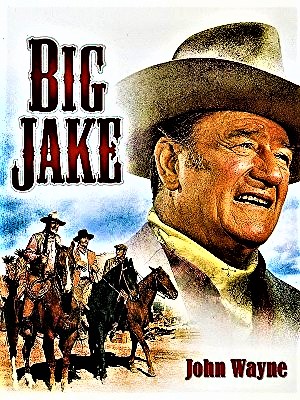
Big Jake  M Jake 1971

Theaters:  May 1971

Streaming:  April 2003

Rated:  PG-13

Runtime:  110 minutes

Genre:  Action – Adventure – Classic – Western

els:  7.0/10

IMDB:  7.2/10

Amazon:  4.8/5 stars

Rotten Tomatoes Critics: NA/10

Rotten Tomatoes Audience:  3.8/5

Metacritic Metascore:  NA/100

Metacritic User Score:  NA/10

Awards: NA

Directed by:  George Sherman, John Wayne (uncredited)

Written by:  Harry J. Fink, Rita M. Fink

Music by:  Elmer Bernstein

Cast:  John Wayne, Richard Boone, Maureen O’Hara

Film Locations: Durango, Sonora, Zacatecas, Mexico

Budget: $4,800,000

Worldwide Box Office: $25,350,000

Little Jake (Ethan Wayne), Big Jake’s (John Wayne) grandson, is kidnapped from the family ranch by a ruthless gang of cutthroats who take the boy across the border from Arizona into Mexico. They will not release the boy until the family delivers a $1,000,000 ransom to them in the dusty deserts of Mexico. Martha McCandles (O’Hara), Big Jake’s estranged wife, manages the ranch while her husband, who has deserted her, travels the west with his redundantly named dog; she calls him home to perform the “harsh and unpleasant business” of bringing the boy back to the family.

George Sherman spent his life in film, starting in the mail room of Warner Brothers and eventually working his way up to director of almost exclusively ‘B’ movies, primarily westerns.  He directed John Wayne in a series of low-budget and forgotten westerns in the 1938 and 1939; a period in John Wayne’s career where he was clawing his way back to stardom after a 1931 run-in with Columbia boss Harry Cohn.  John Wayne never forgot. Sherman only danced in the big time twice. He directed Wayne in Big Jake although he fell ill during filming and John Wayne filled in for him but didn’t take any screen credit for it. He also produced Wayne in the 1961 western, Comancheros.  Sherman earned a reputation of making something out of nothing in his low-budget films; creating motion cantatas of cowboys doing what cowboys do, jumping on horses, riding horses, jumping off horses.  In Big Jake he gives his cinematographer, William H. Clothier, free rein to film the majestic Sonoran Desert panoramas along with superbly and convincingly constructing a story that straddles the fading west as it melts into the modern world of 1909.

John Wayne and Maureen O’Hara reprise their, can’t live with ’em, can’t live without ’em roles, that they so charmingly put together in the 1963 comedy, McLintock!. The charm and laughs are still there but this time Big Jake is a tad meaner.  He is still a gentleman but he can be down right ornery and lethal when needed and in this story, it’s needed.  O’Hara is a true treasure in the Hollywood of days gone by and in this movie she proves why. She is absorbing and natural but there is not enough of her. Her part ends after the opening scenes.  It’s a shame they couldn’t find a way to keep her in through the end. Richard Boone, as bad guy John Fain, upholds his part with a performance that has you believing that he is truly a dastardly beast.

Big Jake is a friends and family affair. Wayne’s friends and family are thick in the making of this movie. They direct, produce and act. Wayne pays his debts and provides avenues for the up and coming just as John Ford and others did for him in the past.  Wayne also makes this a movie of morals and putting the pieces of his broken family back together again.  Another fine, although not great, John Wayne western that you should watch more than once.

Bodegas Castano Hecula 2013

W Hecula 2013Monastrell (Mourvedre) from Yecla, Murcia, Spain
An Eric Solomon Selection

100% mourvedre (monastrell)

14.0% alcohol

Purchased: 12 November 2017  –  $10.99

Opened: 3 March 2018

els:  9.0/10

Wine Advocate:  91

Guia Penin:  88

Cellar Tracker:  87

The Murcia Region of Spain, located in the Segura River basin in the southeastern part of the country with the Beltic Mountains in the central west, the coastal Mediterranean plain to the southwest and the central high plateau to the north and east. Yecla, 45 miles northwest of the Mediterranean coast, is a small Denominación de Origen (DO — Designation of Origin in English) food and wine region in the northeastern corner of the Murcia Region which takes it name from the eponymous small town of 35,000 people. Yecla enjoys a mixed Mediterranean-continental climate; dry with rare freezes and large swings in the daily temperatures. It is mainly noted for its Monastrell wines and is entirely surrounded by the other notable Monastrell regions of Jumilla, Almansa and Alicante.

The DO classification is Spain’s second highest, DOC being the highest, in terms of quality for wines and food. In 2003 Spain added the DO Pago designation applicable only to single estate wines.  A classification that allows wineries some latitude in production and grape usage, slightly mimicking Italy’s Super Tuscan designation.  Currently there are 2 DOCs (Rioja and Priorat), 69 DOs and 14 DO Pagos in the country.

Yecla vineyards, dating back to the seafaring Phoenicians, are mainly planted in red grapes with Mourvedre vines being the most common. Syrah, Grenacha, Merlot, and Petit Verdot are also grown but in lesser amounts. Currently there are about 26,600 acres of vineyards in the Yecla area with approximately 75% of that existing under the DO designation. This constitutes only 1% of the total grape acreage planted in all of Spain. The Yecla wineries produce upwards to 9,000,000 liters of wine per year, of which 95% is exported out of the country.

Mourvedre is the 9th most planted grape in the world, by acreage, and is the 6th most common in Spain. It is one of the primary grapes for GSM blends, Grenacha and Syrah being the other 2, and is only occasionally bottled as a single grape wine. Spanish wine makers also use this grape, along with others, such as Grenacha and Tempranillo, for making sparkling roses or cava roses. It is a black-skinned variety that is believed to have originated in Spain but is now found throughout the world, especially in France, Australia, US, and South Africa. Spain produces the lions share of this grape with France coming in a distant second; all other countries place as a comparative after thought. The grape has bold flavors of blackberries, tobacco and black pepper.  In cool climates the grape takes on notes of red plums.  It is a full-bodied wine with high tannins and medium high acidity allowing for a long shelf life.

The Bodegas Castano is the best known and largest winery in Yecla. The family run operation traces its roots, in the area, back to the 1950s but it wasn’t until the 1980s they started bottling their own wines. Starting in the early 2000s the family steadily upgraded their winery and cellars including temperature controlled fermentation and smaller tanks for selective vinification. Their vineyards and winery occupy about 16,000 acres with Monastrell grapes planted on a little less than 1000 of those acres.

Only 2 of the 8 Castano vineyards grow the grapes for the Hecula wine: the higher altitude Las Gruesas and Pozuelo. The 400 acre Las Gruesas vineyard at roughly 2600-2800′ above sea level has organically poor, clayey to gravelly limestone soils with 35 to 60-year-old vines. In addition to Monastrell grapes, red varieties of Garnacha, Merlot, Cabernet Sauvignon, Syrah, and Cabernet Franc are also grown. The 100 acre Pozuelo vineyard at approximately the same elevation as Las Gruesas has similar soils but not as rocky. Its vines are slightly  older with some in the 80-year range. This vineyard grows, in addition to Monastrell, Garnacha Tintorera, Merlot, Cabernet Sauvignon, Syrah, Macabeo and Tempranillo grapes. The growing season diurnal temperature range in the area is 50-85ºF with rainfall ranging from 0.25-2.0″ per month.

The Monastrell grapes are hand harvested, destemmed, sorted, fermented, and macerated at 77ºF in stainless steel tanks for 10 days. The wine then spends 6 months in half new, French and American oak barrels at approximately 64ºF. Production is limited to approximately 12,000 cases. This is an Eric Solomon Selection, slated mainly for export to the US.

A medium to dark ruby-red wine with a light purple rim. Aromas of black fruits and pepper. Full-bodied and nicely balanced.  The tannins are thick and chewy with a very easy acidity that produces a long-lasting finish.

Enjoy this wine with a Spanish dish of Chicken Paella. You will need a cup of vegetable oil, 1 green and red pepper diced, 3 breasts of de-boned chicken; each breast cut into 4-6 pieces, 3 cups of white rice, 6 cups of chicken broth, 8 ounces of peas; canned or fresh, 1 small onion chopped, 2 tomatoes diced, 1 clove of garlic or 2 teaspoons, salt and pepper to taste,  and parsley.  Heat half the oil and put the chicken into a(n) (iron) skillet. Cook for 15 minuets or until brown and remove to a holding dish. In the same skillet with the hot oil, cook the chopped onion for 5 minutes, add the diced tomatoes, and cook for an additional 5 minutes while mashing the tomatoes. Strain the mixture through a colander and add the solids to a paella cooking pan; woks work great.  Add the rest of the oil, plus the cooked green pepper and chicken. Stir the mixture to avoid further browning of the chicken.  Add salt, pepper and broth.  Keep hot but do not boil.  Add garlic and parsley to the cooked rice.  Add the rice, peas, and red pepper to the paella pan containing the chicken after the broth is reduced by half.  Cook for another 20 minutes.  Remove from heat, cool for 5 minutes, and serve.

An outstanding wine at an unbelievable price. Drink this year but likely good until 2020-2023. Decant and aerate for one hour, or more, before drinking.

$8.95-15.27 wine-searcher.com

A Waste in Time

A Wrinkle in Time   M Wrinkle 2018

Rated:  PG

Runtime:  109 minutes

Genre:  Adventure – Family – Fantasy – Science Fiction

Theaters:  February/March 2018

Streaming:  NA

els:  1.5/10

IMDB:  4.1/10

Amazon:  NA/5 stars

Rotten Tomatoes Critics:  5.2/10

Rotten Tomatoes Audience:  2.5/5

Metacritic Metascore:  52/100

Metacritic User Score:  2.9/10

Awards: NA

Directed by: Ava DuVernay

Written by:  Jennifer Lee, Jeff Stockwell (screenplay), Madeleine L’Engle (book)

Music by:  Ramin Djawadi

Cast: Oprah Winfrey, Reese Witherspoon, Mindy Kaling, Storm Reid, Levi Miller, Chris Pine

Film Locations:  Eureka, Los Angeles, Santi Clarita – California – US;  Hunter Valley, Wanaka – Otaga – New Zealand

Budget: $103,000,000

Worldwide Take: $39,000,000 (Opening Weekend)

Dr. Murray (Pine), an astrophysicist, referred to as Mr. Murray for reasons not stated, tells an audience of his peers that he can transverse 93 billion light years in the wink of an eye using a concept called tessering.  He is laughed off the stage. Later he disappears without a trace leaving his wife and two children adrift in the world without him. Charles Wallace (Deric McCabe), youngest sibling of the two Dr. Murrays and a child prodigy, discovers the three Ws: Mrs. Which (Oprah), Mrs. Whatsit (Reese Witherspoon) and Mrs. Who (Mindy Kaling); shape shifting, time travelers who are in search of a hero to save the universe. Charles Wallace introduces his socially inept sister, Meg (Storm Reid) to the Ws and they all convince her to be that hero; to search for her father and save the universe before the evil thing, It, destroys all that is light and good.

B Wrinkle 1962The movie is based on the Madeleine L’Engle’s 1962 book A Wrinkle in Time, a children’s book that was rejected 26 times before eventually finding a publisher: Farrar, Straus & Giroux. The book has been  in continuous print ever since.  The book, as with the movie, deals openly with evil while simultaneously equating Jesus with Buddha and other notable humans.  Publishers felt these topics too heavy for children and too anti-Christian for adults.  Later L’Engle hinted, because the hero was female, that misogyny also contributed to its multiple rejections. Elizabeth Bennett, Jane Eyre, Scott Finch, Dorothy Gale, Anna Karenina, Joe March, Lady Macbeth, and Natasha Rostova could not be reached for comment.

The director, Ava DuVernay, opened the movie with a brief comment on making the film and thanking the viewers for watching, almost begging them to like it.  This was a tact that I have never experienced before, at least that I can remember (maybe Walt Disney did the same with his movies).  At some level, I suspect, she was warning us that what was to follow was an absolute rotter.  She has managed to make a movie where not one single thing clicks.  It’s all strung together scenes with no audience connection, no avenues provided to bring the viewers into the movie. She gives us no reason to like this movie, just reasons to hope it ends soon.  DuVernay along with the writers Lee and Stockwell seem to have a lot of ideas to make great movies but using them all in one film is probably not wise.  The long drudgery of scene on the planet Uriel comes across as an excuse to film in 3D and imitate the 2009 film Avatar. Sorry, but James Cameron did it better.  For a children’s movie the writing was childish. The Ws tell Meg that her faults are her strengths.  Later Meg tries telling her brother that she is uncoordinated and we are supposed to believe that this is a strength that will conquer the big bad evil thing, It.

This is the first movie that a female director was given a $100 million for a budget.  I’m sure it’s not the last big budget for a woman but hopefully its the last for DuVernay.  As for Jennifer Lee it appears animation is where her talents are best utilized.

There is very little good to say about the acting. Oprah is thoroughly wooden throughout the movie and never quite figures out where to look when using the green screen.  Mindy Kaling reads her lines with no delivery —  sad. Meg has no ability beyond deer in the headlights wonder. Witherspoon was charming and excellent but not enough to cancel out the bad acting going on all around her.  Zach Galifianakis, playing the Happy Medium, was also fun and he had the only line in the movie that made me laugh.  He is lecturing Meg and she tells him he sounds like her mother.  Galifianakis responds in all seriousness, “Why is she a baritone?”.

My family watched this movie together at a theater, which we very seldom do anymore; streaming at home is so much easier.  With my wife and I were our 26 year-old daughter, 15 year-old son, and 3 year-old granddaughter. Not one of us 5 liked the movie.  Not the kid, not the teenager, not the young adult, not us slightly older folks.

The granddaughter didn’t exactly say the movie was bad, she just didn’t watch it.  While the movie was playing she found a better use of her time; passing out popcorn to the rest of us one kernel at a time.  In the end I’m not sure who Disney made this movie for or why they wasted everyone’s time with it.  Save your time and cherish your time, see something else with your precious time.  I haven’t seen a movie this bad in long time.

Cru Food and Wine Bar

Cru Food and Wine Bar, 9595 Six Pines Dr., Suite 650, The Woodlands, TX (Market Street)
Price: $$$ / $$$$$R Cru 2018
Ambiance: 3.5/5
Service: 3.5/5
Food: 4.0/5

Cru, a French term meaning growth but is generally taken to mean terroir or more specifically the quality of a wine grown and produced from a specific terroir. Premier Cru and Grand Cru terms are typically associated with outstanding to excellent quality wines from distinct geographic regions such as a top-level wine labeled Premier Cru from the Medoc region. Cru in Texas appears to be associated with copious choices for savoring tasty whites, bold reds, and all the colors in between; with and without bubbles.

Cru Food and Wine Bar, originally a Texas establishment, is slowly dispersing across the country and currently has 15 locations in the US; 10 in the Texas cities of Austin, Dallas/Fort Worth, and Houston; 2 in Atlanta, Georgia; 2 in Denver, Colorado; and 1 in Lexington, Kentucky. Cru is dedicated to offering superb wines by glass and bottle along with a nice selection of California coastal style entrees and appetizers.

This is our first visit (7 March 2018) to Cru in The Woodlands.  My wife and I stopped in around 8 o’clock in the evening for a glass or two of wine and maybe a small bite of something tempting.  The bar and restaurant occupies a cozy little spot along the North Commons strip, across the street from the diminutive Central Park.  You have three options for seating: a patio for observing the street scene and people watching, an indoor bar and a few small indoor tables that by themselves seat 2-4 comfortably. The interior is tastefully done with blown-up wine labels decorating the back wall.  The interior space was clean and very quiet though there were only 3-4 couples seated around us. A casual and friendly atmosphere.

The waitress was very prompt greeting and seating us, and since it was our first visit, she was very pleasant in explaining the menu, which physically, was a thin wood panel with the food selections on one side and the wine by glass on the other.  I’m not sure who originated this type of menu but it sure is common, albeit nice, for wine bars all across the country.  They had a separate menu for libations and their extensive wine by the bottle offerings. The waitress continued to check in on us for orders and to see if all was well. The only small censure I had with the service was the visits to our table were a tad too spread out; 15-20 minute visit frequency, but I’m likely being overly critical.

W Valdisanti 2012While we studied the food menu we started off with a couple of glasses of a 2012 vintage Tolaini Valdisanti Tenuta S. Giovanni Toscana IGT from Tuscany, Italy at $20 per glass (I’m relying on my memory for the prices so I may be off a bit). A wonderful wine of dark fruits, full-bodied, well structured, with velvety tannins that leave you wanting more.  The wine is a red blend of 75%  Cabernet Sauvignon, 20% Sangiovese, and 5% Cabernet Franc that I rate at 90, maybe 92.  The serpent in the wine glass is the universal symbol for St. John the Baptist, “San Giovanni”, and is also the name of the Italian vineyard from which the wine hails. This wine retails, if you can find it, for $22-30 per bottle.

We eventually decided to have a few small morsels of cheese to go with our wine.  They have 4 different “flights” of cheese boards that include 3 samples of various cheeses along with bread, grapes, sliced apple and pear. We chose the Chef’s Pick flight for $16 that consisted of Testun Ciuc, a bold Italian cheese aged in a wine barrel;  a sheep’s milk Pecorino Brillo, aged in Chianti; and a cow’s milk Cashel Blue, an Irish blue-veined cheese.  All were delicious but we really like the Testun Ciuc.  The powerful flavor paired well with the Tuscan wine.

Our visit was delightful and we will be back, especially to sample some of the more interesting items on their menu such as Lamb Lollipops with blue cheese and prosciutto, Salsiccia pizza topped with goat, roasted peppers and Italian sausage, or the Cast Iron Seared Sea Scallops with spinach parmesan risotto.  Their extensive wine offerings we didn’t even begin to scratch.  They offer an ever-changing selection of about 30 wines by the glass and around 10 times that amount by the bottle.  So little time to experience and enjoy, but we will persevere and try.


Bullets from the Past

22 Bullets  (L’immortel, original title — French Audio, English Subtitles)M 22 Bullets 2010

Rated:  NR

Runtime:  115-117 minutes

Genre:  Action  – Crime – Drama – International – Mystery – Suspense – Thriller

Theaters:  Europe – March 2010

Streaming:  US – February 2014

els:  5.5/10

IMDB:  6.7/10

Amazon:  4.1/5 stars

Rotten Tomatoes Critics:  5.1/10

Rotten Tomatoes Audience:  3.3/5

Metacritic Metascore:  NA/100

Metacritic User Score:  NA/10

Awards: NA

Directed by:  Richard Berry

Written by:  Eric Assous and Richard Berry (screenplay), Franz-Olivier Giesbert (book)

Music by:  Klaus Badelt

Cast:  Jean Reno, Kad Merad, Jean-Pierre Darroussin

Film Locations:  Avignon, Marseille, Paris, France

Budget: $20,000,000

Worldwide Take: $21,300,000

Charlie Mattei (Jean Reno) after a career as a gangster wants to retire and spend the rest of his life peacefully with his family; a wife and 2 children.  Well, if wishes were politicians, thieves would rule — oh wait.  Mattei leaves his gangster business to his old criminal friend, Tony Zacchia (Kad Merad), and for 3 years he actually enjoys some peace until someone has 8 mobsters pump Charlie full of chemically accelerated lead. Charlie miraculously survives and recovers from the damage of 22 bullets and sets out to find those responsible; first without bloodshed then when that doesn’t work, firmer measures are employed.

The movie is loosely based on the real life Marseille mobster, Jacques “Jacky Le Mat” Imbert, who in the 1950s specialized in burglaries, hold-ups, and general thuggery.  By 1960s he added extortion, kidnapping and murder to his resume and was, and still is, considered the “Last Godfather” within French crime circles. In the late 1970 Imbert was gunned down by several mobsters associated with his old crime boss, Tony Zampa.  Doctors removed 22 pieces of metal from his body including 7 bullets.  He survived but his right hand was paralyzed.  Later 11 mobsters working for Zampa were gunned down in apparent retaliation for the failed hit. Police suspected and arrested Imbert but released him after 6 months for lack of evidence in the murders.  He reportedly retired when released but continued to associate with gangsters in Paris including the angelic, drug kingpin Francis “The Belgian” Vanverberghe of  The French Connection infamy.

Richard Berry, director, screenwriter and actor, known mainly for his work in French cinema, puts together a glossy gangster movie with great acting talent and replete with all the essential scenes of murder and car chases but little in the way of pizzazz or a hold-onto-your-seat intensity.  The movie at first has visions of Francis Ford Coppola’s The Godfather but quickly degenerates into a story too-many-times told with an uneven delivery of what, in the end, is another pedestrian revenge flick.  The movie keeps your interest but the character development is spotty for the secondary actors, leaving the viewer occasionally lost in the gun-smoke of plot development.  Berry could have also left out the morality lectures from gangsters; way too out-of-place for this genera. Honor among thieves is one thing but mobsters as altar boys is a step too far.

Jean Reno plays Charlie Mattei with his usual aplomb and sophistication which always makes him one of the more, if not the most interesting person in a movie.  Think Leon in The Professional or the inspector Captain Bezu Fache  in Da Vinci Code.

This is an average revenge movie with some interesting and creative scenes of the bad guys delivering justice to the bad guys but it never gets past the formulaic, and thus, predictable plot.  The movie could have been much more with less mobster morality, more with less graphic in your face violence, more with less regularity; a few real plot twists would have taken this movie to another, more interesting level.

Grotto Italian Restaurant

Grotto Italian Restaurant, 9595 Six Pines, The Woodlands, TX (Market Street)R Grotto A 2018
Price: $$$ / $$$$$
Ambiance: 4.0/5
Service: 4.0/5
Food: 4.0/5

When in North Houston we always make an effort to stop by the Grotto for lunch. We’ve been coming here since 2014, if my memory serves me correctly, and I can’t remember a bad experience, either in the food served or the service.  When I think about it that’s an achievement that applies to almost no other place I can think of with the exception of a few extreme, pricey, high-end establishments.

The Grotto, with 7 locations in Louisiana, Nevada, New Jersey, and Texas, is one of the 60-some different Landry’s specialty restaurants. The Grotto, serving upscale and standard Italian fare, delivers a diverse menu emphasizing quality cuisine and attention to the details. The restaurant occupies a cavernous open chamber of tile, wood, and plaster in subdued but pleasant colors and stylish decor.  When busy this open area can reach into some fairly high decibel levels. The walls have various poems and quotes concerning Italian food and eating that I have only been able to partially decode with my limited vocabulary in the language. Overall the spirit of the interior is one of understated charm and impeccable cleanliness.

We have always had great service at the Grotto with the exception of parking, which is the fault of The Woodlands, Market Street town square shopping district; there simply is not enough parking in the area to accommodate all the shops and shoppers. We have solved this problem in 2 different ways depending on how lazy I am.  Either we use the adjacent Woodlands Mall parking lot and walk the less than 2 blocks to the restaurant or drive up to the front entrance and make use of the valet parking service. Seating is always cheerful and prompt. We have never had a reservation for lunch and had to wait for a table only once, but we just had a drink at the bar, passed a few moments in irrelevant conversation and in no time the hostess showed us to our table.  Once seated we are promptly served with water and a bottomless assortment of spicy and plain breads along with a very nice olive oil concoction of herbs and spices. The waiter has always been attentive in all our visits, quickly taking our drink orders and following up at appropriate intervals to take additional requests or just inquire about the service and or meal. The manager will usually stop by for a quick chat which is always a nice touch.

W O'Lillo 2014Drinks are always a meal prerequisite with us and the Grotto provides ample supplies of everything to satisfy our whims.  Beers to martinis, wine to mojitos, your thirst can be satiated in multiple venues but we usually just partake in wine and beer. They have my standard Italian beers of Moretti and Peroni and an adequate selection of wines by the glass.  They have a much more extensive selection of wine available by the bottle. For this visit we had a Baracchi O’Lillo Toscana IGT Super Tuscan, possibly a young 2016 vintage, that was very good. It was a blend of Cabernet Sauvignon, Merlot, and Sangiovese; brimming with full-bodied black fruits and leaving a lasting finish. I would rate this wine 90+, and for $10 a glass, a steal.

We started off our meal with an appetizer of their meatballs priced at $10. A pair of fist-sized monstrosities filled with herbs and breading.  Very flavorful but way too much if you are also going to have a meal.  These spheres of opulence would be a perfect complement for an after-work drink or two. In the past we have also tried their $14 Scampi Grotto: shrimp scampi, that is very good and definitely less filing than the meatballs.

For our entrees I ordered my usual, Meatzza Pizza for $17.  The ingredients have changed over the years; with and without bacon, with and without mushrooms; the current version consists of pepperoni, Italian sausage, and mushrooms all atop a wonderful thin, crisp crust cooked up in an open-fire pizza oven situated in the middle of the bar.  In my mind, close to a perfect pizza, onions instead of mushrooms would be perfect, but too large for one person. We ended up taking half the pizza home with us.  My wife had the Ravioli di Mare for $18. A delicious serving of seafood ravioli, mushrooms, cherry tomatoes, and shrimp abounding in a wonderfully creamy and smooth white wine sauce.

We usually end our luncheon fare with something sweet but due to the excessive intake of the prior dishes we had to take a pass, but their ever-changing desert cart always  has something irresistible.  Mezzanotte, tiramisu, cheesecake, cookies, strawberry cassata among other seductive treats.  Starting with desert would be an acceptable choice.

The Woodlands Grotto is a fine place, a great place for lunch or dinner.

Castiglion del Bosco Dainero 2012

W Dainero 2012Merlot from Riparbella, Pisa, Tuscany, Italy

90% merlot

10% sangiovese

13.5% alcohol

Purchased: 6 March 2017  –  $16.99

Opened: 28 Feb 2018

els: 8.5/10

James Suckling: 92

Wine Spectator: 90

Cellar Tracker:84

Tuscany, a central Italian region bounded by the Tyrrhenian Sea on the west and the Apennines Mountains on the east, is a name synonymous with Italian Renaissance art, ancient history, landscapes of exquisite beauty, and wine. Its wine history dates back to the enigmatic but successful Etruscans in the 8th century BC, growing rich by trading their wine with the Gauls to the north and the Romans and Greeks to the south and east. The aura and renown of Iron Age Tuscany wine secured its perpetuation through the endless generations of Romans, Christian monks, Florentine merchants, Medicis, Hapsburgs, Bourbons, Bonapartes and todays modern Italians. Good wine and time immemorial happily going hand in hand.

Tuscany has the third highest quantity of acres planted in vines in the country but because of its extremely poor soils and the wine makers emphasis on lower yields, it is only sixth in volume, producing just shy of 300,000,000 liters of wine in 2016. The area has a plethora of DOCG and DOC wine regions plus 5 IGT sub-regions that will bewilder even the most diligent and attentive of students and that’s before the Super Tuscans enter into the smorgasbord of categories; all with their rules about grape varieties and percentages spread over a bursting profusion of wineries and vineyards. The better known regions include: Brunello di Montalcino producing rich, full-bodied sangiovese wines; Chianti and Chianti Classico producing the famous medium-bodied wines; and Bolgheri, the region that first produced the well received Super Tuscans.

Merlot is the 3rd most planted grape in the world and 5th most common in Italy. It is one of the primary grapes for Bordeaux blends and is very popular as a stand alone variety. It is a dark blue to purple grape with a soft, velvety structure with medium tannins and low acidity, producing dark fruity flavors.

Sangiovese is the most planted grape in Tuscany and all of Italy, deriving its name from the Latin for the “blood of Jupiter”. It is possible that this grape dates back to the time of Etruscans and is closely related to the Ciliegiolo grape. A sangiovese wine has an earthy cherry flavor that readily acquires a taste of vanilla and oak after aging in barrels.  The tannins are not too strong but the acidity is high.

The Castiglion del Bosco traces its heritage back to 1100 AD when the castile was built and in the 13th century the family owners added stone walls around the castile. Skipping forward a few years to 1967 the estate joins with a few other local families to found the Brunello di Montalcino wine association. Brunello eventually becomes one of the first Italian wines to be granted the DOC and DOCG categories. Massimo Ferragamo, in 2003, purchased Castiglion del Bosco to add to his winery in Riparbella. By the end of the decade he has added guest villas and a golf course to the Castiglion del Bosco estate.

Dainero is produced from the grapes grown at Castiglion del Bosco’s 25 acres of vineyards at Riparbella, less than 8 miles from the western coast and just north of the Bolgheri wine region. The vineyards are located within the wide-ranging Toscana IGT appellation. The vineyards enjoy an Mediterranean  to a sub-continental climate with cool ocean breezes drafting over the 1475′ above sea level west-facing, vine-covered hills.  The iron-rich, alluvial, clayey soils containing metamorphic gravels and pebbles, ensure that the vines are well-drained, healthy and stable. The vineyards are planted with Merlot, Cabernet Franc, Cabernet Sauvignon, and Petit Verdot. The diurnal growing season temperature-range for the vineyards is 50-85ºF with rainfall averaging 3-4″ per month.

The Merlot grapes were harvested during the first part of September while the Sangiovese grapes were harvested during the last part of this month. The grapes are processed at the Castiglion del Bosco cellars. After sorting the grapes they are gravity fed into steel tanks and fermented for 15 days at 82ºF .  The wine spends 6 months in French oak barrels, 30% of which is new and 70% old.  The wine then spends 6 months in the bottle before it’s marketed to the public.

A ruby-red wine trending towards purple with a tawny rim. Aromas of black fruits, currants, and spice. A medium to full-bodied, balanced and structured, but somewhat thick in the mouth.  The tannins and acidity are working well together producing a slightly sharp and long finish. I rated this wine at 8.5/10 mainly because I believe it is past its prime, not as clear and crisp as it should be.  The wine likely peaked about a year ago.

Enjoy this wine with a dish of spaghetti and Italian sausage.  A platter of hard cheeses would also do this wine justice.

A good wine that you shouldn’t spend more than $10 on. Drink this year. Decant and aerate for one hour, or more, before drinking.

$9.99-20.24 wine-searcher.com


A Little Big Tale

Little Big Man (Theaters – December 1970; Streaming – April 2003)  Rated: PG  —M Little 1970  Runtime: 139 minutes

Genre:  Adventure – Comedy – Satire – Western

els:  6.5/10

IMDB:  7.6/10

Amazon:  4.5/5 stars

Rotten Tomatoes Critics: 7.9/10

Rotten Tomatoes Audience:  3.8/5

Metacritic Metascore:  63/100

Metacritic User Score:  8.0/10

Awards: NA

Directed by:  Arthur Penn

Written by:  Calder Willingham (screenplay), Thomas Berger (book)

Music by:  John Hammond

Cast:  Dustin Hoffman, Faye Dunaway, Chief Dan George, Richard Mulligan

Film Locations: Calgary, Morely, Alberta, Canada; Billings, Crow Indian Reservation, Hardin, Lame Deer, Little Big Horn Battlefield, Nevada City, Virginia City, Montana – Agoura Hills, Los Angeles, Thousand Oaks, California, US

Budget: $15,000,000

Worldwide Box Office: $31,600,000

An ancient and time-worn Jack Crabb (Hoffman), spending his final days in a nursing home, relates his incongruous life of farce and fate to an interested historian.  At the age of 10 a Pawnee raiding party attacks his family and kills his parents. Later a Cheyenne brave finds him and his sister hiding in their destroyed wagon and takes them back to his tribe.  The tribe’s chief, Old Lodge Skins (Chief Dan George) raises the boy and thus begins a series of improbable events that punctuate Jack’s long and full life. Indian on Indian battles, white on red battles, sexually repressed preacher’s wife battles, gunfighter playing, snake oil selling, drunken despondency; all  in a day in the life of a western meme.

Arthur Penn creates a movie of contrasts that is labeled revisionist history but is no more than a comedy situated in the late 19th century American west, incorporating events of historical interest but not necessarily accurate or correct. The contrasts are established through the lives of the story’s actors, their happenstance encounters and experiences highlighting life’s hypocrisy and charades. Jack as a natural gunfighter that cannot stomach killing, a preacher’s wife that seeks pleasure over salvation, a narcissistic general searching for fame through folly. A tragedy’s lessons told through tongue-in-cheek schtick. An effective delivery of farce that unfortunately passed as truth for millions of viewers.

Hoffman takes top billing as lead actor and he delivers a masterful performance both on-screen and as the voice-over narrator, but it is Chief Dan George who shines, turning an ok script into a wonderful exhibition of cheerful existence in the face of our inhumanity. George was nominated for an Academy Award but unfortunately lost out to John Mills in the totally forgettable Ryan’s Daughter. Richard Mulligan, as Custer, turns in a performance that is remarkable in its absurdity, an under-dog role elevated to a tour-de-force of parody. Faye Dunaway’s hilarious representation as a sexually needy whore and preacher’s wife sets the standard for urgency over love, a role reprised brilliantly by Madeline Kahn as Lili von Shtupp in the 1974 romp, Blazing Saddles.

Little Big Man is a fun chuckle of a movie that should not be confused for history but as a satire of the past. A movie encompassing a large swath of all western tales encapsulated into a few hours of humor and jest.


Dying Young

The Curious Case of Benjamin Button (Theaters – December 2008; Streaming – May 2009) M Button 2008Rated: PG  —  Runtime: 166 minutes

Genre: Drama – Fantasy – Mystery – Romance – Suspense

els – 7.5/10

IMDB – 7.8/10

Amazon – 4.6/5 stars

Rotten Tomatoes Critics – 7.1/10

Rotten Tomatoes Audience – 3.7/5

Metacritic Metascore – 70/100

Metacritic User Score – 7.3/10

Awards:  3 Academy Awards – Nominated for 13

Director:  David Fincher

Written by:  Eric Roth (story and screenplay), Robin Swicord (story), F. Scott Fitzgerald (story)

Music by:  Alexandre Desplat

Cast:  Brad Pitt, Cate Blanchett, Julia Ormond

Film Locations:  Cambodia; Montreal, Canada; India; Burbank, Los Angeles, California – Donaldsonville, Laplace, Mandeville, Morgan City, New Orleans, Louisiana, US; St. Thomas, US Virgin Island

Budget:  $167,000,000

Worldwide Take:  $379,000,000

Mr. Gateau, the best clockmaker in all of the southern US, is commissioned to build a clock for a new train station set to open in 1918. When the clock is unveiled, it is running backwards. Mr. Gateau, who lost a son to the recent war, affirms that it is running as designed; to  grant those lost to the war a way back to life and the living.  On 11 November 1918, Armistice Day, Benjamin Button (Brad Pitt) is born, wrinkled and worn, losing his mother to his birth and his father, abandoning him on the porch of an orphanage. Benjamin is a consistent contradiction, experiencing life in a counter-clockwise direction.

The Curious Case of Benjamin Button took 20 years, 7 potential directors prior to Fincher, 3 lead actors before Pitt, 3 different possible producers, and 2 production companies to finally deliver a product for the viewing public to consume. David Fincher brings his visual effect expertise to the forefront, as he usually does, with this enchanted story of love and time. He balances the CGI with a spellbinding collage of romance and courage that moves beyond the flesh. The visual effects are absolutely stunning, keeping this fantasy real and believable.  Fincher was likely the only director that could make this movie and keep the audience interested.

Brad Pitt contributes a somewhat predictable performance, detached but lovable, low-key and restrained, letting his body language provide the message, more so than his dialogue. It works and adds to the mystic of the film but it’s Cate Blanchett’s Daisy that draws you into this movie.  Daisy is a very complex character and Blanchett handles it with grace, charm, and a natural style that holds you in a delightful, enamored state of wonder throughout the film. Sad that she wasn’t even nominated for her more than deserving efforts by the Academy or the Golden Globes.

Benjamin Button is beautifully made, telling a story of true love that outstrips the concepts of time.


Shrew Taming

McLintock!  M McLIntock 1963

Theaters:  November 1963

Streaming: July 1997

Rated: NR

Runtime: 127 minutes

Genre: Comedy – Romance – Western

els:  6.0/10

IMDB:  7.3/10

Amazon:  4.5/5 stars

Rotten Tomatoes Critics:  5.1/10

Rotten Tomatoes Audience:  3.9/5

Metacritic Metascore:  NA/100

Metacritic User Score:  NA/10

Awards: NA

Directed by: Andrew V. McLaglen

Written by: James Edward Grant

Music by: Frank De Vol

Cast: John Wayne, Maureen O’Hara

Film Locations: Fairbank – Chiricahua National Monument – Duquesne – Harshaw – Klondyke – Las Cienegas National Conservation Area – Lochiel – Nogales – Patagonia – Ruby – San Raphael Valley – San Xavier – Sonoita – Sonoran Desert – Tucson, Arizona, USA

Budget: $4,000,000

Worldwide Box Office: $14,500,000

Katherine Gilhooley McLintock (Maureen O’Hara) after a 2 year absence returns to her husband, G.W. McLintock (John Wayne) and their ranch outside of the western town of the eponymous McLintock to ask for a divorce, custody of their teenage daughter, and alimony. G.W., still confused about why she left in the first place, just says no to all and proceeds to woo Katherine back to his arms and their ranch.  While G.W. deals with his recalcitrant wife he also faces challenges from dirt farmers trying to farm the unfarmable high plateau, Indians resisting resettlement to the reservation, along with the worthy and not so worthy suitors pursuing the affections of Becky (Stefanie Powers), his daughter. All matters proceed in a slapdash but charming facetiousness.

This movie is all John Wayne. He chose the director, Andrew V. McLaglen, herded the script through completion with scriptwriter, James Edward Grant, had his son Michael produce the movie, and another son, Patrick star in the slightly incestuous role of  a cow-hand courting his movie daughter Becky. The film also marks the beginning of Wayne letting the world know his views on everything from politics to education within the confines of this and his subsequent movies.

The movie reunites John Wayne with his frequent co-star Maureen O’Hara. These two worked together in 4 other movies including the 1950 Rio Grande, the 1952 The Quiet Man, the 1957 The Wings of Eagles, and the 1971 Big Jake. The two had a special working relationship, each able to abide the other’s head strong tendencies, and both could act their parts, from the common “man” to the polish and charm of the upper crust. Their onscreen affection for each other always came through as honest and real, not only a credit to their abilities as actors but also their deportment as a true lady and a true gentleman, all in an age gone by.

A legitimate classic movie with hints of Shakespeare’s comedy, The Taming of the Shrew, the moral education of Father Knows Best, and the real-life tragedy known as the Trail of Tears. John Wayne taming Maureen O’Hara, John Wayne educating his family and friends, John Wayne attempting to reconcile the law with the Indians’ pride and heritage.  John Wayne shows a humorous side in this movie but he is still the big man on the set.