Astronomers once observed exploding stars (supernovae) and found the universe expanding, driven by a mysterious force called dark energy. This led to the standard cosmological model of the late 1990s, Lambda-CDM, where “Lambda” represents dark energy, assumed constant, and “Cold Dark Matter” (CDM) explains unseen mass shaping cosmic structure. Evidence for CDM includes steady star rotation speeds in galaxies, cosmic microwave background fluctuations, galaxy clustering, and light bending by gravity. Though successful, Lambda-CDM has faced ongoing scrutiny almost from inception of the theory.
Enter the Dark Energy Spectroscopic Instrument (DESI) at Kitt Peak National Observatory in Arizona. With 5,000 robotic fiber-optic sensors, DESI captures light from galaxies and quasars, mapping the universe’s expansion history. A new study, analyzing three years of DESI data, 15 million objects, with plans for 50 million, combines it with cosmic microwave background radiation, supernovae, and weak gravitational lensing data. Fitting all this into Lambda-CDM with a constant dark energy revealed cracks in the model. But if dark energy weakens over time, a “dynamical dark energy“, the model aligns better.
By observing objects up to 11 billion years away, DESI peers deep into cosmic history. Researchers found hints that dark energy’s strength may have peaked around 7 billion years ago, then started weakening, challenging its fixed nature in Lambda-CDM. While not certain, this could rival the 1990s discovery of accelerated expansion, potentially demanding a new model.
The universe’s fate depends on dark energy versus matter. It’s been accelerating, but a weakening dark energy might slow it down, halt it, or, if gravity overtakes sufficiently, trigger a “Big Crunch.” New data from DESI, Europe’s Euclid, NASA’s Nancy Grace Roman, and Chile’s Vera Rubin Observatory could clarify this within five years, possibly nailing dark energy’s role.
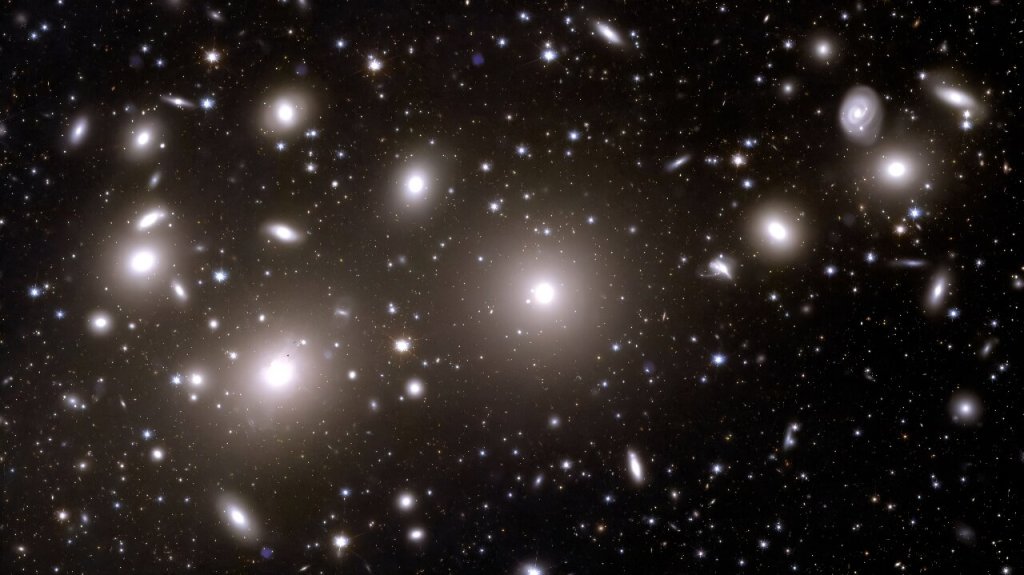
Source: “Dark Energy Seems to Be Changing, Rattling Our View of Universe” by Rey and Lawler, Phys.org, March 2025. Graphic: DESI Collaboration Photo of Galaxies.
White holes, theoretical counterparts to black holes, might be two sides of a cosmic coin. Black holes devour matter with relentless gravity; white holes expel it, hurling energy, particles, and possibly time into the universe. Both stem from Einstein’s general relativity, which predicts black holes, proven by solid evidence, while white holes remain elusive, perhaps lurking beyond our Earthly senses.
To see their link, rethink black holes’ strangest feature and flaw: the singularity. General relativity paints it as a point where spacetime crushes so tight that physics breaks, a bug, not a feature. Exotic matter, with odd traits like negative energy, was once the fix. But the University of Barcelona’s Pablo Bueno and team ditched it, tweaking gravity with higher-curvature corrections to erase singularities. This needs extra dimensions beyond our four, turning black holes from traps into dynamic zones.
The University of Sheffield adds a twist: the event horizon isn’t sharp. Quantum gravity blurs it into a fuzzy gateway where spacetime bends, not breaks. In 4D, black holes are sinkholes, matter vanishes. In higher dimensions, it slips through, heading elsewhere. Sheffield’s take ties this to dark energy, the universe’s expansion driver. Here, it’s the power plant: quantum fluctuations, fueled by dark energy, replace the singularity with a bounce, flipping spacetime to a white hole.
Enter white holes, Janus-like transitions, Roman god of gates and duality. Black holes vacuum everything; white holes, linked via higher dimensions, spit it out, maybe far off. Picture Sagittarius A*, the Milky Way’s core black hole, channeling matter 25,000 light-years to the Orion Nebula’s arm. Unseen, white holes might hide in dimensions we can’t touch.
This hints at a cosmic cycle, like Earth’s water cycle: evaporate, rain, repeat. Black holes swallow, dark energy and quantum gravity bounce it through higher dimensions, and white holes release it back. Barcelona and Sheffield suggest no endpoints, just a recycling of cosmic raw materials across realms we’re barely capable of understanding.
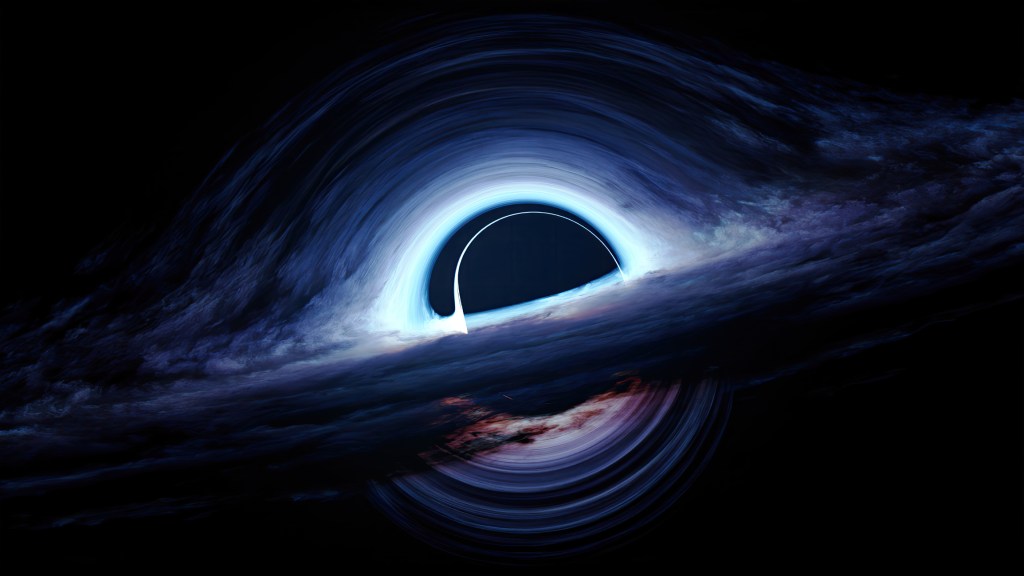
Source: Black Hole Singularity, Gielen and Menendez-Pidal, University of Sheffield, 2025. Regular Black Holes…by Bueno, P. et al, Physics Letter B, February 2025. Graphic: Black Hole Rendering.
Einstein’s theory of general relativity, which includes gravity, predicts that black holes have a tricky feature: a singularity. This is a point where space and time are squeezed so tightly that the laws of physics break down—think of it as a cosmic “error message.” To fix this, scientists often turn to exotic matter—hypothetical substances with bizarre properties like negative energy—to smooth things out. However, a team from the University of Barcelona, led by Pablo Bueno, found an alternative. They didn’t need exotic matter at all. Instead, they tweaked Einstein’s gravity by adding an infinite series of extra “rules” (higher-curvature corrections) to the math.
Their solution works in spacetimes with more than four dimensions—beyond our usual height, width, depth, and time. In these higher-dimensional worlds, black holes can exist without singularities. This “smooths out” black holes, making them less mysterious and more like regular objects in spacetime—no weird stuff required.
The presence of extra dimensions doesn’t just fix singularities—it can also change how black holes behave. In higher-dimensional spacetimes, black holes might have different event horizon shapes (the boundary beyond which nothing escapes) or other structural quirks. The Barcelona team’s work shows that these altered properties emerge naturally from gravity in more than four dimensions, offering a fresh perspective on these cosmic giants.
Thinking outside the box, is it possible that these extra dimensions link black holes to “a reality outside regular spacetime,” like wormholes (tunnels through spacetime), braneworlds (parallel universes on higher-dimensional “membranes”), or even gateways to white holes (theoretical opposites of black holes that spit stuff out)? Theories like string theory and braneworld scenarios suggest that extra dimensions might allow such connections. For example, a wormhole could theoretically bridge two distant points in our universe—or even lead to a completely different universe.
While the math of higher dimensions opens the door to these possibilities, it’s all conjecture. The Barcelona team’s work is a major step forward in understanding black holes in higher dimensions, but it doesn’t directly prove connections to other realities.
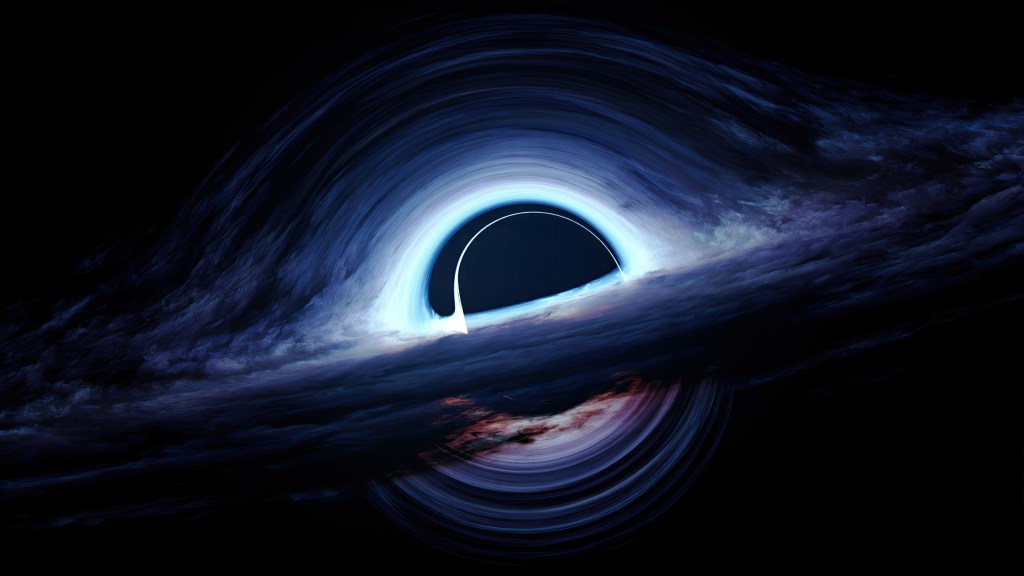
Source: Grok 3. Regular Black Holes… by Bueno, P. et al., Physics Letter B, February 2025. Graphic: Black Hole Rendering, iStock licensed.
A distant galaxy at the edge of the universe and the beginning of time has revealed a remarkable discovery by Yale researchers. They have identified a variable quasar that rapidly brightens as its astrophysical jets periodically align with the position of Earth.
The researchers believe that this quasar, and others like it, played a significant role in bringing light into the early dark universe, alongside massive early stars which preceded the quasars.
Quasars are supermassive black holes at the centers of early galaxies, spinning at relativistic speeds. These early galaxies contained substantial unincorporated material, primordial gas clouds akin to present-day nebulae, which were easily captured by the black hole’s gravity. Near the event horizon of the black hole, this matter is caught in a ‘turbulent’ vortex, creating massive astrophysical jets. These jets, partially composed of ionized plasmas, are expelled at relativistic speeds, extending up to hundreds of light-years from the black hole and perpendicular to its event horizon. As the ionized hydrogen plasmas capture electrons from the neutral hydrogen in the early universe, photons are released, contributing to the illumination of the cosmos.
Thomas Connor, an astronomer at the Chandra X-Ray Center and co-corresponding author of the study, states, “[This] epoch of reionization is considered the end of the universe’s dark ages.”
Trivia: The song Put Your Lights On was written by Erik Schrody (Everlast) and performed with Santana on his 1999 album Supernatural. He wrote the song while recovering from a heart attack, pondering the hope that exists in life.
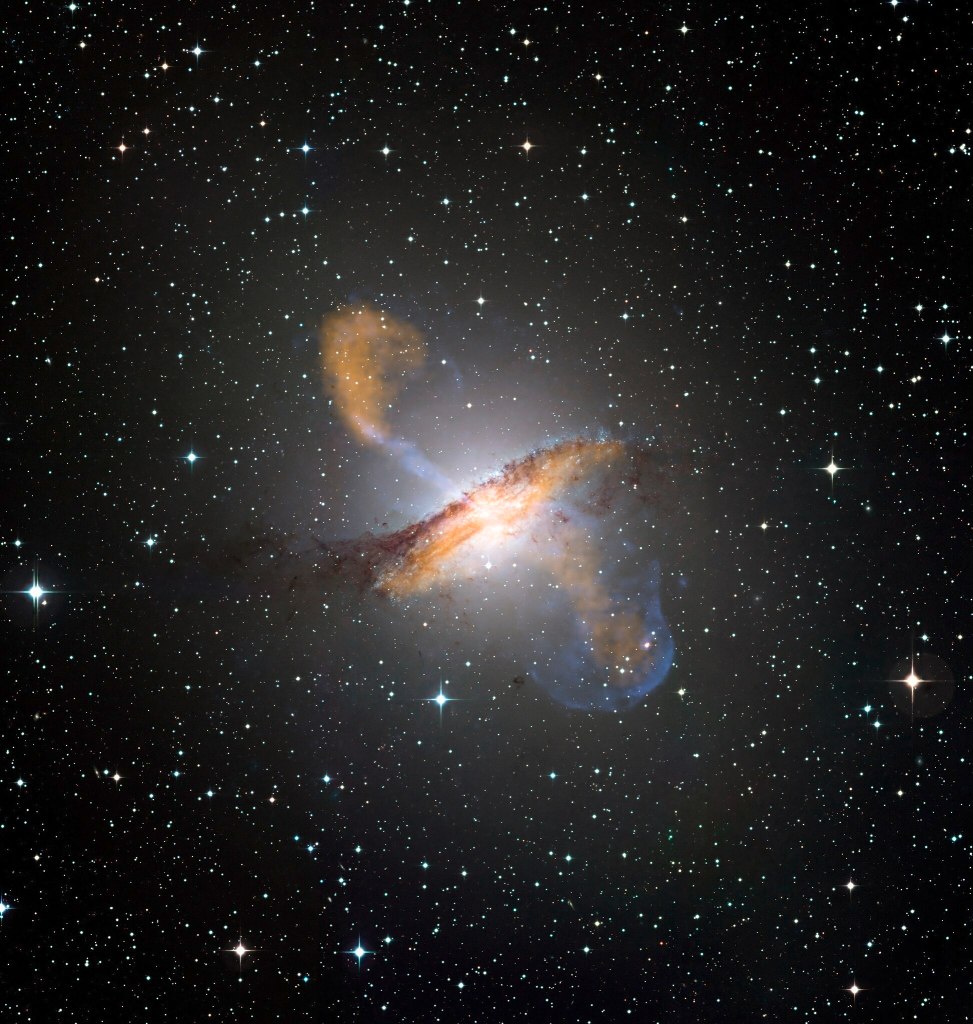
Source: This Quasar May Have Helped Turn the Lights on… by Shelton, Yale, 2025. Graphic: Black Hole Outflows from Centaurus A, ESO, 2009.
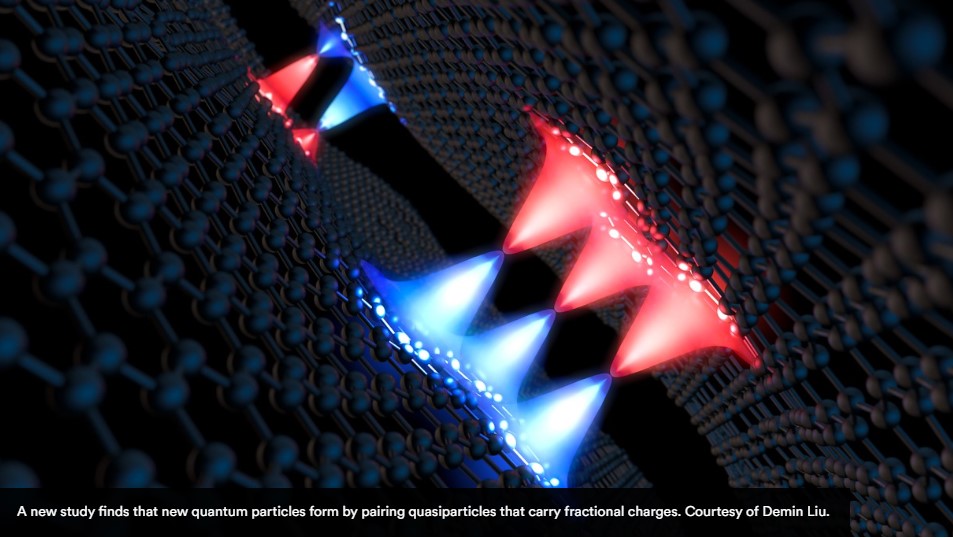
Physicists at Brown University have recently observed a new class of quantum particles called fractional excitons.
Excitons consist of an electron and an electron hole (a quasiparticle, a concept, representing the absence of an electron where one should exist). They allow for energy transfer in a lattice, such as in a transistor. Applying voltage to a transistor influences the movement of electrons and holes through the material. Simplified, this movement can turn the current flow on and off, forming a logic gate.
Despite being composed of fermions, excitons exhibit bosonic behavior and follow bosonic statistics. Fractional excitons, however, show behaviors that don’t fully align with either fermions or bosons. This suggests they belong to a new class of particles with previously unobserved quantum properties.
The researchers speculate that these fractional excitons may lead to advances in quantum computing.
Source: Excitons, Zhang et al, Nature, 2025. Graphic: Quasiparticles, Demin Liu, Brown University 2025.
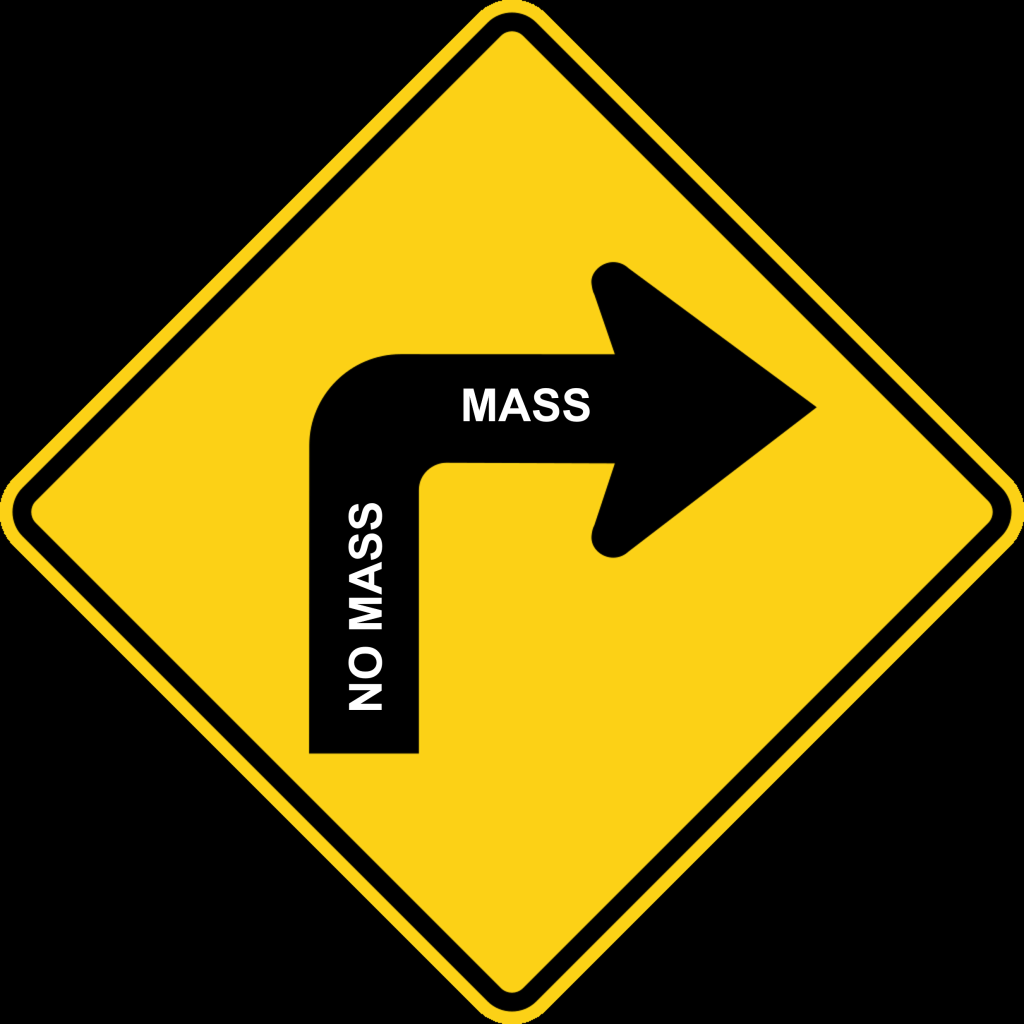
A team of researchers from Penn State and Columbia University has recently observed a quasi-particle that is massless when moving in one direction but acquires mass when moving in a different direction. This quasi-particle, known as a semi-Dirac fermion, was captured by the team inside a ZrSiS crystal and was first theorized 16 years ago. The scientists observed that when the particle travels in one direction at the speed of light, it remains massless. However, when it is forced to change direction, it slows down for the ‘turn’ and gains mass.
This property relates to Einstein’s most famous equation, E=mc², which states that energy and mass are interchangeable, connected by the speed of light squared. According to Einstein’s Theory of Special Relativity, mass traveling at the speed of light would have infinite mass and require infinite energy to maintain its speed, which is impossible. Therefore, only massless particles can travel at the speed of light.
Relativistic effects also come into play when objects approach and attain the speed of light. As an object with mass moves faster, time dilation and length contraction effects become significant. At the speed of light, time would effectively stop for the object, and distances would shrink to zero. These extreme conditions are not physically achievable for objects with mass.
Source: ScienceDaily by Adrienne Berard, 2024. Semi-Dirac Fermions in a Topological Metal. Physical Review X, Shao, et al, 2024.
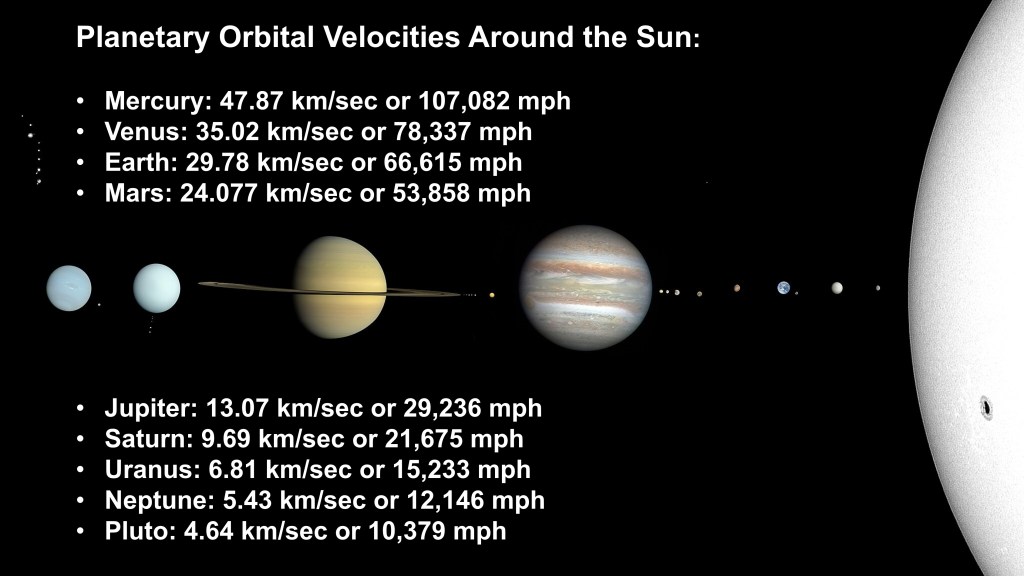
Kepler’s Second Law, first published between 1609 and 1619, describes how a planet’s orbital speed varies along its elliptical orbit around the Sun. As the planet approaches the Sun, the gravitational pull from the Sun is stronger causing the planet to move faster. As a planet moves away from the Sun it slows down.
Kepler’s Second Law in geometric jargon: A line joining a planet and the Sun sweeps out equal areas during equal intervals of time.
Source: Smithsonian, How Things Fly. Graphic of the Planets and the Sun by CactiStaccingCrane 2022.
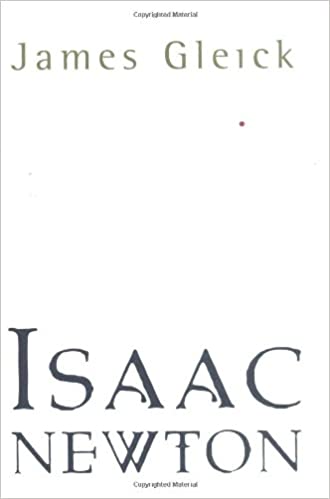
James Gleick left Harvard in 1976 with a degree in English and a disposition towards independence from the 9 to 5. His initial attempt at independence after college was launching a weekly newspaper in the midwest city of Minneapolis, Minnesota. This endeavor ended in failure within a year, and it would take another 10 years before he could leave his day job, succeeding as an author of history of science and a provider of internet service in New York City.
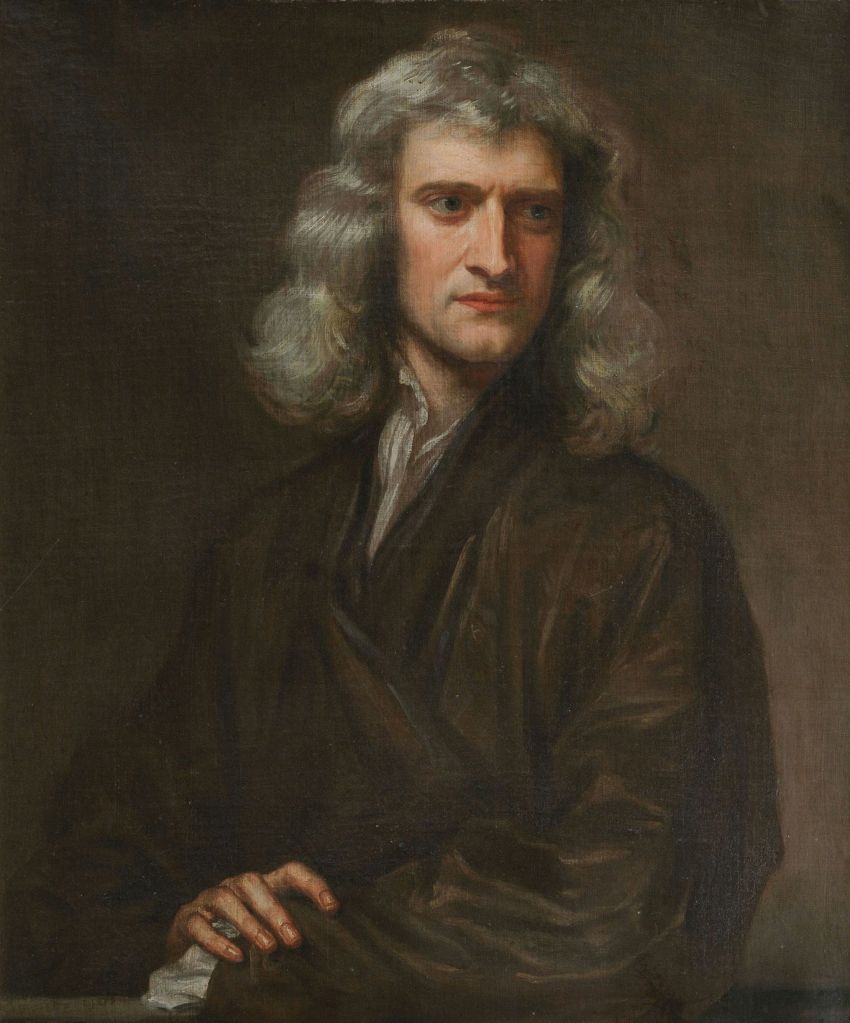
His first book, Chaos: Making a New Science, was critically acclaimed and a million copy best seller establishing Gleick as a first-rate storyteller of difficult subjects to the lay public. He wrote two other bestsellers, both biographies, Genius: The Life and Science of Richard Feynman in 1992 and Isaac Newton nine years later.
Gleick presents Newton’s life in chronological order, painting a beautiful portrait of his acheivements but also imparting a sense of his being as a human. His accomplishments were beyond exceptional, but his temperament was that of a reluctant member of society at large, not easily befriended, easy to offend, and not quick to forgive. Current hypotheses suggest that Newton may have suffered from Asperger’s Syndrome, one of the milder forms of autism. As a social being he appears a lot like Beethoven, also a genius but also without grace or courtesy.
Issac Newton was born fatherless, on Christmas Day in 1642 according to the Julian calendar, still in use in England at the time, or the less interesting 4 January 1643 by the today’s Gregorian calendar, on a sheep farmstead far north of London in Lincolnshire County. His father died about three months before his birth and in three years he was shuffled off to a grandmother’s care for the next 9 years to keep him away and out of site from his mother’s new husband, Reverend Barnabas Smith. His early education was at the ancient King’s School, already more than two hundred years old when he entered in 1655 and still operates as an all-boys grammer school to this day. Upon finishing at King’s School, he entered Trinity College at Cambridge in 1661 and, except for a year away in 1665, he stayed as a student and professor until 1696. Immediately following Cambridge, he became Warden of the King’s Mint and in 1703 became president of the Royal Society and stayed in that position until he died in 1727.
Newton’s contributions to the world were many and varied. His Three Laws of Motion were revolutionary in the 18th century, and as a testament to their lasting correctness are still taught to every school kid early in their education. The Law of Gravitation explained the orbit of the heavenly bodies and why apples fall and not rise, float, or go sideways. It has since been replaced by Einstein’s General Relativity but is still a particularly good approximation for us lessor mortals. Calculus. Enough said.
Newton also intensely studied the bible, believing that the universe could only exist through the existence of God. He rejected the Trinity believing there is one God, God the Father with Jesus and the Holy Spirit subservient to God. Newton also predicted that the end of times would not come before 2060, 38 short years from now. Still a little early to be maxing out your credit cards.
Newton researched and experimented with alchemy, including looking for the Philosophers Stone and the force that keeps the planets in their orbits. Seeking the Philosophers Stone may have been worthy of Harry Potter but I’m not sure about Newton. Newton never published anything on his alchemy studies, likely because it didn’t make any sense. Now looking for the force that kept planets from falling your head during a walk-in park was worthy of Newton and the rest of the world, especially Einstein. Newton found it and it was called gravity.
My one complaint with Gleick’s book is his derisive commenting on Newton’s fascination with alchemy through today’s lens of knowledge rather than accepting that understanding and meaning in this world changes, sometimes for the better, sometimes not. People respond to the time they live in not to the unknowns of the future. Newton put it this way, “What we know is a drop, what we don’t know is an ocean.” and one can only study the drop that he has.
One of my favorite quotes of Newton or anyone for that matter was, “A man may imagine things that are false, but he can only understand things that are true.” I liked this quote when I first saw it, not because it was profound, it was, but because it was an idea I had promulgated early on in my education, if it didn’t make logical sense, it probably was wrong.
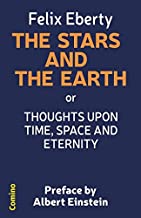
A short read reflecting on the information carried by a photon as it reaches your eye from the far reaches of space.
Originally the book was published in two volumes, both together totaling less than 80 pages, in 1846 and 1847. The book sought the union of physics and religion, metaphysics; for God sees the past and the present as a single point in the space time continuum, time stopping when moving with the light, observing all in three dimensions rather than four. Eberty continues his thesis from an all-seeing God to a time when man’s technological progress allows him to see as God sees or the child of God becomes a god.
Eberty knowing that the speed of light was finite, about 300,000 km/s, contemplated that all visuals captured by any type of eye, human or otherwise, happened in the past. The past including an inconceivably, insignificantly small amount of time in the past, such as a plate of mac and cheese in front of you, is still in the past, what you see has already occurred. Jurgen Neffe, author of a biography of Albert Einstein, stated it succinctly “time travels with light”. Observing light traveling from a billion light years away exhibits events as they happened a billion years ago but if you traveled with those photons for those billion years the past occurs at the same time as your present.
Eberty’s thoughts on the meaning of time and space were recognized at the time not only as novel but metaphysical in nature, maybe not so much today.

 elsToday