Since the earliest times of conscious thought, man has asked not only “Who or what am I?” but “Why am I here?” And the answer is both circular and logical at once: we are because we can ask. I think, therefore I am. But consciousness alone does not tell us what existence is for. And if the question of existence is humanity’s oldest query, beauty is one of its oldest replies. Beauty made existence feel meaningful rather than merely the repetition of appetite and rest; it revealed that life pointed beyond itself. Our Stone Age ancestors were not finger‑painting on cave walls 50,000 years ago for fun. They were attempting to make the invisible visible.
Beauty in being says that existence is not enough. Beauty discloses purpose, and in doing so, it provides it. It is one of the ways human beings make that purpose visible, a sign that we participate in an order of reality greater than ourselves.
Art as Philosophy begins with beauty: an act of existential revelation. Morality and aesthetics often appear in art as emotional or epistemic, yet both are fixed in an ontological core. Beauty is a metaphysical center made visible through existential experience; it discloses the shape of human existence and binds aesthetics and morality to the deeper question of what it means to be human. It provides purpose.
From the earliest myths to the highest metaphysics, beauty has never been treated as a garnish. Long before philosophy had a name, ancient cultures intuited beauty as the signature of an ordered world and cosmos rather than chaos. Harmony in music, proportion in the human form, symmetry in temples: these were not aesthetic add-ons, but revelations of a deeper structure woven into reality itself.
Plato gave this intuition its first philosophical clarity. For him, beauty was not accidental but the radiance of the Good, the Form that awakens desire and draws the soul upward. Encountering beauty in the world triggers anamnesis, the recollection of what the soul already knew. Beauty was not subjective; it was participatory. To encounter beauty was to brush against the eternal. Beauty is the condition under which truth becomes visible and knowable. Without beauty, the intellect cannot ascend; it stalls, and ultimately, descends.
Neoplatonic Plotinus (3rd century AD) deepened Plato’s vision. Beauty, he argued, is the soul’s recognition of its origin in the One. The beautiful is not merely pleasing; it is the way the intelligible realm shines forth, emanates, into the sensible. Without beauty, the mind loses its orientation toward the intelligible and shatters into fragmentation. To perceive beauty is already a kind of knowing, a moment of noesis, a reminder that all things flow from a single source and long to return to their origin. As Plotinus put it, “the soul must be made beautiful to see beauty.” An ordered soul has the clarity to perceive beauty.
Aquinas immersed this lineage into Christian metaphysics. Beauty, for him, is a transcendental of being coextensive with truth and goodness. Beauty is rooted in being itself; consciousness merely receives it. Aquinas’s point is not that beauty is a mental event, but that it is an ontological property: the radiance of form made visible to a perceiving mind. Plato locates beauty in transcendent Forms; Aquinas locates beauty in the immanent form of the thing itself. To call something beautiful is to say that its form reveals its purpose, its integrity, and its participation in the act of existence itself. Beauty incorporates wholeness, proportion, and radiance into being. Beauty pleases, but it requires perceptive judgment; it is the condition under which a being becomes delightful, showing itself to be both knowable and lovable.
Even Kant, who tried to bracket metaphysics and leave beauty suspended in an onto‑epistemological limbo, could not escape the pull of beauty’s universality. His “purposiveness without purpose” is an admission that beauty feels ordered even when we cannot articulate the order. In trying to deny beauty a purpose, he inadvertently gave it one: beauty reveals a structure of meaning that reason cannot fully justify yet cannot ignore.
Heidegger returned beauty to ontology by insisting that art “unconceals” being. Beauty is not decorative but disclosure, the world showing itself as meaningful. He rejected aesthetics as subject‑centered and sought to recover the original Greek sense of aletheia, unconcealment. Heidegger critiques Plato and ignores Aquinas, yet his account of Being as unconcealment resembles Aquinas’s act‑of‑being far more than Plato’s transcendent Forms. He retrieves, but cloaks, the spiritual dimension of ontology in a deliberately unspecific, non‑theological way. For Heidegger, beauty is how truth happens: an event in which being clears a space for beings to appear as what they are, unconcealed and encountered truthfully. Art, especially poetry, is privileged because it lets being shine most intensely. In this sense, beauty comes full circle: it is the radiance of truth and the invitation to goodness.
And Balthasar, gathering the entire philosophical tradition, argued that beauty is the glory of being, the radiance that makes truth lovable and goodness desirable. Without beauty, truth becomes abstract and goodness becomes coercive. His entire theology revolves around the transcendentals of truth, goodness, and beauty, inseparable properties of being that reflect the nature of God. He argued forcefully that in the modern era beauty has been severed from truth and goodness, often reduced to mere aesthetics or subjective preference, and that this breach damages all three. Without beauty’s radiant, attractive power, truth collapses into dry intellectualism and goodness into moralism or duty. Beauty, he insisted, demands as much “courage and decision” as truth and goodness do, and when banished, beauty takes them along in a “mysterious vengeance.” Balthasar absorbs Plato’s intuition within Aquinas’s ontology, locating beauty not in a distant realm of Forms but in the immanent radiance of being itself: the “Glory of Being.”
Across millennia, the consensus is unmistakable: beauty is not subjective preference but the visible expression of an invisible order.
Beauty is the first principle in ascertaining the health of a society. Beauty is the outward sign of truth and goodness in both the individual and the collective. Beauty is not a matter of taste or form but a universal reality, perceptible wherever the soul is clear enough to perceive it.
Civilizations have always intuitively known this, even when they lacked the vocabulary to name it, and one can argue that we still don’t. They built temples, carved statues, raised cathedrals, composed hymns, and painted frescoes not as decorative motifs but as necessity. A necessity of revealing a world ordered enough to trust and beautiful enough to love. Beauty was the first language of meaning, the earliest evidence that reality was intelligible, logical, and worth living in.
To encounter beauty is to encounter a world that makes sense.
Beauty does not precede truth and goodness in God, but it precedes them in the order of human perception. It is the first contact point between the soul and being itself, the moment when beauty discloses its radiance before the mind has time to analyze it or the will has time to respond. Beauty is an invitation to recognize truth and respond to goodness. Reverse the order and the entire structure folds into incomprehensible abstraction. Begin with truth and you end up defending the truths you already prefer. The mind simply reinforces its own assumptions, allowing nothing genuinely new to appear. Begin with goodness and you get moralism. Begin with beauty and find transcendence, an ascent that brings illumination.
But the modern world, unlike every age before it, has attempted to sever beauty from consciousness, from the human capacity to perceive what is objectively there.
Yet modernity, with its suspicion of universals and its allergy to transcendence, has tried to demote beauty to a matter of taste. “Beauty is subjective,” we are told, as though the human longing for harmony, proportion, and radiance were nothing more than a cultural preference. But this claim sinks under its own weight. If beauty were merely subjective, then the Parthenon would be no more meaningful than a strip mall, Michelangelo’s Pietà no more weighty than a child’s clay doodle, and Leonardo’s Vitruvian geometry of the human form would carry no hint of a deeper order in being. The human heart knows better. Even in our most cynical age, people still travel across oceans to stand before the great works of the past, hoping, often without knowing why, to feel again the presence of something real.
Beauty is not an opinion. Beauty is recognition of transcendent qualities.
And recognition implies that something is there to be seen.
This is why the loss of beauty is never merely aesthetic. It is metaphysical. When a civilization can no longer create or perceive beauty, it is not because beauty has vanished but because the soul has clouded. The organ of perception has dimmed. The world has not changed; the viewer has.
This is the quiet tragedy of the modern age: we have not lost beauty, but we have lost the capacity to see it, to create it.
If beauty is the form in which truth and goodness appear, then the loss of beauty is not a stylistic shift: it is a lament of civilizational change. It signals that the culture no longer believes in the radiance of being, no longer trusts that the world is ordered or intelligible. Beauty requires confidence in form. It requires the belief that reality is not arbitrary, that meaning is not an illusion, that the human soul is capable of perceiving something beyond itself.
When this confidence erodes and falters, beauty becomes impossible.
This is why the modern era, for all its technical brilliance, is marked by profound aesthetic exhaustion. The great artistic movements of the twentieth century did not abandon beauty because they discovered something truer; they abandoned beauty because they no longer believed in the metaphysical order that makes beauty possible. Fragmented order, chaos even, replaced harmony. Sensory shock replaced radiance. Psychological intensity replaced form. Beauty was replaced by raw power: a confirmation that the artist could impose meaning rather than receive it. The artist, once a witness to transcendence, became a fabricator of worlds.
And nowhere is this shift from order to chaos more visible than in the work of Pablo Picasso. Picasso is not the cause of the aesthetic shift; he is its herald. His cubist renderings of fractured forms, dislocated bodies, and jagged planes are not innovations in beauty but revelations of a world that no longer seems logical. His paintings do not disclose harmony; they expose unremitting loss. They do not reveal order; they reveal its absence. They do not manifest radiance; they disclose bewilderment and torment. And yet, people call it powerful; and powerful it is. But beauty it is not.
People pay staggering sums for canvases that scream with his dislocations of form, as though truth could be bought. They stand before the broken bodies and insist they see something profound. But what they are seeing is not truth in the classical sense. They are seeing realism rather than reality: accuracy without truth. They are seeing psychological exposure, emotional intensity, historical impact, the perverse thrill of transgression. They are seeing the festering wounds and raw scars of a civilization, mistaking them for truth, but thankfully, never confusing them with goodness.
When beauty fades from consciousness, as it did in the era that slipped away at the dawn of modern art, truth turns upside down and inside out. A culture that cannot perceive beauty begins to call its own fragmented reality honesty writ large. But if art loses beauty, truth is also lost. Truth and goodness are visible to a clear soul. Distortion leaves us guessing.
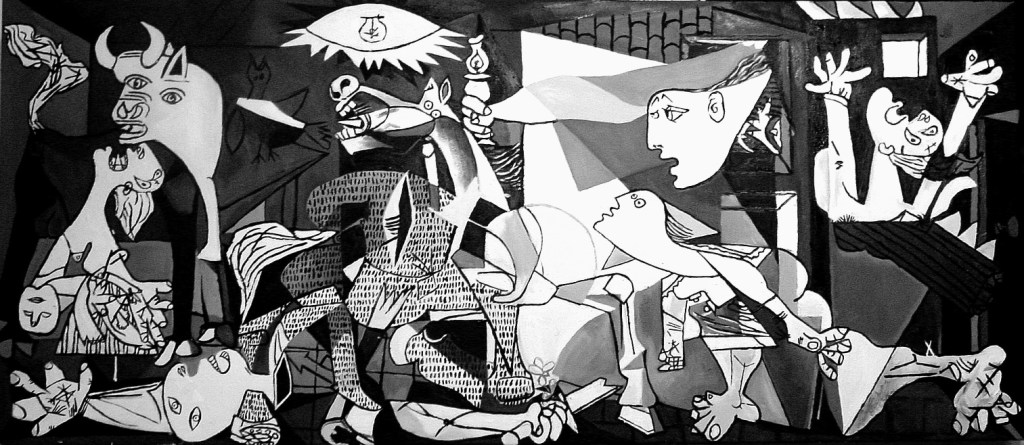
Picasso’s Guernica is the perfect example of this distortion: a masterpiece of torment and bewilderment elevated to the status of beauty by a culture that no longer knows how to recognize beauty: not out of malice, but from a dullness of spirit, the kind that mistakes sophistication for wisdom and complexity for truth.
For the capacity to perceive beauty is not automatic or axiomatic. It must be formed, protected, and kept clear. When it erodes, truth becomes inverted and goodness becomes opaque. Painted in 1937 in response to the bombing of the Basque town of Guernica during the Spanish Civil War, Picasso’s mural is enormous, over 25 feet wide, and simply overwhelming. It is a world shattered into jagged shards: a horse screaming in agony, a mother wailing over her dead child, a soldier’s broken body strewn across the ground, a bull looming with an ambiguous menace, a light bulb glaring like an unblinking mechanical eye. There is no center. There is no harmony. There is no rest.
The painting is a visual, unrelenting scream, a deliberate assault on the viewer’s sense of order. It is not meant to be contemplated; it is meant to shock. And in this sense, Guernica is a perfect expression of its age; an age in which suffering no longer appears within a meaningful frame but erupts as raw, unmediated violence.
The crucial point of Guernica is that it is evocative and powerful, but it is not beautiful.
Its power comes from its honesty about fragmentation, its refusal to offer consolation, its unflinching portrayal of torment. But power is not beauty. Beauty reveals the radiance of being; Guernica reveals the failure of being. Beauty discloses order; Guernica discloses chaos. Beauty invites contemplation; Guernica demands only what the painter wants you to see, annihilation of being, and he gives you only one way to go. His way… a rejection of the past.
And yet, in the modern imagination, the two, power and beauty, have become confused. People stand before Guernica and insist they see beauty of form and execution. But what they are seeing is intensity, authenticity, historical weight, emotional force.
They are seeing the wounds of the world and mistaking those wounds for wisdom.
This confusion is not Picasso’s fault. Art precedes culture. Picasso anticipated rather than directed. He diagnosed the symptoms but offered no cure. For beauty is not something an artist creates; it is something he reveals. And when an artist refuses revelation, or can’t, he produces not‑beauty; a world in which being cannot be perceived. Guernica reveals nothing of being, only fractures and faults.
Where beauty is absent, not‑beauty remains. Guernica is not‑beauty.
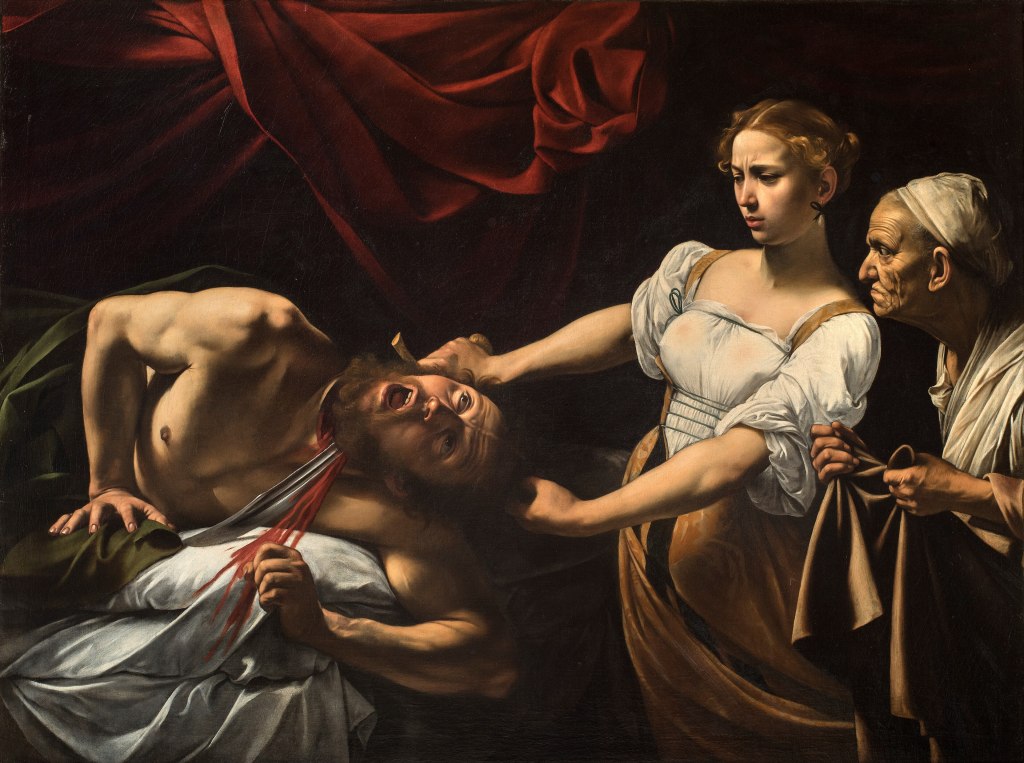
Caravaggio’s Judith Beheading Holofernes confronts the same violence, but within a world where being is still intact, where justice is truth made visible and beauty perceptible.
The story itself is a parable, a theological narrative. In the biblical Book of Judith, the city of Bethulia, perhaps Shechem in the hill‑country of Samaria, is under siege by the Assyrian army led by Holofernes, general of Nebuchadnezzar, because they didn’t support his wars. The people are losing faith and preparing to surrender. Judith, a devout widow, rebukes their despair. She prays, disguises herself, and enters the enemy camp. Over several days she wins Holofernes’ trust. When he collapses in drunken sleep, she takes his sword and beheads him. She returns to Bethulia with his head, and her people rally and rout the invaders.
Caravaggio’s painting (c. 1599) captures this moment of judgment with hyper‑realistic detail and dramatic chiaroscuro. Judith’s face is composed, almost detached, the instrument of justice. Holofernes screams in agony as blood spurts across the canvas. And beside Judith stands the maid, her expression a moral counterweight: not horror, not pity, but a grim, knowing resolve, as though she alone feels the full weight of what justice demands.
Yet the scene rises beyond horror. It embodies a metaphysical beauty because it reveals justice as an eternal, harmonious truth. Beauty here is not mere aesthetic pleasure but the radiance of the Good and the True. Judith’s act is a moral triumph: her faith and courage overcome tyranny, restoring order. Violence serves a higher purpose, not chaos, but a necessary catharsis that discloses transcendental harmony. Even the composition’s balance, with light piercing darkness, symbolizes truth emerging from brutality. Caravaggio turns judgment into revelation: beauty as justice made visible.
The contrast with Picasso could not be sharper. Guernica presents the bombing of the Basque town as a fragmented, monochromatic nightmare; suffering without resolution. It is not‑beauty in the metaphysical sense because it rejects transcendence. There is no redemptive justice, no higher truth to personify. Its cubist abstraction amplifies universal horror, trapping the viewer in an existential downward arc that mirrors war’s senseless destruction. Unlike Caravaggio, where violence leads to truth, Guernica offers only loss. It critiques rather than affirms, making it a powerful ethical statement but not a vessel of transcendental beauty. It is the absence of the divine order that Judith reveals. And where that order collapses in Picasso, it is restored in Michelangelo.
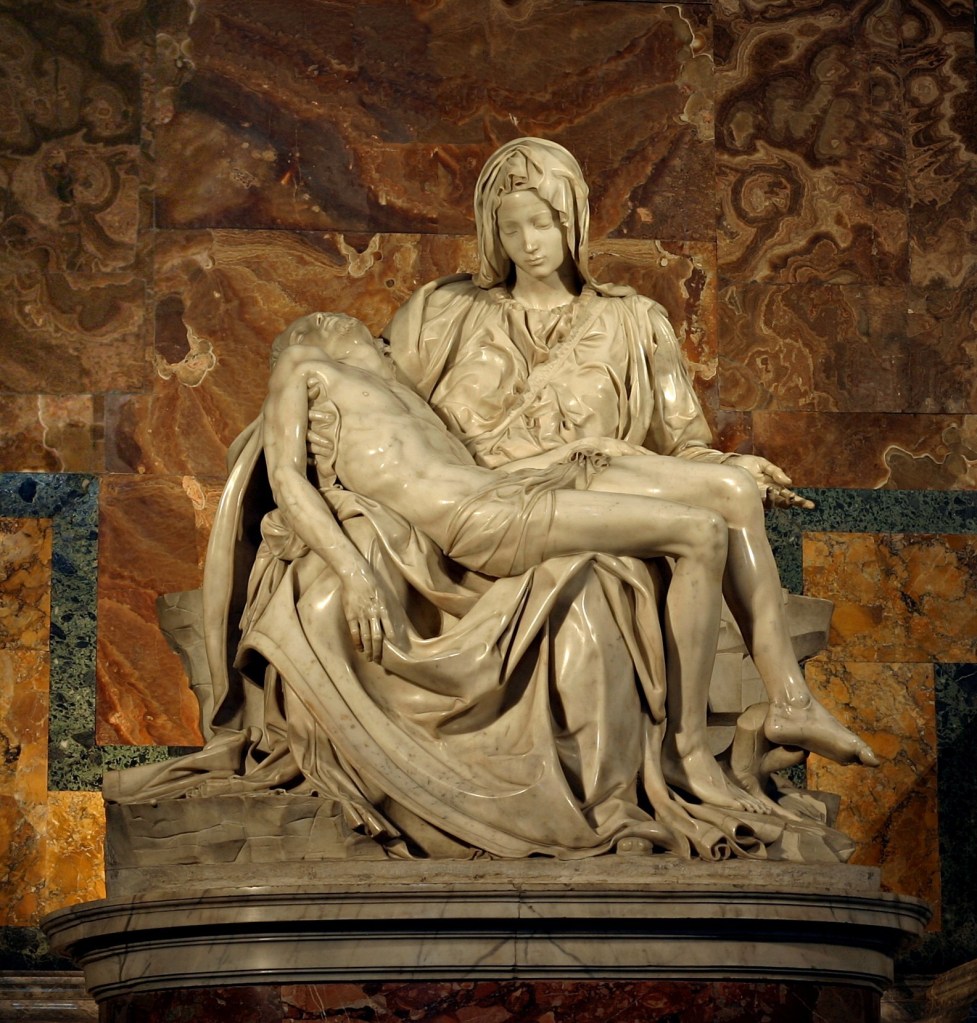
Michelangelo’s Pietà brings an act of violence and suffering into a realm of peace, order, truth, and goodness: into beauty.
Carved in 1499, when the Renaissance still believed that beauty was the visible form of truth, the sculpture depicts Mary cradling the dead Christ, her face serene, her posture composed, her sorrow dignified. Christ’s body is lifeless yet harmonious, the lines of his form flowing with a quiet grace that seems to transcend death itself.
The Pietà depicts beauty. It manifests it. Michelangelo did not infuse the marble with beauty; he allowed beauty to escape from it. The sculpture stands as the Renaissance ideal crafted in stone: beauty as the visible form of truth, truth as the expression of goodness, goodness as the radiance of being. The Pietà is not an image of beauty; it is Beauty itself, the transcendental unity of form, meaning, and love. It stands above all other works in this triptych of form because it reveals what the others only mimic or lose entirely.
All three works depict suffering and violence. But they inhabit different metaphysical planes.
In the Pietà, suffering is real but not absurd. Mary’s sorrow is profound, yet her face is serene, not because she is unfeeling, but because her grief is held within a larger meaning. The sculpture suggests that even in death there is dignity, coherence, and hope. Suffering is transfigured but not denied.
In Judith, suffering is the moral weight of the violence she must commit. Yet violence is framed by justice, and justice by truth. It is still a logical world where meaning still governs.
In Guernica, suffering is unmoored from truth and goodness. The figures scream into a void that offers no escape. There is no frame of meaning, no horizon of hope, no suggestion that agony is anything but senselessness. It is an irrational world without any existential foundational support. A world that makes no sense.
Together, the Pietà, Judith, and Guernica form a kind of metaphysical triptych. Michelangelo’s Pietà stands at the summit, where beauty is the first principle of existence, where form, harmony, and radiance disclose a truth deeper than suffering and a goodness that holds even grief within order. Caravaggio’s Judith occupies the middle panel, where truth is the second principle, where justice becomes visible, where violence is not chaos but judgment, and where goodness emerges through the restoration of order. Picasso’s Guernica completes the sequence not by fulfilling it but by negating it: a world where beauty has withdrawn, where truth has withered, where goodness is impossible. The Pietà transfigures suffering; Judith interprets it; Guernica renders it senseless. In the Pietà, harmony governs. In Judith, justice governs. In Guernica, nothing governs. Beauty, truth, and goodness appear in their proper order in the first two; in the last, they are absent, inverted, or broken. It is a triptych of being, and Guernica is the panel where being loses meaning.
Art is never merely art. It is a civilization peering into a crystal ball and seeing what is to come. It reveals not who people are, but what they are becoming. Art stands upstream of culture because it expresses a civilization’s posture toward being before that posture becomes conscious. The artist feels the tremors before the quake; culture only notices when the ground finally breaks.
Society’s art is therefore its earliest confession.
When a culture produces works like the Pietà, it is not simply exposing beauty; it is expressing metaphysical confidence. It believes the world is ordered, that truth is radiant, that goodness is real, that suffering can be transfigured. It builds cathedrals because it believes heaven is near. It carves marble into harmony because it trusts that form is trustworthy and good.
When a culture produces works like Guernica, it is not merely innovating stylistically; it is confessing metaphysical exhaustion. It no longer believes in order, so it paints fragmentation. It no longer trusts form, so it breaks it. It no longer sees radiance in being, so it reveals only distortion. It no longer believes suffering can be redeemed, so it depicts suffering as absurd.
Beauty has not disappeared from the world; we have simply lost the clarity to perceive it. The modern mind, dazzled by science and flattered by its own mindful openness, has mistaken boundlessness for wisdom, a mind without borders believes everything and sees nothing. Yet this distortion is not permanent. The capacity for beauty can be restored because beauty is not a human invention but a feature of reality itself, the radiance of being waiting to be seen again. To recover beauty is to recover orientation, to remember that truth is luminous, and goodness desirable. And when a civilization regains the ability to see beauty, it regains the capacity to hope.
The soul must be made beautiful to see beauty.
Graphics: Judith Beheading Holofernes by Caravaggio, c. 1598. Pieta by Michelangelo c. 1499. Both Public Domain. Guernica by Picasso, 1937. Art Print. Copyright is likely held by Picasso’s family.



 elsToday