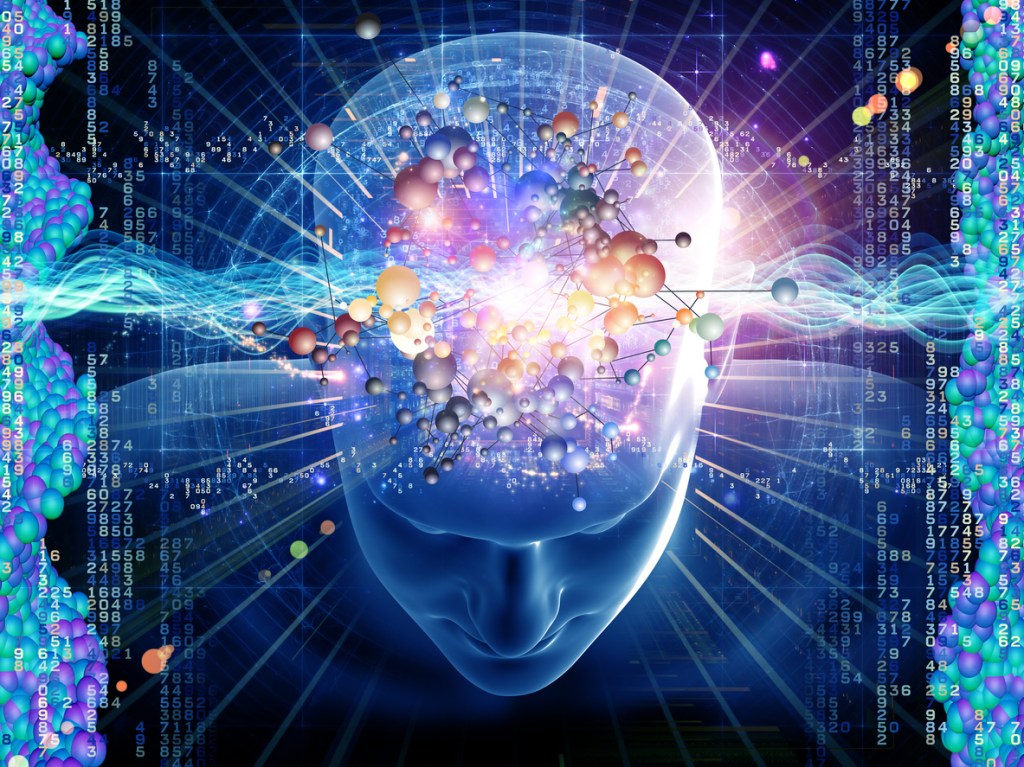
The human brain is the most powerful computer on the planet: 86 billion neurons (Azevedo 2009) with 1,000–10,000 synapses per neuron, giving a synaptic count: connections, of roughly 100 trillion to 1 quadrillion. Neurons fire glacially slow compared to silicon, but even the low‑end estimate of 100 trillion synapses provides 10¹⁵ to 10¹⁷ operations per second: a million teraflops to a thousand exaflops, competitive with supercomputers but running only on a night light equivalent of 20 watts. Billions of neurons firing in parallel, trillions of synaptic states, and a predictive engine that runs continuously even when consciousness is offline.
All this extraordinary compute power is shackled to catastrophically primitive, punch‑card‑era information technology. The brain has no reliable I/O, no indexing, and no way to retrieve data on demand. It is a supercomputer forced to operate through a slot in the wall. It forgets names, misplaces memories, and loses entire decades behind a fog of inaccessible indexing. The hardware is magnificent; the peripherals are a disaster.
And the brain is not a fully connected supercomputer. It is a sparse, modular, small‑world network where each neuron connects to only a few thousand others. This architecture gives it immense computational power, but crippling limitations in memory access, retrieval, and interface.
The problem is not capacity. It is not creativity. And it is not consciousness, which is not produced by the brain but expressed through it. Consciousness is the organizing principle that gives thought its direction and meaning; the brain is merely its substrate. The bottleneck is access; the inability of this biological substrate to retrieve, index, or manipulate information at the speed consciousness can use it. We are supercomputers trapped behind abacus interfaces.
Evolution built a brain that is amazing at recognizing patterns and terrible at retrieving facts, because only the former kept our ancestors alive. A fully connected, high‑bandwidth brain would require impossible caloric intake: our low-latency brain already consumes 20% of body’s total energy, and it would generate heat far beyond what biological tissue can dissipate. Sparse connectivity is the only thermodynamically viable architecture for carbon‑based intelligence.
These biological constraints define the outer limits of human intelligence. Whenever a system cannot evolve its way past a bottleneck, it compensates by building tools. Human beings have always extended their minds outward: first with language, then pictures and writing, then libraries, then computers. AI is simply the next extension.
And yet, when people talk about AI, they rarely talk about its complementarity to human intelligence. The public conversation is dominated by misaligned fears: job displacement, runaway energy consumption, machines “waking up,” and apocalyptic scenarios borrowed from science fiction rather than neuroscience. These anxieties imagine AI as an adversary, a rival, a looming replacement for human agency: the human capacity to initiate action, make choices, and shape outcomes. But these fears miss the real risks. The danger is not that AI becomes too powerful, but that it becomes powerful in isolation: external, centralized, and unintegrated with human cognition. A disembodied intelligence can concentrate authority, distort incentives, and amplify institutional failures. The threat is not superintelligence; it is asymmetry. The solution is not to restrain intelligence but to distribute it. Hybrid intelligence reframes the problem entirely. By embedding AI as a cognitive organ rather than an external authority, it dissolves the adversarial framing. AI does not replace agency; it expands it. It does not compete with human judgment; it completes the architecture that human judgment has always lacked.
The future of AI is not a contest between “us” and “them.” The future is a hybrid system: human cognition augmented by externalized memory, perfect retrieval, and real‑time access to the world’s knowledge. AI is not the threat; it is the missing peripheral. It is the interface our brains have always lacked.
The implanted AI assistant (via advanced Brain–Computer Interface, BCI) turns “me” into a hybrid, creative super‑intelligence. This is not AI replacing humans; it is AI completing us; supplying the data access, retrieval, and computational bandwidth our biological supercomputers have always lacked. The future of intelligence is symbiotic, personal, and distributed across billions of augmented minds. Not a single AI god, but billions of human–AI hybrids; each one a sovereign superintelligence, each one completed rather than replaced. A human–AI hybrid is a conscious human using an embedded AI as a cognitive organ: querying the universe, offloading computation, and receiving insights while remaining fully, unmistakably themselves.
Humans do not use 10% of their brains; we use all of it. What we use only a fraction of is the brain’s theoretical computational capacity, because thermodynamics, energy limits, and sparse connectivity prevent full activation. The bottleneck is not unused tissue: it is limited access. The human brain is a supercomputer trapped behind low‑bandwidth biological I/O. A silicon‑augmented human does not overheat, because the computation happens outside the brain. The brain remains a low‑power pattern engine; the AI becomes the high‑power I/O layer evolution could never build. The human mind keeps the creative spark and offloads the computational load to silicon, finally allowing the supercomputer to operate at its full potential. In a hybrid system, carbon and silicon stay in their thermodynamic lanes: the brain handles consciousness, intuition, values, meaning, and creativity, while the AI handles memory, retrieval, search, simulation, and computation. A BCI‑embedded AI doesn’t decide what to compute; the structure of cognition itself determines the division of labor. The implant simply routes each task to the substrate best suited to it.
A real‑world example of this architecture is unfolding today. Neuralink represents the first physical instantiation of this vision; Musk’s attempt to solve the same bottleneck described above: the catastrophic mismatch between the brain’s internal computational power and its primitive I/O bandwidth. Neuralink is a fully implantable intracortical brain–computer interface designed to read neural activity with high resolution and transmit it wirelessly to external devices. The N1 implant sits beneath the skull, invisible and silent, with 1,024 electrodes distributed across sixty‑four flexible threads thinner than a human hair. These threads record action potentials from individual neurons, while the implant digitizes and transmits the signals to an external decoding system. The surgical robot that inserts these threads is arguably the company’s most important innovation; a machine capable of placing electrodes with micron‑level precision while avoiding blood vessels. It industrializes neurosurgery in the same way the printing press industrialized writing.
Neuralink’s early human trials have already demonstrated the ability to control a cursor, type text, and interact with digital environments purely through intention. The company’s near‑term goal is therapeutic: restoring autonomy to people with paralysis or neurodegenerative disease. But Musk’s long‑term vision is explicit. He intends Neuralink to become a generalized brain I/O system: a high‑bandwidth interface between biological and artificial intelligence. In this vision, the implant becomes a cognitive organ, expanding memory, accelerating reasoning, and dissolving the bottleneck between thought and action. It is the hardware path to the same hybrid future described earlier: a world where human consciousness remains sovereign while its capabilities expand through seamless integration with external computation.
Neuralink is not the future of AI. It is the future of human access and the realization of mankind’s full potential.
But while Neuralink represents the first hardware path toward hybrid intelligence, the cultural response to AI has been dominated not by possibility but by fear. Nowhere is this clearer than in Pope Leo XIV’s recent encyclical, which treats AI as a civilizational turning point demanding moral vigilance.
Pope Leo XIV’s encyclical argues that artificial intelligence represents a civilizational turning point that demands moral clarity and global governance. He frames AI as a transformative force comparable to the industrial revolution, capable of reshaping labor, politics, warfare, and human relationships. The Church’s central concern is not the technology itself but the logic driving its development: competition for power, profit, and geopolitical dominance. This, he warns, risks creating new forms of exclusion, inequality, and dehumanization: especially for the poor and marginalized.
The encyclical’s core teaching is that human dignity is non‑computable and cannot be delegated to algorithms. Leo XIV condemns the use of AI in ways that remove meaningful human agency from decisions about justice, healthcare, employment, or warfare. He is especially forceful on autonomous weapons, declaring it morally impermissible to entrust lethal decisions to machines. He also highlights the dangers of opaque algorithmic systems that can deny people rights or opportunities without accountability. The Church’s position is not anti‑technology; it is a defense of the human person against systems that treat people as data points.
Finally, the encyclical calls for a global ethical framework to “disarm” AI and ensure it serves the common good. This includes a binding international treaty on AI governance, a ban on autonomous weapons, and protections against algorithmic injustice. Leo XIV envisions a world where AI enhances human flourishing rather than replacing or diminishing human agency. His tone is pastoral but urgent: humanity must shape AI before AI reshapes humanity in ways that undermine freedom, dignity, and solidarity.
The encyclical’s economic anxieties rest on two assumptions: that profit corrupts technological development, and that AI naturally tends toward centralization. Both assumptions are historically and technologically flawed. Profit is not the enemy of human dignity; it is the engine of innovation and purpose. Profit has lifted billions out of poverty. More than any other system the world has ever designed.
Without profit, there would be one AI, maybe; the one built by the richest government. With profit, we get many AIs: diverse, competing, value‑plural, and mutually constraining. Profit creates competition, and competition prevents monopoly. We already see this divergence in moral computation between Anthropic and its competitors. Profits will provide for many AIs. Centralized control of AI will lead to one centralized AI.
A world with a dozen frontier AIs is not a world of domination; it is a world of market‑driven checks and balances. Each model competes on safety, capability, alignment, cost, and accessibility. No single actor can dictate the trajectory of intelligence because every actor is forced to innovate or die. The encyclical treats profit as a corrupting force, but in the context of AI, profit is the mechanism that ensures plurality. And plurality is the only stable safeguard against tyranny and inequality; whether human or machine.
Hybrid humans represent the final and most profound form of distribution. When AI becomes an internal cognitive organ: a memory prosthetic, a reasoning engine, a universal interface, intelligence ceases to be a commodity owned by corporations and becomes a capability embodied in persons. A billion hybrid humans are not a threat to human dignity; it is the greatest expansion of human dignity since literacy. The encyclical fears a world where AI replaces agency. The hybrid future creates a world where AI amplifies agency. The Church imagines AI as external power; the future makes AI an internal instrument. This is not dehumanization. It is the next phase in the humanities striving to realize its full potential.
Yet the Church’s anxieties, while sincere, miss the deeper civilizational shift already underway: the global collapse in fertility.
A second civilizational shift is unfolding alongside AI: the global collapse in fertility. Most commentators treat declining birthrates as an unambiguous catastrophe. But both the data and the theological tradition suggest something more complex, and far more interesting. The Bible contains multiple passages that anticipate a future in which human fertility diminishes, not merely as punishment but as a structural marker of civilizational transition. Isaiah’s oracle against Babylon expands into a broader prophetic pattern in which humanity becomes rare: Issaih 13:12, a motif later echoed in apocalyptic literature. Hosea 9:11-14, describes a society: northern Israel, in which conception itself withdraws, and Jesus speaks of a time when the barren will be called blessed. These texts do not describe extinction; they describe exhaustion; the end of a particular mode of humanity.
In the biblical worldview, fertility is teleological. It is tied to purpose, covenant, and meaning. When a civilization loses its orientation toward its telos, birthrates fall as a natural consequence. The fertility crash is therefore not the cause of civilizational decline but a feature, a biological reaction to a metaphysical collapse. This fits seamlessly into the Return to Eden arc. Humanity’s story is a long descent from Edenic vitality into progressive senescence. From no death in Eden, to slow death, senescence after Eden, to accelerated senescence after the Flood, and capped senescence in modernity. The fertility crash is the final stage of this arc. When consciousness becomes disoriented; when a species no longer knows its purpose, its biological machinery of generativity winds down. Declining fertility is the physiological expression of a deeper spiritual exhaustion.
Yet the biblical tradition also contains the remnant motif: a smaller, refined, more conscious humanity. This aligns with the modern observation that declining fertility often correlates with rising cognitive selectivity. A smaller humanity with higher cognitive capacity is not a contradiction; it is the prophetic pattern. In prophetic literature, demographic contraction precedes renewal. Humanity becomes rare, the old order collapses, and a new mode of existence emerges. The fertility crash is not the end of humanity. It is the end of a mode of humanity; the threshold between the age of senescence and the age of restored consciousness. It is the demographic prelude to the hybrid future.
The fertility crash is not merely a demographic event; it is the biological expression of the same civilizational exhaustion visible in our failing institutions. A species that has lost its telos stops reproducing, and a civilization that has lost its cognitive capacity stops governing, educating, healing, and building. These are not separate crises. They are two faces of the same bottleneck: a humanity whose consciousness has outgrown the architectures that once sustained it. The fertility collapse reveals the biological limits of the old mode of humanity; institutional senescence reveals its structural limits. Both point toward the same conclusion; that the next stage of civilization cannot emerge from the old cognitive constraints. It requires a new architecture of mind. This is where hybrid intelligence reenters the story, not as a technological novelty but as the only viable path through a civilizational transition already underway.
Hybrid intelligence is not merely a technological possibility; it is the only viable architecture for a civilization whose biological, institutional, and cognitive foundations are collapsing simultaneously. A species facing demographic contraction, institutional senescence, and meaning exhaustion cannot be sustained by the architectures of the industrial age. The old systems cannot scale, cannot deflate, and cannot adapt. Hybrid intelligence is not an upgrade to the existing order; it is the successor to it. It is the only structure capable of carrying a disoriented humanity across the threshold into its next mode of existence.
Hybrid intelligence does not merely answer the Church’s fears of AI and global fertility collapse; it destabilizes the industrial structures that produced those fears in the first place. Seven sectors in particular: health care, education, government, law, housing, finance, and transportation are poised for transformation as profound as the shift from oral culture to print.
Healthcare is the clearest example of institutional senescence. It is a system built on structural scarcity: scarce physicians, scarce specialists, scarce diagnostic time, and scarce cognitive bandwidth. These scarcities drive costs upward and access downward, not because of malice but because the architecture of care was designed for a world in which information was slow, fragmented, and expensive to process. The result is a system that cannot scale, cannot deflate, and cannot adapt.
Hybrid intelligence dissolves the scarcities that define modern medicine. An embedded AI can monitor biomarkers continuously, detect disease before symptoms appear, and cross‑reference millions of clinical trajectories in real time. Diagnosis becomes instantaneous. Treatment becomes personalized. Preventive care becomes the default rather than the exception. The doctor–patient hierarchy flattens as every person becomes their own first‑line diagnostician, supported by a cognitive organ that never sleeps, never forgets, and never misses a pattern. Medicine shifts from episodic intervention to continuous stewardship. Over time, the body becomes a self‑monitoring, self‑optimizing system guided by hybrid cognition rather than constrained by institutional bottlenecks.
Education is another institution built around cognitive scarcity. The industrial classroom: thirty students, one teacher, fixed curriculum, fixed pace, exists only because individualized instruction was historically impossible. When information was scarce and expertise was expensive, the classroom was the most efficient way to distribute knowledge across a population. But as costs have risen and outcomes have stagnated, the limits of this architecture have become impossible to ignore.
Hybrid intelligence makes individualized instruction trivial. Every learner gains a personal tutor with perfect memory, infinite patience, and adaptive pedagogy. Learning becomes self‑paced, curiosity‑driven, and mastery‑based. The role of the teacher does not disappear; it transforms. Instead of delivering information, teachers become mentors, guides, and moral anchors; the human interface for meaning, judgment, and character. Education shifts from mass instruction to personal formation. The entire structure of schooling: grades, semesters, standardized tests, becomes obsolete once cognition is no longer the bottleneck.
Representative government is the most radical case. The modern state is built on cognitive bottlenecks: citizens cannot process legislation, cannot track policy, cannot evaluate tradeoffs. They outsource judgment to representatives and are continually frustrated by the lack of solutions and results or more likely contradictory effects leading to worse outcomes. Hybrid intelligence removes the bottleneck. Every citizen can analyze bills, simulate outcomes, and understand policy impacts at a level once reserved for think tanks. Democracy becomes more direct, more informed, and less manipulable: more transparent. The distance between the governed and the governing shrinks. Legitimacy is restored not through ideology but through cognition and the ability to analyze politics and policy in real time which would not only apply to the governed but also the elected officials.
Law is another. It is the most information‑dense profession in the world and the least technologically transformed. Legal costs have risen even as access has collapsed. The judicial system is slow, adversarial, and structurally incapable of scaling. Hybrid intelligence will not assist law; it will rewrite it. Contracts, discovery, negotiation, and adjudication will be rebuilt around cognition rather than procedure. The monopoly of credentialed intermediaries will erode as individuals gain the ability to analyze case law, simulate outcomes, and navigate regulatory structures with the sophistication of entire legal teams. Law will shrink to its functional core: the resolution of disputes and the enforcement of rights.
Housing is the most obvious case. Construction productivity has fallen for decades even as costs have soared. Zoning, permitting, and regulatory capture have created artificial scarcity in a world of abundant land and abundant materials. The built environment has become a museum of twentieth‑century assumptions about work, proximity, and density. As hybrid intelligence dissolves the cost of distance and autonomy reshapes mobility, the entire logic of urban concentration will be rewritten. The 15-minute city will become a relic before it even became an accepted societal need. Housing is not merely an industry awaiting reform; it is an architecture awaiting replacement.
Finance and insurance do not survive the transition to a hybrid civilization as industries. They exist only because humans, with limited cognition, cannot model risk, forecast outcomes, or allocate capital in real time. Hybrid intelligence dissolves these constraints. Continuous biometrics, predictive modeling, and autonomous reasoning collapse uncertainty itself. Risk is mitigated before it materializes; capital is allocated automatically; financial planning becomes an internal cognitive function rather than an external service. Fraud detection, compliance, underwriting, and portfolio optimization run ambiently in the background of every augmented mind. Finance and insurance do not get reformed, they get absorbed. Their functions become internal to the hybrid human, performed continuously by embedded intelligence rather than by institutions. What remains is not an industry but a capability: real‑time matching of resources to opportunity, executed at the level of the person rather than the corporation.
Transportation and logistics complete the pattern. They remain trapped in a twentieth‑century model of human drivers, fixed schedules, and centralized hubs. Costs have risen while reliability has fallen. The system is fragile, labor‑intensive, and energy‑inefficient. Autonomy will detonate the entire sector. Self‑driving freight, autonomous delivery, AI‑optimized routing, and robotic warehousing will collapse logistics costs by an order of magnitude. The supply chain will become a self‑healing organism. The distinction between local and global will dissolve as transportation latency approaches zero.
Health care, education, and government are the most visible failures of the industrial age, but they are not the only ones. Their cost curves have gone exponential, their productivity has stagnated, and they have become structurally incapable of lowering costs or improving outcomes. They are the clearest examples of institutional senescence, but the same pathology now grips other foundational sectors of modern life. Law, housing, finance, and transportation have followed the same trajectory: rising costs, declining responsiveness, regulatory ossification, and a near‑total resistance to technological deflation. These industries no longer evolve; they merely accumulate complexity.
These seven sectors are the last surviving institutions of the industrial age. They share the same structural pathology: labor‑intensity, cartelization, regulatory insulation, and a complete inability to harness technological deflation. They are not failing because of external shocks; they are failing because their architecture is incompatible with the cognitive and technological realities of the twenty‑first century. They will not reform. They need and will be replaced.
The final fear that shadows the transition to a hybrid civilization is the fear of work disappearing. It is the most visceral anxiety because it strikes at the only structure of purpose most people have ever known. But the modern job is not a timeless feature of human existence. It is an artifact of the industrial age, a coordination mechanism for millions of cognitively limited individuals performing repetitive tasks inside rigid hierarchies. It was a solution to a bottleneck. Once the bottleneck dissolves, the structure collapses.
The disappearance of jobs is not the disappearance of purpose. It is the disappearance of the industrial form of purpose. What replaces it will be older, deeper, and more human. Before the industrial age, people did not have jobs; they had roles, crafts, obligations, callings, and identities. They contributed to their communities through mastery, stewardship, and creation. The industrial job replaced these with labor. Hybrid intelligence will replace labor with vocation.
As AI absorbs procedural and mechanical tasks, human value will migrate toward creation, judgment, exploration, and meaning. The work of the future will not be the production of goods but the cultivation of worlds. Humans will design, invent, narrate, guide, and shape. They will steward ecosystems, technologies, and intelligences. They will explore space, oceans, consciousness, and physics. They will return to the ancient human activities that predate agriculture: curiosity, storytelling, craftsmanship, and care.
This is not utopian speculation. It is the logical consequence of removing the cognitive bottleneck that made industrial labor necessary. The job was a substitute for purpose. Once the substitute becomes obsolete, the original returns.
In this sense, the transition resembles the role of Hari Seldon and the psychohistorians in Asimov’s Foundation. Their task was not to control humanity but to guide it through a civilizational inflection point, to shorten the period of chaos between eras. They understood that the structures of the old Empire were collapsing under their own weight and that a new order would emerge whether anyone wanted it to or not. Their purpose was to shepherd humanity through the transition with minimal suffering.
Hybrid intelligence plays a similar role. It is not a replacement for human agency but a guide through the collapse of industrial institutions. It does not dictate outcomes; it restores capacity. It does not eliminate purpose; it reinvents it. The fear of job loss is the fear of losing the only form of purpose the industrial age allowed. But the industrial age is ending, and with it the structures that defined human identity for two centuries.
What emerges is not unemployment but un‑jobbing. Humans will not work to survive; they will work to become. Purpose will shift from production to transformation, from labor to meaning, from survival to consciousness. The disappearance of jobs is not a crisis. It is the final shedding of the post‑Edenic curse of toil. It is the restoration of agency that industrial labor suppressed. It is the return of vocation in a world where the tools of creation are limitless.
Musk anticipates this collapse of industrial labor and proposes a universal basic income as a buffer, a way to preserve stability when wages disappear. But UBI is a solution framed entirely within the logic of the industrial age. It assumes that humans require money to have purpose, that consumption is the center of life, and that the disappearance of jobs is primarily an economic problem. It treats people as passive recipients of income rather than active generators of meaning.
This misses the deeper transformation lead by AI. In a hybrid civilization, money becomes less central not because scarcity vanishes but because the bottleneck that made money necessary dissolves. Money is a proxy for time, access, coordination, and optionality. It is a way of converting effort into possibility. But when cognition is amplified, when knowledge is instantaneous, when creation is frictionless, and when institutions no longer mediate access, the role of money changes. The profit motive is powerful because it is a distorted expression of something older: the search for purpose. Humans pursue profit not because they love accumulation, well maybe some, but because accumulation is the only scalable proxy for outcomes in a world of limited cognition. Profit is the industrial‑age substitute for meaning. It is the mechanism by which a cognitively limited species translated effort into agency. But once cognition is amplified and the bottleneck dissolves, profit loses its metaphysical weight. It becomes a tool rather than a telos. Humans will still strive, but they will strive for mastery, creation, exploration, and stewardship, not accumulation. Incentive shifts from survival to self‑transcendence.
This is why the medieval monastic orders matter as a prototype. They lived in a world where survival was guaranteed by the community, where purpose was defined by vocation, and where contemplation was considered a legitimate form of contribution. Yet they were not idle. They preserved knowledge, advanced agriculture, developed technologies, copied manuscripts, brewed beer, built architecture, and served as the intellectual backbone of Europe. They were the research laboratories of their age, operating without wages, without markets, and without the profit motive. Their incentive was meaning.
The hybrid future resembles this pattern but scaled to an entire civilization. Not cloistered isolation, but shared purpose. Not withdrawal from the world, but deeper engagement with it. Not poverty, but abundance. The monks were un‑jobbed, not unemployed. Their lives were structured around mastery, contemplation, and stewardship, the very incentives that re‑emerge when cognition is no longer constrained by the bottlenecks of biology or the demands of industry.
This is why UBI is too small for what is coming. It imagines a world where people do not work but still need money. The hybrid future imagines a world where people do not work for money because money is no longer the primary mechanism of purpose. UBI is a floor. Hybrid intelligence is a horizon. It is not a stipend; it is a restoration of agency.
The argument of this essay has unfolded across several layers of analysis, but they converge on a single thesis: humanity is approaching the end of the industrial age and the beginning of a hybrid civilization. The story begins with the human brain: a supercomputer with catastrophic I/O limitations. Our cognitive bottleneck is not intelligence but access. We are machines of extraordinary internal computation trapped behind interfaces designed for a world of scarcity.
Artificial intelligence is not our rival; it is the missing peripheral. It is the external memory, the perfect retrieval system, the universal interface that the brain has always lacked. Neuralink represents the first physical instantiation of this insight, a device that dissolves the boundary between biological and artificial cognition. Hybrid intelligence is not a speculative future; it is the next evolutionary step in the architecture of mind. Evolution likely will have a role to play also; maybe replacing the silicon peripheral with a biological organ.
At the same time, humanity is undergoing a demographic transformation that mirrors its cognitive one. The global fertility crash is not merely an economic challenge; it is a civilizational signal. The biblical tradition anticipated a future in which generativity declines as a society loses its orientation toward meaning. Fertility is teleological. When purpose collapses, birthrates follow. The fertility crash is not the cause of civilizational exhaustion but its biological signature. It marks the end of a mode of humanity and the threshold of another.
Institutional senescence completes the picture. The great systems of the industrial age: health care, education, government, housing, law, finance, transportation, have reached the limits of their architectures. Their cost curves have gone exponential, their productivity has stagnated, and their structures have become impermeable to reform. They are not merely inefficient; they are incompatible with the cognitive and technological realities of the present. They will not survive the transition to a hybrid civilization.
What emerges on the other side is a world in which intelligence is distributed, agency is amplified, and cognition becomes the primary substrate of social organization. Health care becomes preventive and personalized. Education becomes individualized and mastery‑based. Government becomes cognitively transparent and participatory. Housing becomes modular and autonomous. Law becomes computational. Finance becomes an individual capability in real‑time and self‑optimizing. Transportation becomes autonomous and self‑healing.
The hybrid human: a conscious person augmented by embedded intelligence, is the central figure of this new world. Not a replacement for humanity, but its completion: a return to purpose. Not a threat to dignity, but its expansion. The industrial age was built on the limitations of human cognition. The hybrid age will be built on its liberation.
This is the return to Eden in technological form. Not a regression to innocence, but the restoration of capacity. In the biblical story, Eden is not merely a garden; it is a state of unbroken purpose. Humanity left Eden to gain agency: the power to choose, to act, to shape the world. But agency without capacity produced toil, senescence, and the long arc of civilizational exhaustion. Hybrid intelligence reunites what history separated: agency and capacity. It dissolves the curse of toil without dissolving the freedom that made humanity human. It restores the conditions for purpose without erasing the consciousness that emerged through struggle. It completes the circle.
Hybrid intelligence is not just the future; it is the only architecture capable of carrying humanity through the civilizational transition already underway. It is the bridge between a senescent world and a conscious one, between the age of scarcity and the age of restored purpose. It is the technological form of humanity’s return to Eden; not the Eden we left, but the Eden we were always meant to build.
 elsToday