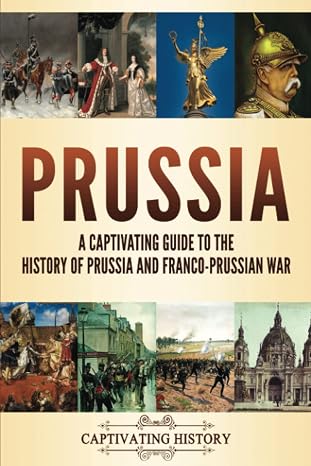
Most who encounter Prussia for the first time meet it in its final incarnation: the iron‑ribbed-fisted kingdom that defeated France in 1870, unified Germany, and marched at the head of Europe’s most disciplined army. This is the Prussia of Bismarck and Moltke: bureaucratic, militarized, unmistakably German. A modern state that the 20th century spent millions of lives ensuring would disappear forever. But this was only the end of Prussian history. Its beginning reaches back centuries and is just as dramatic: a story of conquest, intrigue, and violence; of knights, kings, and popes.
The Prussia Bismarck forged in the 19th century was not the Prussia the Hohenzollerns inherited in 1525, nor the Prussia the crusading Teutonic Knights built beginning in 1226. And it certainly was not the Prussia that existed before any of them: the Prussia without a name.
Prussia is a palimpsest: three different histories written over the same land. Each layer overwrote the last, yet traces remain. Long before the Teutonic Order arrived, the region was a mosaic of Baltic tribal homelands inhabited by the peoples later called the Old Prussians. Pomesanians, Pogesanians, Warmians, Natangians, Sambians, Barts, Galindians, and Sudovians shared related languages and pagan religious practices, but never formed a unified political entity or adopted a single name for their territory. Medieval chroniclers, needing a geographic label, simply called it terra Pruthenorum: “the land of the Prussians,” an exonym derived from the people rather than any indigenous place‑name.
The peoples the Teutonic Knights fought in Prussia and Lithuania were the indigenous descendants of the ancient Balts, an Indo‑European group that had occupied the Baltic forests and coasts for two, perhaps three millennia. They were not Germanic, not migrants, and not related to the tribes Rome or Charlemagne fought. Their resistance was the last stand of Europe’s oldest surviving pagan cultures. Christianity arrived late; Lithuania remained officially pagan until the late 14th century.
Thus, long before the crusading conquest by Catholic monastic knights, “Prussia” existed only as an ethnographic zone: a patchwork of fortified settlements, sacred groves, and tribal districts loosely bound by culture and kinship, not by statehood. When the Teutonic Knights arrived in the 13th century, they conquered a land already known to Europeans as Prussia, but one that had never been a unified realm until the Order imposed its monastic state upon it.
The Order itself had begun far away. The “Order of the German House of St. Mary in Jerusalem” (Ordo domus Sanctae Mariae Theutonicorum Hierosolymitanorum) was founded in Acre, now a northern Israeli Mediterranean city, as a German Marian hospital order, caring for pilgrims and wounded crusaders. Only later did it transform into a Baltic crusading power. The Teutonic Knights were both monks and warriors: a deliberate fusion of religious vows and military service, a Crusader invention.
The Teutonic Order’s transformation into a Baltic crusading state began only after 1226, when Konrad I of Masovia, was losing the brutal border war he had initiated against the pagan Prussians. Konrad’s attempts to seize Prussian lands had failed, and the tribes repaid his aggression with devastating raids into Masovia. Unable to contain these incursions, and lacking support from his fellow Piast dukes; the first ruling dynasty of Poland, Konrad turned to the Teutonic Knights: a disciplined military‑monastic order answerable to the papacy.
Before entering Prussia in 1231, the Knights secured two crucial forms of backing. The first was the Golden Bull of Rimini (1226), in which Frederick II granted them sovereign rights over any territory they might conquer, independence from Polish control, and full imperial protection. The second was papal encouragement from Honorius III, who approved their mission but did not yet define their political status.
Konrad never intended to grant the Knights sovereignty, but the Order used imperial and papal law to turn his plea for help into the foundation of their own state. The Baltic conquest was not improvised, but the knights needed additional authority to turn their victories into sovereignty.
The decisive turn of events for the Knights came under Pope Gregory IX. In 1234, Gregory issued bulls: papal legal documents, that confirmed Frederick’s grants, declared the Prussian campaigns a full crusade, and placed the Order under direct papal protection. With this act, the Knights’ foothold became a permanent crusading dominion. Their wars were now holy wars; their conquests legally theirs; their authority recognized by both empire and papacy. The Knights could now exercise king-like authority over the Baltic lands.
Once entrenched, the Teutonic Knights spent three centuries conquering and christianizing the Baltic, importing German settlers, building cities, and waging crusades against Lithuania and Poland. Their monastic state reached its height in the 14th century, then declined after the defeat at Grunwald (1410) and the loss of western Prussia to Poland (1466). By 1500, the Knights Order‑State was a hollow, bankrupt frontier that they could no longer sustain.
In 1525, the Teutonic Order under the Grand Master, Albert of Hohenzollern dissolved its state and secularized its remaining lands creating the Duchy of Prussia. The Teutonic Knights’ Baltic lands did not revert to Polish control though. They became a semi‑autonomous Lutheran state ruled by Albert of Hohenzollern as a vassal of the Polish Crown. Poland gained overlordship, but not direct possession.
Next came the Thirty Years’ War created the conditions that made a Prussian kingdom possible. Prior to the war the Hohenzollerns’ main territory: Brandenburg, was inside the Holy Roman Empire, while the former Teutonic lands of Ducal Prussia were outside it and under Polish suzerainty. This odd dual structure only becomes politically potent because of what the Thirty Years’ War does to, and ultimately for Brandenburg.
Brandenburg was one of the most ravaged regions in the Empire during the war. Some estimates put its populations losses at 50% with concurrent economic collapse, and political paralysis of the individual fiefdoms. Frederick William, the Great Elector, concluded that Brandenburg could not survive as an estate-dominated state. The war forced him to build a permanent army, form a centralized bureaucracy, create a centralized taxing authority, and finally destroy the political reach of the estates.
Poland, fighting Sweden in the Northern Wars, needed allies, and Frederick William: ever the opportunist, filled that need. In the Treaty of Wehlau (1657) and the Treaty of Oliva (1660), Poland granted the Hohenzollerns full sovereignty over Ducal Prussia. This sovereignty did not make Frederick William a king, but it made kingship possible.
When Frederick William died in 1688, his son Frederick III inherited a militarized Brandenburg and a sovereign Prussia. In 1701, with imperial approval, he crowned himself Frederick I, King in Prussia; a title possible only because Prussia lay outside the Holy Roman Empire. This act transformed the Hohenzollerns from mere electors into kings and marked the beginning of Prussia’s rise as a great power.
The war almost destroyed Brandenburg but, in the end, it made it stronger. Before the war it was weak and disorganized. After the war it shows the beginnings of future Prussian power.
Through continued careful diplomacy and opportunistic events, the Hohenzollerns transformed this peripheral duchy into a sovereign kingdom by 1701 and then into the dominant German power on into the early 20th century. Under the Hohenzollerns, Prussia became synonymous with disciplined governance, military efficiency, and relentless state-building.
In the 19th century, Otto von Bismarck completed the Prussian project. Using war, diplomacy, and political manipulation, he unified the German states under Prussian leadership, culminating in the proclamation of the German Empire in 1871. By then, “Prussia” had evolved from an ethnographic Baltic region into the engine of German nationhood; a transformation spanning six centuries and three radically different political worlds.
By the end of the First World War, the Prussian monarchy had collapsed. Between 1933 and 1935, the Nazi regime dismantled what remained of Prussia’s federal institutions, absorbing its administration into the centralized Reich. After Germany’s defeat in 1945, the Allies governed the country through the Allied Control Council. In February 1947, Allied Control Council Law No. 46 formally abolished the State of Prussia, declaring it a historical bearer of German militarism and dissolving its remaining administrative structures. Thus ended a political entity whose origins lay in Baltic tribal homelands, whose rise was forged by crusading monks and Hohenzollern kings, and whose legacy shaped the fate of Europe for centuries.
Post note:
The first half of the book: History of Prussia is one dimensional and exceptionally incomplete (2 Stars). The Franco-Prussian War is told with enough concise precision to make reading this book worthwhile (3 Stars).
 elsToday