Explorations 12: If I had a Hammer

If I had a hammer
I’d hammer in the morning
I’d hammer in the evening
All over this land

Songwriters: Lee Hays and Pete Seeger.

Seeger and Hays’ ‘If I had a Hammer’, a song about justice and freedom, was first played by the writers at a testimonial dinner in 1949 supporting the US Communist Party. 1949 was the same year Seeger finally wised up to his former friend, and hero Joseph Stalin, disowning him for being the butcher that he had been all along. The song was eventually rebranded to support the civil rights and labor movements of the 1950s and 60s. After the Civil Rights Act of 1964 and Lyndon Johnson’s mid-sixties Great Society War on Poverty programs passed at the Federal level, the song found a new home among the environmentalists. With only a hammer in your fist all the world’s problems big, small, and imagined are nails.

Below are a few recent and past headlines concerning climate change which taken in aggregate are a mash of the silly. Climate change in today’s jargon, by the way, equals global warming. Models of any kind, whether on population, food, weather, climate, prices, crime, are not reliable more than a few years into the future and in the case of weather a few days at most.

Fresh water is bad.

Small Lakes Keep Growing Across The Planet, And It’s a Serious Problem

Science Alert reports (5 December 2022): “A new study has revealed that small lakes on Earth have expanded considerably over the last four decades – a worrying development, considering the amount of greenhouse gases freshwater reservoirs emit.”

Frozen fresh water is good, but it could turn into fresh water.

Climate Change: Kilimanjaro’s and Africa’s Last Glaciers to go by 2050, Says UN

BBC reports (3 November 2022): “Glaciers across the globe – including the last ones in Africa – will be unavoidably lost by 2050 due to climate change, the UN says in a report.”

Salt water is good.

Great Salt Lake Could Disappear by 2027 Researchers Warn

Axios reports (9 January 2023): “If the Great Salt Lake continues to shrink at its current rate, it could disappear in the next five years, according to researchers from more than a dozen universities and environmental organizations.”

Salt water is double good because it’s main use is to make frozen water for Hollywood A-listers.

36 Year Timelapse Shows How Much The Great Salt Lake Has Shrunk

Unofficial Networks reports (5 May 2022): “The Great Salt Lake has decreased twenty feet in elevation from the record high set in 1985 to the record low achieved last year. … Pray to whatever god, gods, higher power, or whatever you believe in. Utah, and the American west need water, badly. (Editor’s note: the Great Salt Lake is not a source of drinking or irrigation water, but it is the primary source of water for the snow that falls on the Sundance Resorts. When it melts in the spring it turns into bad fresh water.)

Frozen fresh water is still good, and fortuitously the bad fresh water will take longer to appear.

Half of World’s Glaciers will Vanish by Year 2100 Due to Global Warming, Study Says

UPI reports (6 January 2023): “Half of the world’s glaciers will melt and disappear before the turn of the next century, according to alarming new research that predicts greater fallout from global warming despite meaningful efforts in recent years to address environmental concerns.

Frozen fresh water is still good even if you must admit your models are bad.

Glacier National Park is Replacing Signs That Predicted Its Glaciers Would be Gone by 2020

CNN reports (8 January 2020): “The signs at Glacier National Park warning that its signature glaciers would be gone by 2020 are being replaced.

The signs in the Montana park were added more than a decade ago to reflect climate change forecasts at the time by the US Geological Survey, park spokeswoman Gina Kurzmen told CNN.

In 2017, the park was told by the agency that the complete melting off [sic] of the glaciers was no longer expected to take place so quickly due to changes in the forecast model, Kurzmen said.”

Frozen water could be bad when it appears but it’s hard to tell because the models are not good.

Snowfalls are Now Just a Thing of the Past

The Independent reports (20 March 2000): “Britain’s winter ends tomorrow with further indications of a striking environmental change: snow is starting to disappear from our lives. …Heavy snow will return occasionally, says Dr. Viner, but when it does we will be unprepared. …Snow will probably cause chaos in 20 years’ time, he said.”
Bourgeois Realism

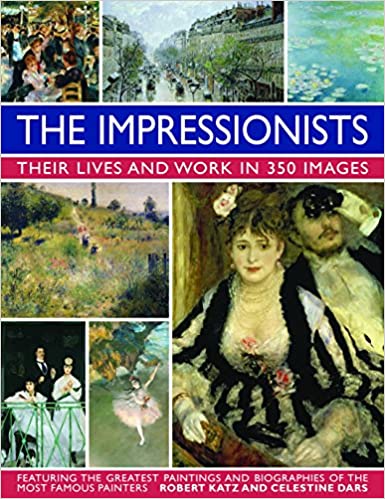
The Impressionists: Their Lives and Work in 350 Images

By Robert Katz and Celestine Dars

Published by Lorenz Books

Copyright: © 2016

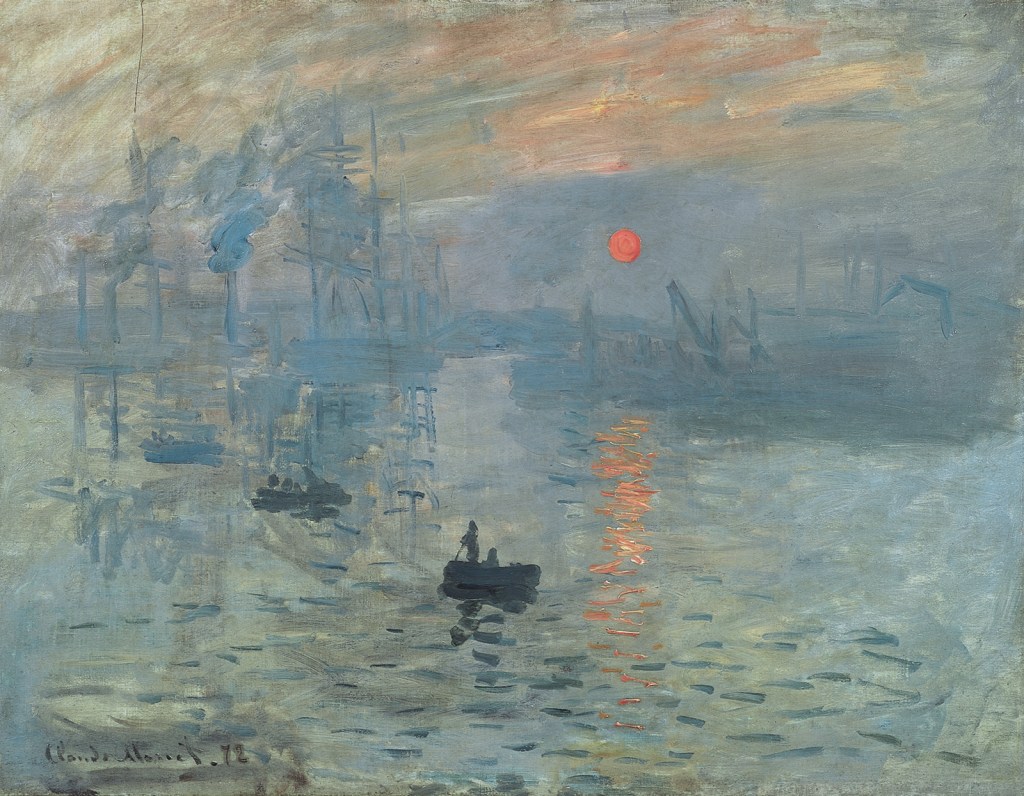
A small coterie of Parisian painters, less than a dozen, mostly French, mostly young and middle class, disillusioned with the elite’s adherence to Neoclassicalism and Romantism, began to experiment in the latter half of 19th century with bold colors and light, loose, broad brushwork and forms, simple, pleasing scenes of everyday life and contentment, landscapes painted in the open air: en plein air, painting what their eyes saw, and their hearts felt. Their style came to be known as Impressionism, a term lifted by an art critic who intended censure and derision from Monet’s painting: ‘Impression, Sunrise’ (shown above right). Impressionism, initially disregarded and rejected by the critics and the public, became the solid foundation for all painting to come; Post-Impressionism, Art Noveau, Cubism, and onto what is today casually labeled modern or contemporary art.

As Impressionism birthed the future of painting in the west, the Realists: Millet, Corot, Corbet, and others created the base for Degas, Manet, Monet to which they added something fresh and enjoyable. Realists painted the world as they perceived it: poor, laboring, dismal, dystopian. The Impressionists kept the Realists’ stage, the world as it is, but added cheerfulness and peace by experimenting with light and form.

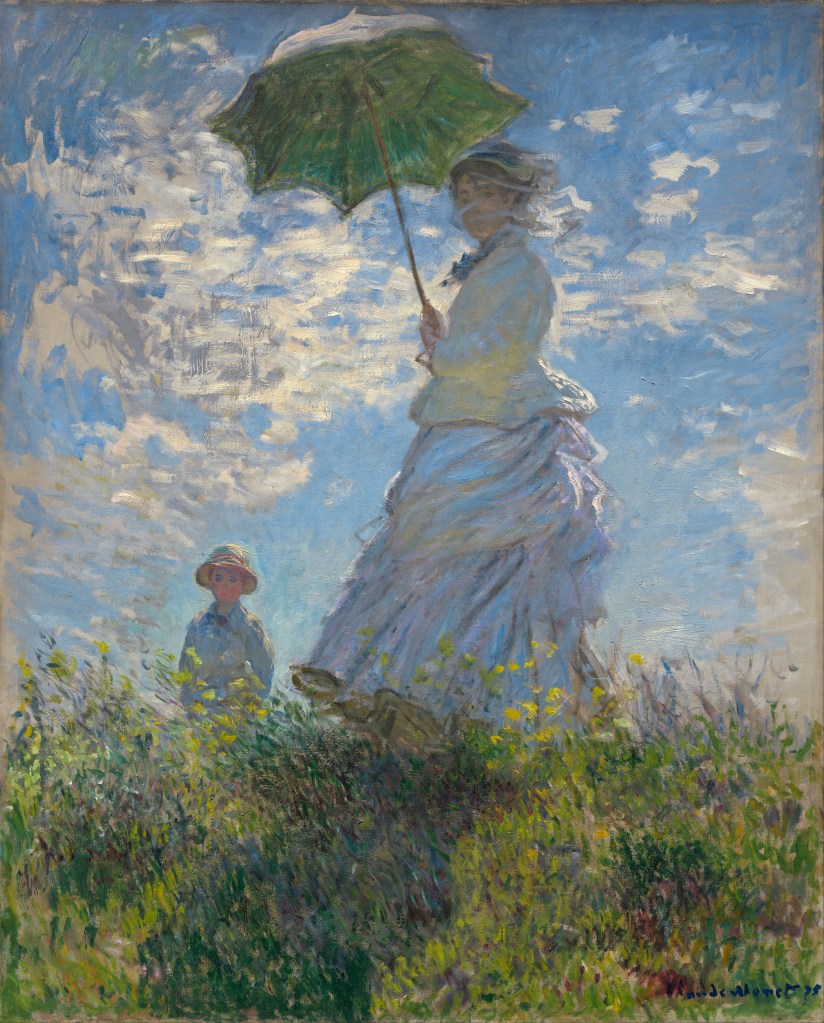
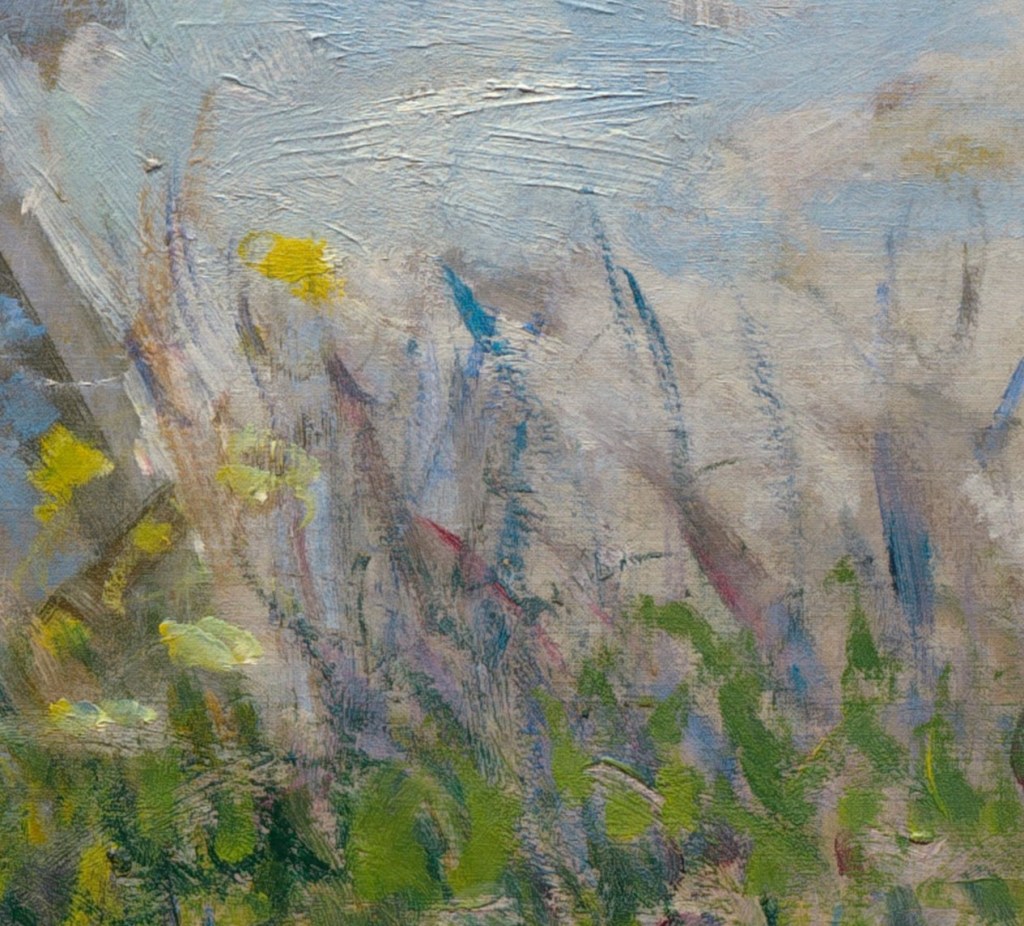
Monet’s genre masterpiece, ‘Woman with a Parasol-Madame Monet and Her Son (shown above left), captures his wife and son in a leisurely stroll around a blustery Argenteuil, a suburb of Paris, in 1875. The woman and son are looking down on the painter with her umbrella blocking out the sun creating an impression of light dancing through the clouds and sky, imparting a stark contrast for the shadows below moving across the grass and flowers. The woman’s vail and dress ripples across her face and body in tune with the breeze. The boy is in the background giving the painting an added sense of depth. The detail of the painting (above right) shows the broad brushstrokes, bold colors and contrasts that came to characterize Impressionistic art.

‘The Impressionist’ brings form and substance to the lives of six of the greatest artists of the genre: Pissarro, Manet, Degas, Monet, Renoir, and Sisley, who gave birth to something new.

The Other Michelangelo

Caravaggio: The Complete Works

By Sebastian Schutze

Published by TASCHEN

Copyright: © 2015

The other Michelangelo, Michelangelo Merisi da Caravaggio, was born almost 100 years after the Michelangelo of Florence and Sistine Chaple fame, in the northern Italian city of Milian, at the time a part of the Spanish Empire; coming of age as a painter in the dying days of the Renaissance art period and the birth of Baroque, developing and leading a style with an increased attention to detail, lighting, and volume not so much in contrast, but in addition to the scientific realism of the previous 200 years.

Caravaggio took the Baroque art beyond the biblical themes of the Renaissance while retaining the humanism, maintaining naturalism but with detail likely unavailable to painters before him, improving on perspective and volume through the use of light and dark: Chiaroscuro, and giving the subjects an emotional bearing that communicates to the viewer a deportment not obtainable to the first Michelangelo.

The book cover, Judith beheading Holofernes, detail above with full painting shown below, depicts Judith looking down and to the viewers left with a look, according to some, of revulsion and disgust, but my interpretation is one of apathy and possibly puzzlement, as noted by the slight creases between the eyebrows and the bridge of the nose and the minor squint of the eyes. Panning out may add an unquestioning repugnance to the painting but not to Judith’s countenance, it remains one of bemusement, a ‘is this all there is’ to vanquishing one’s enemy, while an old woman looks over Judith’s shoulder concurring, not seeing the gore of the moment but the moral of the act and feeling ‘Good, it is done’. The detail may be there, but the viewers interpretation is still required.

Caravaggio, CC BY-SA 4.0 https://creativecommons.org/licenses/by-sa/4.0, via Wikimedia Commons

A Bygone Era

Norman Rockwell’s Christmas Book

By Molly Rockwell

Published by Harry N. Abrams

Copyright: © 1977

A beautiful collection of Norman Rockwell’s Christmas and winter scenes interspersed with Christmas stories, music, and more that you have experienced and loved since you were a little, wide-eyed tyke waiting for permission to tear into your presents.

The book not only contains some great Rockwell snapshots of Christmas but timeless stories of Christmas cheer, that if you haven’t read you should, just for the heart-warming smiles they will bring to your fuddy duddy lips and cheeks. O’Henry’s Gift of the Magi is here along with Moore’s Night Before Christmas, Dicken’s Christmas goblin short story, Virginia’s, “Is there a Santa Claus?” letter, and the newspaper’s response, all to remind and reinforce why Christmas is the world’s favorite holiday.

This book was first published in 1977, which is the one I have, with various reprintings and content expansions through the years, the most recent edition coming out in 2009. The new edition contains additional Rockwell paintings along with poster size prints that are ready for framing. Merry Christmas.

Universal Physics and Local Irrelevance

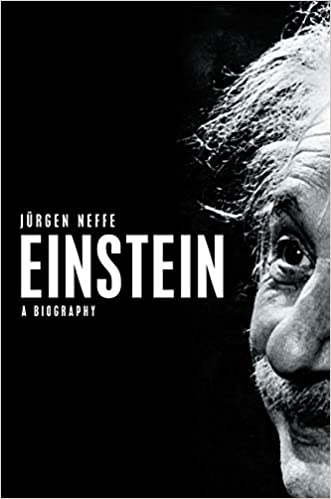
Einstein: A Biography

By Jurgen Neffe

Translated by Shelly Frisch

Published by Farrar, Straus and Giroux

Copyright: © 2007

Neffe brings comprehension to relativity but muddles Einstein’s personal life to inaptness.

Neffe’s non-linear telling of Einstein’s life adds little to the story and a lot of unnecessary page flipping for the reader to grasp the author’s intermittent and incomplete style of writing, whereas his layman descriptions of the theory of relativity generally clears the accumulated fog of physics to bring basic understanding Einstein’s science.

Photoshop Beginnings

I decided to add another hobby to my list of things to waste my time on and today I began my journey into learning Photoshop. I may regret starting this.

This short post falls under the heading of ‘You have to start somewhere’ and with software as non-intuitive as Photoshop that more or less means a few steps past launching the program. I began with something simple hoping that it would facilitate learning the interface–but it didn’t.

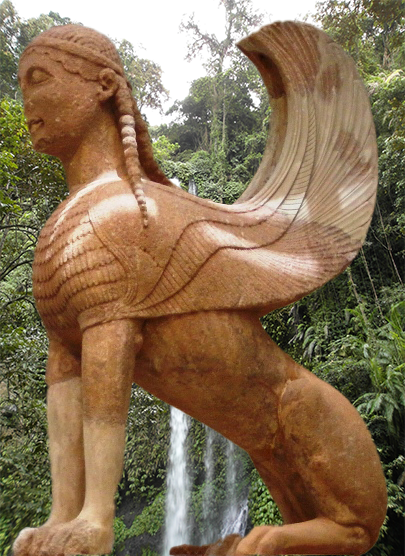
I started with a photo shown above left of a sphinx I took in the museum at Delphi, Greece ten or twelve years ago.

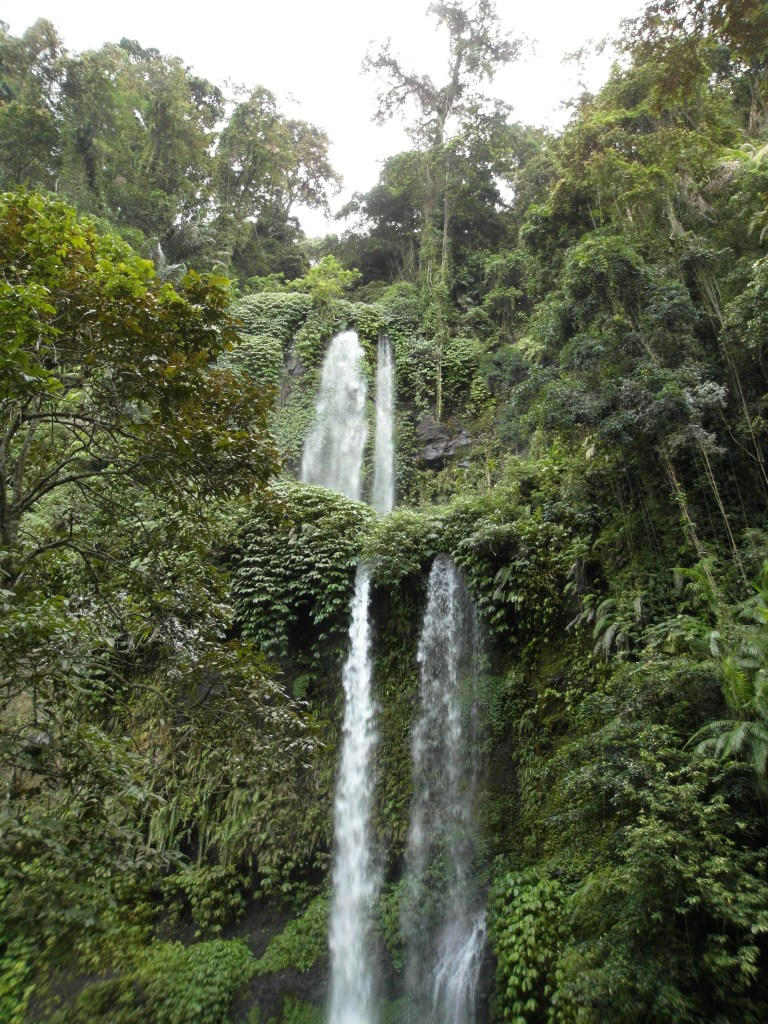
I wanted to replace the drab museum walls surrounding the sphinx with a more pleasing background. The lower waterfalls from Lombok Island, shown to the right, an island immediately east of Bali in the Indonesian Archipelago, fitted the need for a more interesting background.

Both pictures were imported into Photoshop as layers. I cropped the sphinx pic and removed its background and then I arranged the layers so the sphinx is on top the waterfall pic. The result is shown to the left.

The composite pic only took a few minutes once I understood the Photoshop jargon and found the right buttons, but that took about 45 painful minutes. The software is not for the casual user, and it will take some time reach a proficiency that doesn’t raise my blood pressure every time I use it. I’ll post something a little more involved later on.