Rankings: James Suckling 91. Robert Parker 90. ElsBob 91.
ABV: 14.5%
A deep red color, medium to full bodied, aromas of plums and cherries, dry, tannic, with a fresh medium finish. A great sipping wine with strong cheeses or server with steak or lamb.
An excellent wine that has aged nicely with a price is $7-10 less than comparable cabs.
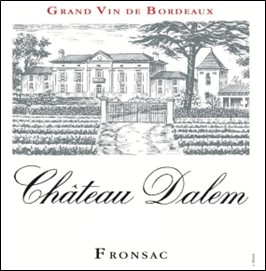
Rhone Red blends from Cotes du Roussillon, Roussillon, South of France, France
Syrah 70%. Grenache 30%.
Purchase price: $13.99
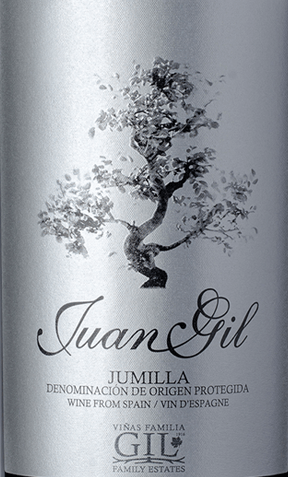
Rankings: Robert Parker 91. ElsBob 91-93.
ABV: 14.5%
A pale to medium purple, full-bodied, with aromas of black fruit and pepper, high tannins and a very nice long finish. A great sipping red wine for your wine-thirty affair or pair with anything spicy, gamey, or blue and pecorino cheeses.
An excellent wine at a very good price. Buy a case, or two, and hold.
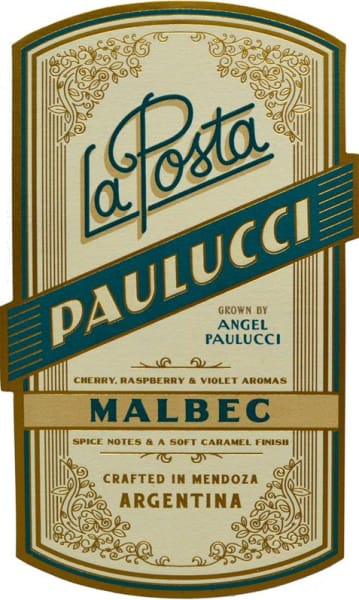
Rankings: Robert Parker 92. James Suckling 90. ElsBob 90-91.
ABV: 15.0%
A deep red in color with notes of black fruits. A full-bodied wine, medium-high in tannins with a medium and balanced finish. Pairs well with rich foods high in fat such as marbled steaks or cured meats.
The grapes are harvested from, on average, 52-year-old vines growing in crappy soils. A medium ruby wine in color with notes of black fruits. Full bodied, high in tannins with a medium finish. Pairs well with beef and pasta.
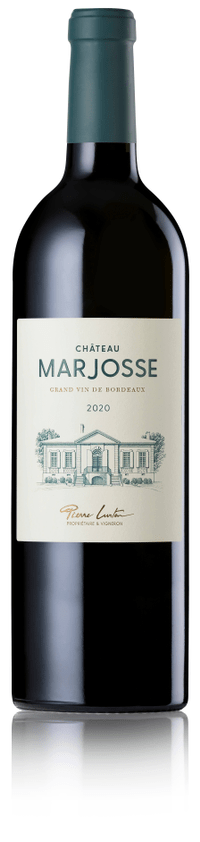
“Marjosse is my secret garden. It gives me energy. It is important for me to have this place and share it.” – Pierre Lurton.
This is a medium-bodied, deep-reddish purple Bordeaux with scents of plums and blackberries. It is a merlot heavy blend with secondary amounts of cabernet sauvignon, cabernet franc and malbec. This is a outstanding wine at a good price.
Chateau Marjosse is a right bank Bordeaux vineyard in the Entre Deux Mers appellation, owned and operated by Pierre Lurton. The vineyard is just under 124 acres, planted mostly in merlot. Smaller portions of cabernet franc, cabernet sauvignon, sauvignon blanc, semillon, chardonnay, old vine malbec and muscadelle. For the red wine, the planted varieties of grape are 80% merlot, 10% cabernet sauvignon, 10% cabernet franc, and a smidgen of malbec. There are three main soil types: sand and red clay, sand and white clay, and limestone. The vines are planted on sloping hillsides, rising almost one thousand feet above sea level. (The above quote is from The Wine Independent article published in February 2023.)
What should you pay for a bottle of wine? Quality, vintage, geographic region, and reputation of the vineyard all influence pricing. Every producer price their wines as high as they believe the market will bear and frequently higher, the same as every other type of business in the world.
Fortunately for the wine drinkers there are about 65,000 wineries in the world producing around thirty-five billion bottles yearly translating into a whole lot of competition to help keep some good wines affordable.
Pricing deals first and foremost with the quality of the wine. Is it any good? Are the components of the wine in balance with each other or do the tannins override the acidity and alcohol? Are the flavors and aromas intense, strong, and bold or weak and faint? Are the flavors and aromas clear and focused or imprecise and expressionless? How complex is wine? Are there multiple layers and nuances? Does the wine exhibit typicity? A great wine will proudly announce its sense of place or its terroir. (Terroir is easier to define for old world wines than it is for new world products.) How’s the finish? Does the taste linger in your mouth after your swallow? An exceptional wine will have a lasting finish.
These six factors are used to gauge the quality of the wine and if you wish to go there, its rating. As I discussed in a previous post, a wine’s rating is a subjective affair. Some find it unnecessary. I find it essential. I find it crucial to know a wine’s rating if I’m going to choose a good wine at a fair price. Without ratings get used to drinking bad wines. There are a few different rating systems: a 100-point scale, a 20-point scale, a 5-point scale, a verbal scale, and others. I use the 100-point scale developed by Robert Parker, but I find myself using Vivino’s 5-point or 5-star system more lately. Most wines go unrated. Wines that are rated professionally usually only have one individual rating, and if you’re lucky sometimes up to five or six which you can average for a more realistic score. Wine’s rated by Vivino’s system have tens to hundreds of individual ratings which tend to smooth out the anomalous, spurious ratings inherent to all rating systems.
Secondly, the vintage of the wine has a significant impact on the price of wine. Some high-quality wines such as Bordeaux and cabernet sauvignon can last for one or two decades, even longer if stored properly. 5-10 years after a wine’s harvest date a bottle can appreciate 200-400% from its original selling price or more but be aware that most wines, red and white alike, do not age well and you may end up paying significant money for a bottle of vinegar.
Other factors such as geographic location and vineyard reputation are fluff to what you really care about, a good tasting wine. Chateau Lafite Rothschild or Sine Qua Non produce some great wines but they are way beyond the means of people without mid-six figure incomes.
Apologies for the long intro to the question: what should you pay for a bottle of wine or for purposes of this post, what should you pay for a bottle of outstanding to exceptional, 90–100-point, red wine? I started with 90-point because it is difficult to find professionally rated wines in the public domain lower than that number. The discussion is also limited to reds because I know almost nothing about white or rose wines.
To begin to answer the above question I gathered pricing, vintage, and rating data for almost sixteen hundred different red wines rated at or above 90-points. The wines are sourced from thirteen countries and every continent, except Antartica of course, with the results skewed towards the nine large producing areas listed below:
Argentina
Australia
Chile
France
Italy
Portugal
South Africa
Spain
U.S.
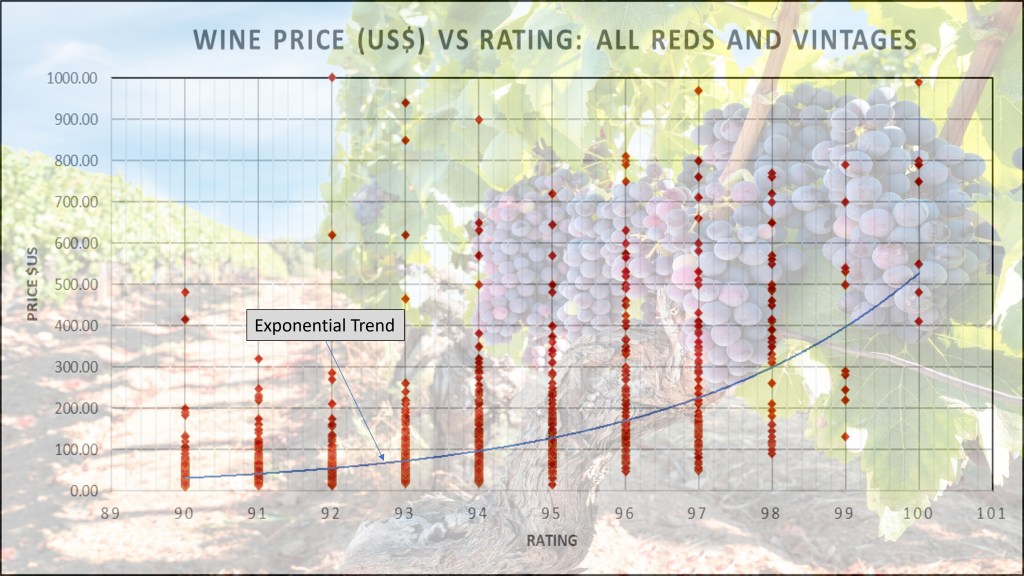
The data were sorted into individual bins by rating and plotted in graphical form as shown above right. The y-axis scale is in dollars and the x-axis is the rating. The y-axis is terminated at $1000 for ease of visualization but there are a handful of wines more expensive than this. The sixteen hundred wines have vintages from 1984-2022. There are very few 2023 reds currently on the market, so they have been excluded. Even though there is a significant amount of scatter in the pricing versus individual rating there is discernable increasing trend in price by higher rating. The trend line shown in blue increasing exponentially from left to right, intersects a 90-point red around $30 and the 100-point at $500 plus.
Below is a chart of the data highlighting the calculated mean (average), median (middle value), and mode (most frequent) wine prices by rating for all red wines and vintages in the data set. The median values are the most useful for comparison shopping purposes and I would suggest that this should be the highest price or ceiling one should pay for any given rated wine. Anything above that and you are just purchasing the shiny coat of paint that adds nothing to the quality of wine. When buying wine by rating the lowest price is the most economically sensical purchase to make. I will expand on that piece of advice below.
The three charts below are the same format as the one above but confined to bracketed vintages from 1984-2014, 2015-18, and 2019-2022. As one would expect and as stated earlier, aged or older wines are more expensive than their more recent counterparts.
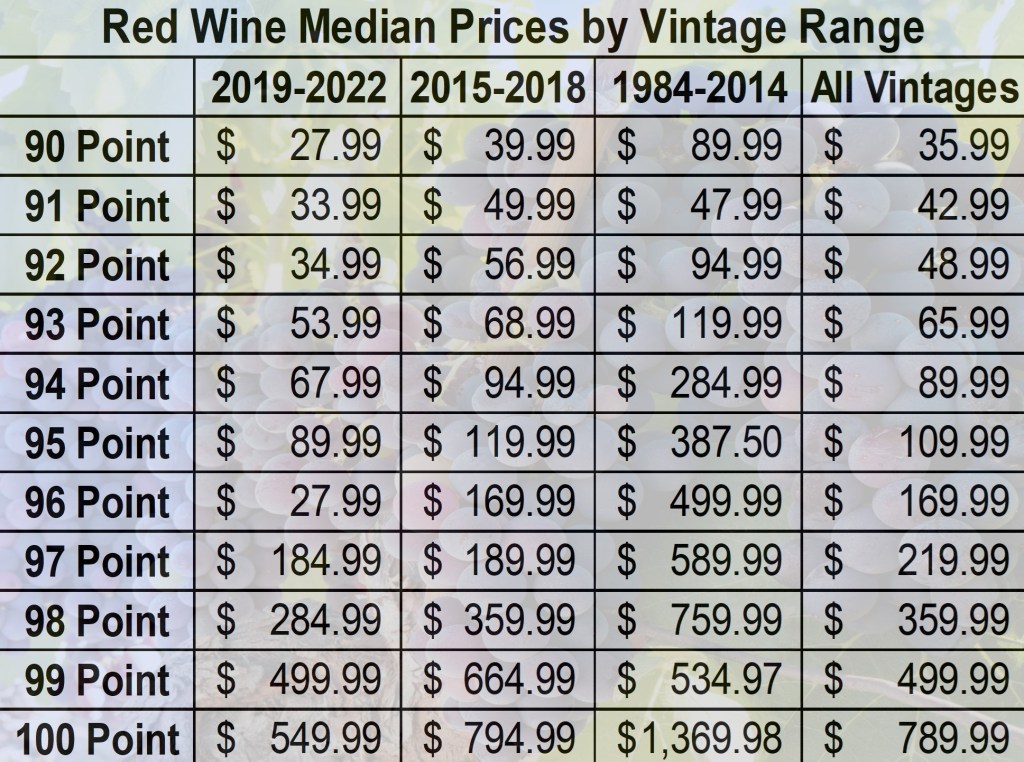
The chart to the left summarizes the median price for the ratings and vintages shown above. Wines increase in price by rating and vintage. Recent wines with a lower rating are cheaper than older wines with higher ratings. Hopefully by taking rating and vintage into account a complicated foray into wine buying will become simple and easily actionable. Keep in mind that the median price should be the highest price paid for any rating and vintage.
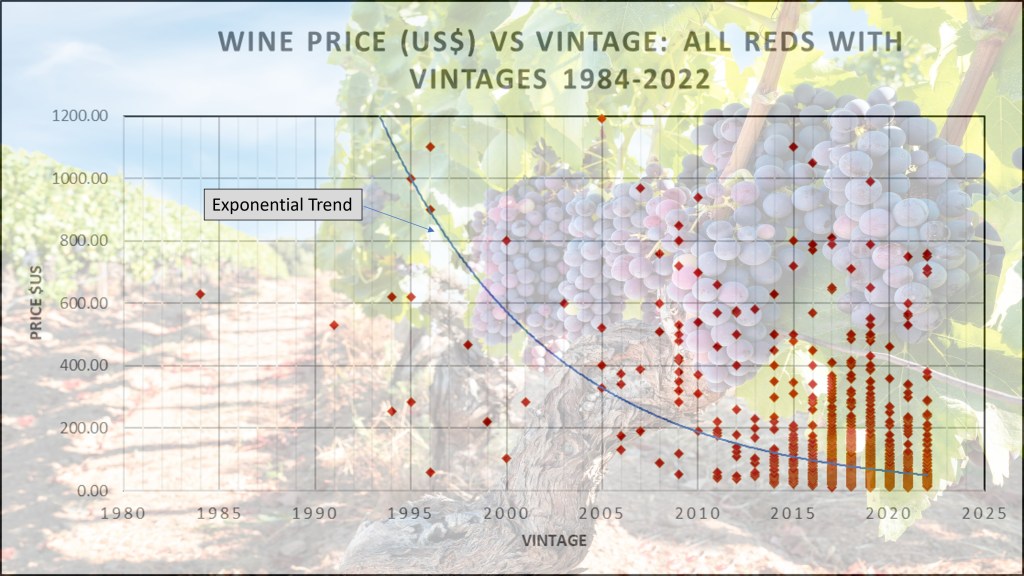
The graph below shows wine prices by vintage. Price is on the y-axis and vintage is on the x-axis. Again, the y-axis is terminated at a lower price than the actual range just to keep visual aspects of the graph manageable. Like ratings the fitted curve trend to price versus vintage is exponential. Older wines cost more, a lot more than recent wines regardless of rating.
In a true to grifter life tale, The Billionaire’s Vinegar: The Mystery of the Worlds’s Most Expensive Bottle of Wine, by Benjamin Wallace details how expensive an old wine can get. Wallace describes how Hardy Rodenstock, allegedly discovered in France a stash of unopened 1787 Chateau Lafite Bordeaux supposedly purchased by Thomas Jefferson while living in Paris after the American Revolution. Rodenstock auctioned a bottle, at Christies, for the tidy sum of $156,000, or $157,000 depending on source, in 1985 to Malcomb Forbes via his son Christopher. In 2023 dollars that would come to $433,740. Rodenstock sold four more bottles to Bill Koch for $400,000 in 1987 or $1,074,378 in 2023 dollars. Old wines can be expensive, and the FBI says they were not only expensive they were also fake. I believe the Feds are still looking for Mr. Rodenstock.
Where do the least and most expensive wines come from? The charts below lists 9 of 11 top wine producing countries in the world and the median price of their wines, as they are priced in the U.S. The yellow highlight is the sorted column. China and Germany are number five and ten in wine production respectively, but little price and rating information is available for comparison purposes, as such they are omitted. Argentina ranks first with the most affordable wines across all outstanding to exceptional rankings. The U.S., mainly California, has the dubious distinction of having the most expensive wines across the 90-100-point ranking scale.
Finally, how much should you spend on a bottle or wine? The best way that I know how to answer that question is to describe my wine buying strategy which, incidentally, may not be the best way to buy wine.
The short description of that strategy is that I like drinking red wine, but I really hate paying a lot for the privilege. To expand on that, first start with the ratings. Without the ratings you are buying blind. Most wines are unrated. If they are rated, they usually will only have one rating in which case you need to have a good feel for how the rater’s judgement fits in with your tastes in wine. Robert Parker is my personal choice. His ratings closely match my own. If he hasn’t rated a bottle of wine, I give it a pass. In the ten years or so that I have been depending on his ratings he has only let me down twice. Both times I felt his ratings were too high, which brings up a useful caution. When you run across a highly rated wine that is less expensive than normal there is a good chance that the rating should be lower than stated rather than you are getting a great deal on a great wine. The second part of purchasing wine is to recognize that for any given varietal whether a cab, a merlot, or whatever, a similar rating should provide similar tastes and aromas for that varietal regardless of where it came from or who produced it. I get a lot of grief for this statement but I’m sticking with it. If you accept this premise, then it really makes sense to buy the least expensive wine available for any given rating. In 2023 that means you will be drinking wine from Argentina, Chile, and Spain. A few years ago, Portugal produced some great inexpensive wines but that has changed dramatically since 2021. U.S. wines, California wines in particular, are good, exceptionally good even but overpriced. No bang for the buck in Napa.
Using this strategy, I consistently buy 90-91-point, occasionally 92–93-point wines ranging in price from $9-17 per bottle. 94-point and higher rated wines are generally beyond what I’m willing to pay. Cheers.
In subsequent posts I will attempt to examine the relationship between wine ratings and price. To get there I thought it may be useful to quickly rehash the reasoning and methodology of ratings, which has been done many times by many others, before I compare them with wine prices.
The Need for Wine Ratings:
After many years of spending considerable time, money, and effort buying and drinking poor quality wines, I was ready to throw in the grapes and stick with whiskey: Irish whiskey, Scotch whisky, Canadian whisky, but not American burbon whiskey, too rough around the edges for my tastes. But this is not about whiskey. This is about choosing a decent wine at an affordable price–choosing a wine that doesn’t provoke tongue burn and esophageal spasms. Finding a wine without pouring over countless wine reviews in search of something within my budget and of acceptable quality. Unless you were a fervent oenophile steeped in the language and nuance of the vine you could get through about as many reviews as there were licks in a Tootsie Pop – 3 – before giving up and picking a wine at random at the local liquor store. An all-around Herculean and, as a rule, unrewarding task. An alternate method was to collect tips from fellow wine travelers. Experience taught me that wine tips were the blood brothers to stock and racehorse tips. Hang onto your wallet when receiving them and expect nothing good to come from them.
Considering the abysmal state of pre-1970s wine analytics, the ability to sort wine by quality and price, it’s a wonder anyone drank the stuff. Before ratings, the sellers of wine usually wrote glowing reviews of their product leading most buyers, through experience, to question their objectivity. Producer and seller reviews continue to the present with caveat emptor remaining germane and necessary to the buyer.
Then along came Robert Parker in the 1970s with a 100-point impartial wine rating/ranking system, a 50-point system in reality, which revolutionized how wine was bought and sold. His approach was to evaluate wines independently of the producers and sellers, communicating his results directly to the consumer.
Parker’s system wasn’t meant to replace wine reviews and tasting notes but to supplement them. The ratings were meant to provide a comparison between the seemingly infinite number of wines that were all labeled good and worthy of your time and money, but impossible to narrow down to something manageable, affordable, and drinkable. The ratings gave the consumer one number, along with price, helping to winnow the field of immense possibilities to single bottle or two for the evening’s festivities.
Wine rankings have their detractors mainly because they are subjective, but all rankings are subjective whatever they may be–books, clothes, cars, phones, whatever. Name a subject and you will be able to find a ranked list and it will have a subjective component. As a species we describe objects by comparing them with other objects and then rank them in a list. Consumer Reports have been doing this since 1936 and as much as they try to be objective there is always a subjective piece in their evaluations. Ranker.com, going live in 2009, has collected a billion votes from millions of users on hundreds of thousands of items and lists, all with subjective content.
When looking for a movie to stream on Friday night you may check out the written reviews which are likely to range from love it to hate it for any given flick, but the first thing that catches your eye are the consensus scores. A movie that scores 30 out of 100 you will give a pass, unless campy movies are your thing, but the ones rated 85 out of 100 prods your interest. You may even go on and read a review or two by critics that you know and trust. This eliminates a bit of the trial and error, taking thousands of movies and finding something we wish to spend our Friday night watching. Not fool-proof but better than written reviews by themselves.
The same process works for wine. That numerical score assigned by a reviewer that you trust narrows the choices of finding an acceptable wine for that Friday night movie, leaving you time to put together a colorful fruit and cheeseboard to complement your well thought out bottle of red… or white.
The Wine Rating Methodology:
Wine ratings are subjective by nature which means the numerical scores will not only change from reviewer to reviewer, but an individual reviewer will likely assign a different score at a different time and place. Moods, physical states, and surroundings affect us all. Smell and taste will not be the same in fresh air as it would in a smokey room. The variables to consistent, or inconsistent, scores are endless, but one must persevere.
To bring some objectivity to ratings the tastings are generally done blind. In blind tastings information about the producer(s) and price is not divulged to the reviewer. In some cases, even the varietal of wine is not communicated before the actual tastings have been completed. The reviewer uses the same scorecard listing the same criteria to analyze all wines. A typical scorecard will contain some or all the following criteria:
Appearance – Color, Viscosity, and Opacity
Consistency or Mouthfeel – Body and Density
Aroma and Bouquet
Taste – Acidity, Flavors, Intensity, Balance, Depth, and Aftertaste
Complexity
Varietal
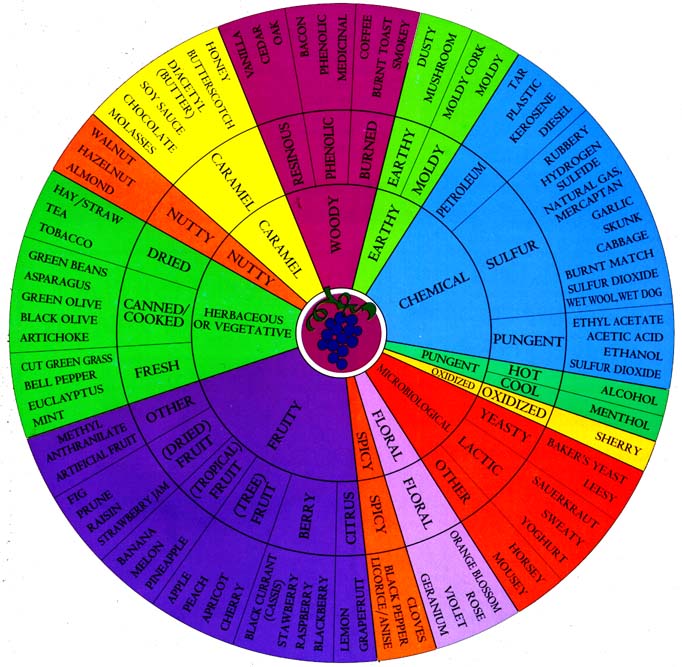
To assist in tasting and evaluating wine the UC Davis wine tasting wheel, divided into three expanding detail circles, was developed, and is shown above right.
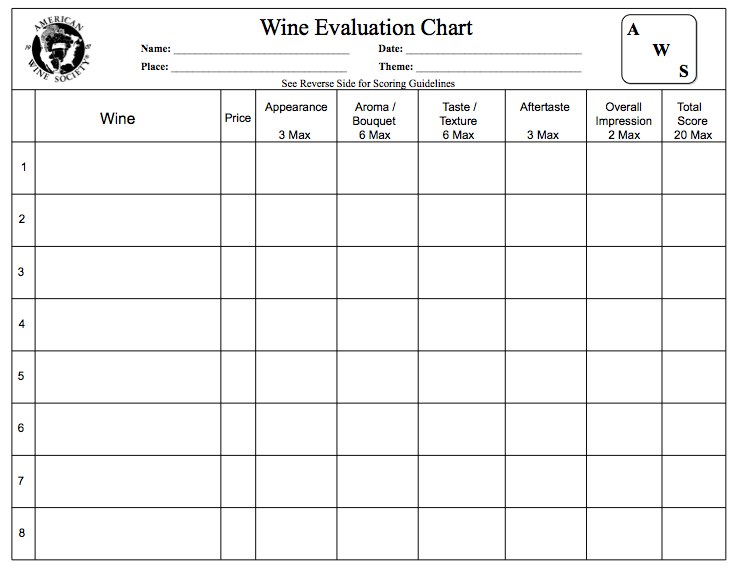
The American Wine Society evaluation sheet shown below is for scoring on the UC Davis 20-point system.
With the above criteria a reviewer will assign a numerical value or star(s) to that vintage bottle of wine. The most common scoring structure is the 100-point system devised by Robert Parker. Others, such as Jancis Robinson use a 20-point system designed at the University of California at Davis in the 1950s. On the simple and basic end of ratings is the ubiquitous 5-star system that ranks wine with very little pretentious hair splitting. Vivino’s use of the 5-star system is strictly constructed and populated from aggregated and averaged individual consumer rankings and correlates very well with the more orthodox expert 100-point ratings. A Vivino 4-star rating equates to a 90-point Parker rating. The four rating scales, plus mine, are listed below.
Ratings in Practice:
On a finale note, those employing the 100-point scale very seldom, either for ranking or subsequent sales promotion, publish any scores below 88 or 89 reducing their scoring system to a 12-point scale that only contains outstanding to extraordinary wines. I have almost no experience with 20-point scales so I cannot speak directly to their posting, or not, of inferior wine scores. Vivino’s 5-Star system publishes all ratings provided by their customers, the good, the bad and the ugly. Vivino’s system subdivides each star into ten parts creating a 40-point system. In the end, whether you are using a 5-, 20-, 40-, 50-, or 100-point system the goal is to add a little quantitative assessment to qualitative reviews.
Robert Parker’s System:
96-100 — An extraordinary wine of profound and complex character displaying all the attributes expected of a classic wine of its variety. Wines of this caliber are worth a special effort to find, purchase and consume.
90-95 — An outstanding wine of exceptional complexity and character. In short, these are terrific wines.
80-89 — A barely above average to very good wine displaying various degrees of finesse and flavor as well as character with no noticeable flaws.
70-79 — An average wine with little distinction except that it is soundly made; in essence, a straightforward, innocuous wine.
50-59 — A wine deemed to be unacceptable.
60-69 — A below average wine containing noticeable deficiencies, such as excessive acidity and/or tannin, an absence of flavor, or possibly dirty aromas or flavors.
University of California at Davis System:
17-20 – Wines of outstanding characteristics having no defects
13-16 – Standard wines with neither outstanding character nor defect
9-12 – Wines of commercial acceptability with noticeable defects
6-8 – Wines below commercial acceptability
1-5 – Completely spoiled wines
American Wine Society Version of UC Davis System:
18 – 20 – Extraordinary
15 – 17 – Excellent
12 – 14 – Good
9 – 11 – Commercially acceptable
6 – 8 – Deficient
0 – 5 – Poor & Objectionable
Vivino et al 5 Star System:
Five Stars – Superlative
Four Stars – Excellent (Robert Parker’s 90-point rating)
Three Stars – Perfect for everyday consumption (Vivino’s average wine is 3.6 stars)
Two Stars – Casual drinking
One Star – Very Ordinary
Els Ranking:
Five Stars – 95-100 points – A most excellent wine
Four Stars – 90-94 points – An outstanding wine (My sweet spot for balancing quality and price)










 elsToday