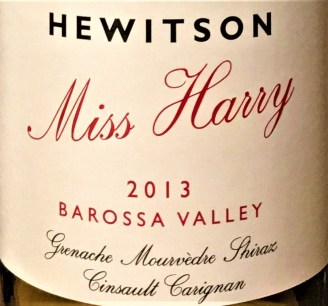
Hewitson Miss Harry G.S.M. 2013

W Miss Harry 2013Rhone Red Blends from Barossa Valley, Barossa, Australia

47% grenache

31% mourvedre

12% shiraz

7% cinsault

3% carignan

14.0% alcohol

Opened 31 Oct 2017

els 9.0/10

Australian Wine Companion  95

Wine Spectator 90

The Hewitson’s vineyards and winery are located in the heart of Australia’s famous wine-producing region, Barossa Valley, about 35 miles northeast of downtown Adelaide, along Australia’s south-central coast. The Barossa Valley, named after the low, rounded mountains of the Barossa Range, was formed by the North Para River, para meaning river in the local dialect. The river provides the vine loving soils and water to nourish the extensive vineyards in the area.

The Barossa Range is named after the British-French, 1811, Battle of Barrosa near Cadiz, Spain, where the British, outnumbered 2-1, routed the French. The different spellings are attributed to a clerical error when the names were registered from the survey records.

The Hewitson’s vineyards contain some of the oldest vines in Australia. Their Old Garden vineyard contains 8 rows of Mourvedre, planted 164 years ago in 1853. The roots of the vines reach down 30 feet into the sandy soils, keeping the plants cool and refreshed even on the hottest, driest days.

The continental climate of Barossa Valley produces summer days reaching past 100 degrees Fahrenheit with the nights dropping down into the low 50s. Rain, during the growing season, has a scanty range and output of less than 1 inch to 1.5 inches per month.

This is a clear ruby-red wine redolent of cherries and spice.  The acidity blends well with the tannins producing a delightfully smooth and balanced wine.  This wine pairs well with just about anything, marbled steaks to pasta to cheese to a solitary glass, or two, enjoyed in the shade on a hot summer day. Decant and aerate the wine for an hour or two, it will help immensely.

$18.99 wine.com

Explorations 7: Excrescence — Pulchritude — Taqiya

Looking up the definitions of 3 words before 7 o’clock in the morning suggests that my education may be incomplete or my memory was erased.

Excrescence:  noun from the Latin excrescentia meaning to grow out

  1. An outgrowth or enlargement, especially an abnormal one, such as a wart.
  2. A disfiguring, extraneous, or unwanted mark or part
  3. A normal outgrowth on the body such as finger nails and hair
  4. A usually unwanted or unnecessary accretion: a bulge on a building

Mushrooms are excrescence of an underground fungus network.

Pulchritude:  noun from the Latin pulchritudo meaning beauty

  1. physical comeliness, beauty, loveliness

Her pulchritude required effort not to stare.

Taqiya:  noun from Arabic meaning prudence or fear

  1. The Islamic practice to be ungrateful to, and or cheat non-Muslims
  2. Islamic religious dissimulation, concealment, while under threat or persecution
  3. Islamic legal exemption to lie when there is an extreme danger to lose ones life or property

Taqiya allowed her to drink wine with her non-Muslim neighbors.

Trivento Malbec Reserve 2015

W Trivento Malbec 2015Malbec from Mendoza, Argentina

100% malbec

13.5% alcohol

Opened 29 Oct 2017

els 8.9/10

Decanter 95

Guia Descorchados 90

Bodega Trivento, the Three Winds Winery, sources its Malbec grapes from the Andean alluvial and colluvium soils of Lujan de Cuyo and Uco Valley, south of Mendoza, Argentina. The vineyards are at an altitude of approximately 3400 feet, soaking up 250 days per year of intense sun, in the dry, thin air; temperatures ranging in the summer growing season from highs of 95 degrees Fahrenheit during the days to 55 degrees at night. The semi-arid climate sparingly doles out less than 1.5 inches of rain per month during the growing season, forcing the growers to add drip irrigation to  assuage the vines thirst.

This inexpensive wine has a wonderful, clear, ruby-red color begging you to further investigate its aromas of cherry and strawberries, its soft tannins, and velvety, favorable finish. Chocolates and pasta will pair well with this Malbec.  Remember to decant and aerate the wine for an hour or two, it will help immensely.

$8.99 wine.com.

Grand Forks, ND Housing Market

Trends from the previous month:

  1. The overall market compared to last month is cooling.
  2. There are fewer homes on the market.
  3. All houses are priced lower, the price per square foot is lower, the square footage per house is higher, and the days on the market has increased.
  4. Houses less than $500,000 are priced lower, the price per square foot is lower, the square footage per house is higher, and the days on the market has increased.
  5. Houses equal to or more than $500,000 are priced higher, the price per square foot is higher, the square footage per house is lower, and the days on the market has increased.RE Housing Oct 2017

Confronting Demons

The Book of Henry  (2017)  PG-13  Runtime: 105 minutesM Henry 201`7

Genre: Drama-Mystery-Suspense-Thriller

els – 6.0/10

IMDb – 6.5/10

Amazon – 4.0/5 stars

Rotten Tomatoes Critics – 4.1/10

Rotten Tomatoes Audience – 3.5/5

Metacritic Metascore – 31/100

Metacritic User Score – 4.4/10

Directed by: Colin Trevorrow

Written by: Gregg Hurwitz

Produced by: Carla Hacken, Jenette Kahn, Sidney Kimmel, Adam Richman, et.al.

Music by: Michael Giacchino

Cast: Naomi Watts, Jaeden Lieberher, Jacob Tremblay

Henry, Jaeden Lieberher, an adolescent genius, is unable to convince the adult world that there is a monster living next door. Running where the adults will not tread, he takes the only road available —until he can’t. Lieberher in Midnight Special was competent, but I simply loved him as Henry in this movie. He is fated for greatness if Hollywood doesn’t totally mess this kid up before he reaches adulthood.

The critics see this movie as a jumbled mess of genres, an excess of ideas smashing into one another, phony and boring, poorly written, directed, and acted: I saw an emotional and passionate presentation of difficult issues that took the movie in unexpected directions, a satisfactory finish, acted and directed superbly, with only the writing coming up short. The writing stumbles mainly with presenting a prodigy capable of doing anything and everything,  amazingly, and then developing, in the end, a rather pedestrian solution to a complicated problem.

Ignore the critics, ignore the written bumps in the road, and see this movie.  Bring a box of Kleenex.

Elephants, Magicians, and Zombies: Oh My

The Fantasies of Robert A. Heinlein B Fantasies Heinlein

Written by:  Robert A. Heinlein

Published by:  Tom Doherty Associates

Copyright:  © 1999

Robert A. Heinlein, the dean of science fiction writers during his lifetime, the first among equals, the first among the 20th century big three: Asimov, Clark, and Heinlein; began his writing and publishing career with short stories and novellas. He first appeared in print with a 1939 short story titled Life Line, published in the pulp fiction magazine, Astounding Science Fiction. He published 29 short stories and novellas before publishing his first novel in 1947, Rocket Ship Galileo.  (Heinlein did write a novel in 1939, For Us, The Living: A Comedy of Customs, but it remained unpublished until 2003, 15 years after his death.)

The Fantasies of Robert A. Heinlein is a collection of 8 short stories and novellas written between 1940 and 1959, illustrating why he was selected as the first Grand Master, in 1974, by The Science Fiction Writers of America.  The line between fantasy and sci-fi is a fine one: the majority of these stories have one foot in each realm with the scales tipping towards the fantastic. I had read all these stories individually many years ago, and I enjoyed them then, but they are still fresh and fun to read today, maybe more so, since they are all packaged together, chronologically, allowing the reader to assess Heinlein’s progression as a writer and story-teller through the years. Below are the short stories and novellas contained in this compilation.

Magic, Inc., © 1940, with an alternate title of The Devil Makes the Law. Magic, Inc. makes the rules until Amanda and Archie take charge.

–And He Built a Crooked House, © 1940. You may run out of time when building your house or maybe your house will run into time.  The title to story was a spoof on the English nursery rhyme:

There was a crooked man, and he walked a crooked mile.
He found a crooked sixpence upon a crooked stile.
He bought a crooked cat, which caught a crooked mouse,
And they all lived together in a little crooked house.

They–, © 1941.  Just because you’re paranoid doesn’t mean your mentally ill.

Waldo, © 1942, written under the pseudonym of Anson MacDonald. Anson was Heinlein’s middle name. Magic makes the world go around.

The Unpleasant Profession of Jonathan Hoag, © 1942. Artistic endeavors usually need some touch up paint.

Our Fair City, © 1948.  It’s hard to dance with a whirlwind when you have crooked feet.

The Man who Traveled in Elephants, © 1957.  A good life, a few good friends, great beginnings. Heinlein considered this his best story.

“–All You Zombies–“, © 1959. Punctuation-wise, word-wise, a strange title; you need to read a few words short of the end to figure it out.  While you are reading, Ella Fitzgerald may be appropriate background music; spring, …time, can really hang you up the most.

Calling Collect?

The Listeners B The Listeners

Written by: James E. Gunn

Published by:  Charles Scribner’s Sons

Copyright:  © 1972

James Gunn presents, successfully and almost convincingly, a fictional account of the emotional, the psychological aspects of searching for intelligent extraterrestrial life: the prerequisite human attributes that a project of this scope requires for a conclusive outcome; mainly the possibility of multiple human lifetimes of tediously seeking something that may not be there.  Gunn postulates the persona needed to continually believe that we are not alone in the vastness of space, someone with the temerity to risk his fruitful years in a quest that will likely fail, his ability to stay the course through countless days and nights of monotonous failure, of a nothingness convulsing his cerebral core to a mush of hopeless sadness.

Gunn illustrates the personalities that it may take to forge ahead with a SETI project of interminable searching, a human that believes he is right in searching the heavens for intelligent life, a human that believes we are not alone in the universe, a humane that believes that all that is needed to succeed is perseverance.

This works in Gunn’s fictional world because the searchers find what they are looking for, an advanced civilization 45 light years from Earth that wishes to impart their collective wisdom to us.  The aliens cryptically convey to us, in their initial message, that they are dying, and as a consequence, pose no threat to our species or planet, allowing humanity to respond with impunity, without risk of triggering an apocalypse.  It’s fiction and everyone does love a happy ending.

The technical side of this novel doesn’t work so well, but sci-fi novels read, coincidently, 45 years after they are published rarely do. Steam turbine powered cars, humongous computers with silly parts, the Arecibo radio telescope with 18 light years of reach capturing 45 light year distant messages, are a few of the distractions, but in the end the visceral concepts are credible suppositions even if the mechanical details of future life lack ingenuity and artistry. A confusing, and possibly superfluous, message presented in the novel is of fictional economic societal solutions, amounting to not much more than welfare, instituted to foster stability and peace, coupled paradoxically, with a prescient passage from a 1968 techno-predictive book, The Year 2000, by Herman Kahn and Anthony Wiener concerning an individual’s responsibility to society:

The year 2000 conditions could produce a situation in which illusion, wishful thinking, even obviously irrational behavior could exist to a degree unheard of today. Such irrational and self-indulgent behavior is quite likely in a situation in which an individual is overprotective and has no systematic or objective contact with reality. For example, there are probably many people for whom work is the primary touch with reality. If work is removed, or if important functions are taken from work, the contact these people have with reality will be to some degree impaired.  The results-minor or widespread-may become apparent in forms such as political disruption, disturbed families, and personal tragedies-or in pursuit of some “humanistic” values that many would think of as frivolous or even irrational.

Contributing to this book’s bond with its reader, and cementing its science cred, are non-fictional extracts from the author’s contemporaneous big thinkers on extraterrestrial life, such as Freeman Dyson and Carl Sagan, liberally sprinkled throughout the “even-numbered chapters”.  One of these excerpts, embedded in the “2nd chapter”, a remark from Frank D. Drake from 1960, can serve as the basis for the book’s plot:

Those who feel that the goal justifies the great amount of effort required will continue to carry on this research, sustained by the possibility that sometime in the future, perhaps a hundred years from now, or perhaps next week, the search will be successful…

Explorations 6: British Royal Navy in Boston – January 1775

An accounting of the British Royal Navy in America on 1 January 1775, modified from Admiral Samuel Graves’,  “List of North American Squadron, on the 1st of January 1775”. Admiral Graves assumed command of Royal Navy in North America in July of 1774, later succeeded by Admiral Richard Howe, brother of General William Howe, in January 1776.  Graves was given the unenviable task of patrolling and controlling 1000 miles of American coast with less than 30 ships stationed from Canada to the Caribbean.

The list and the discussion below only involves the ships assigned to Boston. The largest British warships along the North American east coast were all assigned to Boston. The warships, ships of the line with 3 masts, were rated by the number of mounted guns on

E HMS Asia

Enter aHMS Asia cropped from a watercolor by George Gustavus Lennox 1797 caption

the decks; a 1st ship of the line contained more guns than a 4th ship of the line. Third ships of the line were considered the optimum compromise between guns and maneuverability. Post ships were essentially frigates, warships with 3 masts, built for speed and maneuverability at the expense of firepower, and used mainly as escorts and for patrolling. A schooner is a ship with 2 masts known for its speed, agility and ability for sailing in shallow coastal waters and rivers.


  1. HMS Boyne:  A 3rd ship of the line, serving in the navy from 1766-1783. It carried  70 guns: 28 x 32 pounders, 28 x 18 pounders, and 14 x 9 pounders. It carried a full crew of 520 officers and sailors.  The ship was broken up in 1783.
  2. HMS Somerset:  A 3rd ship of the line, serving in the navy from 1748-1778. It carried 70 guns: 26 x 32 pounders, 28 x 18 pounders, and 16 x 9 pounders. It carried a full crew of 520 officers and sailors. She ran aground at Cape Cod, Massachusetts, during a storm, and was wrecked. The ship served in several battles during the French and Indian War and the Revolutionary War. Paul Revere had to avoid the Somerset while crossing Boston’s Back Bay on his ride to alert Lexington and Concord that the British were coming. The Somerset also provided cannon cover for the retreating British troops, returning to Boston from the battles of Lexington and Concord. The Somerset serving, at the time, as Admiral Graves’ flagship, fired its guns at the rebels fortifications on Breed’s Hill, now known as the Battle of Bunker Hill.
  3. HMS Asia:  A 3rd ship of the line, serving in the navy from 1764-1802. It carried 64 guns: 26 x 24 pounders, 26 x 18 pounders, 10 x 4 pounders and 2 x 9 pounders. It carried a full crew of 480 officers and sailors. The ship was broken up in 1804. A star-crossed ship that initially entered the Revolutionary War by delivering 500 British marines to New York in 1774. She endured a rebel inflicted burning, although, not catastrophic, in 1776, and another fire, this time self-inflicted while in Jamaica in 1796; the fire was extinguished and the ship was saved.  The Asia participated in the capture of Martinique of 1794, but in action a few days later was unable to carry it out its orders of firing on a Martinique fort, because the ships pilot refused to navigate in shallow waters.
  4. HMS Preston:  A 4th ship of the line, serving in the navy from 1757-1815. It carried 50 guns: 22 x 24 pounders, 22 x 12 pounders, 6 x 6 pounders. It carried a full crew of 300 officers and sailors. It was broken up in 1815. She fought an indecisive battle with a larger French warship in 1778 during the Revolutionary War. The Preston was disabled in the British-Dutch Battle of Dogger Bank in 1781.
  5. HMS Glasgow:  A 6th post ship, serving in the navy from 1757-1779. It carried 20  x 9 pounder guns. It carried 130 officers and sailors in January 1775, but was rated to carry 160.  The ship burned in Montego Bay, Jamaica in 1779. She engaged 6 Continental Navy ships, on their maiden voyage, in 1776 and managed to escape unscathed.
  6. HMS Mercury:  A 6th post ship, serving in the navy from 1756-1777. It carried 20 guns, likely 9 pounders. It carried 130 officers and sailors in January 1775, but was rated to carry 160.
  7. HMS Diana:  A schooner serving in the navy from 1775-1775. It carried 4 or 6 x 6 pounders. It carried a crew of 30 officers and sailors.  It has the distinction of being the first British ship captured and destroyed by the rebels in the Revolutionary War, in the mud flats of Boston Harbor. She was commanded by Admiral Samuel Graves nephew, Lieutenant Thomas Graves. Thomas Graves eventually rose to the rank of admiral, and served as second in command under Horatio Nelson during the Battle of Copenhagen in 1801.

Chateau d’Agassac 2014

W D'Agassac 2014Bordeaux Red Blends from Haut-Medoc, Bordeaux, France

Proprietary blend of  cabernet sauvignon and merlot

Opened 14 Oct 2017

els 9.0/10

James Suckling 92

Wine Enthusiast 91

Robert Parker 83

Chateau D’Agassac, a Haut-Medoc winery, purchased in 1996 by the French insurance conglomerate, Groupama, is located in the village of Ludon-Medoc, less than 10 miles north from the center of Bordeaux, and less than 3 miles west of the Garonne River. TheW Chateau d'Agassac charming, fairytale Chateau located at the winery, complete with turrets and moat, is known to have existed as far back as 1238 AD, under the lordship of Gaillard de Gassac, vassal of King Edward I of England. The vineyards, originally swampland, around the Chateau, were  not known to exist prior to the French Revolution in the late 18th century, when the area was drained.

The vines are grown on a young alluvium cover, deposited from the nearby Garonne River during its flood stage. In the western vineyards the soil consists of a  gravel, up to 10 feet thick, and produces refined and elegant wines. Sandy gravels in the middle vineyards, produce subtle wines high in tannins. The eastern most vineyards, closest to the river, consist of clayey gravels, with rounded stones the size of ping-pong balls, reaching 20 feet thick, and produce full body wines.  The vineyards encompass 106 acres, planted with 50% Merlot, 47% Cabernet Sauvignon, and 3% Cabernet Franc; the grapes are harvested from, on average, 25-year-old vines.

The temperatures of Ludon-Medoc reach their peak during August, with highs near 80 and lows hovering around 60. August is the driest month of the year, still producing, on average, about 2.5 inches of rain over those 30 days, with the remaining growing season, before and after August, producing 3 to 3.5 inches of rain each month. The gravels release their sun-acquired heat at night, protecting the vines’ roots from extreme temperature variations during the growing season, and especially during the harvesting of the grapes. The loose gravels also drain away the rain water quickly, keeping the grapes in peak condition.

This Bordeaux needs decanting and aeration for at least 2 hours, 4-6 hours, even better; if not, the acidity and tannins will overpower your senses, infusing your soul with utter regret that you even came to purchase this bottle of fermented grape juice. I opened this bottle after 3 years but in hindsight I should have let it set for at least 2 more years.  With that said, and with proper aeration, this is a good wine; an incredibly dark ruby-purple wine, redolent of plums, prunes and raisins. Full-bodied, dry, and intense with an excellent and protracted finish.

An outstanding wine.

$19.99 wine.com.

Paul Revere

Paul Revere’s Ride B Paul Revere

Written by:  David Hackett Fischer

Published by: Oxford University Press

Copyright:  © 1994

American grade schoolers are taught, are told, that Paul Revere, in the cold, wee hours of 19 April 1775, galloped fiercely through the countryside west of Boston, taking the back roads connecting the small hamlets of Lexington and Concord, yelling at the top of his lungs, “The British are coming”; a story that has passed down through the generations since the Revolutionary War. Dramatic in the telling, yes, correct, not so much. The truth of what happened that night is no less dramatic, extraordinarily dramatic in fact, considering that the American rebels went up against the greatest army and navy on the planet during the latter half of the 18th century, and triumphed.

Warning the Boston countryside of the imminent arrival of British Regulars was not a spontaneous reaction, by the patriot Paul Revere, but a well planned counteraction, with the main details worked out well in advance of the Redcoats march towards Lexington and Concord. Alerted by a Boston stable boy, who revealed that the British officers, in the late afternoon of 18 April 1775, were preparing their horses for a march; the pre-arranged lamp signal, one if by land, two if by sea,  was lit in the tall steeple of Christ Church, tipping-off the rebels that the British were going to take the shorter water route to Concord. This set off a cascading series of events that put into motion upwards to sixty patriots charging through the Boston countryside, alerting and assembling the Minuteman army, warning John Hancock and John Adams of their imminent arrest and hiding rebel assets.

The years preceding the Declaration of Independence on 4 July 1776 saw a significant percentage of self-government seeking colonists locked in a high stakes match of wills with King George III and the British, specifically, the Massachusetts headquartered, Lieutenant-General Thomas Gage, chief of British forces in America and as such the most powerful man in the colonies: General Gage, likely understanding the game being played, resisted brandishing the sword to the very end, when events spiraled out of his control forever in the spring of 1775.

The independence minded colonists, the Whigs, mainly operating from the greater Boston area, resisting the British rule at every turn, prodding them to be the first to use excessive violence against the colonists, to draw enough blood and take sufficient lives that it would light the fuse of war.  The Boston Massacre of 5 March 1970 almost lit that fuse, but the Whigs were not ready for war, they lacked organization, men, materials and most important of all, a plurality of support from the population.  John Hancock, Sam Adams and Paul Revere tamped down the populace’s anger after this event, dampened the fuse of war to await a more felicitous time and place: Concord and Lexington, 19 April 1775.

David Hackett Fischer, currently University Professor and Earl Warren Professor of History at Brandeis University, has written a meticulously researched account of the days leading up to the battles of Concord and Lexington, and the subsequent battle for the hearts and minds of the colonists and British alike; delving into American and British military depositions, pension applications, claims of damages, Thomas Gage, Paul Revere, and other participants’ personal papers, American and British government documents, newspapers, terrain studies, Boston association members, local histories, histories of histories, family trees, weather, tides, phases of the moon; a seemingly inexhaustible list of sources that the author combines into an enjoyable, detailed narrative, in places a bit slow, but always interesting, of the early spring days of 1775 that laid the foundation for the United States of America.