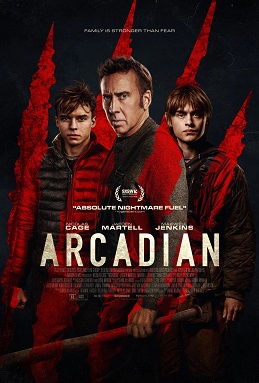
Fear the Night

Arcadians.

Theaters: 12 March 2024

Streaming: 1 May 2018

Runtime:  92 minutes

Genre:  Action – Horror

Els:  6.0/10

IMDB:  5.6/10

Rotten Tomatoes Critics:  83/100

Rotten Tomatoes Audience:  55/100

Metacritic Metascore:  60/100

Metacritic User Score:  5.6/10

Awards: —

Directed by: Ben Brewer

Music by:  Kristin Kontrol and Josh Martin

Cast: Nicholas Cage

Film Locations:  Ireland

Budget:  – $–

Worldwide Box Office:  $0.9 Million

In an apocalyptic world Paul (Cage) and his two sons live a normal farm life during daylight hours and lock themselves into their fortress home during the night, when fuzzy anorexic creatures with extreme dental abnormalities roam in the darkness to kill and feed on humans.

The acting is very good with excellent visuals, but the story is weak on details and inspiration. An OK movie dreaming of a sequel which will never happen.

The name of this movie intrigued me since it was never actually referenced unless I missed it. Arcadia is a district in the central Peloponnesian plane of ancient Greece, which meant refuge or an idyllic place. A place of refuge seems applicable for this movie but not a safe refuge. Or it could just be the city of Arcadia NE of Los Angeles.

Source: IMDb. Rotten Tomatoes. Metacritic. Wikipedia. Graphic: Movie poster for Arcadian.
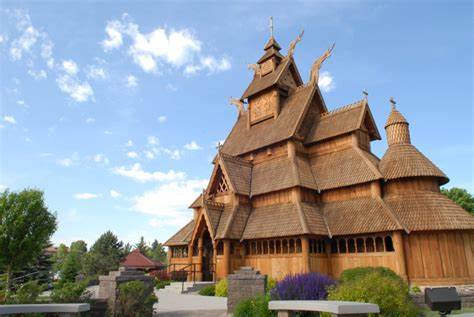
Gol Stave Church


At the Scandinavian Heritage Association’s Heritage Park in Minot, North Dakota there is a full-size replica, built in 2000, of the Gol Stave Church. The original was constructed in Gol, Hallingdal, Norway (~100 miles NW of Oslo) around 1250 AD. It was moved to Bygdoy Park in Oslo, Norway about 100 years ago.

According to Valebrokk et al, inside the church, the corner posts are essential. They are often accentuated and are heavier and more richly decorated than the other structural elements. “They represent the four gospels whose teachings are the supporting foundation of all Christianity” is the description given in a sermon in the thirteenth century. This sermon was held during a church consecration, in which each section of the stave church’s structure was related to spiritual values. The beams upon which the columns rest “signify God’s apostles, the foundation of all Christianity.” The floorboards represent “the humble men who bow in honour; the more they are exposed to the trampling feet of the congregation, the more support they provide.”

The roof surface which protects the church from snow and inclement weather “represents the men…whose prayers protect Christianity from temptation.”

In addition to the replica in Minot, additional replicas exist in the Gordarike Family Park in Gol, which was built in 1995 and in the Norwegian Pavilion in EPCOT, Orlando which was built in 1984.

Source and graphic: scandinavianheritage.org. Excerpts above from Norway’s Stave Churches by Eva Valebrokk and Thomas Thiis-Evensen. Wikipedia.

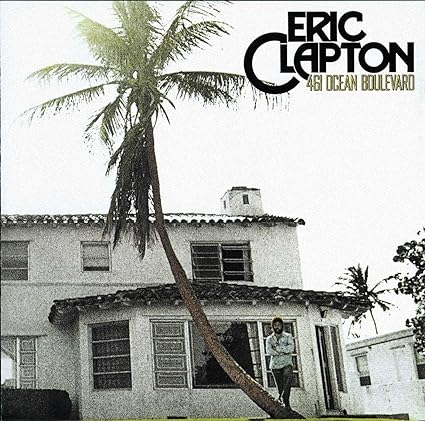
461 Ocean Boulevard

50 years ago, in 1974 Eric Clapton released his second solo album, the hugely successful 461 Ocean Boulevard. It topped the Billboard 200 weekly chart in the USA and reached the top ten in several other countries. It placed number 88 in the Billboard 200 year-end chart and was certified Platinum selling more than two million copies.

The album’s ten tracks run the gambit from hard rock to pop to blues-rock containing 3 new Clapton songs including the theme continuation of Derek & the Dominos, Keep on Growing: Let it Grow. The album’s number one hit, Bob Marley’s: I Shot the Sheriff was released as a single slightly before the album came out in July of 74.  Johnny Otis’s Willie and the Hand Jive, another hit from the album, was released as a single in October of 74.

The album was produced by the legendary Atlantic Records recording engineer, Tom Dowd who also produced the 1970 release of Derek & the Dominos album: Layla and Other Assorted Love Songs.

The album’s title: 461 Ocean Boulevard was the address of the house in Golden Beach, Florida where Clapton and the band stayed in will recording the album at Criteria Studios in Miami.

Source: All Music. Classic Rock Review.

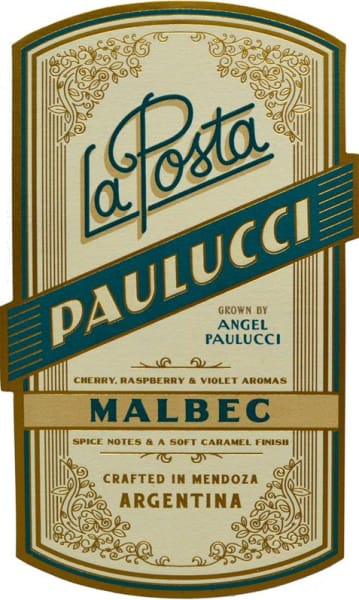
La Posta Paulucci Malbec 2020:

Malbec from Angle Paulucci Vineyard, Mendoza, Argentina.

Purchase price: $15.99.

Ratings: James Suckling 91. ElsBob 90.

ABV: 13.5%

A medium-bodied wine with dark berry flavors, well-integrated tannins, and a medium finish.

Pairs well with dark poultry meats, lean red meat, and blue cheese.

An excellent wine at a great price.

Resilience and Patience

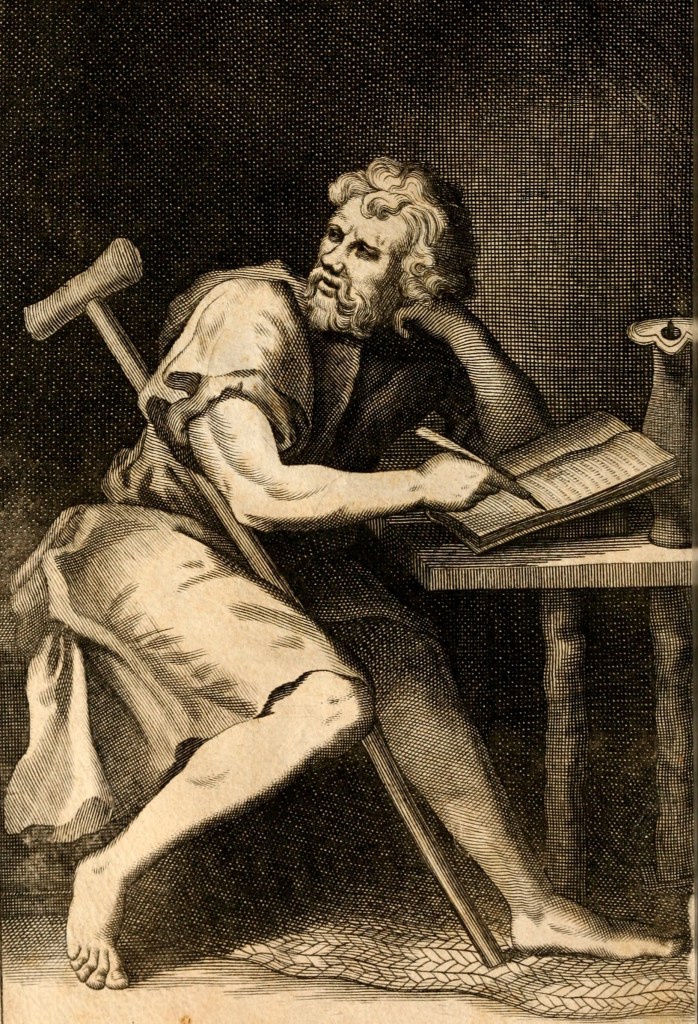
Epictetus was a 1st and 2nd century AD Greek Stoic who lived a simple life and taught philosophy at his school in Nicopolis, Greece. No writings of his have survived, if there were any to begin with, but his pupil Arrian captured his teachings and collected them into two separate works: The Discourses and the Enchiridion.

In The Enchiridion Epictetus briefly discusses 52 or 53 maximums or rules a practicing Stoic should live by with the first and main rule being that you should “only concern yourself with matters that you can control.” Everything else is irrelevant to living a pleasant life.

Stoicism is the philosophy of resilience and patience. Adherents believed in leading a life of virtue, which one did by acquiring wisdom, exhibiting courage, practicing temperance, and promoting justice.

Famous Stoics throughout Greek and Roman history include Zeon of Citium, Eratosthenes of Alexandria, Lucius Seneca, and Marcus Aurelius.

Source: The Enchiridion by Epictetus/Arrian, translated by Elizabeth Carter contained within Ancient Greek Philosophers, published 2018. Graphic of Epictetus by William Sonmans 1715, public domain.

Speak Softly and Scream Murder:

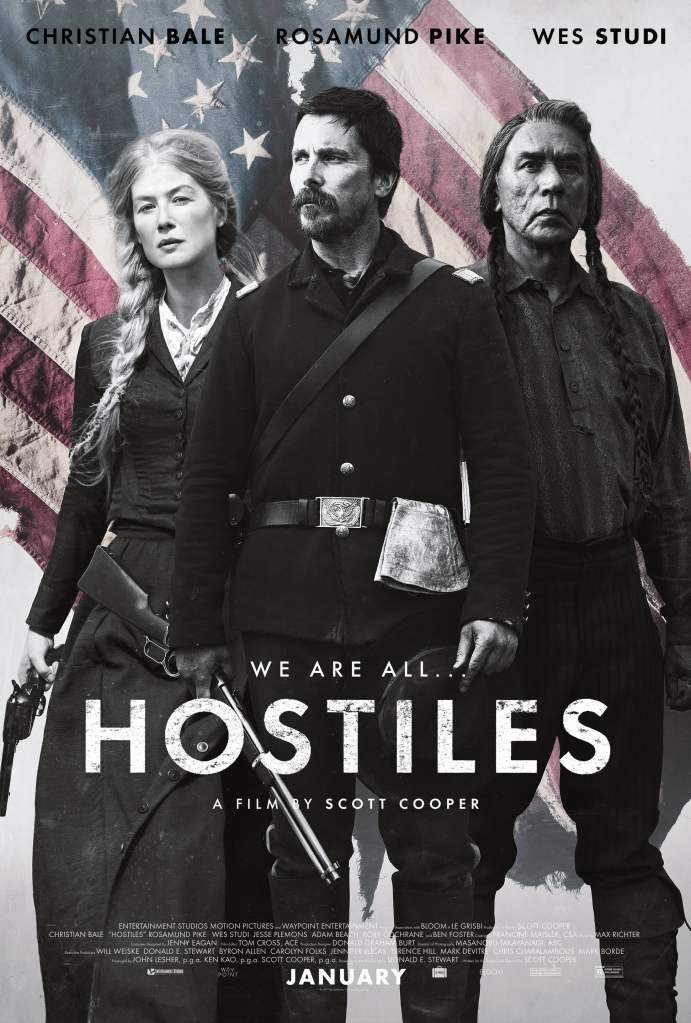
Hostiles

Theaters: 2 September 2017

Streaming: 18 April 2018

Runtime:  133 minutes

Genre:  Drama-Historical Fiction-Western

Els:  6.0/10

IMDB:  7.2/10

Rotten Tomatoes Critics:  70/100

Rotten Tomatoes Audience:  76/100

Metacritic Metascore:  65/100

Metacritic User Score:  7.2/10

Awards: 4 Wins all minor

Directed by: Scott Cooper

Music by:  Max Richter

Cast: Christian Bale – Rosamund Pike – Wes Studi

Film Locations:  Arizona – Colorado – New Mexico

Budget:  – $39 Million

Worldwide Box Office:  $35.7 Million

In the late 1800s U.S. Calvary Captain Joseph Blocker (Bale) is ordered, as a final assignment before retirement, to escort his battlefield enemy, Cheyenne Chief Yellow Hawk (Studi) from New Mexico to his home in Montana. The trip north is filled with anger and violence with reconciliation between whites and reds a distant probability.

The movie is exceptionally well acted along with gorgeous and stunning photography and as a bonus Cooper added a deft piece from matinee westerns of yore to the movie by having Ryan Bingham perform his original song “How Shall a Sparrow Fly” while also playing the part of Calvary Sergeant Paul Malloy. I haven’t witnessed a singing, acting role since John Ford’s “Rio Grande” film starring John Wayne where Ken Curtis of “Gunsmoke” fame sang with his fellow “Sons of the Pioneers“. 

The movie’s Achilles’ heel is the story, worthy of an eighth-grade film project; bland, risk-free, and unsatisfying with all plot lines stuck in neutral not able to engage either the characters or the audience.

Source: IMDB

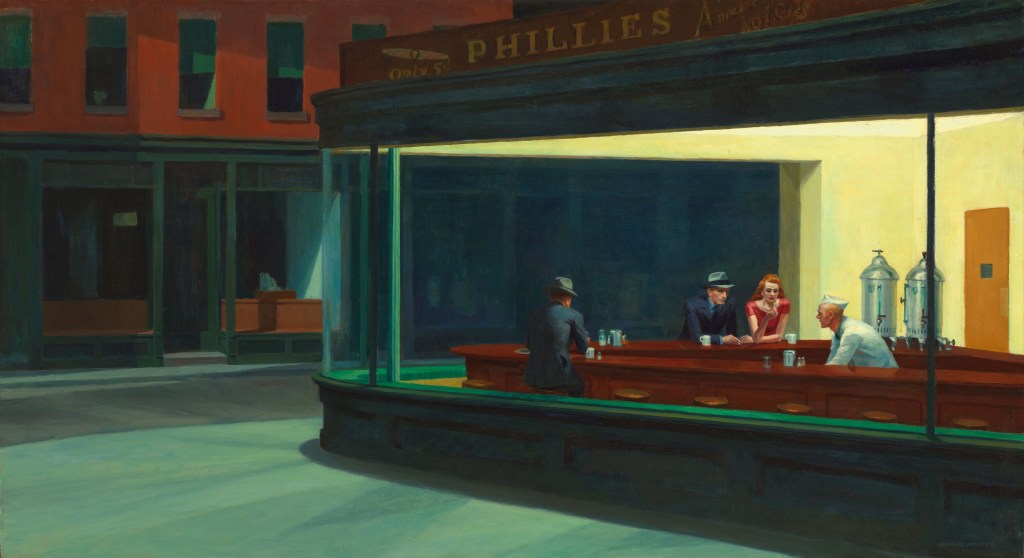
Nighthawks:

Edward Hopper’s 1942 painting, “Nighthawks” was his best-known piece of art. He commented that, “Nighthawks seems to be the way I think of a night street. I didn’t see it as particularly lonely. I simplified the scene a great deal and made the restaurant bigger. Unconsciously, probably, I was painting the loneliness of a large city.” Later, he again downplayed the loneliness aspect of the painting by stressing that it was just “a restaurant on Greenwich Avenue where two streets meet”.

Source: Hopper by Rolf G. Renner, Taschen, 2020 originally published 1991. Painting, “Nighthawks” by Hopper owned by Daniel Rich. Public domain.

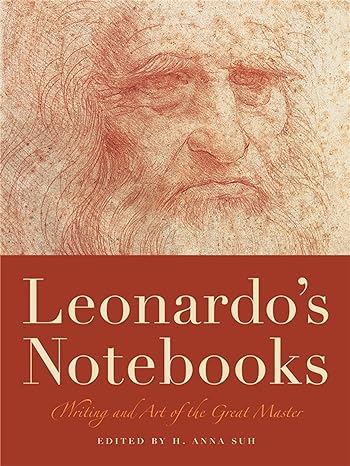
Issac Newton and Leonardo Da Vinci:

Leonardo Da Vinci and Issac Newton were both consummate note takers. They recorded their thoughts, ideas, and anything else that struck their fancy in innumerable notebooks and loose sheets of paper.

Paper was expensive so they both wrote small and covered every inch of paper with drawings and script.

Newton wrote in Latin, Greek, and English with most subject titles in Latin and the text in Greek. To save space his letters were an eye straining one sixteenth of an inch high. An estimated 4000 pages with around 285,000 words plus drawings of his writings have been found to date.

Leonardo wrote in Tuscan Italian, with the text written in a right to left mirror style which some believe he did because he was left-handed, as, by-the-way so was Newton. 13,000 pages of Leonardo’s notes have been found which is believed to be only about a fifth of the total.

Source: “Isaac Newton” by James Gleick, 2003. “Leonardo’s Notebooks” Edited by H. Anna Suh, 2005. “Leonardo Da Vinci” by Walter Isaacson, 2017. Graphic of da Vinci and Newton AI generated.

The Mortal Soul

Let no one be slow to seek wisdom when he is young nor weary in the search thereof when he is grown old. For no age is too early or too late for the health of the soul.”

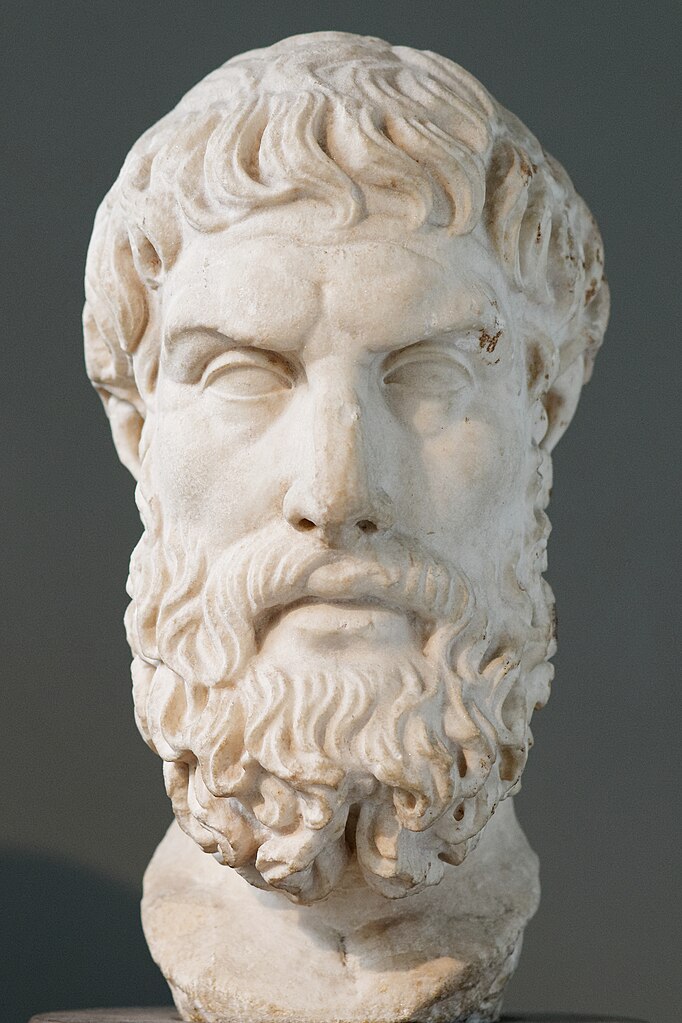
So begins the third and fourth century BC Greek philosopher, Epicurus in his letter to Menoeceus, although who Menoeceus was, has been lost to the ages. Epicurus was a Greek philosopher born on the island of Samos in the Aegean Sea off the coast of Turkey. He established a school next to Plato’s in Athens and taught that one’s purpose in life was to lead a happy, tranquil, self-sufficient life, a pleasant life, and not to fear death.

Epicurus taught that after death there is nothing. Death is/was the end of the body and soul; teaching that self-guilt and shame were the only methods available to prevent the world from overflowing with psychopaths. This is not far from the current Pope’s thoughts on Hell being an empty shell, a place of nothingness. Socrates, on the other hand, taught that the soul is eternal, and one must strive to keep it bright and shiny.

Epicurus ended his letter to Menoeceus, “Meditate therefore on these things (a pleasant life) and things akin to them night and day by yourself, and with a companion like to yourself, and never shall you be disturbed waking or asleep, but you shall live like a god among men. For a man who lives among immortal blessings is not like to a mortal being.”

Sources: “Ancient Greek Philosophers”, numerous translators, published 2018 and Manchester.edu (Indiana). Photo of a bust of Epicurus by Nguyen, public domain.

The Big Sleep

She came over near me and smiled with her mouth and she had little sharp predatory teeth, as white as orange pith and shiny as porcelain. They glistened between her thin too taut lips. Her face lacked color and didn’t look too healthy.

“Tall, aren’t you?” she said.

“I didn’t mean to be.” (said Marlow)

Her eyes rounded. She was puzzled. She was thinking. I could see, even on that short acquaintance, that thinking was always going to be a bother to her.

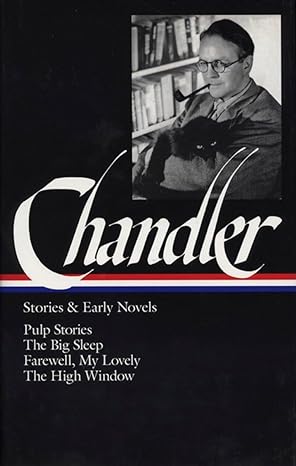
The above excerpt is from Raymond Chandler’s first Philip Marlowe novel: “The Big Sleep”, published in 1939. Marlowe is a hard, introspective private eye dreamed into existence from Chandler’s cynical but playful mind, creating the quintessential detective and crime novel of the 20th century.  “The Big Sleep” has been ranked as one of the best 20th century novels by The Guardian, Time Magazine, Le Mond, and at least 20 other current best book lists.

The 1946 movie adaptation of the book starring Humphrey Bogart and Lauren Bacall with the screenplay by William Faulkner achieved a Metascore of 86 and a user score of 8.0. The Telegraph, critiquing the movie, in 2004 stated that “The Big Sleep is the best scripted, best directed, best acted, and least comprehensible film noir ever made.”

Chandler was 44 years old, an out of work alcoholic, before he wrote his first piece, a short story, “Blackmailers Don’t Shoot”.  “Blackmailers” was the warm-up private eye mystery that would evolve, over the course of the next six years, into his first Philip Marlowe novel: “The Big Sleep”.

Source. Chandler: Stories and Early Novels published by Library of America, 1995. The 100 Greatest Literary Characters by Plath et al published by Rowman and Littlefield, 2019. Graphics: Warner Bros’ 1946. “The Big Sleep” and book cover.