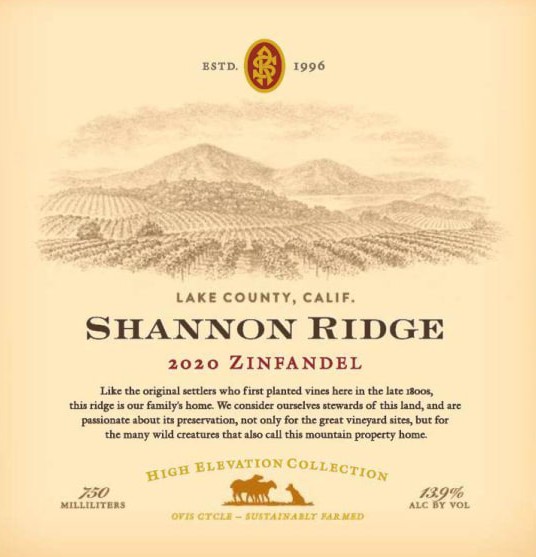
Shannon Ridge High Elevation Zinfandel 2020

Zinfandel from Lake County, North Coast, California

Purchase Price: $11.99

Wine Enthusiast 92, ElsBob 91

ABV 13.9%

Aromas of red cherry, blackberry and spice; full-bodied, semi-dry, soft to medium acidic, with smooth to moderate tannic, peppery finish. Will pair well with beef or chicken and, better yet, as an accompaniment to a cheese, grape, and salami board.

A very good fine wine, remarkable priced. I’ve seen it retail recently for $17 which is still a great price for this wine.

Americana

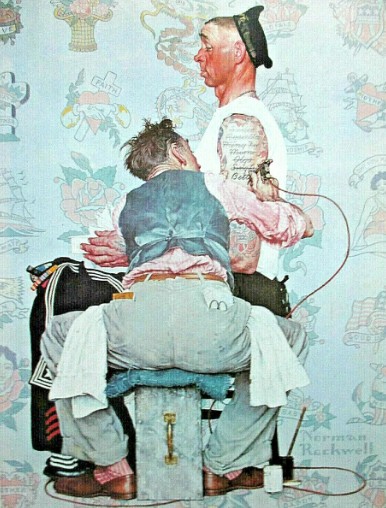
Norman Rockwell, a name synonymous with American Realism, was a master of meticulous detail, yet he never failed to brush a thread of whimsy and rustic existence onto the canvases of his iconic paintings.

Norman Rockwell, an iconic painter of American life, was born on 3 February 1894 into a comfortable New York City family. His father, a lover of Charles Dickens, often sketched illustrations from books, planting early seeds of creativity in young Norman. His mother, overprotective yet proud of her English heritage, spoke often of her artistic but unsuccessful father, whose unrealized dreams seemed to echo in the household. Art wasn’t just a pastime for Rockwell; it pulsed through him, and by age 12, he had resolved to draw for a living, though painting would come later in his journey as an artist.

As a teenager, Rockwell pursued artistic training at the National Academy of Design and later at the Art Students League, where he studied under the influence of Howard Pyle, the renowned illustrator of boys’ adventure tales. Pyle, who had founded the school’s philosophy through his own teachings and legacy, left an indelible mark on Rockwell, shaping his lifelong passion for weaving narrative into art. Before he turned 16, Rockwell landed his first commission—four Christmas cards—a modest start for a boy already dreaming big. By 18, he was painting professionally full-time, his talent unfolding with the quiet determination of youth finding its purpose.

In 1916, Rockwell began his legendary run with The Saturday Evening Post, creating covers that would grace the magazine for the next 47 years. Over that span, 322 of his paintings became what the Post proudly dubbed “the greatest show window in America.” Through these works, Rockwell offered a mirror to the nation—sometimes nostalgic, often tender, always human—reflecting everyday moments that resonated deeply with millions.

While his career soared with the Post, city life never suited him. In 1939, he traded New York’s clamor for the rolling hills of Vermont, and later, in 1953, settled in Massachusetts. These rural landscapes became his muse, dominating his canvases for the first three decades of his career. Rockwell was no haphazard artist; he was methodical, even obsessive, following a rigorous six-step process to bring his visions to life: brainstorming ideas, sketching rough outlines, photographing staged scenes with real people, crafting detailed drawings, experimenting with color studies, and only then committing paint to canvas. Each step was a labor of love, a tip of the hat to the America he loved.

At the heart of his art was a simple, profound drive. As Rockwell himself put it, “Without thinking too much about it in specific terms, I was showing the America I knew and observed to others who might not have noticed.” His paintings weren’t just pictures, they were invitations to see the beauty in the ordinary, the dignity in the overlooked; we see not just an artist, but a storyteller who believed in the quiet goodness of people, brushstroke by brushstroke.

Source: The Norman Rockwell Treasury by Thomas S. Buechner, 1979. Norman Rockwell Museum. Graphic: The Tattooist by Norman Rockwell, 1944, The Brooklyn Museum.

Locke and Citizenship

John Locke, the intellectual and philosophical father of modern Western democracies, argues in his Second Treatise of Government that membership in a political society—and thus citizenship—is not automatically granted by birth on a country’s soil alone. Instead, it depends on the concept of consent, whether explicit or tacit, and the allegiance of the parents. Locke asserts that a child’s status is tied to the political community of the parents rather than merely the geographic location of their birth. Citizenship to Locke was not a right but a contract between the governed and the government. A summation of his reasoning follows:

  1. Voluntary Consent as the Basis of Citizenship: Locke begins with the premise that all individuals are born free and equal in a state of nature. Political society emerges only through the voluntary consent of individuals to join together. For Locke, citizenship is not an inherent trait but a contractual relationship. A child born on foreign soil to non-citizen parents has not entered this contract, nor have their parents done so on their behalf.
  • Parental Influence on Political Identity: Locke suggests that a child’s initial political identity derives from their parents. He describes the natural subjection of children to parental authority, implying that their political allegiance aligns with that of their parents until they reach an age where they can consent for themselves. If the parents are foreigners—not members of the political society where the child is born—they owe no allegiance to that country’s government, and thus neither does the child by extension.
  • Rejection of Jus Soli: Unlike later theories of jus soli (right of the soil), Locke does not consider birth on a territory sufficient for citizenship. He distinguishes between temporary presence and permanent allegiance. A foreigner residing in a country does not automatically become a member of its commonwealth unless they explicitly consent to its laws and government. A child born to such foreigners, being incapable of agreeing to these terms, does not acquire citizenship through birth alone.
  • Tacit Consent and Its Limits: Locke acknowledges that tacit consent—such as owning property or residing long-term in a country—can signal allegiance. However, a newborn child cannot provide consent, tacit or otherwise. If the parents are merely visitors or temporary residents, their presence does not imply a commitment to the political community, and thus the child does not gain citizenship by default.
  • An Illustrative Analogy: Locke reinforces his argument with an example: a child born to English parents in France does not become a French subject simply because of the location of birth. Instead, the child remains tied to the English commonwealth through the parents’ allegiance. This reflects Locke’s view that citizenship stems from political bonds, not just physical geography.

In summary, Locke’s arguments about citizenship, consent, and political society in his Second Treatise of Government are deeply rooted in his broader natural law framework. Natural law, for Locke, is a set of universal moral principles derived from reason and human nature, which govern individuals in the state of nature—before the establishment of organized political societies.

Locke contends that a child born on foreign soil to non-citizen parents is not a citizen of that country because citizenship requires consent and allegiance, which the child inherits from the parents’ status rather than the place of birth. Furthermore, a minor lacks the capacity to consent to the laws and allegiance of a foreign land. Locke’s reasoning underscores individual agency and the contractual nature of political membership, prioritizing these over a purely territorial basis for citizenship.

Source: Second Treaties of Government by John Locke, 1690. Graphic: John Locke by Godfrey Kneller 1697.  Public Domain.

Birthplace of Wine

The modern grape (Vitis vinifera subsp. vinifera) is believed to have evolved from its wild ancestor, Vitis vinifera subsp. sylvestris, native to a broad region spanning the Caucasus Mountains (present-day Armenia, Georgia, and Azerbaijan) to the Mediterranean. This area offered ideal conditions for wild grapevines to flourish after the retreat of the Pleistocene glaciers, with its temperate climate and poor, rocky soils providing excellent drainage on rolling hills and mountainsides.

Archaeological evidence suggests that the domestication of grapes likely began in the South Caucasus region between 6,000 and 8,000 years ago. It’s possible that early farmers selectively cultivated wild grapevines, favoring those with the juiciest and most flavorful fruit, gradually developing them into the domesticated grape varieties familiar to us today.

In modern-day Georgia, approximately 30 miles (50 km) south of Tbilisi, evidence of grape wine production dates back to 6000–5800 BC. At the sites of Gadachrili Gora and Shulaveris Gora—Gora or hills are akin to the “tels” of the Levant—researchers have unearthed ancient pottery fragments containing chemical traces of wine, such as tartaric acid. These findings indicate that the inhabitants of this region were cultivating grapes and fermenting them into wine as early as 8,000 years ago.

This positions Georgia as a leading candidate for the “birthplace of wine,” with a merry winemaking tradition that has persisted through millennia.

Source: Oldest Evidence of Winemaking by Andrew Curry, National Geographic, 2017. Graphic: Caucasus Region by Peter Fitzgerald, modified by Travelpleb, Wikimedia Commons.

Cosmic Gold Rush

Ultra-high-energy cosmic rays (UHECRs) are the universe’s most energetic particles, with energies exceeding 100 quintillion electronvolts (100 EeV)—far beyond anything we can replicate on Earth. First observed over 60 years ago, these particles have puzzled scientists with their immense power and a curious pattern: their energy correlates closely with their electric charge. But where do they come from?

A new theory by physicist Glennys Farrar from New York University offers an answer. She proposes that UHECRs originate in binary neutron star (BNS) mergers—explosive collisions that form a black hole. These events unleash powerful jets of material, acting as cosmic particle accelerators that boost particles to unimaginable energies. The idea links UHECRs’ narrow energy range and charge correlation to a range of combined neutron star mass sufficient to form a black hole.

The theory suggests that the highest-energy UHECRs—those above 100 EeV—could be heavy elements like gold, platinum, or uranium, forged in extreme cosmic events such as supernovae or neutron star collapses (stars can only create elements up to iron through fusion). By tying UHECRs to BNS mergers, Farrar’s work could reveal how precious elements form and deepen our understanding of cosmic cataclysms.

Source: Binary Neutron Star Mergers… by Glennys R. Farrar, Physical Review Letters, 28 February 2025. Graphic: Two Neutron Stars Merging by Universe Today.

Temperance in Early Virginia

The Virginia Colony, established by the Virginia Company of London, was not a cradle of temperance in its early years. Founded in 1607 at Jamestown under a 1606 charter from King James I, this joint-stock venture aimed for profit—gold, trade, and later tobacco—not moral reform. Its settlers, a mix of Anglican adventurers, merchants, and laborers, relied on alcohol (beer and spirits) as a staple, given the assumed scarcity of safe water. Yet, a supposed temperance law dated 5 March 1623 is often cited as America’s first, though no documentary evidence from the Virginia Company’s records supports this claim.

The context for such a measure lies in the colony’s struggles. By 1623, Virginia was a fragile outpost under company control, reeling from the Powhatan Uprising of 1622. This surprise attack by the Powhatan Confederacy killed about 347 settlers—over a quarter of the population—likely in response to English land grabs for growing tobacco. The massacre disrupted food supplies, leaving grain scarce. If a 1623 law restricted alcohol production, it may have been a pragmatic response to conserve resources, not a temperance crusade. Virginia Company records don’t mention such a law, but they do show earlier alcohol regulations for practical ends—economic control, public order, or resource management—rather than moral prohibitions.

Earlier codes hint at this pattern, vigilance in the face of pioneering hardships. The Laws Divine, Moral and Martial, enacted around 1610–1611 under Sir Thomas Dale, imposed strict discipline in the struggling settlement, including penalties for drunkenness to curb idleness. In 1619, Governor George Yeardley’s assembly banned “drunkenness” and excessive gaming, possibly reflecting mild Puritan influence from England’s religious debates. However, these rules targeted abuse, not alcohol itself, and didn’t amount to temperance as later understood. The absence of a Puritan majority—unlike in New England—underscores this distinction. Virginia’s settlers were commerce-driven subjects of the Crown, not the religious reformers who arrived later with the Plymouth Colony (1620) or Massachusetts Bay (1630).

The 1623 claim might stem from a misinterpretation of these regulatory measures, exaggerated by later historians or temperance advocates seeking an early precedent. For comparison, in 1623, the Virginia Company of Plymouth’s minister William Blackstone distributed apples (later tied to cider), but no temperance law emerged there either. Both companies, focused on survival and profit, bore little resemblance to the Puritan ethos that shaped later American temperance movements. Without primary evidence, the 1623 Virginia temperance law remains a historical ghost—possibly a practical rule born of crisis, not a moral milestone.

Source: Initial claim from Encyclopedia of Trivia, elaborated by Grok 3. Graphic: Indian Massacre of 1622, Woodcut by Matthaus Merian, 1628. Public Domain.

Guillaume Gonnet Cotes du Rhone Le Reveur 2022

Rhone Red Blend from Cotes du Rhone, Rhone, Franc

60% Grenache, 20% Syrah

Purchase Price: $10.99

ElsBob 88

ABV 14.5%

Aromas of red cherry and raspberry; full-bodied, dry, medium acidic, with a medium tannic finish. Will pair well with beef or game meat but this would be better served as the second bottle for an after-work social.

A very good fine wine priced a tad high at $11. I’ve seen it retail recently for $20+ which is too much for this wine.

Engraver of Wood:

Gustave Doré, widely regarded as the greatest illustrator of the 19th century, produced meticulous and exquisite works that continue to captivate audiences today, particularly his illustrations for the Bible and Dante’s Divine Comedy. Born, raised, and deceased in France, Doré began his artistic pursuits at the age of six and started illustrating classic literature at twelve using lithography. By nineteen, he embarked on his lifelong mission to illustrate the world’s greatest books, transitioning to woodblock engravings. It is estimated that he created over 10,000 engravings during his lifetime.

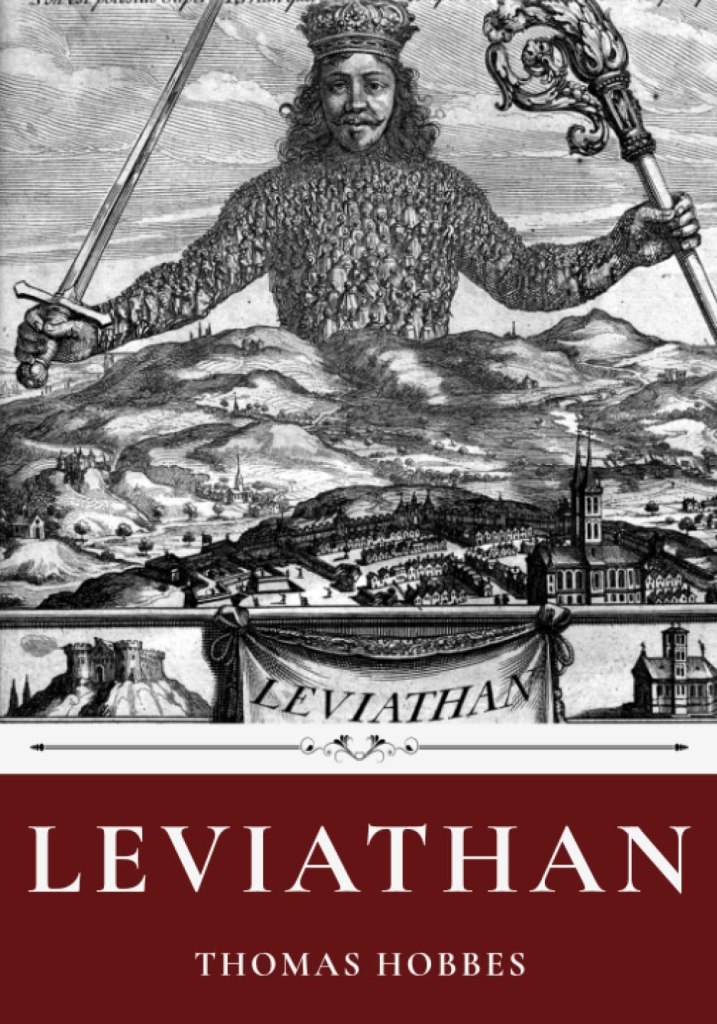
Among his most celebrated works are the engravings for the Vulgate Bible, also known as La Grande Bible de Tours. This collection includes 139 plates depicting scenes from the Old Testament and 81 plates from the New Testament. Featured in the attached graphic is his illustration of Isaiah 27, portraying God (often interpreted as Jesus in Christian theology) slaying Leviathan, symbolizing the ultimate triumph of good over evil.

Source: Gustave Doré Engravings by Alpine Fine Arts, 1995. Graphic: Destruction of Leviathan (Isaiah 27, colorized) by Gustave Doré, 1866, licensed by Gwengoat.

Locke and Jefferson

John Locke’s theory on the social contract is a cornerstone of his political philosophy and western democracies, as outlined in his work “Second Treatise of Government.” According to Locke, the social contract is an agreement among individuals to form a government that will protect their natural rights to life, liberty, and property. The social contract is a compromise between man’s inherent natural rights and the need to preserve and protect those rights.

Thomas Jefferson, in his Declaration of Independence builds on Locke’s concepts, tweak is probably a better word. Locke writes that people have “natural rights” to “life, liberty, and estate” (property), and if a government violates these, it’s “dissolved,” giving people the right to form a new one. Jefferson writes into the Declaration its famous “life, liberty, and the pursuit of happiness”—swapping “property” for a broader, aspirational feel. Locke’s idea that government derives legitimacy from the “consent of the governed” shows up when Jefferson lists grievances against King George III, arguing the king’s abuses justify breaking away. And Locke’s justification for revolution—“when a long train of abuses” threatens these rights, people can resist—mirrors Jefferson’s “whenever any Form of Government becomes destructive of these ends, it is the Right of the People to alter or to abolish it.”

Locke’s key points in his Second Treatise:

  1. State of Nature: Locke believed that in the state of nature, individuals are free and equal, governed by natural law, which dictates that no one should harm another in their life, health, liberty, or possessions. Anarchy with adherence to God’s moral code.
  2. Natural Rights: Locke argued that individuals have inherent rights to life, liberty, and property. These rights are inalienable and must be protected by any legitimate government.
  3. Consent of the Governed: Locke emphasized that government derives its authority from the consent of the governed. People agree to form a government to protect their natural rights, and this consent is the basis of political legitimacy.
  4. Limited Government: Locke’s social contract theory advocates for a government with limited powers, designed to serve the common good and protect individual rights.
  5. Right to Revolution: Locke believed that if a government becomes tyrannical and or violates the social contract, the people have the right to revolt and establish a new government that will better protect their rights.

Source: Second Treaties of Government by John Locke, 1690. Graphic: John Locke by Godfrey Kneller 1697.  Public Domain.

Nebbiolo Grapes

Nebbiolo is an Italian grape variety predominantly associated with the Piedmont region in northwest Italy, near the borders of France and Switzerland. Indigenous to this area, it boasts a long history of cultivation. Evidence indicates that wines made from Nebbiolo have been produced in the region since at least the first millennium AD, with the earliest recorded mention of the grape dating back to the 13th century in the vicinity of Turin.

Today, Nebbiolo is the cornerstone of several renowned wines, including Barolo and Barbaresco. These wines are notable for their clarity, often drawing comparisons to Pinot Noir in appearance. However, they stand out for their medium- to full-bodied structure and complex profile, characterized by aromas of red fruit, pronounced tannins, vibrant acidity, and an extraordinary finish. Decanting is crucial to mellow the tannins and enhance their drinkability.

Nebbiolo wines pair exceptionally well with rich, fatty dishes such as ribeye steak and meals featuring acidic components, including meat ragù and hearty pasta sauces.

Graphic: A bunch of Nebbiolo Grapes by Cristiano Alessandro, Licensed.