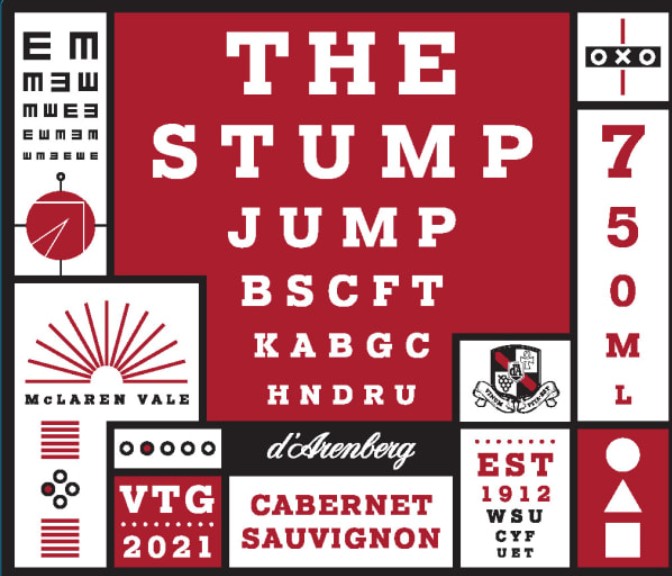
Cabernet Sauvignon from McLaren Vale, South Australia.
Purchase Price: $11.99
Wine Enthusiast 91, Wine Spectator 90, ElsBob 89
ABV 14.5%
Aromas of red and black fruits (Le Rouge et le Noir, Stendahal 1830😊), spice; full bodied, bold, chunky tannins with a medium long finish. Not particularly a great sipping wine. Will need to be paired with bold foods such as lamb or strong cheese.
A very good fine wine at a fair price. Although I find the wine label simply atrocious, the eye charts are a playful sobriety test to determine if you can, or should, have another glass.
Trivia: The phrase “stump jump” in Australia refers to the stump-jump plough, an agricultural tool invented in South Australia in 1876. This plough was designed to “jump” over tree stumps, roots, and rocks allowing farmers to cultivate land without the labor-intensive process of removing the buried debris. The tool was recognized as one of the most important agricultural inventions of the 19th century.
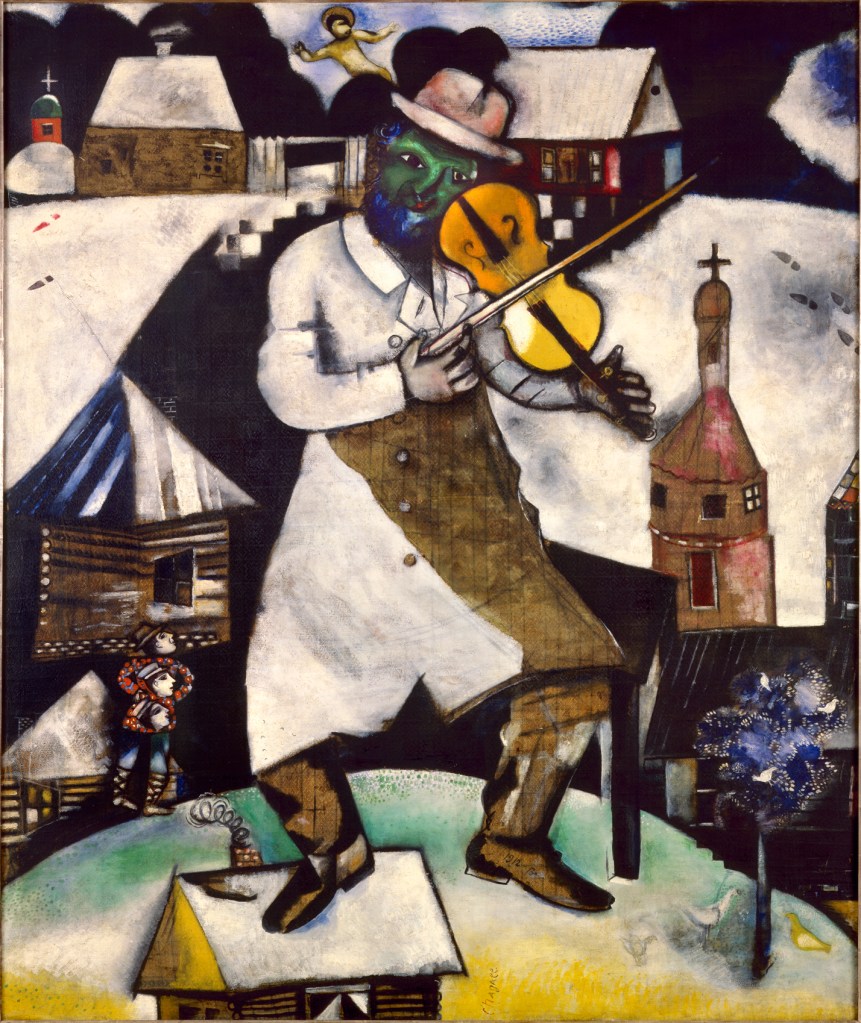
Art critic Raimond Cogniat described Marc Chagall as an artist of opposites, a painter who thrived in the interplay of form and color, color and meaning. Chagall infused his paintings with love and happiness, crafting worlds that felt both fantastical and deeply alive. He shaped reality from his feelings, “making it conform to his inner spiritual logic,” even if, as he once confessed, he wasn’t entirely conscious of his process.
Born Moishe Shagal in 1887 in Vitebsk (now Belarus), Chagall grew up in a Jewish enclave within the Russian Empire. He later embraced France as his adoptive home, blending his Eastern European roots with French artistic flair. Though he briefly explored Cubism during its peak in the early 20th century, he thankfully abandoned that style to carve his own path as an expressionist. Vivid, otherworldly colors, and exaggerated forms defined his style, while his Jewish heritage, evident in depictions of shtetl life, fiddlers, and biblical scenes, remained his anchor. His 1912–1913 painting The Fiddler is said to have inspired the title of the musical Fiddler on the Roof.
In a 1963 speech to an American audience, Chagall reflected on his philosophy: “Any moral crisis is a crisis of color, texture, blood and the elements, of speech, vibration, etc.—the materials with which art, like life, is constructed. Even when mountains of color are piled on a canvas, if one can discern no single object even through great sound and vibration, this will not necessarily give authenticity.” To Chagall, authenticity was more than paint; it demanded the infusion of human experience, blood, and the essence of nature.
Source: Chagall by Raimond Cogniat, translated by Ann Ross, 1977. Graphic: The Fiddler, Chagall, 1912-1913. Public Domain
Black swans are rare and unpredictable events, what the military calls “unknown unknowns“, that often have significant, domain-specific impacts, such as in economics or climate. Despite their unpredictability, societies tend to rationalize these occurrences after the fact, crafting false narratives about their inevitability. COVID-19, for instance, ripples across multiple domains, beginning as a health crisis but expanding to influence the economy, legal systems, and societal tensions. As a human-made pathogen, its risks should have been anticipated.
Black swans throughout history are legendary. Examples include the advent of language and agriculture, the rise of Christianity (predicted yet world-changing), and the fall of Rome, which plunged the Western world into centuries of stagnation. Islam (also predicted), the Mongol conquests, the Black Death, and the Great Fire of London shaped and disrupted societies in profound ways. The fall of Constantinople, the Renaissance, the discovery of America, the printing press, and Martin Luther’s Reformation brought new paradigms. More recently, the Tambora eruption (“the year without a summer”), the Great Depression, WWII brought unforeseen disruptions to economies and geopolitics, the Manhattan Project, Sputnik, the fall of the Berlin Wall, and the rise of PCs and the internet altered the trajectory of human progress. Events like 9/11 and the iPhone have similarly reshaped the modern world. While black swans may be rare, they are not inevitable. We should expect moments of dramatic collapse or unanticipated brilliance to recur throughout history.
Nassim Taleb, author of the 2007 book The Black Swan, suggests several approaches to mitigate the effects of such events without needing to predict them. His recommendations include prioritizing redundancy, flexibility, robustness, and simplicity, as well as preparing for extremes, fostering experimentation, and embracing antifragility: a concept where systems not only withstand shocks but emerge stronger.
Through the lens of history, black swans appear as a mix of good and bad, bringing societal changes that were largely unanticipated before their emergence. As history has shown, predicting the impossible is just that: impossible. What might the next frontier be, the next black swan to transform humanity? Could it be organic AI, a fusion of human ingenuity and machine intelligence, unlocking potential but posing profound risks to free will, societal equilibrium, and humanity’s very essence? (Next week—preparing for a black swan: an example.)
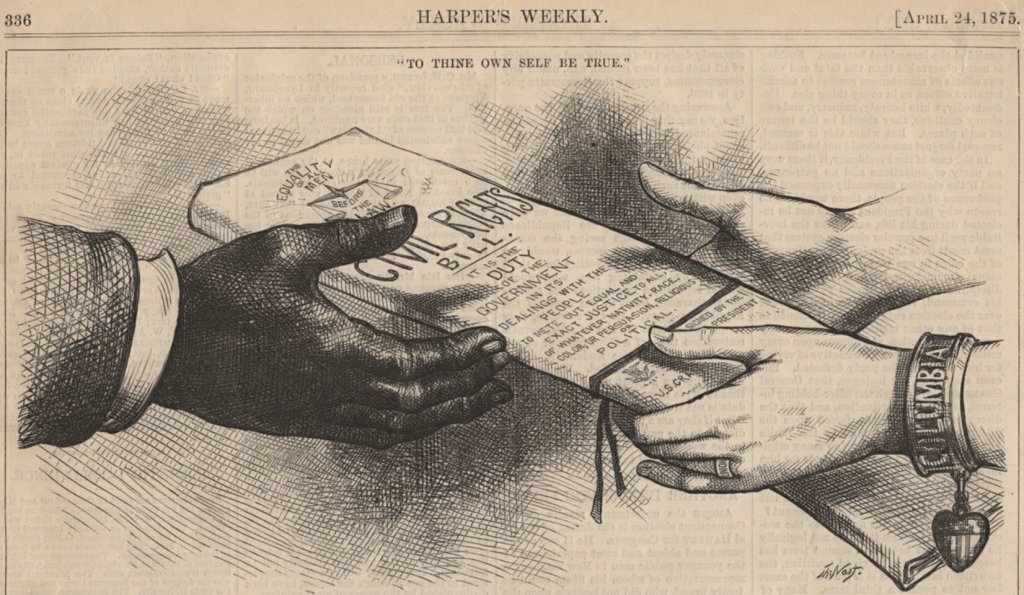
The 14th Amendment, introduced during the Reconstruction era, was crafted to address legal and constitutional deficiencies exposed after the U.S. Civil War. Its first sentence; “All persons born or naturalized in the United States, and subject to the jurisdiction thereof, are citizens of the United States and of the State wherein they reside“, has become a focal point for competing interpretations. Much like the Second Amendment, its wording has sparked legal and grammatical debates, particularly surrounding the clause “and subject to the jurisdiction thereof.”
The Second Amendment faced similar scrutiny for over 200 years, particularly its prefatory clause, “A well-regulated Militia.” This ambiguity was finally addressed in District of Columbia v. Heller (2008), where the Supreme Court clarified that the historical record and documents like the Federalist Papers supported the right of private citizens to own firearms. The Court also ruled that the prefatory clause did not limit or expand the operative clause, “the right of the people to keep and bear Arms, shall not be infringed.“
Likewise, the 14th Amendment’s clause “and subject to the jurisdiction thereof” remains unsettled, awaiting similar historical and grammatical scrutiny to solidify its interpretation. Initially aimed at protecting freed slaves and securing their citizenship, this provision has since invited broader interpretations in response to modern challenges like immigration.
The framers’ intent during Reconstruction was to ensure equality and citizenship for freed slaves and their descendants, shielding them from exclusionary laws. At the time, the inclusive principle of jus soli (birthright citizenship) aligned with the nation’s need to address the injustices of slavery and foster unity among the country’s existing population. However, changing migration patterns and modern cultural dynamics have shifted the debate. The ambiguity of “subject to the jurisdiction thereof” now raises questions about its application, such as how jurisdiction applies to illegal immigrants or children of foreign diplomats, in a globalized world.
Legal precedents such as United States v. Wong Kim Ark (1898) affirmed that nearly all individuals born on U.S. soil are citizens, regardless of whether their parents’ immigration status is legal or illegal. While this aligns with the practical interpretation of jurisdiction, it has spurred debates about the fairness and implications of modern birthright citizenship practices.
Immigration today involves a broader spectrum of cultures and traditions than during earlier waves, when newcomers often shared cultural similarities with the existing population. Assimilation, once relatively seamless, now faces greater challenges. Nations like Britain and Germany have recently revised their jus soli policies to prioritize the preservation of societal norms. The unresolved question of how to address declining populations further complicates the debate; a debate with the citizens that has not occurred much less resolved.
While originally crafted to address the systemic exclusion of freed slaves, the 14th Amendment’s principle of birthright citizenship continues to evolve in its application.
The most expensive wine ever sold is a bottle of 1945 Domaine de la Romanée-Conti, which fetched an astonishing $558,000 at an auction in 2018. This vintage Burgundy wine is pure legend, only 600 bottles were produced that year, and it was also the last vintage made from the vineyard’s old vines before they were replanted.
Second on the current list of exceptionally overpriced wines is a six-liter, imperial bottle of 1992 Screaming Eagle Cabernet Sauvignon that sold for a cool half million dollars at a Napa Valley charity auction in 2000. 1992 was the first vintage produced at winery and since that time Screaming Eagle has become synonymous with a very expensive wine lovers cult.
Somewhere on the list of expensive wines is the auction of several bottles of 1787 Chateau Lafitte (old spelling) sold in 1985 for $400,000. The wine was supposedly from Thomas Jefferson’s personal cellar. The actual provenance was questioned at the time of the sale, but that knowledge was suppressed. It was later revealed that the bottles were forgeries but everyone that mentions that is sued into oblivion.
White holes, theoretical counterparts to black holes, might be two sides of a cosmic coin. Black holes devour matter with relentless gravity; white holes expel it, hurling energy, particles, and possibly time into the universe. Both stem from Einstein’s general relativity, which predicts black holes, proven by solid evidence, while white holes remain elusive, perhaps lurking beyond our Earthly senses.
To see their link, rethink black holes’ strangest feature and flaw: the singularity. General relativity paints it as a point where spacetime crushes so tight that physics breaks, a bug, not a feature. Exotic matter, with odd traits like negative energy, was once the fix. But the University of Barcelona’s Pablo Bueno and team ditched it, tweaking gravity with higher-curvature corrections to erase singularities. This needs extra dimensions beyond our four, turning black holes from traps into dynamic zones.
The University of Sheffield adds a twist: the event horizon isn’t sharp. Quantum gravity blurs it into a fuzzy gateway where spacetime bends, not breaks. In 4D, black holes are sinkholes, matter vanishes. In higher dimensions, it slips through, heading elsewhere. Sheffield’s take ties this to dark energy, the universe’s expansion driver. Here, it’s the power plant: quantum fluctuations, fueled by dark energy, replace the singularity with a bounce, flipping spacetime to a white hole.
Enter white holes, Janus-like transitions, Roman god of gates and duality. Black holes vacuum everything; white holes, linked via higher dimensions, spit it out, maybe far off. Picture Sagittarius A*, the Milky Way’s core black hole, channeling matter 25,000 light-years to the Orion Nebula’s arm. Unseen, white holes might hide in dimensions we can’t touch.
This hints at a cosmic cycle, like Earth’s water cycle: evaporate, rain, repeat. Black holes swallow, dark energy and quantum gravity bounce it through higher dimensions, and white holes release it back. Barcelona and Sheffield suggest no endpoints, just a recycling of cosmic raw materials across realms we’re barely capable of understanding.
Source: Black Hole Singularity, Gielen and Menendez-Pidal, University of Sheffield, 2025. Regular Black Holes…by Bueno, P. et al, Physics Letter B, February 2025. Graphic: Black Hole Rendering.
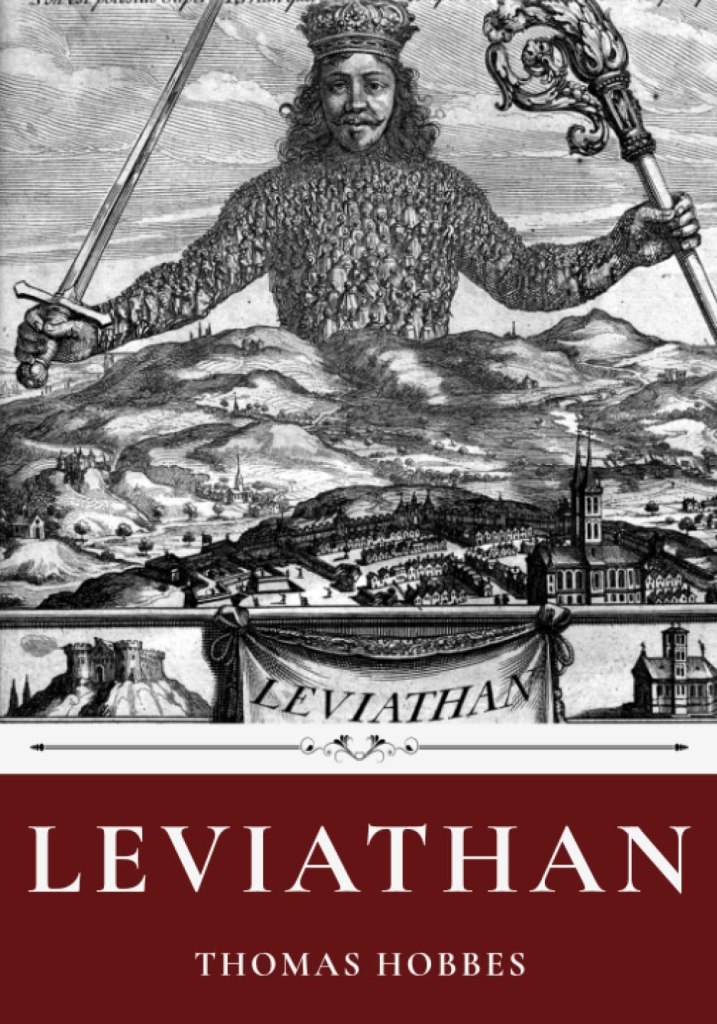
“The notions of right and wrong, justice and injustice, have there no place. Where there is no common power, there is no law; where no law, no injustice.” — Leviathan by Thomas Hobbes
Thomas Hobbes saw human nature as a cauldron of chaos. In his state of nature, life is “nasty, brutish, and short,” a “war of all against all” where self-preservation is the only natural law. Shaped by Thucydides’ tales of strife and Machiavelli’s ruthless pragmatism, Hobbes cast man’s self-interest as a destructive force that casts morality aside. His remedy to avert chaos: a towering sovereign, ideally a monarch, to crush anarchy with an iron fist. The social contract trades liberty for security, forging laws as human tools to bind the beast within. Yet Hobbes stumbled: he failed to grasp power’s seductive pull. He assumed his Leviathan, though human, would rise above the self-interest he despised, wielding authority without buckling to its corruption.
“Reason, which is that law, teaches all mankind…that being all equal and independent, no one ought to harm another in his life, health, liberty, or possessions.” — Second Treatise of Government by John Locke
John Locke painted a gentler portrait of man than did Hobbes. He rooted natural law in reason and divine will, granting all people inherent rights to life, liberty, and property. His state of nature is peaceful yet imperfect, marred by the “want of a common judge with authority,” leaving it vulnerable to human bias and external threats. Optimistic, Locke envisioned a social contract built on the consent of the governed, protecting these rights through mutual respect and laying the groundwork for constitutional rule. Where Hobbes saw a void to be filled with control, Locke trusted reason to elevate humanity, crafting government as a shield, not a shackle.
Hobbes and Locke clash at the fault line of power. Hobbes’s sovereign, meant to tame chaos, reflects the rulers’ thirst for dominance, but his naivety about power’s effect cracks his foundation. Locke’s ideals, morality, reason, rights, empower the ruled, who yearn for liberty after security sours. Hobbes missed the flaw: rulers, driven by the same self-interest he feared, bend laws to their will, spawning a dual reality—one code for the governed, another for the governors. Locke’s vision of freedom and limited government inspires their soul, while Hobbes’s call for order fortifies their bones with courts, police, and laws of men. The U.S. Constitution marries both, yet scandals tip the scales: power corrupts, and liberty frays as safeguards buckle under the rulers’ grip.
Hobbes and Locke both accept the imperfection of man but take different paths to mitigate that imperfection with workable safeguards. Hobbes insists on the rule by law but drafted by imperfect man and applied with a Machiavellian indifference with no solution for absolute powers corrupting influence. Locke also chooses to rule by law but guided by morality, God and the will to depose of despots.
Sources: Leviathan, Thomas Hobbes; Second Treatise of Government, John Locke. Graphic:Original Leviathan frontispiece, a king composed of subjects, designed with Hobbes’s input.
Aromas of black fruits, herbs and spice; medium bodied, semi-dry, moderately light tannins with a smooth finish. Will pair well aged cheese, and pasta.
A very good table wine off the beaten path but overpriced. If you can find it for $10-12 you wouldn’t go wrong picking up a few bottles.
Great art is the interpretation of great beauty. Art without aesthetic is something rawer, more fleeting, an attempt to conjure emotions that challenge the intellect but not necessarily feed the soul. Picasso and Pollock jolted the mind, often with a visceral, nihilistic force. Alfred Sisley, though, honored the soul, developing and refining an impressionistic palette of light and color on landscapes that captured nature’s beauty and humanity’s place in it throughout his career.
Alfred Sisley was born in Paris in 1839 to a prosperous English expatriate family. At 20, in 1859, he left for London to study business, prepping to succeed his aging father, then 58. But over four years there, he skipped lectures, haunting museums instead, captivated by art. Back in Paris by 1862, his parents relented, letting him trade commerce for canvas. Soon after, he met Monet, Renoir, and Bazille, and together they took to painting ‘en plein air’, in the open air, chasing light, color, and atmosphere over precision. From these outings, Impressionism took root.
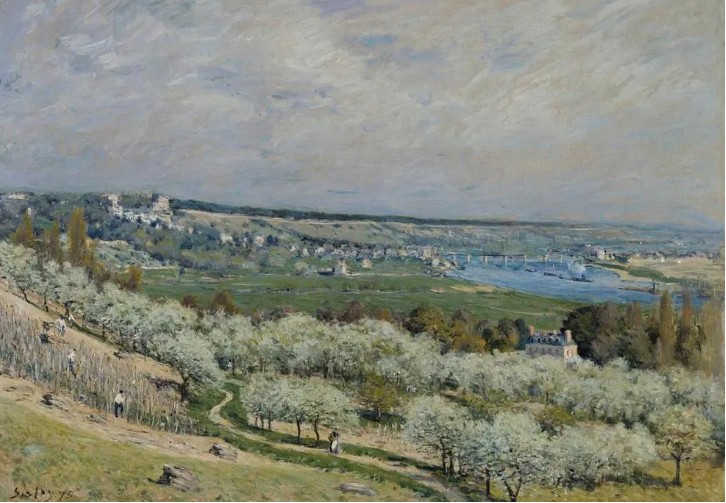
Sisley found inspiration and tranquility in the rural Seine Valley, just tens of miles from Paris, where he painted some of his most enduring landscapes. In The Terrace at Saint-Germain, Spring (1875), near his home, he bathes the valley in a tender, radiant light, blending nature and humanity into a soul-soothing vista. His works, unwavering in their beauty, stand as a testament to art’s power to nourish the spirit, a tribute to life’s grace.
Source: Sisley by Cogniat, translated by Sachs, 1979. Graphic: The Terrace at Saint-Germain, Spring by Sisley, 1875. Walters Art Museum, Baltimore.
Mikhail Bulgakov’s White Guard, set during the Ukrainian War of Independence (1917–1921) amid the Russian Civil War, captures Kyiv in an existential power struggle against varied forces: Ukrainian nationalists allied with German troops, the White Guard clinging to Tsarist dreams, Lenin’s Bolsheviks closing in, plus Poles and Romanians. Against this bloody backdrop, Bulgakov crafts a semi-autobiographical tale of loss and fatalism, culminating in a nihilistic realization of humanity’s purpose: “But this isn’t frightening.All this will pass. The sufferings, agonies, blood, hunger, and wholesale death. The sword will go away, but these stars will remain… So why are we reluctant to turn our gaze to them? Why?”
Bulgakov, a doctor of venereal diseases like the book’s protagonist Alexei Turbin, knew hopelessness. In 1918, syphilis was a scourge, often incurable, leading to madness, mirroring the war’s societal decay. Alexei volunteers for the White Guard, tending to horrors he can’t heal, his efforts dissolving in a dream: “shadows galloped past…Turbin was dying in his sleep.” War becomes a disease, resistance futile. Yet Bulgakov’s lens widens. Sergeant Zhilin dreams of Revelation, “And God shall wipe away all tears…and there shall be no more death,” finding humility in cosmic indifference. Petka, an innocent, dreams simply of a sunlit ball, untouched by great powers. “Blessed are the pure in heart, for they shall see God” (Matthew 5:8).
Then, out of dreamland into the light: “All this will pass.” The stars endure, wars fade. Writing in the 1920s after the White defeat, Bulgakov channels Russian fatalism—Dostoevsky’s inescapable will, Chekhov’s quiet surrender. But he’s not fully broken. His “Why?” pleads, mocks, resists. Why not look up? Survival is luck, death equalizes, yet fighting a losing battle confronts our nothingness. Kyiv falls, the Bolsheviks threaten, the White Guard vanishes, still, Bulgakov continues to ask. Why?
He blends despair with irony, a doctor mocking death as the stars watch. The German expulsion of the Reds in 1918 briefly eased bloodshed, but 1919 brought worse, “Great was the year and terrible the Year of Our Lord 1918, but more terrible still was 1919.” History moves on; stars don’t care. Bulgakov’s question lingers: Why? To fight is to live, fate be damned.
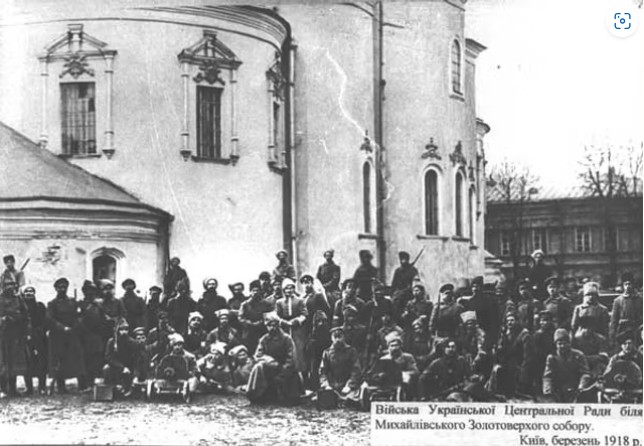
Source: White Guard, Mikhail Bulgakov, trans. Marian Schwartz. Graphic: Ukrainian Soldiers circa 1918.



 elsToday