The Jellyfish of Mind and Being

This essay began as a passing thought about jellyfish, those umbrellas of the sea drifting in blooms, fluthers, smacks, and swarms. They have no brain, no central command, only a diffuse matrix of neurons spread across their bodies. Yet they pulse, sting, drift, eat, and spawn; all without any trace of self-awareness.

This decentralized nerve net exposes the brittleness of Descartes’ dictum, cogito ergo sum: “I think, therefore I am.” Descartes, as did Socrates before him, equated thinking with consciousness.

For Socrates, thinking was the essence of the soul, inseparable from awareness and virtue. For Descartes, thinking was the proof of existence: the cogito. For philosophers today, consciousness reaches beyond thought, defined by the raw fact of experience; the sheer presence of what is.

Philosophers and neuroscientists now separate thinking (Reasoning, problem-solving, language; although language is at minimum a bridge from brain to mind) from consciousness (the subjective “what it’s like” experience). Yet separating the two only deepens the fog, the mystery of being. A newborn may have consciousness without thought. A computer may “think” without consciousness. A jellyfish reacts but does not reflect; its life is sensation without self-awareness.

Consciousness is more than biology or electronics, a core of being rising above life, thought, and reaction. Living is not the same as consciousness. Living is metabolism, reaction, survival. Consciousness is the something extra, the lagniappe, the “what it’s like” to be. A dog feels pain without philosophizing. A newborn hungers without reflection. A jellyfish recoils from harm, detects light, adapts its behavior. Is that sentient? Perhaps. But self-aware thought? Almost certainly not.

The spectrum of awareness occupies a wide corridor of argument and reality. On one end, the jellyfish: life without thought, existence without awareness. On the other, humans: tangled in language, reflection, and self-modeling cognition. Between them lies the mystery. Anesthesia, coma, or dreamless sleep show that thought can vanish while consciousness flickers on, or vice versa. The two are not bound in necessity; reality shows they can drift apart.

Neuroscience maps the machinery, hippocampus for memory, thalamus for awareness, but cannot settle the duality. Neurons may spark and signals flow, yet consciousness remains more than electrical activity. It is not reducible to living. It is not guaranteed by thought. It is the specter of being that transcends living biology.

The jellyfish reminds us that being does not require thinking. Humans remind us that thinking does not explain consciousness. Between them, philosophy persists, not by closure, but by continuing to ask.

Perhaps the jellyfish is not a primitive creature but a reflecting pool of possibilities: showing us that being does not require thinking, and that consciousness may be more elemental than the cogito admits. The question is not whether we think, but whether we experience. And experience, unlike thought, resists definition but it defines who we are.

In the end, Scarecrow, like the jellyfish, had no brain but was deemed the wisest man in Oz.

Graphic: A Pacific sea nettle (Chrysaora fuscescens) at the Monterey Bay Aquarium in California, USA. 2005. Public Domaine

Michel de Montaigne Bergerac 2019

Bordeaux Red Blends from Southwest, France

Merlot 60%, Cabernet Franc 20%, Cabernet Sauvignon 20%

Purchase Price $16.99

Wine Enthusiast 90, Wilfred Wong 90, ElsBob 90

ABV 14%

A clear ruby to purple wine in color. A medium to full bodied wine with aromas of red and black fruits and spice. On the palate plums and cherries predominant with oak derivatives. The tannins are meaty and balanced with crisp acidity. A beautiful finish that will compliment most beef dishes.

An excellent fine wine at a very attractive price. Current prices range from $13.50-18.00.

Trivia:  Michel de Montaigne was likely the most influential philosopher of the 16th-century French Renaissance. A dyed-in-the-wool skeptic, a cantankerous crank whose motto Que sais-je? (“What do I know?”) enshrined his worldview; much like Socrates, who also claimed to know nothing. Montaigne questioned everything and taught that doubt was the only path to wisdom.

But he carried it too far: intellectually thin and logically obtuse. He believed that customs and morals were cultural artifacts, lacking any universal tether. Truth, for Montaigne, was a matter of perspective; malleable, contingent, shaped by accepted practice. One man’s cannibal was another man’s epicurean.

To anchor this relativism, he wrote: “We are, I know not how, double in ourselves, so that what we believe we disbelieve, and cannot rid ourselves of what we condemn.” A long-winded version of c’est la vie (“that’s life”), or more precisely, à chacun son goût (“to each his own”).

Experience was his shrine, but it lacked a foundation. No base of knowledge to anchor belief. A man easily swayed by his own prejudices and lack of a black and white moral code.

His philosophy of go-along-to-get-along, born of tolerance and introspection, risked becoming a prescription for annihilation, not of others, but of moral clarity and oneself. A path to accepting everything and believing nothing. A philosophy polished so smooth it reflects everything and reveals nothing.

The Lost Boys

The end of the Peloponnesian War in 404 BC marked the end of Athens’ Golden Age. Most historians agree that the halcyon days of Athens were behind her.  Some however, such as Victor Davis Hanson in his multi-genre meditations, A War Like No Other, a discourse on military history, cultural decay, and philosophical framing, offers a more nuanced view suggesting that Athens was still capable of greatness, but the lights were dimming.

During the following six decades, after the war, Athens rebuilt. Its navy reached new heights. Its long walls were rebuilt within a decade. Aristophanes retained his satirical edge even if it was a bit more reflective. Agriculture returned in force. Even Sparta reconciled with Athens or vice versa, recognizing once again that the true enemy was Persia.

Athens brought back its material greatness, but its soul was lost. What ended the Golden Age of Athens wasn’t crumbled walls or sunken ships. It was the loss of lives that took the memory, the virtuosity of greatness with it. With them generational continuity, civic pride, and a religious belief in the polis vanished. The meaning, truth, and myth of Athenian exceptionalism died with their passing. The architects of how to lead a successful, purpose driven civilization had disappeared, mostly through death by war or state but also by plague.

Victor Davis Hanson, in his A War Like No Other lists many of the lives lost to and during the war that took much of Athens’ exceptionalism with them to their graves. Below is a partial listing of Hanson’s more complete rendering with some presumptuous additions.

Alcibiades was an overtly ambitious Athenian strategist; brilliant, erratic, and ultimately treasonous. He championed the disastrous Sicilian expedition, Athens greatest defeat. Over the course of the war, he defected multiple times: serving Athens, then Sparta, then Persia, before returning to Athens. He was assassinated in Phrygia around 404 BC while under Persian protection, by, many beleive, the instigation of the Spartan general Lysander.

Euripides though he did not fight in the war exposed its brutality and hypocrisy in his plays such as The Trojan Woman and Helen. The people were not sufficiently appreciative of his war opinions or plays, winning only four firsts at Dionysia compared to 24 and 13 for Sophocles and Aeschylus, respectively. Disillusioned, he went into self-imposed exile in Macedonia and died there around 406 BC by circumstances unknown.

The execution of the Generals of Arginusae remains a legendary example of Athenian arbitrary retribution; proof that a city obsessed with ritualized honor could nullify military genius, and its future, in a single stroke. The naval Battle of Arginusae, fought in 406 BC, east of the Greek island of Lesbos, was the last major Athenian victory over the Spartans in the Peloponnesian War. Athenian command of the battle was split between 8 generals: Aristocrates, Aristogenes, Dimedon, Erasinides, Lysias, Pericles the Younger (son of Pericles), Protomachus, and Thrasyllus. After their victory over the Spartan fleet a storm prevented the Athenians from recovering the survivors, and the dead, from their sunken ships. Of the six generals that returned to Athens all were executed for their negligence. Protomachus and Aristogenes, likely knowing their fate, chose not to return and went into exile.

Pericles, the flesh and blood representation of Athens’ greatness was the statesman and general who led the city-state during its golden age. He died of the plague in 429 BC during the war’s early years, taking with him the vision of democratic governance and Athens’ exceptionalism. His 3 legitimate sons all died during the war. His two oldest boys likely died of the plague around 429 BC and Pericles the Younger was executed for his part in the Battle of Arginusae.

Socrates, the world’s greatest philosopher (yes greater than Plato or Aristotle) fought bravely in the war, but he was directly linked to the traitor Alcibiades. He was tried and killed in 399 BC for subverting the youth and not giving the gods their due. That was all pretense. Athens desired to wash their collective hands of the war and Socrates was a very visible reminder of that. He became a ritual scapegoat swept up into the collective expurgation of the war’s memory.

Sophocles, already a man of many years by the beginning of the war, died in 406 BC at the age of 90 or 91, a few years before Athens’ final collapse. His tragedies embodied the ethical and civic pressures of a society unraveling. With the deaths of Aeschylus in 456 BC, Euripides in 406 BC, and Sophocles soon after, the golden age of Greek tragedy came to a close.

Thucydides, author of the scholarly standard for the Peloponnesian War, was exiled after ‘allowing’ the Spartans to capture Amphipolis, He survived the war, and the plague, but never returned to Athens. His History ends in mid-sentence for the period up to 411 BC. He lived till 400 BC, and no one really knows why he didn’t finish his account of the war. Xenophon picked up where Thucydides left off and finished up the war in his first two books of Hellenica which he composed somewhere in the 380s BC.

The Peloponnesian War ended Athens’ greatest days. The men who kept its lights bright were gone. Its material greatness returned, glowing briefly, but its civic greatness, its soul, slowly dimmed. It was a candle in the wind of time that would be rekindled elsewhere. The world would fondly remember its glory, but Athens had lost its spark.

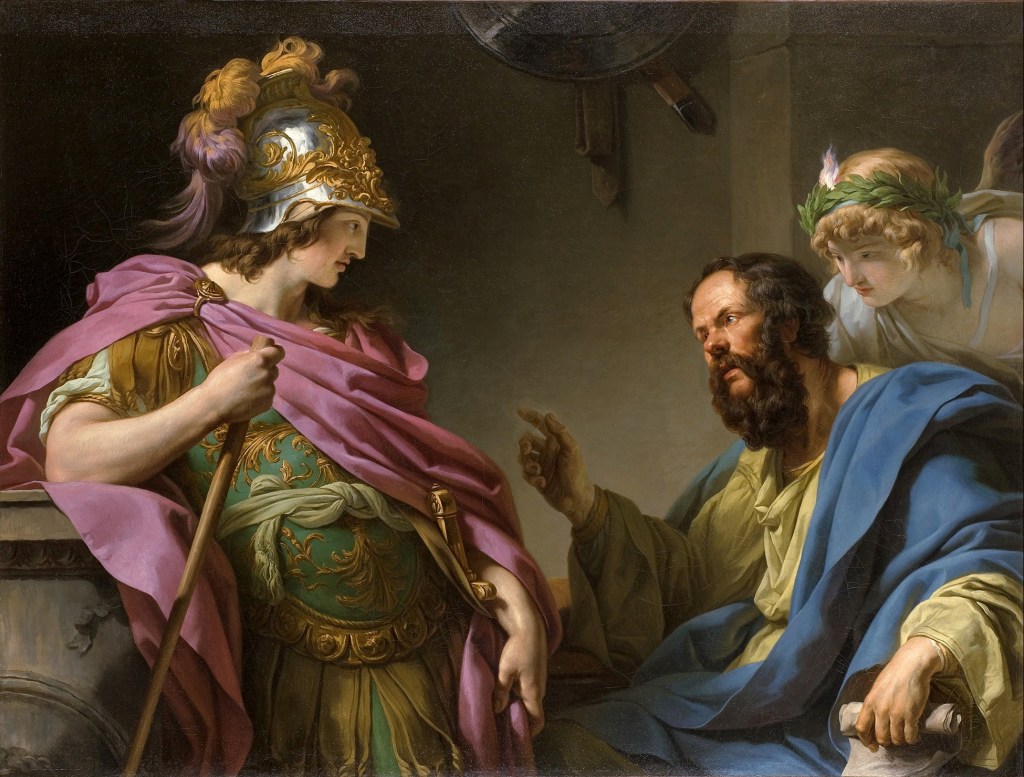
Source: A War Like No Other by Victor Davis Hanson, 2005. Graphic: Alcibiades Being Taught by Socrates, Francois-Andre Vincent, 1776. Musee Fabre, France. Public Domain.

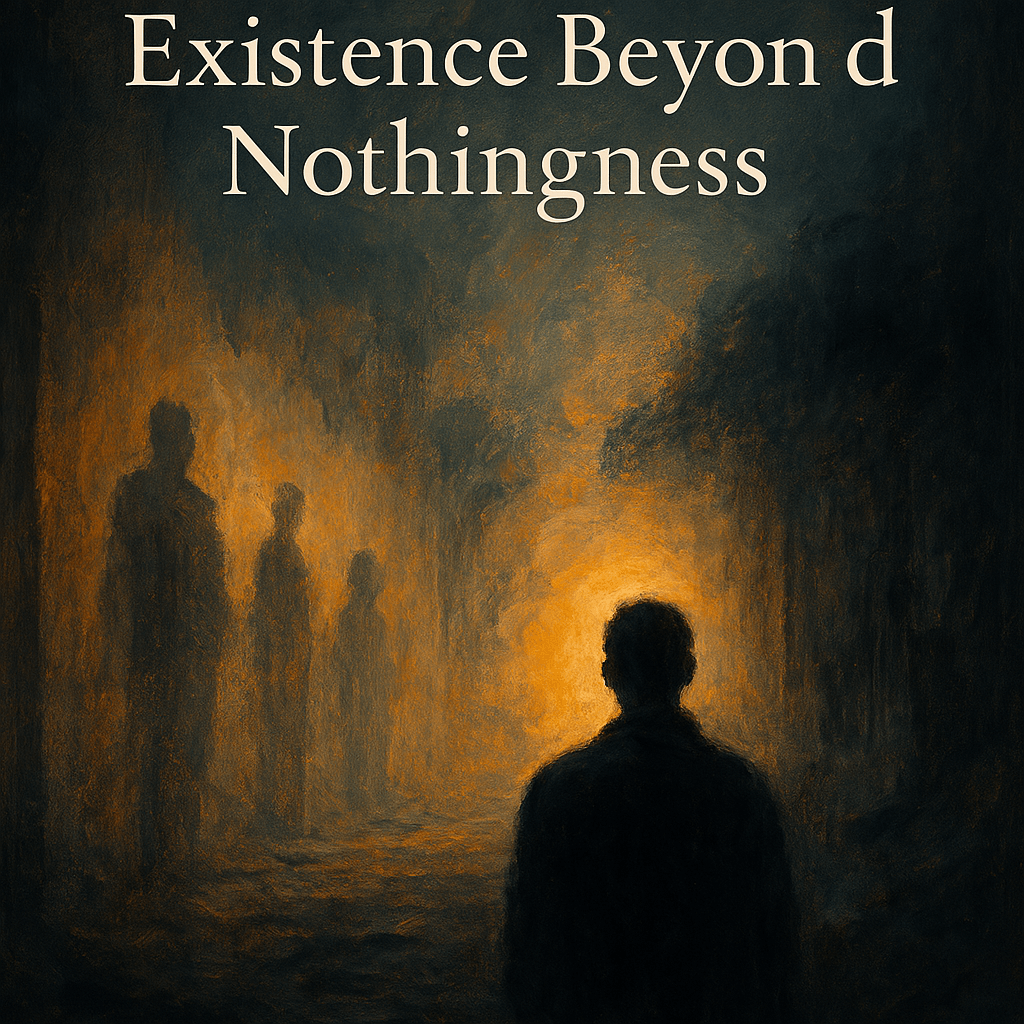
Shadows of Reality — Existence Beyond Nothingness

From the dawn of sentient thought, humanity has wrestled with a single, haunting, and ultimately unanswerable question: Is this all there is? Across the march of time, culture, and science, this question has echoed in the minds of prophets, philosophers, mystics, and skeptics alike. It arises not from curiosity alone, but from something deeper, an inner awareness, a presence within all of us that resists the idea of the inevitable, permanent end. In every age, whether zealot or atheist, this consciousness, a soul, if you will, refuses to accept mortality. Not out of fear, but from an intuition that there must be more. This inner consciousness will not be denied, even to non-believers.

One needs to believe that death is not an end, a descent into nothingness, but a threshold: a rebirth into a new journey, shaped by the echoes of a life already lived. Not logic, but longing. Not reason, but resonance. A consciousness, a soul, that seeks not only to understand, but to fulfill, to carry forward the goodness of a life into something greater still. Faith in immortality beyond sight. A purpose beyond meaning. Telos over logos.

While modern thinkers reduce existence to probability and simulation, the enduring human experience, expressed through ancient wisdom, points to a consciousness, a soul, that transcends death and defies reduction. Moderns confuse intellect or brain with consciousness.

Contemporary thinkers and writers like Philip K. Dick, Elon Musk, and Nick Bostrom have reimagined this ancient question through the lens of technology, probability, and a distinctly modern myopia. Their visions, whether paranoid, mathematical, or speculative, suggest that reality may be a simulation, a construct, or a deception. In each case, there is a higher intelligence behind the curtain, but one that is cold, indifferent, impersonal. They offer not a divine comedy of despair transcending into salvation, but a knowable unknown: a system of ones and zeros marching to the beat of an intelligence beyond our comprehension. Not a presence that draws us like a child to its mother, a moth to a flame, but a mechanism that simply runs, unfeeling, unyielding, and uninviting. Incapable of malice or altruism. Yielding nothing beyond a synthetic life.

Dick feared that reality was a layered illusion, a cosmic deception. His fiction is filled with characters who suspect they’re being lied to by the universe itself, yet they keep searching, keep hoping, keep loving. Beneath the paranoia lies a desperate longing for a divine rupture, a breakthrough of truth, a light in the darkness. His work is less a rejection of the soul than a plea for its revelation in a world that keeps glitching. If life is suffering, are we to blame?

Musk posits that we’re likely living in a simulation but offers no moral or spiritual grounding. His vision is alluring but sterile, an infinite loop of code without communion. Even his fascination with Mars, AI, and the future of consciousness hints at something deeper: not just a will to survive, but a yearning to transcend. Yet transcendence, in his world, is technological, not spiritual. To twist the spirit of Camus: “Should I kill myself or have a cup of coffee?”, without transcendence, life is barren of meaning.

Bostrom presents a trilemma in his simulation hypothesis: either humanity goes extinct before reaching a posthuman stage, posthumans choose not to simulate their ancestors, perhaps out of ethical restraint or philosophical humility, or we are almost certainly living in a simulation. At first glance, the argument appears logically airtight. But on closer inspection, it rests on a speculative foundation of quivering philosophical sand: that consciousness is computational and organic, that future civilizations will have both the means and the will to simulate entire worlds, and that such simulations would be indistinguishable from reality. These assumptions bypass profound questions about the nature of consciousness, the ethics of creation, and the limits of simulated knowledge. Bostrom’s trilemma appears rigorous only because it avoids the deeper question of what it means to live and die.

These views, while intellectually stimulating, shed little light on a worthwhile future. We are consigned to existence as automatons, soulless, simulated, and suspended in probability curves of resignation. They offer models, not meaning. Equations, not essence. A presence in the shadows of greater reality.

Even the guardians of spiritual tradition have begun to echo this hollow refrain. When asked about hell, a recently deceased Pope dismissed it not as fire and brimstone, but as “nothingness,” a state of absence, not punishment. Many were stunned. A civilizational lifetime of moral instruction undone in a breath. And yet, this vision is not far from where Bostrom’s simulation hypothesis lands: a world without soul, without consequence, without continuity. Whether cloaked in theology or technology, the message is the same, there is nothing beyond. The Seven Virtues and the Seven Deadly Sins have lost their traction, reduced to relics in a world without effect.

But the soul knows better. It was not made for fire, nor for oblivion. It was made to transcend, to rise beyond suffering and angst toward a higher plane of being. What it fears is not judgment, but erasure. Not torment, but the silence of meaning undone. Immortality insists on prudent upkeep.

What they overlook, or perhaps refuse to embrace, is a consciousness that exists beyond intellect, a soul that surrounds our entire being and resists a reduction to circuitry or biology. A soul that transcends blood and breath. Meaning beyond death.

This is not a new idea. Socrates understood something that modern thinkers like Musk and Bostrom have bypassed: that consciousness is not a byproduct of the body, but something prior to it, something eternal. For Socrates, the care of the soul was the highest human calling. He faced death not with fear, but with calm, believing it to be a transition, not an end or a nothingness, but a new beginning. His final words were not a lament, but a gesture of reverence: a sacrifice to Asclepius, the god of healing, as if death itself were a cure.

Plato, his student, tried to give this insight form. In his allegory of the cave, he imagined humanity as prisoners mistaking shadows for reality. The journey of the soul, for Plato, was the ascent from illusion to truth, from darkness to light. But the metaphor, while powerful, is also clumsy. It implies a linear escape, a single ladder out of ignorance. In truth, the cave is not just a place, it is a condition. We carry it with us. The shadows are not only cast by walls, but by our own minds, our fears. And the light we seek is not outside us, but within.

Still, Plato’s intuition remains vital: we are not meant to stay in the cave. The soul does not long merely for survival, it is immortal, but it needs growth, nourished by goodness and beauty, to transcend to heights unknown. A transcendence as proof, the glow of the real beyond the shadow and the veil.

In the end, the soul reverberates from within: we are not boxed inside a simulation, nor trapped in a reality that leads nowhere. Whether through reason, compassion, or spiritual awakening, the voice of wisdom has always whispered the same truth: Keep the soul bright and shiny. For beyond the shadows, beyond the veil of death, there is more. There is always more.


Web of Dark Shadows

Cold Dark Matter (CDM) comprises approximately 27% of the universe, yet its true nature remains unknown. Add that to the 68% of the universe made up of dark energy, an even greater mystery, and we arrive at an unsettling realization: 95% of the cosmos remains unexplained.

Socrates famously said, “The only thing I know is that I know nothing.” Over two millennia later, physicists might agree. But two researchers from Dartmouth propose a compelling possibility: perhaps early energetic radiation, such as photons, expanded and cooled into massive fermions, which later condensed into cold dark matter, the invisible force holding galaxies together. Over billions of years, this dark matter may be decomposing into dark energy, the force accelerating cosmic expansion.

Their theory centers on super-heavy fermions, particles a million times heavier than electrons, which behave in an unexpected way due to chiral symmetry breaking: where mirror-image particles become unequally distributed, favoring one over the other. Rather than invoking exotic physics, their model works within the framework of the Standard Model but takes it in an unexpected direction.

In the early universe, these massive fermions behaved like radiation, freely moving through space. However, as the cosmos expanded and cooled, they reached a critical threshold, undergoing a phase transition, much like how matter shifts between liquid, solid, and gas.

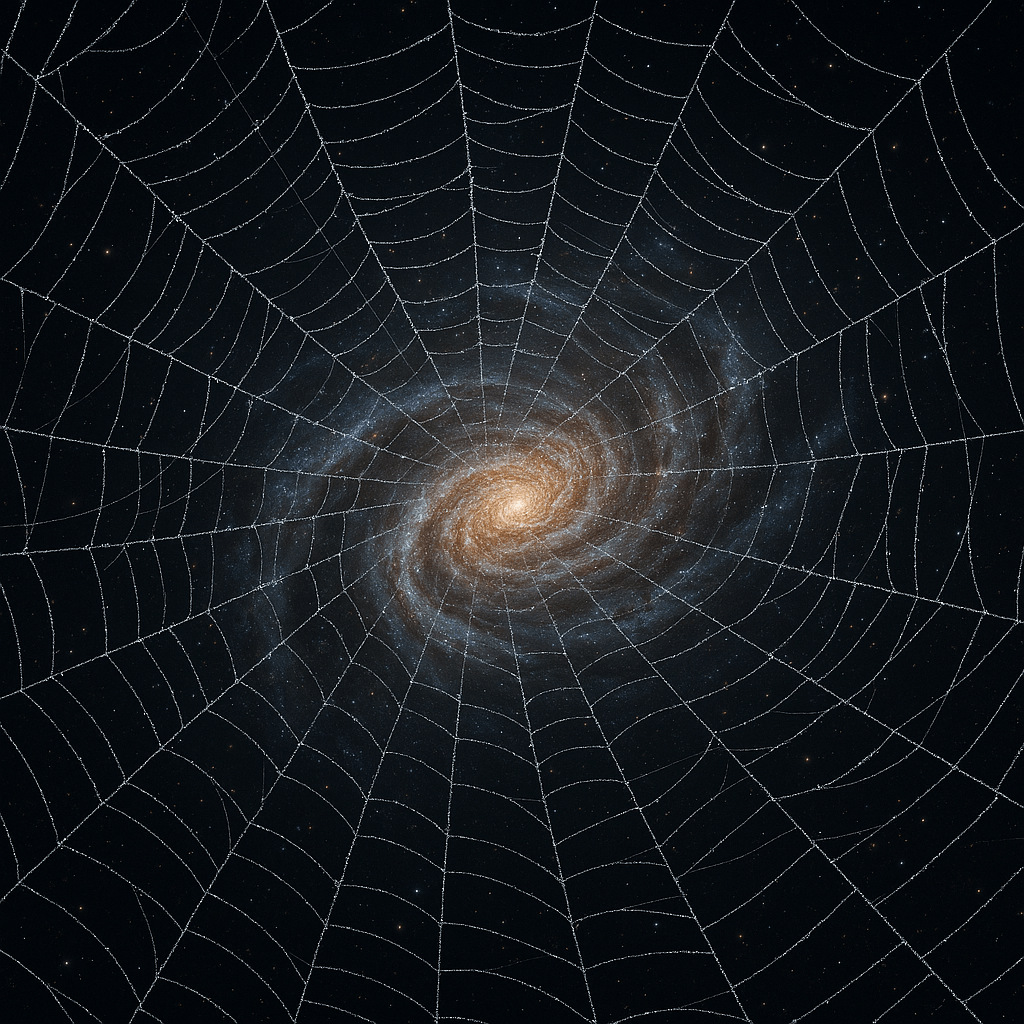
During this transformation, fermion-antifermion pairs condensed—similar to how electrons form Cooper pairs in superconductors, creating a stable, cold substance with minimal pressure and heat. This condensate became diffuse dark matter, shaping galaxies through its gravitational influence, acting as an invisible web counteracting their rotation and ensuring they don’t fly apart.

However, dark matter may not be as stable as once thought. The researchers propose that this condensate is slowly decaying, faster than standard cosmological models predict. This gradual decomposition feeds a long-lived energy source, possibly contributing to dark energy, the force responsible for the universe’s accelerated expansion.

A more radical interpretation, mine not the researchers, suggests that dark matter is not merely decaying, but evolving into dark energy, just as energetic fermion radiation once transitioned into dark matter. If this is true, dark matter and dark energy may be two phases of the same cosmic entity rather than separate forces.

If these hypothesis hold, we should be able to detect, as the researchers suggest, traces of this dark matter-to-dark energy transformation in the cosmic microwave background (CMB). Variations in density fluctuations and large-scale structures might reveal whether dark matter has been steadily shifting into dark energy, linking two of cosmology’s biggest unknowns into a single process.

Over billions of years, as dark matter transitions into dark energy, galaxies may slowly lose their gravitational cage and begin drifting apart. With dark energy accelerating the expansion, the universe may eventually reach a state where galaxies unravel completely, leaving only isolated stars in an endless void.

If dark matter started as a fine cosmic web, stabilizing galaxies, then over time, it may fade away completely, leaving behind only the accelerating force of dark energy. Instead of opposing forces locked in conflict, what if radiation, dark matter, and dark energy were simply different expressions of the same evolving entity?

A tetrahedron could symbolize this transformation:

  • Radiation (Energetic Era) – The expansive force that shaped the early universe.
  • Dark Matter (Structural Phase) – The stabilizing gravitational web forming galaxies.
  • Dark Energy (Expansion Phase) – The force accelerating cosmic evolution.
  • Time (Governing Force) – The missing element driving transitions between states.

Rather than the universe being torn apart by clashing forces, it might be engaged in a single, continuous transformation, a cosmic dance shaping the future of space.

Source: CDM Analogous to Superconductivity by Liang and Caldwell, May 2025, APS.org. Graphic: Galaxy and Spiderweb by Copilot.

Near Death Experiences

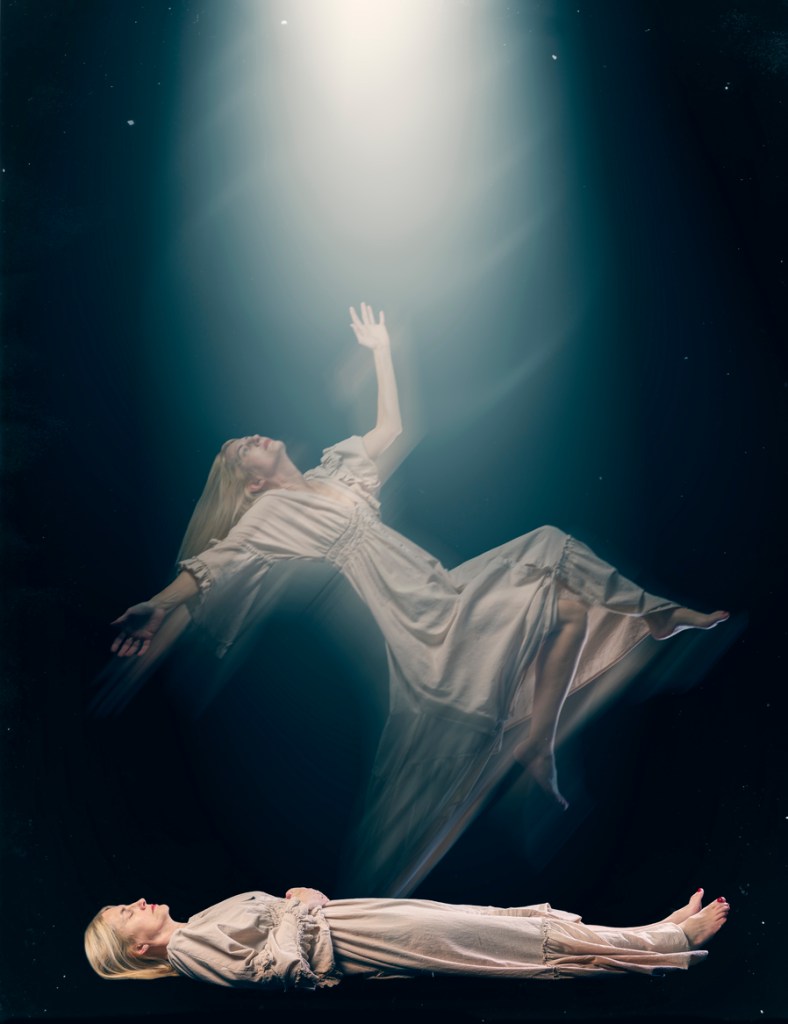
Bruce Greyson in a paper published in the Journal Humanities states that, “Near-death experiences (NDEs) are vivid experiences that often occur in life-threatening conditions, usually characterized by a transcendent tone and clear perceptions of leaving the body and being in a different spatiotemporal dimension.”

NDEs have been reported throughout history and across various cultures, with many interpreting them as proof of life after death or the continuation of existence beyond the death of the physical body.

Dr. Eben Alexander, a neurosurgeon, experienced his own NDE during a week-long coma induced by a brain illness. During this experience, he reported traveling outside his body to another world, where he encountered an angelic being and the maker of the universe. He interpreted his experience not only as evidence that consciousness exists outside the mortal body but also as proof of God and heaven.

Socrates believed that the soul, a concept encompassing not only consciousness but also the whole psyche of a person, was immortal and existed in a realm beyond the physical world. According to the Platonic concept of “anamnesis”, the soul is temporarily housed in the mortal body until the body’s death, at which point it returns to a “spiritual” realm. Socrates firmly believed that because the soul is immortal, it is imperative to live a moral and virtuous life to avoid damaging the soul.

Zeno of Citium and the Stoics, following in Socrates’ footsteps, developed the concept of “pneuma” or spirit, which they viewed as a physical substance that returns to the cosmos after the death of the body. They believed that the universe is a living being, a concept known as “pantheism,” and that pneuma or souls are part of the greater universal whole.

Omniscience–Omnipresence.

Source: The Near-Death Experience by Sabom, JAMA Network, Proof of Heaven by Alexander. Memorabilia by Xenophon. Graphic: Out of Body, istock licensed.

Seeking God

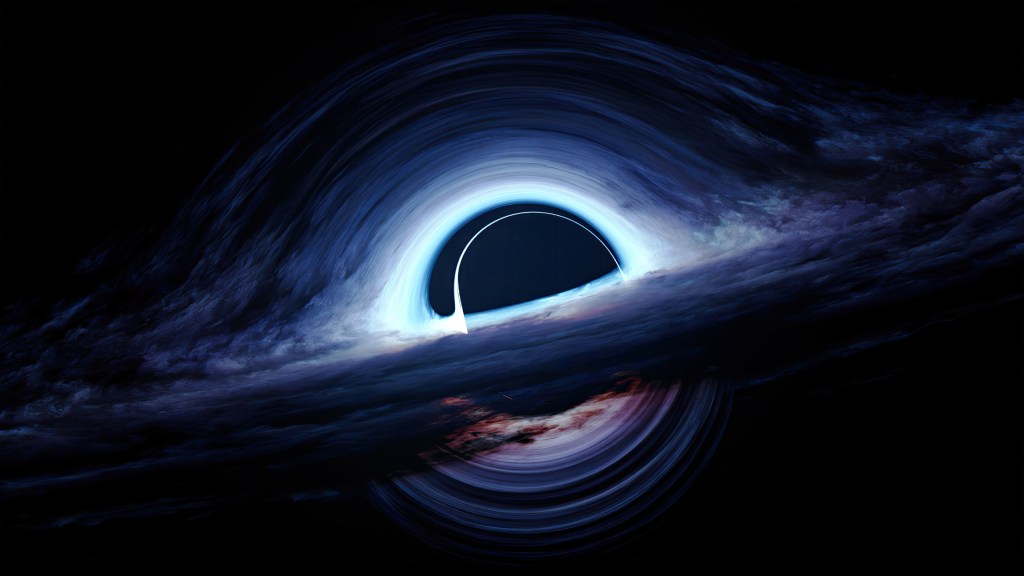
95% of the universe is a mystery. About 68% is dark energy, which is believed to drive the accelerated expansion of the universe, though its exact nature is unknown. 27% is dark matter, which holds galaxies together and is believed to consist of one or more massive, yet unknown, particles.

Science Daily reports that researchers at the University of Michigan and five other institutions “have strengthened the case that matter becomes dark energy when massive stars collapse and become black holes.” This suggests that the universe’s expansion may be partly explained by the expansion of black holes through cosmological coupling. It also implies that black holes can gain mass without consuming matter, directly challenging the Standard Model of particle physics.

This either leads to the Big Freeze—infinite expansion through not quite infinite time—or the Big Crunch, where gravity eventually says ‘Enough!’ and collapses everything back into an infinitesimal point.

To sum up, we may or may not understand 5% of the universe, while the remaining 95% aligns with Socrates’ axiom from 6th century Greece—we essentially know nothing.

Source: University of Michigan. “Evidence Mounts for Dark Energy from Black Holes.” Science Daily. 2024. Graphic: Black Hole.

Epistemic Humility

Donald Rumsfeld, expanding on Socrates’ statement, “The only true wisdom is in knowing you know nothing,” pedantically states in the year 2002 that, “There are known knowns—things we know that we know. There are known unknowns—things we know we don’t know. But there are also unknown unknowns—things we don’t know we don’t know.

Which suggests that we all are pre-ordained to a life of study to shorten the list of unknowns and the embarrassment of being unprepared.

G.K. Chesterton anticipating that a lifetime, or something less than a lifetime of study has its dangers, warned in his 1908 collection of essays, “All Things Considered,” “Without education, we are in a horrible and deadly danger of taking educated people seriously.” Implying that a myopic education may allow for mastering a single subject but is ill-equipped to understand anything broader; unable to see the forest for the trees.

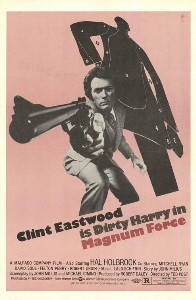
Which leads us to the 1973 “Magnum Force” with Clint Eastwood, wielding a Smith and Wesson Model 29 .44 magnum in a Dirty Harry hand, explaining to an unfortunate soul that “A man’s got to know his limitations,” highlighting the concept of epistemic humility: the recognition that one’s knowledge and understanding is always limited and to proceed accordingly.

Source: Socrates. G.K. Chesterton. Socratic-Method.com.  Graphic: Magnum Force poster, copyright Warner Bros.

The Noble Lie

In Plato’s Republic, a “Noble Lie” is a myth, or a falsehood knowingly propagated by the elites to maintain social harmony, or stated succinctly, to keep the plebs in their place and make sure they love it.

Plato believed that society required a class system led by philosophers who needed to create a lie that unites and binds the lower classes to the state. Without this binding myth the classes will turn on each other, and the government will fail.

The Noble Lie myth promoted by Plato, via Socrates, was that the populace was born with hierarchical souls with the upper classes having better souls. Another myth was Karl Marx stating, “From each according to his ability, to each according to his needs,” formulating a classless society where goods and services were free.

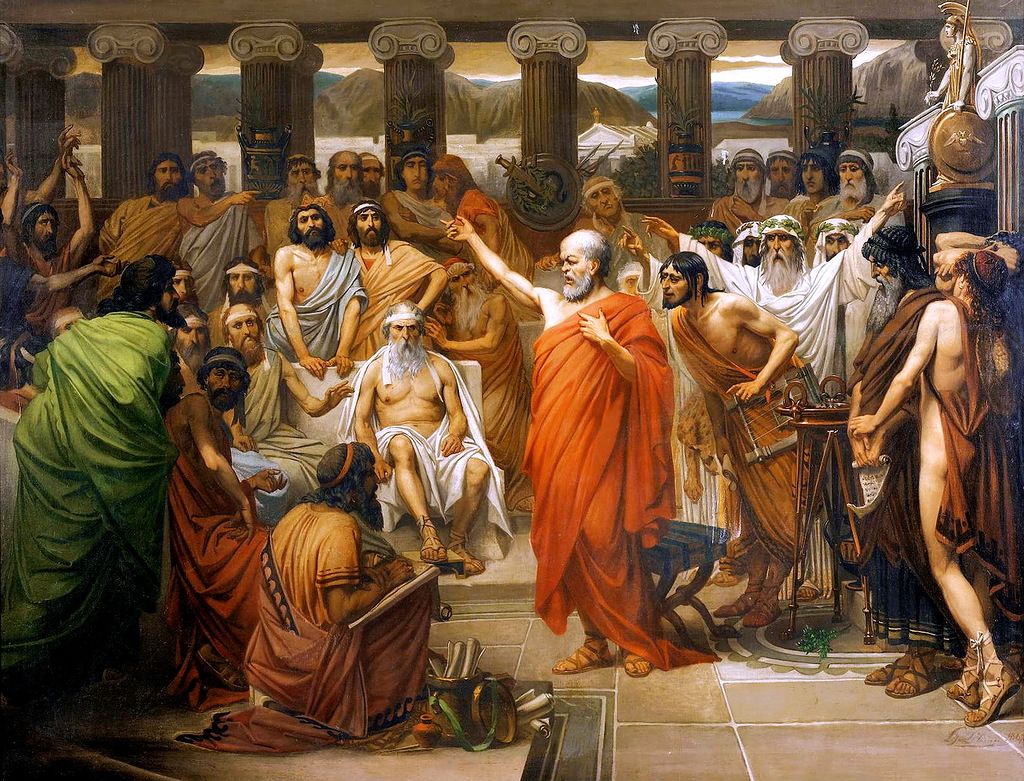
Source: Plato’s Republic. A Noble Lie by Plato Intelligence. Introduction to Plato: The Noble Lie by Paul Krause, 2019, Minerva Wisdom. Graphic: Socrates’ Address by Lebrun, 1867, public domain.

End Times for Socrates

Plato documents Socrates’ final days in four books all written as dialogues. The first dialogue, ensuing shortly before Socrates’ trial for impiety and corruption of Athenian youth occurs between Socrates and the Athenian prophet, Euthyphro, who together attempt to define piety without success.

The second book, Apology, Socrates defends himself to the Athenian court, poorly in all respects, purposefully one suspects, confessing that his life’s quest is one of seeking wisdom, nothing more.

Crito is the third book in this series, and it takes place in Socrates’ prison cell after he has been found guilty of his crimes with his execution scheduled for the next day. Crito, a wealthy friend of Socrates, has come to urge him to escape. Socrates refuses and the ensuing dialogue revolves around justice and the damage to one’s soul through the actions of injustice.

In the fourth book Phaedo, a Greek philosopher, visits on the day of Socrates’ execution, and has a discussion centered on the immortality of the soul. Socrates offers four arguments for why the soul must be eternal while the body is mortal, firmly imprinting the duality of nature into the human psyche for endless generations to come.

Source:  Euthyphro, Apology, Crito, and Phaedo by Plato, 4th century BC. Graphic: Statue of Socrates by Drosis, Athens, Classical Wisdom.