The end of the Peloponnesian War in 404 BC marked the end of Athens’ Golden Age. Most historians agree that the halcyon days of Athens were behind her. Some however, such as Victor Davis Hanson in his multi-genre meditations, A War Like No Other, a discourse on military history, cultural decay, and philosophical framing, offers a more nuanced view suggesting that Athens was still capable of greatness, but the lights were dimming.
During the following six decades, after the war, Athens rebuilt. Its navy reached new heights. Its long walls were rebuilt within a decade. Aristophanes retained his satirical edge even if it was a bit more reflective. Agriculture returned in force. Even Sparta reconciled with Athens or vice versa, recognizing once again that the true enemy was Persia.
Athens brought back its material greatness, but its soul was lost. What ended the Golden Age of Athens wasn’t crumbled walls or sunken ships. It was the loss of lives that took the memory, the virtuosity of greatness with it. With them generational continuity, civic pride, and a religious belief in the polis vanished. The meaning, truth, and myth of Athenian exceptionalism died with their passing. The architects of how to lead a successful, purpose driven civilization had disappeared, mostly through death by war or state but also by plague.
Victor Davis Hanson, in his A War Like No Other lists many of the lives lost to and during the war that took much of Athens’ exceptionalism with them to their graves. Below is a partial listing of Hanson’s more complete rendering with some presumptuous additions.
Alcibiades was an overtly ambitious Athenian strategist; brilliant, erratic, and ultimately treasonous. He championed the disastrous Sicilian expedition, Athens greatest defeat. Over the course of the war, he defected multiple times: serving Athens, then Sparta, then Persia, before returning to Athens. He was assassinated in Phrygia around 404 BC while under Persian protection, by, many beleive, the instigation of the Spartan general Lysander.
Euripides though he did not fight in the war exposed its brutality and hypocrisy in his plays such as The Trojan Woman and Helen. The people were not sufficiently appreciative of his war opinions or plays, winning only four firsts at Dionysia compared to 24 and 13 for Sophocles and Aeschylus, respectively. Disillusioned, he went into self-imposed exile in Macedonia and died there around 406 BC by circumstances unknown.
The execution of the Generals of Arginusae remains a legendary example of Athenian arbitrary retribution; proof that a city obsessed with ritualized honor could nullify military genius, and its future, in a single stroke. The naval Battle of Arginusae, fought in 406 BC, east of the Greek island of Lesbos, was the last major Athenian victory over the Spartans in the Peloponnesian War. Athenian command of the battle was split between 8 generals: Aristocrates, Aristogenes, Dimedon, Erasinides, Lysias, Pericles the Younger (son of Pericles), Protomachus, and Thrasyllus. After their victory over the Spartan fleet a storm prevented the Athenians from recovering the survivors, and the dead, from their sunken ships. Of the six generals that returned to Athens all were executed for their negligence. Protomachus and Aristogenes, likely knowing their fate, chose not to return and went into exile.
Pericles, the flesh and blood representation of Athens’ greatness was the statesman and general who led the city-state during its golden age. He died of the plague in 429 BC during the war’s early years, taking with him the vision of democratic governance and Athens’ exceptionalism. His 3 legitimate sons all died during the war. His two oldest boys likely died of the plague around 429 BC and Pericles the Younger was executed for his part in the Battle of Arginusae.
Socrates, the world’s greatest philosopher (yes greater than Plato or Aristotle) fought bravely in the war, but he was directly linked to the traitor Alcibiades. He was tried and killed in 399 BC for subverting the youth and not giving the gods their due. That was all pretense. Athens desired to wash their collective hands of the war and Socrates was a very visible reminder of that. He became a ritual scapegoat swept up into the collective expurgation of the war’s memory.
Sophocles, already a man of many years by the beginning of the war, died in 406 BC at the age of 90 or 91, a few years before Athens’ final collapse. His tragedies embodied the ethical and civic pressures of a society unraveling. With the deaths of Aeschylus in 456 BC, Euripides in 406 BC, and Sophocles soon after, the golden age of Greek tragedy came to a close.
Thucydides, author of the scholarly standard for the Peloponnesian War, was exiled after ‘allowing’ the Spartans to capture Amphipolis, He survived the war, and the plague, but never returned to Athens. His History ends in mid-sentence for the period up to 411 BC. He lived till 400 BC, and no one really knows why he didn’t finish his account of the war. Xenophon picked up where Thucydides left off and finished up the war in his first two books of Hellenica which he composed somewhere in the 380s BC.
The Peloponnesian War ended Athens’ greatest days. The men who kept its lights bright were gone. Its material greatness returned, glowing briefly, but its civic greatness, its soul, slowly dimmed. It was a candle in the wind of time that would be rekindled elsewhere. The world would fondly remember its glory, but Athens had lost its spark.
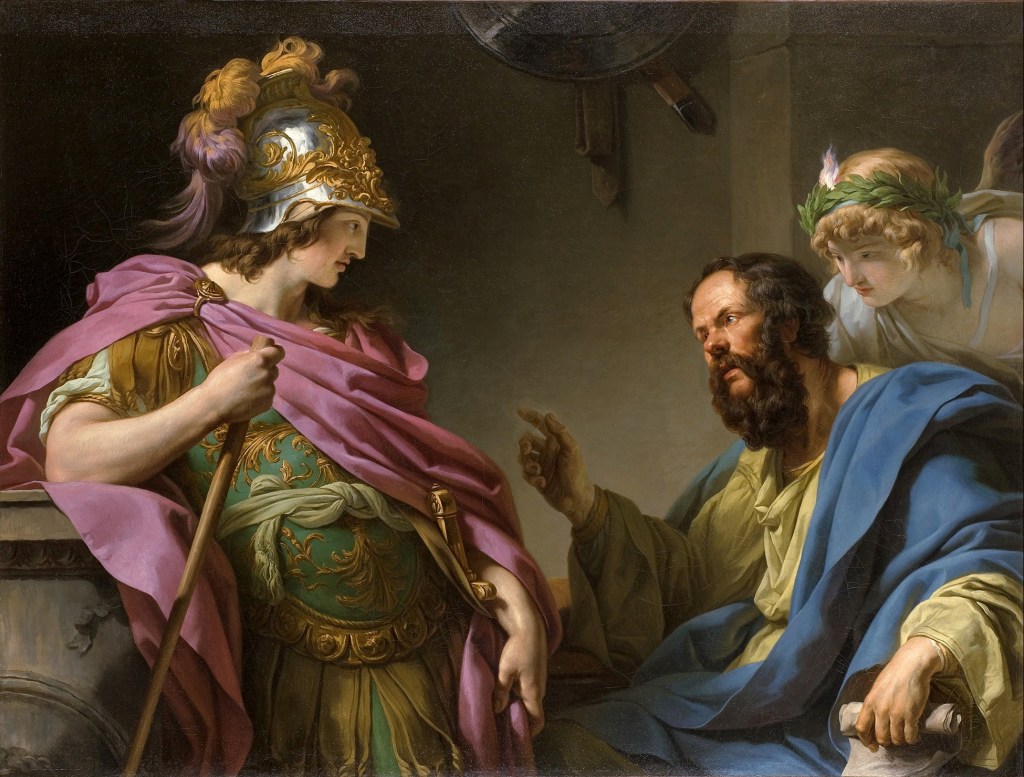
Source: A War Like No Other by Victor Davis Hanson, 2005. Graphic: Alcibiades Being Taught by Socrates, Francois-Andre Vincent, 1776. Musee Fabre, France. Public Domain.
The Peloponnesian War, fought over 27 years (431-404 BC), cost the ancient Greek world nearly everything. War deaths alone approached 8-10 percent of their population: up to 200,000 deaths from battle and plague. The conflict engulfed nearly all of Greece, from the mainland to the Aegean islands, Asia Minor and Sicily. Though Sparta and its allies, in the end, claimed a tactical victory, the war left Greece as a shadow of its former self.
The Golden Age of Athens came to an end. Athenian democracy was replaced, briefly, by the Thirty Tyrants. Sparta, unwilling to jettison its insular oligarchy, failed to adapt to imperial governance, naval power, or diplomatic nuance. Within a generation Sparta was a relic of history. First challenged by former allies in the Corinthian War, then shattered by Thebes, which stripped the martial city-state of its aura of invincibility along with its helot slave labor base: the economic foundation of Sparta. Another generation later, Macedon under Philip II and Alexander the Great finished off Greek dominance of the Mediterranean. After Alexander’s death in 323 BC, Rome gradually absorbed all the fractured pieces. Proving again, building an empire is easier than keeping one.
Thucydides, heir to the world’s first historian: Herodotus, reduced the origins of the Peloponnesian War to a primal emotion: fear. In Book I of his History of the Peloponnesian War he writes: “The growth of the power of Athens, and the alarm which this inspired in Sparta, made war inevitable.” Athens had violated trade terms under the Megarian Decree with a minor Spartan ally but that was pretext, not cause. Sparta did not go to war over market access. It went to war over fear. Fear of what Athens had become and a future that armies and treaties may not contain.
War and fear go together like flame to fuse. Sparta went to war not for fear of a foe, Sparta knew no such people. It was not fear of an unknown warrior, nor fear of battlefields yet to be choregraphed, but fear of an idea: democracy maintained and backed by Athenian power. And perhaps, more hauntingly precise, fear of itself. Not that it feared it was weak but of what it may become. They feared no sword or spear, their discipline reigned supreme against flesh and blood. Yet no formation, no stratagem, no tactic of war could bring down a simple Athenian belief: the rule of the many, an idea anathema, heretical even, to the Spartan way of life.
So, they marched to war, not to defeat an idea but to silence the source. Not to avenge past aggression but to stop a future annexation. They won battles, small and large. They razed cities. But they only destroyed men. The idea survived. It survived in fragments, bits here, bits there, across time and memory. What it did kill, though, was the spirit of Athens, the Golden Age of Athens. But the idea that was Athens lived on across space and time: chiseled into republics that rose from its ashes and ruins.
The radiance of Athens dimmed to shadow. Socrates became inconvenient. Theater became therapy; a palliative smothering of a cultural surrender. And so, civilization moved to Rome.
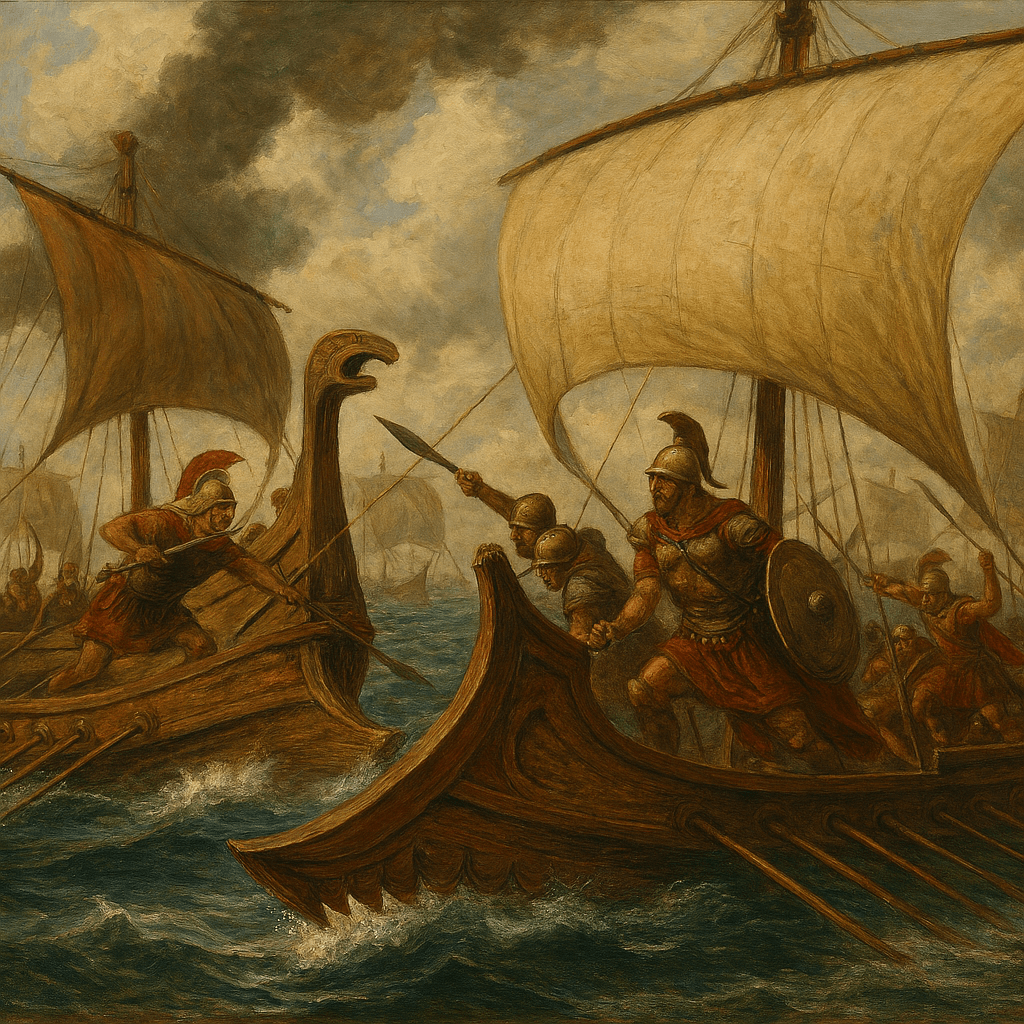
Source: A War Like No Other by Victor Davis Hanson, 2005. History of the Peloponnesian War by Thucydides, Translated by Richard Crawley, 2021. Graphic: Syracuse vs Athens Naval Battle. CoPilot.
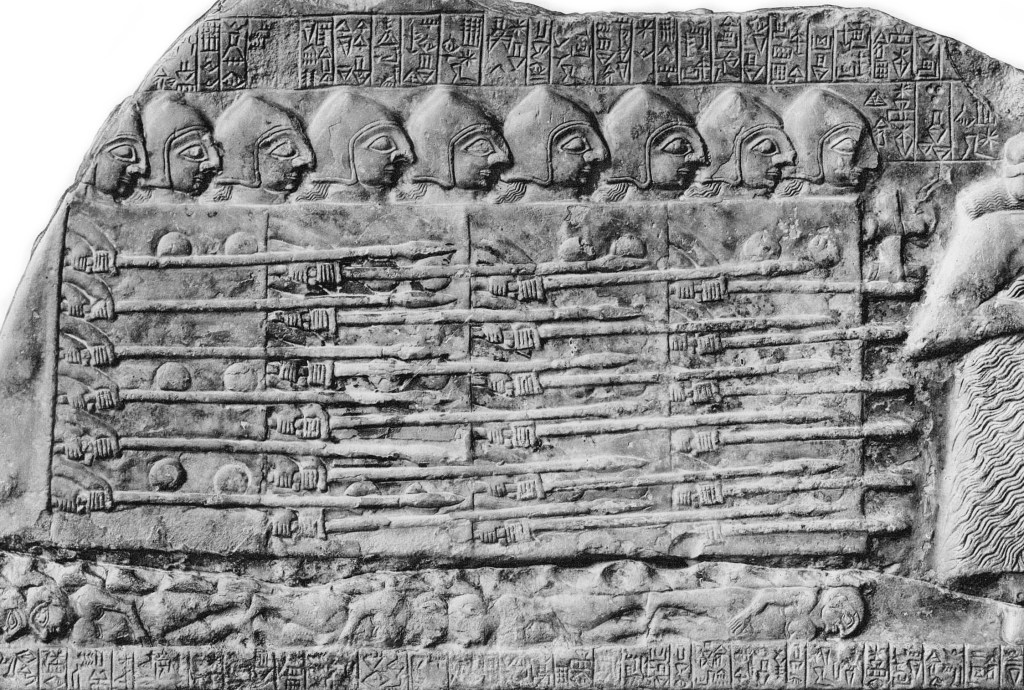
Near the ancient Sumerian city of Girsu, mid-way between present-day Bagdad and Kuwait City, stood a battle marker; the Stele of Vultures, now housed in the Louvre. It commemorates Lagash’s 3rd millennium BC victory over Umma. The stele derives its name from the monument’s carved vultures flying away with the heads of the dead. It also depicts soldiers of Lagash marching in a dense, shield to shield formation, holding spears chest high and horizontal, led by their ruler: Eannatum, who commissioned the stele in 2460 BC. The importance of the stele, though, is that it is the first visual depiction of the use of a phalanx in a battle. It is believed that the phalanx as a military tactic is much older.
The phalanx was more than a combat formation, it was a battlefield philosophy enshrining discipline and courage over strength, unity of the team over the individual. A dense, rectangular wall of men, generally 8 deep stretching across the battlefield to protect against flanking maneuvers. Each man wore heavy armor of leather and bronze: helmet, cuirass, greaves, armed with a spear and a short sword. But the breakthrough that brought the phalanx great renown was the apsis, a round shield invented for the Greek hoplite in the 8th or 7th century BC. With its dual grip, a forearm strap and central handhold, it allowed the infantryman precise control of his shield, helping create an impenetrable barrier of bronze and bone against the oncoming enemy’s spears and swords. It transformed the phalanx from an offensive wall of attack to an added defensive engine of defiance.
The phalanx only succeeded in cohesion. When courage and discipline held, the formation with the apsis as its core defense was practically unbeatable on confined terrain. It overcame the enemy with a seamless, tight mass executing a relentless forward march into the belly of the opposing beast. But it was only as strong as its weakest link. Once discipline faltered and cohesion broke, the formation collapsed, and the opposing army ran it to ground. Victory belonged not to brute force, but to the combined strength of the military unit. Teams won, individuals lost.
From late 8th century BC onward, Greek phalanxes were manned by hoplites: citizen soldiers, generally landowners and farmers. Emerging in Sparta or Argos, possibly imported from Sumeria or born of parallel discovery in Greece, phalanx battles initially were confined, blunt, and deadly affairs. They devolved into fierce pushing masses of brawn, bone, and metal until one side broke. Heavy casualties occurred when the enemy lines broke and soldiers fled Helter skelter in shock and chaos, pursued by the victors for plunder, unless they were restrained by honor.
The phalanx became the standard that destroyed the mighty Persian armies at Marathon and Thermopylae early in the 5th century BC. At Marathon in 490 BC 10,000 Athenians and 1000 Plataeans stretched out their formation to match the breadth of 26,000 Persians, filling the Marathon plain and denying the armies any room for flanking movements.
The Greeks stacked their wings with additional rows of hoplites and thinned them progressively toward the center creating a convex crescent. The Greek wings advance faster than the center generating a pincer movement that collapsed on the Persian center. When the dust settled 192 Athenians and 11 Plataeans were lost while the Persian losses were approximated at 6400.
In the 19th century, Napoleon, possibly improvising on phalanx encircling tactics developed at Marathon, would invert his attacking army with a concave formation consisting of a strong center and weaker wings. His strategy being to split the enemies’ center with strength and attack their divided ranks on the flanks. The tactic worked until Wellington at Waterloo.
At Marathon, unity triumphed with geometric discipline. At Thermopylae the formation bought time and ended with a sacrifice that concluded Persian hubris.
During the second Persian invasion in 480 BC, Darius’s son Xerxes with 120,000-300,000 men attacked a contingent of 7000 Greeks at Thermopylae. The Greeks held back the Persian advance like a cork in a bottle, using a rotating phalanx of roughly 200 men to defend a narrow pass for two days, until betrayal by Ephialtes exposed their flank and they were destroyed in a inescapable Persian barrage of arrows. Greek losses were estimated at 4000 men including Leonidas’ 300 Spartans and 2000-4000 Persians (beginning and ending estimates for manpower strength vary widely).
The Greeks defiant stand at Thermopylae allowed the Greek navy to regroup at Salamis where they won a decisive victory against the Persian navy. A year later the Greeks at Plataea crushed the Persians quest for a Hellenic satrapy.
The Phalanx endured for another century, including use in the Peloponnesian War, where it remained lethal but of limited use. Then came Epaminondas at Leuctra in 371 BC, transforming the phalanx into a machine that erased Sparta’s mighty reputation. Typically, each army’s phalanx strength was concentrated on their right wing so that the strongest part of a force always faced off against the weaker wing of the opposition. What Epaminondas did was say nuts to that.
He reversed the order and created an oblique formation, more triangular than rectangular with his strongest troops on the left wing. His left wing was stacked 50 deep while keeping his center and right wings thin. His 50-deep was aimed directly at Sparta’s best under the command of King Cleombrotus (in those days officers and kings were in the front rows of the phalanx). As the phalanxes began to attack Epaminondas kept his right-wing stationery creating an asymmetrical front. The left wing easily broke through Sparta’s right wing, killing Cleombrotus and collapsing their superior flank. At that point Epaminondas’s wing pivoted inward creating an enveloping arc around the remaining parts of Sparta’s phalanx effectively ending the Spartan myth of invincibility.
Epaminondas tactics shortened battles with fewer casualties. His innovations proved that properly trained and equipped citizen soldiers could defeat professional warriors while instilling a new civic honor through restraint and discipline. His oblique formation allowed landowners and farmers to settle their disputes, usually in a few hours or less, with minimal loss, and return to their farms in time for the harvest. Epaminondas not only brought asymmetrical tactics to the battlefield but shattered claims of superiority by employing the unexpected.
As the Golden Age of Athens and western civilization’s Greek center waned and Roman hegemony rose, the phalanx evolved again. The Greek phalanx gave way to the Roman manipular system, a staggered checkerboard pattern, enabling units to rotate, reinforce, or retreat as needed. It was a needed refinement and improvement to the phalanx, more effectual on open plains and less susceptible to calvary and arrows.
Then came Hannibal to Cannae in 216 BC. During the 2nd Punic War, he upended the war cart of tactics once again and ruthlessly exploited Rome’s refinements.
Hannibal’s improvisations of the phalanx maneuvering tactics, but not the actual formation, showed that he had studied Marathon. Instead of a convex line with strong wings and a weak center he developed a concave line with strong wings and weak center. He allowed the center to fall back, which the Romans unwittingly obliged by surging into Hannibal’s weak center. With the Romans committed Hannibal’s deception encircled them with precision and brutal lethality. The Romans were annihilated on the field losing somewhere between 50,000-70,000 killed and another 10,000 captured. Hannibal lost 6000-8000 men (again estimates vary). Then came the 3rd Punic War.
The phalanx began as a wall of spears and shields, a bulwark of bronze and bone. Its stunning victories echo through history’s scholarly halls and hallowed plains of death and destruction. Yet its Achilles’ heel, vulnerable flanks, precise terrain requirements proved incompatible to horses and gunpowder.
Still its legacy of discipline and unity endure. Born of necessity, refined through rigor, and studied for centuries, the phalanx stands as a testament Aristotle’s enduring insight, slightly abridged but still profound, ‘The whole is greater than the parts.’ And perhaps the Roman’s said it best: ‘E pluribus unum’, ‘out of many, one.’
Source: A War Like No Other by Victor Davis Hanson, 2005. Et al. Graphic: Stele of Vultures.
At the end of first year of the Peloponnesian War in 431 BC Athenians held the customary public funeral to honor the soldiers who gave their lives in the war against Sparta. As Thucydides records in his “History of the Peloponnesian War” the funeral was a procession of citizens that ushered ten cypress coffins representing the ten Athenian tribes plus one more for the soldiers not recovered from the field of battle to the public graveyard at Ceramicus.
Thucydides further states that “When the bodies had been buried, it was customary for some wise and prudent notable and chief person of the city, preeminent in honor and dignity, before all the people to make a prayer in praise of the dead, and after doing this, each one returned to his House. That time to report the praises of the first who were killed in the war, Pericles, son of Xanthippus, was chosen; who, having finished the solemnities made in the tomb, climbed on a chair, from where all the people could see and hear him, and gave this discourse.”
Pericles’ speech was given not only as a tribute to the fallen, but a celebration of the Athenian citizens’ patriotism and urged them to honor the dead by continued support for the city and its democratic ideals.
The following is the first paragraph of the speech recorded by Thucydides:
Most of those who have spoken here before me have commended the lawgiver who added this oration to our other funeral customs. It seemed to them a worthy thing that such an honor should be given at their burial to the dead who have fallen on the field of battle. But I should have preferred that, when men’s deeds have been brave, they should be honored in deed only, and with such an honor as this public funeral, which you are now witnessing. Then the reputation of many would not have been imperiled on the eloquence or want of eloquence of one, and their virtues believed or not as he spoke well or ill. For it is difficult to say neither too little nor too much; and even moderation is apt not to give the impression of truthfulness. The friend of the dead who knows the facts is likely to think that the words of the speaker fall short of his knowledge and of his wishes; another who is not so well informed, when he hears of anything which surpasses his own powers, will be envious and will suspect exaggeration. Mankind are tolerant of the praises of others so long as each hearer thinks that he can do as well or nearly as well himself, but, when the speaker rises above him, jealousy is aroused and he begins to be incredulous. However, since our ancestors have set the seal of their approval upon the practice, I must obey, and to the utmost of my power shall endeavor to satisfy the wishes and beliefs of all who hear me.
Source: Richard Hooker, 1996, University of Minnesota, Human Rights Library. Graphic: Pericles Funeral Oration by Philipp Foltz, 1877, Public domain.
Aaron Poochigian earned a PhD in Classics from the University of Minnesota and an MFA in Poetry from Columbia University. He has authored four books of poetry and translated seven books from Greek and French. He won the Muse Book Award for his book of poetry, Manhattanite and the Richard Wilbur Award for another book of poetry, American Divine. He currently lives and writes in New York City.
In an interview with Heide Sander in 2021 she asked Poochigian to share a story about what first drew him poetry. His answer, to me anyway, was unexpected to say the least, “I had a religious experience when I was 18. Sitting outside an ivy-covered old brick building on the quad of my campus, I was looking at the opening lines of an epic poem in Latin, the Aeneid: ‘Arma virumque cano Troiae qui primus ab oris. . .‘ Though I did not yet know the language, the sky became brighter, and I could feel my synapses lighting up, and it became clear to me that I was supposed to spend my life writing poetry. For better or worse, for richer and poorer, that’s what I have done.”
I find this fascinating. What strain of curiosity exists for someone to read lines of poetry, or any text for that matter, in a language one doesn’t understand. Truly beguiling or maybe closer to the point, mystifying but I’m not a poet so I’m likely missing something important.
For those that are curious, The Aeneid an epic poem written in Latin by Virgil between 29-19 BC, describes the adventures of Aeneas, a Trojan who fled Troy after it fell to the Greeks and who subsequently made his way to Italy, becoming the ancestor of all Romans. The above quoted Latin phrase in bold type is a small snippet from the opening line of the Aeneid which the entire line in English reads as follows: “I sing of arms and the man who first from the shores of Troy came to Italy and Lavinian shores, exiled by fate, that man who was tossed much both on lands and on the deep by the power of the gods because of the mindful anger of savage Juno; also he suffered many things in war until he could found a city and bring his gods to Latium, whence the Latin race and the Alban fathers and the walls of high Rome” .
Poochigian, in his introduction, feels the need to point out that slavery existed during the Golden Age of Athens, as if it ever went away. He states: “…would do well to acknowledge that the entire edifice of the glorious civilization that was fifth century Athens including its rich tradition of theatrical performance, was built on a foundation of forced, uncompensated labor. Athenians themselves may have been willfully blind to the injustice of reserving democratic self-determination for themselves and relegating their defeated enemies to abject servitude, but it is impossible for us now to ignore it.”
The “built on a foundation” and “willfully blind” are very bold assumptions whose conclusive inerrancy would improve with a smidgen of support from the historical record. Also, to translate the works of a free Athenian citizen, whose works were supposedly built on the backs of slaves, then hold out your hand for payment does seem a bit much. One may wish to consider how the future humans will look upon present-day west coast cities in the U.S. Will their view of us be judged by the abhorrent spectacle of unending tent cities and homelessness, unchecked crime, filth in the streets, untreated mental illness, rampant drug use and addiction? Should the future disparage our attempts to uplift the human condition of some because we failed to uplift all? If we cannot accept the civilizational accomplishments from 2800 years ago because slavery existed then, as it does today, do we expect the future to treat us differently?
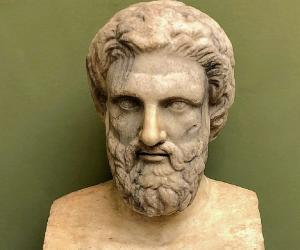
Aristophanes — Wikipedia
Aristophanes Biography:
Aristophanes, Greek playwright, born circa 448-6 and died circa 386-5 grew up in Athens during the Age of Pericles, 461-429 BC. His early adult years on into middle age occurred during the declining period of the Athenian Golden Age due to the mounting strategic failures and monetary costs of the city-state’s losing gambles in the Peloponnesian War from 431-404 BC.
It is unknown whether Aristophanes fought in the war, but it is believed he did due to the Athenian compulsory draft of all eligible citizens during the Peloponnesian War. Then again, if he did serve in the military, it didn’t appear to impede his prodigious writing output.
Aristophanes, known as the ‘Father of Comedy’, produced thirty-six to forty plays, maybe more, of which only eleven exist in completed form while another eleven are found in fragments. He is the only writer of Greek ‘Old Comedy’ whose plays still survive.
He submitted his first play, The Banqueters to the festival in Dionysia in 427 BC, receiving second prize out of the three that were accepted for live performance. His plays went on to garner eleven prizes at Dionysia and Lenaea even managing the exceptional feat of winning first and second prize at Lenaea in 422 BC for his plays The Preview and The Wasps respectively.
Aristophanes plays, at least the eleven surviving ones, are all stylistic examples of what is now called ‘Old Comedy’, the initial form of Greek theater comedy. Old Comedy was characterized by the merciless skewering of public figures while entertaining the audience with beautiful lyrical songs, dance, ribald and licentious speech, and absurd plots. Aristophanes plots began sane and logically, centered around an imaginative hero, progressing to a preposterous but victorious heroic conclusion such as in The Birds where a middle-aged burnout from Athens, searching the wilderness for peace, stumbles into a ruling role of the bird kingdom which in the end supplants the Greek gods for supremacy.
Greek Competitive Theater:
Ancient Greeks invented theater with Greek tragedy first appearing in the late sixth century BC. It is believed that Greek theater began as songs and dances, known as the dithyramb, honoring Dionysus or Bacchus, the Greek god of all that was fun: wine, fertility, festivity, insanity, and theater. The songs and dances celebrating fertility evolved into rites of spring with theatrical plays becoming central to the festivities. The Dionysia as the festival became known was the second most important Greek celebration after the Panathenaic, the quadrennial Athenian athletic games.
The theatric festival was eventually held as a competition where three tragic poets or playwrights wrote and produced three tragedies on a common theme. Additionally, the poets were also required to produce a satyr play, a heroic tragedy with cheerful atmospherics and rural backgrounds. An award, initially believed to have been a goat, fortunately becoming a wreath of ivy and/or a bronze tripod cauldron, was given to the best tragic poet. The term “tragedy” comes from the Greek word ‘tragoidia’, which translates to ‘goat song’. From 449 BC onward the best actors, known as protagonists, were also given prizes.
Comedy was introduced at Dionysia in 486 BC with five poets initially competing for the prize. In 440 BC a minor festival to Dionysus was established in January at Lenaea where initially, only comedy was staged. Tragedy was added at Lenaea in 432 BC. Five comedies were presented yearly at Lenaea except during the Peloponnesian War when only three plays were staged. Four tragedies were presented at this winter festival but were composed by only two poets.
Aristophanes’ Theater Awards for Comedy:
Second prize at the Dionysia in 427 BC for The Banqueters (now lost)
First prize at Dionysia in 426 BC for The Babylonians (only fragments remain)
First prize at the Lenaea in 425 BC for The Acharnians
First prize at Lenaea in 424 BC for The Knights
Third (last) prize at Dionysia in 423 BC for The Clouds (first edition now lost)
First prize at the Lenaea in 422 BC for The Preview (now lost)
Second prize at the Lenaea in 422 BC for TheWasps
Second prize at the Dionysia in 421BC for Peace
Second prize at the Dionysia in 414 BC for The Birds
First prize at the Lenaea in 411 BC for Lysistrata
First prize at the Lenaea in 405 BC for The Frogs
Aristophanes — Four Plays Plot Summaries and Commentary:
Clouds is a tale detailing the importance of an education and the resulting moral rot that accompanies it. A spendthrift and unappreciative son Pheidippides is driving his father, Strepsiades, into bankruptcy. Strepsiades counts on the wrong argument, taught by sophists at the Thinkery school with Socrates as the headmaster, to win him a reprieve from his debts.
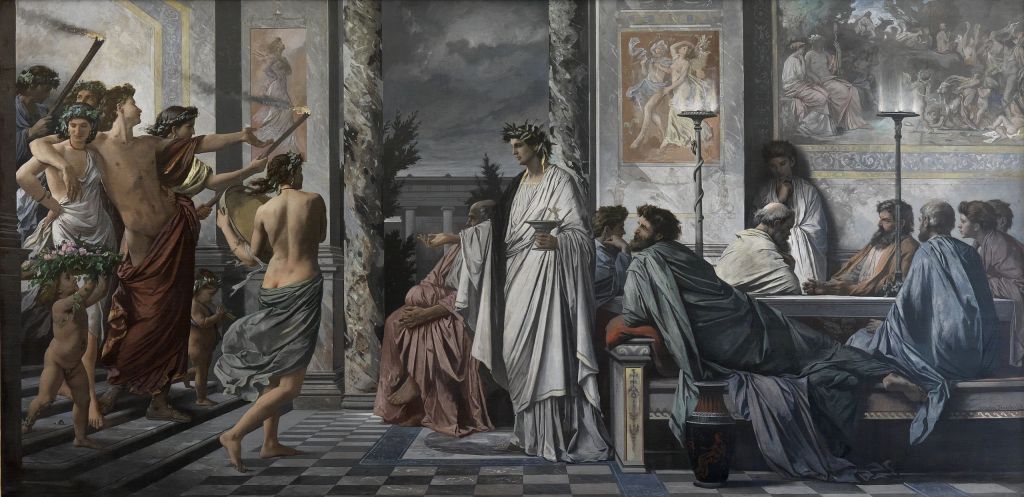
Symposium by Feuerbach — First version — 1869 — Socrates is in the right center facing the wall.
Sophists, in the original Greek meaning were sages or experts imparting wisdom and learning. During the Golden Age of Athens in fifth century BC, professional educators roamed the Greek empire teaching for a fee on a wide range of subjects from rhetoric, poetry, music, philosophy, and mathematics. Rhetoric or the art of apprising and persuasion was the preeminent study for the litigious Athenians. When discussing sophists, one would be remiss not to mention that Aristophanes had numerous students under his care throughout his career as a playwright, which one can assume were not instructed for free, whereas Socrates taught and lectured for free.
The Clouds that took third (last) at Dionysia in 423 BC is now lost. The one that reaches us here in the 21st century is a revised version of the play from 418 BC, which Aristophanes, it is believed, never presented to the public.
In Plato’s Apology the author claims this play was a contributing factor in the conviction and execution of Socrates for the specious crime of corrupting Athen’s youth.
Birds, taking second prize at Dionysia in 414 BC, attempts to find utopia outside of the struggles of Athens. The plot begins with a worn-out Athenian, Pisthetaerus, wandering in the wilderness with his fellow traveler, Euelpides, looking for Tereus the Hoopoe, supreme leader of the birds. Upon finding Tereus, Pisthetaerus hatches a great idea to establish a city in the sky, Cloudcuckooland and reclaim the birds’ standing as the first among gods.
Many have tried to find allegorical meaning in the play, but sometimes a fairy-tale is just that, a fairy-tale, a fantasy that entertains without it being weighed down with heavy philosophical and political interpretations.
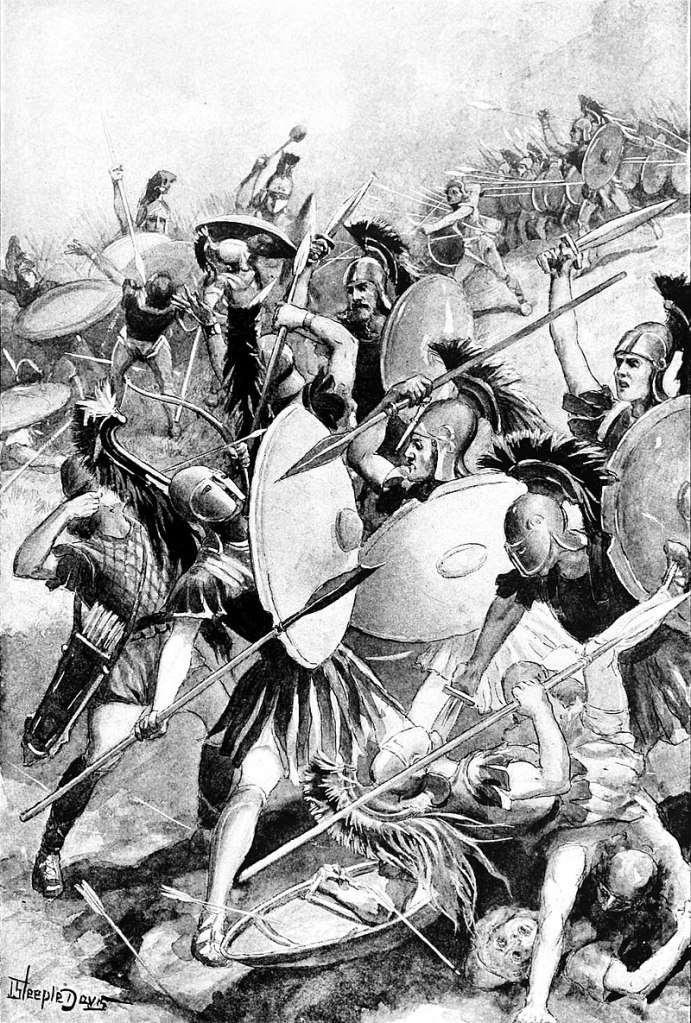
Destruction of Athenian army at Syracuse — Davis 1900 — Wikipedia
Lysistrata, taking first prize at Lenaea in 411 BC, has Aristophanes bringing the matriarchy to the forefront of Greek society were the Athenian wives, brides, and lovers of war-locked men attempt to end the Peloponnesian War. Lysistrata and the other women of Athens hatch a plan to deny sex to the men until they end the war thus denying themselves, their one and only desire in life.
By 411 BC Athens was losing badly in the Peloponnesian War through the treachery of Alcibiades, the incompetence of military commanders in Sicily and elsewhere, and the political blunders emanating from Athens. Having lost most of their navy in 413 BC, Athens was slowing and mercilessly succumbing to Sparta and its ally, Persia, with their tightening noose around Athens’ perimeter choking off their much-needed trade and silver resources to continue the war.
The play has feminist overtones, but it is unabashedly an enactment of societal male domination designed to protect women from their baser and irrational instincts. While the play is a creed to the ethos of patriarchy, it subtly informs the Athenians that all is lost, and it was time to make peace with Sparta.
Women of the Assembly goes by more names than the devil: Assemblywomen, Congresswomen, A Parliament of Women, Women at the Assembly, Women of Ecclesia, Women in Parliament, Women in Power, and possibly others. Ecclesia, along with the plethora of previously listed names, in ancient Greece was the assembly of citizens of the city-state which included all male citizens 18 years and older. In Aristophanes time the Ecclesia was summoned by the ruling Boule of four hundred, a Greek council or senate. The assemblies were charged with debating and voting on matters presented to them by the council.
The play, presented in 391 BC, is one of Aristophanes’ weaker and rightly, less appreciative efforts, garnering no awards at Dionysia or Lenaea. The women of Athens take over the Ecclesia, dressed as men and force a communistic system of sexual equity for all, the ugly and the beautiful, and a ban on the rich. Equality of outcomes, of one ring, to rule them all.
The play on the surface is an exploration of feminist power in government whereas it is truly a rebuke of effeminate men in the halls of government. Aristophanes believed in a binary world. If men and women were interchangeable and indistinguishable then madness and sadness is everyone’s just reward.
Literary Criticism:
German poet Henrich Heine said: “There is a God, and his name is Aristophanes.” Once a god is conceded all negatives melt away. I will concede the obvious–the negatives are not only trivial but possibly non-existent.
Aristophanes plays were filled not only with comedy but with fantasy and fetish, irrationalism, satire, ribald commentary, and vulgar ridicule of Athenian society. Aristophanes respected no sacred cows, skewering everyone and everything with impunity, an unrestrained destruction, fairly or unfairly, imparting a message to all comers that they were mostly fools. Open season was declared on poetry, religion, philosophy, and politics as were the famous and infamous of society such as Socrates, Cleon, fellow poet Euripides, and when he ran out of the famous, he turned his sharp swords of locution on the Athenian people. He truly was a god of Greek poetry, comedy, and theater.
Aristophanes surfeit use of vulgarity, phallic imaging, and sexual inuendo comes across as juvenile upon reading his plays but then these plays are for presentation at festivals honoring Bacchus, the Greek god of wine. It may not be unrealistic to assume that his audience, at a minimum, is slightly inebriated, in which case Aristophanes isn’t being crude but deliberately playing to his audience’s relaxed mental state.
Poochigian believes in magic. The magic of poetry, stating in 2021, “Poetry is a magic circle of sound and image in which anything can happen. Yes, poetry means magic to me, and I see the poet as a magician who, with his/her incantations, creates special spaces outside of prose and everyday life.” He is an able translator of Aristophanes plays bringing his Greek poetry into realm of the vernacular of almost blue-collar English but managing to leave the magic behind in the agoras and councils of the Athens.
Poochigian’s translation of Tereus’, king of the birds, great speech summoning his subjects is typical, “…come here, all you endowed with wings, all you who flutter over acres of fertile land, you myriad throngs who feed on grain, you swift seed-pickers who warble such delightful songs. Come all that over furrowed ground twitter, molto espressivo, this pleasant sound–tio, tio, tio, tio, tio, tio, tio, tio...” Where is the beauty, the magic in this translation? This is prose of the common man. It is amusing though that the Italian term, molto espressivo, meaning very expressive, is used to translate the Greek to English.
An anonymous translator from the early 20th century gives us Epops summoning his subjects, “…here, here, quick, quick, quick, my comrades in the air: all you who pillage the fertile farming lands, the numberless tribes who gather and devour the barley seeds, the swift flying race that sings so sweetly. And you whose gentle twitter resounds through the fields with the little cry of tiotiotiotiotiotiotiotio…” This is poetry. This is magic.
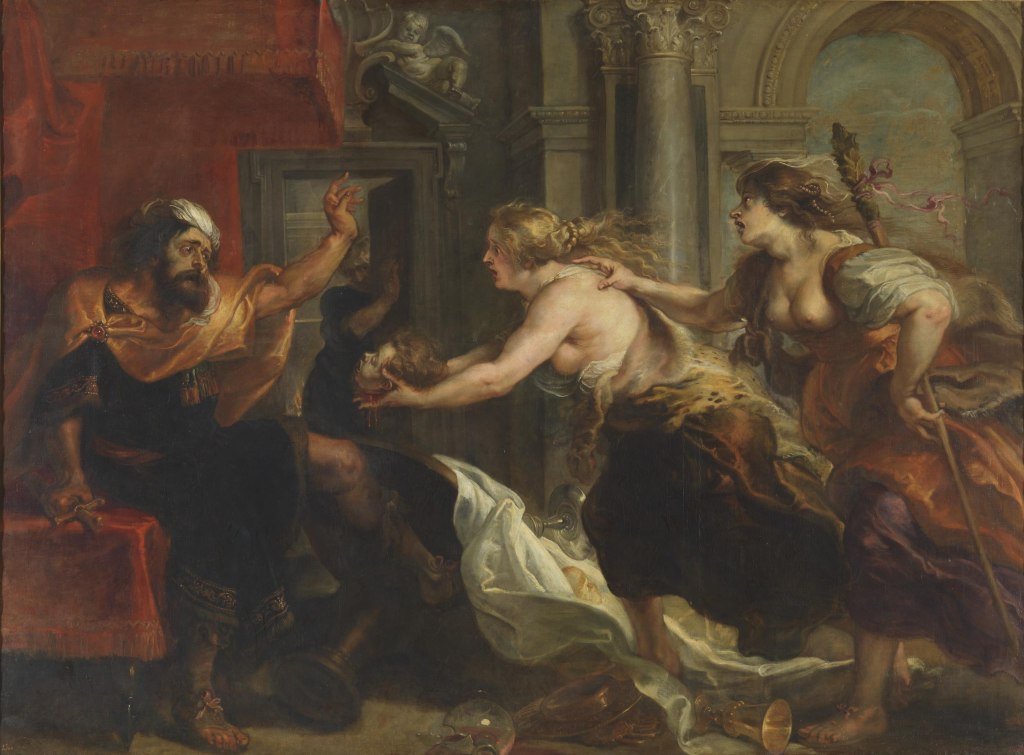
Tereus Confronted with the Head of his Son Itys — Rubens — 1636-38
Epops, in Latin and Greek, is a hoopoe. A bird with a long beak and a crest of feathers. Why the anonymous translator called Tereus Epops is unknown. The name of the king of birds in Aristophanes play is the hoopoe Tereus. Tereus is a character from Greek mythology who was the king of Thrace and the son of Ares, the god of war, and Bistonis, a water nymph. He married Procne, the daughter of Pandion, the king of Athens. However, he also raped and mutilated his sister-in-law Philomela, who was Procne’s sister. As a result, Procne and Philomela took revenge on Tereus by killing his son Itys and serving him as a meal to Tereus. When Tereus discovered the truth, he tried to kill them, but the gods intervened and turned them all into birds. Tereus became a hoopoe. Procne became a nightingale with a beautiful song. Philomela became a swallow who could not sing.
Aristophanes’ Surviving Complete Plays Bibliography:

 elsToday