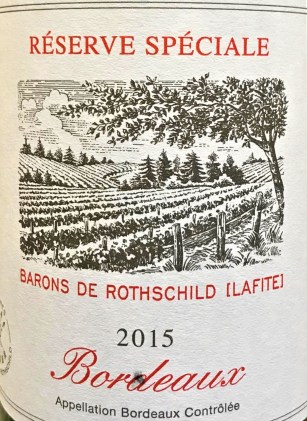
Domaines Barons de Rothschild (Lafite) Reserve Speciale Bordeaux

W Lafite 2015Bordeaux from Bordeaux, France

60% merlot

40% cabernet sauvignon

12.5% alcohol

Opened 30 Nov 2017

els 8.5/10

Decanter 86

Reserve Speciale Bordeaux is from a family of wines created by Barons de Rothschild (Lafite) to provide, in their terms, “wines ideal for everyday drinking and more accessible than the Grands Crus” which they brand as “The Collection”, and includes the Legende, Saga, and Reserves brands; all three of which, bottle both Bordeaux reds and whites.

The family name of Lafite can be traced back to a Pauillac French monastery in the 13th century but the legendary winery took root with the planting of the vineyards by Jacques de Segur in the 1670s. Londoners, surprisingly enough, where the first to sing the praises of Lafite wines, which made their way to that city by way of British corsairs seizing the French merchant ships and confiscating their wine in the early 1700s. French nobility took notice of Chateau Lafite’s wine after Richelieu introduced it to King Louis XV; quickly becoming the “Kings Wine”; served at the tables of the 18th century French aristocratic rich and famous. After the French Revolution the Chateau changed owners several times until Baron James de Rothschild purchased it in 1868 and it has remained in the family ever since, with the minor exception of a German expropriation for a short time during WWII.  In 1995, the winery began selecting grapes for their “accessible” line of wines from  the region’s Bordeaux, Medoc, and Pauillac family, and non-family owned vineyards; to become part of the Barons de Rothschild (Lafite), “The Collection”.

The Reserve Speciale Bordeaux is sourced mainly from vineyards in the Entre-Deux-Mers (between two tides) wine region; situated between the tidal rivers Garonne and Dordogne. This is the largest sub-region of Bordeaux but less than half the acreage is planted in vines with the rest being generally forested.  This region produces only white wine that can carry the AOC Entre-Deux-Mers.  The reds are sold under various Bordeaux labels.

This wine has a clear ruby-red color, redolent of red berries and spice. Very smooth, not bold, with a quick finish.  A nice, inexpensive table wine that doesn’t overly impress but will pair well with cheese and friends.

A good wine. Decant and aerate for at least one hour.

$10.00-16.00  wine-searcher.com

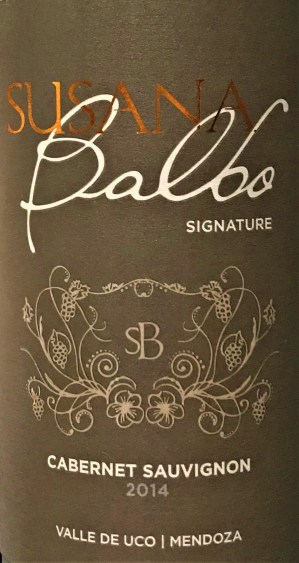
Susana Balbo Signature Cabernet Sauvignon 2014

W Balbo 2014Cabernet Sauvignon from Uco Valley, Mendoza, Argentina
95% cabernet sauvignon

5% merlot

14.3% alcohol

Opened 21 Nov 2017

els 9.2/10

James Suckling 93

Wine Advocate 91

Vinaceous 91

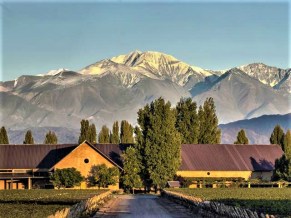
Susana Balbo’s winery, established in the stunning, idyllic eastern foothills of the Andes Mountains, within the viticultural region of Uco Valley, which lies southwest of Mendoza, Argentina; is surrounded by 52 acres of Malbec, Cabernet Sauvignon, Cabernet Franc and Petit Verdot vines; produces 4 brands of wines with distinct and complex personalities that appreciate long, secluded years in their bottles: Crios, Ben Marco, Nostros and Susana Balbo Signature.

The vineyards are at an average elevation of about 3800 feet above sea level where the

W Balbo Winery

The Susana Balbo Winery and Vineyards. Photo by Susana Balbo Winery.

steppe climate provides a large swing in growing season temperatures ranging from daytime highs in the mid 80s to night-time lows approaching 50 degrees Fahrenheit, with arid conditions that receive a paltry 1 to 1.25 inches of rain per month. To compensate for the semi-desert conditions and the well-drained alluvial soils of Uco Valley, the vineyards are drip irrigated from the Andes’ snow melted water to provide just the right of amount of essential moisture to produce these flavorful wines.

The grapes are hand-picked and fermented in concrete vessels and finished with 13 months in 70% second use and 30% first use French oak barrels.  The wine has a clear, bright ruby color with aromas of black berries and a very subtle hint of mint and earth. A long, full, dry finish with close to perfect tannins. Wonderful.

An outstanding wine. Decant and aerate for at least one hour.

$20.99 wine.com

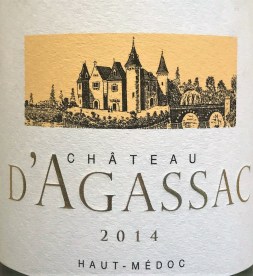
Chateau d’Agassac 2014

W D'Agassac 2014Bordeaux Red Blends from Haut-Medoc, Bordeaux, France
Proprietary blend of  cabernet sauvignon and merlot

Opened 14 Oct 2017

els 9.0/10

James Suckling 92

Wine Enthusiast 91

Robert Parker 83

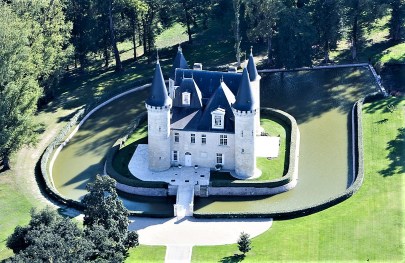
Chateau D’Agassac, a Haut-Medoc winery, purchased in 1996 by the French insurance conglomerate, Groupama, is located in the village of Ludon-Medoc, less than 10 miles north from the center of Bordeaux, and less than 3 miles west of the Garonne River. TheW Chateau d'Agassac charming, fairytale Chateau located at the winery, complete with turrets and moat, is known to have existed as far back as 1238 AD, under the lordship of Gaillard de Gassac, vassal of King Edward I of England. The vineyards, originally swampland, around the Chateau, were  not known to exist prior to the French Revolution in the late 18th century, when the area was drained.
The vines are grown on a young alluvium cover, deposited from the nearby Garonne River during its flood stage. In the western vineyards the soil consists of a  gravel, up to 10 feet thick, and produces refined and elegant wines. Sandy gravels in the middle vineyards, produce subtle wines high in tannins. The eastern most vineyards, closest to the river, consist of clayey gravels, with rounded stones the size of ping-pong balls, reaching 20 feet thick, and produce full body wines.  The vineyards encompass 106 acres, planted with 50% Merlot, 47% Cabernet Sauvignon, and 3% Cabernet Franc; the grapes are harvested from, on average, 25-year-old vines.

The temperatures of Ludon-Medoc reach their peak during August, with highs near 80 and lows hovering around 60. August is the driest month of the year, still producing, on average, about 2.5 inches of rain over those 30 days, with the remaining growing season, before and after August, producing 3 to 3.5 inches of rain each month. The gravels release their sun-acquired heat at night, protecting the vines’ roots from extreme temperature variations during the growing season, and especially during the harvesting of the grapes. The loose gravels also drain away the rain water quickly, keeping the grapes in peak condition.

This Bordeaux needs decanting and aeration for at least 2 hours, 4-6 hours, even better; if not, the acidity and tannins will overpower your senses, infusing your soul with utter regret that you even came to purchase this bottle of fermented grape juice. I opened this bottle after 3 years but in hindsight I should have let it set for at least 2 more years.  With that said, and with proper aeration, this is a good wine; an incredibly dark ruby-purple wine, redolent of plums, prunes and raisins. Full-bodied, dry, and intense with an excellent and protracted finish.

An outstanding wine.

$19.99 wine.com.

Chateau Peymouton 2012

W Chateau PeymoutonBordeaux Red Blends from St. Emilion, Bordeaux, France

65% merlot

25% cabernet franc

10% cabernet sauvignon

13.5% alcohol

Opened 9 Oct 2017

els 8.9/10

Wilfred Wong 92

Wine Enthusiast 90

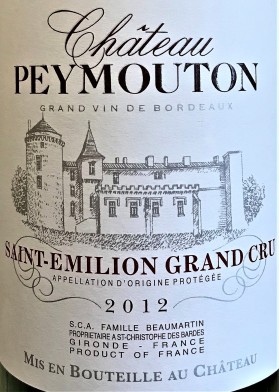
The Beaumartin family winery, approximately 2 miles east of picturesque St. Emilion and 23 miles east-northeast of Bordeaux, on the right bank of the Dordogne River, consists of 2 vineyards; the Chateau Laroque, covering 150 acres, and the Chateau Peymouton, covering 76 acres, both growing predominately Merlot, with lesser amounts of Cabernet Franc, and minor acreage devoted to Cabernet Sauvignon grapes, all from vines planted in the early 1960s.

The vines of the Saint Emilion area spring from clayey limestones, with growing season temperatures ranging from the low 50s at night to the mid-80s during the day, receiving as little as a half-inch to as much as 4 inches of rain per month with the harvest season usually being the driest time of the year.  Cabernet Sauvignon vines generally do not grow well here, due to dampness of the soils, thus Merlot and Cabernet Franc vines dominate.

St. Emilion wines are reclassified every 10 years, vying for the elite, but limited award, Premier Cru Classes, and the lesser, but still good Grand Cru Classes, judged and assigned by two different tasting panels. The recent year’s reclassifications, 2006 and 2012, are hopelessly tied up in legal dramas by Chateaus that have lost their Cru Class. Chateau Peymouton is rated below the Grand Cru Class as a generic grand cru, although it is still a very good wine.

A dark, ruby-red wine, aromas of dark berries, smooth tannins and acidity with a nice balance and moderate finish.  This wine will go well with red, fatty meats.

A good wine.

$21.99 wine.com

Chateau Bel Air Haut-Medoc 2012

W Bel Air.jpgBordeaux Red Blends from Medoc, Bordeaux, France (Domaines Joel Irigaray)
55% cabernet sauvignon

45% merlot

12.5% alcohol

Opened 7 Oct 2017

els 8.9/10

Hailing from the St. Emilion area on the right bank of the Gironde, Chateau Bel Air, Joel Irigaray Domaines, is a Bordeaux blend of Cabernet Sauvignon and Merlot.  St. Emilion is blessed with wonderful mix of vine growing soils of gravel, clays and limestone, coupled with an oceanic climate of hot summers, and warm autumns, with just the right amount of rain when needed. The vineyards around St. Emilion and the Bordeaux region date back to at least the Roman plantings in the 2nd century AD; proving that good things do last.

A good, solid, dark, purple to ruby-red wine, redolent of cherry fruits, smooth tannins and acidity.  Serve with a juicy rib-eye and enjoy its balanced and long finish.

A good wine.

$13.99

Baracchi O’lillo 2014

W Baracchi OlilloTuscan Red Blend from Tuscany, Italy
25% cabernet sauvignon
25% merlot
25% sangiovese
25% syrah
14.5% alcohol by volume

els 9.0/10

James Suckling 93

Wine Spectator 90

The Baracchi winery and vineyards are located on the southern, sunny slopes of the Apennine Mountains, in the eastern central area of Tuscany, just outside the stone walls of the ancient, small city of Cortona.

Legend has it that Cortona was originally established by Noah, shortly after the great flood; falling in love with the fertile soils and natural beauty of the area. Umbrians, Etruscans, Romans, Guelphs, Medici, Italians have all called Cortona theirs. The town, at approximately 1600 feet above sea level, overlooks Lake Trasimene, the setting for one of the Roman Empires great military defeats at the hands of Hannibal in 217 BC (Carnage and Culture, The Punic Wars).  When touring the Tuscany wine region this is a required stop to cherish and savor the legends, the history, the scenery, the food, and certainly, the wine.

The Baracchi Estate, winery and vineyards, a family business since 1860, is run by Riccardo and his son Benedetto, producing some of the best wines in the region. There are 4 vineyards sitting about 1000 feet above sea level, enjoying hot days, rising to the high 80s, and cool nights dipping down to the chilly low 50s. The rains, coming roughly once a week, deliver from 1.5 to 3 inches of water per month to the thirsty vines. The soils range from sandy to clayey and chalky. The wines are aged in French oak barrels.

This red blend is a brilliant ruby-red, redolent with red and black cherries and just a whisper of black pepper.  The tannins are about as smooth as a cloudless Mediterranean sky, with an enjoyable, hearty and long finish.

An outstanding wine.

$19.99 wine.com

Tahbilk Cabernet Sauvignon 2013

W Tahbilk 2013Cabernet Sauvignon from Central Victoria, Australia
100% cabernet sauvignon
14.0% alcohol by volume

els 8.9/10

Australian Wine Companion 94

Wine Spectator 90

Tahbilk established itself in 1860, as the first winery in the Goulburn Valley of Central Victoria, Australia and is one of the oldest wineries in Australia. Reginald Purbrick purchased the winery in 1925 and 5 generations of family have been making wines there ever since.

The vineyards are situated less than 500 feet above sea level but the temperatures are cool nights of about 50 degrees Fahrenheit with the days hovering in the low 80s during the growing season. Rain is sufficient at about 1.5 to 2.5 inches per month. The soils are sandy.

Tahbilk cabernet sauvignon is produced from about 70 acres of old vines planted in 1949.

The wine is a brilliant ruby-red with a great fragrance of black cherry and plum.  Mild herbal and spice hints add to its sensual aroma. The tannins are smooth and easy, producing a balanced but a long and intense finish. A good wine.

$19.99 wine.com

Vina Tarapaca Gran Reserva Cabernet Sauvignon 2013

W Tarapaca 2013Cabernet Sauvignon from Isla de Maipo, Maipo Valley, Central Valley, Chile

100% cabernet sauvignon

14.3% alcohol

Purchased: 12 July 2016  –  $16.99

Opened: 12 July 2017

els:  9.1/10

James Suckling:  92

Decanter:  91

Natalie MacLean:  91

Globe and Mail:  91

Cellar Tracker:  86

The Central Valley wine region, aka, the Inland Valleys, of Chile is a 250-mile north-south region nestled within the 600-mile north-south depression between the western Coastal Ranges and the eastern Andes, all within the central part of country. The wine region extends from northern most, heavily vined, Maipo Valley, near the capital city of Santiago, down to the table wine capital of Maule Valley in the south, which shares its southern border with the Bio-Bio region. Geographically analogous to the California Inland Valleys with the Central Valley bracketed by the Coastal Ranges to the west and the Sierra Nevadas to the east. Unlike the Inland Valleys of California, the Inland Valleys of Chile have a greater diversity of terroir requiring a narrowing of focus before climate, soils and rainfall can be adequately discussed.

Chile is the 8th largest producer of wine, by volume, in the world while the Central Valley wine region produces around 85%, by volume, of all wine in Chile. Cabernet Sauvignon and Merlot, Petit Verdot, Syrah, Carmenere and Carignan grapes dominate the plantings in the Inland Valleys. Cabernet Sauvignon accounts for more than a third of all vines planted in Chile and almost 50% of the vines in Maipo Valley.

Maipo Valley, an area of 276,000 acres has a little more than 11% of those acres dedicated to growing grapes, and Cabernet Sauvignon is the reigning monarch on these regal lands. Most Chilean wines of prestige come from here, often referred to as the Bordeaux of South America. Like the Rioja wine region in Spain, Maipo Valley is divided into 3 sub-regions based on altitude: Alto, Medio or Central, and Bajo or Pacific; Maipo. Alto Maipo vineyards on the western foothills of the Andes are the area’s crown jewels, producing extraordinary Bordeaux blends from vineyards more than 1300′ above sea level, and as high as 2600′. Down slope and to the west from Alto are the Medio Maipo vineyards producing slightly less discriminating wines. Lower down and further west are the wineries, not necessarily the vineyards, of Bajo Maipo; producers of good wines if sourced from the higher elevations to the east.

Cabernet Sauvignon is the most widely grown grape in the world; coming from zero in the mid-1600s, when it was established as a new species by the natural cross-breeding of Cabernet Franc and Sauvignon Blanc grapes, then rapidly ascending to the prominence of being planted in one out of every 16 vine cultivated acres. A black, thick-skinned grape that has multitude of aromas and flavors from pepper to mint to jam.  With its high tannins and medium acidity it possess the potential for a long shelf life of ageing and consumers just can’t get enough of it.

Vina Tarapaca, founded in 1874 in the western foothills of the Andes Mountains, by Don Francisco de Rojas Salamanca which he originally named, Vina de Rojas. In 1892 the winery was sold to Don Antonio Zavala and was renamed Vina Zavala. When the Zavala divorced his wife, Mrs. Mercedes Ulloa, the winery passed to her as part of the settlement and she renamed the winery to Vina Tarapaca Ex Zavala; honoring her divorce lawyer and future president of the country, Don Arturo “The Lion of Tarapaca” Alessandri and spiting her former husband at the same time. Ouch. In 1992 La Compañía Chilena de Fosforos acquired the company and began gearing its production towards the export market. Also in 1992 the company acquired the Maipo Valley property: El Rosario Estate. In 2008 the company entered into a partnership with the VSPT Wine Group to export fine Chilean and Argentinean wines to international markets.

Vina Tarapaca’s winery and vineyards are located in Isla de Maipo, a town along the Maipo River of about 26,000, approximately 25 miles southwest of Santiago.  The estate encompasses about 6400 acres of which 1600 are planted in vines, and are totally surrounded by mountains and the river. The Cabernet Sauvignon vineyards are tucked into a small mountain canyon growing in piedmont or mountain alluvial soils of a gravelly loam that overlays a sandy, gravelly sub-strata. The soil’s drainage is good and the roots can go deep. The growing season diurnal temperature range is about 50-87ºF and the rainfall averages about 0.5″ per month.

The grapes were harvested in the last 2 weeks of April. A pre-fermentation cold maceration period was carried out at 54ºF.  The grapes were then fermented at about 80ºF, followed by another maceration period for 10 days. The wine was then aged for 12 months in new and old, French and American oak barrels.

A deep purple; I always love writing that, wine with an earthy blackberry aroma and a faint herbal scent. Full bodied but the tannins and acidity will not overpower you. It has a well-balanced, nice long finish.

A nice wine to enjoy with my super easy shredded pork soft tacoritoes.  You will need about 1 pound of pork, I usually use boneless pork ribs, 1 medium chopped white onion, 2 tablespoons of minced garlic, 2 packages of taco seasoning, 2 diced tomatoes, sliced jalapeno peppers to taste, 16 ounces of a 3 cheese Mexican mix, and 12-24 flour tortillas. Boil the pork in water, along with the onion, garlic, and 1.5 packages of  the taco seasoning for several hours or until the pork is easily shredded with a fork. Drain off all the water except about a cup and shred the pork.  Add in the tomatoes, jalapeno, and the remaining seasoning and mix.  Add additional liquid if too dry.  Mix thoroughly and slowly simmer for about 10 minutes. Spread 1-2 tablespoons of the pork mixture on a tortilla and roll up.  Top with cheese and microwave until the cheese is melted.  Serve with sides of sour cream, picante sauce and other condiments you usually use for your tacos.

An outstanding wine at a nice price. Drink this year but it likely will be good until 2021-2023. Decant and aerate for one hour, or more, before drinking. A great value wine that is now, rather scarce. The link below had the wine at the time of this posting.

$18.40 wine-searcher.com

Casas del Bosque Gran Reserva Cabernet Sauvignon 2014

W Casa Bosque 2014Cabernet Sauvignon from Maipo Valley, Central Valley, Chile

100% cabernet sauvignon

14.5% alcohol

Purchased: 6 January 2017  –  $15.99

Opened: 3 May 2017

els:  9.0/10

James Suckling: 94

Wine Advocate: 89

Cellar Tracker: 89

The Central Valley wine region, aka, the Inland Valleys, of Chile is a 250-mile north-south region nestled within the 600-mile north-south depression between the western Coastal Ranges and the eastern Andes, all within the central part of country. The wine region extends from northern most, heavily vined, Maipo Valley, near the capital city of Santiago, down to the table wine capital of Maule Valley in the south, which shares its southern border with the Bio-Bio region. Geographically analogous to the California Inland Valleys with the Central Valley bracketed by the Coastal Ranges to the west and the Sierra Nevadas to the east. Unlike the Inland Valleys of California, the Inland Valleys of Chile have a greater diversity of terroir requiring a narrowing of focus before climate, soils and rainfall can be adequately discussed.

Chile is the 8th largest producer of wine, by volume, in the world while the Central Valley wine region produces around 85%, by volume, of all wine in Chile. Cabernet Sauvignon and Merlot, Petit Verdot, Syrah, Carmenere and Carignan grapes dominate the plantings in the Inland Valleys. Cabernet Sauvignon accounts for more than a third of all vines planted in Chile and almost 50% of the vines in Maipo Valley.

Maipo Valley, an area of 276,000 acres has a little more than 11% of those acres dedicated to growing grapes, and Cabernet Sauvignon is the reigning monarch on these regal lands. Most Chilean wines of prestige come from here, often referred to as the Bordeaux of South America. Like the Rioja wine region in Spain, Maipo Valley is divided into 3 sub-regions based on altitude: Alto, Medio or Central, and Bajo or Pacific; Maipo. Alto Maipo vineyards on the western foothills of the Andes are the area’s crown jewels, producing extraordinary Bordeaux blends from vineyards more than 1300′ above sea level, and as high as 2600′. Down slope and to the west from Alto are the Medio Maipo vineyards producing slightly less discriminating wines. Lower down and further west are the wineries, not necessarily the vineyards, of Bajo Maipo; producers of good wines if sourced from the higher elevations to the east.

Cabernet Sauvignon is the most widely grown grape in the world; coming from zero in the mid-1600s, when it was established as a new species by the natural cross-breeding of Cabernet Franc and Sauvignon Blanc grapes, then rapidly ascending to the prominence of being planted in one out of every 16 vine cultivated acres. A black, thick-skinned grape that has multitude of aromas and flavors from pepper to mint to jam.  With its high tannins and medium acidity it possess the potential for a long shelf life of ageing and consumers just can’t get enough of it.

Juan Cuneo Solari, the son of an Italian immigrants, established, in 1993, the Casas del Bosque winery. He located it west of Maipo Valley in Casablanca Valley, smack dab in the middle of the Coastal Ranges.  He has vineyards in the valley but sources the grapes for his Gran Reserva from Maipo Valley to the east.  The winery only produces a limited 90,000 cases of wine, total for all varietals, per year, concentrating on quality over quantity. Their limited production is largely devoted to serving an international clientele via export.

Casas del Bosque produces grapes from 500 acres scattered around Chile’s better viticultural valleys and terroirs. The cooler climate Casablanca vineyards produce their white grapes; Sauvignon Blanc, Chardonnay and Riesling along with the reds; Pinot Noir and Syrah. Premium Gran Reserva Cabernet Sauvignon and Carmenere reds are sourced from the warmer climate Rapel and Maipo Valleys. The Maipo Valley vineyards are located in both the Alto and Medio regions of the valley.

The grapes were harvested at the end of April and the beginning of May.  The grapes were destemmed, crushed, and fermented for 10-15 days at temperatures as high as 90ºF. Following fermentation, an additional 5-day maceration supplied more time for skin color to find its way into the wine. The wine was then aged in new and used French oak barrels for 14-months with 3 intervening racks. The wine was aged for an additional 3-months in bottles before being released to the public.

A very good full-bodied, dark ruby-colored Cabernet Sauvignon with a spicy dried-fruit bouquet. The tannins are smooth and the wine has a long mellow fruity finish. This wine will hold up well for several years to come.

Enjoy with a South American favorite, beef filled empanadas. You can make your own pastry but we usually just use a loaf of frozen bread dough.  I seen others use frozen pizza dough. Let the bread dough thaw and rise.  Heat 1 tablespoon of olive oil, add 1 pound of ground beef, 1 tablespoon of fresh garlic, and cook till well done. Salt to taste. Drain off excess oil and set aside. In the same pan add the remaining olive oil and heat. Add 2 tablespoons of tomato past, 2 teaspoons ground cumin, 1 teaspoon dried oregano, 1-3 teaspoons of tabasco sauce, 5 cloves of garlic, minced, or 1 tablespoon, 1 chopped green and red bell pepper, 1 chopped medium onion and fry it all for about 10 minutes; stirring a lot until everything is soft. Add in the ground beef and simmer for another 5 to 10 minutes.  Salt and pepper to taste.  After the bread dough has risen, cut the 4-6″ diameter tube into 1/4″ slices; less than the thickness of the tip of your little finger. Lay the slices flat and add just enough of the beef mixture to allow you to fold the circle in half creating a bulging half-moon. Crimp the open edge with a fork. Either using a wok or a deep fryer, heat, to 350ºF, sufficient lard or oil to cover several empanadas at one time.  Fry until golden brown, about 5-8 minutes depending on size.  Empanadas actually taste better the next day. Experiment by adding small cubes of boiled potatoes, carrots, or shredded pork. Cover with melted cheese if desired. Dipping in sour cream or guacamole is an added pleasure.

An outstanding wine at a nice price. Drink this year but likely will be good until 2022-2024. Decant and aerate for one hour, or more, before drinking. A great value wine that is now, rather scarce. The link below had the wine at the time of this posting.

$16.95 Atlas Wine Sales

Concrete Old Vine Zinfandel 2012

W Concrete 2012Zinfandel from Lodi AVA, San Joaquin County, Inland Valleys, California

85% zinfandel

10% cabernet franc

5% cabernet sauvignon

15.5% alcohol

Purchased: 6 March 2017  –  $19.99

Opened: 24 April 2017

els:  9.0/10

Tasting Panel: 93

Wine Enthusiast: 89

Cellar Tracker: 84

The US, when first discovered by the Vikings, was covered in vines and they named the area Vineland. Unfortunately the early settlers discovered that those vines produced a terrible wine. The effort to find a suitable vine for the US began in earnest in the 1600s with the introduction of the Mission grape to Texas, Arizona, and New Mexico and Vitis vinifera to Virginia.  America’s first commercial winery was not established until 1798, finding its home in Kentucky.  Today the US is the 4th largest producer of wine in the world, behind Spain and ahead of Argentina, accounting for 8% of the world’s wine production. There are 89 regions in the country planting 129 prime varieties of grape. The country has almost 8000 wineries producing 800 million gallons of wine in 2016.

California is far and away the largest grower and producer of wine in the country.  There are almost 600,000 acres of vines, 5900 growers and 4700 wineries in the state producing 238 million cases of wine. Chardonnay and Cabernet Sauvignon are the most common wine varieties accounting for about 90,000 and 85,000 acres planted, respectively. The state has 5 main growing regions: Central Coast, Inland Valleys, North Coast, Sierra Foothills, and South Coast.  Within these 5 regions are 200 AVAs.  The AVAs  are defined by geography only.  85% of the grapes used on an AVA labelled bottle must be grown there but there are no restrictions on what grapes or amounts that can be used.

The central valley of California, collectively known as the Inland Valleys, is an extended 450 miles of fertile farmland stretching from Redding in the north to Bakersfield to the south, best known for its vegetables and nuts. The central valley wine growing regions though, are compressed into a smaller 200 mile segment in the middle portion of this area beginning a little north of Sacramento near Esparto and finishing just north of Fresno with the San Joaquin River defining the southern edge. There are 5 separate appellations or AVAs in the Inland Valleys, including the northern most AVAs of Capay Valley and Dunnigan Hills; the central area AVAs of Clarksburg and Lodi; and the southern most AVA, Madera. These Inland Valley AVAs account for almost 50% of all vineyard acreage planted in California. Lodi and Madera AVAs produce 75% of the wine from these 5 Inland Valley areas. Predominate grapes grown in this region are Zinfandel, Petite Sirah, Brandy grapes, and Muscat of Alexandria. Brandy grapes, generally a white variety, but not exclusively, include Flame Tokay from the Lodi AVA and Thompson Seedless from the Madera AVA. Other Brandy grapes include Burger, Green Hungarian, French Colombard, Malaga and Muscat of Alexandria. Muscat of Alexandria, a white grape, is considered one of the oldest genetically unmodified vines in the world today.  It is used many as a table grape or for raisin production. The grape is also used in making port, sherry, and as already mentioned, brandy.

As the south flowing Sacramento and north flowing San Joaquin Rivers complete their Inland Valley journey to the sea, they merge, turn west, and discharge their combined waters into the San Francisco Bay. The rivers are forced to turn west here as they have to wrap around the deflecting, elevated plateau that eventually throws off its cloak of easy nonchalance and transforms into the youthful, snow-capped Sierra Nevadas to the east. Lodi AVA claims its place in California viniculture as the east bank occupant of this plateau and the pre-Sierra Nevada foothills. Lodi is spread over 550,000 acres with 90,000 of those precious acres dedicated to growing grapes; more than the rest of the north and central coast regions combined. Cabernet Sauvignon, Chardonnay, Merlot, Sauvignon Blanc and Zinfandel are all grown in abundance here. These 5 varietals out pace the rest of California in terms of grapes grown and produced. Zinfandel is the 800 pound gorilla in Lodi, producing more of these grapes than anywhere else in the world. Zinfandel has been around for a long time in Lodi, boasting many old vine plantings, some exceeding 120-years in age. The area was able to escape the 1930 prohibition era by the wink and nod claim that the vineyards were all for home wine making use. The AVA is home to roughly 60 wineries with some very large producers located here, such as Robert Mondavi and Sutter Home. Another 90 or so non-resident wineries source their grapes from Lodi. The soils of Lodi are predominately composed of thick, well drained loams with large stones exposing themselves here and there.  The breezes coming across the San Francisco Bay provide the basis for a Mediterranean climate of cool nights, warm days and very dry summers.

The Lodi AVA takes its name from the city of Lodi, a community of 65,000 sitting at the lofty heights of 45′ above sea level, 80 miles east of the Pacific coast and 50 miles west of the Sierras.  The city traces it origins back to the 1840s but it wasn’t until the turn of the century that they decided to become a legitimate settlement by incorporating in 1909.  The area’s Flame Tokay grape inspired the 1907 Tokay Carnival that drew 30,000 visitors and crowned Miss Bertha de Alamada as the first and last, Queen Zinfandel. In addition to wine the area was once known for prodigious production of wheat and watermelons. Wine, wheat and watermelons, oh my.

Zinfandel grapes are identical to the Italian Primitivo and the Croatian Tribidrag grapes. It is believed that this grape originated in Croatia, just east, across the Adriatic Sea from Italy. The grape, today, is grown predominately in the US and Italy with these 2 countries accounting for about 80% of the worldwide planted acreage. In Italy it is the 12th most common grape planted, mainly in the boot region of Puglia. In California it is the 3rd most common grape grown, behind Chardonnay and Cabernet Sauvignon (possibly it is the 3rd most common grape in the US also). World-wide it is the 29th most common grape planted. The grape was introduced into the US in the early 19th century along the eastern seaboard and didn’t reach the west coast until about 1850. Zinfandel grapes are dark, thin-skinned, high in sugar, producing a bold, full-bodied wine with aromas of strawberries, blackberries and cinnamon. The wine is known to have an alcohol content reaching or exceeding 15% but low tannins and acidity result in a generally short shelf life especially as a white Zinfandel.  Due to its thin skin it easily turns to raisins in hot weather or excessive time on the vine.

The Concrete Wine Company, established in 2014, is named for its mid-1900s concrete fermenting tanks.  Three partners started the company; Tyson Rippey, who is the director of operations at Lodi Vintners, and wine makers Joseph Smith and Barry Gnekow. The company produces their wines through a layered system of fermentation and aging, ostensibly achieving great wines at an economical price. The wines are fermented separately in three different portions; concrete, Flash Détente in stainless steel, and French and American oak barrels, mixed back together, and followed by ageing in the same oak barrels. This process creates what the company calls the Vertical Profile Palate, producing flavors that travel vertically in the mouth instead of horizontally.  Ok.

The company’s Lodi, head trained, old vine Zinfandel vineyards were planted in the early 1900’s and are considered to be some of the oldest in the AVA. The vines are planted in well drained, loamy soils  encouraging deep root penetrations into the cool subsoil.  The vines are chilled and shaken by the nightly western breezes coming off the San Francisco Bay. The Lodi climate has a growing season, diurnal temperature range of  50-90ºF and a rain-fall range of 0-2.0″ per month. July and August rains are rare.

The 2012 the Zinfandel grapes were picked with a Brix range of 25-27. The grapes were crushed, de-stemmed, and separated. The wine then went through the Flash Détente process in addition to fermentation in a combination of 75-year-old concrete tanks and small 60-gallon, new and used French and American oak barrels. The wine is aged in these same oak barrels for at least a year.

This is an outstanding Zinfandel exhibiting a wonderful ruby chocolate color, a cinnamony plum aroma and a full-bodied, but smooth, berry taste. It has a nice medium finish.

Enjoy this wine with a grilled, chopped onion stuffed, high-fat burger, topped with avocado slices or guacamole, bacon, Swiss cheese, and a fried egg, all served on a light wheat flour bun.  Add a side dish of fruit slices of apple and orange mixed with almond slivers and big spinach leaves to complete this California repast.

An outstanding wine at a fair price. Drink now. Decant and aerate for one hour, or more, before drinking.  I tend to shy away from California wines, not due to quality, but rather their price tends to be higher than comparable wines from other regions of the world, but this wine is not only delicious but very economical.

$19.99 at wine.com