The Sum of All Fears–Real and Imagined

The Peloponnesian War, fought over 27 years (431-404 BC), cost the ancient Greek world nearly everything. War deaths alone approached 8-10 percent of their population: up to 200,000 deaths from battle and plague. The conflict engulfed nearly all of Greece, from the mainland to the Aegean islands, Asia Minor and Sicily. Though Sparta and its allies, in the end, claimed a tactical victory, the war left Greece as a shadow of its former self.

The Golden Age of Athens came to an end. Athenian democracy was replaced, briefly, by the Thirty Tyrants. Sparta, unwilling to jettison its insular oligarchy, failed to adapt to imperial governance, naval power, or diplomatic nuance. Within a generation Sparta was a relic of history.  First challenged by former allies in the Corinthian War, then shattered by Thebes, which stripped the martial city-state of its aura of invincibility along with its helot slave labor base: the economic foundation of Sparta. Another generation later, Macedon under Philip II and Alexander the Great finished off Greek dominance of the Mediterranean. After Alexander’s death in 323 BC, Rome gradually absorbed all the fractured pieces. Proving again, building an empire is easier than keeping one.

Thucydides, heir to the world’s first historian: Herodotus, reduced the origins of the Peloponnesian War to a primal emotion: fear. In Book I of his History of the Peloponnesian War he writes: “The growth of the power of Athens, and the alarm which this inspired in Sparta, made war inevitable.” Athens had violated trade terms under the Megarian Decree with a minor Spartan ally but that was pretext, not cause. Sparta did not go to war over market access. It went to war over fear. Fear of what Athens had become and a future that armies and treaties may not contain.

War and fear go together like flame to fuse. Sparta went to war not for fear of a foe, Sparta knew no such people. It was not fear of an unknown warrior, nor fear of battlefields yet to be choregraphed, but fear of an idea: democracy maintained and backed by Athenian power. And perhaps, more hauntingly precise, fear of itself. Not that it feared it was weak but of what it may become. They feared no sword or spear, their discipline reigned supreme against flesh and blood. Yet no formation, no stratagem, no tactic of war could bring down a simple Athenian belief: the rule of the many, an idea anathema, heretical even, to the Spartan way of life.

So, they marched to war, not to defeat an idea but to silence the source. Not to avenge past aggression but to stop a future annexation. They won battles, small and large. They razed cities. But they only destroyed men. The idea survived. It survived in fragments, bits here, bits there, across time and memory. What it did kill, though, was the spirit of Athens, the Golden Age of Athens. But the idea that was Athens lived on across space and time: chiseled into republics that rose from its ashes and ruins.

The radiance of Athens dimmed to shadow. Socrates became inconvenient. Theater became therapy; a palliative smothering of a cultural surrender. And so, civilization moved to Rome.

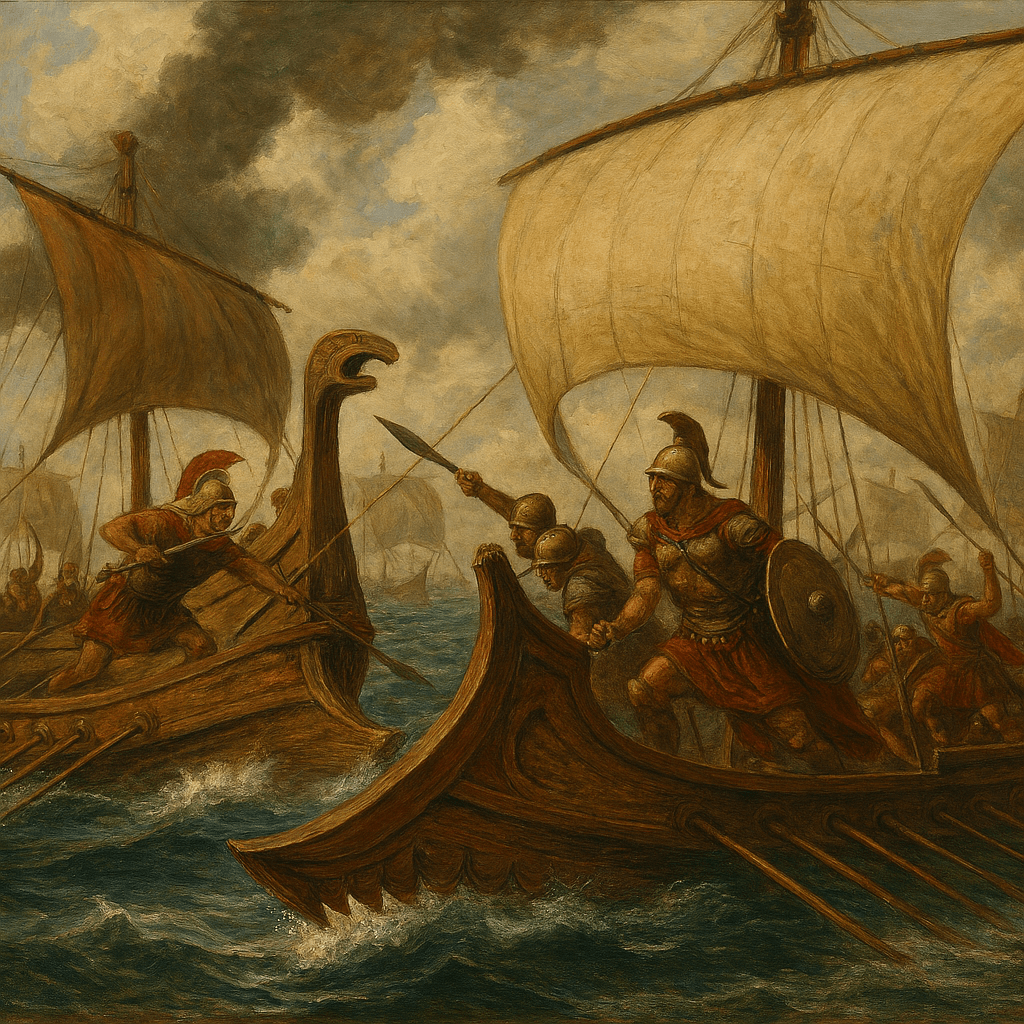
Source: A War Like No Other by Victor Davis Hanson, 2005. History of the Peloponnesian War by Thucydides, Translated by Richard Crawley, 2021. Graphic: Syracuse vs Athens Naval Battle. CoPilot.

The Last Queen

Cleopatra VII, descendant of Alexander the Great’s general Ptolemy Soter, inheriting the Egyptian Empire upon Alexander’s death, was the last pharaoh or queen of Egypt. Upon her death in 30 B.C., less than two weeks after the death of her lover, Mark Antony, she took her own life, likely with a fast-acting poison rather than the bite of an asp. This cleared the way for Augustus, the founder of the Roman Empire, to incorporate Egypt into the Roman realm.

In Cleopatra: A Life, Stacy Schiff weaves an engrossing tale of the queen’s ruthless ambition to restore the Egyptian Empire to its former glory. Though Cleopatra’s life lasted less than 40 years, she brought Rome into her world, achieving greatness that ultimately led to her downfall.

Cleopatra wanted greatness and found the means to attain it. Schiff states in her book that “Cleopatra appears to have had sex with only two men. They happen, however, to have been Julius Caesar and Mark Antony, among the most prominent Romans of the day. …Cleopatra had a child with Caesar and after his murder — three more with his protégé…The two [Cleopatra and Anthony] would together attempt to forge a new empire, in an alliance that spelled their ends.

Source: Cleopatra: A Life by Stacy Shiff, 2010.

The Last Stoic

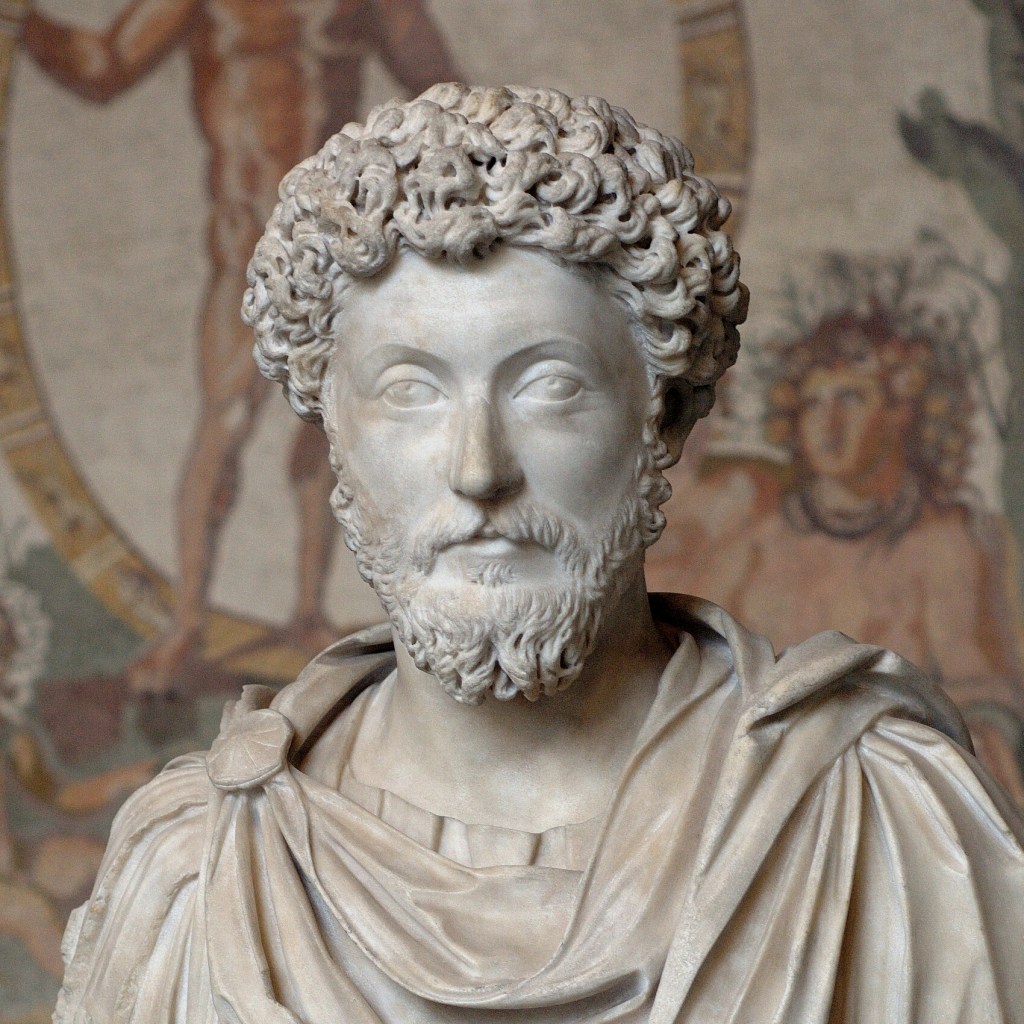
Marcus Aurelius Antoninus, Roman Emperor, soldier, stoic philosopher, stated in Book I of his Meditations that Plutarch’s nephew, Sextus taught him: “…life according to Nature, Dignity without pretense, solicitous consideration for friends, tolerance of amateurs and of those whose opinions have no ground in science.”

Marcus Aurelius, along with Alexander the Great are two rulers who came closest to Plato’s concept of a Philosopher-King. Plato believed that to rule justly and wisely required a thorough foundation in philosophical principles coupled with the skill to serve for the benefit of the state and the ruled rather than for personal gain.

Source: Meditations by Marcus Aurelius. Graphic: Bust of Aurelius extracted from Glyptothek Munich. Public Domain.

Alexander the Great

There is nothing impossible to him who will try.’ Alexander is believed to have said this during his siege of a fortress, possibly at Tyre or Gaza, both occurring in 332 BC.

A more direct translation from the original Greek changes the above quote to ‘For the courageous, nothing is unattainable.’ The first quote emphases determination while the more accurate second translation stresses courage.

The saying has been passed down through the ages but the exact where, when, and even if he said this has been lost to the winds of time.

Tyre was an island fortress about 0.6 miles off the Mediterranean coast in southern Lebanon. Alexander at the time lacked a navy to attack the fortress so he built a 3200’ long by 200’ wide causeway from the shore to the island which is still in existence to this day. After 4 months the land siege proved ineffective, causing Alexander to put together a navy. The combined naval and land siege allowed Alexander to capture the city.

During the siege of Gaza, shortly after Alexander’s victory over Tyre, the Macedonian army captured the city on their 4th assault of the city’s walls using the machines that were built to breach the walls of Tyre. Repercussions for the cities refusal to surrender were catastrophic with Alexander slaughtering all males and selling the women and children into slavery.

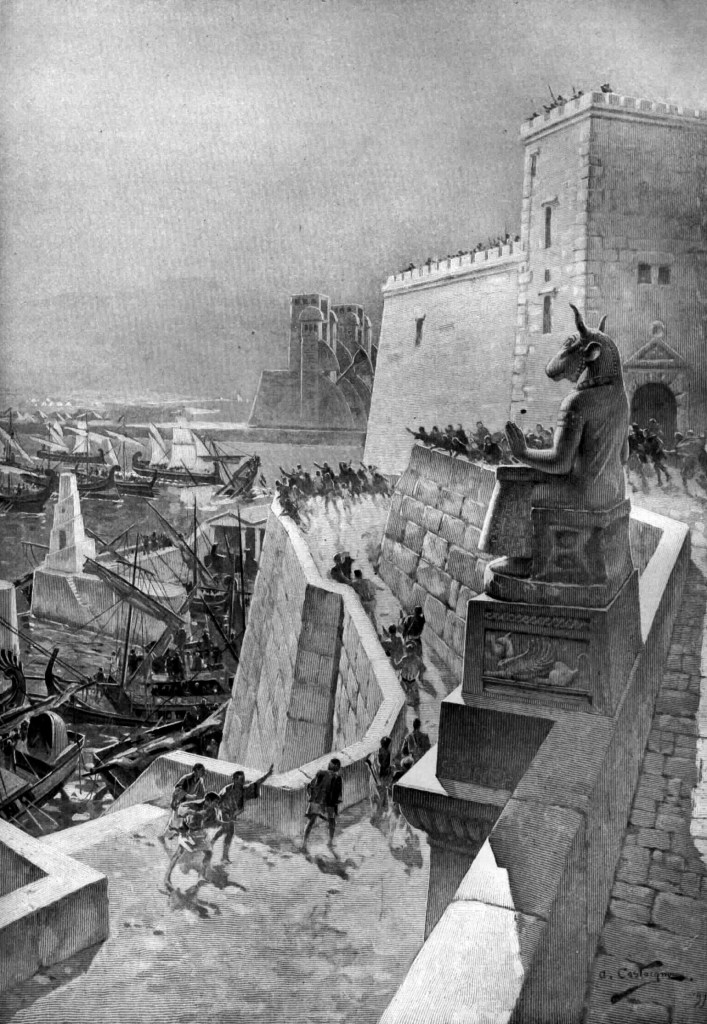
Source: Siege of Tyre by Uggerud, 2024, The Collector. Siege of Gaza by Hansley, Greece High Definition. Courage of Alexander, Memoria Press. Alexander the Great.org. Graphic: The Great Siege of Tyre by Andre Castaigne, 1898-99, Public Domain

A Little Package of our Past

World History: 50 Key Milestones You Really Need to Know B 50 History

Written by:  Ian Crofton

Published by:  Quercus

Copyright:  © 2011

Attempting to describe 12-15,000 years, since the big ice fields melted, of human endeavors in 200 pages and 50 topics would seem presumptuous and futile, and you would be right, but one has to start somewhere and the first steps can and should be small but decisive.  One can quibble about the exact 50 topics, and I will do just that in a bit, but the author, Ian Crofton, performs the task with aplomb, and provides the maximum amount of useful information possible given the limiting format.

This book is a quick and fun read for both those without a broad or deep introduction to human history or those that just want to refresh their memory on once familiar, but long forgotten topics. Even if you are familiar with all the topics in the book there will be a sufficient amount of new informational tidbits to make it worth your time. For myself, as one example, I found the observation that our ancestral hunter-gather cousins versus the first cereal grain farmers, were healthier, due mainly to their higher protein intake from a meat rich diet, was new and interesting.

Each “idea” or event is developed, chronologically, over 4 printed pages that includes a short thesis, an expansion of that thesis, a timeline of notable events, a famous quote(s) and an ending synopsis of the discussion.  The publisher of this book, Quercus, has published at least 27 other books of a similar nature and format that explore the great topics of the human experience including: architecture, art, astronomy, big ideas, biology, chemistry, the digital world, earth, economics, ethics, the future, genetics, the human brain, literature, management, math, philosophy, philosophy of science, physics, politics, psychology, quantum physics, religion, science, universe, war, and world history. I believe they continue to add more topics as the years go by.  I have several of the topics, listed above on my already too fat reading list.

Not to detract from the topics that the author has chosen, his are all defendable, but for myself I probably would have included 5 different topics devoted to: the Iron Age, Israelites of the 12th century BC, 1st century Christianity, Sumerians development of an alphabet in 300 BC coupled with Guttenberg’s first printing press in the 15th century AD, 18th century BC Babylonian Hammurabi’s, and 7th century BC Greek Draco’s legal codifications, and finally the advent of computers in the 20th century and beyond.  Adding 5 topics requires that 5 be removed. I would likely leave out: Empires and Kingdoms of Africa, The Bubonic Plague, the Vietnam War, integral to the late 20th century US, but will likely be a footnote on communism in the future, and lastly, the Arab-Israeli conflict and the post 9-11 topics, at a minimum, combined into a topic on 21st century divisions in civilization and culture, as if that were something new. On further thought, maybe just leave those last two topics out completely, mainly because they are too fresh to decide their seminality to our future development as a species.

That leaves our list one shy of 50. What topic(s) would you add?