Awards: — Nominated Hollywood Critics Association Midseason Awards
Directed by: Christopher McQuarrie
Written by: Christopher McQuarrie and Erik Jendresen
Music by: Lorne Balfe
Cast: Tom Cruise, Ving Rhames, Simon Pegg
Film Locations: England — Italy — Norway — UAE
Budget: $291 million
Worldwide Box Office: $567.5 million
AI is aware. Cruise is there. An artificial intelligence called the ‘Entity’ is learning and moving for ultimate control, but it is afraid. All the branches of the Entity’s probability tree lead to success except the ones sprouting Ethan Hunt.
This is the seventh ‘Mission: Impossible’ franchise movie with the eighth, Mission: Impossible — Dead Reckoning Part Two set for release in June of 2024.
I’m going to depart from my usual thoroughly researched and long-winded reviews and say with absolute conviction–watch this movie and leave it at that. It’s the best action movie since Blade Runner 2049 (Harrison Ford should have quit when he was ahead) in 2017. Every piece in this flick is solid; directing, acting, writing, camera, and music. There was one hole in the plot, but I will leave it to you to find. Also, early in the film there appeared to be a glitch in the CGI rendering involving Cruise’s chin, but I will have to watch it again to see if it was real or just my imagination.
One last thing. There is a major train scene in the movie using a steam locomotive which intrigued me due to their extreme scarcity in world today. So, I checked it out. The steam locomotive used in the movie was a specially built replica, three were built, of a Class 52 locomotive, a type of German steam engine that operated from 1942 to 1962. The replicas were constructed by The Steam Workshop in the UK, and then transported to Norway for filming.
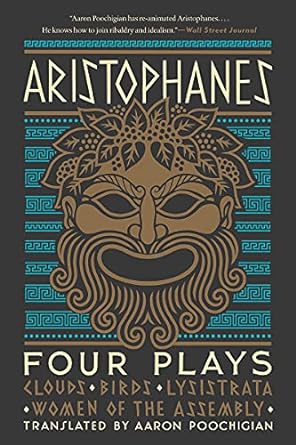
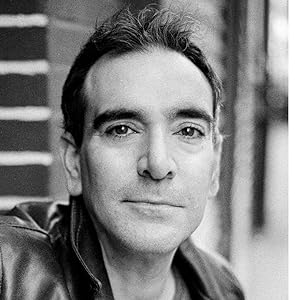
Aaron Poochigian earned a PhD in Classics from the University of Minnesota and an MFA in Poetry from Columbia University. He has authored four books of poetry and translated seven books from Greek and French. He won the Muse Book Award for his book of poetry, Manhattanite and the Richard Wilbur Award for another book of poetry, American Divine. He currently lives and writes in New York City.
In an interview with Heide Sander in 2021 she asked Poochigian to share a story about what first drew him poetry. His answer, to me anyway, was unexpected to say the least, “I had a religious experience when I was 18. Sitting outside an ivy-covered old brick building on the quad of my campus, I was looking at the opening lines of an epic poem in Latin, the Aeneid: ‘Arma virumque cano Troiae qui primus ab oris. . .‘ Though I did not yet know the language, the sky became brighter, and I could feel my synapses lighting up, and it became clear to me that I was supposed to spend my life writing poetry. For better or worse, for richer and poorer, that’s what I have done.”
I find this fascinating. What strain of curiosity exists for someone to read lines of poetry, or any text for that matter, in a language one doesn’t understand. Truly beguiling or maybe closer to the point, mystifying but I’m not a poet so I’m likely missing something important.
For those that are curious, The Aeneid an epic poem written in Latin by Virgil between 29-19 BC, describes the adventures of Aeneas, a Trojan who fled Troy after it fell to the Greeks and who subsequently made his way to Italy, becoming the ancestor of all Romans. The above quoted Latin phrase in bold type is a small snippet from the opening line of the Aeneid which the entire line in English reads as follows: “I sing of arms and the man who first from the shores of Troy came to Italy and Lavinian shores, exiled by fate, that man who was tossed much both on lands and on the deep by the power of the gods because of the mindful anger of savage Juno; also he suffered many things in war until he could found a city and bring his gods to Latium, whence the Latin race and the Alban fathers and the walls of high Rome” .
Poochigian, in his introduction, feels the need to point out that slavery existed during the Golden Age of Athens, as if it ever went away. He states: “…would do well to acknowledge that the entire edifice of the glorious civilization that was fifth century Athens including its rich tradition of theatrical performance, was built on a foundation of forced, uncompensated labor. Athenians themselves may have been willfully blind to the injustice of reserving democratic self-determination for themselves and relegating their defeated enemies to abject servitude, but it is impossible for us now to ignore it.”
The “built on a foundation” and “willfully blind” are very bold assumptions whose conclusive inerrancy would improve with a smidgen of support from the historical record. Also, to translate the works of a free Athenian citizen, whose works were supposedly built on the backs of slaves, then hold out your hand for payment does seem a bit much. One may wish to consider how the future humans will look upon present-day west coast cities in the U.S. Will their view of us be judged by the abhorrent spectacle of unending tent cities and homelessness, unchecked crime, filth in the streets, untreated mental illness, rampant drug use and addiction? Should the future disparage our attempts to uplift the human condition of some because we failed to uplift all? If we cannot accept the civilizational accomplishments from 2800 years ago because slavery existed then, as it does today, do we expect the future to treat us differently?
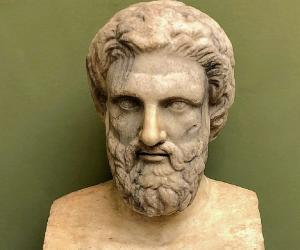
Aristophanes — Wikipedia
Aristophanes Biography:
Aristophanes, Greek playwright, born circa 448-6 and died circa 386-5 grew up in Athens during the Age of Pericles, 461-429 BC. His early adult years on into middle age occurred during the declining period of the Athenian Golden Age due to the mounting strategic failures and monetary costs of the city-state’s losing gambles in the Peloponnesian War from 431-404 BC.
It is unknown whether Aristophanes fought in the war, but it is believed he did due to the Athenian compulsory draft of all eligible citizens during the Peloponnesian War. Then again, if he did serve in the military, it didn’t appear to impede his prodigious writing output.
Aristophanes, known as the ‘Father of Comedy’, produced thirty-six to forty plays, maybe more, of which only eleven exist in completed form while another eleven are found in fragments. He is the only writer of Greek ‘Old Comedy’ whose plays still survive.
He submitted his first play, The Banqueters to the festival in Dionysia in 427 BC, receiving second prize out of the three that were accepted for live performance. His plays went on to garner eleven prizes at Dionysia and Lenaea even managing the exceptional feat of winning first and second prize at Lenaea in 422 BC for his plays The Preview and The Wasps respectively.
Aristophanes plays, at least the eleven surviving ones, are all stylistic examples of what is now called ‘Old Comedy’, the initial form of Greek theater comedy. Old Comedy was characterized by the merciless skewering of public figures while entertaining the audience with beautiful lyrical songs, dance, ribald and licentious speech, and absurd plots. Aristophanes plots began sane and logically, centered around an imaginative hero, progressing to a preposterous but victorious heroic conclusion such as in The Birds where a middle-aged burnout from Athens, searching the wilderness for peace, stumbles into a ruling role of the bird kingdom which in the end supplants the Greek gods for supremacy.
Greek Competitive Theater:
Ancient Greeks invented theater with Greek tragedy first appearing in the late sixth century BC. It is believed that Greek theater began as songs and dances, known as the dithyramb, honoring Dionysus or Bacchus, the Greek god of all that was fun: wine, fertility, festivity, insanity, and theater. The songs and dances celebrating fertility evolved into rites of spring with theatrical plays becoming central to the festivities. The Dionysia as the festival became known was the second most important Greek celebration after the Panathenaic, the quadrennial Athenian athletic games.
The theatric festival was eventually held as a competition where three tragic poets or playwrights wrote and produced three tragedies on a common theme. Additionally, the poets were also required to produce a satyr play, a heroic tragedy with cheerful atmospherics and rural backgrounds. An award, initially believed to have been a goat, fortunately becoming a wreath of ivy and/or a bronze tripod cauldron, was given to the best tragic poet. The term “tragedy” comes from the Greek word ‘tragoidia’, which translates to ‘goat song’. From 449 BC onward the best actors, known as protagonists, were also given prizes.
Comedy was introduced at Dionysia in 486 BC with five poets initially competing for the prize. In 440 BC a minor festival to Dionysus was established in January at Lenaea where initially, only comedy was staged. Tragedy was added at Lenaea in 432 BC. Five comedies were presented yearly at Lenaea except during the Peloponnesian War when only three plays were staged. Four tragedies were presented at this winter festival but were composed by only two poets.
Aristophanes’ Theater Awards for Comedy:
Second prize at the Dionysia in 427 BC for The Banqueters (now lost)
First prize at Dionysia in 426 BC for The Babylonians (only fragments remain)
First prize at the Lenaea in 425 BC for The Acharnians
First prize at Lenaea in 424 BC for The Knights
Third (last) prize at Dionysia in 423 BC for The Clouds (first edition now lost)
First prize at the Lenaea in 422 BC for The Preview (now lost)
Second prize at the Lenaea in 422 BC for TheWasps
Second prize at the Dionysia in 421BC for Peace
Second prize at the Dionysia in 414 BC for The Birds
First prize at the Lenaea in 411 BC for Lysistrata
First prize at the Lenaea in 405 BC for The Frogs
Aristophanes — Four Plays Plot Summaries and Commentary:
Clouds is a tale detailing the importance of an education and the resulting moral rot that accompanies it. A spendthrift and unappreciative son Pheidippides is driving his father, Strepsiades, into bankruptcy. Strepsiades counts on the wrong argument, taught by sophists at the Thinkery school with Socrates as the headmaster, to win him a reprieve from his debts.
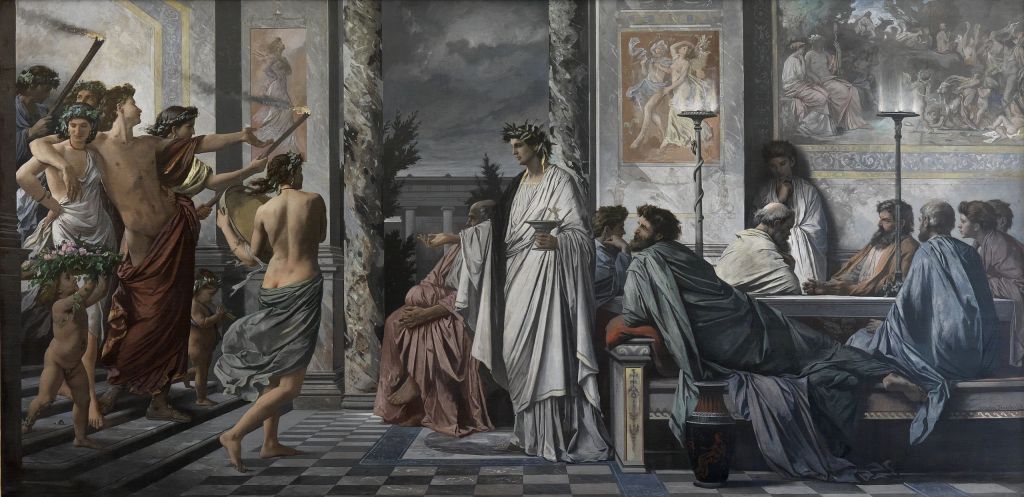
Symposium by Feuerbach — First version — 1869 — Socrates is in the right center facing the wall.
Sophists, in the original Greek meaning were sages or experts imparting wisdom and learning. During the Golden Age of Athens in fifth century BC, professional educators roamed the Greek empire teaching for a fee on a wide range of subjects from rhetoric, poetry, music, philosophy, and mathematics. Rhetoric or the art of apprising and persuasion was the preeminent study for the litigious Athenians. When discussing sophists, one would be remiss not to mention that Aristophanes had numerous students under his care throughout his career as a playwright, which one can assume were not instructed for free, whereas Socrates taught and lectured for free.
The Clouds that took third (last) at Dionysia in 423 BC is now lost. The one that reaches us here in the 21st century is a revised version of the play from 418 BC, which Aristophanes, it is believed, never presented to the public.
In Plato’s Apology the author claims this play was a contributing factor in the conviction and execution of Socrates for the specious crime of corrupting Athen’s youth.
Birds, taking second prize at Dionysia in 414 BC, attempts to find utopia outside of the struggles of Athens. The plot begins with a worn-out Athenian, Pisthetaerus, wandering in the wilderness with his fellow traveler, Euelpides, looking for Tereus the Hoopoe, supreme leader of the birds. Upon finding Tereus, Pisthetaerus hatches a great idea to establish a city in the sky, Cloudcuckooland and reclaim the birds’ standing as the first among gods.
Many have tried to find allegorical meaning in the play, but sometimes a fairy-tale is just that, a fairy-tale, a fantasy that entertains without it being weighed down with heavy philosophical and political interpretations.
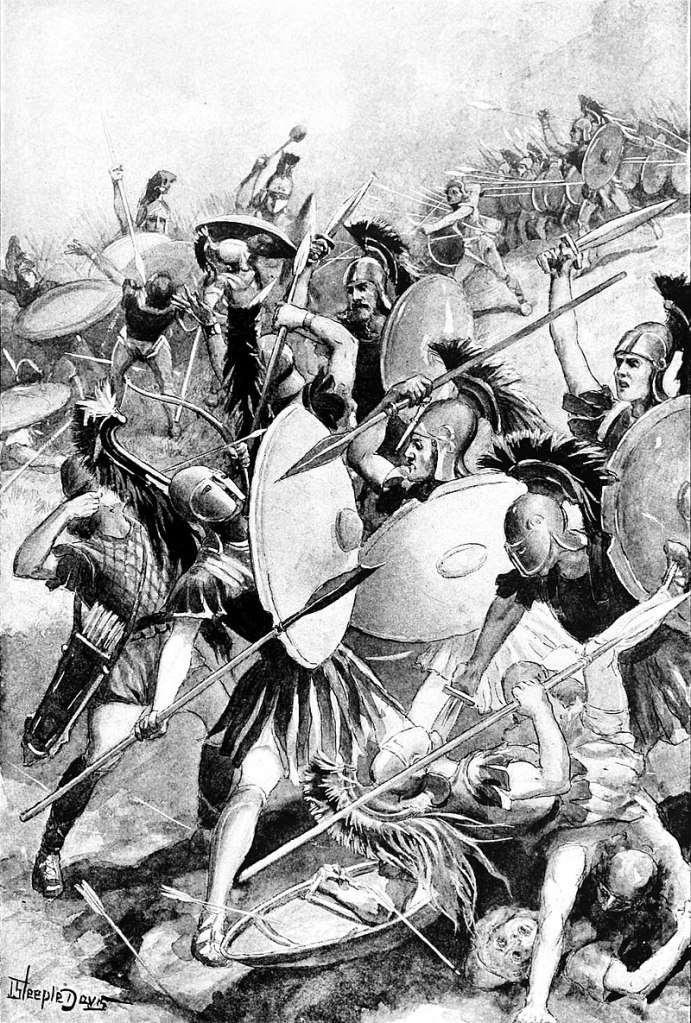
Destruction of Athenian army at Syracuse — Davis 1900 — Wikipedia
Lysistrata, taking first prize at Lenaea in 411 BC, has Aristophanes bringing the matriarchy to the forefront of Greek society were the Athenian wives, brides, and lovers of war-locked men attempt to end the Peloponnesian War. Lysistrata and the other women of Athens hatch a plan to deny sex to the men until they end the war thus denying themselves, their one and only desire in life.
By 411 BC Athens was losing badly in the Peloponnesian War through the treachery of Alcibiades, the incompetence of military commanders in Sicily and elsewhere, and the political blunders emanating from Athens. Having lost most of their navy in 413 BC, Athens was slowing and mercilessly succumbing to Sparta and its ally, Persia, with their tightening noose around Athens’ perimeter choking off their much-needed trade and silver resources to continue the war.
The play has feminist overtones, but it is unabashedly an enactment of societal male domination designed to protect women from their baser and irrational instincts. While the play is a creed to the ethos of patriarchy, it subtly informs the Athenians that all is lost, and it was time to make peace with Sparta.
Women of the Assembly goes by more names than the devil: Assemblywomen, Congresswomen, A Parliament of Women, Women at the Assembly, Women of Ecclesia, Women in Parliament, Women in Power, and possibly others. Ecclesia, along with the plethora of previously listed names, in ancient Greece was the assembly of citizens of the city-state which included all male citizens 18 years and older. In Aristophanes time the Ecclesia was summoned by the ruling Boule of four hundred, a Greek council or senate. The assemblies were charged with debating and voting on matters presented to them by the council.
The play, presented in 391 BC, is one of Aristophanes’ weaker and rightly, less appreciative efforts, garnering no awards at Dionysia or Lenaea. The women of Athens take over the Ecclesia, dressed as men and force a communistic system of sexual equity for all, the ugly and the beautiful, and a ban on the rich. Equality of outcomes, of one ring, to rule them all.
The play on the surface is an exploration of feminist power in government whereas it is truly a rebuke of effeminate men in the halls of government. Aristophanes believed in a binary world. If men and women were interchangeable and indistinguishable then madness and sadness is everyone’s just reward.
Literary Criticism:
German poet Henrich Heine said: “There is a God, and his name is Aristophanes.” Once a god is conceded all negatives melt away. I will concede the obvious–the negatives are not only trivial but possibly non-existent.
Aristophanes plays were filled not only with comedy but with fantasy and fetish, irrationalism, satire, ribald commentary, and vulgar ridicule of Athenian society. Aristophanes respected no sacred cows, skewering everyone and everything with impunity, an unrestrained destruction, fairly or unfairly, imparting a message to all comers that they were mostly fools. Open season was declared on poetry, religion, philosophy, and politics as were the famous and infamous of society such as Socrates, Cleon, fellow poet Euripides, and when he ran out of the famous, he turned his sharp swords of locution on the Athenian people. He truly was a god of Greek poetry, comedy, and theater.
Aristophanes surfeit use of vulgarity, phallic imaging, and sexual inuendo comes across as juvenile upon reading his plays but then these plays are for presentation at festivals honoring Bacchus, the Greek god of wine. It may not be unrealistic to assume that his audience, at a minimum, is slightly inebriated, in which case Aristophanes isn’t being crude but deliberately playing to his audience’s relaxed mental state.
Poochigian believes in magic. The magic of poetry, stating in 2021, “Poetry is a magic circle of sound and image in which anything can happen. Yes, poetry means magic to me, and I see the poet as a magician who, with his/her incantations, creates special spaces outside of prose and everyday life.” He is an able translator of Aristophanes plays bringing his Greek poetry into realm of the vernacular of almost blue-collar English but managing to leave the magic behind in the agoras and councils of the Athens.
Poochigian’s translation of Tereus’, king of the birds, great speech summoning his subjects is typical, “…come here, all you endowed with wings, all you who flutter over acres of fertile land, you myriad throngs who feed on grain, you swift seed-pickers who warble such delightful songs. Come all that over furrowed ground twitter, molto espressivo, this pleasant sound–tio, tio, tio, tio, tio, tio, tio, tio...” Where is the beauty, the magic in this translation? This is prose of the common man. It is amusing though that the Italian term, molto espressivo, meaning very expressive, is used to translate the Greek to English.
An anonymous translator from the early 20th century gives us Epops summoning his subjects, “…here, here, quick, quick, quick, my comrades in the air: all you who pillage the fertile farming lands, the numberless tribes who gather and devour the barley seeds, the swift flying race that sings so sweetly. And you whose gentle twitter resounds through the fields with the little cry of tiotiotiotiotiotiotiotio…” This is poetry. This is magic.
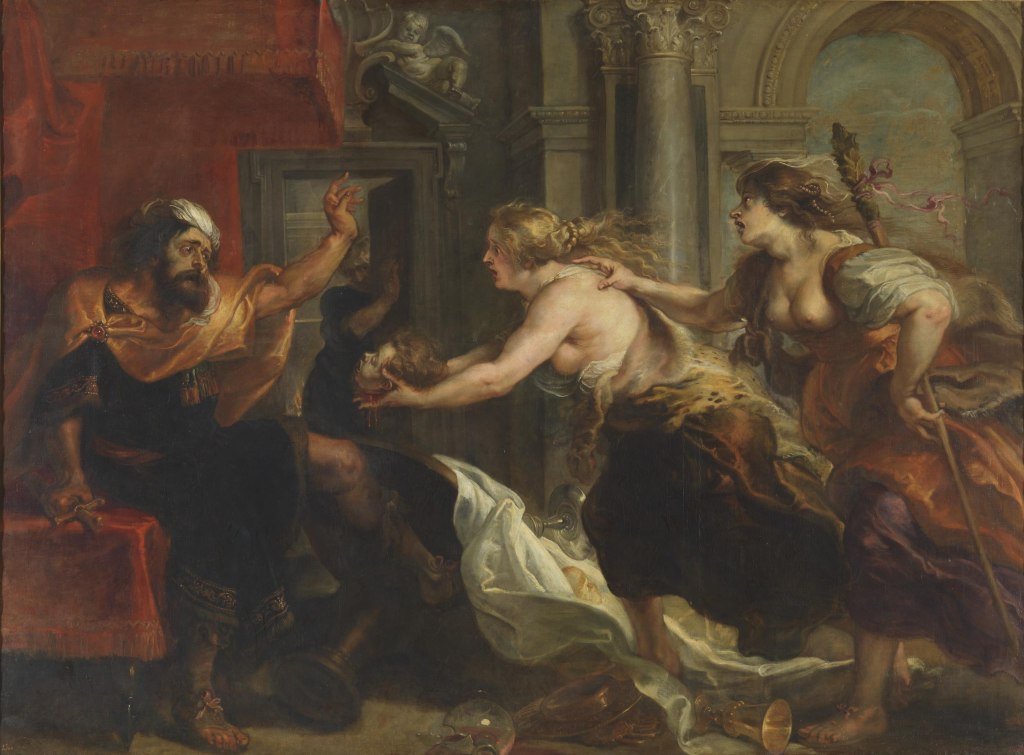
Tereus Confronted with the Head of his Son Itys — Rubens — 1636-38
Epops, in Latin and Greek, is a hoopoe. A bird with a long beak and a crest of feathers. Why the anonymous translator called Tereus Epops is unknown. The name of the king of birds in Aristophanes play is the hoopoe Tereus. Tereus is a character from Greek mythology who was the king of Thrace and the son of Ares, the god of war, and Bistonis, a water nymph. He married Procne, the daughter of Pandion, the king of Athens. However, he also raped and mutilated his sister-in-law Philomela, who was Procne’s sister. As a result, Procne and Philomela took revenge on Tereus by killing his son Itys and serving him as a meal to Tereus. When Tereus discovered the truth, he tried to kill them, but the gods intervened and turned them all into birds. Tereus became a hoopoe. Procne became a nightingale with a beautiful song. Philomela became a swallow who could not sing.
Aristophanes’ Surviving Complete Plays Bibliography:
What should you pay for a bottle of wine? Quality, vintage, geographic region, and reputation of the vineyard all influence pricing. Every producer price their wines as high as they believe the market will bear and frequently higher, the same as every other type of business in the world.
Fortunately for the wine drinkers there are about 65,000 wineries in the world producing around thirty-five billion bottles yearly translating into a whole lot of competition to help keep some good wines affordable.
Pricing deals first and foremost with the quality of the wine. Is it any good? Are the components of the wine in balance with each other or do the tannins override the acidity and alcohol? Are the flavors and aromas intense, strong, and bold or weak and faint? Are the flavors and aromas clear and focused or imprecise and expressionless? How complex is wine? Are there multiple layers and nuances? Does the wine exhibit typicity? A great wine will proudly announce its sense of place or its terroir. (Terroir is easier to define for old world wines than it is for new world products.) How’s the finish? Does the taste linger in your mouth after your swallow? An exceptional wine will have a lasting finish.
These six factors are used to gauge the quality of the wine and if you wish to go there, its rating. As I discussed in a previous post, a wine’s rating is a subjective affair. Some find it unnecessary. I find it essential. I find it crucial to know a wine’s rating if I’m going to choose a good wine at a fair price. Without ratings get used to drinking bad wines. There are a few different rating systems: a 100-point scale, a 20-point scale, a 5-point scale, a verbal scale, and others. I use the 100-point scale developed by Robert Parker, but I find myself using Vivino’s 5-point or 5-star system more lately. Most wines go unrated. Wines that are rated professionally usually only have one individual rating, and if you’re lucky sometimes up to five or six which you can average for a more realistic score. Wine’s rated by Vivino’s system have tens to hundreds of individual ratings which tend to smooth out the anomalous, spurious ratings inherent to all rating systems.
Secondly, the vintage of the wine has a significant impact on the price of wine. Some high-quality wines such as Bordeaux and cabernet sauvignon can last for one or two decades, even longer if stored properly. 5-10 years after a wine’s harvest date a bottle can appreciate 200-400% from its original selling price or more but be aware that most wines, red and white alike, do not age well and you may end up paying significant money for a bottle of vinegar.
Other factors such as geographic location and vineyard reputation are fluff to what you really care about, a good tasting wine. Chateau Lafite Rothschild or Sine Qua Non produce some great wines but they are way beyond the means of people without mid-six figure incomes.
Apologies for the long intro to the question: what should you pay for a bottle of wine or for purposes of this post, what should you pay for a bottle of outstanding to exceptional, 90–100-point, red wine? I started with 90-point because it is difficult to find professionally rated wines in the public domain lower than that number. The discussion is also limited to reds because I know almost nothing about white or rose wines.
To begin to answer the above question I gathered pricing, vintage, and rating data for almost sixteen hundred different red wines rated at or above 90-points. The wines are sourced from thirteen countries and every continent, except Antartica of course, with the results skewed towards the nine large producing areas listed below:
Argentina
Australia
Chile
France
Italy
Portugal
South Africa
Spain
U.S.
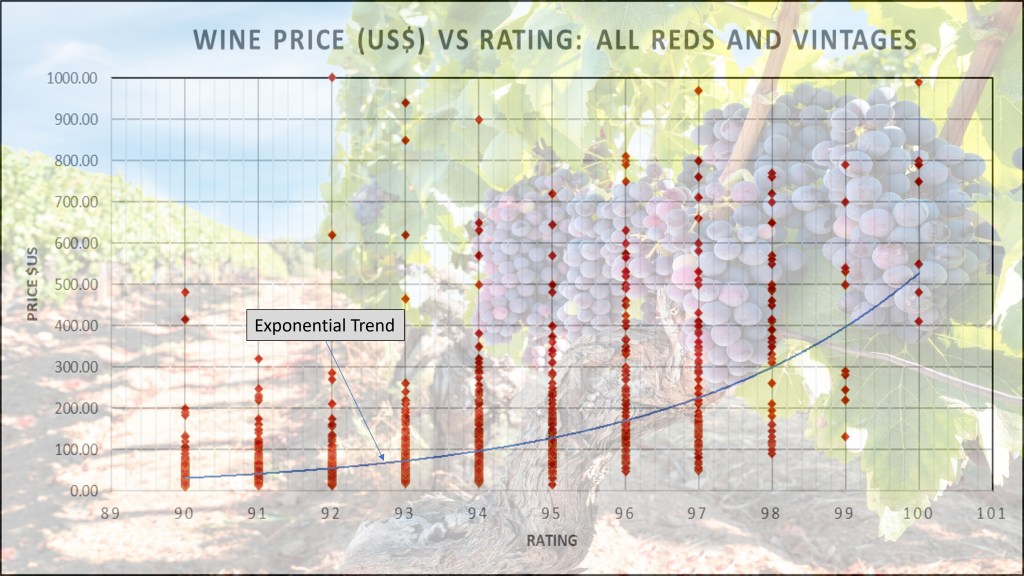
The data were sorted into individual bins by rating and plotted in graphical form as shown above right. The y-axis scale is in dollars and the x-axis is the rating. The y-axis is terminated at $1000 for ease of visualization but there are a handful of wines more expensive than this. The sixteen hundred wines have vintages from 1984-2022. There are very few 2023 reds currently on the market, so they have been excluded. Even though there is a significant amount of scatter in the pricing versus individual rating there is discernable increasing trend in price by higher rating. The trend line shown in blue increasing exponentially from left to right, intersects a 90-point red around $30 and the 100-point at $500 plus.
Below is a chart of the data highlighting the calculated mean (average), median (middle value), and mode (most frequent) wine prices by rating for all red wines and vintages in the data set. The median values are the most useful for comparison shopping purposes and I would suggest that this should be the highest price or ceiling one should pay for any given rated wine. Anything above that and you are just purchasing the shiny coat of paint that adds nothing to the quality of wine. When buying wine by rating the lowest price is the most economically sensical purchase to make. I will expand on that piece of advice below.
The three charts below are the same format as the one above but confined to bracketed vintages from 1984-2014, 2015-18, and 2019-2022. As one would expect and as stated earlier, aged or older wines are more expensive than their more recent counterparts.
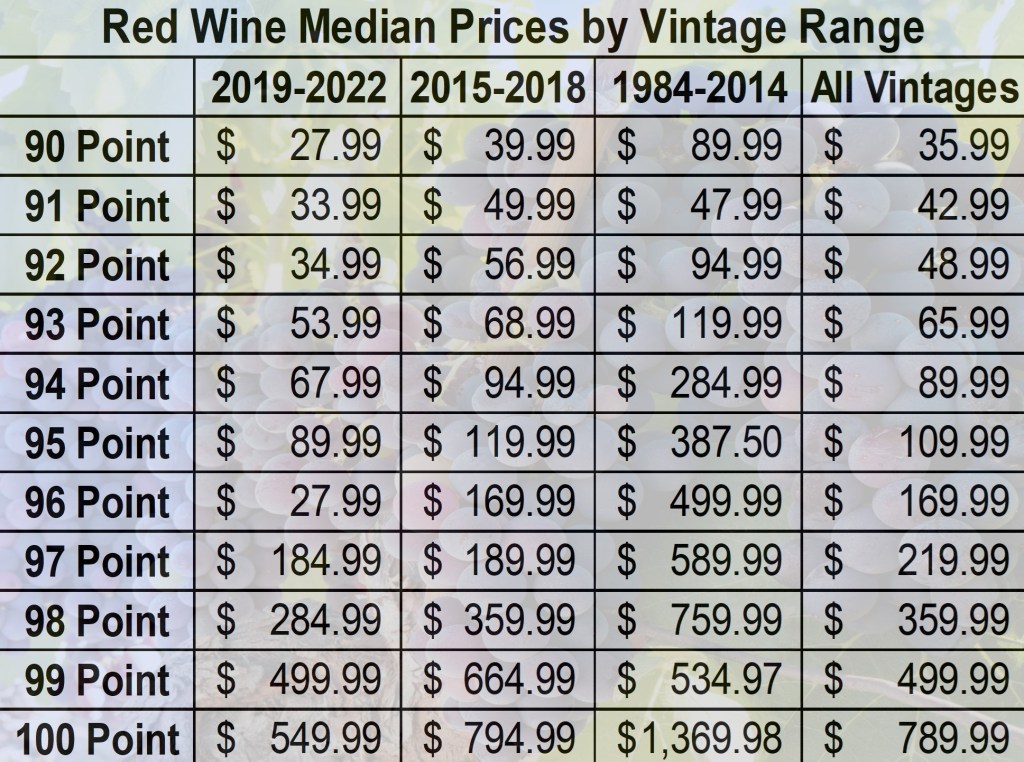
The chart to the left summarizes the median price for the ratings and vintages shown above. Wines increase in price by rating and vintage. Recent wines with a lower rating are cheaper than older wines with higher ratings. Hopefully by taking rating and vintage into account a complicated foray into wine buying will become simple and easily actionable. Keep in mind that the median price should be the highest price paid for any rating and vintage.
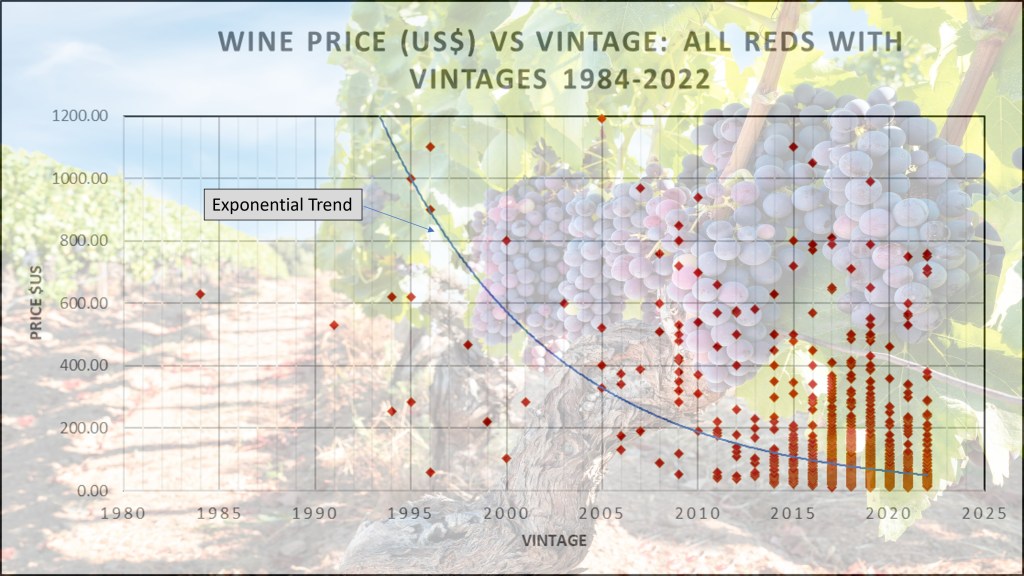
The graph below shows wine prices by vintage. Price is on the y-axis and vintage is on the x-axis. Again, the y-axis is terminated at a lower price than the actual range just to keep visual aspects of the graph manageable. Like ratings the fitted curve trend to price versus vintage is exponential. Older wines cost more, a lot more than recent wines regardless of rating.
In a true to grifter life tale, The Billionaire’s Vinegar: The Mystery of the Worlds’s Most Expensive Bottle of Wine, by Benjamin Wallace details how expensive an old wine can get. Wallace describes how Hardy Rodenstock, allegedly discovered in France a stash of unopened 1787 Chateau Lafite Bordeaux supposedly purchased by Thomas Jefferson while living in Paris after the American Revolution. Rodenstock auctioned a bottle, at Christies, for the tidy sum of $156,000, or $157,000 depending on source, in 1985 to Malcomb Forbes via his son Christopher. In 2023 dollars that would come to $433,740. Rodenstock sold four more bottles to Bill Koch for $400,000 in 1987 or $1,074,378 in 2023 dollars. Old wines can be expensive, and the FBI says they were not only expensive they were also fake. I believe the Feds are still looking for Mr. Rodenstock.
Where do the least and most expensive wines come from? The charts below lists 9 of 11 top wine producing countries in the world and the median price of their wines, as they are priced in the U.S. The yellow highlight is the sorted column. China and Germany are number five and ten in wine production respectively, but little price and rating information is available for comparison purposes, as such they are omitted. Argentina ranks first with the most affordable wines across all outstanding to exceptional rankings. The U.S., mainly California, has the dubious distinction of having the most expensive wines across the 90-100-point ranking scale.
Finally, how much should you spend on a bottle or wine? The best way that I know how to answer that question is to describe my wine buying strategy which, incidentally, may not be the best way to buy wine.
The short description of that strategy is that I like drinking red wine, but I really hate paying a lot for the privilege. To expand on that, first start with the ratings. Without the ratings you are buying blind. Most wines are unrated. If they are rated, they usually will only have one rating in which case you need to have a good feel for how the rater’s judgement fits in with your tastes in wine. Robert Parker is my personal choice. His ratings closely match my own. If he hasn’t rated a bottle of wine, I give it a pass. In the ten years or so that I have been depending on his ratings he has only let me down twice. Both times I felt his ratings were too high, which brings up a useful caution. When you run across a highly rated wine that is less expensive than normal there is a good chance that the rating should be lower than stated rather than you are getting a great deal on a great wine. The second part of purchasing wine is to recognize that for any given varietal whether a cab, a merlot, or whatever, a similar rating should provide similar tastes and aromas for that varietal regardless of where it came from or who produced it. I get a lot of grief for this statement but I’m sticking with it. If you accept this premise, then it really makes sense to buy the least expensive wine available for any given rating. In 2023 that means you will be drinking wine from Argentina, Chile, and Spain. A few years ago, Portugal produced some great inexpensive wines but that has changed dramatically since 2021. U.S. wines, California wines in particular, are good, exceptionally good even but overpriced. No bang for the buck in Napa.
Using this strategy, I consistently buy 90-91-point, occasionally 92–93-point wines ranging in price from $9-17 per bottle. 94-point and higher rated wines are generally beyond what I’m willing to pay. Cheers.
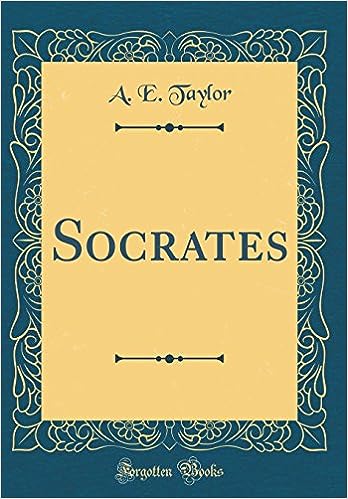
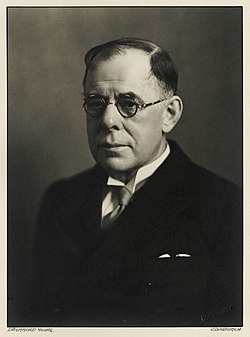
Alfred Edward Taylor was born in Oundle, England in 1869, and died in Edinburgh, Scotland in 1945. He was a professor, a Greek classicist, and a philosopher of metaphysics and ethics. He spent his adult life at the ancient Scottish Universities of St. Andrews and Edinburgh researching and teaching the spiritual; the immortal basis for morality and the philosophy of Plato. Plato was a student of Socrates and as such he was a concern to and within the orbit of Taylor.
Socrates’, leaving no written record, entire philosophical corpus and biography have reached us today primarily through the writings of two near contemporary Greeks: Plato and Xenophon. Taylor’s contribution to our present day understanding of Socrates was to argue that Plato’s four basic texts on Socrates: Euthyphro, Apology, Crito, and Phaedo, are accurate depictions of what Socrates said and did. Xenophon, who also wrote extensively about Socrates but later, Taylor argued, is less reliable. This may seem trivial, but this point has been and still is contested due to the immense stature of Socrates as one of the founders of Western philosophy in general and ethics in particular. The basic question among philosophers is whether Plato’s writings describing Socratic philosophy are accurate or are amalgamations of Socratic and Platonic thought? Who knows? The dispute will continue till the end of days so we will leave it as Taylor says.
Taylor’s studies within the philosophy of ethics and morality centered on what is right and good, whether the two were complementary and/or achievable. Taylor argued right and good or the moral practice of the individual is constrained and flawed without the aid of the supernatural: God. His thesis was that searching inward, within oneself for rebirth and betterment, for a moral compass, flows only in circles leading nowhere. To reach a higher level of morality or good requires looking outward to the spiritual through contemplation of the eternal good. Taylor argued that the will to reach for a better or eternal good is impetus for the eternal, the divine good to reach for you. Additionally, morality, Taylor surmises, plateaus in the human confines of a person’s physical life, requiring, unfortunately or fortunately depending on your perspective, death to continue the soul’s moral journey for better or worse.
Socrates:
Any biography of Socrates is going to be short. Almost all authoritative writings concerning his work, teachings, and life that have reached us in the 21st century consists of approximately two hundred written pages, in English, by Plato and about three hundred English written pages by Xenophon with the two containing significant overlap. Taylor’s biography, using Plato and Xenophon as primary sources, is no exception managing to encapsulate Socrates’ remarkable life into a quick read of 142 pages. Within these few pages concerning this most remarkable man everything has been disputed except for the Athenians putting him to death for being a royal pain in the rear, some have used the term gadfly. That is the one piece of his life that no one disagrees with. No one disputes that he was put to death in 399 BC, and it is likely that no one disputes that he was a royal pain in the posterior, a gadfly.
Socrates was born, circa 469 BC, grew up and lived in Athens until he was put to death in 399 BC at the age of seventy. He lived during the Golden Age of Athens (478-404 BC) and the overlapping Age of Pericles (461-429 BC) both now combined and known by the excessively non-descriptive non-demonym: Fifth Century Athens. (Why classical historians thought this was a useful, didactic change defies any sound, logical reasoning. Alas it was changed to avoid hurt feelings of Greeks and Athenians whose best years occurred two thousand seven hundred years ago. How you soothe pouting children should not be an instruction manual for sane adults.)
Socrates only left Athens to serve in military battles prior to and during the (second) Peloponnesian War. He was a hoplite in the Athenian army, a heavy infantry soldier outfitted with a shield, sword, and/or spear fighting in a phalanx or block-like formation. By all accounts he was a good and courageous soldier. His first recorded engagement, at the age of thirty-eight, was the battle and siege at Potidaea beginning in 432 BC. lasting until 429 BC. Potidaea was a Greek city-state, approximately 155 miles, as the crow flies, north of Athens, threatening to break free of Athenian control. This battle helped trigger the much larger and costlier Peloponnesian War beginning in 431 BC and lasting until 404 BC.
Socrates saved the life of Alcibiades, a gifted Athenian general and politician, but exceptionally duplicitous and erratic. Socrates heroic action should have garnered him the prize for valor, but Alcibiades was awarded it instead due to his higher birth and rank. A very powerful disincentive to the rank and file indeed.
Five and seven years later Socrates fought for Athens in the losing battles of Delium and Amphipolis, respectively, during the initial stages of the twenty-seven year-long Peloponnesian War. During the battle of Delium in 424 BC, Alcibiades saved Socrates’ life thus repaying Socrates’ valiant deed and cementing their life-long, but problematic, friendship.
Alcibiades recounts a story of Socrates during the engagement of Potidaea that bears on the philosopher’s power, or possibly prophetic power of thought. One morning Socrates, while contemplating an assumed perplexing problem became motionless, a state he remained in until the next morning when he said a prayer and walked away invigorated, amazing his fellow soldiers who had been watching him through the night. This story has him either being completely lost in thought, refusing to move to avoid breaking that train of thought, or as another occurrence of the ‘Sign’, voice, or daimonion that came to him, starting in his childhood and continuing throughout his adult life.
The ‘Sign’ was a voice usually described as an inner call, not to action, but to caution, a warning of future woes to come. Socrates mentioned at his trial that whenever the voice spoke to him it turned him away from something he was about to do. Some believe the ‘Sign’ was simply his subconscious speaking to him while others feel it was divine. A message from God.
To stretch a minor detail, Socrates almost never referred to the Gods, just God in the singular, a minor point yes, but a point all the same that the ‘Sign’ may have been religious vision or experience from the perspective of monotheism versus accepted Greek polytheism. At his trial he states, “It is to fulfill some function that I believe God has placed me in the city. I never cease to rouse each and every one of you, to persuade and reproach you all day long…” His ‘Sign’ did not speak to him during his trial leaving him to conclude that the sentence of death was something he should accept.
Socrates’ ‘religion’ began with his belief in the soul, and that it was immortal and unchanging. The soul existed before you were born and continued after your death. He believed the soul was your truth, your essence, your reality beyond your corporal self. He believed the soul must be looked after and kept in immaculate condition.
Socrates believed that to care for your soul required a focus on personal growth. Growth comes from the pursuit of wisdom and knowledge, the study of philosophy, to further one’s understanding of not only yourself but the world around you. The pursuit of wisdom through what became known as the Socratic method, questioning and logical reasoning started with yourself: ‘know thyself’ and expanded to include the universe beyond your own flesh. To seek wisdom and knowledge by examining your life was to seek truth. Seeking wisdom and knowledge for the sake of truth is what Socrates meant when he spoke his famous line at his trial in 399 BC, “The unexamined life is not worth living.” Without truth, life is not worth living. Without truth one risks living a lie.
Socrates examined and questioned everything and everyone. His thirst for knowledge and wisdom all flowed from his stated belief in his own ignorance, stating “as for me all I know is that I know nothing.” No one that knew Socrates believed this statement for a second. He was known as a sage, a philosopher, and shrewd one at that. His wisdom was even embraced by the Oracle of Delphi who said Socrates was the wisest person in Athens.
For Socrates, though, his statement professing to know nothing wasn’t an expression of humility or ignorance but a challenge. A challenge to question one’s beliefs and opinions concerning all things seen and unseen. Two plus two equals four, everything else is questionable. “All I know is that I know nothing” is an acknowledgement that the search for wisdom: truth, at a minimum is transitory, possibly imaginary, and thus one must never stop searching. This was not to say there were no truths available to the living, but the search could be difficult and deceptive.
Socrates’ quest for the truth manifested itself first through his rejection of fame, money, and power. The corollary of that rejection is he lived a life of poverty, neglected hygiene, and wore no shoes. No shoes whether with feet on burning stones or frosted rocks. Pain and discomfort did not seem to bother him.
Secondly his quest for the truth was through the spoken word, never written. Conversations with his fellow Athenians occurred throughout the city, the Lyceum and the Agora were his two favorite haunts where he questioned his victims, and they were victims, in his famous ‘Socratic Method’ style of inquisition. Below is a short description of Socratic torture from the–Explainer: Socrates and the Life Worth Living (link below):
Socrates engages an interlocutor who appears to possess knowledge about an idea
The interlocutor makes an attempt to define the idea in question
Socrates asks a series of questions which test and unravel the interlocutor’s definition
The interlocutor tries to reassemble their definition, but Socrates repeats step three
Both parties arrive at a state of perplexity, or aporia (ed. a philosophical puzzle), in which neither can any further define the idea in question
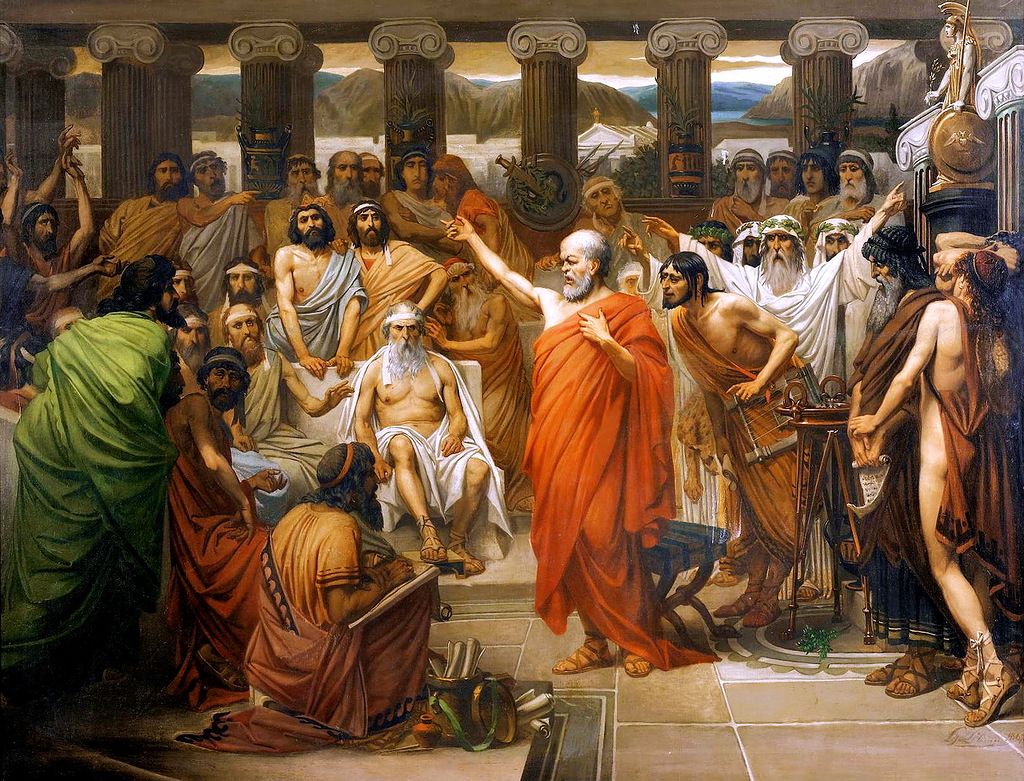
Socrates’ Address. Louis J. Lebrun. 1867
A humorous sketch illustrating his method from Plato’s ‘Euthyphro‘ picks up near the end of a discussion concerning the gods:
Euthyphro: Why you don’t suppose, Socrates, that the gods gain any advantage from what they get from us, do you?
Socrates: Well then, what would those gifts of ours to the gods be?
Euthyphro: What else than honor and praise, and, as I said before, gratitude?
Socrates: Then, Euthyphro, holiness is grateful to the gods, but not advantageous or precious to the gods?
Euthyphro: I think it is precious, above all things.
Socrates: Then again, it seems, holiness is that which is precious to the gods.
Euthyphro: Certainly.
Socrates: Then will you be surprised, since you say this, if your words do not remain fixed but walk about, and will you accuse me of being the Daedalus who makes them walk, when you are yourself much more skillful than Daedalus and make them go round in a circle? Or do you not see that our definition has come round to the point from which it started? For you remember, I suppose, that a while ago we found that holiness and what is dear to the gods were not the same, but different from each other; or do you not remember?
Socrates: Then don’t you see that now you say that what is precious to the gods is holy? And is not this what is dear to the gods?
Euthyphro: Certainly.
Socrates: Then either our agreement a while ago was wrong, or if that was right, we are wrong now.
Euthyphro: So it seems.
Socrates: Then we must begin again at the beginning and ask what holiness is. Since I shall not willingly give up until I learn. […]
Euthyphro: Some other time, Socrates. Now I am in a hurry, and it is time for me to go.
Socrates: Oh my friend, what are you doing? You go away and leave me cast down from the high hope I had that I should learn from you what is holy, and what is not, and should get rid of Meletus’s indictment by showing him
Socrates’ learnings in search of the truth have been passed down to us through Plato, Aristotle, Epicurus, Locke, and others, climaxing in Jefferson’s preamble to Western civilization’s crowning ode to self and country: the ‘Declaration of Independence‘, proclaiming the fundamental, natural rights of man: Life, Liberty and the pursuit of Happiness.
The phrase the ‘pursuit of Happiness’ has been thoroughly misconstrued to mean something foreign and vulgar to Jefferson’s original intent. The ‘pursuit of Happiness’ was not a grant to seek earthly enrichments and pleasures but a call to a higher state of being. Epicurus provided a definition of happiness that comes closest to the meaning of Jefferson, “the end of all our actions is to be free from pain and fear, and once this is obtained the tempest of the soul is quelled.” Life, Liberty, and the pursuit free from pain and fear. The ‘pursuit of Happiness’ sounds better.
Epicurus seeks a soul free of pain and fear. Socrates sought a pure soul. Both pursued it through the same means. Socrates and Epicurus’ greatest pleasure in life was the pursuit of wisdom and truth. Neither sought fame, money, or power nor feared death. Epicurus did not fear death because it was the end of the body and the soul. There was nothingness after death. No greater glory. No damnation. Just nothing. Socrates did not fear death because a pure and good soul went on to something better.
Socrates, then, lived a good life. A life in pursuit of truth. A death to continue his journey to a higher plane.
Socrates died, supposedly, for impiety and corruption of the youth. Both charges were difficult to square with reality, but they achieved the desired outcome: removing an inconvenient seeker of truth. Silencing the moral inquisitor, the examiner of the soul. Extinguishing the gadfly.
At the end of his trial Socrates’ soul was at peace but still he seeks truth: “Now the hour to part has come. I go to die, you go to live. Which of us goes to the better lot is known to no one, except God.”
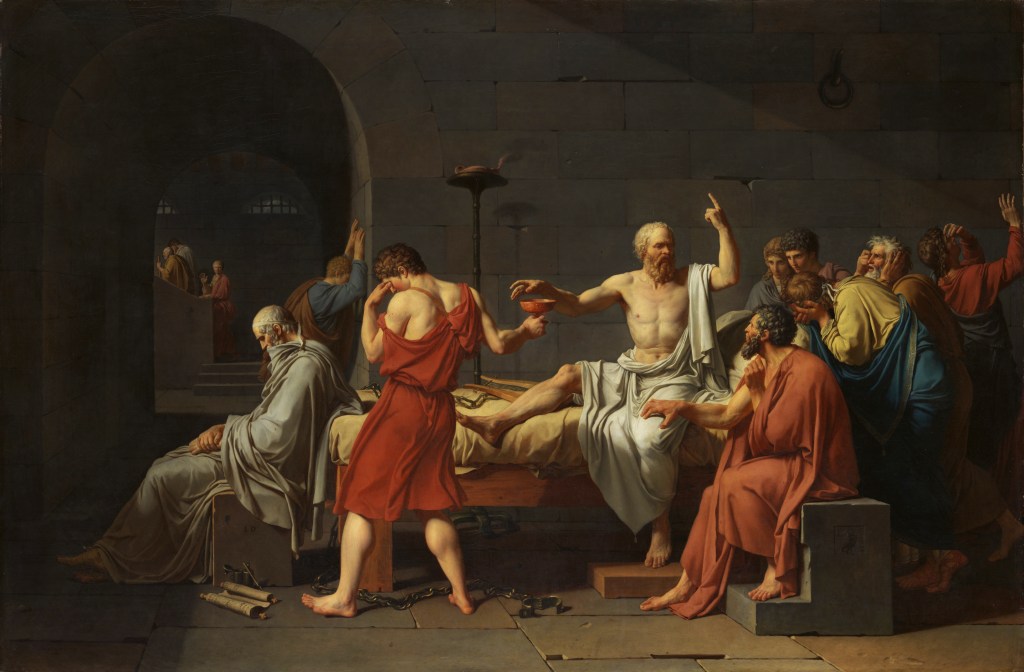
The Death of Socrates. By Jacques-Louis David. 1787
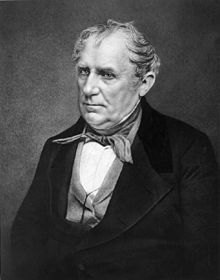
James Fenimore Cooper died in 1851 at the age of 61 in Cooperstown, New York, a small town founded by his father, William Cooper in 1785. The city is located on the southern edge of Otsego Lake which means ‘Place of the Rock’ in the Mohawk language and Glimmerglass in his novel ‘The Deerslayer‘.
Cooper, the eleventh of twelve children, after his first birthday spent his pre-teen years in Cooperstown. He was enrolled at Yale University when he was thirteen and expelled for dangerous mischief at 16 without obtaining a degree. He crewed a merchant ship at the age of seventeen and sailed across the Atlantic to London and down along the Spanish coast into the Mediterranean. In 1808 he joined the U.S. Navy and spent the next two years serving aboard inland lake gunboats and preforming recruiting duties. He resigned his commission in the navy in 1810 for the lack of excitement. (In life where timing is everything, the British naval blockade of American trade during the war of 1812 may have provided Cooper with some needed excitement.) In 1811 he married a wealthy heiress, Susan Augusta de Lancey and settled down to life of leisure for the next decade.
In 1820, after ten years of dabbling in various occupations, more as hobbies rather than employment, he decided to take up writing, producing his first novel, a poor imitation of Jane Austin novels, ‘Precaution’ in the same year. His second novel ‘The Spy‘ was more successful and gave him a measure of fame and wealth, enough to encourage him to continue his pursuit as a novelist and writer.
His first ‘Leatherstocking’ novel. ‘The Pioneers‘ appeared in 1823 followed by the second ‘Leatherstocking’ novel, ‘The Last of the Mohicans‘ in 1826. ‘The Last of the Mohicans‘ is considered his greatest triumph as an author from the time it was written to the present day and has been adapted to film many times over the last one hundred years.
As a testament to his success as a writer, after two centuries almost all his fictional novels are still in print.
The Deerslayer:
‘The Deerslayer‘, first published in 1841, was the fifth and final volume of the ‘Leatherstocking‘ historical romantic novels by Cooper. In ‘The Deerslayer‘ the author brings the protagonist of the ‘Leatherstocking‘ series, Natty Bumppo, back from the future as a prequel to the first four novels. Running in the background to the story is the French and Indian Wars, setting the stage and providing context for the action and dialogue occurring on and around Otsego Lake known as Glimmerglass in the novel.
Natty, referred to by his nicknames Deerslayer and Hawkeye, is a young 17th century moralistic American frontiersman living and traveling among the Iroquoian Mohawks, in what is now known as central upstate New York. Deerslayer has a strong innate sense of right and wrong from a civilized Christian perspective which he continually attempts to square and bridge with the less polished cultural tenets of his Indian brothers. To avoid moral conflicts with his adopted tribal brothers he focuses on the good in the red and, with a nod to cultural sensitivity, he internally closets any interpretive bad in the red as inconsequential. Deerslayer though, takes a less compromising position with his white brethren; admonishing them for traits and behaviors that diverge from his Christian grounding in what is right.
Cooper reinforces the inherent conflicts between good and bad by creating good Indians, Mohawks, and bad Indians, Mingos. The noble, liberated savage versus the evil, fearsome savage. In the end the white and red dissipate and all that is left is the perpetual struggle between good and evil.
Layered on top of Deerslayer’s sententious inclinations is a romance played out between Natty and the beautiful daughter of his traveling companion’s friend: Judith. Judith is slowly drawn to Deerslayer’s inherent goodness while Natty remains committed to his frontiersman bachelor ways. Another gap for the Deerslayer to bridge but in this instance, fails.
Literary Criticism:
‘The Deerslayer‘ received much critical praise from the time of publication onward into the 20th century. Author D.H. Lawrence found the book “one of most beautiful and perfect books…” Critic Carl Van Doren called novel “as a whole absorbing.” Wilkie Collins, author, said “Cooper is the greatest artist in the domain of romantic fiction yet produced in America.” Critic Lounsbury proclaimed that ‘The Pathfinder‘ and ‘The Deerslayer‘ “were pure works of art.”
Not all criticism was positive. Mark Twain supposedly found it dreadful and wrote ten pages explaining his thesis in the aptly titled: ‘Fenimore Cooper’s Literary Offenses‘. As is his want and style, Twain’s account of Cooper’s offenses was exceptionally funny though I’m less than sure if he was serious in his criticisms or if he just saw an opening to throw a few well-constructed barbs to help pay the bills and meet contractual obligations. An excerpt from the opening to ‘Fenimore Cooper’s Literary Offenses‘:
“Cooper’s art has some defects. In one place in ‘Deerslayer‘, and in the restricted space of two-thirds of a page, Cooper has scored 114 offences against literary art out of a possible 115. It breaks a record.
There are nineteen rules governing literary art in the domain of romantic fiction–some say twenty-two. In ‘Deerslayer‘ Cooper violated eighteen of them….”
In subsequent posts I will attempt to examine the relationship between wine ratings and price. To get there I thought it may be useful to quickly rehash the reasoning and methodology of ratings, which has been done many times by many others, before I compare them with wine prices.
The Need for Wine Ratings:
After many years of spending considerable time, money, and effort buying and drinking poor quality wines, I was ready to throw in the grapes and stick with whiskey: Irish whiskey, Scotch whisky, Canadian whisky, but not American burbon whiskey, too rough around the edges for my tastes. But this is not about whiskey. This is about choosing a decent wine at an affordable price–choosing a wine that doesn’t provoke tongue burn and esophageal spasms. Finding a wine without pouring over countless wine reviews in search of something within my budget and of acceptable quality. Unless you were a fervent oenophile steeped in the language and nuance of the vine you could get through about as many reviews as there were licks in a Tootsie Pop – 3 – before giving up and picking a wine at random at the local liquor store. An all-around Herculean and, as a rule, unrewarding task. An alternate method was to collect tips from fellow wine travelers. Experience taught me that wine tips were the blood brothers to stock and racehorse tips. Hang onto your wallet when receiving them and expect nothing good to come from them.
Considering the abysmal state of pre-1970s wine analytics, the ability to sort wine by quality and price, it’s a wonder anyone drank the stuff. Before ratings, the sellers of wine usually wrote glowing reviews of their product leading most buyers, through experience, to question their objectivity. Producer and seller reviews continue to the present with caveat emptor remaining germane and necessary to the buyer.
Then along came Robert Parker in the 1970s with a 100-point impartial wine rating/ranking system, a 50-point system in reality, which revolutionized how wine was bought and sold. His approach was to evaluate wines independently of the producers and sellers, communicating his results directly to the consumer.
Parker’s system wasn’t meant to replace wine reviews and tasting notes but to supplement them. The ratings were meant to provide a comparison between the seemingly infinite number of wines that were all labeled good and worthy of your time and money, but impossible to narrow down to something manageable, affordable, and drinkable. The ratings gave the consumer one number, along with price, helping to winnow the field of immense possibilities to single bottle or two for the evening’s festivities.
Wine rankings have their detractors mainly because they are subjective, but all rankings are subjective whatever they may be–books, clothes, cars, phones, whatever. Name a subject and you will be able to find a ranked list and it will have a subjective component. As a species we describe objects by comparing them with other objects and then rank them in a list. Consumer Reports have been doing this since 1936 and as much as they try to be objective there is always a subjective piece in their evaluations. Ranker.com, going live in 2009, has collected a billion votes from millions of users on hundreds of thousands of items and lists, all with subjective content.
When looking for a movie to stream on Friday night you may check out the written reviews which are likely to range from love it to hate it for any given flick, but the first thing that catches your eye are the consensus scores. A movie that scores 30 out of 100 you will give a pass, unless campy movies are your thing, but the ones rated 85 out of 100 prods your interest. You may even go on and read a review or two by critics that you know and trust. This eliminates a bit of the trial and error, taking thousands of movies and finding something we wish to spend our Friday night watching. Not fool-proof but better than written reviews by themselves.
The same process works for wine. That numerical score assigned by a reviewer that you trust narrows the choices of finding an acceptable wine for that Friday night movie, leaving you time to put together a colorful fruit and cheeseboard to complement your well thought out bottle of red… or white.
The Wine Rating Methodology:
Wine ratings are subjective by nature which means the numerical scores will not only change from reviewer to reviewer, but an individual reviewer will likely assign a different score at a different time and place. Moods, physical states, and surroundings affect us all. Smell and taste will not be the same in fresh air as it would in a smokey room. The variables to consistent, or inconsistent, scores are endless, but one must persevere.
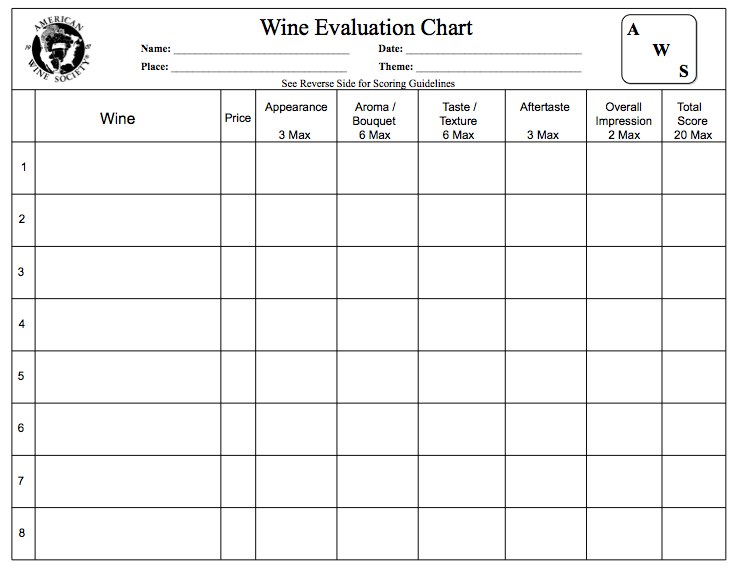
To bring some objectivity to ratings the tastings are generally done blind. In blind tastings information about the producer(s) and price is not divulged to the reviewer. In some cases, even the varietal of wine is not communicated before the actual tastings have been completed. The reviewer uses the same scorecard listing the same criteria to analyze all wines. A typical scorecard will contain some or all the following criteria:
Appearance – Color, Viscosity, and Opacity
Consistency or Mouthfeel – Body and Density
Aroma and Bouquet
Taste – Acidity, Flavors, Intensity, Balance, Depth, and Aftertaste
Complexity
Varietal
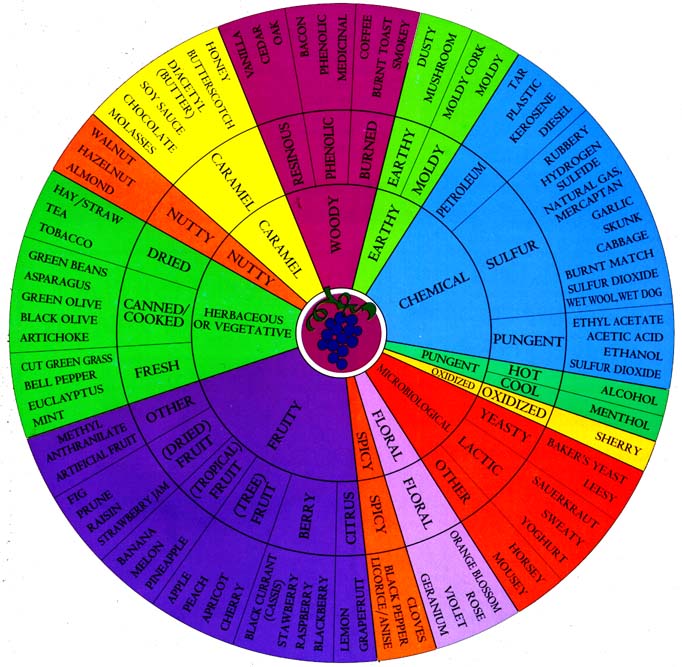
To assist in tasting and evaluating wine the UC Davis wine tasting wheel, divided into three expanding detail circles, was developed, and is shown above right.
The American Wine Society evaluation sheet shown below is for scoring on the UC Davis 20-point system.
With the above criteria a reviewer will assign a numerical value or star(s) to that vintage bottle of wine. The most common scoring structure is the 100-point system devised by Robert Parker. Others, such as Jancis Robinson use a 20-point system designed at the University of California at Davis in the 1950s. On the simple and basic end of ratings is the ubiquitous 5-star system that ranks wine with very little pretentious hair splitting. Vivino’s use of the 5-star system is strictly constructed and populated from aggregated and averaged individual consumer rankings and correlates very well with the more orthodox expert 100-point ratings. A Vivino 4-star rating equates to a 90-point Parker rating. The four rating scales, plus mine, are listed below.
Ratings in Practice:
On a finale note, those employing the 100-point scale very seldom, either for ranking or subsequent sales promotion, publish any scores below 88 or 89 reducing their scoring system to a 12-point scale that only contains outstanding to extraordinary wines. I have almost no experience with 20-point scales so I cannot speak directly to their posting, or not, of inferior wine scores. Vivino’s 5-Star system publishes all ratings provided by their customers, the good, the bad and the ugly. Vivino’s system subdivides each star into ten parts creating a 40-point system. In the end, whether you are using a 5-, 20-, 40-, 50-, or 100-point system the goal is to add a little quantitative assessment to qualitative reviews.
Robert Parker’s System:
96-100 — An extraordinary wine of profound and complex character displaying all the attributes expected of a classic wine of its variety. Wines of this caliber are worth a special effort to find, purchase and consume.
90-95 — An outstanding wine of exceptional complexity and character. In short, these are terrific wines.
80-89 — A barely above average to very good wine displaying various degrees of finesse and flavor as well as character with no noticeable flaws.
70-79 — An average wine with little distinction except that it is soundly made; in essence, a straightforward, innocuous wine.
50-59 — A wine deemed to be unacceptable.
60-69 — A below average wine containing noticeable deficiencies, such as excessive acidity and/or tannin, an absence of flavor, or possibly dirty aromas or flavors.
University of California at Davis System:
17-20 – Wines of outstanding characteristics having no defects
13-16 – Standard wines with neither outstanding character nor defect
9-12 – Wines of commercial acceptability with noticeable defects
6-8 – Wines below commercial acceptability
1-5 – Completely spoiled wines
American Wine Society Version of UC Davis System:
18 – 20 – Extraordinary
15 – 17 – Excellent
12 – 14 – Good
9 – 11 – Commercially acceptable
6 – 8 – Deficient
0 – 5 – Poor & Objectionable
Vivino et al 5 Star System:
Five Stars – Superlative
Four Stars – Excellent (Robert Parker’s 90-point rating)
Three Stars – Perfect for everyday consumption (Vivino’s average wine is 3.6 stars)
Two Stars – Casual drinking
One Star – Very Ordinary
Els Ranking:
Five Stars – 95-100 points – A most excellent wine
Four Stars – 90-94 points – An outstanding wine (My sweet spot for balancing quality and price)
Stephen Mitchell was born in Brooklyn in 1943 (80ish), educated at ‘Ivy League’ schools in the US and France, and, quoting his words, “de-educated through intensive Zen practice“. That may be just a spoonful of humor, it is though a spoonful of humility, and a large serving of Zen-Socratic wisdom. A wisdom that becomes one that reflects upon his life and realizes his education has granted him neither knowledge nor wisdom. He does not say what the Ivy League has instilled in him, but the derivation of any real value from those hallowed halls, as seen from the Zen rear-view mirror, appears minimal.
In an interview with the Los Angeles Times, he ruminates that “If I’m a scholar, I’m an amateur“. A humble observation in the truest form of the personal quest for fulfillment and enlightenment. In the same interview, elaborating on Chuang-tzu in Mitchell’s ‘The Second Book of the Tao‘, he says: “I have no pretensions to scholarship. I just love to play with the Taoist masters. For them, nothing is sacred. The best tribute is contradiction.” Again, humility before all, all before self.
In a separate interview with Scott London also discussing ‘The Second Book of the Tao‘ Mitchell relates the teachings of Chuang-tzu as a philosophy of the unassuming and the simple life. “There was nothing to live up to,” he says. “There was only a passion for the genuine, a fascination with words, and a constant awareness that the ancient Masters are alive and well in the mind that doesn’t know a thing.” Mitchell personifies and lives that philosophy.
Mitchell has translated and authored many books including the bestselling Tao Te Ching, Gilgamesh, The Gospel According to Jesus, and his latest book, The First Christmas released in 2021. He is also the coauthor of three of his wife Byron Katie’s bestselling books: Loving What Is, A Thousand Names for Joy, and A Mind at Home with Itself and numerous children’s books.
The Discovery of the Story of Gilgamesh:
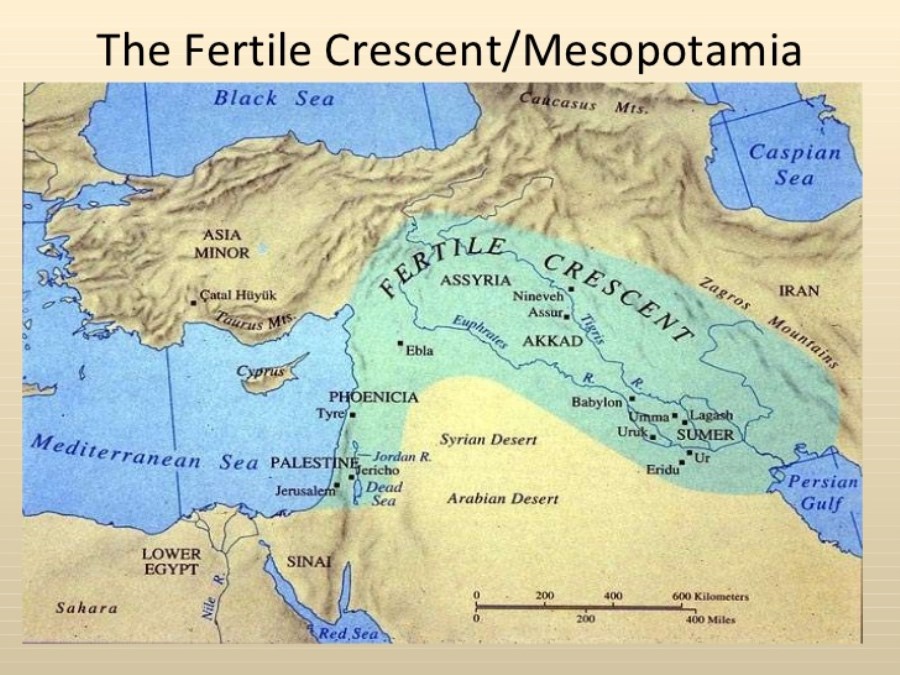
The Epic of Gilgamesh was, in the beginning, a series of Sumerian poems/stories likely passed down through the ages as oral histories before being written down in Akkadian 700-1000 years after the reign of the mythical/historical King of Uruk: Gilgamesh.
Mitchell may have been introduced to the literary stature of Gilgamesh while translating the Austrian mystic poet, Rainer Marie Rilke. Rilke wrote at the end of 1916. “I … consider it to be among the greatest things (the poem Gilgamesh) that can happen to a person. I have immersed myself in [it], and in these truly gigantic fragments I have experienced measures and forms that belong with the supreme works that the conjuring Word has ever produced.”
The poem, written in Assaryian cuneiform script, on clay tablets, was discovered by Austen Henry Layard while excavating mounds, beginning in 1844, around what is now known as the city of Mosul. The mounds turned out to be the remains of the ancient Assyrian capital palaces of Nineveh including the library of King Ashurbanipal or Ashur Banipal (668-627 BC) depending on the source. Over 25,000 clay tablets from the library, twelve of which contained the poem, were shipped back to the British Museum. It took until 1872 before the poem was discovered among this immense trove of tablets and in 1872 George Smith translated and published the poem. These twelve tablets contain the fullest version of the poem found to date.
The first surviving version of the combined epic is known as the Old Babylonian version and dates from the 18th century BC. The longer and more complete copy of the poem, from King Ashurbanipal’s library is from the 10th to the 13th centuries BC and is known as the Standard version. Currently seventy-three fragments, possibly more, of the Standard version have been discovered containing some two thousand lines of the original, which is surmised to be three thousand lines long.
Mitchell mainly adapts the Standard version into a contemporary English language poem with gap filler supplied by the Old Babylonian version. Where there is no original material to complete known gaps, Mitchell has contributed original work to provide clarity and to maintain continuity.
The Man of Gilgamesh:
Gilgamesh is accepted as being the 5th king of Uruk, possibly reigning roughly in the 26th century BC (2800-2500 BC) for 126 years. Some believe the long reign of 126 years may actually be a number in base six which would equate to 54 years in base ten. Very little is known of his reign with the exception that he built the walls Uruk, is listed in the Sumerian King list, and is mentioned as a contemporary of Aga, son of King Enmebaragesi of Kish.
Aga, who ruled over Sumer for 625 years, is the antagonist in the Sumerian poem ‘Gilgamesh and Aga‘, recording the King of Kish’s siege of Uruk after Gilgamesh refused to submit to him. From the poem Aga commands Gilgamesh and the citizens of Uruk to work forever as slaves on Kish’s irrigation projects.
There are wells to be finished. There are wells in the land to be finished. There are shallow wells in the land to be completed. There are deep wells and hoisting ropes to be completed
Gilgamesh is made King of Uruk for his defiance and resistance to Aga’s demands. King Gilgamesh captures Aga on the 10th day of the siege but sets him free to return to Kish.
The Land of Gilgamesh:
Uruk was a Sumerian city-state established in the southern reaches of Mesopotamia and was located on the east bank of the Euphrates River. The river today, through the process of river channel migration, is much further to the west. The city and its surrounding area were home to about 40,000-125,000 people, who during the time of Gilgamesh controlled the entire Sumer area.
The Sumerian area and Uruk lay claim to the beginnings of civilization, urbanization, laws, and writing. Cuneiform, wedge shaped writing on clay tablets and the earliest known system of writing, dates to the fourth millennium BC with the oldest examples being inventories of goods stored and transported in and out of the Sumer area.
The oldest known surviving law code, the Code of Ur-Nammu, in the world comes down through the ages from the Sumerian king Ur-Nammu or his son Shulgi of Ur during the last half of 21st century through the beginning of 20th century BC. The Code of Urukagina is older but is known only through references in other ancient writings. The better-known Babylonian Code of Hammurabi is younger and dates from the eighteenth-century BC.
The greatest architectural monument of Uruk was the White Temple built upon the Anu Ziggurat during the fourth millennium. The temple was thirteen meters high and 22.3 x 17.5 meters in depth and width. It stood upon a ziggurat with dimensions of 50 x 46 x 10 meters in depth, width, and height, respectively. On the flat plains surrounding Uruk it was visible in the distance for kilometers.
German archaeological excavations in 2003, conducted in and around the old riverbed of the Euphrates, have reportedly revealed garden enclosures, specific buildings, and structures described in The Epic of Gilgamesh, including Gilgamesh’s tomb. According to The Death of Gilgamesh, he was buried at the bottom of the Euphrates when the waters parted after he died. There is debate whether these excavations and discoveries exist or are a hoax. These discoveries have not been confirmed and no updates from the original can be found but one of the original authors of the 2003 study is Jorg Fassbinder, a geophysical archeologist associated with the University of Munich.
Uruk is also recognized as the city of Erech, founded by Nimrod, great-grandson of Noah, as mentioned in Genesis 10:10:
8And Cush begat Nimrod: he began to be a mighty one in the earth.
9He was a mighty hunter before the LORD: wherefore it is said, Even as Nimrod the mighty hunter before the LORD.
10And the beginning of his kingdom was Babel, and Erech, and Accad, and Calneh, in the land of Shinar.
11Out of that land went forth Asshur, and builded Nineveh, and the city Rehoboth, and Calah
The Legend of Gilgamesh:
Gilgamesh in Sumerian possibly means ‘The Old Man Is a Young Man’ or ‘The Ancestor Was a Hero’. An immortal Hero, a synthesis that brings us to the story and plot of Gilgamesh.
Gilgamesh is the epic hero of the times. Dashing, brave, adventurous; a seeker of immortality and wisdom but not much in the way of kingly benevolence. The gods knowing Gilgamesh lacked wisdom sent him his twin and his opposite: Enkidu. Enkidu became Gilgamesh’s brother and constant companion. Thus begins the quest of Gilgamesh to find himself. It is far more than that, though, as Mitchell explains:
“Part of the fascination of Gilgamesh (the story and person) is that, like any great work of literature, it has much to tell us about ourselves. In giving voice to grief and the fear of death, perhaps more powerfully than any book written after it, in portraying love and vulnerability and the quest for wisdom, it has become a personal testimony for millions of readers in dozens of languages.“
Gilgamesh, as with some of his readers of today, is slow to learn the lessons of life, slow to acquire wisdom even when it is given to him/us for free. From the old Babylonian Version in Book X, Siduri, a wise matron brewer of beer offers Gilgamesh an opiate of advice for his pain brought on through the death of his brother Enkidu.
“Gilgamesh, where are you roaming? You will never find the eternal life that you seek. When the gods created mankind, they also created death, and they held back eternal life for themselves alone. Humans are born, they live, then they die, this is the order that the gods have decreed. But until the end comes, enjoy your life, spend it in happiness, not despair. Savour your food, make each of your days a delight, bathe and anoint yourself, wear bright clothes that are sparkling clean, let music and dancing fill your house, love the child who holds you by the hand, and give your wife pleasure in your embrace. That is the best way for a man to live.”
Gilgamesh declines the advice to live for the day and continues with his quest for immortality.
Awards: — Nominated for Best Summer Blockbuster Trailer
Directed by: Steven Caple Jr.
Written by: Joby Harold–Darnell Metayer–Josh Peters–Eric Hoeber–Jon Hoeber
Music by: Jongnic Bontemps
Cast: Anthony Ramos–Dominque Fishback–Peter Cullen–Ron Perlman–Peter Dinklage
Film Locations: United States–Peru–Canada
Budget: $195-200 million
Worldwide Box Office: $436.7 million
Maximals, robotic animals, join forces with the Autobots to battle the ruthless mechanoid Terrorcons who are attempting to bring their master, Unicron, a planet eating god, to Earth.
This is the seventh ‘Transformer’ franchise movie with two more in development plus an animated prequel planned for 2024 release. It is debatable whether the franchise can survive this painful ‘Fall of the Beast’. If it does survive, they need to bring in a whole new crew for the subsequent releases and relegate this movie’s crop of personalities to daytime TV or better yet, Saturday morning cartoons.
There is absolutely no talent or passion on display anywhere in this movie. There is no direction apparent, just a series of shots randomly glued together. There is no acting, just the reading of lines for both the human and the voice over roles. The screenplay was a committee effort of giggling adolescents. Even the CGI scenes are inferior to the standards of today. This is not a $200 million movie.
If you have moved past the age and mental maturity of a 12-year-old, this movie is not something you need to spend 2 hours of your life on.
(Note: This is the third of 3 reviews detailing the stories and methods of stock market trend followers and traders that collectively became known as ‘Turtles’. The following short bio is a repeat from the second post in this series.)
Biography:
Michael W. Covel, 54, born in Virgina, is an author of 8 books on markets and trading with a specialization in the market technical analysis known as trend following or ‘Turtle’ trading.
He also hosts a podcast, ‘Trend Following Radio‘, which he has, to date, recorded more than 1200 episodes. The podcast follows a format of interviewing leading authorities in economics, trading, and various other topics of interest to the investment world.
Market Players:
People analyzing and trading the markets fall into two distinct groups: fundamental and technical. Those taking a fundamental approach to the markets tend to be long-term investors whereas technical analysts have a short-term focus.
A fundamental analyst of the market keys in on news and financial data to assess the relative strength of a security. These investors tend to adhere to the Efficient Market Hypothesis/Theory (EMH or EMT): that individual securities are fairly valued. Inherent to this theory is that markets are rational. Stock prices reflect all the information available and are not affected by emotional spasms otherwise known as volatility. Ha.
Actually, volatility is a well-defined statistical measure of a stock’s price swings away from its mean. Large price swings equate to high volatility. High volatility stocks are riskier stocks to trade because the price swings are large and unpredictable. There are those on the technical side of trading that believe that volatility and risk are unrelated, but this always seems to be, at its core, a sematic argument. Additionally, higher volatility stocks have a higher price premium built into their option prices.
By sifting through mountains of market news and financial data investors are attempting to identify financially strong securities to hold for the long term. Also, in their quest to understand and know the markets and companies, they hope to uncover the rare, undervalued security which may lead to significant profit. Ironically, undervalued, aka value stocks, belie the premise behind the EMH. Doubly ironic, searching for value stocks is akin to unicorn hunting, neither exists in the real world, so why bother, in my most humble opinion.
The timing of entry to and exit from a market trade is the greatest pitfall for a long-term investor. A trade may take the price elevator south, accumulating significant losses before there is any data, or none, to support its rapid descent.
A technical analyst is only concerned with the security’s price, and its current trend. Is it going up, down, or sideways? There is a belief that technical analysts and traders are attempting to predict the future direction of security’s price, but this is incorrect. Technical traders, using statistical probabilities, attempt to take the path of greatest potential profitability. The greatest downside to technical trading is that all statistical analysis of a security or market is calculated from data derived from the past and the present but never the future so even with the best tools trends reverse themselves with warning.
Technical analysts like to think of themselves as card counters at a blackjack table trying to ascertain when the deck is heavy or light in high cards. A higher ratio of high cards favors the player. Stocks with a strong trend favor the trader. The problem with this analogy is that the US market has close to ten thousand ticker symbols that trade daily or to keep the metaphor intact about two hundred decks of cards for the card counting trader to digest.
Ten thousand securities, all with their own trend or no trend, all in constant state of flux, it is difficult to consistently pick the stocks with the winning trend. Losses are and will be incurred under the best of systems. Successful trend followers exit losing trades when they are down about 20%. Exit your losers and quickly to stay in the game.
Whether a fundamental investor or a technical trader, forecasting price is fraught with danger and losses. In the immortal words of Niels Bohr, father of the mathematical foundations of quantum theory: “It is very hard to predict, especially the future.” (Quote and variations sometimes attributed to others such as: Samuel Goldwyn, Yogi Berra, and Mark Twain)
Trend Following:
Covel’s ‘Trend Following’ deals with the technical analysis of the markets with a not so insignificant dollop of whining condescension directed towards the fundamentalists. The book is divided into three sections. The first two sections, written mainly by Covel, define and explain market technical analysis and trading along with seven in-depth interviews with successful trend traders. The concluding section is a collection of trend following research papers written by experts in the field of technical analysis and trading. Interspersed throughout the book are a plethora of epigraphs, epigrams, and aphorisms, ranging in worth from the profound to the quaint. Most are the equivalent of footnotes, sometimes useful and instructive, but mostly time-consuming and distracting.
The first edition in 2004 was a manageable 256 pages. The second edition in 2005 increased in size by 65% and totaled 420 pages. The 2009 third edition was even fatter with 464 pages. The fourth edition I can find neither hide nor hair of, but it likely experienced similar inflationary page count pressures. The 5th edition of this book comes in at an eye watering 688 pages: 578 pages of trending stuff and 109 pages of footnote/index stuff. Stuff is the correct word, mostly.
This book is beginning to resemble the 3-semester text for college calculus where every possible type of integral insists on its 15 minutes of fame. Teaching and learning take a back seat to the authors’ need to impress their peers. For the sake of future readers interested in trading on the price trend let us hope that Covel may stop adding material and start addressing the always interesting topic of concision.
Trend following, trend trading, momentum investing, ‘Turtle’ trading all refers to the same basic method of analyzing the market: probabilistic analysis of the current price and the trend of its price history. The concept of price and its trend is too simple of a concept for a good chunk of Wall Street traders to accept but we all follow trends without thinking. We follow the herd when deciding where to shop, what schools to send the kids to, what books to read. Why are stock price trends anathema to a good chunk of the investor class? Who knows? Ed Seykota, one the world’s most successful trend traders’ comments, “All profitable systems trade trends.” Trading at a profit or loss implies a trend.
To evaluate the results of trading on the trend requires a focus on absolute return. All that means is that one makes the most profit possible. Making the most requires that the trader be on the right side of the market at the right time. Being on the right side of the market starts with not fighting the trend, going with the flow. When the markets or security are on an upswing do not try to convince yourself that a downturn is imminent, even though trend reversals are common, betting on reversals is the road to bankruptcy. The trend is your friend. Stay friendly. Stay profitable.















 elsToday