Before the One Ring, created by Sauron during the Second Age, Plato created, as a thought experiment, the Ring of Gyges which gave its wearer the cloak of invisibility. Gyges discovered that when he was invisible, he could commit immoral acts and crimes without suffering any adverse consequences or retribution from society.
Plato in his Republic, using the ring of invisibility as an analogy, explores man’s ability to remain honest and moral in the face of immunity from all consequences. He concludes that if one is free of any consequences he will act in his own self-interest, justice be damned, or as the 19th century historian and writer, Lord Acton states, “Power tends to corrupt, and absolute power corrupts absolutely.”
This leads Plato, through the lips of Socrates, to suggest that justice is not a social construct but an inherent quality of one’s soul. The soul must be in harmony with one’s actions and a harmonious soul contributes to a just society. Socrates believed and advised, and he followed his advice, that a harmonious and pure soul leads to true happiness and fulfillment or as the ancient Greeks called it: eudaimonia. For Aristotle eudaimonia is the highest human good and the only human good that is desirable for its own sake, an end in itself. Justice is a by-product of true happiness. Unhappy people and unhappy societies are not just people and just societies.
J.R.R. Tolkien, not only a writer but also a philologist, most certainly was aware of Plato’s Ring of Gyges as an analogy of ultimate power when he used his One Ring in the Lord of the Rings as the definitive symbol of man’s quest to resist and fight evil.
Source: The Republic by Plato. Reason and Meaning.com. Philosophy Terms. Oxford Reference. Graphic: The One Ring, Good Free Photos.
Ralph Waldo Emerson, author of the transcendental essay, “Self-Reliance” is often credited with saying, “When you strike at a king, you must kill him.” The exact setting and time for the quote is unknown but Ann Althouse believes it was said during a conversation with Oliver Wendell Holmes Jr., one of the most widely cited Supreme Court justices, after Holmes attacked Plato. Emerson’s parried with the quote above, meaning that if you strike at the philosopher king you must be thorough.
Niccolò Machiavelli, in his book “The Prince”, didn’t specifically mention the need to “kill the king” however, he did say, “If an injury has to be done to a man it should be so severe that his vengeance need not be feared,” and he also added “People should either be caressed or crushed. If you need to injure someone, do it in such a way that you do not have to fear their vengeance.”
Source: The Prince, Machiavelli. Emerson, Althouse Blog, 2019. Graphic: Emerson by Hawes, 1857, Public Domain.
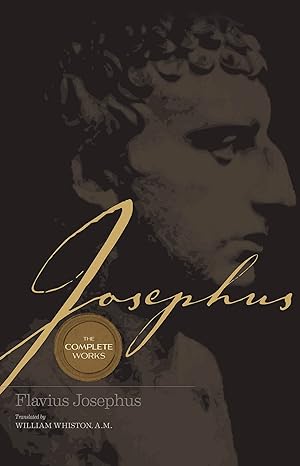
Flavius Josephus, a first century Jewish scholar and historian wrote four extant works:
The Jewish War. (Jewish Revolt) 75 AD – The first revolt against the Romans from 66-73 AD
The Antiquities of the Jews. 95 AD – From Adam to the death of Herod’s sons
Against Apion. 97 AD – A defense of Judaism
Vita or The Life of Flavius. 99 AD – Biography
These works provide significant source material and insight into first-century Judaism and Christianity.
Josephus was born into the Jewish priesthood on his father’s side and of Hasmonean royal descent maternally. He served in the Jewish military during the Jewish War but surrendered to the Romans and he was considered a traitor to Jews ever after. While waiting to be executed by the Romans he predicted that Vespasian would eventually be crowned emperor of Rome. Vespasian, because of the prophecy, spared his life and made him a consultant, but still a slave, to the Roman army. Josephus gained his freedom when Vespasian became emperor in 69 AD, at which time he changed his name to Flavius Josephus. Flavius was the family name of the emperor Vespasian.
Source: Josephus: The Complete Works, 2003. Jewish Virtual Library. World History Encyclopedia.
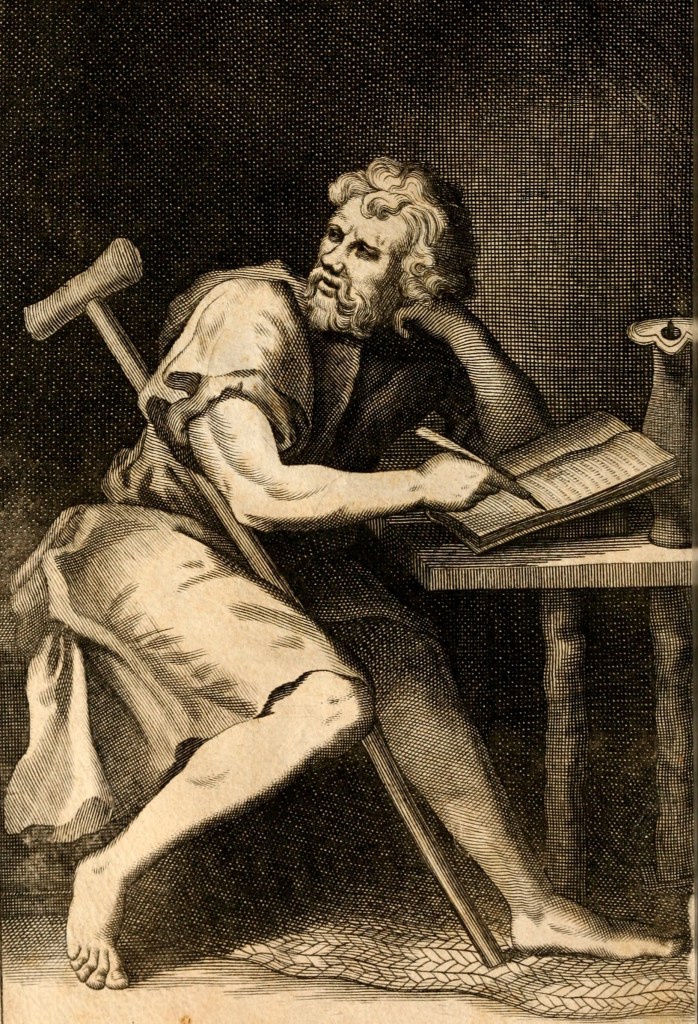
Epictetus was a 1st and 2nd century AD Greek Stoic who lived a simple life and taught philosophy at his school in Nicopolis, Greece. No writings of his have survived, if there were any to begin with, but his pupil Arrian captured his teachings and collected them into two separate works: The Discourses and the Enchiridion.
In The Enchiridion Epictetus briefly discusses 52 or 53 maximums or rules a practicing Stoic should live by with the first and main rule being that you should “only concern yourself with matters that you can control.” Everything else is irrelevant to living a pleasant life.
Stoicism is the philosophy of resilience and patience. Adherents believed in leading a life of virtue, which one did by acquiring wisdom, exhibiting courage, practicing temperance, and promoting justice.
Famous Stoics throughout Greek and Roman history include Zeon of Citium, Eratosthenes of Alexandria, Lucius Seneca, and Marcus Aurelius.
Source: The Enchiridion by Epictetus/Arrian, translated by Elizabeth Carter contained within Ancient Greek Philosophers, published 2018. Graphic of Epictetus by William Sonmans 1715, public domain.
“Let no one be slow to seek wisdom when he is young nor weary in the search thereof when he is grown old. For no age is too early or too late for the health of the soul.”
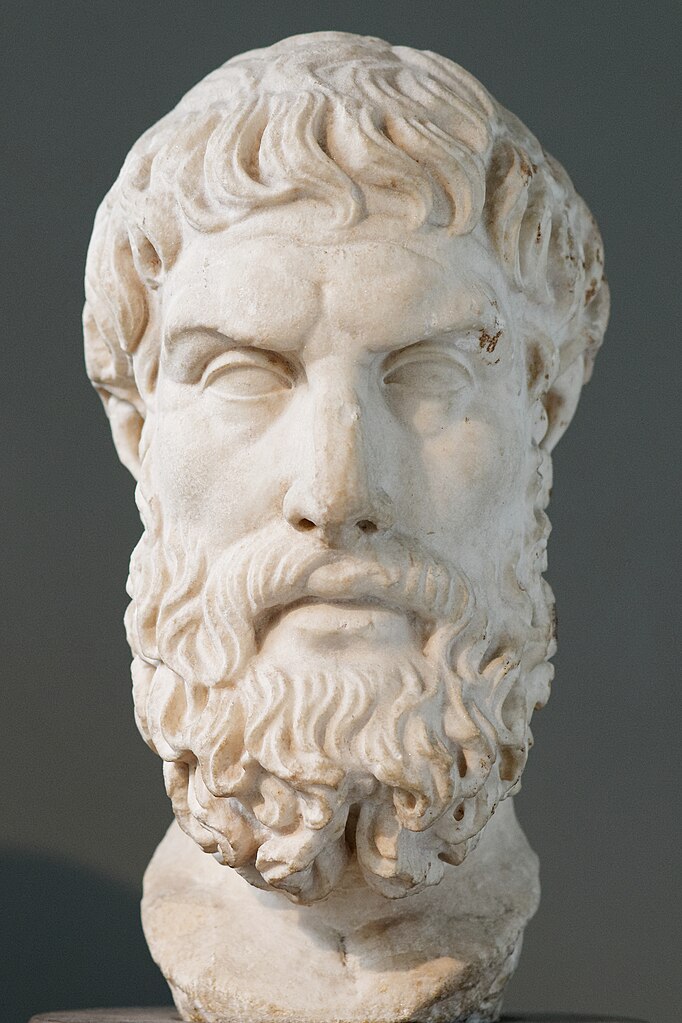
So begins the third and fourth century BC Greek philosopher, Epicurus in his letter to Menoeceus, although who Menoeceus was, has been lost to the ages. Epicurus was a Greek philosopher born on the island of Samos in the Aegean Sea off the coast of Turkey. He established a school next to Plato’s in Athens and taught that one’s purpose in life was to lead a happy, tranquil, self-sufficient life, a pleasant life, and not to fear death.
Epicurus taught that after death there is nothing. Death is/was the end of the body and soul; teaching that self-guilt and shame were the only methods available to prevent the world from overflowing with psychopaths. This is not far from the current Pope’s thoughts on Hell being an empty shell, a place of nothingness. Socrates, on the other hand, taught that the soul is eternal, and one must strive to keep it bright and shiny.
Epicurus ended his letter to Menoeceus, “Meditate therefore on these things (a pleasant life) and things akin to them night and day by yourself, and with a companion like to yourself, and never shall you be disturbed waking or asleep, but you shall live like a god among men. For a man who lives among immortal blessings is not like to a mortal being.”
Sources: “Ancient Greek Philosophers”, numerous translators, published 2018 and Manchester.edu (Indiana). Photo of a bust of Epicurus by Nguyen, public domain.
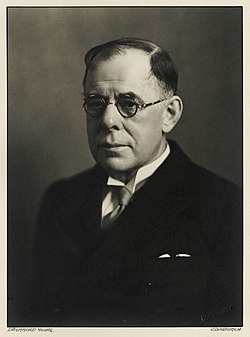
Alfred Edward Taylor was born in Oundle, England in 1869, and died in Edinburgh, Scotland in 1945. He was a professor, a Greek classicist, and a philosopher of metaphysics and ethics. He spent his adult life at the ancient Scottish Universities of St. Andrews and Edinburgh researching and teaching the spiritual; the immortal basis for morality and the philosophy of Plato. Plato was a student of Socrates and as such he was a concern to and within the orbit of Taylor.
Socrates’, leaving no written record, entire philosophical corpus and biography have reached us today primarily through the writings of two near contemporary Greeks: Plato and Xenophon. Taylor’s contribution to our present day understanding of Socrates was to argue that Plato’s four basic texts on Socrates: Euthyphro, Apology, Crito, and Phaedo, are accurate depictions of what Socrates said and did. Xenophon, who also wrote extensively about Socrates but later, Taylor argued, is less reliable. This may seem trivial, but this point has been and still is contested due to the immense stature of Socrates as one of the founders of Western philosophy in general and ethics in particular. The basic question among philosophers is whether Plato’s writings describing Socratic philosophy are accurate or are amalgamations of Socratic and Platonic thought? Who knows? The dispute will continue till the end of days so we will leave it as Taylor says.
Taylor’s studies within the philosophy of ethics and morality centered on what is right and good, whether the two were complementary and/or achievable. Taylor argued right and good or the moral practice of the individual is constrained and flawed without the aid of the supernatural: God. His thesis was that searching inward, within oneself for rebirth and betterment, for a moral compass, flows only in circles leading nowhere. To reach a higher level of morality or good requires looking outward to the spiritual through contemplation of the eternal good. Taylor argued that the will to reach for a better or eternal good is impetus for the eternal, the divine good to reach for you. Additionally, morality, Taylor surmises, plateaus in the human confines of a person’s physical life, requiring, unfortunately or fortunately depending on your perspective, death to continue the soul’s moral journey for better or worse.
Socrates:
Any biography of Socrates is going to be short. Almost all authoritative writings concerning his work, teachings, and life that have reached us in the 21st century consists of approximately two hundred written pages, in English, by Plato and about three hundred English written pages by Xenophon with the two containing significant overlap. Taylor’s biography, using Plato and Xenophon as primary sources, is no exception managing to encapsulate Socrates’ remarkable life into a quick read of 142 pages. Within these few pages concerning this most remarkable man everything has been disputed except for the Athenians putting him to death for being a royal pain in the rear, some have used the term gadfly. That is the one piece of his life that no one disagrees with. No one disputes that he was put to death in 399 BC, and it is likely that no one disputes that he was a royal pain in the posterior, a gadfly.
Socrates was born, circa 469 BC, grew up and lived in Athens until he was put to death in 399 BC at the age of seventy. He lived during the Golden Age of Athens (478-404 BC) and the overlapping Age of Pericles (461-429 BC) both now combined and known by the excessively non-descriptive non-demonym: Fifth Century Athens. (Why classical historians thought this was a useful, didactic change defies any sound, logical reasoning. Alas it was changed to avoid hurt feelings of Greeks and Athenians whose best years occurred two thousand seven hundred years ago. How you soothe pouting children should not be an instruction manual for sane adults.)
Socrates only left Athens to serve in military battles prior to and during the (second) Peloponnesian War. He was a hoplite in the Athenian army, a heavy infantry soldier outfitted with a shield, sword, and/or spear fighting in a phalanx or block-like formation. By all accounts he was a good and courageous soldier. His first recorded engagement, at the age of thirty-eight, was the battle and siege at Potidaea beginning in 432 BC. lasting until 429 BC. Potidaea was a Greek city-state, approximately 155 miles, as the crow flies, north of Athens, threatening to break free of Athenian control. This battle helped trigger the much larger and costlier Peloponnesian War beginning in 431 BC and lasting until 404 BC.
Socrates saved the life of Alcibiades, a gifted Athenian general and politician, but exceptionally duplicitous and erratic. Socrates heroic action should have garnered him the prize for valor, but Alcibiades was awarded it instead due to his higher birth and rank. A very powerful disincentive to the rank and file indeed.
Five and seven years later Socrates fought for Athens in the losing battles of Delium and Amphipolis, respectively, during the initial stages of the twenty-seven year-long Peloponnesian War. During the battle of Delium in 424 BC, Alcibiades saved Socrates’ life thus repaying Socrates’ valiant deed and cementing their life-long, but problematic, friendship.
Alcibiades recounts a story of Socrates during the engagement of Potidaea that bears on the philosopher’s power, or possibly prophetic power of thought. One morning Socrates, while contemplating an assumed perplexing problem became motionless, a state he remained in until the next morning when he said a prayer and walked away invigorated, amazing his fellow soldiers who had been watching him through the night. This story has him either being completely lost in thought, refusing to move to avoid breaking that train of thought, or as another occurrence of the ‘Sign’, voice, or daimonion that came to him, starting in his childhood and continuing throughout his adult life.
The ‘Sign’ was a voice usually described as an inner call, not to action, but to caution, a warning of future woes to come. Socrates mentioned at his trial that whenever the voice spoke to him it turned him away from something he was about to do. Some believe the ‘Sign’ was simply his subconscious speaking to him while others feel it was divine. A message from God.
To stretch a minor detail, Socrates almost never referred to the Gods, just God in the singular, a minor point yes, but a point all the same that the ‘Sign’ may have been religious vision or experience from the perspective of monotheism versus accepted Greek polytheism. At his trial he states, “It is to fulfill some function that I believe God has placed me in the city. I never cease to rouse each and every one of you, to persuade and reproach you all day long…” His ‘Sign’ did not speak to him during his trial leaving him to conclude that the sentence of death was something he should accept.
Socrates’ ‘religion’ began with his belief in the soul, and that it was immortal and unchanging. The soul existed before you were born and continued after your death. He believed the soul was your truth, your essence, your reality beyond your corporal self. He believed the soul must be looked after and kept in immaculate condition.
Socrates believed that to care for your soul required a focus on personal growth. Growth comes from the pursuit of wisdom and knowledge, the study of philosophy, to further one’s understanding of not only yourself but the world around you. The pursuit of wisdom through what became known as the Socratic method, questioning and logical reasoning started with yourself: ‘know thyself’ and expanded to include the universe beyond your own flesh. To seek wisdom and knowledge by examining your life was to seek truth. Seeking wisdom and knowledge for the sake of truth is what Socrates meant when he spoke his famous line at his trial in 399 BC, “The unexamined life is not worth living.” Without truth, life is not worth living. Without truth one risks living a lie.
Socrates examined and questioned everything and everyone. His thirst for knowledge and wisdom all flowed from his stated belief in his own ignorance, stating “as for me all I know is that I know nothing.” No one that knew Socrates believed this statement for a second. He was known as a sage, a philosopher, and shrewd one at that. His wisdom was even embraced by the Oracle of Delphi who said Socrates was the wisest person in Athens.
For Socrates, though, his statement professing to know nothing wasn’t an expression of humility or ignorance but a challenge. A challenge to question one’s beliefs and opinions concerning all things seen and unseen. Two plus two equals four, everything else is questionable. “All I know is that I know nothing” is an acknowledgement that the search for wisdom: truth, at a minimum is transitory, possibly imaginary, and thus one must never stop searching. This was not to say there were no truths available to the living, but the search could be difficult and deceptive.
Socrates’ quest for the truth manifested itself first through his rejection of fame, money, and power. The corollary of that rejection is he lived a life of poverty, neglected hygiene, and wore no shoes. No shoes whether with feet on burning stones or frosted rocks. Pain and discomfort did not seem to bother him.
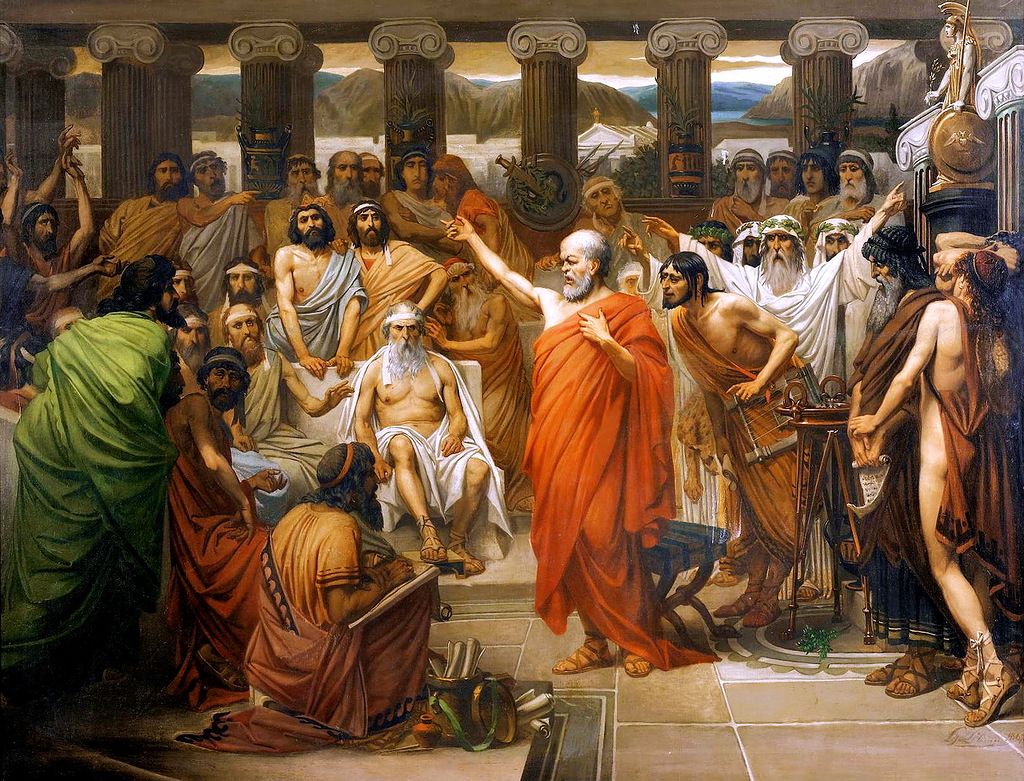
Secondly his quest for the truth was through the spoken word, never written. Conversations with his fellow Athenians occurred throughout the city, the Lyceum and the Agora were his two favorite haunts where he questioned his victims, and they were victims, in his famous ‘Socratic Method’ style of inquisition. Below is a short description of Socratic torture from the–Explainer: Socrates and the Life Worth Living (link below):
Socrates engages an interlocutor who appears to possess knowledge about an idea
The interlocutor makes an attempt to define the idea in question
Socrates asks a series of questions which test and unravel the interlocutor’s definition
The interlocutor tries to reassemble their definition, but Socrates repeats step three
Both parties arrive at a state of perplexity, or aporia (ed. a philosophical puzzle), in which neither can any further define the idea in question
Socrates’ Address. Louis J. Lebrun. 1867
A humorous sketch illustrating his method from Plato’s ‘Euthyphro‘ picks up near the end of a discussion concerning the gods:
Euthyphro: Why you don’t suppose, Socrates, that the gods gain any advantage from what they get from us, do you?
Socrates: Well then, what would those gifts of ours to the gods be?
Euthyphro: What else than honor and praise, and, as I said before, gratitude?
Socrates: Then, Euthyphro, holiness is grateful to the gods, but not advantageous or precious to the gods?
Euthyphro: I think it is precious, above all things.
Socrates: Then again, it seems, holiness is that which is precious to the gods.
Euthyphro: Certainly.
Socrates: Then will you be surprised, since you say this, if your words do not remain fixed but walk about, and will you accuse me of being the Daedalus who makes them walk, when you are yourself much more skillful than Daedalus and make them go round in a circle? Or do you not see that our definition has come round to the point from which it started? For you remember, I suppose, that a while ago we found that holiness and what is dear to the gods were not the same, but different from each other; or do you not remember?
Socrates: Then don’t you see that now you say that what is precious to the gods is holy? And is not this what is dear to the gods?
Euthyphro: Certainly.
Socrates: Then either our agreement a while ago was wrong, or if that was right, we are wrong now.
Euthyphro: So it seems.
Socrates: Then we must begin again at the beginning and ask what holiness is. Since I shall not willingly give up until I learn. […]
Euthyphro: Some other time, Socrates. Now I am in a hurry, and it is time for me to go.
Socrates: Oh my friend, what are you doing? You go away and leave me cast down from the high hope I had that I should learn from you what is holy, and what is not, and should get rid of Meletus’s indictment by showing him
Socrates’ learnings in search of the truth have been passed down to us through Plato, Aristotle, Epicurus, Locke, and others, climaxing in Jefferson’s preamble to Western civilization’s crowning ode to self and country: the ‘Declaration of Independence‘, proclaiming the fundamental, natural rights of man: Life, Liberty and the pursuit of Happiness.
The phrase the ‘pursuit of Happiness’ has been thoroughly misconstrued to mean something foreign and vulgar to Jefferson’s original intent. The ‘pursuit of Happiness’ was not a grant to seek earthly enrichments and pleasures but a call to a higher state of being. Epicurus provided a definition of happiness that comes closest to the meaning of Jefferson, “the end of all our actions is to be free from pain and fear, and once this is obtained the tempest of the soul is quelled.” Life, Liberty, and the pursuit free from pain and fear. The ‘pursuit of Happiness’ sounds better.
Epicurus seeks a soul free of pain and fear. Socrates sought a pure soul. Both pursued it through the same means. Socrates and Epicurus’ greatest pleasure in life was the pursuit of wisdom and truth. Neither sought fame, money, or power nor feared death. Epicurus did not fear death because it was the end of the body and the soul. There was nothingness after death. No greater glory. No damnation. Just nothing. Socrates did not fear death because a pure and good soul went on to something better.
Socrates, then, lived a good life. A life in pursuit of truth. A death to continue his journey to a higher plane.
Socrates died, supposedly, for impiety and corruption of the youth. Both charges were difficult to square with reality, but they achieved the desired outcome: removing an inconvenient seeker of truth. Silencing the moral inquisitor, the examiner of the soul. Extinguishing the gadfly.
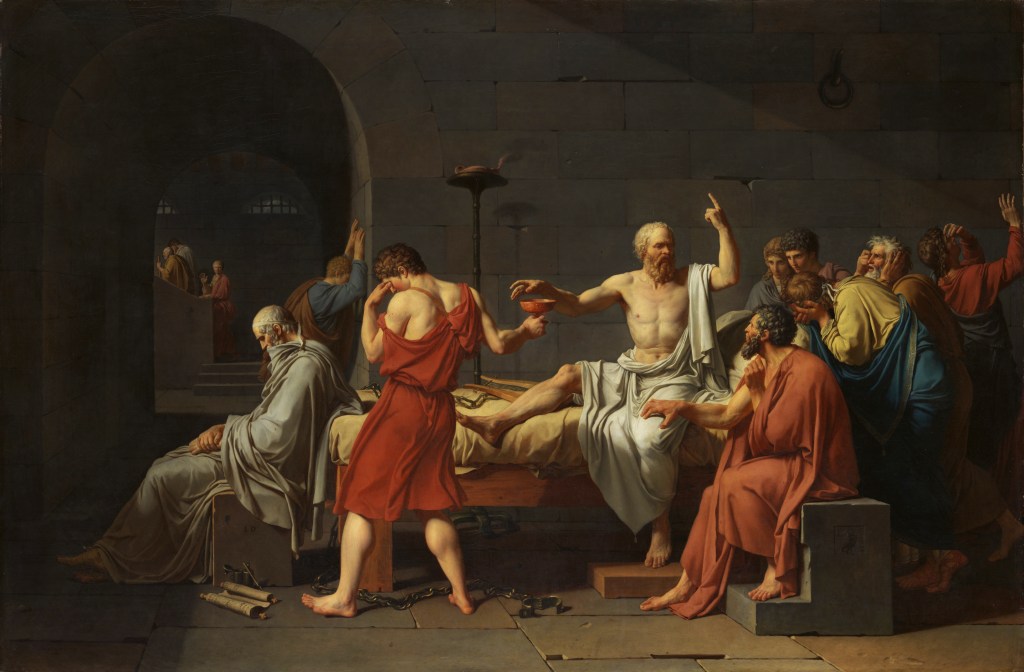
At the end of his trial Socrates’ soul was at peace but still he seeks truth: “Now the hour to part has come. I go to die, you go to live. Which of us goes to the better lot is known to no one, except God.”
The Death of Socrates. By Jacques-Louis David. 1787
Original Book Publication Dates: 1705/1714/1729/1733
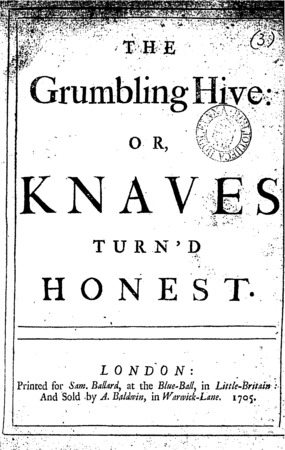
Bernard Mandeville was a free thinker, a contrarian, a troublemaker and likely loved every minute of it. His writings on vice and free living were greedily consumed by the 18th century public, and his notoriety began with a simple poem of 433 eight syllable coupled, rhymed lines, a doggerel of no artistic merit but with a moralistic message that has echoed, in various forms throughout the ages. It was originally titled: The Grumbling Hive or, Knaves turned Honest.
Mandeville was born in 1670 in the Dutch city of Rotterdam where he received a classical education at the Erasmus school and a medical degree from the University of Leiden. In the medical field he developed a special interest in what we would now call psychiatry and the use of talk therapy for curing hypochondriacs, the same branch his father practiced. He anticipated Freud by 175 years. Upon completing his medical studies, he moved to London to learn the language and decided to stay. In London he specialized in treating hypochondriacs, stomach ailments, writing political and philosophical tracts, all in which he achieved minor fame and fortune.
Beyond these meager particulars of his early life very little is known about Mandeville’s personal history. To know him, but not necessarily understand him, one must study his pamphlets and books on politics and philosophy and everything he wrote was soaked with politics and philosophy.
Mandeville’s written works sold so well that dozens of editions were needed to keep up with demand. His most celebrated work was The Grumbling Hive which he published anonymously in 1705. This little ditty immediately became a hit with the public and generated an immense amount of discourse and criticism.
Over the next 25 years or so he expanded the poem with commentary and essays under his own name with the next updated edition coming out in 1714 titled: The Fable of the Bees: or Private Vices, Public Benefits. In 1923 he again expanded the Fable of the Bees with an essay attacking charity schools, free schools for the poor, as nothing more than a vehicle to assuage the guilty conscience of the rich. The schools, while teaching the basics, the three Rs, were also a forum for instructing young minds in morality and religion. Mandeville was not so much against instructing the kids in addition and subtraction but that teaching morality in a capitalistic society was counterproductive.
Mandeville’s premise was that the rich set up and donated to the schools to atone for their gains attained through vice and greed. Mandeville would likely surmise that today’s charity and political donations, such as George Soros’ funding of weak on crime prosecutors, was atonement for their selfish gains in business and the markets. To put it mildly this did not go well with the upper crust, but it did increase the sales of his books.
In 1728 Mandeville expanded the Fable of the Bees again by adding a second volume which provided additional defense of his thesis that vice is good in the form of dialogs: elaborations on the division of labor and their associated economics. The two volumes were published together in 1733, the year of Mandeville’s death.
Mandeville’s basic thesis underlaying the Fable of the Bees was that greed and vice were good for the economy and society. A person’s self-interest in the pursuit of wealth and luxury provides benefits for everyone. A rising tide lifts all boats. The idea of selfishness for the public good certainly predates Mandeville and continues to the present day. The 1987 movie Wall Street, Gordon Gekko played by Michael Douglas argues that the human march of progress is fueled by personal self-interest and greed. Self-interest to accumulate wealth and fame. Morality does not enter into the equation, or it shouldn’t.
Mandeville believed that vice had a negligible effect on the population, but he obviously understood that it was the gateway drug to harder crimes. He understood that victimless crime led to felonious crime. He understood the “Broken Windows Theory” before it had a name. As such he strongly advocated for a robust and universal system of justice. A system that John Adams in 1779 would codify into the Massachusetts constitution as “a government of laws, and not of men.” By laws Mandeville meant the rules of conduct that private society imposed on itself over centuries of trial and error. He was not prescribing a legislative solution to criminal behavior although he offered advice in that arena also. Rather his economic laissez faire attitude carried over to his thoughts on justice. The fewer government mandates the better. He would readily agree with the 20th century Italian political philosopher Bruno Leoni’s notion on government decrees, “legislation…has come to resemble more and more a sort of diktat that the winning majorities in the legislative assemblies impose upon the minorities, often with the result of overturning long-established individual expectations and creating completely unprecedented ones.”
He emphasized the word justice, as in justice for all, without giving much serious thought to the criminal part of the equation. Mandeville’s endeavors at navigating the differences between vice and crime usually led to ambiguous reasoning and muddy waters. He had a wishful belief in a harmless sort of anarchy where everyone didn’t or shouldn’t bother their neighbors — much. Mandeville was stuck between his belief that selfish behavior is good, and that morality is an illusion, leaving no room for compromise. In the end all behavior could be explained by our selfish desires and motives. Altruistic behaviors were just cover for a guilty conscience.
Mandeville’s intellectual, educational, and philosophical journey, with little supporting evidence other than circumstantial bits and pieces, could be a great case study in nature versus nurture. His father and great-grandfather were both respected physicians with the wherewithal to send him to the best schools in Rotterdam.
His formal education began at the local Erasmus school which gave the students a grounding in Christianity, literature, poetry, drama, art, philosophy, languages, and history with an emphasis on lifelong learning. Desiderius Erasmus, a 15th, and 16th century resident of Rotterdam believed that man could only rise above other animals through self-improvement and study.
Another local resident of Rotterdam that had a profound influence on Mandeville was his contemporary, although a few decades older than himself, Pierre Bayle, a philosopher, and skeptic in the purest sense of the word. Bayle believed Christianity did not have a lock on virtuosity and morality. He believed in religious toleration beyond Catholicism for the simple reason that he was persecuted as a protestant. And he believed that one shouldn’t burden one’s conscience with guilt from minor transgressions or sins of the flesh.
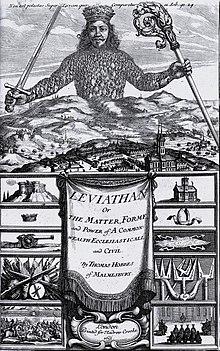
Thomas Hobbes, who died in the same decade that Mandeville was born, was an English polymath best known for his treatise on government and the governed: Leviathan. Leviathan is a discussion on how the individual and societies should be governed, and the covenants between the ruled and the ruler(s) that were needed to hold common-wealth, or as he called it, the Leviathan together. One of Hobbes main points about man as an individual in Leviathan, and which Mandeville was certainly familiar with, was that good and evil were constructs, mere names, for human emotional and physical appetites. The desires that make us human. Morality was nonsense.
26 years after Mandeville’s death Adam Smith wrote The Theory of Moral Sentiments where he introduced the concept of the ‘Invisible Hand’, a concept of individual self-interest driving the economic advancement of society. Adams stated, “They (ed. society) are led by an invisible hand to make nearly the same distribution of the necessaries of life, which would have been made, had the earth been divided into equal portions among all its inhabitants, and thus without intending it, without knowing it, advance the interest of the society, and afford means to the multiplication of the species.” Smith’s ‘Invisible Hand’ is practically interchangeable with Mandeville’s self-interest and greed thesis. Smith expanded upon the ‘Invisible Hand’ in his 1976 publication The Wealth of Nations.
The Theory of Moral Sentiments introduced the ‘Invisible Hand’ but was primarily intended to provide logical reasoning for man’s altruistic nature and furnish a rebuttal to Mandeville and others. Adams believed that morality was more than a word, more than an ethical nicety. Smith believed our sense of morality was real and natural. It was built into our being through the experience of living, and he termed it sympathy, what we would now call empathy. It was natural to care about the lives of others either because we have walked in the shoes of the less fortunate, or we can see with our own eyes what the less fortunate are living with or without. Empathy was the laissez faire sense of justice that Mandeville could not see, but should have, because it was in the opposite direction of selfishness. He wouldn’t look there because he believed it couldn’t be found.
Richard Dawkins’ 1976 book The Selfish Gene asserts that a human gene propagates itself into the future through the individual selfish motives of survival rather than through the desire to better a group or organism. The thought that a gene can be selfish is no more plausible than it can run a 4-minute mile, but it is a useful term to use as a descriptor. Dawkins claims that the selfish gene increases its chances of replication and survival by promoting altruistic behavior between like members of a group or organism. The selfish actions of the individual or the gene leads to unselfish actions of the group or the organism.
In the end Mandeville articulated a theory of self-interest driving societal economic advancement that causes emotional discomfort in most of us, not because it is wrong but because it is only half right. We may be selfish, but altruism and benevolence are part of our nature, a major part of who we are. Selfishness and altruism together advance our species and our society.
Bibliography:
1685 de Medicina Oratio Scholastica. Regneri Leers, Rotterdam. An oration in which BM declares his intent to study medicine at Leyden.
1689 Disputatio Philosophica de Brutorum Operationibus. Abraham Elzevier, Leyde. A dissertation delivered at Leyden in 1689, in which Mandeville defended the Cartesian position that animals are unfeeling automata.
1691 Disputatio Medica Inauguralis de Chylosi Vitiata. Abraham Elzevier, Leyden. Mandeville’s medical dissertation in which he argued that digestion involved fermentation, rather than warmth.
1703 Some Fables After the Easie and Familiar Method of Monsieur de la Fontaine. Printed for and sold by R. Wellington, London
1703 The Pamphleteers. A Satyr, London
1704 Æsop Dress’d or A Collection of Fables Writ in Familiar Verse. Printed for R. Wellington, London
1704 Typhon: Or the Wars Between Gods and Giants. Printed for J. Pero, Little Britain
1705 The Grumbling Hive, or Knaves Turn’d Honest. Printed for S. Ballard and A. Baldwin, London
1709 The Virgin Unmask’d: Or, Female Dialogues Betwixt an Elderly Maiden Lady … Printed, and are to be sold by J. Morphew, and J. Woodward, London
1709 The Female Tatler, by “a Society of Ladies”. A. Baldwin, London
1711 A Treatise of the Hypochondriack and Hysterick Diseases. In Three Dialogues. Printed J. Tonson, London
1712 Wishes to a Godson, with Other Miscellany Poems. Printed for J. Baker, London
1714 The Mischiefs that Ought Justly to be Apprehended from a Whig-Government. Printed for J. Roberts, London
1714 The Fable of the Bees: or, Private Vices, Public Benefits. Printed and sold by J. Roberts, London
1720 Free Thoughts on Religion, the Church, and National Happiness. Printed, and sold by T. Jauncy, and J. Roberts, London
1723 An Essay on Description in Poetry with A Description of a Rouz’d Lion. Printed in St. James Journal
1723 The Death of Turnus. Printed in St. James Journal
1723 The Fable of the Bees: or, Private Vices, Public Benefits. Expanded Edition. Printed for E. Parker, London
1724 A Modest Defence of Publick Stews. Printed by A. Moore, London
1725 An Enquiry into the Causes of the Frequent Executions at Tyburn: and a Proposal for Some Regulations Concerning Felons in Prison, and the Good Effects to be Expected from Them. Letters to the British Journal
1729 The Fable of the Bees: or, Private Vices, Public Benefits. Volume II. Printed and sold by J. Roberts, London
1732 An Enquiry into the Origin of Honour and the Usefulness of Christianity in War. Printed for J. Brotherton, London
1732 A Letter to Dion, Occasion’d by his Book called Alciphron. Printed and Sold by J. Roberts, London
1733 The Fable of the Bees: or, Private Vices, Public Benefits. Volumes I and II. London



 elsToday