More Grease

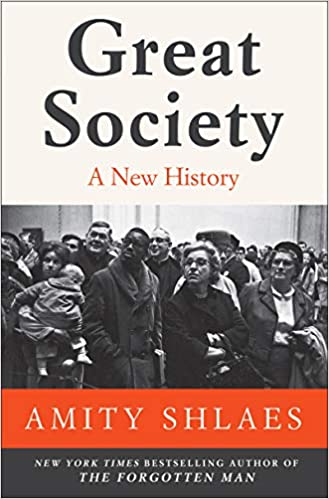
Great Society: A New History

By Amity Shlaes

Published by Harper

Copyright: © 2019
Amity Shlaes, age 62, is the Presidential Scholar at the King’s College, a Christian, classical liberal arts school in Manhattan where she teaches Coolidge, the subject of her most recent book. She previously taught at New York’s Stern School of Business, also in Manhattan where she lectured on Great Depression economics, a subject of her third book which was released in 2007. She is chairwoman of the board of the Calvin Coolidge Presidential Foundation of Plymouth, Vermont, and chairs the jury for the Manhattan Institute’s Hayek Book Prize located in, well–Manhattan. Shlaes is a past trustee of the German Marshall Fund, a public policy think tank promoting cooperation between North America and Europe, initially funded by the West German government as a memorial to the post WWII Marshall Plan. In the early 2000s she was a senior fellow of economic history at the Council on Foreign Relations, a think tank specializing in U.S. foreign policy and international relations.

Shlaes and Sauvik Chakraverti shared the inagural $15,000 Bastiat Prize, a journalism award given by the Reason Foundation, in 2002 for her political economy writing. (Chakraverti received the award for being the greatest libertarian ever.) She gave the 2004 Bradley Lecture, an American Enterprise Institute program series, on the Schechter vs United States Supreme court case that invalidated parts of the legal and regulatory over-reach during the FDR administration. Shlaes received the $50,000 Hayek Book Prize in 2007 for “The Forgotten Man: A New History of the Great Depression. She also recieved the 2007 New York City Deadline Club award, a journalistic Pulitzer type award for opinion writing. Shlaes recieved the 2021 $250,000 Bradley Prize from the Milwaukee based Lynde and Harry Bradley Foundation, a grassroots and faith-based philanthropic organization, for her work on economic history.

Amity Shlaes has five New York Times bestsellers: The Greedy Hand: How Taxes Drive Americans CrazyThe Forgotten Man: A New History of the Great Depression, The Forgotten Man: Graphic Edition, Coolidge, and Great Society: A New History.

Shlaes has written for numerous publications over years including The New Republic, The New Yorker, the Spectator of London, The New York Times, The Washington Post, the National Review, the Wall Street Journal, The American Spectator, Foreign Affairs, Bloomberg News, and Die Zeit. She currently writes a column for Forbes.

Great Society: A New History details Lyndon Johnson’s efforts as president to eliminate poverty in United States. On 22 November 1963, a few hours after the assassination of John Kennedy, Lyndon Johnson was sworn in as the 36th president of the United States. Johnson inherited a robust, growing economy with low unemployment. As a life-long politician, inheriting a healthy economy was not something he believed he could run on for the 1964 presidential election and win. He chose to finish Kennedy’s sensible initiatives on tax rate cuts, budget reduction and civil rights guarantees to all while he worked out the details for his own signature plans that became known as the War on Poverty. The purpose of his strategy was not only to eliminate poverty but expand federal government involvement in education, health and finances for the elderly, and providing aid to the working poor and unemployed. Between August 1964 and July 1965 Congress passed and Johnson signed four major programs that were the prime tactics behind the strategy for the War on Poverty. The first bill signed was the Economic Opportunity Act which created the Job Corps and Youth Corps, along with providing work, education, and training for young adults. Additional programs were geared towards college students, rural poor, and migrants. The second bill passed was the Food Stamp Act which provided nutritional subsidies for the poor. The Elementary and Secondary Education Act was the third bill passed and involved grants to schools and states to assist in the education of low-income families. The final bill passed was the Social Security Act of 1965 which created Medicare and Medicaid.

Proponents of the War on Poverty programs state that poverty rates decreased, as defined by the US government’s Census Bureau, from approximately 23% in 1958 to 11.3% in 1973. The Great Society programs were not fully funded and implemented until late 1965 to late 1966 at which time the poverty rates had already dropped below 15% without any of Johnson’s anti-poverty stimulants. Poverty rates since the passage of the Great Society programs have stubbornly remained between 11 and 15%. An alternate interpretation of the Great Society programs is that at best, they did nothing to reduce poverty to, at worst, they cemented poverty forever more into a narrow range between 11-15% of the population. Inflation adjusted cost estimates for the Great Society programs from inception to present are somewhere north of $60 trillion or a little more than a trillion dollars per year.

Shlaes tells us the story of Johnson’s War on Poverty. She begins with the Kennedy years and ends with Nixon, but it is all Johnson in between. Johnson fathered the Great Society, nursed his skinny stepson into the corpulent war in Vietnam, and left before he had to pay child support. She tells the story of the events and happenings that brought us the Great Society, but she tells the story through the people on the ground and in the halls of power. Michael Harrington and Tom Hayden, socialists with the Students for Democratic Society who crafted the Port Huron statement, a communist manifesto which played a starring role in the birth of the Great Society. Abbie Hoffman who took over SDS and morphed it into a violent Maoist offshoot called the Yippies who were always throwing a temper tantrum against something. Walter Reuther, UAW president and king maker for the Democrat party and money man for all things socialist. Sargent Shriver, poster child for the Peter Principle, was the actual architect of the War on Poverty. Daniel Patrick Moynihan, an intellectual with a heart and absolutely no common sense until his epiphany on cause and effect in 1980s. Burns and Nixon who had the dubious distinction of following Johnson like the men walking behind the elephant parade with a broom and an excessively big bucket and they will be hated for it forever. And Paul Volker the man who showed the nation the secret recipe to fix problems caused by fiscally prolificate politicians — a barrel of remarkably high interest rates.

Shlaes tells this story through the eyes of the men and women who were there. She tells their stories and doesn’t offer much in the way of opinion, neither good nor bad. Even in the end she plays the historian without interjecting herself into the story but the story snitches on itself: good intentions and bad ideas are not the basis for public policy.

Shlaes’ books:

Shlaes’ Lectures and Video:

(The picture of Amity Shlaes comes from the Great Society: A New History jacket back cover. The graph of poverty rates is derived from Census Bureau data.)
A New Center

Galileo: Watcher of the Skies

By David Wootton

Published by Yale University Press

Copyright: © 2010

David Wootton, age 71, is the Anniversary Professor (a named professor in the British system is equivalent to a full professor in the American system…I believe) of History at the University of York in England. His work ranges from the history of the individual to the wider-ranging histories, and philosophies of ideas that shaped our world. His published interests concentrate on the Renaissance but stretch back to the Greeks and forward to the embryonic American experiment. He is an old-school historian with his scholarship supported by the evidence available coupled with the existing mores of the times. His selection of topics that I have read or perused suggests a thorough dearth of confidence in past historical interpretations and a jaundiced view of present sense and sensibilities. Or more succinctly and in his own words, “History is always about a particular time, a particular place; it is always about groups more than it is about individuals; it is always the history of somewhere.” and if I may so boldly add, it is always the history of (some)time.

Wootton’s written works (books) include:

Wootton’s lectures and pop culture additions include:

Wootton’s biography of Paolo Sarpi, a contemporary and patron of Galileo, likely provided, albeit 27 years later, the impetus and scholarship for Wootton publishing his second biography in 2006 on that aforementioned watcher of the skies. Sarpi, a devout Copernican and a supposedly not so devout Catholic supported Galileo’s heliocentric theories and shielded him, for a time, from his Roman inquisitors. Parenthetically, Wootton in his book on Galileo almost apologizes for writing biographies mainly because his peers look down on the genre, a sentiment I used to harbor but I now appreciate the category because they provide the who to the what, where, and when.

Bad Medicine, Wootton’s second book, postulates that doctors have dispensed more harm than good, beginning with Hippocrates in the fifth century B.C and continuing through to the present day. Covid or the Wuhan Flu pandemic will not provide the medical profession with the needed catharsis to dispel Wootton’s conjecture.

In The Invention of Science Wootton walks us through the birth of the scientific method starting with a supernova shining in the Renaissance night sky of the 1500s and culminating with Newton’s discovery that visible light contains a plethora, or at least 7 wavelengths and hues in the early 1700s.

In Power, Pleasure, and Profit, Wootton expands on the concept of selfishness driving all human progress. A concept, although anathema to all Christian and Western ethics and morality, was espoused by Machiavelli’s The Prince, published in the early 1500s and Mandeville’s The Fable of the Bees, also known as The Grumbling Hive, first published in 1705.

Wootton’s Besterman Lecture: Adam Smith, Poverty, and Famine, we find out that charity is not a word in Smith’s vocabulary. Academics and maybe the rest us can really get into the weeds.

And finally, before I get into Galileo, The BBC devoted 40 minutes interviewing four guests, Wootton being one of them, on The Fable of the Bees, written initially as a poem, as stated above, by Bernard Mandeville and expanded into a book length dissertation sub-titled Private Vices, Publick Benefits which proposes that personal pleasure and greed drive human progress not altruism or Christian charity.

Galileo, born in the small city of Pisa, Italy in 1564, lived to the astronomical age of 77, some 25 years beyond the average lifespan for that era. He spent his final years blind, serving a life sentence, originally in a papal prison but eventually the prison was exchanged for confinement to his home located in a small village outside of Florence. His crime was for authoring a book defending the heliocentric model of the universe as theorized by Copernicus in 1543 rather than promoting the geocentric model as demanded by the Catholic Church.

Galileo was a tinkerer and thinker more akin to our modern definition of an engineer rather than a scientist, taking innovative ideas and novel inventions to the next level. He didn’t invent the telescope, Hans Lippershay of the Netherlands in 1608 did, but Galileo’s design quickly became the standard and he eventually increased Lippershay’s 3x magnification to 23-30x. His leaden tube with a convex lens in one end and concave lens in the other end discovered the mountains and plains of the moon, the moons of Jupiter, the rings of Saturn, the phases of Venus, possibly the planet Neptune, individual stars of the Milky Way, and sunspots. Today we can purchase a 30x set of binoculars for less than $100 which we use to peep through our neighbors’ windows and watch songbirds in the meadow across the street. All his discoveries aided in the proof of a heliocentric universe, his universe being mostly what we would refer to today as the solar system. Our discoveries prove that our neighbors are weird.

Galileo was a fascinating man and genus who introduced the world to a new way of advancing our knowledge of the world and the universe. His tinkering and thinking were the rudimentary beginnings of what we now call the scientific method–observe, hypothesize, test, repeat.

His proof of Copernicus’ theory was mostly correct. The Church’s defense of the geocentric model wasn’t. The Church admitted their error in 1992.

Bits and Pieces

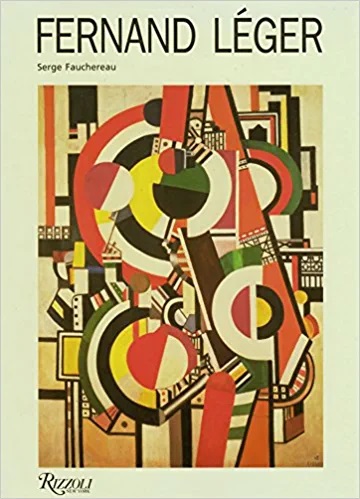
Fernand Leger

By Serge Fauchereau

Translated by David Macey

Published by Rizzoli International Publications

Copyright: © 1994

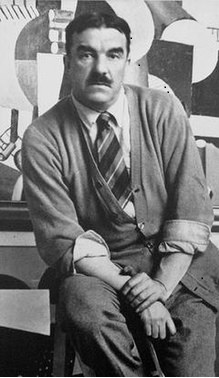
Fernand Leger in 1916

Serge Fauchereau, born on Halloween in 1939 in France, is an art curator; art critic; professor of literature, art history, and writing; and author of artist biographies and art styles. Fauchereau has spent his adult life educating the public on, and extolling, 20th century avant-garde painting and sculpture, specifically the abstract and cubist styles.

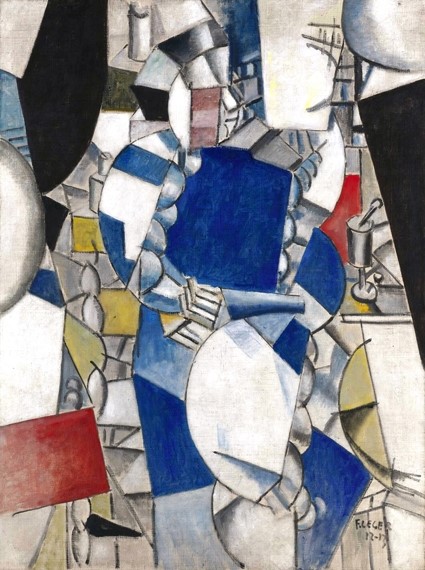
Cubism – The Woman in Blue – Legar 1912

Abstract art attempts to free visual representations of reality from the concrete, expressing form and color spiritually, emotionally, metaphysically without the chains of perspective, fact, or conclusions. Cubism, a mathematical sub-set within the abstract world, takes the whole of reality apart piece by piece, reexamines and reimages the pieces, giving them their own perspective, color, and frame; and then collects the many pieces into something greater than the one. Sometimes this works.

Paul Cézanne, 19th century French post-impressionist painter, is considered the father of Cubism but not actually a Cubist himself. Cezanne stretched the accepted norms of perspective, giving separate objects within his paintings their own reality, their own commentary. Pablo Picasso and Georges Braque, along, to a lesser extent, with Fernand Leger, took their cues from Cezanne, developing a style that became known as Early Cubism in the first 15 years of 20th century.

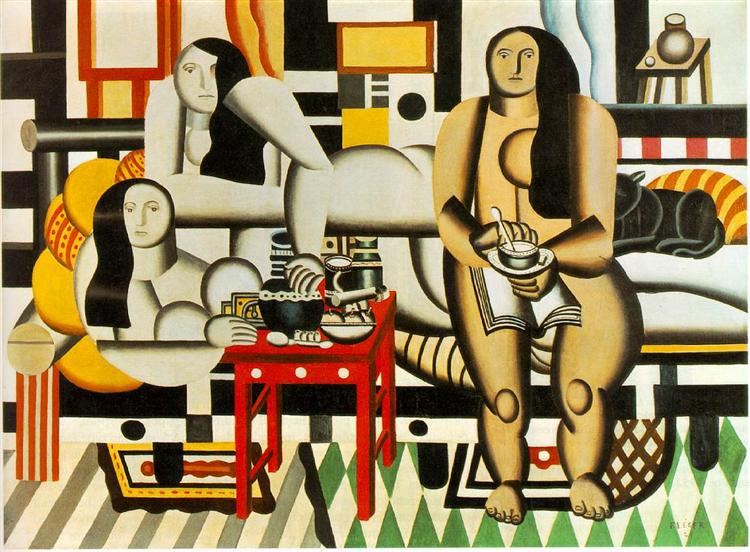
Tubism – Three Women – Legar 1921
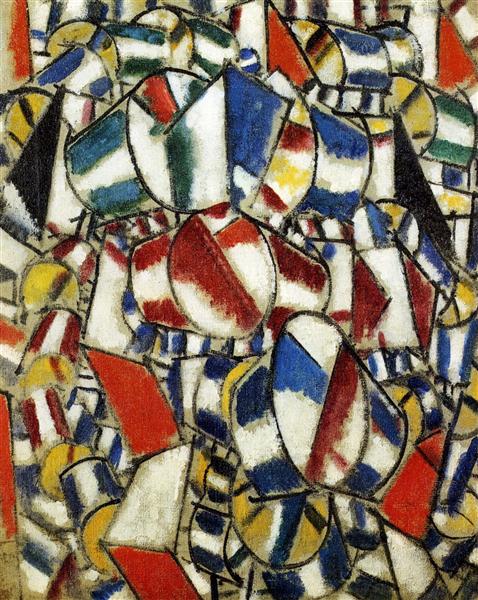
Contrast of Forms – Legar 1913

Fernand Leger, born in Normandy, France in 1881, was an extrovert who successfully kept his private life hidden from the public, expressing himself exclusively through his paintings and films. His early works, before 1908, were strongly influenced by the French impressionistic painters. Dissatisfied with his impressionistic efforts he destroyed all his paintings from this period.

Moving on from impressionism, he circulated with the Parisian modern art crowd, where he began to experiment with the Cubist style, finishing his initial works, La Couseuse and Compotier sur la Table in 1909. After WWI, in which he served on the Verdun front and was wounded, he developed his own style, a modified form of Cubism which he called Tubism, more a foray into pop art than a formal artistic movement. Beginning in the early 1920s he collaborates and directs art films beginning with La Roue followed by Skating Rink and Le Ballet Mecanique.

Till the end of his life in 1955 he continued to paint, lecture, exhibit and travel, cementing his reputation as pioneer in the world of modern art. His reputation continues to grow with his Cubist Contrast of Forms selling at a Christie auction in 2017 for $70,062,500.

Giant Before Us

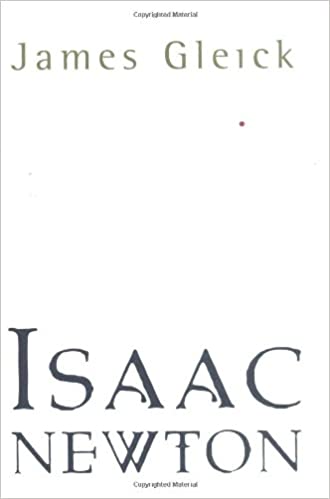
Isaac Newton

By James Gleick

Published by Pantheon

Copyright: © 2003

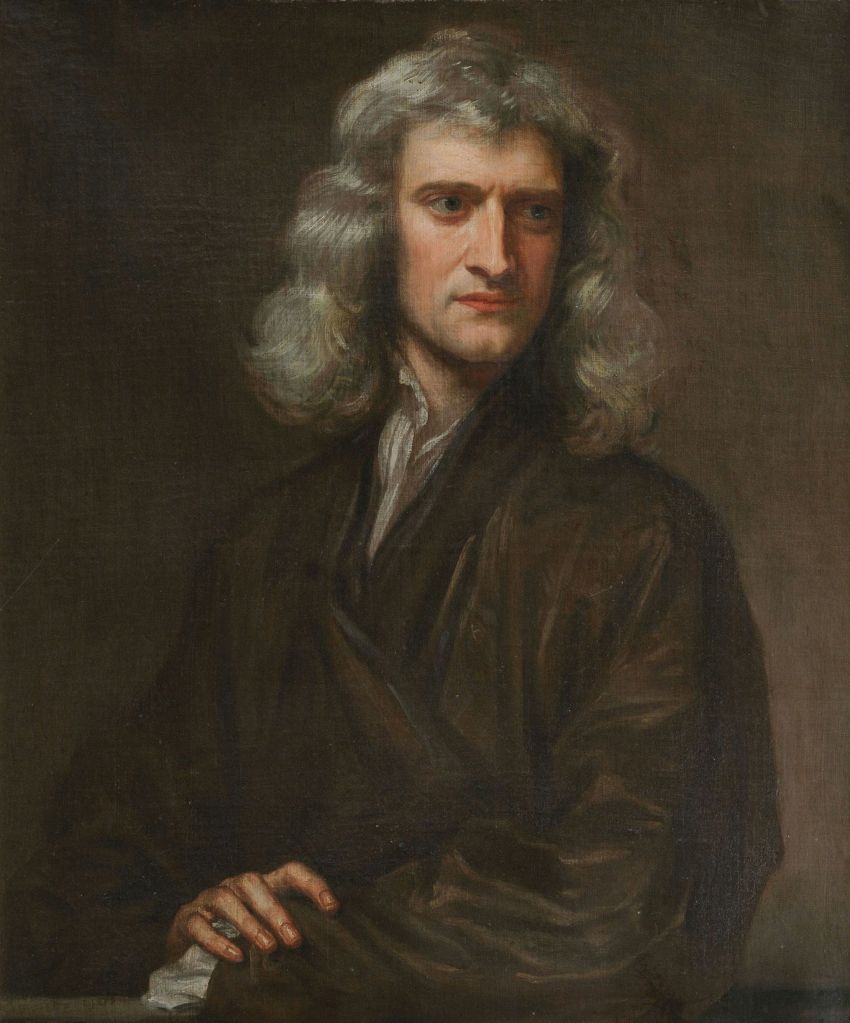
Isaac Newton at 46

James Gleick left Harvard in 1976 with a degree in English and a disposition towards independence from the 9 to 5. His initial attempt at independence after college was launching a weekly newspaper in the midwest city of Minneapolis, Minnesota. This endeavor ended in failure within a year, and it would take another 10 years before he could leave his day job, succeeding as an author of history of science and a provider of internet service in New York City.

His first book, Chaos: Making a New Science, was critically acclaimed and a million copy best seller establishing Gleick as a first-rate storyteller of difficult subjects to the lay public. He wrote two other bestsellers, both biographies, Genius: The Life and Science of Richard Feynman in 1992 and Isaac Newton nine years later.

Gleick presents Newton’s life in chronological order, painting a beautiful portrait of his acheivements but also imparting a sense of his being as a human. His accomplishments were beyond exceptional, but his temperament was that of a reluctant member of society at large, not easily befriended, easy to offend, and not quick to forgive. Current hypotheses suggest that Newton may have suffered from Asperger’s Syndrome, one of the milder forms of autism. As a social being he appears a lot like Beethoven, also a genius but also without grace or courtesy.

Issac Newton was born fatherless, on Christmas Day in 1642 according to the Julian calendar, still in use in England at the time, or the less interesting 4 January 1643 by the today’s Gregorian calendar, on a sheep farmstead far north of London in Lincolnshire County. His father died about three months before his birth and in three years he was shuffled off to a grandmother’s care for the next 9 years to keep him away and out of site from his mother’s new husband, Reverend Barnabas Smith. His early education was at the ancient King’s School, already more than two hundred years old when he entered in 1655 and still operates as an all-boys grammer school to this day. Upon finishing at King’s School, he entered Trinity College at Cambridge in 1661 and, except for a year away in 1665, he stayed as a student and professor until 1696. Immediately following Cambridge, he became Warden of the King’s Mint and in 1703 became president of the Royal Society and stayed in that position until he died in 1727.

Newton’s contributions to the world were many and varied. His Three Laws of Motion were revolutionary in the 18th century, and as a testament to their lasting correctness are still taught to every school kid early in their education. The Law of Gravitation explained the orbit of the heavenly bodies and why apples fall and not rise, float, or go sideways. It has since been replaced by Einstein’s General Relativity but is still a particularly good approximation for us lessor mortals. Calculus. Enough said.

Newton also intensely studied the bible, believing that the universe could only exist through the existence of God. He rejected the Trinity believing there is one God, God the Father with Jesus and the Holy Spirit subservient to God. Newton also predicted that the end of times would not come before 2060, 38 short years from now. Still a little early to be maxing out your credit cards.

Newton researched and experimented with alchemy, including looking for the Philosophers Stone and the force that keeps the planets in their orbits. Seeking the Philosophers Stone may have been worthy of Harry Potter but I’m not sure about Newton. Newton never published anything on his alchemy studies, likely because it didn’t make any sense. Now looking for the force that kept planets from falling your head during a walk-in park was worthy of Newton and the rest of the world, especially Einstein. Newton found it and it was called gravity.

My one complaint with Gleick’s book is his derisive commenting on Newton’s fascination with alchemy through today’s lens of knowledge rather than accepting that understanding and meaning in this world changes, sometimes for the better, sometimes not. People respond to the time they live in not to the unknowns of the future. Newton put it this way, “What we know is a drop, what we don’t know is an ocean.” and one can only study the drop that he has.

One of my favorite quotes of Newton or anyone for that matter was, “A man may imagine things that are false, but he can only understand things that are true.” I liked this quote when I first saw it, not because it was profound, it was, but because it was an idea I had promulgated early on in my education, if it didn’t make logical sense, it probably was wrong.

Bourgeois Realism

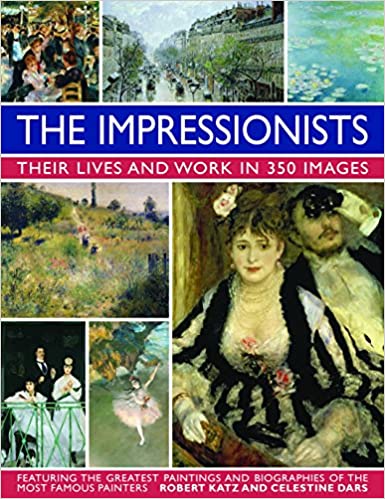
The Impressionists: Their Lives and Work in 350 Images

By Robert Katz and Celestine Dars

Published by Lorenz Books

Copyright: © 2016

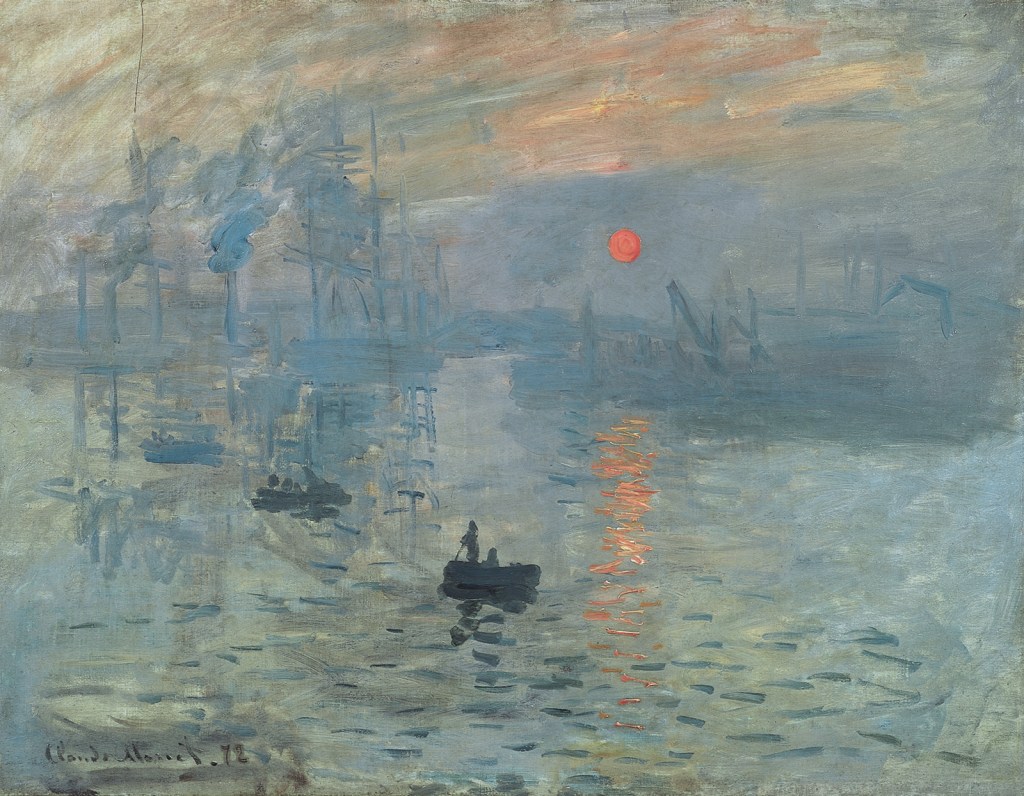
A small coterie of Parisian painters, less than a dozen, mostly French, mostly young and middle class, disillusioned with the elite’s adherence to Neoclassicalism and Romantism, began to experiment in the latter half of 19th century with bold colors and light, loose, broad brushwork and forms, simple, pleasing scenes of everyday life and contentment, landscapes painted in the open air: en plein air, painting what their eyes saw, and their hearts felt. Their style came to be known as Impressionism, a term lifted by an art critic who intended censure and derision from Monet’s painting: ‘Impression, Sunrise’ (shown above right). Impressionism, initially disregarded and rejected by the critics and the public, became the solid foundation for all painting to come; Post-Impressionism, Art Noveau, Cubism, and onto what is today casually labeled modern or contemporary art.

As Impressionism birthed the future of painting in the west, the Realists: Millet, Corot, Corbet, and others created the base for Degas, Manet, Monet to which they added something fresh and enjoyable. Realists painted the world as they perceived it: poor, laboring, dismal, dystopian. The Impressionists kept the Realists’ stage, the world as it is, but added cheerfulness and peace by experimenting with light and form.

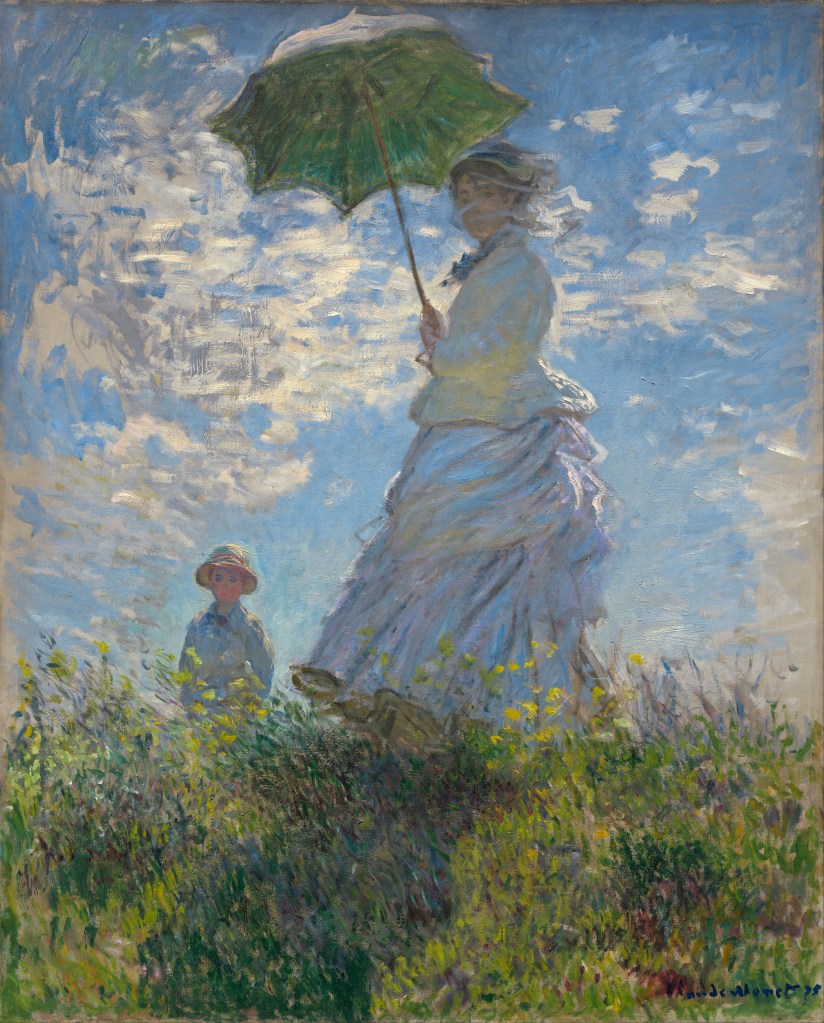
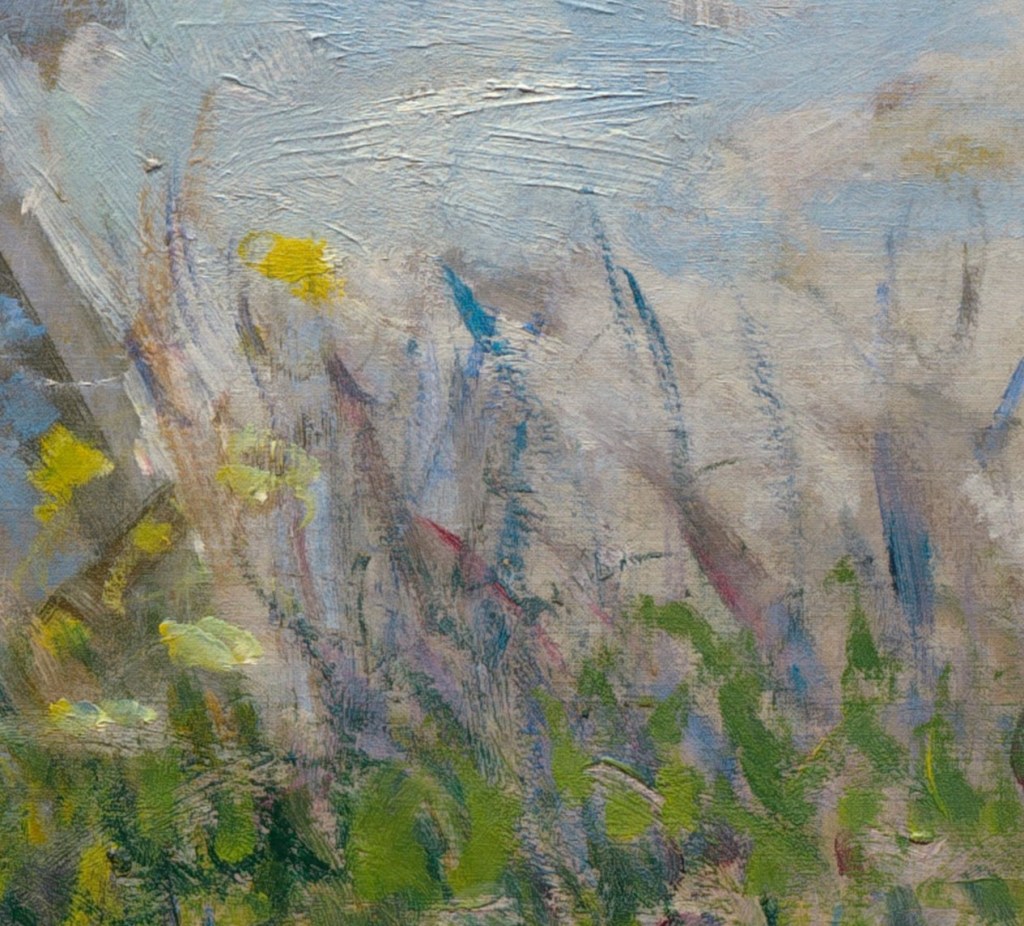
Monet’s genre masterpiece, ‘Woman with a Parasol-Madame Monet and Her Son (shown above left), captures his wife and son in a leisurely stroll around a blustery Argenteuil, a suburb of Paris, in 1875. The woman and son are looking down on the painter with her umbrella blocking out the sun creating an impression of light dancing through the clouds and sky, imparting a stark contrast for the shadows below moving across the grass and flowers. The woman’s vail and dress ripples across her face and body in tune with the breeze. The boy is in the background giving the painting an added sense of depth. The detail of the painting (above right) shows the broad brushstrokes, bold colors and contrasts that came to characterize Impressionistic art.

‘The Impressionist’ brings form and substance to the lives of six of the greatest artists of the genre: Pissarro, Manet, Degas, Monet, Renoir, and Sisley, who gave birth to something new.

The Other Michelangelo

Caravaggio: The Complete Works

By Sebastian Schutze

Published by TASCHEN

Copyright: © 2015

The other Michelangelo, Michelangelo Merisi da Caravaggio, was born almost 100 years after the Michelangelo of Florence and Sistine Chaple fame, in the northern Italian city of Milian, at the time a part of the Spanish Empire; coming of age as a painter in the dying days of the Renaissance art period and the birth of Baroque, developing and leading a style with an increased attention to detail, lighting, and volume not so much in contrast, but in addition to the scientific realism of the previous 200 years.

Caravaggio took the Baroque art beyond the biblical themes of the Renaissance while retaining the humanism, maintaining naturalism but with detail likely unavailable to painters before him, improving on perspective and volume through the use of light and dark: Chiaroscuro, and giving the subjects an emotional bearing that communicates to the viewer a deportment not obtainable to the first Michelangelo.

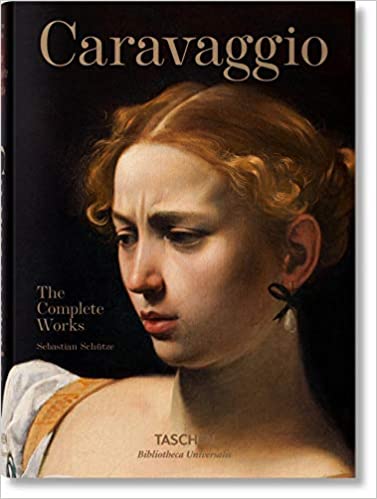
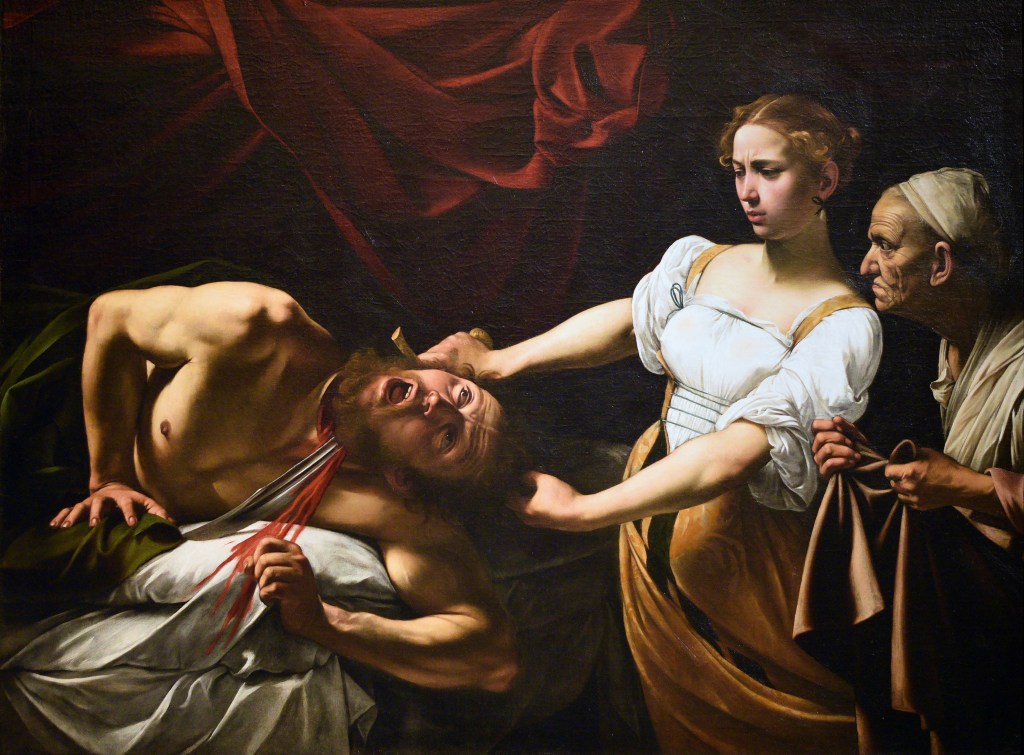
The book cover, Judith beheading Holofernes, detail above with full painting shown below, depicts Judith looking down and to the viewers left with a look, according to some, of revulsion and disgust, but my interpretation is one of apathy and possibly puzzlement, as noted by the slight creases between the eyebrows and the bridge of the nose and the minor squint of the eyes. Panning out may add an unquestioning repugnance to the painting but not to Judith’s countenance, it remains one of bemusement, a ‘is this all there is’ to vanquishing one’s enemy, while an old woman looks over Judith’s shoulder concurring, not seeing the gore of the moment but the moral of the act and feeling ‘Good, it is done’. The detail may be there, but the viewers interpretation is still required.

Caravaggio, CC BY-SA 4.0 https://creativecommons.org/licenses/by-sa/4.0, via Wikimedia Commons

It Happened Already

The Stars and The Earth or Thoughts upon Time, Space, and Eternity

By Felix Eberty

Translator: Josephine Caruana

Published by Comino-Verlag

Copyright: © 2018

A short read reflecting on the information carried by a photon as it reaches your eye from the far reaches of space.

Originally the book was published in two volumes, both together totaling less than 80 pages, in 1846 and 1847. The book sought the union of physics and religion, metaphysics; for God sees the past and the present as a single point in the space time continuum, time stopping when moving with the light, observing all in three dimensions rather than four. Eberty continues his thesis from an all-seeing God to a time when man’s technological progress allows him to see as God sees or the child of God becomes a god.

Eberty knowing that the speed of light was finite, about 300,000 km/s, contemplated that all visuals captured by any type of eye, human or otherwise, happened in the past. The past including an inconceivably, insignificantly small amount of time in the past, such as a plate of mac and cheese in front of you, is still in the past, what you see has already occurred. Jurgen Neffe, author of a biography of Albert Einstein, stated it succinctly “time travels with light”. Observing light traveling from a billion light years away exhibits events as they happened a billion years ago but if you traveled with those photons for those billion years the past occurs at the same time as your present.

Eberty’s thoughts on the meaning of time and space were recognized at the time not only as novel but metaphysical in nature, maybe not so much today.

You Are Here: Now What?

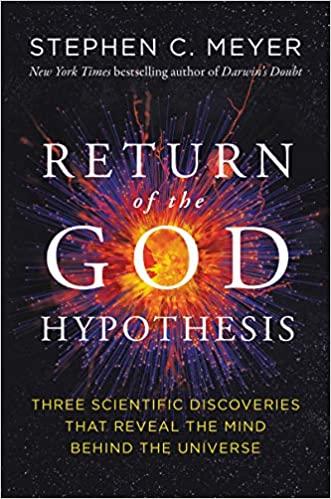
Return of the God Hypothesis

By Stephen C. Meyers

Published by HarperOne

Copyright: © 2021

An interesting if not an enlightening, but thoroughly tedious treatise.

Meyer, in excruciating detail, examines the evidence for a universe designed, created, and set into motion by the hand of God. His proofs assess how the universe is perfectly tuned to foster our existence, how human DNA’s complexity is beyond random chance, and how the explosion of multi-celled life forms during the Cambrian Period (485-539 mya (million years ago)) is unlikely Darwinian in nature.

The first two proofs are plausible, and his arguments are meticulously developed, while the Cambrian explosion of life does not address the hundreds of millions to a billion years of missing rock section prior to the beginning to the Cambrian Period. The explosion of life may simply be a function of where one begins to sample the evidence.

Meyer’s case for God orchestrating our existence is convincing but you only need to read Part II, about 150 pages in the hardback version of the book, while the other 300 pages can be consigned to doctoral students in logic and religion.

Universal Physics and Local Irrelevance

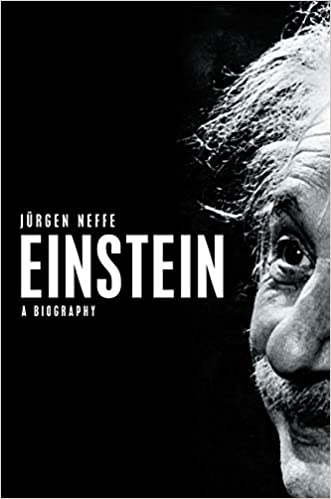
Einstein: A Biography

By Jurgen Neffe

Translated by Shelly Frisch

Published by Farrar, Straus and Giroux

Copyright: © 2007

Neffe brings comprehension to relativity but muddles Einstein’s personal life to inaptness.

Neffe’s non-linear telling of Einstein’s life adds little to the story and a lot of unnecessary page flipping for the reader to grasp the author’s intermittent and incomplete style of writing, whereas his layman descriptions of the theory of relativity generally clears the accumulated fog of physics to bring basic understanding Einstein’s science.

Early Italian Renaissance Painting

Piero Della Francesca

By Anna Maria Maetzke

Photographs by Alessandro Benci

Published by Silvana Editoriale

Copyright: © 2013

An art book short on art and long on art history and art criticism.

Piero della Francesca, born in Tuscany in the early 15th century, is regarded as a true master before his time, eerily anticipating post impression by 500 years. Francesca was a major force in inputting perspective into paintings, greatly influenced by an Italian contemporary polymath, Leon Battista Alberti.

Francesca’s greatest works include the painting to the right, Federico da Montefeltro, Duke of Urbino, and the fresco, The Legend of the True Cross, located within the basilica of San Francesco in Arezzo, Italy.

The book contains all surviving paintings by the artist, about 150, which showcase his genius when compared with fellow artists such as Donatello and Brunelleschi, along with extensive research and commentary on Francesca’s life and art.