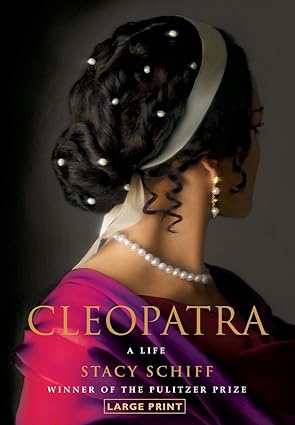
The Last Queen

Cleopatra VII, descendant of Alexander the Great’s general Ptolemy Soter, inheriting the Egyptian Empire upon Alexander’s death, was the last pharaoh or queen of Egypt. Upon her death in 30 B.C., less than two weeks after the death of her lover, Mark Antony, she took her own life, likely with a fast-acting poison rather than the bite of an asp. This cleared the way for Augustus, the founder of the Roman Empire, to incorporate Egypt into the Roman realm.

In Cleopatra: A Life, Stacy Schiff weaves an engrossing tale of the queen’s ruthless ambition to restore the Egyptian Empire to its former glory. Though Cleopatra’s life lasted less than 40 years, she brought Rome into her world, achieving greatness that ultimately led to her downfall.

Cleopatra wanted greatness and found the means to attain it. Schiff states in her book that “Cleopatra appears to have had sex with only two men. They happen, however, to have been Julius Caesar and Mark Antony, among the most prominent Romans of the day. …Cleopatra had a child with Caesar and after his murder — three more with his protégé…The two [Cleopatra and Anthony] would together attempt to forge a new empire, in an alliance that spelled their ends.

Source: Cleopatra: A Life by Stacy Shiff, 2010.
Epistemic Humility

Donald Rumsfeld, expanding on Socrates’ statement, “The only true wisdom is in knowing you know nothing,” pedantically states in the year 2002 that, “There are known knowns—things we know that we know. There are known unknowns—things we know we don’t know. But there are also unknown unknowns—things we don’t know we don’t know.

Which suggests that we all are pre-ordained to a life of study to shorten the list of unknowns and the embarrassment of being unprepared.

G.K. Chesterton anticipating that a lifetime, or something less than a lifetime of study has its dangers, warned in his 1908 collection of essays, “All Things Considered,” “Without education, we are in a horrible and deadly danger of taking educated people seriously.” Implying that a myopic education may allow for mastering a single subject but is ill-equipped to understand anything broader; unable to see the forest for the trees.

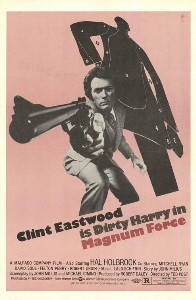
Which leads us to the 1973 “Magnum Force” with Clint Eastwood, wielding a Smith and Wesson Model 29 .44 magnum in a Dirty Harry hand, explaining to an unfortunate soul that “A man’s got to know his limitations,” highlighting the concept of epistemic humility: the recognition that one’s knowledge and understanding is always limited and to proceed accordingly.

Source: Socrates. G.K. Chesterton. Socratic-Method.com.  Graphic: Magnum Force poster, copyright Warner Bros.

The Fall

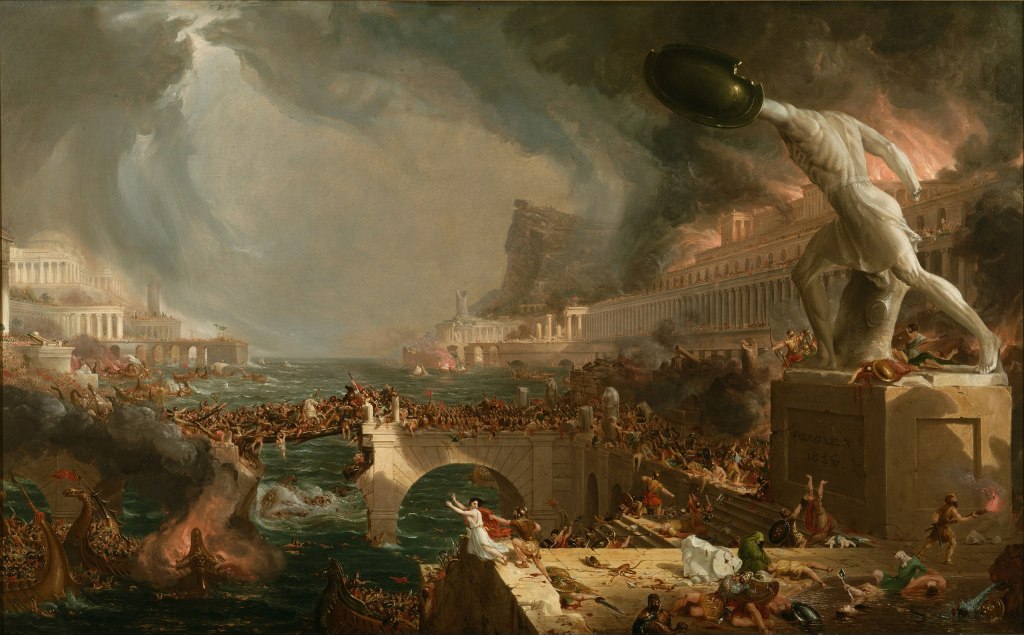
Edward Gibbons’ epilogue to his book, “The Decline and Fall of the Roman Empire”, mentions several factors that led to the collapse of the Empire:

  1. Barbarian Invasions: Incursions and settlements of Germanic tribes, Saxons, Huns, Alans, and others that overtaxed and weakened the Roman military and its infrastructure.
  2. Decline of Civic Virtue: Loss of a sense of civic duty and responsibility and the subsequent decay of public morality
  3. Christianity: Spiritual concerns took the focus away from civic duties. (Gibbons wasn’t an atheist but likely a deist or a detached Christian with a disdain for organized religion.)
  4. Economic Decay: The empire faced heavy taxation, inflation, and reliance on slave labor. Inflation was due to government corruption, excessive trade imports, military spending, and debasement of the currency.
  5. Political Corruption: A corrupt and unstable political system led to ineffective and nonsensical governance.
  6. Military Overextension: The Empire was too large to manage, resulting in an over-stretched military.

Marcus Aurelius in his book, “Meditations” also mentions the Antonine Plague years of 165-180 AD (a second outbreak occurring from 251-266 AD) as the primary cause of the Empire’s decline. The plague reduced Rome’s population, affecting its military’s ability to defend its borders, and the loss of labor to maintain its infrastructure.

Additional factors have also been mentioned by others, including: a disloyal military, civil wars, lead poisoning, and the always useful-climate change.

Source: “The Decline and Fall of the Roman Empire” by Edward Gibbons, 1776-1788. “Meditations” by Marcus Aurelius. Graphic: Destruction by Thomas Cole, 1836, from the series: The Course of Empire. New York Historical Society. Public Domain.

Amor Fati

Marcus Aurelius in “Meditations” reflects and instructs continuously on living harmoniously within the constructs of the universe, nature, and reason.

His philosophical foundation, Stoicism, meant living virtuously and rationally within a structured system that he believed was a manifestation of “Logos”, the rational principle that governs the universe. “Logos” can be understood as a divine rationality or intelligence that permeates and directs the universe.

Reason or “Logos” is the central pillar of Stoicism and is the guiding principle that governs the universe. Rational thought, rather than emotional impulse, is about seeking wisdom, demonstrating courage, seeking justice, and exercising temperance: living virtuously.

Nature means understanding that everything in life is interconnected, that all life is part of a larger, harmonious system governed by reason.

The Universe, to Stoics, is a well-ordered system where all actions happen for a reason. Stoics believed that one must live in harmony with the universe and embrace “Amor Fati”, accepting fate and focusing only on matters within one’s control.

Source: Meditations by Marcus Aurelius. Friedrich Nietzsche.

Life Goes On

Marcus Aurelius, the last Stoic, stays his fear of death by believing that life’s pauses and changes are preludes to death of which we should not fear. He stated in Book IX of his Meditations: “[as you] …pass to the ages of your life, boyhood for instance, youth, manhood, old age; for each change of these was a death; was there anything to be afraid of?”

This comes directly from Heraclitus, a Greek philosopher and influencer of the first Stoic: Zeno, stating that, “The living and the dead, the sleeper and the watcher, the young and the old are the same.

St. Augustine in Confessions rephrases Marcus and Heraclitus with the joyful question; “And lo! My infancy died long since, and I am alive… Declare to me, your suppliant, did my infancy succeed to some age of mine that is also dead?

Joseph Butler, Christian apologist and philosopher, carries the thought to its logical conclusion, writing: “We have passed undestroyed through those many and great resolutions of matter, so peculiarly appropriated to us ourselves; why should we imagine death will be so fatal to us?”

Butler’s argument is that if we’ve survived many transformations throughout our lives, there’s no reason to believe that death would be our ultimate end. His view is grounded in the belief that our continued existence after death is consistent with the enduring nature of our existence during life.

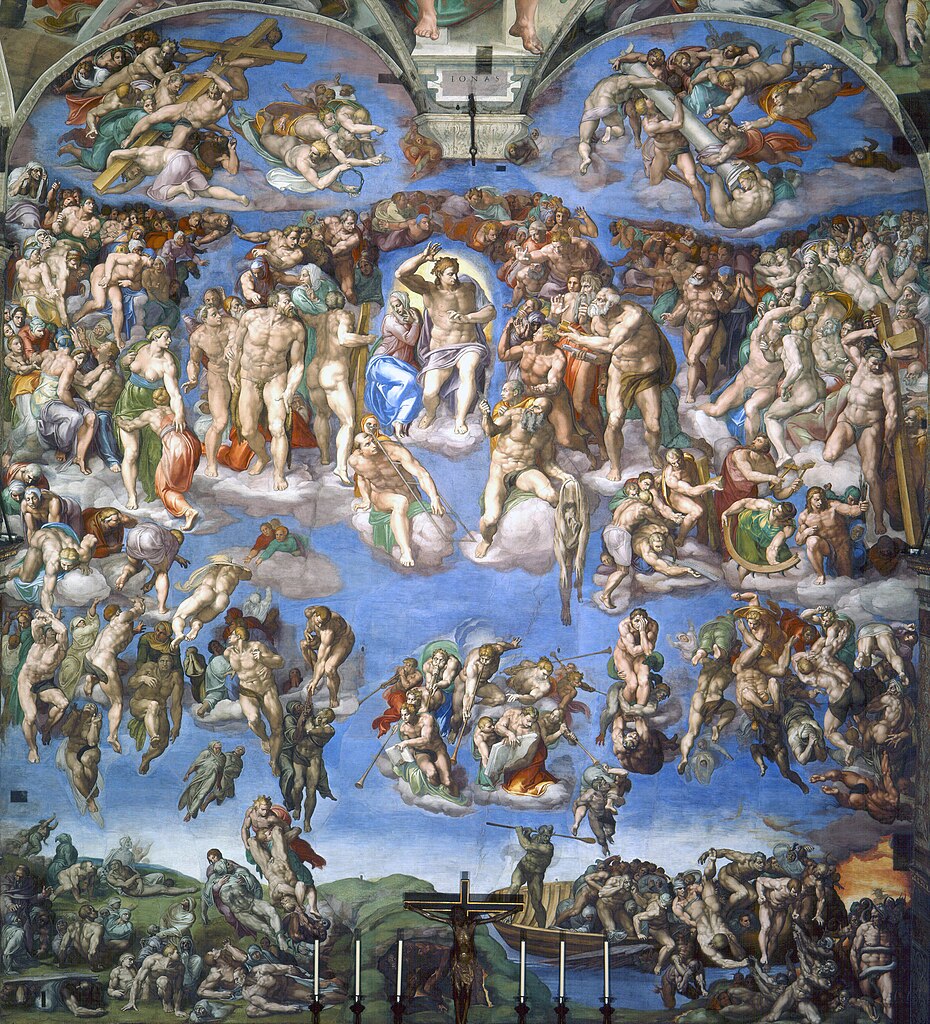
Source: Meditations by Marcus Aurelius, edited by Farquharson. Graphic: The Last Judgement by Michelangelo, Sistine Chapel. Public Domain.

The Age of Metternich

Klemens von Metternich, under the Habsburgs, was the Foreign Minister, Chancellor of Austria and chief censor of word and speech in the immediate aftermath of the Napoleonic Era.

A strict monarchist, he attempted to suppress liberal democracies and nationalist movements by censoring the press, books, speech, and even tombstones through a process that became known as the Metternich System spanning the years from 1815-1848. This period subsequently became known as the Age of Metternich.

His system of censorship was implemented through the Habsburgs Court Police. Attacks against the monarchy, government, heads of state, religion, and immoral utterances were forbidden. The press was relentlessly controlled and censored. Violators of the censorship rules faced imprisonment, fines, confiscation of their works, and banning of publications.

The Metternich System collapsed when revolutionary idealism broke out in Vienna in 1848, and Metternich fled to England to save his skin.

Source: A Little History by E. H. Gombrich. Graphic: Metternich by Sir Thomas Lawrence 1814-1819.

Zip It — Zip it Good

Today in 1893 Whitcomb Judson received approval for two patents on his ‘clasp-locker’ invention. An improved version was renamed the ‘zipper’ by B.F. Goodrich in 1923.

Zippers primary use early on was to close boots and tobacco pouches. A few years later they began to show up on jackets and by the late 1930s they replaced buttons on men’s pants.

Graphic: By Dominique Toussaint, 2006, Wikimedia Commons.

Luckiest Man

When Lou Gehrig delivered his retirement speech to his fans at Yankee Stadium in 1939, he proved, not that he was the greatest baseball player ever, that went without saying, but that he was one of most humble humans to ever walk on this planet. A characteristic sorely missing from our society in the 21st century.

Forced to retire from the game he loved because of ALS, which would take his life two short years later, he told the world that I consider myself the luckiest man on the face of this earth.’

His full speech is listed below (will only take a minute to read).

“Fans, for the past two weeks you have been reading about the bad break I got. Yet today I consider myself the luckiest man on the face of this earth. I have been in ballparks for seventeen years and have never received anything but kindness and encouragement from you fans.

“Look at these grand men. Which of you wouldn’t consider it the highlight of his career just to associate with them for even one day? Sure, I’m lucky. Who wouldn’t consider it an honor to have known Jacob Ruppert? Also, the builder of baseball’s greatest empire, Ed Barrow? To have spent six years with that wonderful little fellow, Miller Huggins? Then to have spent the next nine years with that outstanding leader, that smart student of psychology, the best manager in baseball today, Joe McCarthy? Sure, I’m lucky.

“When the New York Giants, a team you would give your right arm to beat, and vice versa, sends you a gift – that’s something. When everybody down to the groundskeepers and those boys in white coats remember you with trophies – that’s something. When you have a wonderful mother-in-law who takes sides with you in squabbles with her own daughter – that’s something. When you have a father and a mother who work all their lives so you can have an education and build your body – it’s a blessing. When you have a wife who has been a tower of strength and shown more courage than you dreamed existed – that’s the finest I know.

“So I close in saying that I may have had a tough break, but I have an awful lot to live for.”

Source: Lou Gehrig’s Farewell Speech, lougehrig.com. Graphic: Lou Gehrig with the New York Yankees, 1923. Pacific and Atlantic Photos. Public Domain.

The Divine Comedy:

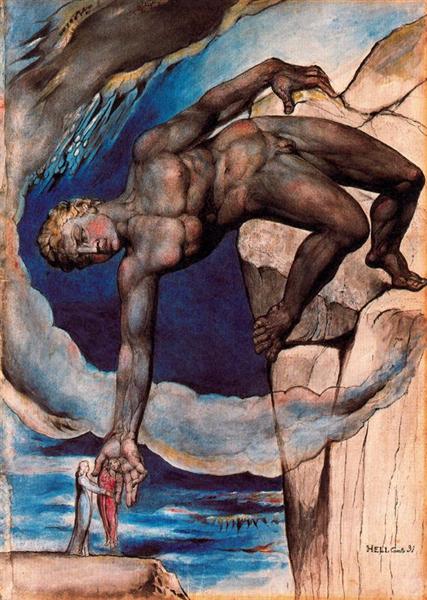
William Blake (1757-1827), in the final years of his life created 102 watercolors and 7 copper plates, most unfinished, for Dante’s ‘The Divine Comedy’. One of the more profound and captivating of these paintings is ‘Antaeus Setting Virgil and Dante into the Ninth Circle of Hell’.

The giant Antaeus, son of Neptune and Gaia, was invincible as long as he remained attached to his mother. Hercules, for his 11th task, had to defeat Antaeus but couldn’t if he touched the Earth, so he lifted him off the ground and strangled him to death.

The Ninth Circle is reserved for the treacherous and is subdivided into 4 rings. The first part is reserved for familial traitors and is named Caina as in Cain and Abel. The second ring, Antenora for Antenora of Troy is for national traitors. Ptolomaea for Ptolemy is the third ring for those who betray their guests. Finally, the inner ring is called Judecca for Judas Iscariot betrayer of Christ and is for the worst traitors: those who turn on their masters. At the center of the Ninth Circle resides Satan.

Finally, as an aside, Dante’s ‘The Divine Comedy’ shouldn’t be interpreted as The Divine Humor, but as The Divine Outcome. The author meant that comedy was the opposite of tragedy. Tragedies begin well and end badly, but Dante’s Comedy begins badly, in Hell, and ends well with Dante reaching his desired destination: Heaven.

Source: Will Blake, The Divine Comedy by David Bindman, 2000. The Divine Comedy by Dante Alighieri, circa 1321. Bulfinch’s Mythology, 1867. Graphic: Antaeus Setting Down Dante and Virgil in the Last Circle of Hell, Blake, 1827, Public Domain.

A Riddle

Homer is said to have died of grief or maybe shame when he was unable to solve the riddle posed below by some small children:

‘What do you leave behind if you know you have it and what do you take with you if don’t know you have it?’

Lice.

Almost nothing is known about Homer, including his existance, making everything said about him to be either myth, allegorical, or just made up out of whole cloth.

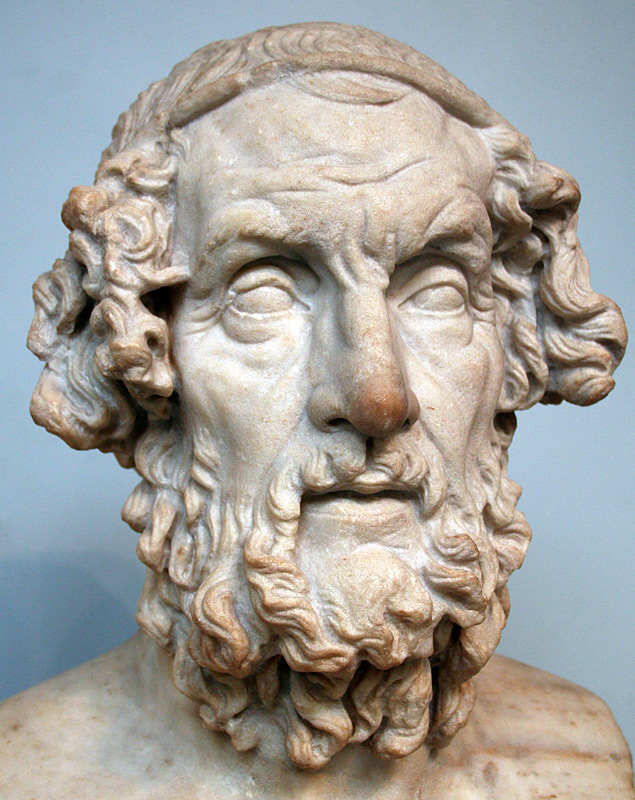
Source: Bulfinch’s Mythology, 1991 – 1st published 1855. Graphic: Bust of Homer, British Museum, Public Domain