No Remorse – No Acquittal

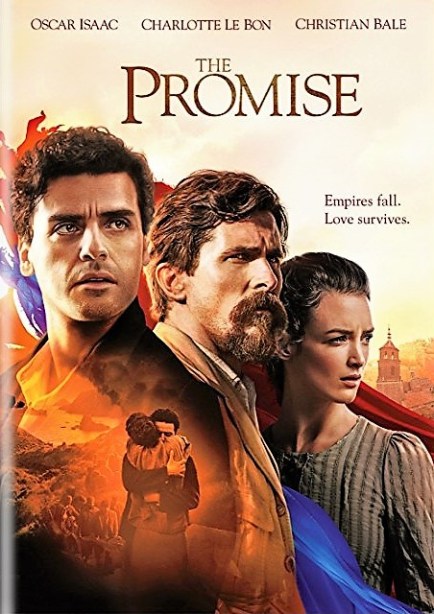
The Promise (2017)M The Promise

els – 9.0/10

IMDb – 6.0/10

Amazon – 4.5/5 stars

Rotten Tomatoes Critics – 5.6/10

Rotten Tomatoes Audience – 4.7/5

Directed by: Terry George

Written by: Terry George and Robin Swicord

Produced by: Eric Esrailian, William Horberg, Mike Medavoy, et.al.

Music by: Gabriel Yared

Cast: Oscar Isaac, Charlotte Le Bon, Christian Bale

The defeat of the Ottoman Empire at the end of the First Balkan War in May of 1913 resulted in the loss of 85% of their territory and signaled the end of the Muslim sultanate in Europe. The Balkan nations, at the end of the war, expelled 100s of thousands of Muslims from their newly liberated lands, to lands within Anatolia, which at the time, were mostly inhabited by Christian Armenians. The resettled Muslims resented their inferior status along-side their more affluent Christian neighbors, adding fuel to the smoldering hatred of all things not Muslim and Turk.

At the outbreak of WWI in July of 1914, the remaining fragments of the Ottoman Empire joined the Germans in battling the Russians, with the hope of regaining past glory and territory. Blaming the Armenians for the Balkan War defeats, the Turks used WWI to light the match to their smoldering contempt for Armenians, igniting an inferno of maniacal, murderous elimination that was to engulf the Christians for the next 7 years. The match struck in April of 1915. The Turks arrested and eventually murdered almost 300 of the Armenian elite in Constantinople. The Pogrom would continue through 1922 resulting in the deaths of 800,000 to 1.5 million Armenians.

The critics panned this movie for insufficient plot development concerning the romantic triangle between the 3 protagonists. Well, ok then.  Getting lost in the reeds of sex while the rivers run red with the blood of a thousand, thousand innocents, suggests that the proctors of art criticism are not even remotely up to the task.

Yes, The Promise is a love story, as a sub-plot, within the main story of telling the horrific events of the genocidal Armenian murders by Muslim Turks.  Numerous Turk methods of depravity are chronicled here, marching Armenian women and children into the Syrian desert sands to die of dehydration, cruel enslavement of the Armenian men to build infrastructure until they drop dead of starvation, injury or murder, the burning of Armenian towns and the mass execution of the towns inhabitants, and at the utmost limits of debasement the request for the payouts from Armenian’s life insurance policies after the Turks have killed them.

To this day Turkey refuses to acknowledge the death of the Armenian Christians as genocide; the current, unremorseful, Turkish Prime Minister Recep Tayyip Erdoğan prefers to refer to it as the Event of 1915.

Explorations: 2

E Lexington

Lexington (CV-2) burning and listing during the Battle of the Coral Sea. Commissioned 1927, scuttled 8 May 1942. Carried 2971 crew and 78 aircraft.


The Battle of the Coral Sea, Pacific Theater, WWII 4-8 May 1942. This was the first major naval battle between Allied forces and the Imperial Japanese Navy, involving aircraft carriers. The battle was also a first where the two navy’s ships never saw or fired on one another directly.  The battle was carried out almost exclusively by aircraft fighters and bombers launched from the carriers.

The allies entered the battle with 2 fleet carriers, 9 cruisers, 13 destroyers, 128 aircraft, and various support ships, while the Japanese had 2 fleet carriers, 1 light carrier, 9 cruisers, 15 destroyers, 127 aircraft along with various support ships. Ship losses were, greater, by tonnage, on the allied side which included the Lexington aircraft carrier, 1 destroyer, and several smaller ships totaling 42,497 tons.  The Imperial Navy lost 1 light carrier, 1 destroyer and several smaller ships equal to 19,000 tons.  The Allies lost 543 men while the Japanese lost 1029.

The Battle of the Coral Sea was to have profound and positive consequences for the Allies in one month, at Battle of Midway; by keeping 2 of the Imperial Navy’s carriers out of action in this upcoming naval battle.

Additional information for the Battle of the Coral Sea:

  1. Battle of the Coral Sea, by Charles River Editors, CreateSpace Publishing, © 2016.
  2. The Coral Sea 1942, by Mark Stille and John White, Osprey Publishing, © 2009.
  3. The Battle of the Coral Sea, by Office of Naval Intelligence, CreateSpace Publishing, © 2009.

Sky’s Restaurant and Cloud 9 Lounge

Sky Restaurant and Cloud 9 Lounge, 322 Demers, Grand Forks, NDR Sky's

  • Price: $$$$$
  • Ambiance: 4.0/5
  • Service: 4.5/5
  • Food: 3.5/5

Wednesday, sundown is an hour or so away, temperature has dropped to 70, the few trees sway, and the day’s end has a name:

And after such a blazing day
At last the breeze began to play
I drained my glass and turned to see
Her face she smiled she spoke to me
I told her my name I asked her the same
She said they call me sky…

(partial lyrics to Sky performed by Human League, written by: Philip Oakey and N. Barton © 2011.)

We met some friends at Sky’s for dinner, drinks, catch-up conversation and laughs. The guys discussed ways of the world, fishing, favorite and not so favorite beers and of course, times gone by. The gals were in high form, animated, speaking in their secret language; we ignored each other, mostly, except to comment on the food and drinks, and with more drinks, more comments, not necessarily on food and drinks, but certainly drinks were discussed when only the ice remained.

The restaurant and lounge are located on the second floor of the old First National Bank building, built-in 1915, accessible by escalator near the main floor entrance. Sky’s atmosphere and décor are upscale chic with a casual flare, nice clean lines without any pretensions to something greater, wooden chairs and cloth booths. White, starched table cloths at the booth tables would have afforded a stylish touch. There were some plastic looking orangish-red chairs with chrome frames mixed in with the wooden chairs at the tables, appearing embarrassed and out-of-place. We sat at a booth overlooking Demers Avenue which is not terrible scenic but it affords an opportunity to study the people on the sidewalks below without shame or guilt.

We started our event with Tanqueray and tonic and a margarita on the rocks. Not particularly difficult to make well, but nevertheless they were good, cool, and refreshing. We followed that up with more margaritas, Bailey’s, and Stella beers. A fine night it was. For some inexplicable reason we passed on sampling the wine selection, which appeared prodigious, but now we have an additional reason to return.

We followed the drinks up with an appetizer of escargot, $12, immersed in cognac butter with a faint amount of garlic, brought to our table in a white porcelain escargot tray, served very hot, but in a nit-picking way, not sizzling, popping and bubbling, affording a 4th of July delivery. A sliced white bread roll was added to soak up every drop of the piquant butter.  The escargots were delicious and definitely primed us for the entrees.

I ordered the filet mignon, $36, with a warm pink center, and accompanied with asparagus spears and a demi-glaze sauce served on the side, but I passed on the potatoes for waist-line reasons. My spouse asked for the herb crusted lamb loin, $28, served medium, and topped off with asparagus spears, garlic mashed potatoes and apple chutney sauce.  The filet was presented in a pedestrian manner with a half-dozen of so asparagus spears stacked on top of each other, opposite the steak sans dress.  The filet came well done with the very center being medium well and a peppercorn sauce was substituted for the demi-glaze.  The overcooked filet was tender but lacked the juiciness of medium.  The asparagus was crisp, not tough, and tasty.  The waitress was apologetic for the steak and sauce errors and offered to start over, but being the trooper that I am, I just carried on. She then offered to buy dessert but in the end we declined, although having the manager trek over to our booth and tell us that the chef had a terrible toothache and was having trouble concentrating on his art would have cheered us some…more.  The lamb, served sliced and stacked en-echelon around the contours of the plate, bogarting ones attention to the detriment of the asparagus and potatoes. The lamb came as ordered, a perfect warm pink center, seasoned to perfection. Wonderful.

Service was as one would expect, prompt, courteous, and attentive at all the right times.

We’ll go again mainly to sample the wine selection and under the assumption that the kitchen was having a bad night or toothache, deserving of a second chance.

Noir Righteousness

The Big Nowhere B Big Nowhere.jpg

Written by:  James Ellroy

Published by: Mysterious Press

Copyright:  © 1988

Life it seems, will fade away
Drifting further every day

Deathly lost, this can’t be real
Cannot stand this hell I feel

(Partial lyrics to Metallica’s Fade to Black, ©1984. Songwriters: James Hetfield, Lars Ulrich, Cliff Burton, Kirk Hammett).

When there are no heroes, no good guys, no morals worth fighting for, then you’ve walked into The Big Nowhere.  There are no prizes here so Sam Spade took the night train out of L.A., and Mike Hammer’s 45 would have melted by the 9th chapter, leaving a rather skinny book with a sloppy ending. No one, no thing is redeemable in this novel, possibly not even the reader, who is captivated, disheartened, engrossed, disgusted on the raw truth presented as living without a soul, trying to make sense of this hell on earth, wishing never to come anywhere near The Big Nowhere.

…thinking Coleman’s Upshaw fixation would break him down on his homosexuality, stymie and stalemate him.  He was wrong. Coleman picked up Augie Duarte at a downtown bar, sedated him and took him to an abandoned garage in Lincoln Heights.  He strangled him and hacked him and ate him and emasculated him like Daddy and the others had tried to do to him…

Everyone deserves to die, sooner rather than later, in this l.a. l.a. land; the protagonists, if there are any, the antagonists, the groupies, the followers and the hanger-ons, everyone.

The Big Nowhere is the second, and likely the best, of Ellroy’s L.A. Quartet which includes:

  1. Black Dahlia © 1987
  2. The Big Nowhere © 1988
  3. L.A. Confidential © 1990
  4. White Jazz © 1992

Don’t miss this one.

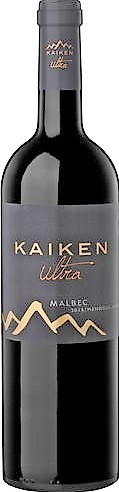
Kaiken Ultra Malbec 2013

W Kaiken Malbec 2013Malbec from Mendoza, Argentina
100% malbec
14.5% alcohol by volume

els 8.7/10

James Suckling 93

Wine Spectator 90

The Kaiken Winery, named after the gregarious caiquen goose, is located a few miles southwest of Mendoza, Argentina on a medial position of an alluvial fan born from sediment disgorged from the towering Andes to the west, and a few stones throw north of the spirited, flowing braids of the Rio Mendoza.

The malbec grapes are harvested from 3 vineyards north and south of Mendoza, ranging from 950-1250 meters above sea level, rendering thirsty, hot days and dry, cool nights, partnering with the sandy, loamy soils in providing temperament and complexion to the impending wines.

With a clear ruby-red color the wine exudes a black cherry and plum bouquet with a mild vanilla sweetness coming later. This malbec is smooth all around; pleasant and mellow tannins with a simple and balanced finish. On a better day I might rate this wine 9.0/10 but it just doesn’t manifest the pizzazz, personally, to push it to that level.

The 2013 vintage is very difficult to find but there is a similarly rated 2015 Kaiken Ultra Malbec available for $18.99 wine.com.

Explorations: Quetzals

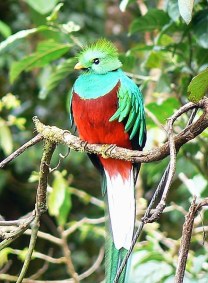
E Quetzal.jpgE Male Resplendent Quetzal.jpgQuetzals are large colorful birds with iridescent feathers, usually found in the humid highlands from northern South America and southern North America. There are 6 species in 2 genera within the family Trogonidae. They eat fruits, berries, insects and an occasional frog or lizard. The picture to the left is of a golden headed quetzal.

The resplendent quetzal, picture of a male to the right, is the national bird of Guatemala and the Guatemalan currency is also named the quetzal. It is considered one of the most beautiful birds in the western hemisphere. During mating season it will grow a twin tail feather train up to 3 feet in length.

War in Paradise

Tales of the South Pacific B South Pacific

Written by:  James A. Michener

Published by:  Curtis Publishing Company

Copyright:  © 1947

James Michener, an adopted child of a Pennsylvania Quaker, instilled his fictional Tales of the South Pacific from his garrisoned experiences as a Lieutenant Commander in the US Navy during the latter half of his WWII tour of duty. From 1944-1946, he was stationed mainly on Espiritu Santo, a small island on the eastern edge of the Coral Sea, as a naval historian, but he frequently visited other tropical islands in the area.

The short stories collected in this book, which Michener won the 1948 Pulitzer Prize in Fiction, probe the symbiosis and bonds between the American G.I. and frequently, female Pacific Islanders. The tales revolve around mostly the same characters, with a commander generally filling in as the first person narrator, and a few common plot lines such as a forthcoming, but fictitious island invasion.

Michener’s descriptive prose can be captivating and luxurious, sometimes almost hypnotic, such as the sketch of the local song birds on the protagonist’s lover’s plantation in the poignant love story, Our Heroine:

…Their harsh cries were modified by the delicate chirping of a graceful swallowlike bird that flew in great profusion among the cacao trees. This gracious bird was sooty black except for a white breast and belly.  Gliding and twisting through the shadows it looked like a shadow itself. Then bursting into the sunlight, its white body shone brilliantly…

The composition is good, probably better than anything else he wrote later in life but it does not reach the level of a master story-teller such as what Joseph Conrad attained in his Heart of Darkness or a Jack London story, for instance: All Gold Canyon:

…The red-coated many-antlered buck acknowledged the lordship of the spirit of the place and dozed knee-deep in the cool, shaded pool.  There seemed no flies to vex him and he was languid with rest.  Sometimes his ears moved when the stream awoke and whispered; but they moved lazily, with foreknowledge that it was merely the stream grown garrulous at discovery that it had slept…

Tales of the South Pacific is the antithesis of Michener’s future product; short stories versus monstrously thick and wordy novels, crisp and straightforward plot lines versus cloudy and cumbersome themes, and finally a compassionate acknowledgement for his reader’s attention rather than a dismissive condescension for those not willing to commit to consuming his turgid volumes of fictional excess.

Michener wrote one good book: Tales of the South Pacific.

Tercos Bonarda 2015

W Tercos Bonarda 2015Bonarda from Tupungato, Uco Valley, Mendoza, Cuyo Region, Argentina

100% bonarda

13.9% alcohol by volume

Purchased: 12 July 2017 – $19.99

Opened: 8 September 2017

els:  9.0/10

James Suckling:  93

Insider: 92

Natalie Maclean:  90

Wine Align: 86

Wine Enthusiast: 82

Argentina is the world’s 6th largest producer of wine by volume, just behind the US and ahead of Australia. It produces about 6% of the world’s total wine. The country has in excess of 500,000 acres planted in grapes. Red grapes account for about 55% of the total grown in the country with rose and whites accounting for the rest.  The country grows more than 100 varietals of grapes but the 6 main ones make up almost half of the total acreage planted. Four varietals account for 79% of all red grapes planted and 42% of the total for all red, white, and rose grapes: Malbec 36% total/20% red, Bonarda 17%/9%, Cabernet Sauvignon 14%/7%, and Syrah 11%/6%.  Two varietals account for 35% of all white grapes planted or 7% of the total of all grapes: Torrontes Riojano 20% white/4% total and Chardonnay 15%/3%. Argentina has 4 main wine-producing regions: Atlantic, Cuyo, North, and Patagonia. Cuyo is the largest and most important wine-producing, macroeconomic region in central Argentina and includes the wine sub-regions of La Rioja, Mendoza, and San Juan; with Mendoza being the largest of the 3 by area, population, GDP, and wine production.

Argentina was the first South American country attempting to grow vines, beginning in Mendoza in the early 1800s.   The initial plantings came from the Bordeaux region of France, including the ubiquitous Malbec.  Eventually, Mendoza was producing world-class Malbec wines, on par or superior to those produced in France, mainly due to its high elevations in the foothills of the Andes, well-drained soils, and lots and lots of hot sunshine. Today the country produces 75% of the world’s Malbec.  The country’s 2nd most planted grape, on 47,000 acres, is Bonarda, aka Douce Noir, Corbeau, and Charbono accounting for almost all of the world’s total acreage.

Cuyo Region, in the western Andes foothills of central Argentina is the country’s main wine-producing area that includes the provinces of San Juan, San Luis, Mendoza, and La Rioja. The region covers a 450 miles, north to south, from the village of San Blas de los Sauces in the north to the small city of General Alvear in the south. The region accounts for almost 80% of country’s wine production. The area is one of the driest wine-producing areas of the world requiring some form of irrigation for the all the vineyards.

The Mendoza region, lapping up onto the eastern foothills of the youthful Andes, is the largest wine-producing area in all of Argentina, accounting for 65-75% of the country’s total. A third of the country’s vineyards are dedicated to Malbec with Mendoza also producing the lion’s share of that variety. The region’s vineyards range from 1600-5600′ above sea level. The Mendoza wine region is partitioned into another 5 sub-areas: Central Oasis, East Mendoza, North Mendoza, South Mendoza, and Uco Valley.

The Uco Valley, striking in a north-south direction, just east and parallel to the Andes Mountains, is 45 miles long and about 15 miles wide on average. The northern edge of valley is situated at the small town of San Jose and the southern limit is anchored by the tiny village of El Cepillo. The valley is crossed by the braided Tunuyan and Tupungato Rivers, sourced from the snow packs high in the Andes Mountains. There are over 60,000 acres of vineyards ranging from 2800-5600′ above sea level in the sub-region. The main varietals grown are Malbec, Cabernet Sauvignon, Merlot, Tempranillo, Pinot Noir, Chardonnay and Sauvignon Blanc. Malbec accounts for almost 45% of all acreage planted. Soils throughout the Uco Valley are alluvial and consist of a rocky, clayey sub-soil overlain by a stony, sandy surface. The soils are immature, infertile, and well-drained; perfect for growing grapes. The dry valley sits in the rain shadow of the mountains requiring irrigation for the vineyards. Growing season temperatures range from 50-85°F with rainfall averages of 1-3.75″ per month.

Tupungato is located in the northern third of the Uco Valley, in the shadow of the Tupungato volcano and about 40 miles south of Mendoza. About a third of the acreage is devoted to vineyards with Malbec and Chardonnay the undisputed kings of the area. The soils are immature, stony and well-drained. Growing season temperatures range from 50-85°F with rainfall ranging from 0.5-1.33″ per month.

Bonarda, also known as Douce Noir, Corbeau, and Charbono, is the country’s 2nd most planted grape.  It is planted on more than 47,000 acres which is more than 99% of the world-wide total. The grape is thought to have originated in northern Italy along the Po River valley 3000 years ago, first planted by the Etruscans and brought to Argentina by Italian immigrants. It is a thick-skinned, medium-sized blueish-black grape producing a deep red wine high in tannins.  It has aromas of black fruit, plums, and anise. A full-bodied wine with great structure and long aging potential.

Ricardo Santos, owner of the Norton Winery, was the first producer in Argentina to export Malbec wines to the US in 1972. Santos sold this winery in 1989 and purchased vineyards around Mendoza, Maipu and Russell. The Ricardo Santos Bodega and Vineyards, today run by Ricardo’s sons, Patricio and Pedro Santos, has its winery located just south of Mendoza in Russell, Maipu. The winery was built in 2005 and has a capacity 700,000 liters or 185,000 gallons per year.  Its air-conditioned cellars accommodate 300 oak barrels. The winery produces 5 reds and 1 white under two labels:  Ricardo Santos and Tercos.

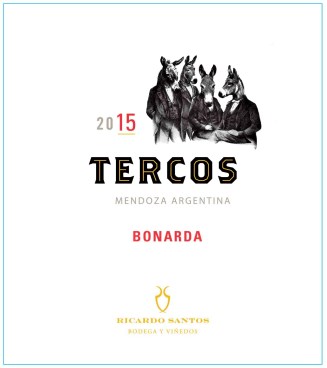
Tercos was developed by Pedro and Patricio Santos. The wine’s iconic, humorous and possibly triple entendre wine label of 4-donkeys in 3-piece suits is suggestive of a play on the word stubborn, the literal Spanish to English translation of Tercos, insinuating the difficulty of producing a superb wine from the local dry and poor volcanic-alluvial soils, and finally, they may be donkeys, but they dress up rather nicely.

The Bonarda grape is grown at their Finca La Pitonisa vineyard, or in English, the Witch Estate, which is in the evening shadows of the inactive Andean stratovolcano Tupungato towering another 17,799′ over the 3600′ above sea level vineyards. The volcano contributes to the silica rich, sandy loams of vineyard soils, containing various amounts of aluminum, calcium, sodium, magnesium, zinc and iron which augment the flavors and body of this wine. The vines were planted between 1977 and 1990 placing them mostly into the old vine category of lower yield but concentrated grapes. The grapes for the 2015 vintage were harvested in the 3rd week of April.

The grapes were picked, crushed and fermented in stainless steel tanks for 23 days at 77°F.  In December the wine was transferred to 15,000 3/4 liter bottles.

This is a satisfying wine with a pleasing, dark ruby-red to violet color. The aroma is easy with berries, plums and raisins in the forefront with a hint of cloves and spice. The taste is very smooth all around and the balanced finish lasts well into your next sip.

Bonarda compliments so many dishes and entrees, but I usually take a simple path and prepare a plate of thinly sliced sausages such as hard salami and summer sausage with some mild cheddar. Toss in a handful of salted cashews and seedless grapes and you’re all set. Bon appetit.

An outstanding wine at a great price. Drink this year but it’s likely good until 2025. Decant and aerate for one hour, or more, before drinking.

$12.99 wine.com
Amidst the Mole

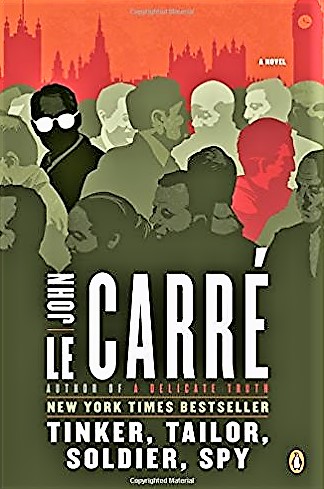
Tinker, Tailor, Soldier, Spy Tinker Tailor

Written by:  John le Carré

Published by: Alfred A. Knopf Incorporated

Copyright:  © 1974

David John Moore Cornwell, alias John le Carré, a son of a con-man, whose father was a sometimes Rich Man, Poor Man; worked for British Intelligence in the 1950s and 1960s but was betrayed in 1964 to the Russians by Kim Philby, a British KGB double agent working within the MI6.

Tinker, Tailor, Soldier, Spy is the fictionalized tale of the hunt for Philby, nom de guerre Gerald, by retired British spy, George Smiley. Smiley, the physical antithesis of James Bond; is an overweight, over the hill, myopic, failure in love; but intellectually superlative, standing shoulder to shoulder with Sherlock and Columbo.

The title of the book comes from a children’s counting rhyme that traces back to at least the late Renaissance:

Tinker, Tailor,
Soldier, Sailor,
Rich Man, Poor Man,
Beggar Man, Thief.

and was used for assigning code names to one of the five suspected Soviet moles in British Intelligence. Tinker, Tailor, Soldier, Poor Man and Beggar Man were all senior intelligence officers within the Circus, an euphemism for British Intelligence, with Smiley being Beggar Man.

John le Carré writes with heavy characterization to the point of distraction along with frequent time and space jumps that will often bewilder. The opening sentence “The truth is, if old Major Dover hadn’t dropped dead at Taunton races Jim would never have come to Thursgood’s at all.” is absolutely critical to the plot development but remains a complete mystery for most of the tale. Read carefully but do not tarry.

Enough Already

Alien ConvenantAlien: Covenant

Theaters:  May 2017

Streaming:  August 2017

Rated:  R

Runtime:  120-122 minutes

Genre:  Action – Adventure – Fantasy – Horror – Science Fiction – Thriller

els:  2.5/10

IMDb:  6.5/10

Amazon:  2.9/5 stars

Rotten Tomatoes Critics:  6.3/10

Rotten Tomatoes Audience:  3.3/5

Metacritic Metascore:  65/100

Metacritic User Score:  5.9/10

Awards:

Directed by:  Ridley Scott

Written by:  John Logan and Dante Harper, screenplay; Jack Paglen and Michael Green, story

Music by:  Jed Kurzel

Cast:  Michael Fassbender, Katherine Waterson, Billy Crudup

Film Locations:  Australia and New Zealand

Budget:  $97,000,000

Worldwide Box Office:  $240,900,000

The year is 2104, a little more than a decade since the ill-fated Prometheus was destroyed, denying humanity’s creators from undoing the birth of man, and the Weyland Corporation is sending another ship: the Covenant, carrying several thousands humans, to populate another, distant planet.  The ship has all its human occupants in stasis for the trip and all are watched over by a new and improved version of the psychopath David: Walter.  A starburst, looking a lot like a meteor shower, pierces the ship’s hull and kills the captain while he sleeps in his stasis chamber.  Walter wakes up the 14 members of the ship’s crew, including those married to each other to repair the ship.  The newly revived crew receives a human-like transmission from a nearby planet that appears to be a perfect place to start a new colony, better than their original destination.  The new captain, with the commonsense of a milk cow, diverts the ship putting in motion a series of explicable bad decisions that endangers everyone, the ship’s crew, the ship’s occupants, and the ship.

Samuel Coleridge, author of The Rime of the Ancient Mariner, stated that a written unbelievable narrative that was shown to have a “semblance of truth” could be enjoyed by the reader or audience by suspending judgement on the implausible parts. This is usually stated as the willing suspension of disbelief or to believe the unbelievable.  J.R.R. Tolkien, author of The Hobbit and The Lord of the Rings, took this concept in a different direction by suggesting that the narrative could have a secondary belief system within an inner consistency of reality.  Tolkien believed that suspension of disbelief was only required when the story’s plot line does not maintain an internally consistent fictional world.

Alien Covenant fails not because of poor direction or bad acting but because the writers of the story and screenplay put forth an unbelievable and implausible plot that destroys everything else the movie has to offer, and that’s before you even discover it is a complete rehash of the five previous Alien movies (I refuse to add in the Predator vs Alien movies).  The writers, mainly John Logan, somehow believe that the Peter Weyland Corporation is willing to put up a fortune of bitcoins and pieces of eight to build, outfit and send off a colossal starship, containing thousands of human embryos and adults, capable of traversing the vast parsecs of empty space, to find a suitable planet for human colonization; then staff the running of the ship with unintelligent and irrational beings that are incapable of assessing risk or following protocols, all the while compounding the silliness of their decision-making by having spouses or significant others amplifying their emotional buffoonery.  Gads, why not just leave it to Mother, Father, David or Walter.  With computers or androids running the show the writers can at least insert some plausible scenarios for illogical scenes that don’t have to rely on the characters and or audiences being absolute morons.  If  all else fails maybe the space faring chimps: Albert, Ham and Gordo have some offspring that are up for the task.  Hopefully Logan will return to writing plays and leave science fiction to those that can formulate plausible plots.

Alien Covenant goes where the previous Alien movies have already gone. Good androids, bad androids. Sniff and closely examine all gooey eggs, repeat endlessly. Find the Alien, lose the Alien. Burn, nuke, melt, freeze, shoot, chop, slice, dice, mince, atomize the Alien. How about we just bury the concept so deep that all the Alien acid combined will not be able to uncover it again.