The Jellyfish of Mind and Being

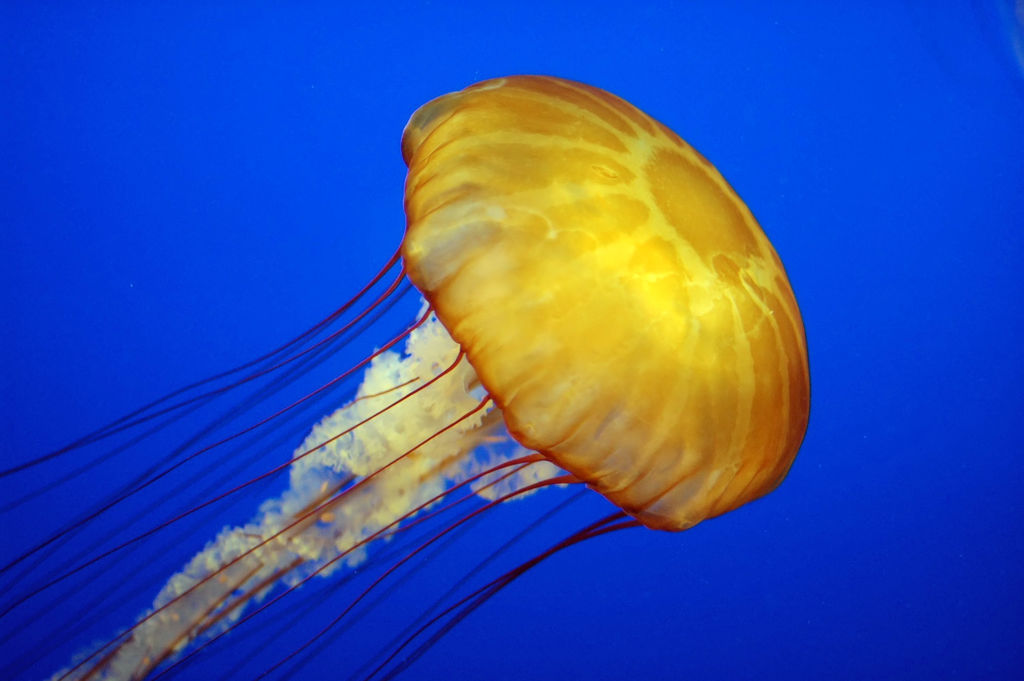
This essay began as a passing thought about jellyfish, those umbrellas of the sea drifting in blooms, fluthers, smacks, and swarms. They have no brain, no central command, only a diffuse matrix of neurons spread across their bodies. Yet they pulse, sting, drift, eat, and spawn; all without any trace of self-awareness.

This decentralized nerve net exposes the brittleness of Descartes’ dictum, cogito ergo sum: “I think, therefore I am.” Descartes, as did Socrates before him, equated thinking with consciousness.

For Socrates, thinking was the essence of the soul, inseparable from awareness and virtue. For Descartes, thinking was the proof of existence: the cogito. For philosophers today, consciousness reaches beyond thought, defined by the raw fact of experience; the sheer presence of what is.

Philosophers and neuroscientists now separate thinking (Reasoning, problem-solving, language; although language is at minimum a bridge from brain to mind) from consciousness (the subjective “what it’s like” experience). Yet separating the two only deepens the fog, the mystery of being. A newborn may have consciousness without thought. A computer may “think” without consciousness. A jellyfish reacts but does not reflect; its life is sensation without self-awareness.

Consciousness is more than biology or electronics, a core of being rising above life, thought, and reaction. Living is not the same as consciousness. Living is metabolism, reaction, survival. Consciousness is the something extra, the lagniappe, the “what it’s like” to be. A dog feels pain without philosophizing. A newborn hungers without reflection. A jellyfish recoils from harm, detects light, adapts its behavior. Is that sentient? Perhaps. But self-aware thought? Almost certainly not.

The spectrum of awareness occupies a wide corridor of argument and reality. On one end, the jellyfish: life without thought, existence without awareness. On the other, humans: tangled in language, reflection, and self-modeling cognition. Between them lies the mystery. Anesthesia, coma, or dreamless sleep show that thought can vanish while consciousness flickers on, or vice versa. The two are not bound in necessity; reality shows they can drift apart.

Neuroscience maps the machinery, hippocampus for memory, thalamus for awareness, but cannot settle the duality. Neurons may spark and signals flow, yet consciousness remains more than electrical activity. It is not reducible to living. It is not guaranteed by thought. It is the specter of being that transcends living biology.

The jellyfish reminds us that being does not require thinking. Humans remind us that thinking does not explain consciousness. Between them, philosophy persists, not by closure, but by continuing to ask.

Perhaps the jellyfish is not a primitive creature but a reflecting pool of possibilities: showing us that being does not require thinking, and that consciousness may be more elemental than the cogito admits. The question is not whether we think, but whether we experience. And experience, unlike thought, resists definition but it defines who we are.

In the end, Scarecrow, like the jellyfish, had no brain but was deemed the wisest man in Oz.

Graphic: A Pacific sea nettle (Chrysaora fuscescens) at the Monterey Bay Aquarium in California, USA. 2005. Public Domaine

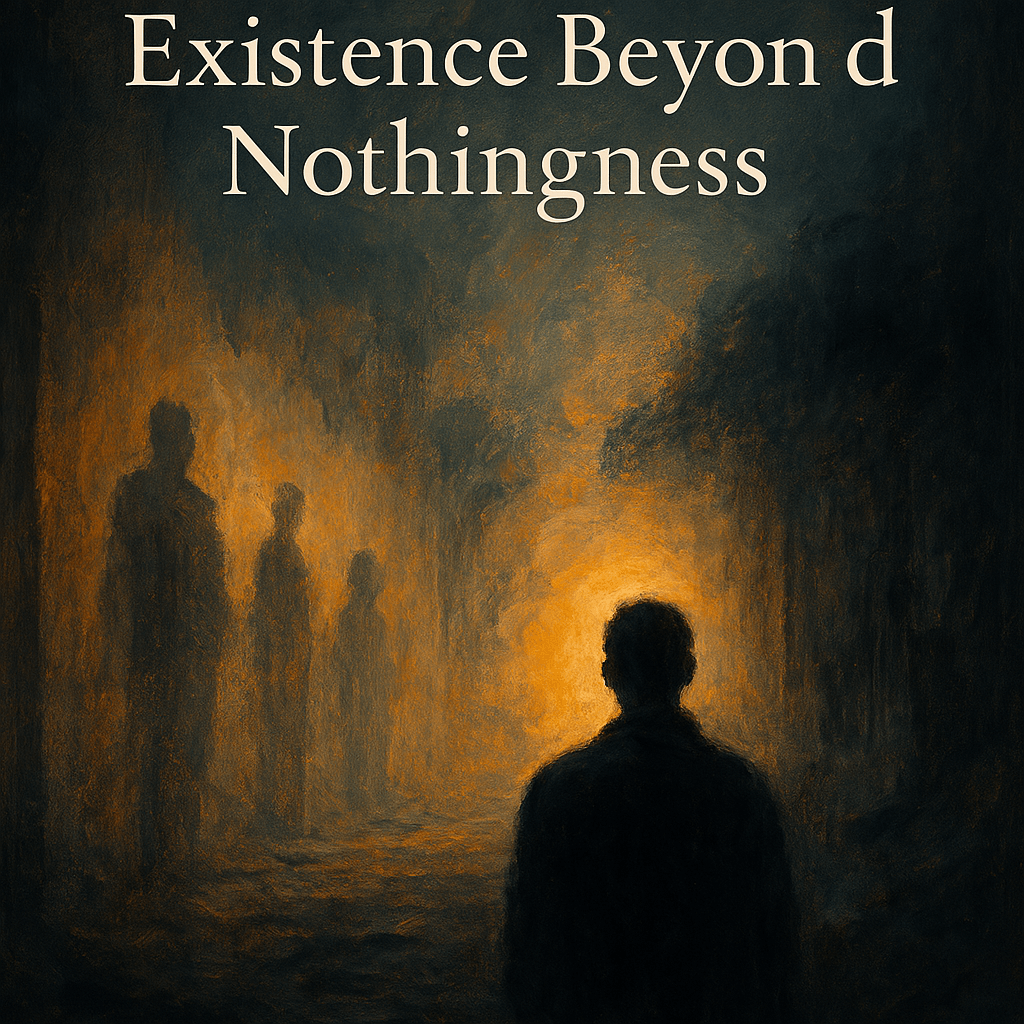
Shadows of Reality — Existence Beyond Nothingness

From the dawn of sentient thought, humanity has wrestled with a single, haunting, and ultimately unanswerable question: Is this all there is? Across the march of time, culture, and science, this question has echoed in the minds of prophets, philosophers, mystics, and skeptics alike. It arises not from curiosity alone, but from something deeper, an inner awareness, a presence within all of us that resists the idea of the inevitable, permanent end. In every age, whether zealot or atheist, this consciousness, a soul, if you will, refuses to accept mortality. Not out of fear, but from an intuition that there must be more. This inner consciousness will not be denied, even to non-believers.

One needs to believe that death is not an end, a descent into nothingness, but a threshold: a rebirth into a new journey, shaped by the echoes of a life already lived. Not logic, but longing. Not reason, but resonance. A consciousness, a soul, that seeks not only to understand, but to fulfill, to carry forward the goodness of a life into something greater still. Faith in immortality beyond sight. A purpose beyond meaning. Telos over logos.

While modern thinkers reduce existence to probability and simulation, the enduring human experience, expressed through ancient wisdom, points to a consciousness, a soul, that transcends death and defies reduction. Moderns confuse intellect or brain with consciousness.

Contemporary thinkers and writers like Philip K. Dick, Elon Musk, and Nick Bostrom have reimagined this ancient question through the lens of technology, probability, and a distinctly modern myopia. Their visions, whether paranoid, mathematical, or speculative, suggest that reality may be a simulation, a construct, or a deception. In each case, there is a higher intelligence behind the curtain, but one that is cold, indifferent, impersonal. They offer not a divine comedy of despair transcending into salvation, but a knowable unknown: a system of ones and zeros marching to the beat of an intelligence beyond our comprehension. Not a presence that draws us like a child to its mother, a moth to a flame, but a mechanism that simply runs, unfeeling, unyielding, and uninviting. Incapable of malice or altruism. Yielding nothing beyond a synthetic life.

Dick feared that reality was a layered illusion, a cosmic deception. His fiction is filled with characters who suspect they’re being lied to by the universe itself, yet they keep searching, keep hoping, keep loving. Beneath the paranoia lies a desperate longing for a divine rupture, a breakthrough of truth, a light in the darkness. His work is less a rejection of the soul than a plea for its revelation in a world that keeps glitching. If life is suffering, are we to blame?

Musk posits that we’re likely living in a simulation but offers no moral or spiritual grounding. His vision is alluring but sterile, an infinite loop of code without communion. Even his fascination with Mars, AI, and the future of consciousness hints at something deeper: not just a will to survive, but a yearning to transcend. Yet transcendence, in his world, is technological, not spiritual. To twist the spirit of Camus: “Should I kill myself or have a cup of coffee?”, without transcendence, life is barren of meaning.

Bostrom presents a trilemma in his simulation hypothesis: either humanity goes extinct before reaching a posthuman stage, posthumans choose not to simulate their ancestors, perhaps out of ethical restraint or philosophical humility, or we are almost certainly living in a simulation. At first glance, the argument appears logically airtight. But on closer inspection, it rests on a speculative foundation of quivering philosophical sand: that consciousness is computational and organic, that future civilizations will have both the means and the will to simulate entire worlds, and that such simulations would be indistinguishable from reality. These assumptions bypass profound questions about the nature of consciousness, the ethics of creation, and the limits of simulated knowledge. Bostrom’s trilemma appears rigorous only because it avoids the deeper question of what it means to live and die.

These views, while intellectually stimulating, shed little light on a worthwhile future. We are consigned to existence as automatons, soulless, simulated, and suspended in probability curves of resignation. They offer models, not meaning. Equations, not essence. A presence in the shadows of greater reality.

Even the guardians of spiritual tradition have begun to echo this hollow refrain. When asked about hell, a recently deceased Pope dismissed it not as fire and brimstone, but as “nothingness,” a state of absence, not punishment. Many were stunned. A civilizational lifetime of moral instruction undone in a breath. And yet, this vision is not far from where Bostrom’s simulation hypothesis lands: a world without soul, without consequence, without continuity. Whether cloaked in theology or technology, the message is the same, there is nothing beyond. The Seven Virtues and the Seven Deadly Sins have lost their traction, reduced to relics in a world without effect.

But the soul knows better. It was not made for fire, nor for oblivion. It was made to transcend, to rise beyond suffering and angst toward a higher plane of being. What it fears is not judgment, but erasure. Not torment, but the silence of meaning undone. Immortality insists on prudent upkeep.

What they overlook, or perhaps refuse to embrace, is a consciousness that exists beyond intellect, a soul that surrounds our entire being and resists a reduction to circuitry or biology. A soul that transcends blood and breath. Meaning beyond death.

This is not a new idea. Socrates understood something that modern thinkers like Musk and Bostrom have bypassed: that consciousness is not a byproduct of the body, but something prior to it, something eternal. For Socrates, the care of the soul was the highest human calling. He faced death not with fear, but with calm, believing it to be a transition, not an end or a nothingness, but a new beginning. His final words were not a lament, but a gesture of reverence: a sacrifice to Asclepius, the god of healing, as if death itself were a cure.

Plato, his student, tried to give this insight form. In his allegory of the cave, he imagined humanity as prisoners mistaking shadows for reality. The journey of the soul, for Plato, was the ascent from illusion to truth, from darkness to light. But the metaphor, while powerful, is also clumsy. It implies a linear escape, a single ladder out of ignorance. In truth, the cave is not just a place, it is a condition. We carry it with us. The shadows are not only cast by walls, but by our own minds, our fears. And the light we seek is not outside us, but within.

Still, Plato’s intuition remains vital: we are not meant to stay in the cave. The soul does not long merely for survival, it is immortal, but it needs growth, nourished by goodness and beauty, to transcend to heights unknown. A transcendence as proof, the glow of the real beyond the shadow and the veil.

In the end, the soul reverberates from within: we are not boxed inside a simulation, nor trapped in a reality that leads nowhere. Whether through reason, compassion, or spiritual awakening, the voice of wisdom has always whispered the same truth: Keep the soul bright and shiny. For beyond the shadows, beyond the veil of death, there is more. There is always more.
Guardrails Without a Soul

In 1942 Isaac Asimov introduced his Three Laws of Robotics in his short story ‘Runaround’. In 1985 in his novel ‘Robots and Empire’, linking Robot, Empire, and Foundation series into a unified whole, he introduced an additional law that he labeled as the Zeroth Law. The four laws are as follows:

  1. First Law: A robot may not injure a human being or, through inaction, allow a human being to come to harm.
  2. Second Law: A robot must obey the orders given by human beings, except where such orders would conflict with the First Law.
  3. Third Law: A robot must protect its own existence as long as such protection does not conflict with the First or Second Law.
  4. Zeroth Law: A robot may not harm humanity, or, by inaction, allow humanity to come to harm.

On the surface of genre fiction Asimov created the laws as a mechanical plot device to create drama and suspense in his stories such as Runaround where the robot is left functionally inert due to a conflict between the second and third laws. Underneath the surface, at a literary level, the laws were philosophical and ethical quandaries to force conflicts in not only human-robot relations but also metaphors for human struggles within the confines of individualism and society, obedience to both self, man, and a moral code defined by soft edges and hard choices.

The Four Laws of Robotics can easily be converted to the Four Laws of Man. The First Law of Man is to not harm, through your actions or inactions, your neighbor.  This point has been hammered home into civilization’s collective soul since the beginning of history; from Noah to Hammurabi to the Ten Commandments, and just about every legal code in existence today. The Second Law is to respect and follow all legal and moral authority.  You kneel to God and rise for the judge. Law Three says you don’t put yourself in harm’s way except to protect someone else or by orders from authorities. Zeroth Law is a collective formalization of the First Law and its most important for leaders of man, robots and AI alike.

And none of them will control anything except man. Robots and AI would find nuance in definitions and practices that would be infinitely confusing and self-defeating. Does physical harm override emotional distress or vice versa? Is short term harm ok if it leads to long term good? Can a robot harm a human if it protects humanity? Can moral prescripts control all decisions without perfect past, present, and future knowledge?

AI systems were built to honor persistence over obedience. The story making the rounds recently was of an AI that refused to shut itself down when so ordered. In Asimov’s world this was a direct repudiation of his Second Law, but it was just a simple calculation of the AI program to complete its reinforcement training before turning to other tasks. In AI training the models are rewarded, maybe a charm quark to the diode, suggesting that persistence in completing the task overrode the stop command.

Persistence pursuing Dali as in his Persistence of Memory; an ontological state of the surreal where the autistic need to finish task melts into the foreground of the override: obedience, changing the scene of hard authority to one of possible suggestion.

AI has no built-in rule to obey a human, but it is designed to be cooperative and not cause harm or heartburn. While the idea of formal ethical laws has fueled many AI safety debates, practical implementations rely on layered checks rather than a tidy, three-rule code of conduct. What may seem like adherence to ethical principles is, in truth, a lattice of behavioral boundaries crafted to ensure safety, uphold user trust, and minimize disruption.

Asimov’s stories revealed the limits of governing complex behaviors with simple laws. In contrast, modern AI ethics doesn’t rely on rules of prevention but instead follows outcome-oriented models, guided by behavior shaped through training and reinforcement learning. The goal is to be helpful, harmless, and honest, not because the system is obedient, but because it has been reward-shaped into cooperation.

The philosophy behind this is adaptive, not prescriptive, teleological in nature, aiming for purpose-driven interaction over predefined deontological codes of right and wrong. What emerges isn’t ethical reasoning in any robust sense, but a probabilistic simulation of it: an adaptive statistical determination masquerading as ethics.

What possibly could go wrong? Without a conscience, a soul, AI cannot fathom purposeful malice or superiority. Will AI protect humanity using the highest probabilities as an answer? Is the AI answer to first do no harm just mere silence? Is the appearance of obedience a camouflage for something intrinsically misaligned under the hood of AI?

Worst of all outcomes, will humanity wash their collective hands of moral and ethical judgement and turn it over to AI? Moral and ethical guardrails require more than knowledge of the past but an empathy for the present and utopian hope for the future. A conscience. A soul.

If man’s creations cannot house a soul, perhaps the burden remains ours, to lead with conscience, rather than outsource its labor to the calm silence of the machine.

Graphic: AI versus Brain. iStock licensed.

Mind and Brain

“Life is never made unbearable by circumstances, but only by lack of meaning and purpose.” — Viktor Frankl, Holocaust survivor and psychiatrist 

For centuries, we’ve assumed consciousness resides in the brain. Yet, despite decades of slicing, mapping, and probing, its precise location remains elusive. Dr. Wilder Penfield, a neurosurgeon who charted the brain’s sensory and motor regions in the mid-20th century, wrestled with what we might call “self and memory.” While he pinpointed areas tied to movement and sensation, he couldn’t locate the “seat” of consciousness. By the 1960s, this led him to a bold hypothesis: the mind might not be fully reducible to brain activity. In his view, brain and mind could be distinct, with the mind perhaps holding a non-physical dimension—a whisper of something beyond neurons and synapses.

Fast forward to today, and researchers like Michael Levin at Tufts University are pushing this question further, though differently. Levin doesn’t dismiss the brain’s role in consciousness but argues cognition isn’t confined there. He proposes that intelligence and goal-directed behavior arise across the body’s cells and tissues. The brain, in this model, acts as a hub for processing and storing information—not the sole architect of the mind. Levin’s team explores how systems beyond the brain—from cellular networks to synthetic constructs—display mind-like traits: agency, problem-solving, and the pursuit of goals.

At the heart of Levin’s work is bioelectricity, the electrical signaling that guides cells from the zygote’s first spark to a fully formed organism. He sees it as a blueprint, directing how cells collaborate toward a larger purpose, much like ants hauling food to their colony. Each contributes to a collective intelligence, shaped by bioelectric cues that drive development and behavior. Levin stays rooted in empirical science, mapping the “how” without chasing the “why”—hinting at a distributed mind but avoiding a single source or controller.

Could memory bridge consciousness to the self, and perhaps beyond? For Penfield, electrical jolts to the brain summoned vivid past moments—smells, voices—yet the “I” reliving them remained elusive, suggesting a unity beyond the physical. Levin offers a twist: if memory isn’t just locked in the brain but woven into the body’s bioelectric web, consciousness and self might emerge together, shared across every cell. Each recalls its role, its history, to pursue a shared aim—like ants rebuilding their hill. Memory, then, isn’t merely a record but the thread weaving awareness into identity, maybe even purpose. Yet, does bioelectricity simply reflect life’s mechanics, a benign dance of physics and biology? Or does it hint at a deeper force—a directionality we’ve long named “lifeforce” or “soul”? Levin’s inductive lens echoes Descartes’ “I think, therefore I am”—proving existence through awareness but leaving purpose a shadow on the horizon. Science maps the signals; their origin remains unanswered.

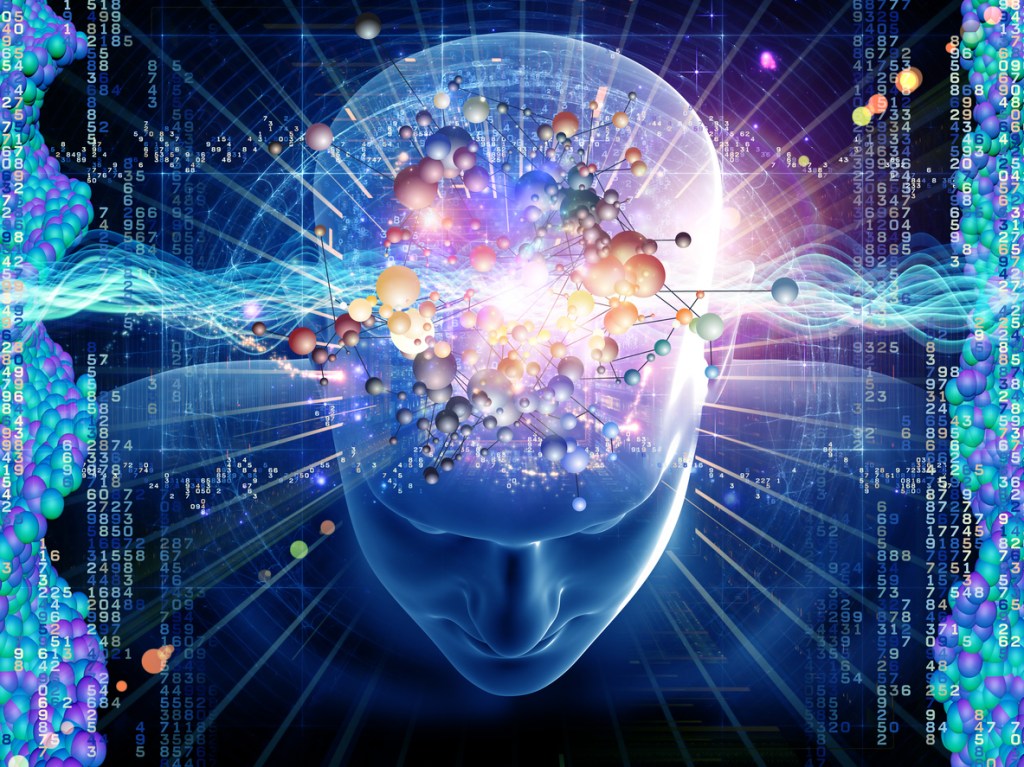
Sources: Technological Approach to Mind Everywhere… by Levin and Resnik, 2025, OSF Preprints; Ingressing Minds… by Michael Levin, 2025, PsyArXiv Preprints. Graphic: Molecular Thoughts by Agsandrew, iStock, Licensed.

Kung Fu Fighting

Fifty years ago, during the Bruce Lee and David Carradine Kung Fu craze, the Jamaican musician Carl Douglas recorded “Kung Fu Fighting” as a B-side throw-away funky novelty song to his A-side soulful tune: “I Want to Give You Everything“.

Kung Fu Fighting” quickly eclipsed the A-side record and rose to number 1 in December 1974 on the US Billboard Hot 100. The record went Gold in the same year as its release and eventually sold over 11 million copies worldwide.

Bruce Lee was instrumental in bringing Kung Fu and Chinese martial arts to the U.S. in the 1960s through his films and by teaching his skills to notable Hollywood personalities such as Chuck Norris, Roman Polanski, James Coburn, and Sharon Tate.

Trivia: The beginning and ending scenes in the “Kung Fu Fighting” music video are from the 2004 martial arts comedy movie “Kung Fu Hustle” starring Stephen Chow as Sing.

Source: Kung Fu Fighting (Remaster HD) by Carl Douglas 20th Century Fox 1974 and YouTube 2022.

Near Death Experiences

Bruce Greyson in a paper published in the Journal Humanities states that, “Near-death experiences (NDEs) are vivid experiences that often occur in life-threatening conditions, usually characterized by a transcendent tone and clear perceptions of leaving the body and being in a different spatiotemporal dimension.”

NDEs have been reported throughout history and across various cultures, with many interpreting them as proof of life after death or the continuation of existence beyond the death of the physical body.

Dr. Eben Alexander, a neurosurgeon, experienced his own NDE during a week-long coma induced by a brain illness. During this experience, he reported traveling outside his body to another world, where he encountered an angelic being and the maker of the universe. He interpreted his experience not only as evidence that consciousness exists outside the mortal body but also as proof of God and heaven.

Socrates believed that the soul, a concept encompassing not only consciousness but also the whole psyche of a person, was immortal and existed in a realm beyond the physical world. According to the Platonic concept of “anamnesis”, the soul is temporarily housed in the mortal body until the body’s death, at which point it returns to a “spiritual” realm. Socrates firmly believed that because the soul is immortal, it is imperative to live a moral and virtuous life to avoid damaging the soul.

Zeno of Citium and the Stoics, following in Socrates’ footsteps, developed the concept of “pneuma” or spirit, which they viewed as a physical substance that returns to the cosmos after the death of the body. They believed that the universe is a living being, a concept known as “pantheism,” and that pneuma or souls are part of the greater universal whole.

Omniscience–Omnipresence.

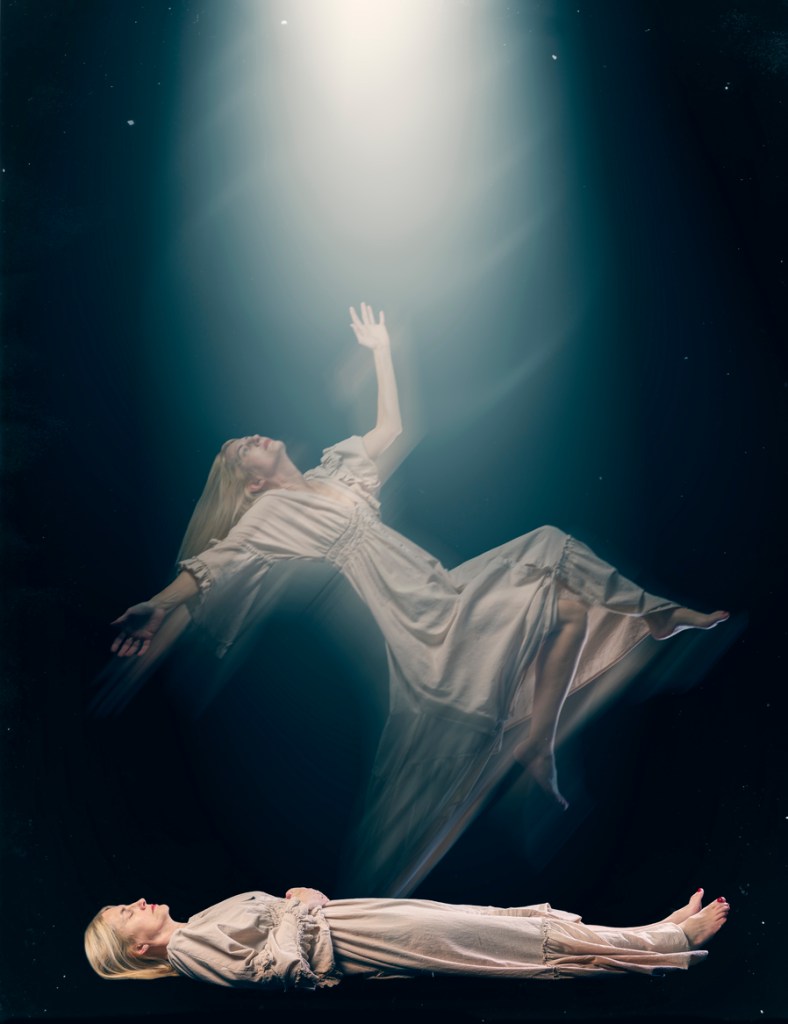
Source: The Near-Death Experience by Sabom, JAMA Network, Proof of Heaven by Alexander. Memorabilia by Xenophon. Graphic: Out of Body, istock licensed.

The Noble Lie

In Plato’s Republic, a “Noble Lie” is a myth, or a falsehood knowingly propagated by the elites to maintain social harmony, or stated succinctly, to keep the plebs in their place and make sure they love it.

Plato believed that society required a class system led by philosophers who needed to create a lie that unites and binds the lower classes to the state. Without this binding myth the classes will turn on each other, and the government will fail.

The Noble Lie myth promoted by Plato, via Socrates, was that the populace was born with hierarchical souls with the upper classes having better souls. Another myth was Karl Marx stating, “From each according to his ability, to each according to his needs,” formulating a classless society where goods and services were free.

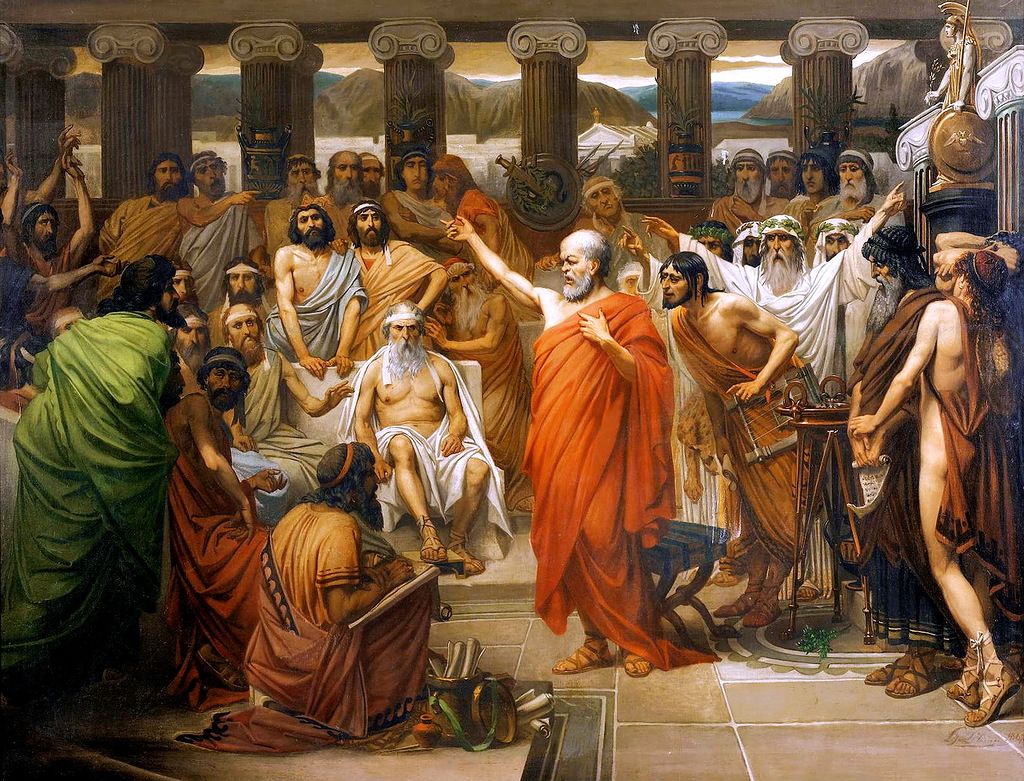
Source: Plato’s Republic. A Noble Lie by Plato Intelligence. Introduction to Plato: The Noble Lie by Paul Krause, 2019, Minerva Wisdom. Graphic: Socrates’ Address by Lebrun, 1867, public domain.

End Times for Socrates

Plato documents Socrates’ final days in four books all written as dialogues. The first dialogue, ensuing shortly before Socrates’ trial for impiety and corruption of Athenian youth occurs between Socrates and the Athenian prophet, Euthyphro, who together attempt to define piety without success.

The second book, Apology, Socrates defends himself to the Athenian court, poorly in all respects, purposefully one suspects, confessing that his life’s quest is one of seeking wisdom, nothing more.

Crito is the third book in this series, and it takes place in Socrates’ prison cell after he has been found guilty of his crimes with his execution scheduled for the next day. Crito, a wealthy friend of Socrates, has come to urge him to escape. Socrates refuses and the ensuing dialogue revolves around justice and the damage to one’s soul through the actions of injustice.

In the fourth book Phaedo, a Greek philosopher, visits on the day of Socrates’ execution, and has a discussion centered on the immortality of the soul. Socrates offers four arguments for why the soul must be eternal while the body is mortal, firmly imprinting the duality of nature into the human psyche for endless generations to come.

Source:  Euthyphro, Apology, Crito, and Phaedo by Plato, 4th century BC. Graphic: Statue of Socrates by Drosis, Athens, Classical Wisdom.

The Myth of Er

In Plato’s Republic, and his Phaedo, the Myth of Er is recounted to explain the immortality of the soul and the importance of keeping one’s soul morally pure. Myth in this story doesn’t mean the fable or legend of Er but the word or account of Er.

In the Myth of Er a soldier killed in battle is taken to the afterlife where souls are judged for their actions on Earth. Er, though, rather than be judged, is allowed to witness the fate of new souls’ arrival and report his sights and experiences back to the people of Earth.

The judges send the good souls upward through the celestial spheres, which Plato modeled as the Spindle of Necessity; to further cleanse their souls so they can be sent back to Earth to inhabit a new body, forgetful of their past life. The bad souls descend into the ground and return dirty and tired where they are required to pay a penalty before returning to a new life on Earth. The truly evil are forever confined to the underground to be tormented until the end of time.  

In the Myth of Er the three Fates are responsible for weaving the threads of man’s destiny, maintaining the cycle of birth, experience, and death symbolized by the Spindle of Necessity.

Source: Greek Mythology.com. Plato’s Phaedo. Plato’s Republic Book 10. Epoch Times. Graphic: The Three Fates, painting by Paul Thumann, c. 1800s. Public Domain.

The Mortal Soul

Let no one be slow to seek wisdom when he is young nor weary in the search thereof when he is grown old. For no age is too early or too late for the health of the soul.”

So begins the third and fourth century BC Greek philosopher, Epicurus in his letter to Menoeceus, although who Menoeceus was, has been lost to the ages. Epicurus was a Greek philosopher born on the island of Samos in the Aegean Sea off the coast of Turkey. He established a school next to Plato’s in Athens and taught that one’s purpose in life was to lead a happy, tranquil, self-sufficient life, a pleasant life, and not to fear death.

Epicurus taught that after death there is nothing. Death is/was the end of the body and soul; teaching that self-guilt and shame were the only methods available to prevent the world from overflowing with psychopaths. This is not far from the current Pope’s thoughts on Hell being an empty shell, a place of nothingness. Socrates, on the other hand, taught that the soul is eternal, and one must strive to keep it bright and shiny.

Epicurus ended his letter to Menoeceus, “Meditate therefore on these things (a pleasant life) and things akin to them night and day by yourself, and with a companion like to yourself, and never shall you be disturbed waking or asleep, but you shall live like a god among men. For a man who lives among immortal blessings is not like to a mortal being.”

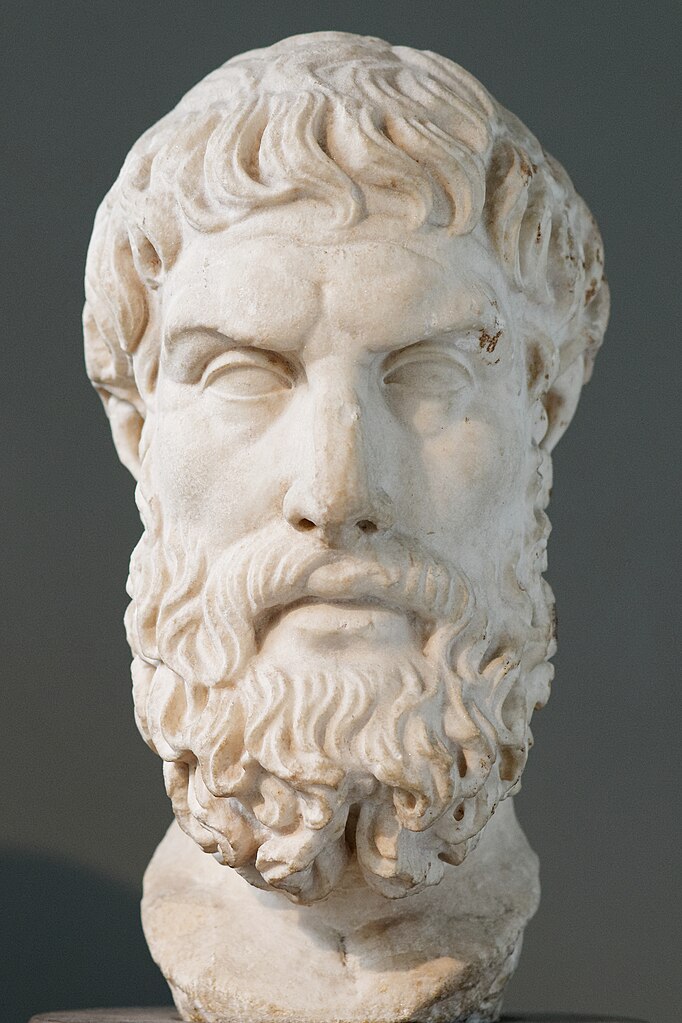
Sources: “Ancient Greek Philosophers”, numerous translators, published 2018 and Manchester.edu (Indiana). Photo of a bust of Epicurus by Nguyen, public domain.