Black Swans Part II

Last week, we introduced Taleb’s definition of black swans; rare, unpredictable ‘unknown unknowns’ in military terms, with major impacts, exploring historical examples that reshaped society post-event. This week I’m going to introduce a fictional black swan and how to react to them but before that the unpredictable part of Taleb’s definition needs some modifications. True black swans by Taleb definition are not only rare but practically non-existent outside of natural disasters such as earthquakes. To discuss a black swan, I am going to change the definition a bit and say these events are unpredictable to most observers but predictable or at least imaginable to some. Taleb would likely call them grey swans. For instance, Sputnik was known to the Soviets, but an intelligence failure and complete surprise to the rest of the world. Nikola Tesla anticipated the iPhone 81 years ahead of time. 9/11 was known to the perpetrators and was an intelligence failure. Staging a significant part of your naval fleet in Pearl Harbor during a world war and forgetting to surveil the surrounding area is not a black swan, just incompetence.

With that tweak out of the way, we’ll explore in Part II where Taleb discusses strategies to mitigate a black (grey) swan’s major impacts with a fictional example. His strategies can be applied to pre-swan events as well as post-swan. Pre-swan planning in business is called contingency planning, risk management, or, you guessed it, black swan planning. They include prioritizing redundancy, flexibility, robustness, and simplicity, as well as preparing for extremes, fostering experimentation, and embracing antifragility.

Imagine a modern black swan: a relentless AI generated cyberattack cripples the Federal Reserve and banking system, wiping out reserves and assets. Industry and services collapse nationwide and globally as capital evaporates, straining essentials, with recovery decades away if ever. After the shock comes analysis and damage reports, then the rebuilding begins.

The Treasury, with no liquid assets, must renegotiate debt to preserve global trust. Defense capabilities are maintained at a sufficient level, hopefully hardened, to protect national security, while the State Department reimagines the world to effectively bolster domestic production and resource independence while keeping the wolves at bay.

Non-essential programs, from expansive infrastructure projects, research, federal education initiatives, all non-essential services are shelved, shifting priorities and remaining resources to maintaining core social and population safety nets like Social Security and Defense. Emergency measures kick in: targeted taxes on luxury goods and wealth are imposed to boost revenue and redirect resources. Tariffs encourage domestic production and independence.

Federal funding to states and localities is reduced to a trickle. States and municipalities must take ownership of essential public services such as education, water, roads, and public safety. The states are forced to retrench and innovate, turning federal scarcity into local progress.

Looking ahead, resilience becomes the first principle. Diversification takes center stage, with the creation of a sovereign wealth fund based on assets like gold, bitcoin, and commodities, bolstered by states that had stockpiled reserves such as rainy-day funds, ensuring financial stability. Local agriculture, leaner industries and a realigned electrical grid, freed from federal oversight, innovate under pressure, strengthening a recovery. Resilience becomes antifragility, the need to build stronger and better in the face of adversity. And finally, the government must revert to its Lockean and Jeffersonian roots, favoring liberty and growth over control, safety, and stagnation: anti-fragility.

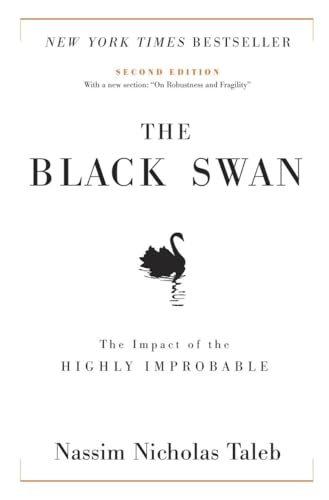
Source: The Black Swan by Nassim Nicholas Taleb, 2007. Graphic: The Black Swan hardback cover.

Fate of the Universe

Astronomers once observed exploding stars (supernovae) and found the universe expanding, driven by a mysterious force called dark energy. This led to the standard cosmological model of the late 1990s, Lambda-CDM, where “Lambda” represents dark energy, assumed constant, and “Cold Dark Matter” (CDM) explains unseen mass shaping cosmic structure. Evidence for CDM includes steady star rotation speeds in galaxies, cosmic microwave background fluctuations, galaxy clustering, and light bending by gravity. Though successful, Lambda-CDM has faced ongoing scrutiny almost from inception of the theory.

Enter the Dark Energy Spectroscopic Instrument (DESI) at Kitt Peak National Observatory in Arizona. With 5,000 robotic fiber-optic sensors, DESI captures light from galaxies and quasars, mapping the universe’s expansion history. A new study, analyzing three years of DESI data, 15 million objects, with plans for 50 million, combines it with cosmic microwave background radiation, supernovae, and weak gravitational lensing data. Fitting all this into Lambda-CDM with a constant dark energy revealed cracks in the model. But if dark energy weakens over time, a “dynamical dark energy“, the model aligns better.

By observing objects up to 11 billion years away, DESI peers deep into cosmic history. Researchers found hints that dark energy’s strength may have peaked around 7 billion years ago, then started weakening, challenging its fixed nature in Lambda-CDM. While not certain, this could rival the 1990s discovery of accelerated expansion, potentially demanding a new model.

The universe’s fate depends on dark energy versus matter. It’s been accelerating, but a weakening dark energy might slow it down, halt it, or, if gravity overtakes sufficiently, trigger a “Big Crunch.” New data from DESI, Europe’s Euclid, NASA’s Nancy Grace Roman, and Chile’s Vera Rubin Observatory could clarify this within five years, possibly nailing dark energy’s role.

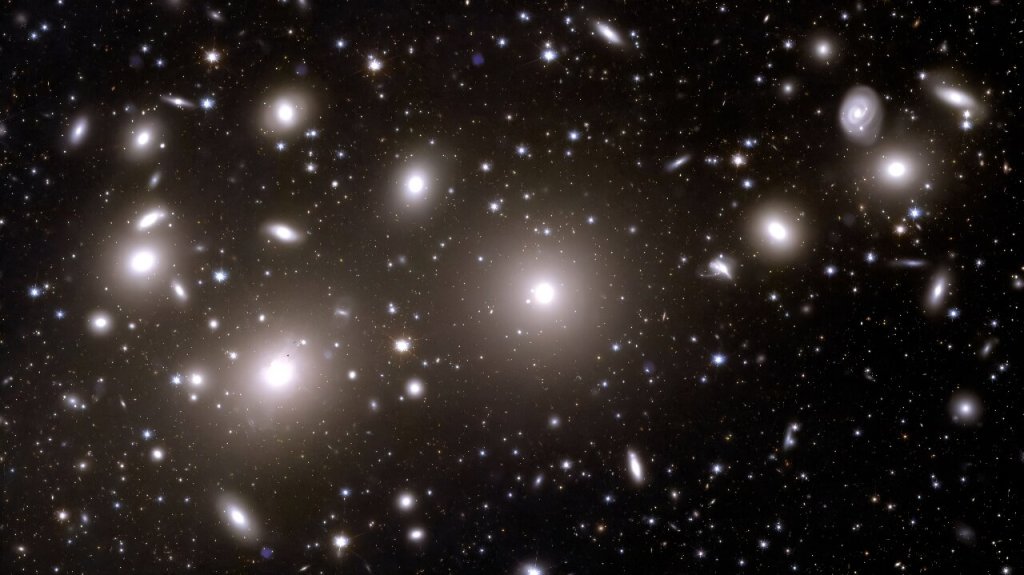
Source: “Dark Energy Seems to Be Changing, Rattling Our View of Universe” by Rey and Lawler, Phys.org, March 2025. Graphic: DESI Collaboration Photo of Galaxies.

White Holes, Black Holes, and the Cosmic Cycle

White holes, theoretical counterparts to black holes, might be two sides of a cosmic coin. Black holes devour matter with relentless gravity; white holes expel it, hurling energy, particles, and possibly time into the universe. Both stem from Einstein’s general relativity, which predicts black holes, proven by solid evidence, while white holes remain elusive, perhaps lurking beyond our Earthly senses. 

To see their link, rethink black holes’ strangest feature and flaw: the singularity. General relativity paints it as a point where spacetime crushes so tight that physics breaks, a bug, not a feature. Exotic matter, with odd traits like negative energy, was once the fix. But the University of Barcelona’s Pablo Bueno and team ditched it, tweaking gravity with higher-curvature corrections to erase singularities. This needs extra dimensions beyond our four, turning black holes from traps into dynamic zones. 

The University of Sheffield adds a twist: the event horizon isn’t sharp. Quantum gravity blurs it into a fuzzy gateway where spacetime bends, not breaks. In 4D, black holes are sinkholes, matter vanishes. In higher dimensions, it slips through, heading elsewhere. Sheffield’s take ties this to dark energy, the universe’s expansion driver. Here, it’s the power plant: quantum fluctuations, fueled by dark energy, replace the singularity with a bounce, flipping spacetime to a white hole. 

Enter white holes, Janus-like transitions, Roman god of gates and duality. Black holes vacuum everything; white holes, linked via higher dimensions, spit it out, maybe far off. Picture Sagittarius A*, the Milky Way’s core black hole, channeling matter 25,000 light-years to the Orion Nebula’s arm. Unseen, white holes might hide in dimensions we can’t touch. 

This hints at a cosmic cycle, like Earth’s water cycle: evaporate, rain, repeat. Black holes swallow, dark energy and quantum gravity bounce it through higher dimensions, and white holes release it back. Barcelona and Sheffield suggest no endpoints, just a recycling of cosmic raw materials across realms we’re barely capable of understanding.

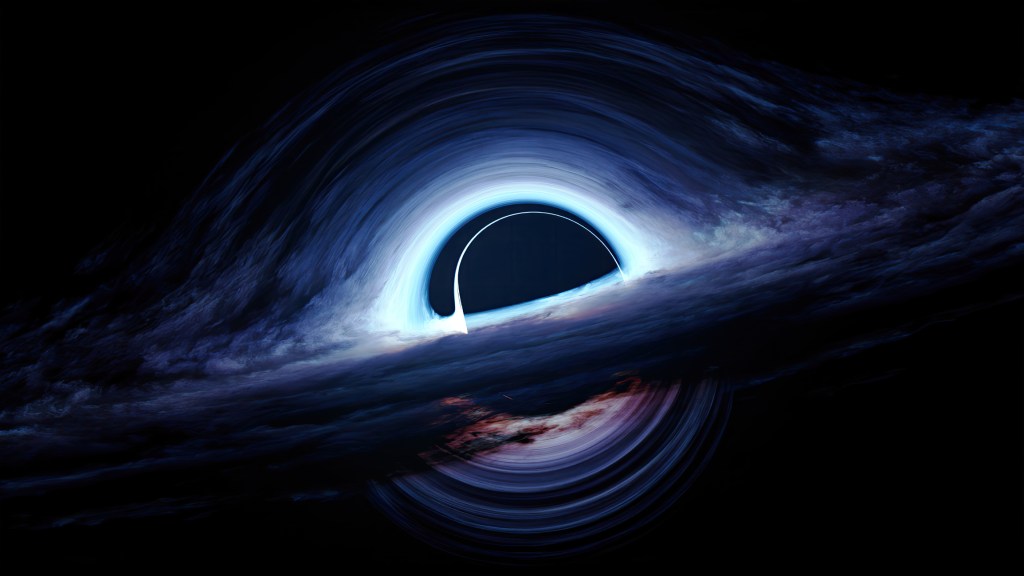
Source: Black Hole Singularity, Gielen and Menendez-Pidal, University of Sheffield, 2025. Regular Black Holes…by Bueno, P. et al, Physics Letter B, February 2025. Graphic: Black Hole Rendering.

Gravity and Vanilla Black Holes

Einstein’s theory of general relativity, which includes gravity, predicts that black holes have a tricky feature: a singularity. This is a point where space and time are squeezed so tightly that the laws of physics break down—think of it as a cosmic “error message.” To fix this, scientists often turn to exotic matter—hypothetical substances with bizarre properties like negative energy—to smooth things out. However, a team from the University of Barcelona, led by Pablo Bueno, found an alternative. They didn’t need exotic matter at all. Instead, they tweaked Einstein’s gravity by adding an infinite series of extra “rules” (higher-curvature corrections) to the math.

Their solution works in spacetimes with more than four dimensions—beyond our usual height, width, depth, and time. In these higher-dimensional worlds, black holes can exist without singularities. This “smooths out” black holes, making them less mysterious and more like regular objects in spacetime—no weird stuff required.

The presence of extra dimensions doesn’t just fix singularities—it can also change how black holes behave. In higher-dimensional spacetimes, black holes might have different event horizon shapes (the boundary beyond which nothing escapes) or other structural quirks. The Barcelona team’s work shows that these altered properties emerge naturally from gravity in more than four dimensions, offering a fresh perspective on these cosmic giants.

Thinking outside the box, is it possible that these extra dimensions link black holes to “a reality outside regular spacetime,” like wormholes (tunnels through spacetime), braneworlds (parallel universes on higher-dimensional “membranes”), or even gateways to white holes (theoretical opposites of black holes that spit stuff out)? Theories like string theory and braneworld scenarios suggest that extra dimensions might allow such connections. For example, a wormhole could theoretically bridge two distant points in our universe—or even lead to a completely different universe.

While the math of higher dimensions opens the door to these possibilities, it’s all conjecture. The Barcelona team’s work is a major step forward in understanding black holes in higher dimensions, but it doesn’t directly prove connections to other realities.

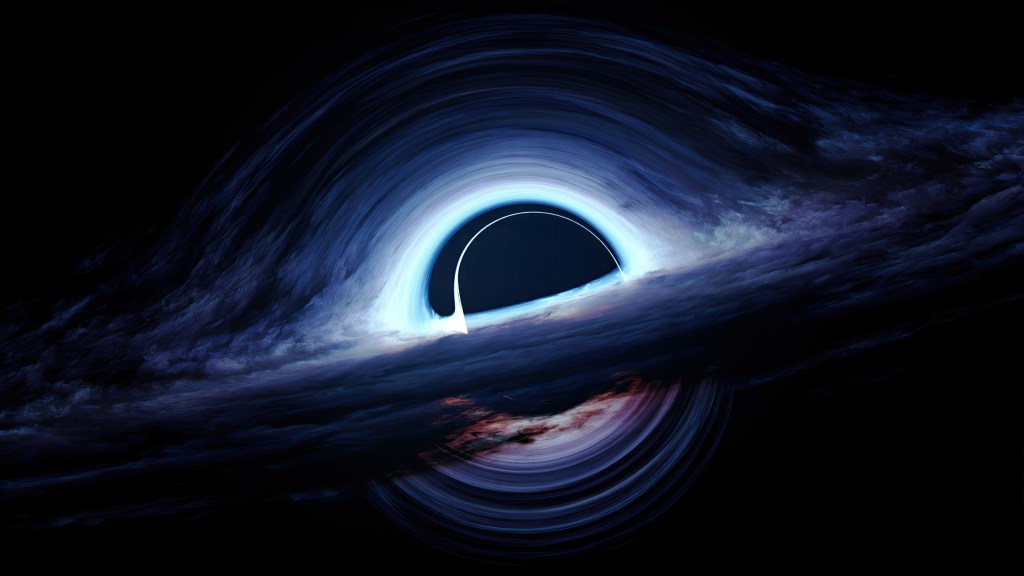
Source: Grok 3. Regular Black Holes… by Bueno, P. et al., Physics Letter B, February 2025. Graphic: Black Hole Rendering, iStock licensed.

Closer to Zero

“The answer to the ultimate question of life, the universe, and everything is 42” Douglas Adams.

But to the question “Are we alone?”—the answer leans towards likely,”  ElsBob

In a recent systems-thinking thought experiment, researchers from Germany and the U.S. revisited the statistical “Hard Steps” model, originally proposed by Brandon Carter in 1983, which aimed to estimate the probability of intelligent life emerging. Carter’s model focused on rare biological milestones—such as photosynthesis and multicellularity—concluding that intelligent life should be exceedingly rare due to the improbability of these “hard steps.” 

In a February 2025 paper, Mills et al. propose a tweak to this framework. Rather than life’s progression depending on a handful of unlikely biological breakthroughs, they suggest Earth’s environmental evolution—marked by the presence of water, organic compounds, oxygen, and geochemical shifts—created a more gradual pathway toward complexity. They argue that these conditions didn’t so much lower the odds of each step but reframed life’s development as a cumulative process, softening the gauntlet of improbable hurdles envisioned by Carter. 

Is this new? Not entirely. The idea that life’s journey—from planetary formation to advanced neural systems, language, and sociocultural structures—unfolded as a process has roots in the 1950s, with pioneers like Urey and Miller. What’s novel in Mills et al.’s work is their integration of geological timelines and Bayesian reasoning to qualitatively soften the perceived improbability of life’s emergence, rather than delivering a fully quantitative overhaul of the Hard Steps model. Where Carter’s framework likened intelligent life to finding a unicorn, this tweak nudges it from “highly improbable” to “slightly less than highly improbable.” 

Now, the fun part—calculating the odds of a planet fostering life advanced enough for Alan Turing to deem it intelligent. 

The “witch’s cauldron” of variables for simple life might include (though not exhaustively): a planet in the habitable zone, liquid water, organic molecules, self-replicating systems, protocell formation, anaerobic metabolism, photosynthesis, aerobic respiration, multicellularity, geochemical cycles, plate tectonics, ocean currents, atmospheric dynamics, natural radiation, planetary stability, appropriate size and gravity, and a protective magnetic field—plus, perhaps, a partridge in a pear tree. Estimating these probabilities is speculative, but let’s assume a rough combined probability for simple life emerging on a suitable planet. Using reasonable constraints, Grok 3 might estimate this at approximately 1 in 1 billion (10⁻⁹). 

The leap to sentient, intelligent life adds further layers: advanced neural systems, social organization, cultural evolution, time, and a dash of random chance. These additional factors could reduce the odds by another factor of 1,000, shifting the probability to between 1 in 1 trillion (10⁻¹²) and 1 in 1 quadrillion (10⁻¹⁵). These are back-of-the-envelope figures, grounded in the spirit of the thought experiment rather than precise data. 

To make these abstract numbers relatable, let’s scale them to the universe and our galaxy. Current estimates suggest the observable universe contains roughly 100 billion galaxies (10¹¹), each with an average of 100 million stars (10⁸). Assuming 3 planets per star (a conservative guess based on exoplanet studies), that yields approximately 3 × 10¹⁹ planets—30 quintillion—across the universe. In the Milky Way, with 100 billion stars (10¹¹), we might estimate 300 billion planets (3 × 10¹¹). 

Applying the probabilities: 

Simple life in the universe: At 1 in 1 billion (10⁻⁹), roughly 3 × 10¹⁰ planets—30 billion—might host simple life. 

Intelligent life in the universe: At 1 in 1 trillion (10⁻¹²) to 1 in 1 quadrillion (10⁻¹⁵), between 30 million (3 × 10⁷) and 30,000 (3 × 10⁴) planets might harbor intelligent life. 

Simple life in the Milky Way: At 1 in 1 billion (10⁻⁹), about 300 planets (3 × 10²) could sustain simple life. 

Intelligent life in the Milky Way: At 1 in 1 trillion (10⁻¹²) to 1 in 1 quadrillion (10⁻¹⁵), the odds drop to 0.3 (3 × 10⁻¹) to 0.0003 (3 × 10⁻⁴) planets—statistically less than 1.

Across the vast universe, intelligent life seems plausible on millions or thousands of planets, depending on how pessimistic the odds. On a galactic scale, though one planet with intelligent life is statistically improbable meaning that Earth is likely alone in the Milky Way as far as sentient beings are concerned.  Still, these numbers remain speculative, blending science with educated guesswork—and a touch of cosmic whimsy.

Source: …Evolution of Intelligent Life, Mills, et al, Science Advances 2025. Graphic: Grok 3 Drawn DNA.
15 Million Asteroids

How high’s the water, mama?
Two feet high and rising
How high’s the water, papa?
She said is two feet high and rising”
(Johnny Cash Five Feet High and Rising)

The early development of life on Earth relied on two essential building blocks: carbonaceous (carbon) material and water. It has long been postulated that asteroids, comets, and other planetesimals brought these ingredients to our planet. Water in meteorites existed in the form of hydrous minerals and possibly brine.

Researchers from Rutgers University, led by Professor Katherine Bermingham, studied isotopes of molybdenum from meteorites and Earth’s crust. They inferred that water arrived on Earth during its late accretion phase, around 4.1-3.8 billion years ago. The team also suggested that the water was delivered by inner solar system planetesimals such as comets and asteroids.

This is a crucial milestone in Earth’s development timeline, as there are two competing theories about when water was delivered to our planet: the Moon-Forming Event and the Late Heavy Bombardment (LHB). The Moon is believed to have formed about 4.5 billion years ago, shortly after Earth formed around 4.56 billion years ago, caused by a large object crashing into Earth. The LHB is a period of intense bombardment by planetesimals on the inner planets, occurring around 4.1-3.8 billion years ago.

An inference from the LHB is that all planets and moons existing at that time either contained or still contain water.

Trivia: Assuming the median size of planetesimals striking Earth during its early formation was around 15 kilometers (9.3 miles) with an average water content of 5% of their total volume, it would take about 15,688,960 hunks of rock to supply the current volume of water on Earth. Dividing that number by the LHB time interval of 300 million years suggests a significant impact every 227 months, or roughly every 19 years.

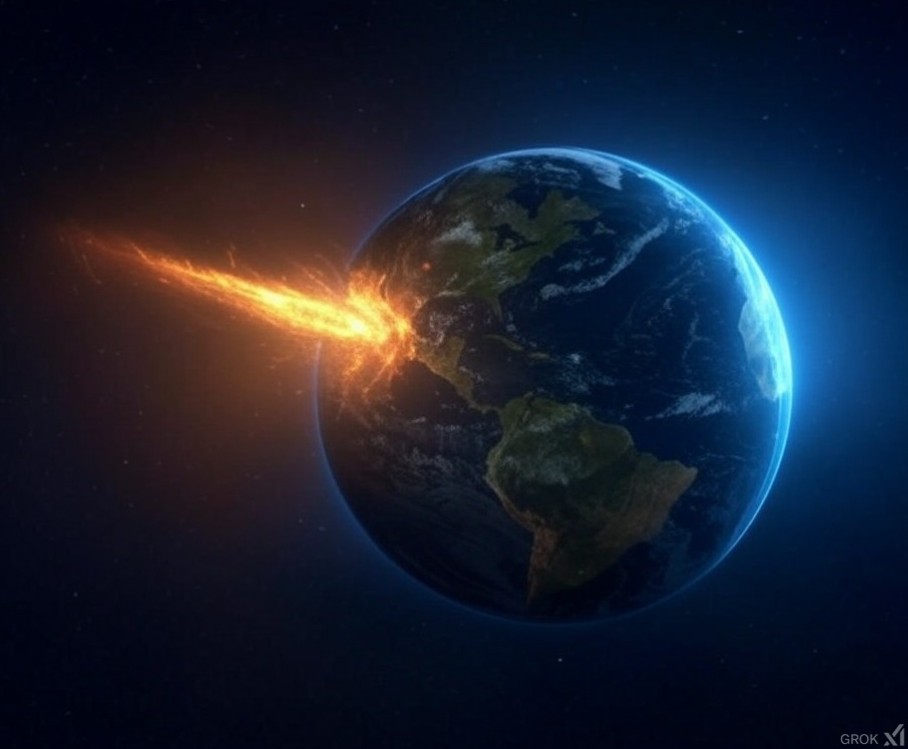
Source: Life-bearing Water, by Bermingham et al, Rutgers, 2025. Graphic: Comet Cometh, Grok, 2025.

Put Your Lights On

A distant galaxy at the edge of the universe and the beginning of time has revealed a remarkable discovery by Yale researchers. They have identified a variable quasar that rapidly brightens as its astrophysical jets periodically align with the position of Earth.

The researchers believe that this quasar, and others like it, played a significant role in bringing light into the early dark universe, alongside massive early stars which preceded the quasars.

Quasars are supermassive black holes at the centers of early galaxies, spinning at relativistic speeds. These early galaxies contained substantial unincorporated material, primordial gas clouds akin to present-day nebulae, which were easily captured by the black hole’s gravity. Near the event horizon of the black hole, this matter is caught in a ‘turbulent’ vortex, creating massive astrophysical jets. These jets, partially composed of ionized plasmas, are expelled at relativistic speeds, extending up to hundreds of light-years from the black hole and perpendicular to its event horizon. As the ionized hydrogen plasmas capture electrons from the neutral hydrogen in the early universe, photons are released, contributing to the illumination of the cosmos.

Thomas Connor, an astronomer at the Chandra X-Ray Center and co-corresponding author of the study, states, “[This] epoch of reionization is considered the end of the universe’s dark ages.”

Trivia: The song Put Your Lights On was written by Erik Schrody (Everlast) and performed with Santana on his 1999 album Supernatural. He wrote the song while recovering from a heart attack, pondering the hope that exists in life.

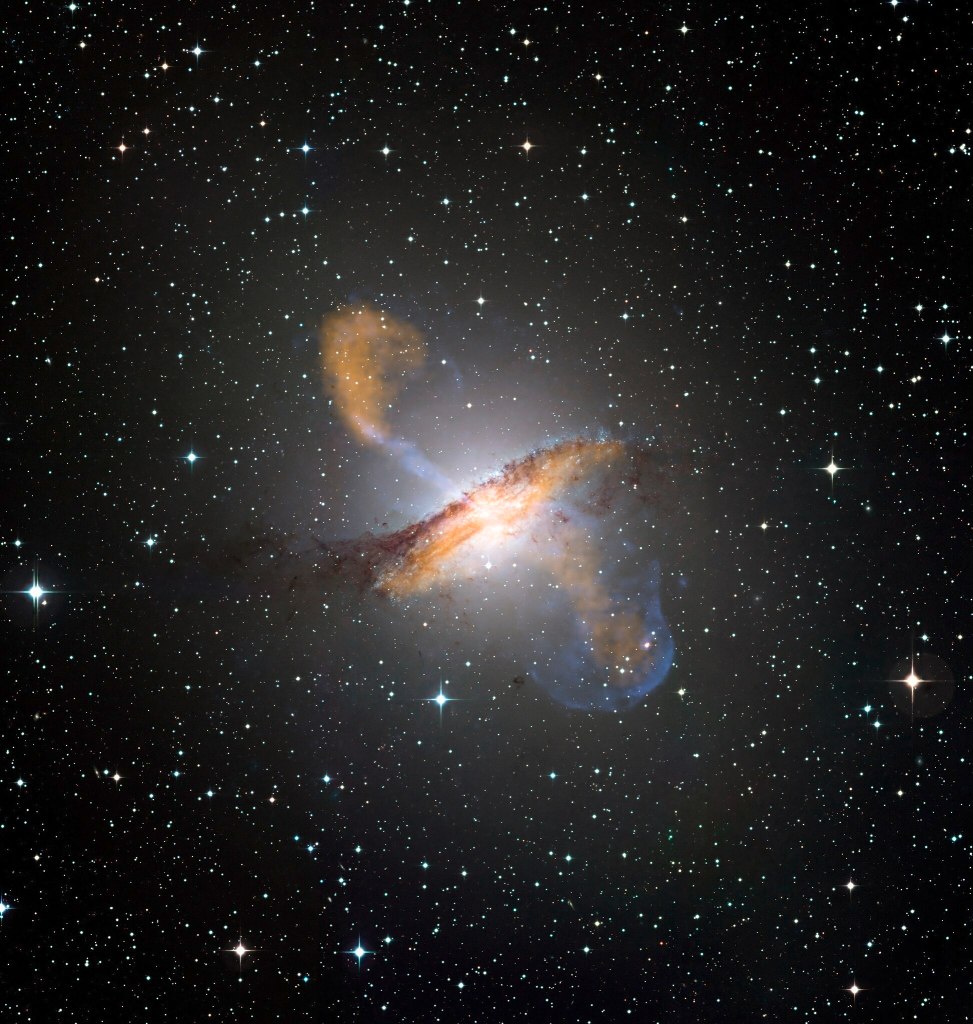
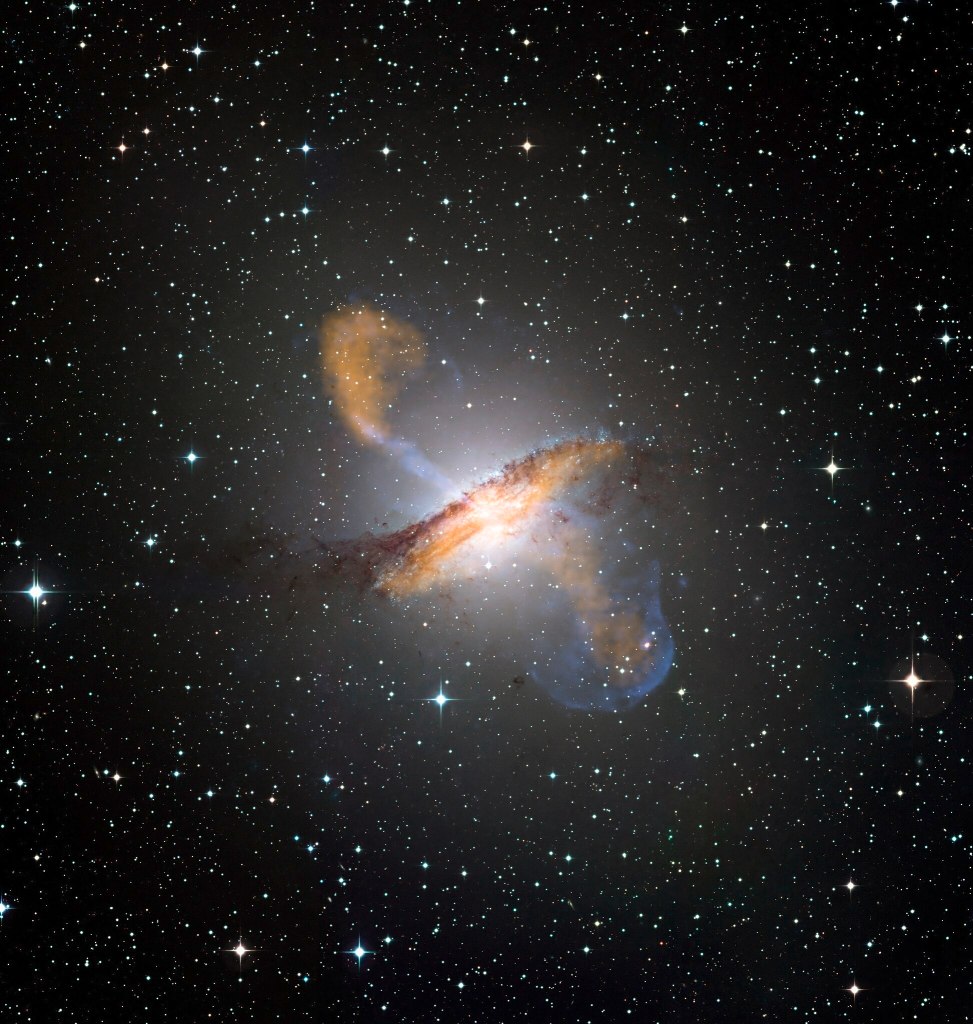
Source: This Quasar May Have Helped Turn the Lights on… by Shelton, Yale, 2025. Graphic: Black Hole Outflows from Centaurus A, ESO, 2009.

Plasma Jets

In a galaxy far, far away within the Draco (Dragon) constellation, an international team has, for the first time, observed plasma jets forming in real time and shooting out at relativistic speeds, perpendicular to the plane of a black hole’s event horizon. Plasma jets, composed of ionized matter, are a subset of astrophysical jets—energetic, narrow beams of matter and radiation ejected from various objects, primarily black holes, along their axis of rotation.

These plasma jets were observed in the Milky Way’s gravitationally captured satellite, the Draco Dwarf Galaxy, located 270 million light-years from Earth. The Draco Dwarf Galaxy is home to a black hole that apparently has a white dwarf star companion. A likely scenario is that the white dwarf was once a companion to a much larger star that evolved faster, went supernova, and collapsed into a black hole. Today, the black hole is possibly cannibalizing material from the white dwarf, potentially leading to the plasma jets observed by researchers.

Source: Astronomers observe real-time formation of black hole jets by UMBC, 2025. Graphic: Black Hole Outflows from Centaurus A, ESO, 2009.

Fractional Excitons

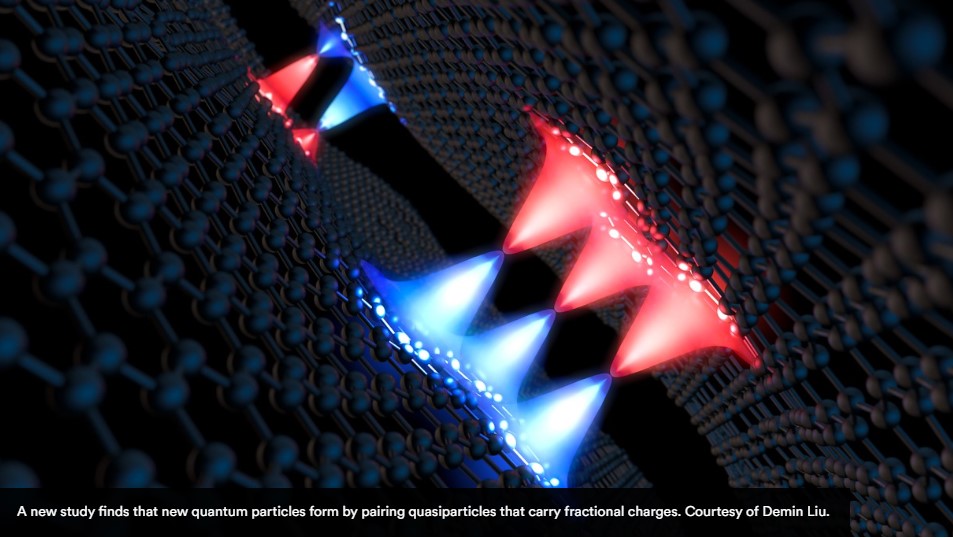
Physicists at Brown University have recently observed a new class of quantum particles called fractional excitons.

Excitons consist of an electron and an electron hole (a quasiparticle, a concept, representing the absence of an electron where one should exist). They allow for energy transfer in a lattice, such as in a transistor. Applying voltage to a transistor influences the movement of electrons and holes through the material. Simplified, this movement can turn the current flow on and off, forming a logic gate.

Despite being composed of fermions, excitons exhibit bosonic behavior and follow bosonic statistics. Fractional excitons, however, show behaviors that don’t fully align with either fermions or bosons. This suggests they belong to a new class of particles with previously unobserved quantum properties.

The researchers speculate that these fractional excitons may lead to advances in quantum computing.

Source: Excitons, Zhang et al, Nature, 2025. Graphic: Quasiparticles, Demin Liu, Brown University 2025.

Mass–No Mass

A team of researchers from Penn State and Columbia University has recently observed a quasi-particle that is massless when moving in one direction but acquires mass when moving in a different direction. This quasi-particle, known as a semi-Dirac fermion, was captured by the team inside a ZrSiS crystal and was first theorized 16 years ago. The scientists observed that when the particle travels in one direction at the speed of light, it remains massless. However, when it is forced to change direction, it slows down for the ‘turn’ and gains mass.

This property relates to Einstein’s most famous equation, E=mc², which states that energy and mass are interchangeable, connected by the speed of light squared. According to Einstein’s Theory of Special Relativity, mass traveling at the speed of light would have infinite mass and require infinite energy to maintain its speed, which is impossible. Therefore, only massless particles can travel at the speed of light.

Relativistic effects also come into play when objects approach and attain the speed of light. As an object with mass moves faster, time dilation and length contraction effects become significant. At the speed of light, time would effectively stop for the object, and distances would shrink to zero. These extreme conditions are not physically achievable for objects with mass.

Source: ScienceDaily by Adrienne Berard, 2024. Semi-Dirac Fermions in a Topological Metal. Physical Review X, Shao, et al, 2024.