Put Your Lights On

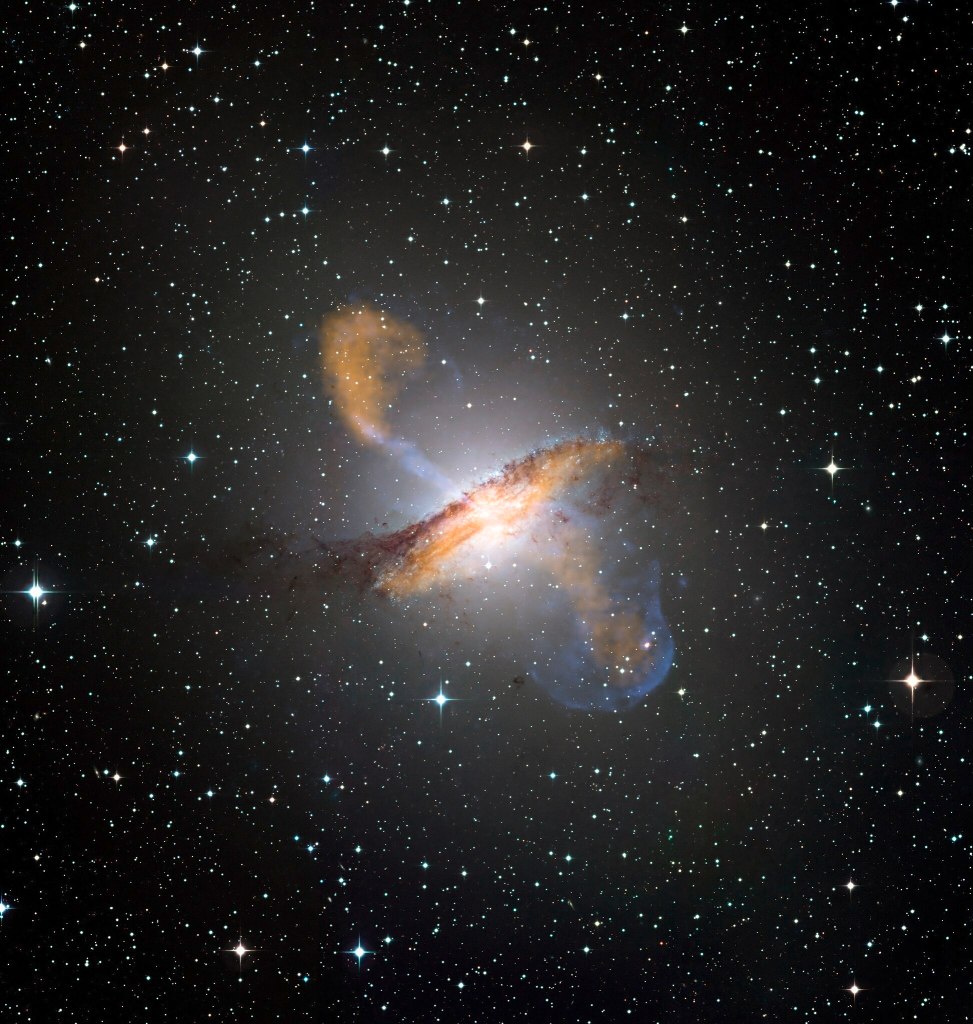
A distant galaxy at the edge of the universe and the beginning of time has revealed a remarkable discovery by Yale researchers. They have identified a variable quasar that rapidly brightens as its astrophysical jets periodically align with the position of Earth.

The researchers believe that this quasar, and others like it, played a significant role in bringing light into the early dark universe, alongside massive early stars which preceded the quasars.

Quasars are supermassive black holes at the centers of early galaxies, spinning at relativistic speeds. These early galaxies contained substantial unincorporated material, primordial gas clouds akin to present-day nebulae, which were easily captured by the black hole’s gravity. Near the event horizon of the black hole, this matter is caught in a ‘turbulent’ vortex, creating massive astrophysical jets. These jets, partially composed of ionized plasmas, are expelled at relativistic speeds, extending up to hundreds of light-years from the black hole and perpendicular to its event horizon. As the ionized hydrogen plasmas capture electrons from the neutral hydrogen in the early universe, photons are released, contributing to the illumination of the cosmos.

Thomas Connor, an astronomer at the Chandra X-Ray Center and co-corresponding author of the study, states, “[This] epoch of reionization is considered the end of the universe’s dark ages.”

Trivia: The song Put Your Lights On was written by Erik Schrody (Everlast) and performed with Santana on his 1999 album Supernatural. He wrote the song while recovering from a heart attack, pondering the hope that exists in life.

Source: This Quasar May Have Helped Turn the Lights on… by Shelton, Yale, 2025. Graphic: Black Hole Outflows from Centaurus A, ESO, 2009.
Plasma Jets

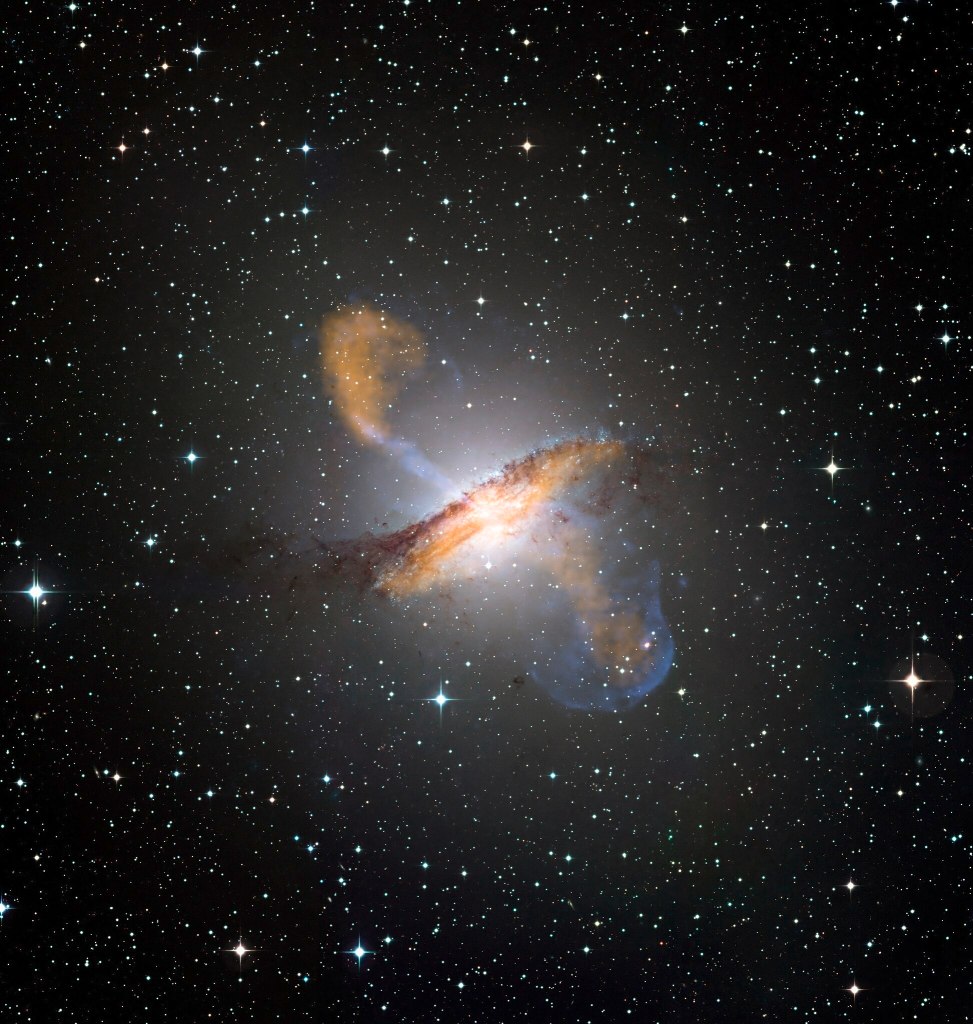
In a galaxy far, far away within the Draco (Dragon) constellation, an international team has, for the first time, observed plasma jets forming in real time and shooting out at relativistic speeds, perpendicular to the plane of a black hole’s event horizon. Plasma jets, composed of ionized matter, are a subset of astrophysical jets—energetic, narrow beams of matter and radiation ejected from various objects, primarily black holes, along their axis of rotation.

These plasma jets were observed in the Milky Way’s gravitationally captured satellite, the Draco Dwarf Galaxy, located 270 million light-years from Earth. The Draco Dwarf Galaxy is home to a black hole that apparently has a white dwarf star companion. A likely scenario is that the white dwarf was once a companion to a much larger star that evolved faster, went supernova, and collapsed into a black hole. Today, the black hole is possibly cannibalizing material from the white dwarf, potentially leading to the plasma jets observed by researchers.

Source: Astronomers observe real-time formation of black hole jets by UMBC, 2025. Graphic: Black Hole Outflows from Centaurus A, ESO, 2009.

Fractional Excitons

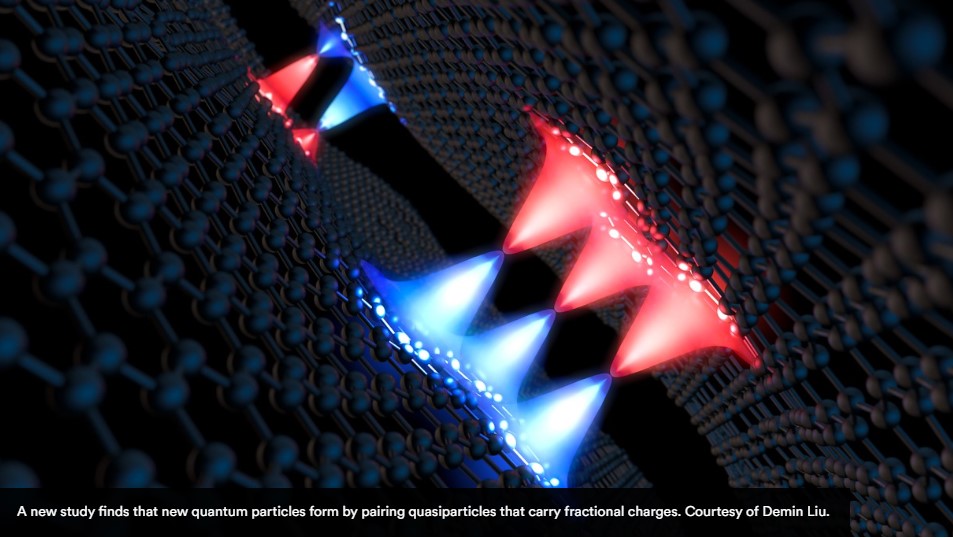
Physicists at Brown University have recently observed a new class of quantum particles called fractional excitons.

Excitons consist of an electron and an electron hole (a quasiparticle, a concept, representing the absence of an electron where one should exist). They allow for energy transfer in a lattice, such as in a transistor. Applying voltage to a transistor influences the movement of electrons and holes through the material. Simplified, this movement can turn the current flow on and off, forming a logic gate.

Despite being composed of fermions, excitons exhibit bosonic behavior and follow bosonic statistics. Fractional excitons, however, show behaviors that don’t fully align with either fermions or bosons. This suggests they belong to a new class of particles with previously unobserved quantum properties.

The researchers speculate that these fractional excitons may lead to advances in quantum computing.

Source: Excitons, Zhang et al, Nature, 2025. Graphic: Quasiparticles, Demin Liu, Brown University 2025.

Mass–No Mass

A team of researchers from Penn State and Columbia University has recently observed a quasi-particle that is massless when moving in one direction but acquires mass when moving in a different direction. This quasi-particle, known as a semi-Dirac fermion, was captured by the team inside a ZrSiS crystal and was first theorized 16 years ago. The scientists observed that when the particle travels in one direction at the speed of light, it remains massless. However, when it is forced to change direction, it slows down for the ‘turn’ and gains mass.

This property relates to Einstein’s most famous equation, E=mc², which states that energy and mass are interchangeable, connected by the speed of light squared. According to Einstein’s Theory of Special Relativity, mass traveling at the speed of light would have infinite mass and require infinite energy to maintain its speed, which is impossible. Therefore, only massless particles can travel at the speed of light.

Relativistic effects also come into play when objects approach and attain the speed of light. As an object with mass moves faster, time dilation and length contraction effects become significant. At the speed of light, time would effectively stop for the object, and distances would shrink to zero. These extreme conditions are not physically achievable for objects with mass.

Source: ScienceDaily by Adrienne Berard, 2024. Semi-Dirac Fermions in a Topological Metal. Physical Review X, Shao, et al, 2024.

Mycelium RoboDogs’ Psychedelic Dreams

With apologies to Philip K. Dick, Cornell researchers have developed a novel way to control their ‘biohybrid’ robots by utilizing mycelia’s natural electrical signals.

Rob Shepherd, head of Cornell’s Organic Robotics Lab says, ‘By growing mycelium into the electronics of a robot, we were able to allow the biohybrid machine to sense and respond to the environment.’

Choose your hallucination, ‘Blade Runner’ or ‘The Matrix’.

Source: Science Daily and Cornell University, September 2024. Graphic: Shrooms and Robodogs. DALL E 3

Universal Physics and Local Irrelevance

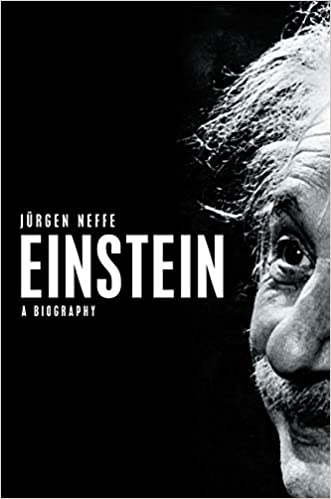
Einstein: A Biography

By Jurgen Neffe

Translated by Shelly Frisch

Published by Farrar, Straus and Giroux

Copyright: © 2007

Neffe brings comprehension to relativity but muddles Einstein’s personal life to inaptness.

Neffe’s non-linear telling of Einstein’s life adds little to the story and a lot of unnecessary page flipping for the reader to grasp the author’s intermittent and incomplete style of writing, whereas his layman descriptions of the theory of relativity generally clears the accumulated fog of physics to bring basic understanding Einstein’s science.