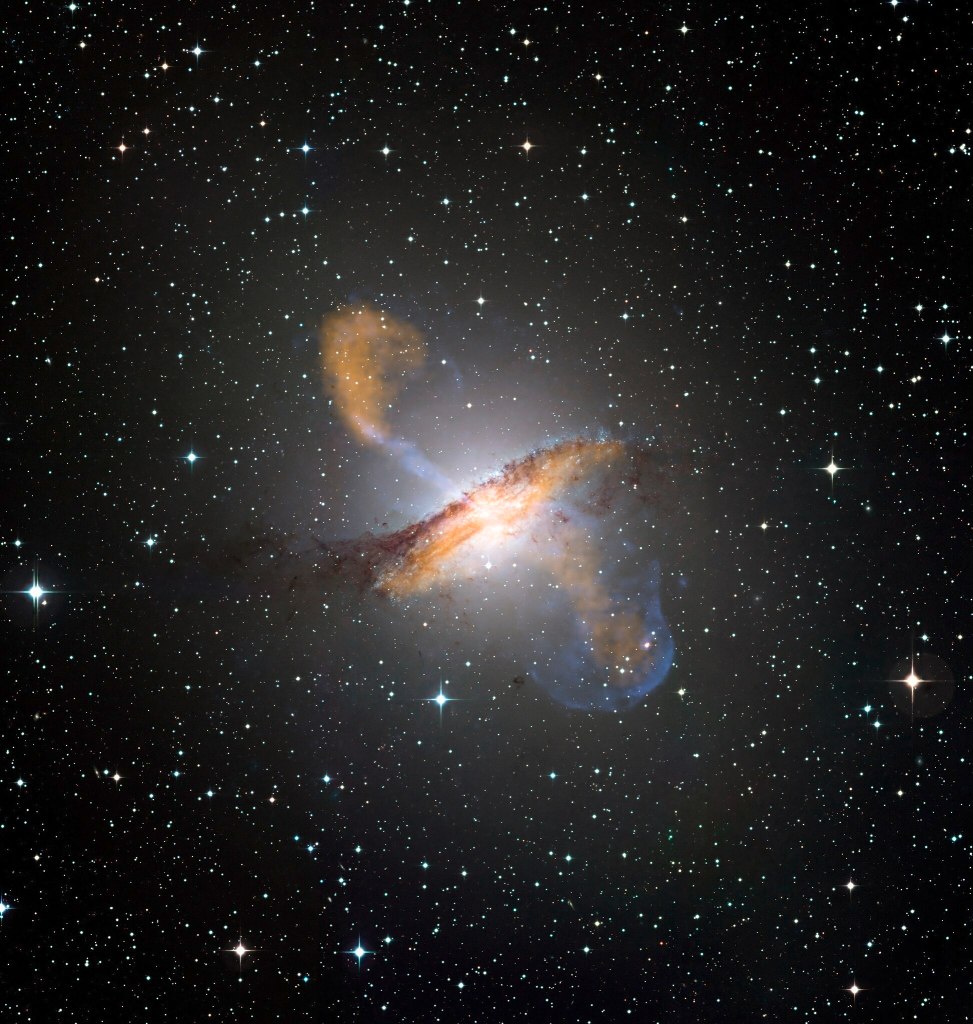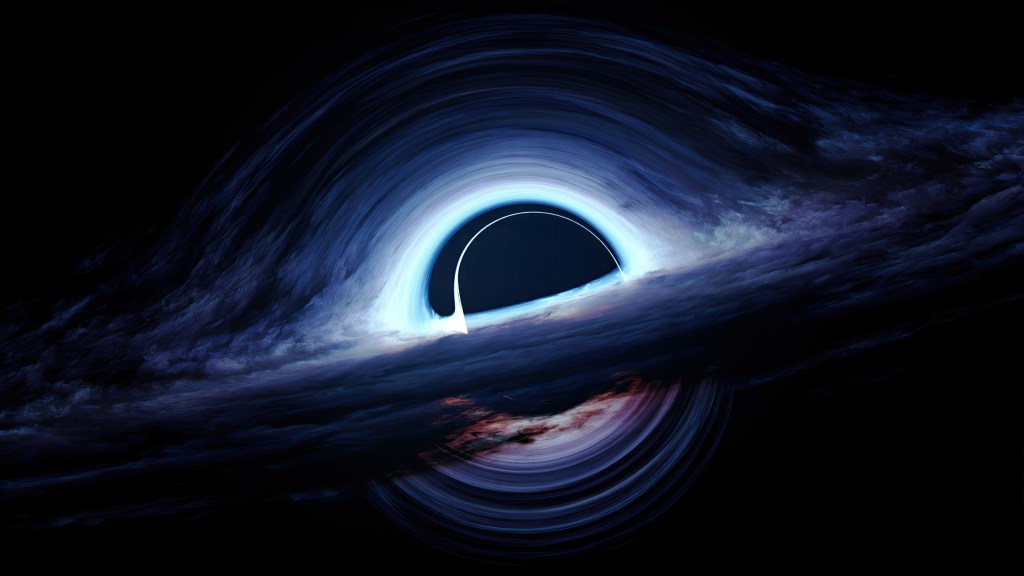
A distant galaxy at the edge of the universe and the beginning of time has revealed a remarkable discovery by Yale researchers. They have identified a variable quasar that rapidly brightens as its astrophysical jets periodically align with the position of Earth.
The researchers believe that this quasar, and others like it, played a significant role in bringing light into the early dark universe, alongside massive early stars which preceded the quasars.
Quasars are supermassive black holes at the centers of early galaxies, spinning at relativistic speeds. These early galaxies contained substantial unincorporated material, primordial gas clouds akin to present-day nebulae, which were easily captured by the black hole’s gravity. Near the event horizon of the black hole, this matter is caught in a ‘turbulent’ vortex, creating massive astrophysical jets. These jets, partially composed of ionized plasmas, are expelled at relativistic speeds, extending up to hundreds of light-years from the black hole and perpendicular to its event horizon. As the ionized hydrogen plasmas capture electrons from the neutral hydrogen in the early universe, photons are released, contributing to the illumination of the cosmos.
Thomas Connor, an astronomer at the Chandra X-Ray Center and co-corresponding author of the study, states, “[This] epoch of reionization is considered the end of the universe’s dark ages.”
Trivia: The song Put Your Lights On was written by Erik Schrody (Everlast) and performed with Santana on his 1999 album Supernatural. He wrote the song while recovering from a heart attack, pondering the hope that exists in life.
Source: This Quasar May Have Helped Turn the Lights on… by Shelton, Yale, 2025. Graphic: Black Hole Outflows from Centaurus A, ESO, 2009.
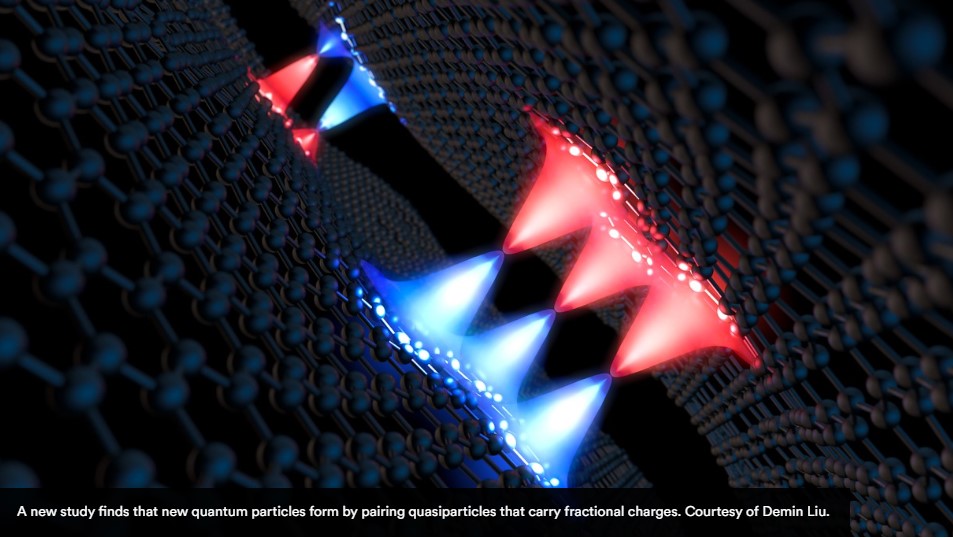
Physicists at Brown University have recently observed a new class of quantum particles called fractional excitons.
Excitons consist of an electron and an electron hole (a quasiparticle, a concept, representing the absence of an electron where one should exist). They allow for energy transfer in a lattice, such as in a transistor. Applying voltage to a transistor influences the movement of electrons and holes through the material. Simplified, this movement can turn the current flow on and off, forming a logic gate.
Despite being composed of fermions, excitons exhibit bosonic behavior and follow bosonic statistics. Fractional excitons, however, show behaviors that don’t fully align with either fermions or bosons. This suggests they belong to a new class of particles with previously unobserved quantum properties.
The researchers speculate that these fractional excitons may lead to advances in quantum computing.
Source: Excitons, Zhang et al, Nature, 2025. Graphic: Quasiparticles, Demin Liu, Brown University 2025.
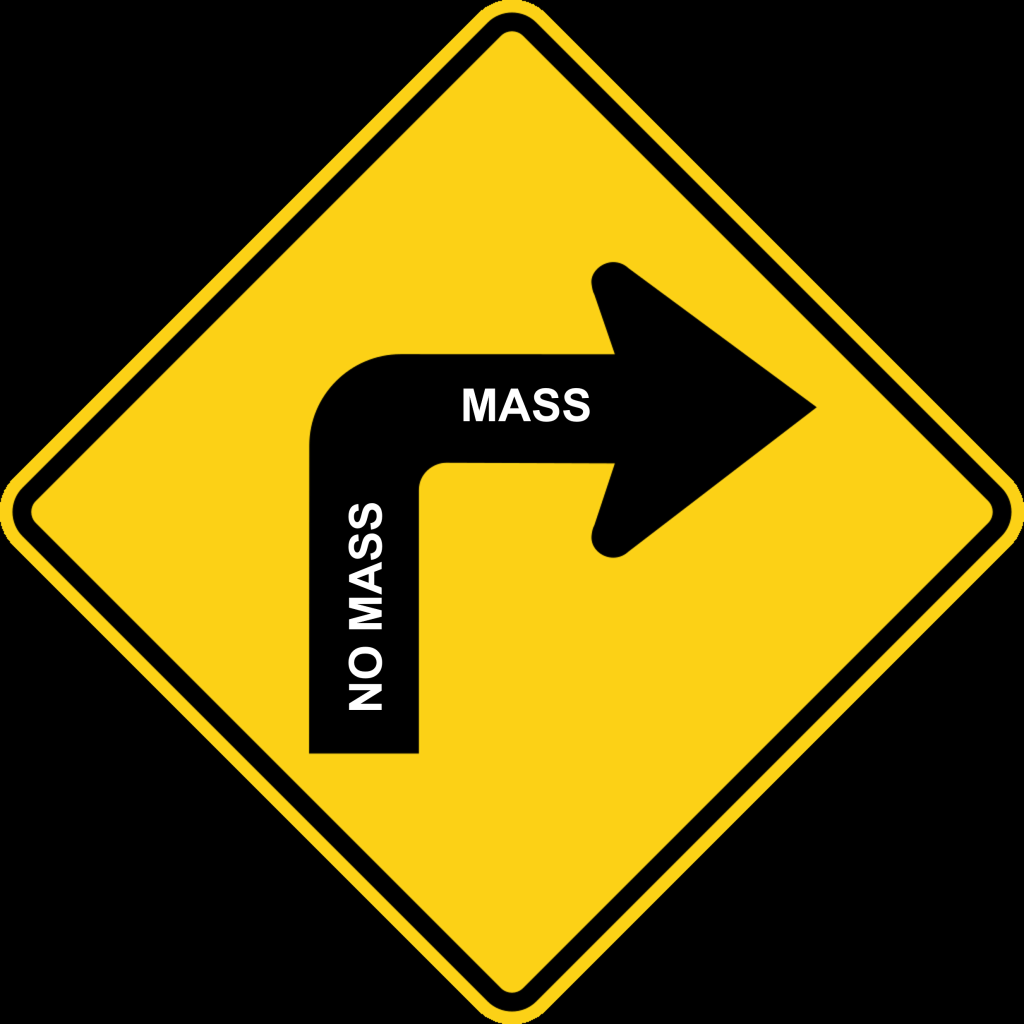
A team of researchers from Penn State and Columbia University has recently observed a quasi-particle that is massless when moving in one direction but acquires mass when moving in a different direction. This quasi-particle, known as a semi-Dirac fermion, was captured by the team inside a ZrSiS crystal and was first theorized 16 years ago. The scientists observed that when the particle travels in one direction at the speed of light, it remains massless. However, when it is forced to change direction, it slows down for the ‘turn’ and gains mass.
This property relates to Einstein’s most famous equation, E=mc², which states that energy and mass are interchangeable, connected by the speed of light squared. According to Einstein’s Theory of Special Relativity, mass traveling at the speed of light would have infinite mass and require infinite energy to maintain its speed, which is impossible. Therefore, only massless particles can travel at the speed of light.
Relativistic effects also come into play when objects approach and attain the speed of light. As an object with mass moves faster, time dilation and length contraction effects become significant. At the speed of light, time would effectively stop for the object, and distances would shrink to zero. These extreme conditions are not physically achievable for objects with mass.
Source: ScienceDaily by Adrienne Berard, 2024. Semi-Dirac Fermions in a Topological Metal. Physical Review X, Shao, et al, 2024.
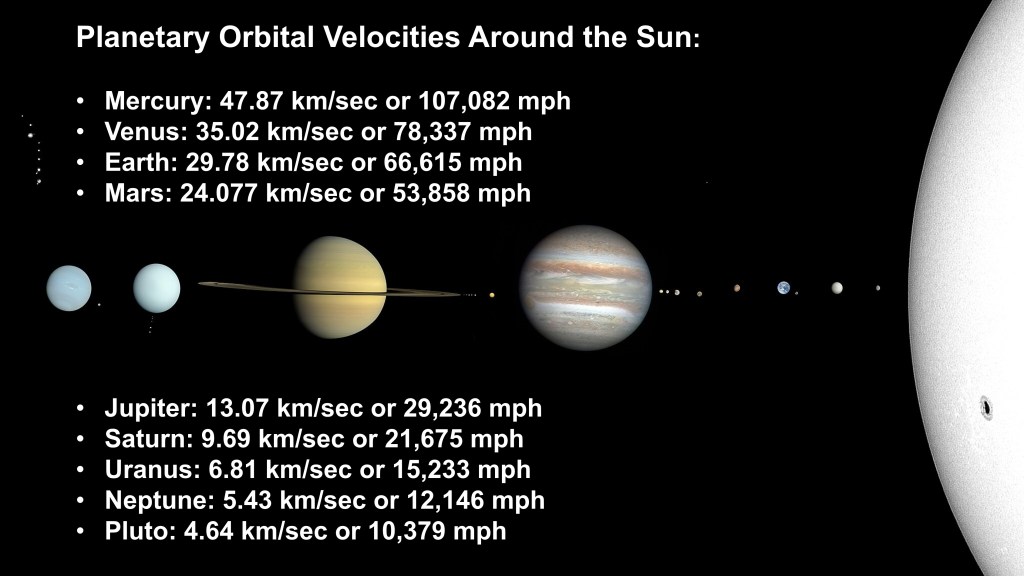
Kepler’s Second Law, first published between 1609 and 1619, describes how a planet’s orbital speed varies along its elliptical orbit around the Sun. As the planet approaches the Sun, the gravitational pull from the Sun is stronger causing the planet to move faster. As a planet moves away from the Sun it slows down.
Kepler’s Second Law in geometric jargon: A line joining a planet and the Sun sweeps out equal areas during equal intervals of time.
Source: Smithsonian, How Things Fly. Graphic of the Planets and the Sun by CactiStaccingCrane 2022.
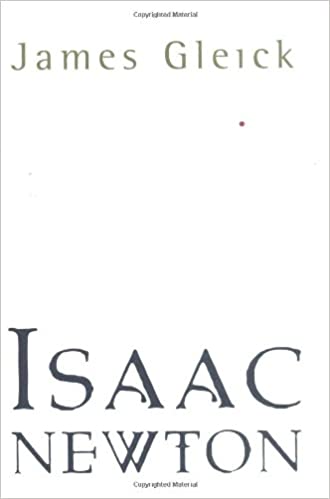
James Gleick left Harvard in 1976 with a degree in English and a disposition towards independence from the 9 to 5. His initial attempt at independence after college was launching a weekly newspaper in the midwest city of Minneapolis, Minnesota. This endeavor ended in failure within a year, and it would take another 10 years before he could leave his day job, succeeding as an author of history of science and a provider of internet service in New York City.
His first book, Chaos: Making a New Science, was critically acclaimed and a million copy best seller establishing Gleick as a first-rate storyteller of difficult subjects to the lay public. He wrote two other bestsellers, both biographies, Genius: The Life and Science of Richard Feynman in 1992 and Isaac Newton nine years later.
Gleick presents Newton’s life in chronological order, painting a beautiful portrait of his acheivements but also imparting a sense of his being as a human. His accomplishments were beyond exceptional, but his temperament was that of a reluctant member of society at large, not easily befriended, easy to offend, and not quick to forgive. Current hypotheses suggest that Newton may have suffered from Asperger’s Syndrome, one of the milder forms of autism. As a social being he appears a lot like Beethoven, also a genius but also without grace or courtesy.
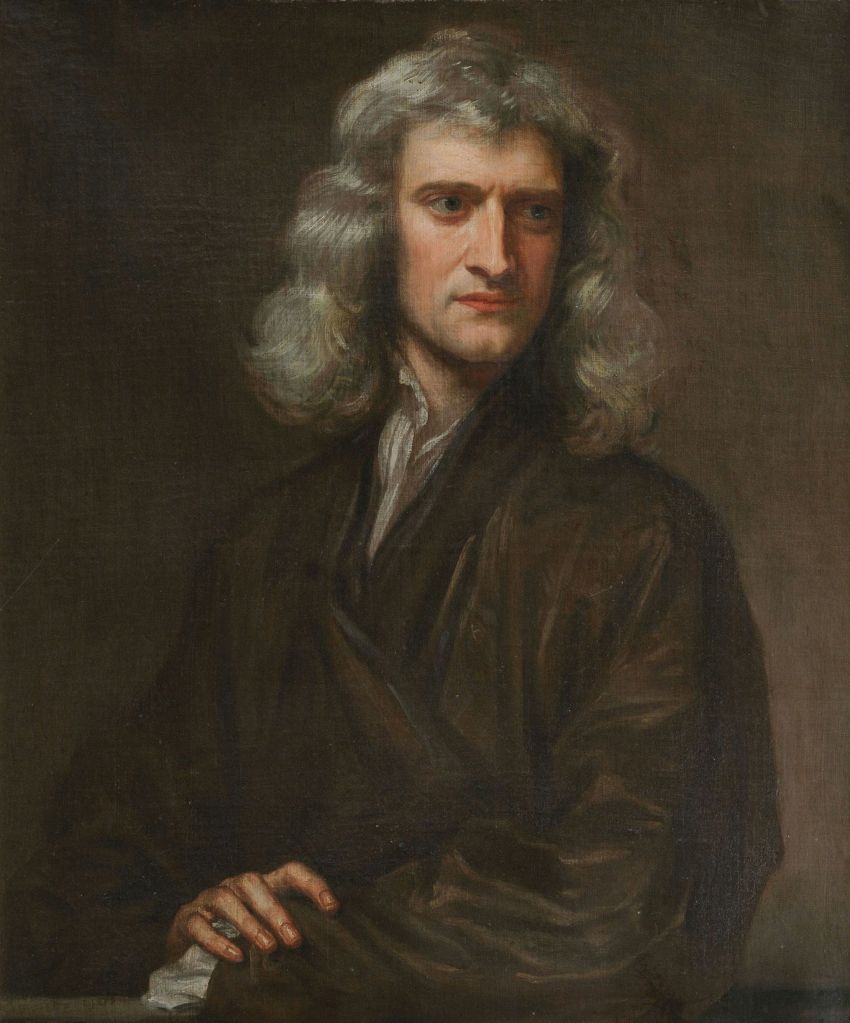
Issac Newton was born fatherless, on Christmas Day in 1642 according to the Julian calendar, still in use in England at the time, or the less interesting 4 January 1643 by the today’s Gregorian calendar, on a sheep farmstead far north of London in Lincolnshire County. His father died about three months before his birth and in three years he was shuffled off to a grandmother’s care for the next 9 years to keep him away and out of site from his mother’s new husband, Reverend Barnabas Smith. His early education was at the ancient King’s School, already more than two hundred years old when he entered in 1655 and still operates as an all-boys grammer school to this day. Upon finishing at King’s School, he entered Trinity College at Cambridge in 1661 and, except for a year away in 1665, he stayed as a student and professor until 1696. Immediately following Cambridge, he became Warden of the King’s Mint and in 1703 became president of the Royal Society and stayed in that position until he died in 1727.
Newton’s contributions to the world were many and varied. His Three Laws of Motion were revolutionary in the 18th century, and as a testament to their lasting correctness are still taught to every school kid early in their education. The Law of Gravitation explained the orbit of the heavenly bodies and why apples fall and not rise, float, or go sideways. It has since been replaced by Einstein’s General Relativity but is still a particularly good approximation for us lessor mortals. Calculus. Enough said.
Newton also intensely studied the bible, believing that the universe could only exist through the existence of God. He rejected the Trinity believing there is one God, God the Father with Jesus and the Holy Spirit subservient to God. Newton also predicted that the end of times would not come before 2060, 38 short years from now. Still a little early to be maxing out your credit cards.
Newton researched and experimented with alchemy, including looking for the Philosophers Stone and the force that keeps the planets in their orbits. Seeking the Philosophers Stone may have been worthy of Harry Potter but I’m not sure about Newton. Newton never published anything on his alchemy studies, likely because it didn’t make any sense. Now looking for the force that kept planets from falling your head during a walk-in park was worthy of Newton and the rest of the world, especially Einstein. Newton found it and it was called gravity.
My one complaint with Gleick’s book is his derisive commenting on Newton’s fascination with alchemy through today’s lens of knowledge rather than accepting that understanding and meaning in this world changes, sometimes for the better, sometimes not. People respond to the time they live in not to the unknowns of the future. Newton put it this way, “What we know is a drop, what we don’t know is an ocean.” and one can only study the drop that he has.
One of my favorite quotes of Newton or anyone for that matter was, “A man may imagine things that are false, but he can only understand things that are true.” I liked this quote when I first saw it, not because it was profound, it was, but because it was an idea I had promulgated early on in my education, if it didn’t make logical sense, it probably was wrong.
A short read reflecting on the information carried by a photon as it reaches your eye from the far reaches of space.
Originally the book was published in two volumes, both together totaling less than 80 pages, in 1846 and 1847. The book sought the union of physics and religion, metaphysics; for God sees the past and the present as a single point in the space time continuum, time stopping when moving with the light, observing all in three dimensions rather than four. Eberty continues his thesis from an all-seeing God to a time when man’s technological progress allows him to see as God sees or the child of God becomes a god.
Eberty knowing that the speed of light was finite, about 300,000 km/s, contemplated that all visuals captured by any type of eye, human or otherwise, happened in the past. The past including an inconceivably, insignificantly small amount of time in the past, such as a plate of mac and cheese in front of you, is still in the past, what you see has already occurred. Jurgen Neffe, author of a biography of Albert Einstein, stated it succinctly “time travels with light”. Observing light traveling from a billion light years away exhibits events as they happened a billion years ago but if you traveled with those photons for those billion years the past occurs at the same time as your present.
Eberty’s thoughts on the meaning of time and space were recognized at the time not only as novel but metaphysical in nature, maybe not so much today.
An interesting if not an enlightening, but thoroughly tedious treatise.
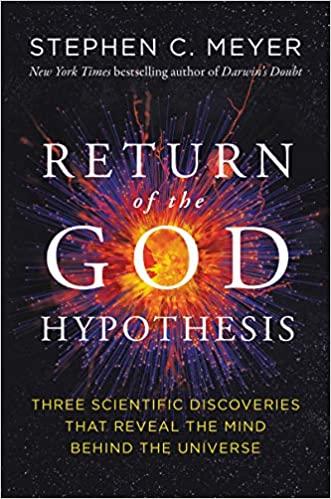
Meyer, in excruciating detail, examines the evidence for a universe designed, created, and set into motion by the hand of God. His proofs assess how the universe is perfectly tuned to foster our existence, how human DNA’s complexity is beyond random chance, and how the explosion of multi-celled life forms during the Cambrian Period (485-539 mya (million years ago)) is unlikely Darwinian in nature.
The first two proofs are plausible, and his arguments are meticulously developed, while the Cambrian explosion of life does not address the hundreds of millions to a billion years of missing rock section prior to the beginning to the Cambrian Period. The explosion of life may simply be a function of where one begins to sample the evidence.
Meyer’s case for God orchestrating our existence is convincing but you only need to read Part II, about 150 pages in the hardback version of the book, while the other 300 pages can be consigned to doctoral students in logic and religion.
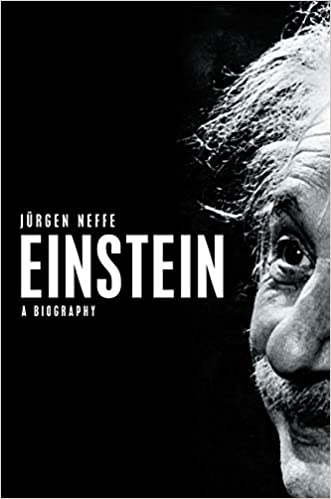
Neffe brings comprehension to relativity but muddles Einstein’s personal life to inaptness.
Neffe’s non-linear telling of Einstein’s life adds little to the story and a lot of unnecessary page flipping for the reader to grasp the author’s intermittent and incomplete style of writing, whereas his layman descriptions of the theory of relativity generally clears the accumulated fog of physics to bring basic understanding Einstein’s science.