Pericles-Funeral Oration:

At the end of first year of the Peloponnesian War in 431 BC Athenians held the customary public funeral to honor the soldiers who gave their lives in the war against Sparta. As Thucydides records in his “History of the Peloponnesian War” the funeral was a procession of citizens that ushered ten cypress coffins representing the ten Athenian tribes plus one more for the soldiers not recovered from the field of battle to the public graveyard at Ceramicus.

Thucydides further states that “When the bodies had been buried, it was customary for some wise and prudent notable and chief person of the city, preeminent in honor and dignity, before all the people to make a prayer in praise of the dead, and after doing this, each one returned to his House. That time to report the praises of the first who were killed in the war, Pericles, son of Xanthippus, was chosen; who, having finished the solemnities made in the tomb, climbed on a chair, from where all the people could see and hear him, and gave this discourse.

Pericles’ speech was given not only as a tribute to the fallen, but a celebration of the Athenian citizens’ patriotism and urged them to honor the dead by continued support for the city and its democratic ideals.

The following is the first paragraph of the speech recorded by Thucydides:

Most of those who have spoken here before me have commended the lawgiver who added this oration to our other funeral customs. It seemed to them a worthy thing that such an honor should be given at their burial to the dead who have fallen on the field of battle. But I should have preferred that, when men’s deeds have been brave, they should be honored in deed only, and with such an honor as this public funeral, which you are now witnessing. Then the reputation of many would not have been imperiled on the eloquence or want of eloquence of one, and their virtues believed or not as he spoke well or ill. For it is difficult to say neither too little nor too much; and even moderation is apt not to give the impression of truthfulness. The friend of the dead who knows the facts is likely to think that the words of the speaker fall short of his knowledge and of his wishes; another who is not so well informed, when he hears of anything which surpasses his own powers, will be envious and will suspect exaggeration. Mankind are tolerant of the praises of others so long as each hearer thinks that he can do as well or nearly as well himself, but, when the speaker rises above him, jealousy is aroused and he begins to be incredulous. However, since our ancestors have set the seal of their approval upon the practice, I must obey, and to the utmost of my power shall endeavor to satisfy the wishes and beliefs of all who hear me.

Source: Richard Hooker, 1996, University of Minnesota, Human Rights Library. Graphic: Pericles Funeral Oration by Philipp Foltz, 1877, Public domain.

Phaedo

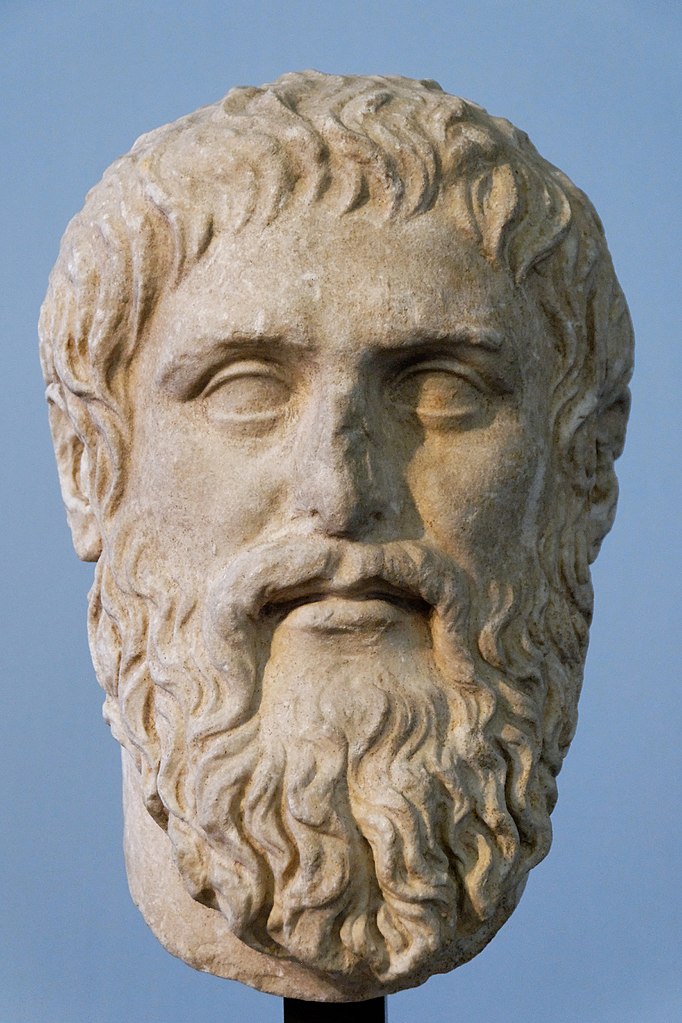
Phaedo is the fourth and final Socratic dialogue by Plato (the others being Euthyphro, Apology, and Crito) discussing the day Socrates was put to death by the Athenian state. Phaedo, who was with Socrates on the day of his death, is in the Greek city of Phlius at a later time and is asked by his friend Echecrates to tell him all about that eventful day.

The dialogue begins with Socrates proposing that a philosopher should look forward to death, but it is immoral for one to take his own life. He posits that the soul is immortal and one’s life should be geared to keeping one’s soul pure. He then provides three, or four depending on interpretations, arguments for the immortality of the soul. First, he puts forth the cyclical argument that death follows life which is followed by death and so on. Second, he proposes that we are born knowing what our souls knew before birth, we just can’t remember it until the proper questions are raised. Finally, Socrates puts forth the Affinity argument which states that the body is mortal and visible, and the soul is immortal and invisible.

After these arguments Socrates introduces Forms, actually a Platonic idea, the fourth argument according to some, sometimes known as the two-world theory where reality is set against what our senses tell us. Our senses give us a visible but imperfect perception of the world as opposed to Forms which are only conceived in one’s mind and are invisible and unchanging.

At the end of the dialog Socrates tells his audience the myth of Er, a discussion of where to soul goes upon death. He then says his goodbyes, drinks hemlock, and slowly dies.

The Phaedo is more a compilation of Plato’s beliefs than a thorough discussion of Socratic philosophy, especially the discussions of Forms.

Source: Ancient Greek Philosophers, translated by Benjamin Jowett, published 2018. Phaedo by Tim Connolly, Internet Encyclopedia of Philosophy. Graphic: Copy of a Bust of Plato, original by Silanion. Photo of bust by Nguyen, 2009.

Resilience and Patience

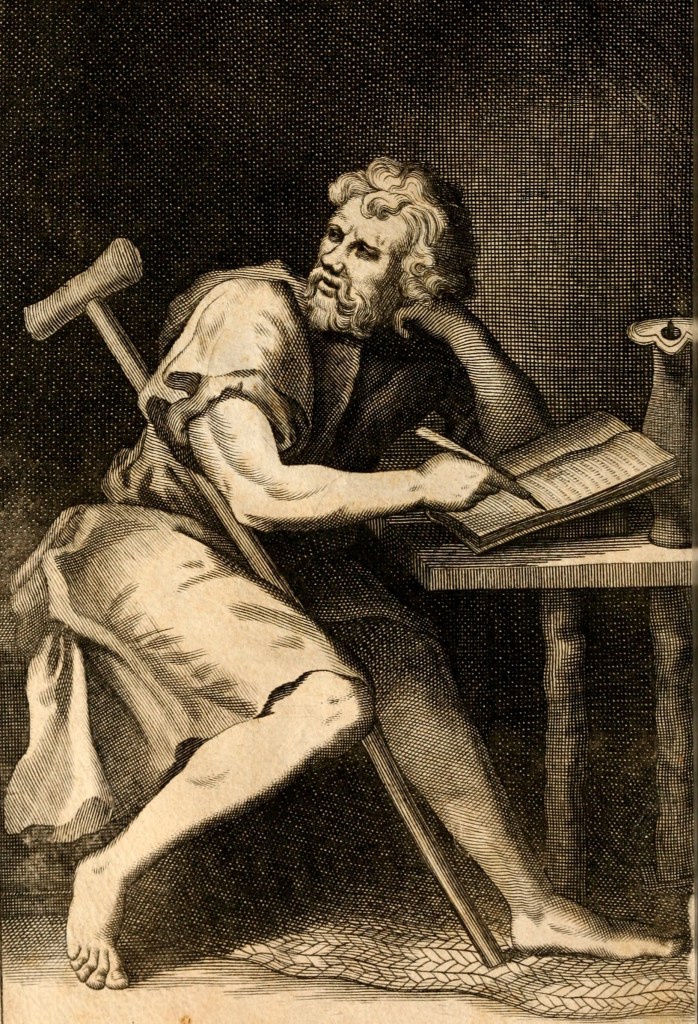
Epictetus was a 1st and 2nd century AD Greek Stoic who lived a simple life and taught philosophy at his school in Nicopolis, Greece. No writings of his have survived, if there were any to begin with, but his pupil Arrian captured his teachings and collected them into two separate works: The Discourses and the Enchiridion.

In The Enchiridion Epictetus briefly discusses 52 or 53 maximums or rules a practicing Stoic should live by with the first and main rule being that you should “only concern yourself with matters that you can control.” Everything else is irrelevant to living a pleasant life.

Stoicism is the philosophy of resilience and patience. Adherents believed in leading a life of virtue, which one did by acquiring wisdom, exhibiting courage, practicing temperance, and promoting justice.

Famous Stoics throughout Greek and Roman history include Zeon of Citium, Eratosthenes of Alexandria, Lucius Seneca, and Marcus Aurelius.

Source: The Enchiridion by Epictetus/Arrian, translated by Elizabeth Carter contained within Ancient Greek Philosophers, published 2018. Graphic of Epictetus by William Sonmans 1715, public domain.

The Mortal Soul

Let no one be slow to seek wisdom when he is young nor weary in the search thereof when he is grown old. For no age is too early or too late for the health of the soul.”

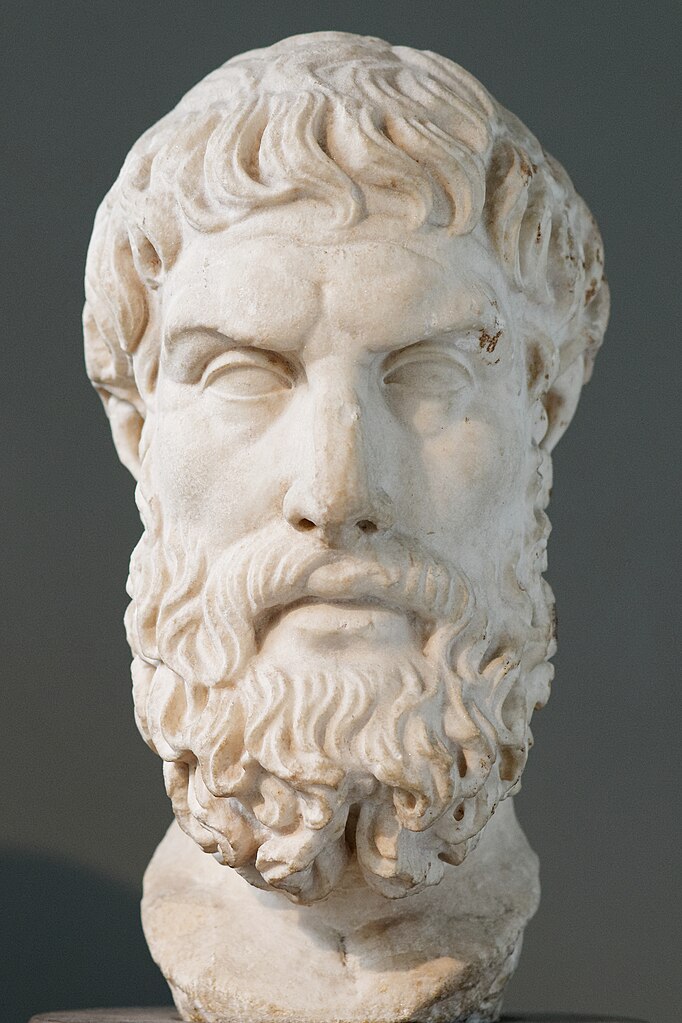
So begins the third and fourth century BC Greek philosopher, Epicurus in his letter to Menoeceus, although who Menoeceus was, has been lost to the ages. Epicurus was a Greek philosopher born on the island of Samos in the Aegean Sea off the coast of Turkey. He established a school next to Plato’s in Athens and taught that one’s purpose in life was to lead a happy, tranquil, self-sufficient life, a pleasant life, and not to fear death.

Epicurus taught that after death there is nothing. Death is/was the end of the body and soul; teaching that self-guilt and shame were the only methods available to prevent the world from overflowing with psychopaths. This is not far from the current Pope’s thoughts on Hell being an empty shell, a place of nothingness. Socrates, on the other hand, taught that the soul is eternal, and one must strive to keep it bright and shiny.

Epicurus ended his letter to Menoeceus, “Meditate therefore on these things (a pleasant life) and things akin to them night and day by yourself, and with a companion like to yourself, and never shall you be disturbed waking or asleep, but you shall live like a god among men. For a man who lives among immortal blessings is not like to a mortal being.”

Sources: “Ancient Greek Philosophers”, numerous translators, published 2018 and Manchester.edu (Indiana). Photo of a bust of Epicurus by Nguyen, public domain.

Exploration 17: Time

I have a few questions. If time didn’t exist–

  • How old would you be when you die?
  • How would you separate your birth from that of your mother’s?
  • Would you be self-aware?
  • Or in a slightly diffent form, would life be possible?
  • What form would E=mc2 and F=ma take?
    • E and F=m–some form of a n-dimensional black hole?
    • E and F=0–absolute zero temp, nothingness? This seems silly.
  • What form would physics, the universe, and everything take without time?
  • Would mathematics be any different?
    • If mathematics is constant what would the metaphysical ramifications be?

Is time artificial, a construct, a rationalization for something we do not understand?

I’ll stop now.

Explorations: 4

E Plato Aristotle.jpg

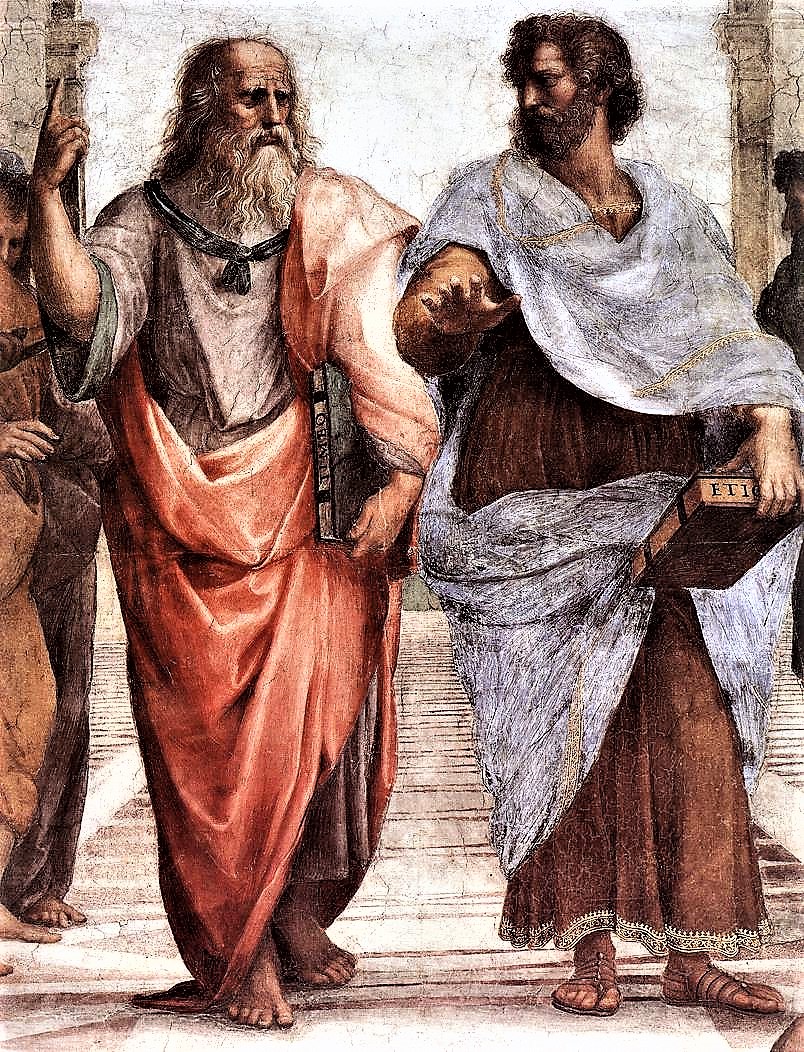
Plato and Aristotle cropped from Raphael’s School of Athens

Aristotle, the father of western philosophy, strongly influenced the U.S. founding fathers’ beliefs in individuality and man’s purpose, illustrated by Thomas Jefferson’s first sentence of the preamble to the U.S. Declaration of Independence; We hold these truths to be self-evident, that all men are created equal, that they are endowed by their Creator with certain unalienable Rights, that among these are Life, Liberty and the pursuit of Happiness. 

The pursuit of happiness was Aristotle’s belief of man’s purpose, his end, his goal, his telos; the pursuit of happiness, the pursuit of fulfillment, the pursuit of excellence, or using Aristotle’s term, the pursuit of virtue: man’s purpose, man’s telos.

Darwin’s theory of evolution assumes that all organisms reach their present state through natural selection, random processes, accidental design, anti-telos. Organisms evolving with a purpose implies intelligent design, which entails religion, not science, except that it can be argued that the intent of an organism’s evolution is to enhance its ability to survive, which is a purpose, an end, a goal: telos.